
Pressure Effects on Reaction Rates
Explore why increasing pressure accelerates some gas reactions but can slow reactions in solution. Learn how collision frequency, activation volume, and transition-state changes explain these effects, extending beyond the required Year 11 Chemistry syllabus.
Imagine a gas mixture reacting inside a sealed cylinder. You push the piston in until the gas occupies half its original volume, keeping the temperature constant. The molecules haven’t changed, but there are now twice as many molecules in every cubic centimetre. What happens to the reaction rate?
For a simple reaction between two gaseous reactants, the rate can increase fourfold. That makes sense if you think about collision frequency. But now imagine applying pressure to a reaction taking place in a liquid. The result can be quite different. Pressure might accelerate the reaction, slow it down, or have very little effect.
The explanation involves something called the volume of activation: a measure of how the volume of a reacting system changes as it moves from reactants towards the transition state.
This article goes beyond the required NSW Year 11 Chemistry syllabus. The Year 11 Chemical Reactions topic provides the prerequisite knowledge, but activation volume is an additional concept rather than an HSC assessment requirement.
01Why pressure changes the rate of gas reactions
Start with the collision theory you already know from Year 11.
For a reaction to occur, reacting particles must collide with sufficient energy and an appropriate orientation. Increasing the concentration of a gaseous reactant means more particles occupy the same volume, increasing the frequency of collisions.
Pressure provides another way to change the concentration of a gas.
For an ideal gas:
\[ PV=nRT \]
where:
- \(P\) is pressure, measured in pascals (Pa).
- \(V\) is volume, measured in cubic metres (\(\mathrm{m^3}\)).
- \(n\) is the amount of gas, measured in moles (mol).
- \(R\) is the ideal gas constant, \(8.314\ \mathrm{J\,mol^{-1}\,K^{-1}}\).
- \(T\) is absolute temperature, measured in kelvin (K).
Rearranging gives:
\[ P=\frac{n}{V}RT \]
At constant temperature and with a fixed amount of gas, increasing pressure means decreasing volume.
The concentration of a gaseous reactant is:
\[ [A]=\frac{n_A}{V} \]
Therefore, at constant temperature:
\[ P_A=[A]RT \]
Here, \(P_A\) is the partial pressure of gas A, and \([A]\) is its molar concentration.
This relationship is the important connection: compressing a gas increases its concentration and its partial pressure.
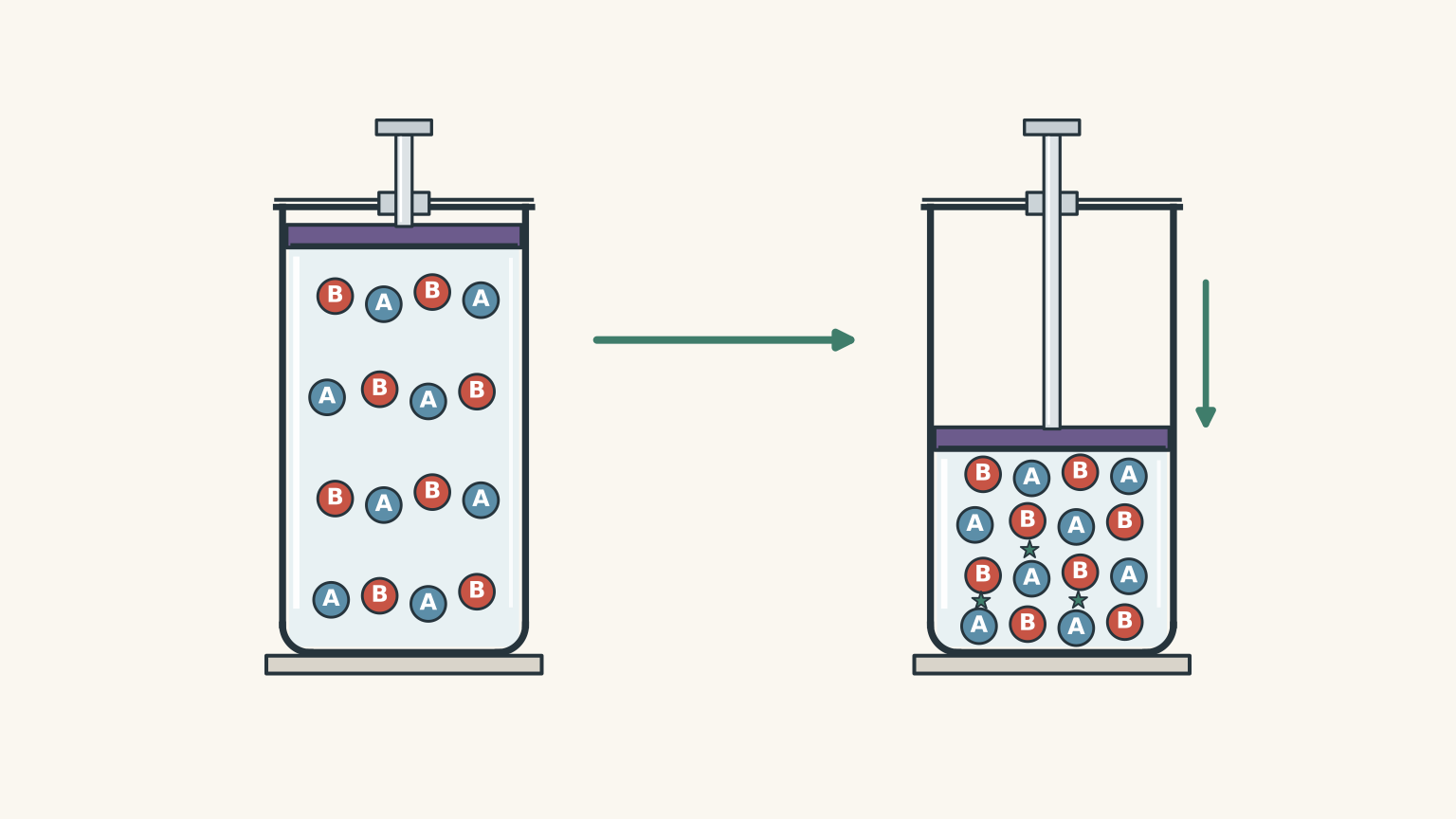
Due to technical limitations, this figure may display incorrectly or contain inaccuracies. Please check key details against your course materials.
Connecting concentration to reaction rate
Consider a simple elementary reaction:
\[ \ce{A(g) + B(g) -> Products} \]
An elementary reaction occurs in a single reaction step. Its rate law is:
\[ r=k[A][B] \]
Here:
- \(r\) is the reaction rate.
- \(k\) is the rate constant.
- \([A]\) and \([B]\) are the concentrations of the two reactants.
Suppose the volume of the reaction vessel is halved at constant temperature.
Both reactant concentrations double:
\[ [A]_{\mathrm{new}}=2[A]_{\mathrm{old}} \]
\[ [B]_{\mathrm{new}}=2[B]_{\mathrm{old}} \]
Substituting into the rate law:
\[ r_{\mathrm{new}} =k(2[A])(2[B]) \]
\[ r_{\mathrm{new}}=4k[A][B] \]
Therefore:
\[ \boxed{r_{\mathrm{new}}=4r_{\mathrm{old}}} \]
The initial reaction rate increases fourfold.
Why fourfold rather than twofold? Doubling the concentration of A doubles the opportunities for A to collide with B. Doubling the concentration of B doubles those opportunities again.
The result is four times as many A-B encounters per unit volume, assuming the same collision effectiveness.
Notice that temperature has not changed. The particles have not gained additional average kinetic energy. There are simply more particles occupying each unit of volume.
Worked example: Compressing a gas reaction
A gas-phase elementary reaction follows the rate law:
\[ r=k[A][B] \]
Initially, the concentrations are:
- \([A]=0.10\ \mathrm{mol\,L^{-1}}\)
- \([B]=0.15\ \mathrm{mol\,L^{-1}}\)
The rate constant is \(0.40\ \mathrm{L\,mol^{-1}\,s^{-1}}\).
The reaction vessel is compressed to half its original volume at constant temperature. Calculate the new initial reaction rate.
Step 1
Using the rate law:
\[ r=k[A][B] \]
Substitute the values:
\[ r=0.40\times0.10\times0.15 \]
\[ r=0.0060\ \mathrm{mol\,L^{-1}\,s^{-1}} \]
Step 2
The volume has halved, while the number of moles of each gas remains constant.
Therefore, both concentrations double:
\[ [A]_{\mathrm{new}}=0.20\ \mathrm{mol\,L^{-1}} \]
\[ [B]_{\mathrm{new}}=0.30\ \mathrm{mol\,L^{-1}} \]
Step 3
\[ \begin{aligned} r_{\mathrm{new}} &=0.40\times0.20\times0.30\\ &=0.024\ \mathrm{mol\,L^{-1}\,s^{-1}} \end{aligned} \]
Step 4
The new initial rate is:
\[ \boxed{0.024\ \mathrm{mol\,L^{-1}\,s^{-1}}} \]
Comparing the rates:
\[ \frac{0.024}{0.0060}=4 \]
The rate increases fourfold because both reactant concentrations doubled.
This result assumes an ideal gas mixture, constant temperature, and an unchanged rate constant.
02An important distinction: total pressure and partial pressure
There is a subtle problem with the statement that increasing pressure always increases the rate of a gaseous reaction.
What if you increase the pressure without compressing the reacting gases?
Imagine adding an inert gas, such as neon, to a sealed reaction vessel.
The total pressure increases, but the concentrations of the reacting gases remain unchanged if the volume and temperature are constant.
For an ideal gas mixture:
\[ P_{\mathrm{total}}=P_A+P_B+P_{\mathrm{inert}}+\cdots \]
The total pressure is the sum of the partial pressures of the individual gases.
Adding neon increases its own partial pressure. It does not increase the partial pressures of A and B.
Consequently, the concentrations of A and B remain unchanged:
\[ [A]=\frac{P_A}{RT} \]
\[ [B]=\frac{P_B}{RT} \]
Since the rate law depends on \([A]\) and \([B]\), the reaction rate remains unchanged under these assumptions.
This distinction is useful:
| How pressure is increased | Effect on reacting gas concentrations | Expected effect on rate |
|---|---|---|
| Compressing the reaction mixture at constant temperature | Increase | Usually increases |
| Adding inert gas at constant volume | Unchanged | Usually unchanged |
| Adding inert gas at constant pressure | Decrease because the volume expands | May decrease |
These predictions assume ideal gas behaviour and a reaction whose rate is controlled by the stated reactant concentrations. Some gas reactions involve third-body collisions, where an additional molecule transfers energy during a reaction step. In those cases, an inert gas can influence the rate.
The important lesson is that total pressure alone does not tell you what happens to reaction rate. You need to know what happened to the reacting species.
03Why reactions in solution behave differently
Now consider a reaction taking place in a liquid solvent.
You might predict that increasing pressure should increase the concentration of the reactants, just as it does for gases.
There is a problem with that prediction.
Liquids are much less compressible than gases. Their particles are already closely packed, so applying pressure does not usually produce anything like the concentration increase that occurs when a gas is compressed to half its volume.
Does this mean pressure has no effect on reactions in solution?
No. In fact, pressure can have a substantial effect on their rate constants.
The difference is that we need to consider what happens to the reacting system as it approaches the transition state.
What is a transition state?
A reaction does not usually happen because reactants suddenly transform into products in one effortless movement.
Bonds must be broken, formed, or rearranged.
As the reaction proceeds, the reactants pass through a short-lived arrangement called the transition state.
The transition state is the highest-free-energy arrangement along the reaction pathway. It is not a stable intermediate that can be isolated in a flask.
Think of two people trying to carry a large object through a narrow doorway. They must move towards each other, adjust their positions, and briefly occupy an awkward arrangement before getting through.
The transition state is a little like that difficult moment of rearrangement.
The analogy is limited, of course. Molecules do not have fixed shapes like furniture, and solvent molecules also rearrange around them. But it helps picture why the arrangement reached during a reaction can have a different effective volume from the starting materials.
Introducing the volume of activation
The volume of activation, represented by \(\Delta^\ddagger V\), describes the effective volume change between the reactants and the transition state.
For a simple reaction involving A and B:
\[ \Delta^\ddagger V = \overline{V}_{TS} - \left(\overline{V}_A+\overline{V}_B\right) \]
Here:
- \(\Delta^\ddagger V\) is the volume of activation.
- \(\overline{V}_{TS}\) is the partial molar volume of the transition state.
- \(\overline{V}_A\) and \(\overline{V}_B\) are the partial molar volumes of the reactants.
A partial molar volume describes the effective contribution of one mole of a substance to the volume of a mixture.
This is not simply the physical size of an individual molecule. In a solution, the surrounding solvent molecules matter too.
As the reactants approach the transition state, the solvent may reorganise, become more closely packed, or interact differently with developing charges.
The activation volume accounts for the overall effective volume difference.
There are three possible cases.
Case 1: Negative activation volume
\[ \Delta^\ddagger V<0 \]
The transition state has a smaller effective volume than the reactants.
Increasing pressure favours the formation of this more compact arrangement.
The rate constant increases.
Case 2: Positive activation volume
\[ \Delta^\ddagger V>0 \]
The transition state has a larger effective volume than the reactants.
Increasing pressure makes reaching this arrangement less favourable.
The rate constant decreases.
Case 3: Approximately zero activation volume
\[ \Delta^\ddagger V\approx0 \]
There is little effective volume difference between the reactants and transition state.
The direct pressure effect on the rate constant is relatively small.
This gives us a result that is quite different from the simple gas collision model: in solution, increasing pressure does not necessarily increase reaction rate. The direction depends on the activation volume.
The mathematical relationship
The pressure dependence of the rate constant can be described using:
\[ \boxed{ \Delta^\ddagger V = -RT\left(\frac{\partial\ln k}{\partial P}\right)_T } \]
This is the formal definition used by IUPAC for the volume of activation.
The symbols are:
- \(\Delta^\ddagger V\): volume of activation, in \(\mathrm{m^3\,mol^{-1}}\).
- \(R\): ideal gas constant, \(8.314\ \mathrm{J\,mol^{-1}\,K^{-1}}\).
- \(T\): absolute temperature, in K.
- \(k\): reaction rate constant, expressed using consistent concentration-based units.
- \(P\): pressure, in Pa.
- \(\ln k\): natural logarithm of the rate constant.
The subscript \(T\) means that temperature is held constant while pressure changes.
You do not need to memorise this equation for the required Year 11 course. It is useful here because it makes the relationship between pressure and reaction rate mathematically precise.
For a pressure interval over which the activation volume is approximately constant, the equation becomes:
\[ \boxed{ \ln\left(\frac{k_2}{k_1}\right) \approx -\frac{\Delta^\ddagger V\Delta P}{RT} } \]
where:
- \(k_1\) is the rate constant at the initial pressure.
- \(k_2\) is the rate constant at the final pressure.
- \(\Delta P=P_2-P_1\) is the pressure increase.
The equation tells us something useful about the sign.
If activation volume is negative, increasing pressure makes the logarithm of the rate-constant ratio positive. Therefore, \(k_2>k_1\).
If activation volume is positive, increasing pressure makes the logarithm negative. Therefore, \(k_2<k_1\).
Worked example: Pressure changes a solution reaction
A reaction in solution has an activation volume of \(+12.0\ \mathrm{cm^3\,mol^{-1}}\).
The pressure increases by \(50.0\ \mathrm{MPa}\) at a constant temperature of 298 K.
Estimate the ratio of the final rate constant to the initial rate constant.
Step 1
Since:
\[ 1\ \mathrm{cm^3}=10^{-6}\ \mathrm{m^3} \]
We obtain:
\[ \Delta^\ddagger V=12.0\times10^{-6} \ \mathrm{m^3\,mol^{-1}} \]
And:
\[ \Delta P=50.0\times10^6\ \mathrm{Pa} \]
Step 2
\[ \ln\left(\frac{k_2}{k_1}\right) = -\frac{\Delta^\ddagger V\Delta P}{RT} \]
Substitute the values:
\[ \ln\left(\frac{k_2}{k_1}\right) = -\frac{(12.0\times10^{-6})(50.0\times10^6)} {8.314\times298} \]
\[ \ln\left(\frac{k_2}{k_1}\right) = -\frac{600}{2477.6} \]
\[ \ln\left(\frac{k_2}{k_1}\right) =-0.242 \]
Step 3
Taking the exponential of both sides:
\[ \frac{k_2}{k_1}=e^{-0.242} \]
\[ \boxed{\frac{k_2}{k_1}=0.785} \]
Step 4
The final rate constant is approximately 78.5% of its initial value.
The rate constant has decreased by approximately 21.5%.
This makes sense because the activation volume is positive. The transition state has a larger effective volume than the reactants, so increasing pressure makes its formation less favourable.
Notice that this calculation predicts the change in the rate constant. If reactant concentrations also change under pressure, the observed reaction rate must account for those changes separately.
04How chemists investigated pressure effects in solution
The difference between gas and solution reactions raises an interesting experimental problem.
If liquids are already closely packed, why can pressure still change their reaction rates?
Chemists needed a way to measure reaction rates at different pressures while keeping other conditions as consistent as possible.
Building an experiment that measures rate under pressure
A modern approach uses a high-pressure stopped-flow kinetic instrument.
The apparatus is conceptually similar to a conventional stopped-flow system, but the reaction takes place inside a pressure-controlled environment.
Consider the path taken by the reactants.
- Two separate reservoirs hold the reactant solutions.
- High-pressure lines connect the reservoirs to a mixing chamber.
- The reactants are rapidly mixed.
- The mixture flows into a sealed observation cell inside a pressure vessel.
- A hydraulic pump applies pressure through a surrounding pressure-transmitting fluid.
- A pressure gauge monitors the pressure, while temperature control maintains the chosen temperature.
- Light passes through the observation cell, and a detector measures changes in absorbance or fluorescence as the reaction proceeds.
The detector provides a signal that changes as reactants are consumed or products form. The signal can be used to follow the reaction over time and determine its rate constant.
These instruments are specialist research equipment. The pressure vessels require engineered containment and controlled operation; they are not equipment to improvise for a school experiment.
The Menshutkin reaction: A useful historical example
One important reaction investigated under high pressure is the Menshutkin reaction.
It involves pyridine reacting with ethyl iodide to form an ionic product:
\[ \ce{C5H5N + C2H5I -> [C7H10N]+ + I-} \]
The reaction involves the nitrogen atom in pyridine forming a bond with the ethyl group while the carbon-iodine bond breaks.
It is a nucleophilic substitution reaction.
The reactants begin as neutral molecules, while the product consists of ions. The solvent therefore interacts differently with the reactants, the transition state, and the products.
This makes the reaction useful for investigating how pressure affects the surrounding solvent and the transition state.
Earlier measurements had shown that the rate constant for this reaction increased as pressure rose from approximately 1 to 2890 atmospheres.
An analysis by Stearn and Eyring gave an activation volume of approximately:
\[ \Delta^\ddagger V=-20\ \mathrm{cm^3\,mol^{-1}} \]
at 30 °C and near atmospheric pressure.
The negative value indicated that the transition state had a smaller effective volume than the reactants.
In 1958, M. G. Gonikberg and V. M. Zhulin investigated the reaction further.
They measured its rate constants in acetone at 40 °C across six pressures:
| Pressure (atm) |
|---|
| 1 |
| 250 |
| 500 |
| 750 |
| 1000 |
| 3000 |
They also investigated the volume contraction associated with the reaction in acetone.
Their analysis supported the conclusion that the transition state was considerably less strongly solvated than the ionic reaction product.
In other words, the solvent interacted differently with the partially formed ionic arrangement in the transition state than it did with the fully formed product ions.
This helped establish that pressure effects in solution could provide information about the molecular arrangement during a reaction.
The key advance was not simply observing that pressure changed the rate. It was using that change to learn something about the transition state and its surrounding solvent.
Why experimental controls matter
There is another complication.
Applying pressure does not necessarily affect only the reacting molecules. It can also change the physical properties of the solvent.
For example, a solvent may become much more viscous or even undergo a phase change under sufficiently high pressure.
This can produce an unexpected change in reaction rate that has nothing to do with the simple activation-volume model.
A 1967 investigation by Kondo, Tojima, and Tokura examined pressure effects on Menshutkin reactions in several solvents.
They found unusual pressure-induced acceleration in benzene and nitrobenzene at approximately 1200 and 1500 \(\mathrm{kg\,cm^{-2}}\), respectively.
Their interpretation was that the solvents were undergoing pressure-induced freezing.
This matters because a change in physical state can alter molecular mobility and solvent interactions.
A pressure experiment must therefore control more than just temperature. Researchers also need to consider whether the solvent remains in the same phase throughout the measurement.
The distinction is important:
- A change in the rate constant within an unchanged liquid phase can provide information about activation volume.
- A phase change can introduce additional effects that make a simple activation-volume interpretation unreliable.
The experimental method must be designed to distinguish these possibilities.
Reading a pressure-versus-rate graph
The experimental data can be used to plot the natural logarithm of the rate constant against pressure.
The slope gives information about activation volume:
\[ \text{slope}=-\frac{\Delta^\ddagger V}{RT} \]
At constant temperature, the three possible trends are:
- A positive slope indicates negative activation volume.
- A negative slope indicates positive activation volume.
- A horizontal line indicates approximately zero activation volume.
One limitation is that activation volume does not have to remain constant as pressure increases.
The relationship may become nonlinear at higher pressures because the solvent and reacting system continue to change as they are compressed.
The simple straight-line interpretation is therefore an approximation over a suitable pressure range, not a universal law that every reaction follows indefinitely.
05Activation volume versus reaction volume
There is one more distinction worth understanding.
Activation volume and reaction volume sound similar, but they describe different stages of a reaction.
The volume of activation describes the volume change between reactants and the transition state:
\[ \Delta^\ddagger V = V_{\mathrm{TS}}-V_{\mathrm{reactants}} \]
The reaction volume describes the volume change between reactants and products:
\[ \Delta V_{\mathrm{rxn}} = V_{\mathrm{products}}-V_{\mathrm{reactants}} \]
These quantities answer different questions.
| Quantity | What it describes | What it helps predict |
|---|---|---|
| Activation volume, \(\Delta^\ddagger V\) | Reactants to transition state | Pressure effect on reaction rate constant |
| Reaction volume, \(\Delta V_{\mathrm{rxn}}\) | Reactants to products | Pressure effect on equilibrium position |
This distinction becomes particularly important when studying chemical equilibrium.
Imagine a reaction whose products occupy a smaller effective volume than its reactants.
Increasing pressure favours the products at equilibrium.
However, if the activation volume is positive, increasing pressure can simultaneously decrease the forward rate constant.
There is no contradiction. Equilibrium position and reaction rate describe different things.
The pressure dependence of the equilibrium constant is described by:
\[ \left(\frac{\partial\ln K}{\partial P}\right)_T = -\frac{\Delta V_{\mathrm{rxn}}}{RT} \]
Here, \(K\) is the equilibrium constant.
Notice that this equation uses reaction volume, not activation volume.
For a more detailed treatment of the separate equilibrium effect, see When Does Changing Pressure Have No Effect on Gaseous Equilibrium?.
06Questions and solutions
Question 1
A gas-phase elementary reaction follows:
\[ \ce{A(g) + B(g) -> Products} \]
Its rate law is:
\[ r=k[A][B] \]
At constant temperature, the partial pressure of A is doubled while the partial pressure of B remains unchanged.
Assuming ideal gas behaviour and a constant rate constant, determine the factor by which the initial reaction rate changes. Explain your reasoning.
Solution 1
The initial reaction rate doubles.
At constant temperature, the concentration of a gas is proportional to its partial pressure:
\[ [A]=\frac{P_A}{RT} \]
Doubling the partial pressure of A therefore doubles its concentration.
The concentration of B remains unchanged.
Using the rate law:
\[ r=k[A][B] \]
The new rate is:
\[ r_{\mathrm{new}}=k(2[A])[B] \]
\[ r_{\mathrm{new}}=2k[A][B] \]
Therefore:
\[ \boxed{r_{\mathrm{new}}=2r_{\mathrm{old}}} \]
The trap is assuming that pressure must double every reactant concentration. Only the partial pressure of A has changed, so only its concentration doubles.
Question 2
A gaseous reaction has the experimentally determined rate law:
\[ r=k[A]^2[B] \]
An initial mixture is prepared at constant temperature.
Two separate experiments are performed.
- Run A: The original mixture is compressed to one-third of its original volume without changing the number of moles of either reactant.
- Run B: The original mixture remains at its initial volume, but neon is added until the total pressure reaches the same value as in Run A.
Determine:
- The ratio of the initial rate in Run A to the original initial rate.
- The ratio of the initial rate in Run B to the original initial rate.
- The ratio of the initial rates in Run A and Run B.
Assume ideal gas behaviour, no third-body effect, and an unchanged rate constant.
Solution 2
Run A has 27 times the original rate, Run B has the original rate, and Run A is therefore 27 times faster than Run B.
Run A: Compression
The volume decreases to one-third of its original value.
Since the number of moles remains constant, both reactant concentrations triple:
\[ [A]_{\mathrm{new}}=3[A] \]
\[ [B]_{\mathrm{new}}=3[B] \]
Substitute into the rate law:
\[ r_{\mathrm{new}}=k(3[A])^2(3[B]) \]
\[ r_{\mathrm{new}}=27k[A]^2[B] \]
Therefore:
\[ \boxed{\frac{r_A}{r_{\mathrm{original}}}=27} \]
Run B: Adding neon
The volume and temperature remain constant.
Adding neon increases total pressure, but the partial pressures of A and B do not change.
Their concentrations therefore remain constant.
The rate law gives:
\[ r_B=k[A]^2[B] \]
Therefore:
\[ \boxed{\frac{r_B}{r_{\mathrm{original}}}=1} \]
Comparing the two runs
\[ \frac{r_A}{r_B}=\frac{27}{1} \]
\[ \boxed{r_A=27r_B} \]
The important constraint is that equal total pressures do not guarantee equal reactant partial pressures.
Run A increases the concentrations of both reactants. Run B only increases the concentration of the inert gas.
A student who compares total pressure alone would incorrectly predict equal reaction rates.
Question 3
A reaction occurs in solution at a constant temperature of 298 K.
Its measured rate constants are:
| Pressure (MPa) | Rate constant (\(\mathrm{L\,mol^{-1}\,s^{-1}}\)) |
|---|---|
| 5.0 | \(2.00\times10^{-3}\) |
| 55.0 | \(3.00\times10^{-3}\) |
Assuming the activation volume remains constant over this pressure range, calculate the activation volume.
State whether increasing pressure accelerates or slows the reaction.
Use:
\[ R=8.314\ \mathrm{J\,mol^{-1}\,K^{-1}} \]
Solution 3
The activation volume is approximately:
\[ \boxed{\Delta^\ddagger V=-20.1\ \mathrm{cm^3\,mol^{-1}}} \]
Increasing pressure accelerates the reaction by increasing its rate constant.
Step 1: Identify the pressure and rate-constant changes.
The pressure change is:
\[ \Delta P=55.0-5.0 \]
\[ \Delta P=50.0\ \mathrm{MPa} \]
The rate-constant ratio is:
\[ \frac{k_2}{k_1} = \frac{3.00\times10^{-3}} {2.00\times10^{-3}} \]
\[ \frac{k_2}{k_1}=1.50 \]
Step 2: Apply the activation-volume relationship.
\[ \Delta^\ddagger V = -\frac{RT\ln(k_2/k_1)}{\Delta P} \]
Step 3: Substitute the values.
Convert pressure into pascals:
\[ \Delta P=50.0\times10^6\ \mathrm{Pa} \]
Then:
\[ \Delta^\ddagger V = -\frac{(8.314)(298)\ln(1.50)} {50.0\times10^6} \]
Since:
\[ \ln(1.50)=0.4055 \]
We obtain:
\[ \Delta^\ddagger V = -2.01\times10^{-5}\ \mathrm{m^3\,mol^{-1}} \]
Convert into cubic centimetres:
\[ \boxed{\Delta^\ddagger V=-20.1\ \mathrm{cm^3\,mol^{-1}}} \]
Step 4: Explain the physical meaning.
The activation volume is negative.
This means the transition state has a smaller effective volume than the reactants in solution.
Increasing pressure favours the formation of this arrangement, increasing the rate constant.
Notice that the experimental data show an increase in \(k\), not merely an increase in reactant concentration. That is what allows us to investigate activation volume.
Question 4
A reaction in solution has the following properties at a particular temperature:
\[ \Delta^\ddagger V_{\mathrm{forward}} =+8.0\ \mathrm{cm^3\,mol^{-1}} \]
\[ \Delta V_{\mathrm{rxn}} =-12.0\ \mathrm{cm^3\,mol^{-1}} \]
An increase in pressure is applied while temperature remains constant.
A student argues:
“The reaction produces products with a smaller effective volume, so increasing pressure must make the forward reaction faster.”
Evaluate this argument.
In your response:
- Predict what happens to the forward rate constant.
- Predict what happens to the equilibrium constant.
- Calculate the activation volume of the reverse reaction.
- Explain how the forward rate constant can decrease while the equilibrium constant increases.
Assume the same reaction pathway is maintained in both directions.
Solution 4
The student’s argument is incorrect.
Increasing pressure decreases the forward rate constant, increases the equilibrium constant, and gives the reverse reaction an activation volume of:
\[ \boxed{\Delta^\ddagger V_{\mathrm{reverse}} =+20.0\ \mathrm{cm^3\,mol^{-1}}} \]
The mistake is confusing the volume of activation with the reaction volume.
Part 1: Forward rate constant
The forward activation volume is positive:
\[ \Delta^\ddagger V_{\mathrm{forward}}>0 \]
Therefore, increasing pressure decreases the forward rate constant.
Pressure makes the larger-volume transition state less favourable relative to the reactants.
Part 2: Equilibrium constant
The reaction volume is negative:
\[ \Delta V_{\mathrm{rxn}}<0 \]
This means the products have a smaller effective volume than the reactants.
Increasing pressure favours the products at equilibrium.
Therefore, the equilibrium constant increases.
The two predictions are different because they describe different stages of the reaction.
Part 3: Reverse activation volume
The forward and reverse activation volumes are related by:
\[ \Delta^\ddagger V_{\mathrm{forward}} - \Delta^\ddagger V_{\mathrm{reverse}} = \Delta V_{\mathrm{rxn}} \]
Rearranging:
\[ \Delta^\ddagger V_{\mathrm{reverse}} = \Delta^\ddagger V_{\mathrm{forward}} - \Delta V_{\mathrm{rxn}} \]
Substitute:
\[ \Delta^\ddagger V_{\mathrm{reverse}} = 8.0-(-12.0) \]
\[ \boxed{\Delta^\ddagger V_{\mathrm{reverse}} =+20.0\ \mathrm{cm^3\,mol^{-1}}} \]
Part 4: Resolving the apparent contradiction
Both forward and reverse rate constants decrease as pressure increases because both activation volumes are positive.
However, the reverse activation volume is larger.
Therefore, pressure slows the reverse reaction more strongly than the forward reaction.
Since the equilibrium constant is related to the ratio of the forward and reverse rate constants, the equilibrium position can shift towards products even while the forward rate constant decreases.
This is the key distinction: equilibrium describes the relative rates at equilibrium, while activation volume describes the pressure dependence of an individual reaction pathway.
Question 5
A gas A is in contact with a liquid solution containing dissolved reactant B.
The dissolved gas reacts with B through the following reaction:
\[ \ce{A(aq) + B(aq) -> Products} \]
The experimentally determined rate law is:
\[ r=k[A][B] \]
The pressure of the gas above the solution is increased from 20.0 MPa to 40.0 MPa at a constant temperature of 298 K.
The following observations are made:
- The dissolved concentration of A doubles from \(0.0200\) to \(0.0400\ \mathrm{mol\,L^{-1}}\).
- The concentration of B remains constant.
- The observed initial reaction rate increases by a factor of 1.80.
Assume:
- Henry’s law remains linear over this pressure range.
- The increase in hydrostatic pressure experienced by the solution is 20.0 MPa.
- The reaction mechanism and rate law remain unchanged.
- The activation volume is constant over this interval.
- Changes in solvent volume and other pressure-dependent effects can be neglected.
Calculate:
- The ratio \(k_2/k_1\).
- The activation volume of the reaction.
- Whether pressure favours or opposes formation of the transition state.
- The expected rate change if the dissolved concentration of A were held constant while applying the same pressure increase.
Solution 5
The rate constant decreases to 90.0% of its original value, giving a positive activation volume of approximately:
\[ \boxed{\Delta^\ddagger V=+13.1\ \mathrm{cm^3\,mol^{-1}}} \]
Despite this decrease in the rate constant, the observed reaction rate increases because the dissolved concentration of A doubles.
This question combines two different pressure effects.
Part 1: Calculate the rate-constant ratio
Start with the rate law:
\[ r=k[A][B] \]
The ratio of the initial rates is:
\[ \frac{r_2}{r_1} = \frac{k_2[A]_2[B]_2} {k_1[A]_1[B]_1} \]
Rearrange:
\[ \frac{r_2}{r_1} = \frac{k_2}{k_1} \times \frac{[A]_2}{[A]_1} \times \frac{[B]_2}{[B]_1} \]
Substitute the experimental information:
\[ 1.80 = \frac{k_2}{k_1} \times 2 \times 1 \]
Therefore:
\[ \boxed{\frac{k_2}{k_1}=0.900} \]
The rate constant decreases by 10%.
Part 2: Calculate the activation volume
Use:
\[ \Delta^\ddagger V = -\frac{RT\ln(k_2/k_1)}{\Delta P} \]
The pressure change is:
\[ \Delta P=40.0-20.0 \]
\[ \Delta P=20.0\times10^6\ \mathrm{Pa} \]
Substitute:
\[ \Delta^\ddagger V = -\frac{(8.314)(298)\ln(0.900)} {20.0\times10^6} \]
Since:
\[ \ln(0.900)=-0.1054 \]
We obtain:
\[ \Delta^\ddagger V = +1.31\times10^{-5}\ \mathrm{m^3\,mol^{-1}} \]
Converting units:
\[ \boxed{\Delta^\ddagger V =+13.1\ \mathrm{cm^3\,mol^{-1}}} \]
Part 3: Interpret the sign
The activation volume is positive.
The transition state has a larger effective volume than the reactants.
Increasing pressure therefore opposes the formation of the transition state and decreases the rate constant.
Part 4: Predict the rate if dissolved A remains constant
If the concentration of A is held constant, and B is already unchanged, the only relevant change in the rate law is the rate constant.
Therefore:
\[ \frac{r_2}{r_1} = \frac{k_2}{k_1} \]
\[ \boxed{\frac{r_2}{r_1}=0.900} \]
The observed rate would decrease by 10%.
This is the important result.
The original experiment showed an 80% increase in reaction rate, even though pressure actually reduced the rate constant.
The increase in dissolved reactant concentration was strong enough to outweigh the opposing activation-volume effect.
A student who simply concludes that pressure accelerated the reaction because its observed rate increased would miss the underlying mechanism.
07What to remember when analysing pressure effects
The most useful starting point is to identify what pressure is changing.
| Situation | Main consideration |
|---|---|
| Gaseous reactants are compressed | Increased reactant concentrations and collision frequency |
| An inert gas is added at constant volume | Total pressure rises, but reactant partial pressures remain unchanged |
| A reaction takes place in solution | Pressure can change the rate constant through activation volume |
| A gas dissolves before reacting in solution | Both dissolved reactant concentration and activation volume may affect the observed rate |
| Equilibrium is being considered | Reaction volume, rather than activation volume, determines the pressure dependence of the equilibrium constant |
There are two particularly tempting mistakes to avoid.
First, do not assume that increasing total pressure always increases the concentration of every reacting gas. Partial pressures matter.
Second, do not assume that pressure always accelerates reactions in solution. The sign of the activation volume determines whether pressure increases or decreases the rate constant.
The wider connection is between reaction kinetics and chemical equilibrium. Once you can distinguish the activation volume from the reaction volume, you can analyse how pressure affects both the speed of a reaction and its final equilibrium position without confusing the two.
For the Year 11 foundation behind these ideas, revisit How to Explain Reaction-Rate Changes in HSC Chemistry.
08Scientific sources
The additional chemistry in this article is informed by the following scientific literature and authoritative references:
IUPAC, Compendium of Chemical Terminology (Gold Book), 5th edition (2025), entry: Volume of Activation. DOI: 10.1351/goldbook.V06644. Provides the formal definition and pressure-dependence equation.
Gonikberg, M. G., and Zhulin, V. M. (1958). “The Pressure Effect on the Rate of Menshutkin Reactions.” Australian Journal of Chemistry, 11(3), 285-289. DOI: 10.1071/CH9580285. Reports measurements of the pyridine-ethyl iodide reaction under elevated pressure.
Kondo, Y., Tojima, H., and Tokura, N. (1967). “Solvent Effect under High Pressure. A Novel Procedure for the Estimation of the Activation Volume and an Abnormal Acceleration of Reaction under High Pressure.” Bulletin of the Chemical Society of Japan, 40(6), 1408-1412. DOI: 10.1246/bcsj.40.1408. Investigates solvent effects and limitations of interpreting pressure-dependent reaction rates.
Chen, B., Hoffmann, R., and Cammi, R. (2017). “The Effect of Pressure on Organic Reactions in Fluids-a New Theoretical Perspective.” Angewandte Chemie International Edition, 56, 11126-11142. DOI: 10.1002/anie.201705427. Reviews activation volumes, reaction volumes, and the effects of pressure on reaction pathways.
Rensselaer Polytechnic Institute, Center for Biotechnology and Interdisciplinary Studies. High-Pressure Stopped-Flow Kinetics Instrument. Describes modern experimental equipment for measuring reaction kinetics under elevated hydrostatic pressure.