
Maxwell-Boltzmann Speed Distributions Explained
Learn why gas molecules move at different speeds, how temperature and molar mass affect their distribution, and how most probable, mean, and rms speeds compare. Includes worked calculations and challenging extension questions with solutions.
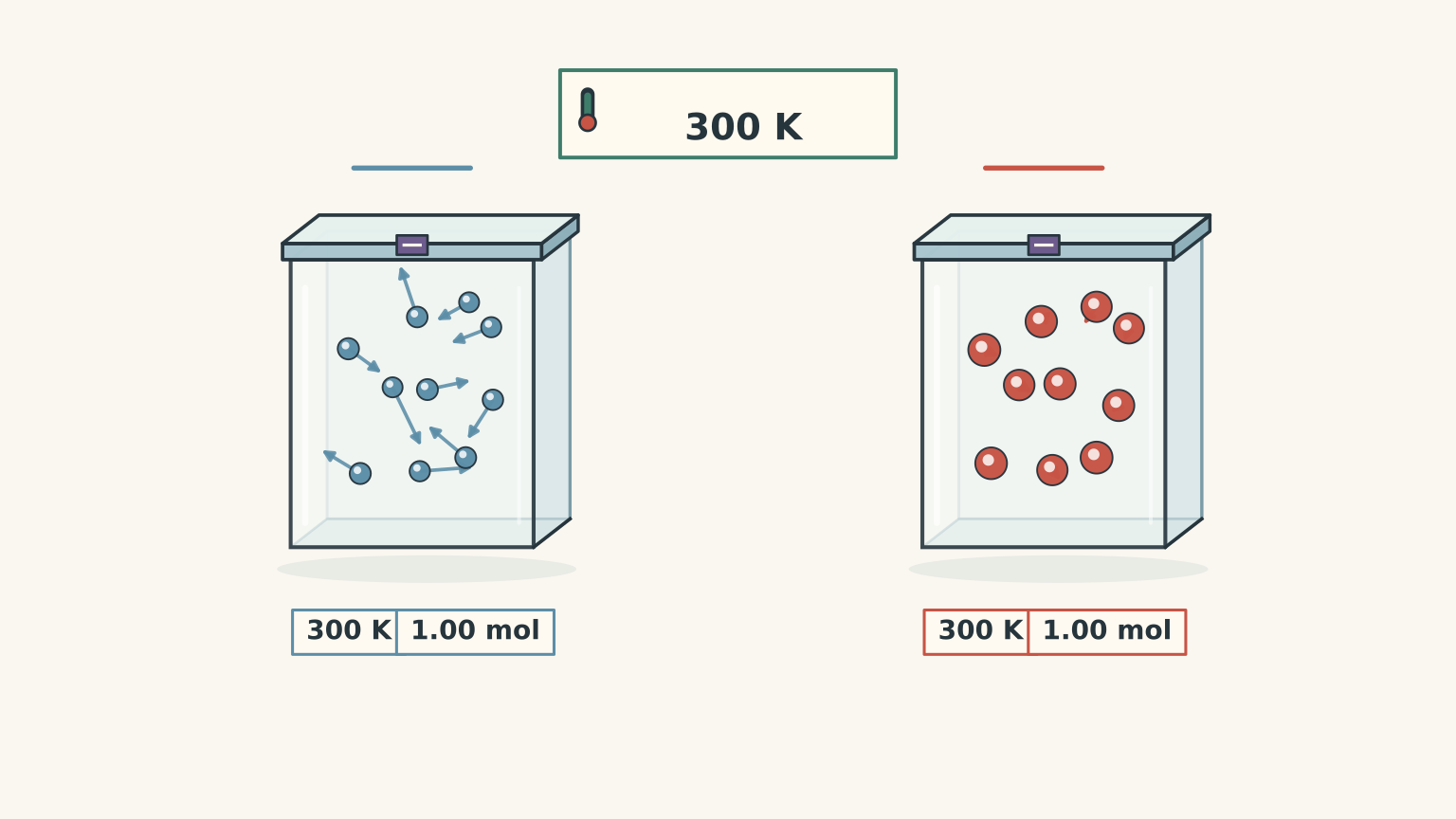
Two sealed containers each hold one mole of gas at 300 K. One contains helium, and the other contains argon. Both have the same number of particles and the same temperature, so would you expect their particles to travel at the same speed?
They don’t. Helium atoms typically move more than three times as fast as argon atoms under these conditions. Even more surprisingly, the helium atoms don’t all move at one speed. Some are much slower than average, some are much faster, and their speeds change as they collide.
The Maxwell-Boltzmann speed distribution explains that spread. It predicts which molecular speeds are common, which are rare, and why the meaning of an “average speed” isn’t quite as simple as it sounds.
Syllabus note: This is an extension beyond the required NSW Chemistry 11-12 Syllabus (2025) content. That syllabus is scheduled for Year 11 implementation in 2028. Its Quantitative chemistry focus area includes comparing the masses of equimolar amounts of pure substances. We’ll use that familiar mole concept as our starting point, then explore molecular speeds. The distribution equations and advanced questions here are enrichment, not an additional HSC assessment requirement.
Due to technical limitations, this figure may display incorrectly or contain inaccuracies. Please check key details against your course materials.
01Equal moles don’t mean equal molecular speeds
In Year 11 Quantitative chemistry, you learn that one mole of any substance contains approximately \(6.022 \times 10^{23}\) specified particles.
For example:
| Pure substance | Amount | Molar mass | Sample mass |
|---|---|---|---|
| Helium, \(\ce{He}\) | 1.00 mol | 4.00 g/mol | 4.00 g |
| Argon, \(\ce{Ar}\) | 1.00 mol | 40.0 g/mol | 40.0 g |
Both samples contain the same number of atoms, but an argon atom is approximately ten times as massive as a helium atom.
This gives us a useful question.
If both gases have the same temperature, which atoms should move faster?
Think about the kinetic energy of a moving object:
\[ E_k=\frac12 mv^2 \]
Here:
- \(E_k\) is translational kinetic energy, measured in joules (J).
- \(m\) is the mass of one particle, in kilograms (kg).
- \(v\) is its speed, in metres per second (m/s).
Translational motion means movement from one position to another, rather than rotation or vibration.
If two particles have the same kinetic energy but different masses, the lighter particle must have a greater speed.
That is the first useful mental model. At the same temperature, lighter gas particles generally move faster than heavier ones.
But there’s a missing piece: temperature does not assign one particular kinetic energy to every molecule.
Temperature describes an average, not every particle
In a gas at thermal equilibrium, particles move randomly and collide with one another. During collisions, they exchange energy.
One particle might speed up while another slows down. The individual speeds fluctuate, even though the gas maintains a stable temperature.
For an ideal gas in thermal equilibrium, the average translational kinetic energy per mole is:
\[ \overline{E}_{k,\mathrm{mol}}=\frac32RT \]
where:
- \(\overline{E}_{k,\mathrm{mol}}\) is average translational kinetic energy expressed per mole, in J/mol.
- \(R=8.314\ \mathrm{J\,mol^{-1}\,K^{-1}}\) is the ideal gas constant.
- \(T\) is the absolute temperature, in kelvin (K).
The important feature is that molecular mass does not appear in this equation.
At the same temperature, helium and argon have the same average translational kinetic energy per particle, even though their typical speeds differ.
This is an average over many particles, not a statement that every particle has identical energy.
02Why molecular speeds form a distribution
Imagine a speed camera recording passing cars. Instead of listing every individual speed, it sorts them into intervals: 40-50 km/h, 50-60 km/h, 60-70 km/h, and so on.
You could then draw a graph showing how many cars fall into each interval.
A gas-speed distribution works similarly. The difference is that gas particles move in three dimensions, continually change speed through collisions, and don’t have drivers choosing how fast to go.
Suppose we could record the instantaneous speeds of an enormous number of oxygen molecules at 300 K.
We would find:
- Relatively few moving extremely slowly.
- Many moving at intermediate speeds.
- Progressively fewer moving at very high speeds.
The resulting curve is called the Maxwell-Boltzmann speed distribution.
How to read the curve
The horizontal axis shows molecular speed.
The vertical axis describes how concentrated the molecules are around each speed. More precisely, for a normalised distribution, it shows the fraction of molecules per unit of speed.
The area under the curve between two speeds gives the fraction of molecules whose speeds fall within that interval.
Because every molecule has some speed, the total area under the normalised curve is 1, or 100%.
This creates an important distinction:
A tall curve does not necessarily represent more molecules than a short curve.
If two normalised distributions represent different samples, their total areas are still equal to 1. One might be tall and narrow; the other might be short and broad.
A curve’s height tells us how concentrated the speeds are around a particular value, not the total amount of gas in the container.
The smooth curve is an ideal prediction for an enormous population of particles. A real measurement involving finitely many particles would fluctuate around it.
Why is the curve asymmetric?
The curve rises quite steeply from zero speed, reaches one peak, then falls more gradually towards high speeds.
There are two competing effects.
First, molecular motion takes place in three dimensions. There are more combinations of velocity components that produce a moderate speed than combinations that produce a speed extremely close to zero.
Second, very high speeds require unusually high translational kinetic energies. Those energies become increasingly unlikely.
Together, these effects produce a single peak and a tail extending towards higher speeds.
The distribution is therefore not symmetrical around its peak.
That asymmetry is why different definitions of a “typical speed” produce different answers.
03Three different ways to describe a typical speed
Suppose you need to describe the molecular motion of oxygen gas using just one number.
Which should you choose?
The speed at the top of the curve? The arithmetic average of every molecular speed? Or a speed that represents the average kinetic energy?
All three are useful, but they answer different questions.
Most probable speed
The most probable speed, \(v_{\mathrm{mp}}\), is the speed at which the Maxwell-Boltzmann distribution reaches its maximum height.
It is the mode of the distribution.
If you divide the speed axis into very narrow intervals of equal width, the interval around the most probable speed contains the greatest fraction of molecules.
It does not mean that most molecules have exactly that speed. For a continuous distribution, we compare intervals, not exact individual values.
Mean speed
The mean speed, \(\bar v\), is the ordinary arithmetic average of the molecular speeds.
For \(N\) particles:
\[ \bar v=\frac{v_1+v_2+\cdots+v_N}{N} \]
Here, \(v_1,v_2,\ldots,v_N\) represent the individual particle speeds in m/s, and \(N\) is the number of particles.
The faster-moving molecules in the long right-hand tail pull the mean speed above the most probable speed.
One subtle point: the mean is not necessarily the speed that divides the area under the curve into two equal halves. That would be the median speed.
Root-mean-square speed
The root-mean-square speed, \(v_{\mathrm{rms}}\), is calculated differently.
First, square each molecular speed. Next, calculate the mean of those squared speeds. Finally, take the square root.
\[ v_{\mathrm{rms}} = \sqrt{ \frac{v_1^2+v_2^2+\cdots+v_N^2}{N} } \]
Why do that instead of using an ordinary average?
Because kinetic energy depends on the square of speed.
A molecule moving twice as fast has four times the kinetic energy of an otherwise identical molecule. Squaring the speeds therefore gives faster molecules greater weight.
The rms speed is particularly useful when linking molecular motion to kinetic energy and gas pressure.
For any set of non-negative speeds, rms speed is at least as large as mean speed. For a Maxwell-Boltzmann distribution, it is strictly larger.
The three Maxwell-Boltzmann formulas
For an ideal gas at thermal equilibrium, the characteristic speeds are:
| Quantity | Formula | What it describes |
|---|---|---|
| Most probable speed | \(v_{\mathrm{mp}}=\sqrt{\frac{2RT}{M}}\) | Peak of the speed distribution |
| Mean speed | \(\bar v=\sqrt{\frac{8RT}{\pi M}}\) | Arithmetic average of molecular speeds |
| RMS speed | \(v_{\mathrm{rms}}=\sqrt{\frac{3RT}{M}}\) | Speed connected to average kinetic energy |
In these equations:
- \(R\) is the ideal gas constant, \(8.314\ \mathrm{J\,mol^{-1}\,K^{-1}}\).
- \(T\) is absolute temperature, in K.
- \(M\) is molar mass, in kg/mol.
- \(\pi\) is the mathematical constant approximately equal to 3.14159.
- All three calculated speeds have units of m/s.
Remember that molar mass is often supplied in g/mol. Convert it into kg/mol before substituting into these formulas.
The equations give the following ordering:
\[ v_{\mathrm{mp}}<\bar v<v_{\mathrm{rms}} \]
For any ideal gas following the Maxwell-Boltzmann distribution, this ordering stays the same.
There is one more distinction worth remembering: speed is a magnitude, while velocity includes direction. A stationary container of gas can have an average molecular velocity of zero because directions cancel, while the mean molecular speed remains hundreds of metres per second.
Worked example: Three characteristic speeds of oxygen
Oxygen gas, \(\ce{O2}\), is at a temperature of 300 K. Its molar mass is 32.0 g/mol. Calculate its most probable speed, mean speed, and rms speed. Explain why the answers differ.
Step 1
\[ M=\frac{32.0}{1000} =0.0320\ \mathrm{kg/mol} \]
Use \(T=300\ \mathrm K\) and \(R=8.314\ \mathrm{J\,mol^{-1}\,K^{-1}}\).
Step 2
\[ \begin{aligned} v_{\mathrm{mp}}&=\sqrt{\frac{2RT}{M}}\\ &=\sqrt{\frac{2(8.314)(300)}{0.0320}}\\ &=395\ \mathrm{m/s} \end{aligned} \]
This is the speed at which the distribution reaches its peak.
Step 3
\[ \begin{aligned} \bar v&=\sqrt{\frac{8RT}{\pi M}}\\ &=\sqrt{\frac{8(8.314)(300)} {\pi(0.0320)}}\\ &=446\ \mathrm{m/s} \end{aligned} \]
The mean speed is higher because the fast-moving molecules in the right-hand tail pull the arithmetic average upwards.
Step 4
\[ \begin{aligned} v_{\mathrm{rms}}&=\sqrt{\frac{3RT}{M}}\\ &=\sqrt{\frac{3(8.314)(300)}{0.0320}}\\ &=484\ \mathrm{m/s} \end{aligned} \]
Step 5
The characteristic speeds are approximately:
- Most probable: 395 m/s
- Mean: 446 m/s
- RMS: 484 m/s
These are not competing predictions of one speed. They are three different summaries of the same distribution.
The rms value is greatest because squaring the individual speeds gives high-speed molecules more influence.
For example, calculating the average translational kinetic energy per mole directly gives:
\[ \begin{aligned} \overline E_{k,\mathrm{mol}} &=\frac32RT\\ &=\frac32(8.314)(300)\\ &=3741\ \mathrm{J/mol} \end{aligned} \]
That energy is connected to the rms speed, not to the square of the ordinary mean speed.
04How temperature changes the distribution
Consider a sealed sample of nitrogen gas at 300 K.
Now imagine heating the gas until its temperature reaches 600 K.
Would every molecule simply double its speed?
No. Heating raises the average translational kinetic energy and changes the whole statistical distribution. Molecules continue to exchange energy through collisions, so we cannot assign the same speed increase to every individual molecule.
For a Maxwell-Boltzmann gas of fixed molar mass, every characteristic speed scales with the square root of absolute temperature:
\[ v\propto\sqrt{T} \]
Here, \(v\) represents any of the three characteristic speeds, not the speed of every individual molecule.
If temperature doubles:
\[ \frac{v_2}{v_1} =\sqrt{\frac{T_2}{T_1}} =\sqrt2 \approx1.414 \]
The characteristic speeds increase by about 41%, not 100%.
Why does the curve become lower?
When temperature increases, molecular speeds spread over a greater range of values.
The distribution stretches horizontally.
But the total area under a normalised curve must remain 1, so its peak becomes lower.
For the same gas, if absolute temperature is multiplied by four, all three characteristic speeds double. The normalised distribution becomes twice as wide on the speed axis and half as high at its peak.
This does not mean half the molecules disappear. It means the molecules are distributed over a wider range of speeds.
05How molecular mass changes the distribution
Now keep temperature fixed and change the gas.
Compare one mole of helium with one mole of argon, both at 300 K.
Recall their molar masses:
\[ \begin{aligned} M_{\ce{He}}&=0.00400\ \mathrm{kg/mol}\\ M_{\ce{Ar}}&=0.0400\ \mathrm{kg/mol} \end{aligned} \]
From the characteristic-speed equations:
\[ v\propto\frac{1}{\sqrt M} \]
This means lighter molecules have greater characteristic speeds at the same temperature.
The helium-to-argon speed ratio is:
\[ \begin{aligned} \frac{v_{\ce{He}}}{v_{\ce{Ar}}} &=\sqrt{\frac{M_{\ce{Ar}}}{M_{\ce{He}}}}\\ &=\sqrt{\frac{0.0400}{0.00400}}\\ &=\sqrt{10}\\ &\approx3.16 \end{aligned} \]
The helium atoms have characteristic speeds approximately 3.16 times those of argon atoms.
This ratio applies separately to the most probable, mean, and rms speeds.
A subtle point: helium is not guaranteed to be faster than argon in every individual comparison.
Some argon atoms move unusually quickly, and some helium atoms move unusually slowly. Their distributions overlap.
The correct conclusion is that helium has a greater typical speed, not that every helium atom outruns every argon atom.
The most useful comparison rule
All three characteristic speeds depend on the same ratio:
\[ v\propto\sqrt{\frac{T}{M}} \]
When comparing two equilibrium gases:
- Increasing \(T\) increases characteristic speeds.
- Increasing \(M\) decreases characteristic speeds.
- If \(T/M\) is identical, their entire normalised Maxwell-Boltzmann speed distributions are identical.
That last result is especially interesting.
Two different gases can have identical speed distributions without having the same temperature.
Worked example: Can two gases at different temperatures have identical speed distributions?
A container holds 0.250 mol of neon gas at 300 K. A second container holds 0.250 mol of argon gas at 600 K.
Assume both gases behave ideally and are individually at thermal equilibrium.
Neon has a molar mass of 20.0 g/mol, while argon has a molar mass of 40.0 g/mol.
Determine whether their Maxwell-Boltzmann speed distributions are identical. Then compare their average translational kinetic energies per mole.
Step 1
\[ \begin{aligned} M_{\ce{Ne}}&=0.0200\ \mathrm{kg/mol}\\ M_{\ce{Ar}}&=0.0400\ \mathrm{kg/mol} \end{aligned} \]
Step 2
For neon:
\[ \frac{T}{M}=\frac{300}{0.0200} =15000\ \mathrm{K\,mol/kg} \]
For argon:
\[ \frac{T}{M}=\frac{600}{0.0400} =15000\ \mathrm{K\,mol/kg} \]
The ratios are identical.
Therefore, the normalised speed distributions are identical, including their peak positions, widths, and shapes.
Step 3
For neon:
\[ \begin{aligned} v_{\mathrm{mp}} &=\sqrt{\frac{2(8.314)(300)}{0.0200}}\\ &=499\ \mathrm{m/s} \end{aligned} \]
For argon:
\[ \begin{aligned} v_{\mathrm{mp}} &=\sqrt{\frac{2(8.314)(600)}{0.0400}}\\ &=499\ \mathrm{m/s} \end{aligned} \]
Both have the same most probable speed. Their mean and rms speeds also match.
Step 4
For neon:
\[ \begin{aligned} \overline E_{k,\mathrm{mol}} &=\frac32RT\\ &=\frac32(8.314)(300)\\ &=3741\ \mathrm{J/mol} \end{aligned} \]
For argon:
\[ \begin{aligned} \overline E_{k,\mathrm{mol}} &=\frac32(8.314)(600)\\ &=7483\ \mathrm{J/mol} \end{aligned} \]
Argon has twice the average translational kinetic energy per mole, despite having the same molecular speed distribution.
That is possible because each argon atom is twice as massive as a neon atom.
The example exposes a common mistake: identical molecular speeds do not necessarily imply identical kinetic energies or temperatures.
06Why the distinction matters: Gas escaping through a tiny opening
Imagine a sealed container holding a mixture of helium and argon.
A tiny opening connects the container to a vacuum.
Which type of atom is more likely to escape through the opening during a short interval?
At equal temperature and equal particle concentration, helium escapes more rapidly.
The reason involves more than the location of the peak of the speed distribution.
Faster particles encounter the opening more frequently. Even within one gas, the particles escaping through the opening are biased towards higher speeds compared with the particles remaining inside.
This process is called effusion.
For a tiny idealised opening, the escape rate is proportional to:
\[ \text{Escape rate}\propto c\bar v \]
Here, \(c\) is the number of particles of the particular gas per cubic metre, measured in particles/m³, and \(\bar v\) is that gas’s mean molecular speed in m/s. The opening’s area is assumed to be fixed.
Since \(\bar v\propto\sqrt{T/M}\), the escape rate scales as:
\[ \text{Escape rate}\propto c\sqrt{\frac{T}{M}} \]
For two gases at the same temperature, with equal number densities and identical opening conditions:
\[ \frac{\text{Rate}_A}{\text{Rate}_B} =\sqrt{\frac{M_B}{M_A}} \]
This is the familiar square-root dependence behind Graham’s law.
The result assumes molecular effusion: an opening sufficiently small compared with the distance particles typically travel between collisions, and negligible gas pressure outside. It does not describe every ordinary leak or the mixing of gases through open air.
For a fuller treatment of the escape-rate calculation, see Graham’s Law of Effusion: Molar Mass and Gas Escape Rates.
The connection is useful because the most probable speed is not automatically the correct speed to use in every physical calculation. Effusion depends on mean speed, while average translational kinetic energy depends on rms speed.
07Where the Maxwell-Boltzmann model works
The formulas in this guide describe classical, non-relativistic particles in an ideal gas at thermal equilibrium.
That includes several important assumptions.
Gas particles are treated as having negligible volume compared with the container, and intermolecular interactions do not significantly affect their equilibrium behaviour. They can exchange energy through collisions.
The gas must also have reached thermal equilibrium. Immediately after rapid heating, mixing, or expansion, a sample may temporarily have a speed distribution that does not follow the equilibrium Maxwell-Boltzmann curve.
At very high densities, where intermolecular interactions become important, or at temperatures and densities where quantum effects matter, the simple model can fail.
The equations describe translational motion. Molecules such as \(\ce{N2}\) and \(\ce{CO2}\) may also store energy through rotation or vibration. Those additional forms of energy do not change the ideal-gas relationship between temperature and average translational kinetic energy.
You do not need the advanced calculus used to derive the distribution to understand its predictions. The University of Reading’s kinetic-theory notes provide a more mathematical treatment if you want to explore the derivation.
The practical decision is simple: before using a characteristic-speed equation, identify the gas, temperature, and physical quantity being described. A single speed is only a summary of a much wider distribution.
08Questions and solutions
The first question checks the basic calculation. The next four explore increasingly demanding situations where an apparently reasonable shortcut leads to the wrong conclusion.
Question 1
A sample of nitrogen gas, \(\ce{N2}\), is at 300 K and behaves ideally.
Its molar mass is 28.0 g/mol.
Calculate:
a. The most probable molecular speed.
b. The rms molecular speed.
c. Explain why the two speeds are different.
Use \(R=8.314\ \mathrm{J\,mol^{-1}\,K^{-1}}\).
Solution 1
The most probable speed is approximately 422 m/s, while the rms speed is approximately 517 m/s. The rms value is larger because it gives faster-moving particles more weight when calculating the average.
Part a: Most probable speed
Convert molar mass:
\[ M=0.0280\ \mathrm{kg/mol} \]
Then:
\[ \begin{aligned} v_{\mathrm{mp}} &=\sqrt{\frac{2RT}{M}}\\ &=\sqrt{\frac{2(8.314)(300)}{0.0280}}\\ &=422\ \mathrm{m/s} \end{aligned} \]
This is the peak of the nitrogen speed distribution.
Part b: RMS speed
\[ \begin{aligned} v_{\mathrm{rms}} &=\sqrt{\frac{3RT}{M}}\\ &=\sqrt{\frac{3(8.314)(300)}{0.0280}}\\ &=517\ \mathrm{m/s} \end{aligned} \]
Part c: Explanation
The most probable speed identifies the most common narrow speed interval.
The rms speed is calculated by squaring molecular speeds before averaging, so particles moving unusually quickly contribute more strongly.
The two values describe the same molecular population. Neither implies that all nitrogen molecules move at exactly that speed.
The tempting mistake is to treat temperature as assigning one fixed speed to each molecule.
Question 2
Two rigid containers have identical volumes and contain the same pure gas, oxygen.
Both samples are at thermal equilibrium and behave ideally.
| Condition | Container A | Container B |
|---|---|---|
| Amount | 1.00 mol | 3.00 mol |
| Temperature | 300 K | 1200 K |
| Molar mass | 32.0 g/mol | 32.0 g/mol |
A student makes three predictions:
- Container B has a higher most probable speed.
- Container B’s normalised speed-distribution peak must be three times as tall because it contains three times as many molecules.
- Container B must have twelve times the pressure of A.
Determine which predictions are correct.
Then calculate:
a. The ratio of most probable speeds.
b. The ratio of the heights of the normalised distribution peaks.
c. The ratio of the actual numbers of molecules found in very narrow, equal-width speed intervals centred on the respective peaks.
Assume the intervals are sufficiently narrow that the distribution height is approximately constant across each interval.
Solution 2
Predictions 1 and 3 are correct, but prediction 2 is false. Container B has twice the most probable speed, half the normalised peak height, and approximately 1.5 times as many molecules near its own peak when equal-width intervals are compared.
Part a: Speed ratio
Because both containers contain oxygen, their molar masses are equal.
\[ \begin{aligned} \frac{v_{\mathrm{mp},B}}{v_{\mathrm{mp},A}} &=\sqrt{\frac{T_B}{T_A}}\\ &=\sqrt{\frac{1200\ \mathrm K}{300\ \mathrm K}}\\ &=2 \end{aligned} \]
Container B’s most probable speed is twice that of A.
Heating increases characteristic speeds, but not in direct proportion to temperature.
Part b: Normalised peak height
Increasing absolute temperature by a factor of four doubles the horizontal speed scale.
The normalised Maxwell-Boltzmann curve becomes twice as wide.
Because its total area remains 1, its peak height is halved.
Therefore:
\[ \frac{h_B}{h_A}=\frac12 \]
Here, \(h_A\) and \(h_B\) are the maximum heights of the two normalised distribution curves.
The tempting mistake is to confuse normalised probability density with an actual molecule count. Container B’s three moles do not make its normalised curve three times taller.
Part c: Actual molecule counts near the peaks
The number of molecules in a very narrow speed interval is approximately proportional to:
\[ N_{\mathrm{interval}}\propto Nh\Delta v \]
Here:
- \(N_{\mathrm{interval}}\) is the number of particles in the selected interval.
- \(N\) is the total number of particles.
- \(h\) is the distribution height near that interval.
- \(\Delta v\) is the interval width in m/s.
Since the intervals have equal widths:
\[ \begin{aligned} \frac{N_{\mathrm{interval},B}} {N_{\mathrm{interval},A}} &\approx \frac{N_B}{N_A} \frac{h_B}{h_A}\\ &=3\left(\frac12\right)\\ &=1.5 \end{aligned} \]
Container B has approximately 50% more molecules in a narrow interval around its own most probable speed, even though its normalised peak is only half as tall.
This is the distinction between a fraction and an actual number of molecules.
Pressure prediction
The ideal gas equation is:
\[ PV=nRT \]
Here, \(P\) is pressure in pascals (Pa), \(V\) is volume in cubic metres, and \(n\) is amount in moles.
With equal container volumes:
\[ \begin{aligned} \frac{P_B}{P_A} &=\frac{n_BT_B}{n_AT_A}\\ &=\frac{3.00(1200)}{1.00(300)}\\ &=12 \end{aligned} \]
Container B does have twelve times the pressure.
The important lesson is that speed distributions and pressure depend on different combinations of quantities. The normalised speed-distribution shape depends on temperature and molecular mass, while total pressure also depends on how many particles occupy the volume.
Question 3
A researcher records the instantaneous speeds of two small groups of particles.
All particles within a group have the same mass.
Group A has particles of mass \(4.0\times10^{-26}\ \mathrm{kg}\).
Group B has particles of mass \(8.0\times10^{-26}\ \mathrm{kg}\).
The observed speeds are:
| Particle | Group A speed | Group B speed |
|---|---|---|
| 1 | 200 m/s | 100 m/s |
| 2 | 400 m/s | 300 m/s |
| 3 | 600 m/s | 500 m/s |
A student argues:
“Group A has a higher mean speed, so its particles must have a higher average kinetic energy. Therefore Group A must also be hotter.”
a. Calculate the mean speed and rms speed of both groups.
b. Calculate the average translational kinetic energy per particle in each group.
c. Evaluate the student’s argument.
d. Can these six measurements establish which group has the higher thermodynamic temperature? Explain.
Solution 3
Group A has both the higher mean speed and higher rms speed, but Group B has the greater average translational kinetic energy per particle. The observations alone are not enough to establish thermodynamic temperatures.
The student’s argument fails because kinetic energy depends on both mass and squared speed.
Part a: Mean and rms speeds
For Group A, the arithmetic mean is:
\[ \begin{aligned} \bar v_A &=\frac{200+400+600}{3}\\ &=400\ \mathrm{m/s} \end{aligned} \]
Its rms speed is:
\[ \begin{aligned} v_{\mathrm{rms},A} &=\sqrt{\frac{200^2+400^2+600^2}{3}}\\ &=\sqrt{186667}\\ &\approx432\ \mathrm{m/s} \end{aligned} \]
For Group B:
\[ \begin{aligned} \bar v_B &=\frac{100+300+500}{3}\\ &=300\ \mathrm{m/s} \end{aligned} \]
And:
\[ \begin{aligned} v_{\mathrm{rms},B} &=\sqrt{\frac{100^2+300^2+500^2}{3}}\\ &=\sqrt{116667}\\ &\approx342\ \mathrm{m/s} \end{aligned} \]
All speeds are expressed in m/s. The intermediate values inside the final square roots have units of \(\mathrm{m^2/s^2}\).
Group A has the higher mean and rms speeds.
Part b: Average kinetic energy
For particles of the same mass within one group:
\[ \overline E_k=\frac12mv_{\mathrm{rms}}^2 \]
For Group A:
\[ \begin{aligned} \overline E_{k,A} &=\frac12(4.0\times10^{-26})(186667)\\ &=3.73\times10^{-21}\ \mathrm J \end{aligned} \]
For Group B:
\[ \begin{aligned} \overline E_{k,B} &=\frac12(8.0\times10^{-26})(116667)\\ &=4.67\times10^{-21}\ \mathrm J \end{aligned} \]
Group B’s average kinetic energy is greater.
The ratio is:
\[ \begin{aligned} \frac{\overline E_{k,B}}{\overline E_{k,A}} &=\frac{4.67\times10^{-21}} {3.73\times10^{-21}}\\ &\approx1.25 \end{aligned} \]
Group B has approximately 25% more average translational kinetic energy per particle in this snapshot.
Part c: Evaluate the argument
The student correctly identifies Group A as having the greater mean speed.
However, the conclusion about kinetic energy is incorrect.
Group B’s particles are twice as massive. Their lower speeds do not compensate completely for that greater mass.
The student also uses mean speed as though its square directly gives average kinetic energy.
That is another mistake:
\[ \overline{v^2}\ne(\bar v)^2 \]
for a collection with a spread of speeds.
To calculate average kinetic energy, we need the mean squared speed, or equivalently the square of the rms speed.
Part d: Temperature
No reliable thermodynamic temperature comparison can be established from these six measurements alone.
They describe only three particles in each group at one instant. We have not established that either group represents a large equilibrium gas following a Maxwell-Boltzmann distribution.
If these averages were representative of large, equilibrated ideal-gas samples, Group B’s higher average translational kinetic energy would indicate a higher temperature.
But that additional equilibrium assumption is essential.
This is why measuring a few molecular speeds and describing the equilibrium temperature of an entire gas are different tasks.
Question 4
A sealed container holds a mixture of helium and argon at the same uniform temperature.
Initially, it contains:
- 0.0500 mol of helium
- 0.0500 mol of argon
The molar masses are 4.00 g/mol for helium and 40.0 g/mol for argon.
A very small opening leads into a vacuum. The opening is sufficiently small for ideal molecular effusion, and the container temperature is maintained by an external thermal reservoir.
Only a negligible amount initially escapes during the first measurement.
a. Compare the initial partial pressures of helium and argon.
b. Calculate the ratio of their initial effusion rates.
c. Estimate the percentage of the first escaping molecules that are helium atoms.
d. Explain why the helium atoms collected outside the container do not have exactly the same speed distribution as helium atoms inside it.
e. Predict how the composition of the gas remaining in the container changes as effusion continues.
Solution 4
The gases initially have equal partial pressures, but helium effuses approximately 3.16 times as rapidly as argon. About 76% of the initially escaping atoms are helium. The escaping atoms are also biased towards higher speeds, and the remaining mixture gradually becomes richer in argon.
Part a: Partial pressures
For an ideal gas mixture:
\[ P_i=\frac{n_iRT}{V} \]
Here, \(P_i\) is the partial pressure of component \(i\), and \(n_i\) is its amount in moles.
Both gases occupy the same volume and have the same temperature.
Their amounts are also equal, so:
\[ P_{\ce{He}}=P_{\ce{Ar}} \]
Each contributes half the total pressure.
The tempting mistake is to assume heavier argon atoms must exert more partial pressure. Their lower characteristic speeds compensate for their greater mass at the same temperature.
Part b: Effusion-rate ratio
Under the specified conditions, equal mole amounts in a shared volume give equal initial number densities.
Use the square-root relationship:
\[ \begin{aligned} \frac{\text{Rate}_{\ce{He}}} {\text{Rate}_{\ce{Ar}}} &=\sqrt{\frac{M_{\ce{Ar}}}{M_{\ce{He}}}}\\ &=\sqrt{\frac{40.0}{4.00}}\\ &=3.16 \end{aligned} \]
Helium escapes approximately 3.16 times as rapidly as argon initially.
Part c: Initial escaping fraction
For every one argon atom escaping, approximately 3.16 helium atoms escape.
Therefore, the initial helium fraction in the escaping stream is:
\[ \begin{aligned} x_{\ce{He}} &=\frac{3.16}{3.16+1}\\ &=0.760 \end{aligned} \]
Here, \(x_{\ce{He}}\) is the helium fraction among escaping particles.
So approximately 76.0% of the initially escaping atoms are helium, and 24.0% are argon.
This differs from the 50:50 mixture inside the container.
Part d: Speed selection
The escaping helium atoms are not a random, speed-unbiased sample of all helium atoms in the container.
Faster atoms encounter the opening more often. Once direction is averaged over, the contribution of a narrow speed interval to the escape stream is weighted by speed as well as by the fraction of atoms in that interval.
This means the escaping helium atoms are biased towards higher speeds.
The same applies to argon atoms.
The mistake would be to assume that an opening samples every speed with equal likelihood.
Part e: Remaining composition
As effusion continues, helium is depleted more rapidly.
The remaining gas gradually becomes enriched in argon.
The initial 3.16:1 escape-rate ratio will not remain constant throughout the process, because the helium-to-argon number-density ratio changes.
Even though the temperature is maintained, composition is not.
The problem combines three different ideas: equal partial pressures, unequal molecular-speed distributions, and speed-biased escape through an opening.
Question 5
An insulated, rigid vessel is divided into two equal-volume compartments by a removable wall.
Each compartment has a volume \(V\).
The left compartment contains 1.00 mol of helium at 300 K.
The right compartment contains 1.00 mol of argon at an unknown temperature.
Both gases are initially at thermal equilibrium within their own compartments.
Their molar masses are:
\[ \begin{aligned} M_{\ce{He}}&=4.00\ \mathrm{g/mol}\\ M_{\ce{Ar}}&=40.0\ \mathrm{g/mol} \end{aligned} \]
A measurement reveals that the two gases initially have exactly identical normalised Maxwell-Boltzmann speed distributions.
The separating wall is then removed. The gases mix in the combined volume \(2V\) and eventually reach a new common thermal equilibrium.
Assume both gases are monatomic and ideal, the entire vessel is rigid and thermally insulated, no gas escapes during mixing, and there is no lasting bulk motion.
For a final comparison, imagine identical, sufficiently small effusion openings into a vacuum, measured over negligibly short intervals so they do not alter the states. Before mixing, each opening would sample one original compartment. After equilibration, one opening would sample the common mixture.
Determine:
a. The initial temperature of argon.
b. The ratio of the initial argon pressure to the initial helium pressure.
c. Whether the two speed distributions remain identical immediately after the wall is removed, before significant collisions between the two gases have occurred.
d. The final equilibrium temperature.
e. Whether the final equilibrium speed distributions are identical. Calculate the final most probable speeds of both gases.
f. Compare the initial effusion rates through the separate identical openings. Then compare the species-specific effusion rates from the common mixture after thermal equilibrium is reached.
g. Compare the final partial pressures of helium and argon.
A student argues:
“The two gases start with exactly the same speed distribution. Since they are mixed in an insulated vessel, they cannot acquire different speed distributions without an external energy source.”
Explain the precise error in this argument.
Solution 5
Argon initially has a temperature of 3000 K, and its initial pressure is ten times helium’s. Their speed distributions are initially identical, but after mixing and reaching a common equilibrium temperature of 1650 K, helium has a much higher characteristic speed than argon.
The initial effusion rates are equal, yet after equilibrium helium effuses approximately 3.16 times as rapidly. Meanwhile, the final partial pressures are equal.
The crucial insight is that energy can move between the gases even when no energy enters or leaves the entire vessel.
Part a: Initial argon temperature
The gases have identical normalised Maxwell-Boltzmann speed distributions.
For ideal equilibrium gases, the distribution’s speed scale depends on:
\[ \sqrt{\frac{T}{M}} \]
Therefore:
\[ \frac{T_{\ce{He}}}{M_{\ce{He}}} = \frac{T_{\ce{Ar}}}{M_{\ce{Ar}}} \]
Rearranging:
\[ \begin{aligned} T_{\ce{Ar}} &=T_{\ce{He}} \frac{M_{\ce{Ar}}}{M_{\ce{He}}}\\ &=300\left(\frac{40.0}{4.00}\right)\\ &=3000\ \mathrm K \end{aligned} \]
The argon must be ten times hotter to have the same molecular speed distribution as helium.
This is the first reversal of intuition: equal molecular speed distributions do not imply equal temperatures when molecular masses differ.
Part b: Initial pressure ratio
Use the ideal gas equation:
\[ P=\frac{nRT}{V} \]
Both compartments contain the same amount of gas and have the same volume.
Therefore:
\[ \begin{aligned} \frac{P_{\ce{Ar},i}}{P_{\ce{He},i}} &=\frac{T_{\ce{Ar},i}}{T_{\ce{He},i}}\\ &=\frac{3000}{300}\\ &=10 \end{aligned} \]
The subscript \(i\) means initial.
Argon has ten times helium’s initial pressure.
This may seem strange because their molecular speeds have identical distributions. But argon atoms are ten times as massive. At the same speed, they carry more momentum, and their impacts exert a greater pressure.
Part c: Immediately after removing the wall
At the instant the wall is removed, the molecular speed distributions do not suddenly change.
Before substantial interspecies collisions have occurred, helium atoms retain their previous velocities, and argon atoms retain theirs.
Their initial speed distributions are still identical.
However, the system as a whole is not in thermal equilibrium. The two gases began at different temperatures and pressures, and their initial spatial distributions are different.
During mixing, collisions transfer energy and momentum between them.
We must not apply a single common-temperature Maxwell-Boltzmann model to the entire mixture immediately after removing the partition.
Part d: Final temperature
The vessel is rigid and insulated.
No gas escapes, and no energy enters or leaves the complete system.
Therefore, total internal energy is conserved.
For a monatomic ideal gas:
\[ U=\frac32nRT \]
Here, \(U\) is internal energy in joules, and \(n\) is the amount of gas in moles.
Each gas initially contains 1.00 mol.
Since both are monatomic ideal gases, their combined initial internal energy equals the final internal energy:
\[ \begin{aligned} \frac32R(300+3000) &=\frac32R(2T_f)\\ 3300&=2T_f\\ T_f&=1650\ \mathrm K \end{aligned} \]
The subscript \(f\) means final.
The final equilibrium temperature is 1650 K.
The argon cools from 3000 K, while the helium warms from 300 K.
The total energy is unchanged, but its distribution between the two gases changes.
Part e: Final speed distributions
At equilibrium, both gases have the same temperature:
\[ T_{\ce{He},f}=T_{\ce{Ar},f}=1650\ \mathrm K \]
However, their molecular masses remain different.
Therefore, their values of \(T/M\) are no longer equal.
The final speed distributions cannot be identical.
For helium:
\[ \begin{aligned} v_{\mathrm{mp,He}} &=\sqrt{\frac{2RT_f}{M_{\ce{He}}}}\\ &=\sqrt{\frac{2(8.314)(1650)}{0.00400}}\\ &=2619\ \mathrm{m/s} \end{aligned} \]
For argon:
\[ \begin{aligned} v_{\mathrm{mp,Ar}} &=\sqrt{\frac{2RT_f}{M_{\ce{Ar}}}}\\ &=\sqrt{\frac{2(8.314)(1650)}{0.0400}}\\ &=828\ \mathrm{m/s} \end{aligned} \]
Both gases initially had a most probable speed of approximately 1117 m/s.
After equilibration:
- Helium has a higher most probable speed than before.
- Argon has a lower most probable speed than before.
- Helium’s most probable speed is approximately \(\sqrt{10}\), or 3.16 times, argon’s.
The same final speed ratio applies to mean and rms speeds.
The equilibrium process makes the temperatures equal, not the molecular speeds equal.
Part f: Effusion-rate comparison
For identical small openings, the initial escape rate of each gas is proportional to its number density multiplied by its mean speed.
Initially, both compartments have:
- The same amount of gas, 1.00 mol.
- The same volume, \(V\).
- Identical normalised speed distributions.
Their number densities and mean speeds are therefore equal.
So their initial effusion rates are equal:
\[ \frac{\text{Rate}_{\ce{He},i}} {\text{Rate}_{\ce{Ar},i}}=1 \]
After complete mixing and equilibration, both gases occupy the same combined volume \(2V\).
Each still contains 1.00 mol, so their final number densities are equal.
But now their temperatures are equal while their molar masses differ.
Therefore:
\[ \begin{aligned} \frac{\text{Rate}_{\ce{He},f}} {\text{Rate}_{\ce{Ar},f}} &=\sqrt{\frac{M_{\ce{Ar}}}{M_{\ce{He}}}}\\ &=\sqrt{\frac{40.0}{4.00}}\\ &=3.16 \end{aligned} \]
The initially equal effusion rates become unequal.
This is not a contradiction. The rates depend on molecular speed and number density, not simply on temperature or pressure considered separately.
Part g: Final partial pressures
At final equilibrium, both gases occupy the same total volume \(2V\).
Both have:
- Equal mole amounts.
- Equal temperatures.
- Equal occupied volumes.
The final partial pressures must therefore be equal:
\[ \begin{aligned} P_{\ce{He},f}&=\frac{n_{\ce{He}}RT_f}{2V}\\ P_{\ce{Ar},f}&=\frac{n_{\ce{Ar}}RT_f}{2V} \end{aligned} \]
Because \(n_{\ce{He}}=n_{\ce{Ar}}=1.00\ \mathrm{mol}\):
\[ P_{\ce{He},f}=P_{\ce{Ar},f} \]
Their final partial-pressure ratio is 1:1.
Notice how the comparisons have reversed:
| Property | Initially | After equilibrium |
|---|---|---|
| Gas temperatures | Argon ten times hotter | Equal |
| Normalised speed distributions | Identical | Different |
| Argon-to-helium pressure ratio | 10:1 | 1:1 partial pressures |
| Helium-to-argon effusion-rate ratio | 1:1 | Approximately 3.16:1 |
Why the student’s argument fails
The student correctly recognises that an insulated vessel cannot exchange energy with its surroundings.
But they incorrectly conclude that the energy of each gas must remain unchanged.
Insulation conserves the energy of the whole system, not the energy held separately by helium and argon.
During mixing, collisions allow argon atoms to transfer energy to helium atoms.
Helium’s average translational kinetic energy rises, while argon’s falls.
The gases eventually reach the same temperature. Because their masses remain different, their equilibrium speed distributions become different.
The decisive constraint is conservation of total energy, combined with thermal equilibration between the gases.
This problem is a reminder that two systems can begin with identical observable speed distributions but evolve differently because those distributions do not reveal molecular mass or energy on their own.
09What this lets you understand next
A Maxwell-Boltzmann distribution is more useful than a single molecular speed because it tells you how an entire population behaves.
You can now distinguish three questions:
- Which speed occurs most commonly? Use the most probable speed.
- What is the ordinary average molecular speed? Use the mean speed.
- What speed represents the average translational kinetic energy? Use the rms speed.
You can also see why changing temperature, molecular mass, or the way particles are selected changes the interpretation.
That provides a foundation for collision theory. In a chemical reaction, the most important particles are often not those near the most probable speed, but those in the high-energy part of the population that have enough energy to overcome a reaction’s activation-energy barrier. Their fraction depends on the energy distribution, and successful reactions may also require suitable collision orientation.
One final distinction: Maxwell-Boltzmann distributions describe a range of random molecular speeds. Maxwell’s prediction of the speed of light concerns electromagnetic waves and a completely different physical prediction.
For gas particles, the next useful question is not simply “How fast are they moving?” It is “Which part of the distribution controls the process I’m trying to explain?”