
Why Standard Potentials Do Not Change When Half-Equations Are Scaled
Learn why multiplying a half-equation changes the amount of reaction but not its standard reduction potential. Explore the standard hydrogen electrode experiment, the relationship between voltage and Gibbs free energy, and worked HSC Chemistry examples.
An acidified dichromate half-cell can accept six electrons:
\[ \ce{Cr2O7^2- + 14H+ + 6e- -> 2Cr^3+ + 7H2O} \]
An iron(III)/iron(II) half-cell transfers just one electron:
\[ \ce{Fe^3+ + e- -> Fe^2+} \]
To combine these half-equations, you must multiply the iron half-equation by six. But should you also multiply its standard reduction potential by six?
No. The potential stays exactly the same.
The iron half-cell still has a standard reduction potential of \(+0.77\ \text{V}\), not \(+4.62\ \text{V}\).
The reason is that voltage measures energy transferred per unit of electrical charge. Multiplying a half-equation increases the amount of charge transferred, but it increases the total energy change in the same proportion.
Let’s follow the measurement behind that number, then work through what happens when you balance the electrons.
01What does electrode potential actually measure?
A voltmeter measures the electrical potential difference between two points. It does not measure the total energy released by a chemical reaction.
One volt is equivalent to one joule of energy transferred per coulomb of charge:
\[ 1\ \text{V}=1\ \text{J C}^{-1} \]
This relationship is the key to the entire question.
Imagine buying bottled water. If the price is $2 per litre, buying six litres costs $12. The total cost increases, but the price per litre remains $2.
Voltage works in a similar way. The total energy transferred can increase when more charge passes through a cell, but the energy transferred per coulomb does not automatically increase.
The analogy is about the mathematics of a unit rate. Voltage is a thermodynamic quantity, not literally a price.
The important distinction
| Quantity | What it measures | What happens when the reaction is multiplied by 2? |
|---|---|---|
| Reaction amount | How much chemical change occurs | Doubles |
| Electrons transferred | Total charge transferred | Doubles |
| Gibbs free energy change, \(\Delta G^\circ\) | Total available chemical energy per mole of reaction as written | Doubles |
| Standard cell potential, \(E^\circ_{\text{cell}}\) | Energy transferred per unit of charge | Unchanged |
The potential is an intensive property. This means it does not depend on the amount of reaction represented by the balanced equation.
That is why balancing electrons changes the coefficients in your half-equations without changing their tabulated standard reduction potentials.
02How are standard electrode potentials measured?
There is an experimental problem behind the numbers in a standard reduction-potential table.
Suppose you place a zinc strip into a solution containing \(\mathrm{Zn}^{2+}\) ions. You know that zinc can lose electrons:
\[ \ce{Zn(s) -> Zn^2+(aq) + 2e-} \]
But how would you measure the electrode potential of that zinc half-cell?
Connecting a voltmeter to the zinc electrode alone won’t work. A voltmeter measures a potential difference between two electrical connections. You need another electrode to compare against.
Chemists solve this problem by using a reference electrode called the standard hydrogen electrode (SHE).
The standard hydrogen electrode
The standard hydrogen electrode provides an agreed reference point of exactly \(0.00\ \text{V}\).
Its reduction half-equation is:
\[ \ce{2H+(aq) + 2e- -> H2(g)} \]
The apparatus consists of:
- A platinum electrode immersed in an acidic solution containing hydrogen ions.
- Hydrogen gas bubbled over the platinum electrode.
- A second half-cell containing the electrode being investigated.
- A salt bridge connecting the two solutions.
- An external wire connecting the electrodes through a high-resistance voltmeter.
The platinum provides a conducting surface for electron transfer without being consumed in the reaction. It may be coated with platinum black to increase its effective surface area.
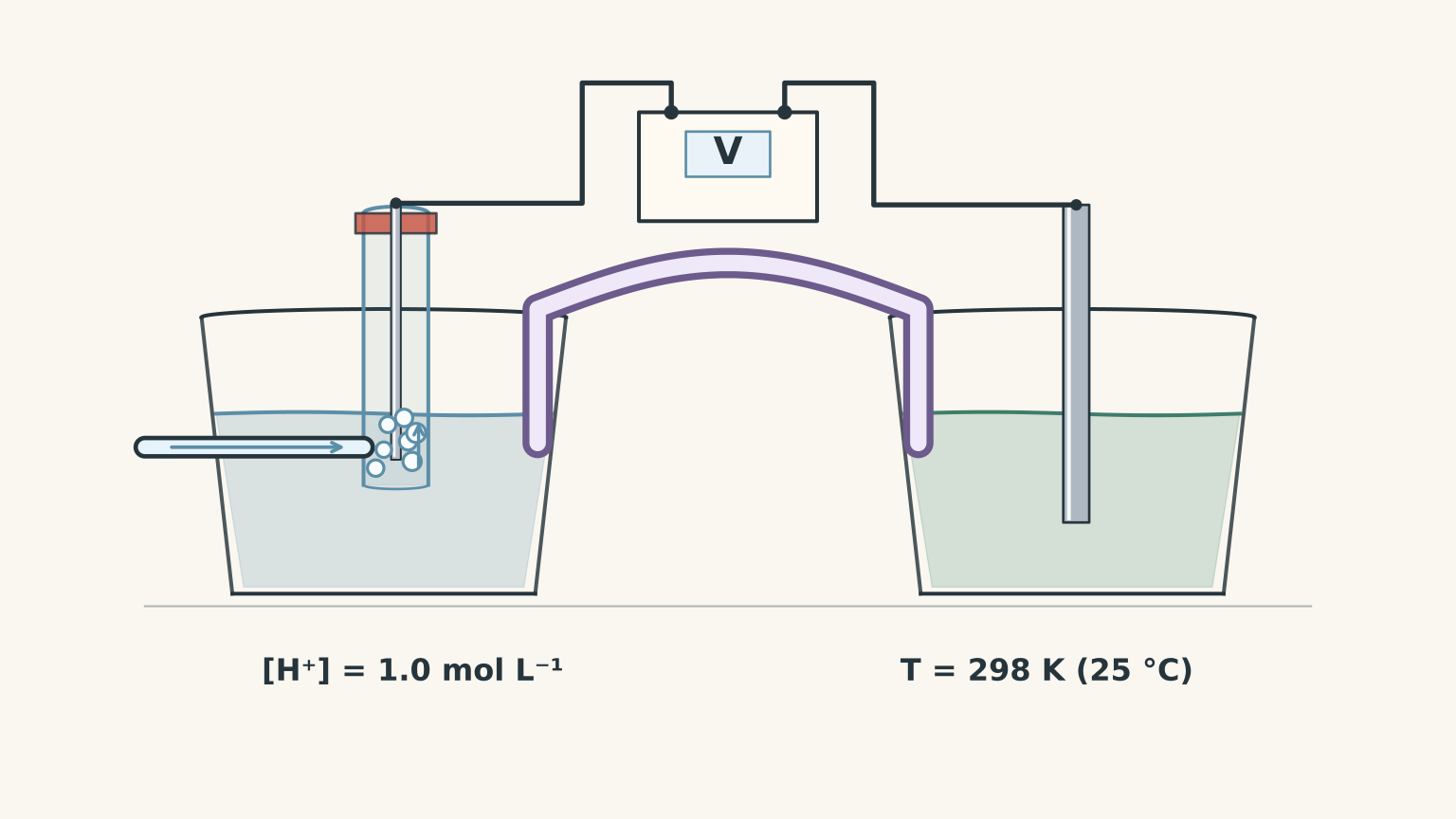
Due to technical limitations, this figure may display incorrectly or contain inaccuracies. Please check key details against your course materials.
For the usual HSC standard conditions, the reference electrode uses:
| Condition | Standard value |
|---|---|
| Hydrogen ion concentration | \(1.0\ \text{mol L}^{-1}\) |
| Hydrogen gas pressure | \(100\ \text{kPa}\) |
| Temperature | \(298\ \text{K}\) or \(25^\circ\text{C}\) |
| Electrode | Platinum |
The SHE is assigned \(E^\circ=0.00\ \text{V}\) by convention. This is a reference choice, not a claim that the electrode has no electrical properties.
The IUPAC Gold Book definition of the standard hydrogen electrode provides the formal reference convention. The experimental arrangement is also described in OpenStax Chemistry 2e.
What does the experiment actually show?
Consider connecting a standard zinc half-cell to the standard hydrogen electrode.
The zinc half-cell has:
\[ \ce{Zn^2+ + 2e- -> Zn} \qquad E^\circ=-0.76\ \text{V} \]
The hydrogen half-cell has:
\[ \ce{2H+ + 2e- -> H2} \qquad E^\circ=0.00\ \text{V} \]
Predict which electrode will be positive.
The hydrogen electrode has the more positive reduction potential, so it acts as the cathode. Zinc acts as the anode.
The reactions are:
Anode – oxidation:
\[ \ce{Zn -> Zn^2+ + 2e-} \]
Cathode – reduction:
\[ \ce{2H+ + 2e- -> H2} \]
Electrons travel through the external wire from zinc to platinum.
The salt bridge also plays an important role. As zinc atoms become \(\mathrm{Zn}^{2+}\) ions, positive charge accumulates in the zinc solution. Anions from the salt bridge migrate towards this anode compartment.
At the hydrogen electrode, hydrogen ions are consumed. Cations from the salt bridge migrate towards the cathode compartment to maintain electrical neutrality.
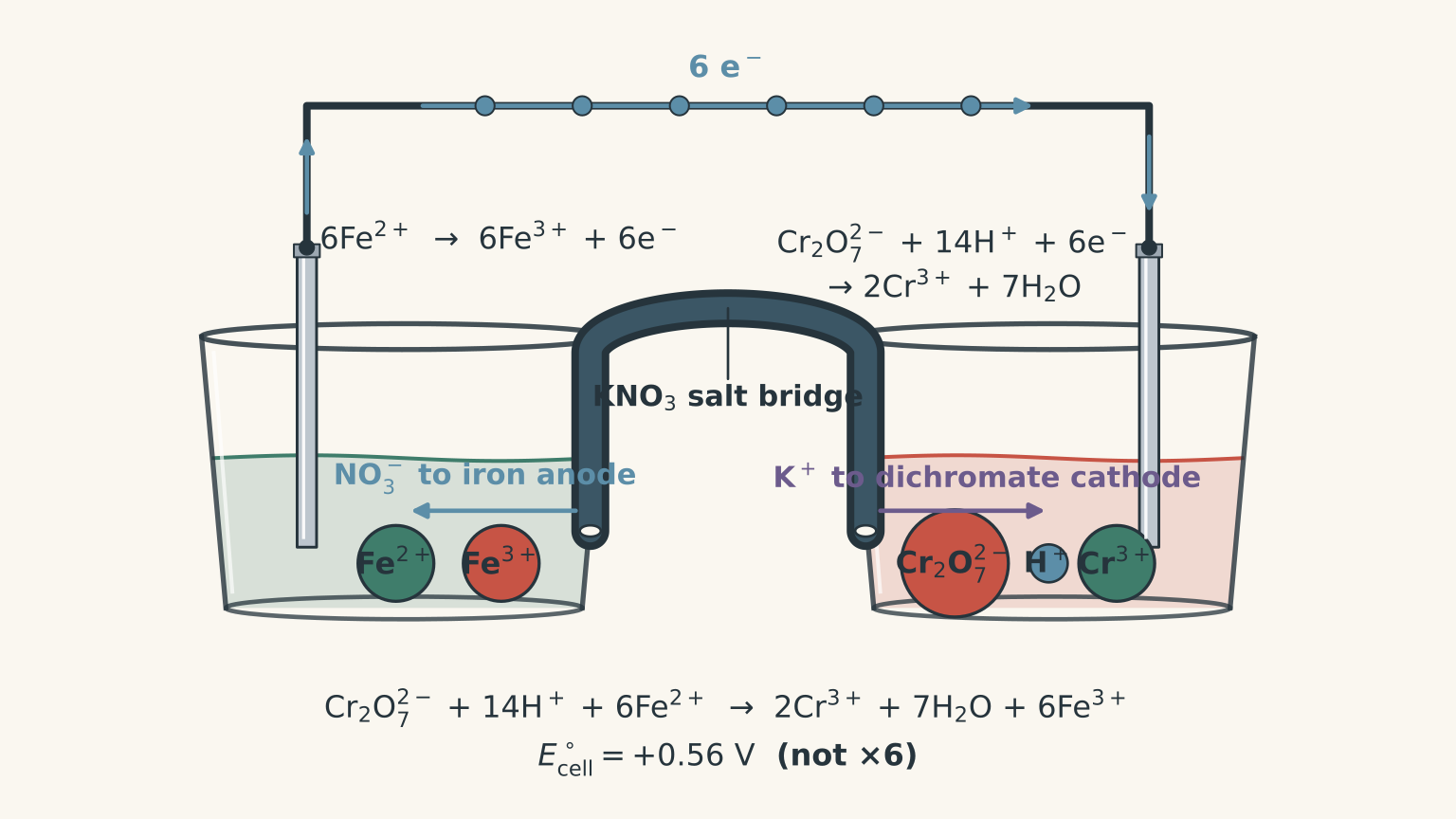
If the salt bridge contains \(\ce{KNO3}\), the expected movements are:
- \(\ce{NO3-}\) towards the zinc anode.
- \(\mathrm{K}^{+}\) towards the hydrogen cathode.
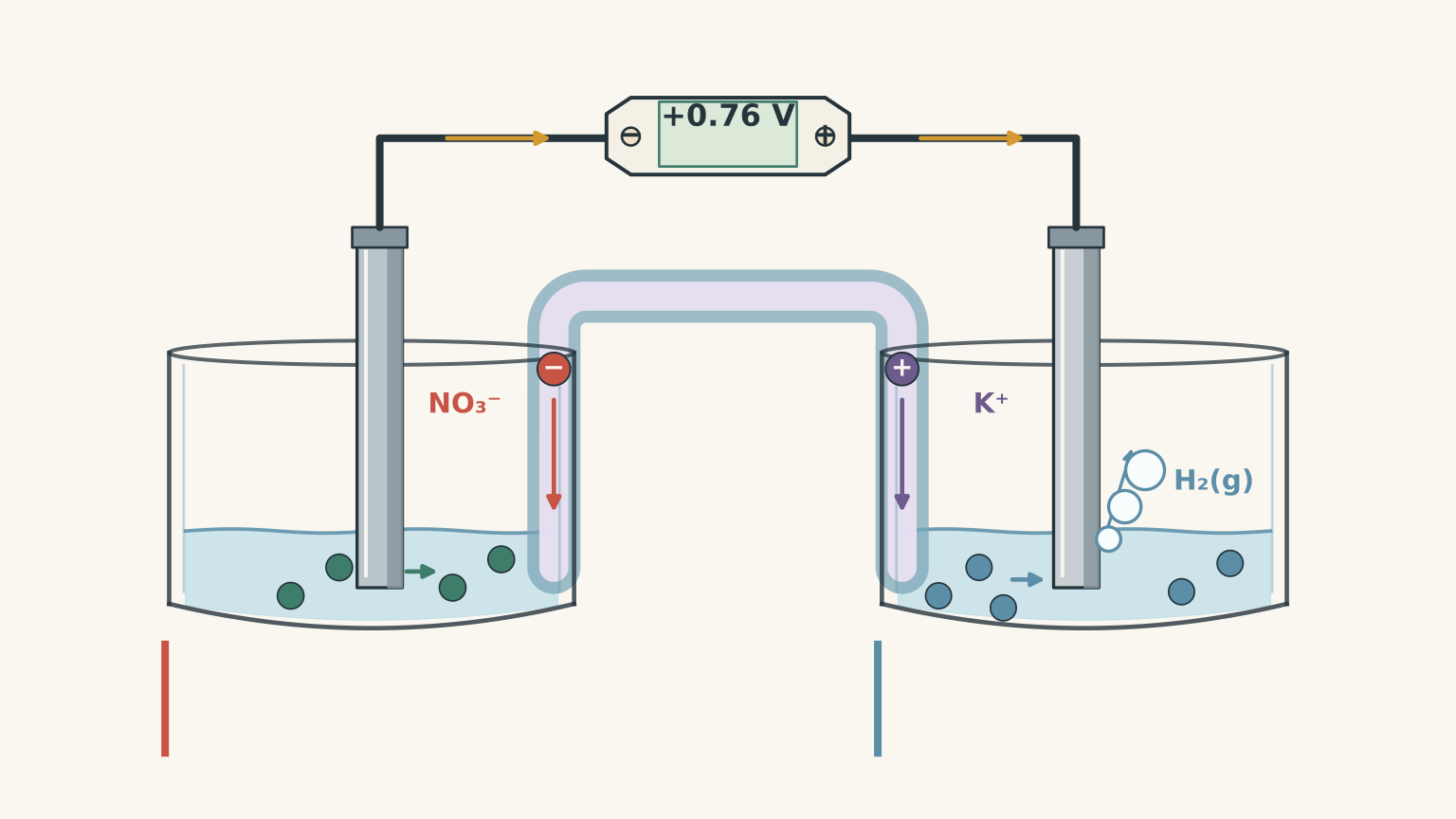
Due to technical limitations, this figure may display incorrectly or contain inaccuracies. Please check key details against your course materials.
The standard cell potential is:
\[ \begin{aligned} E^\circ_{\text{cell}} &=E^\circ_{\text{cathode}}-E^\circ_{\text{anode}}\\ &=0.00-(-0.76)\\ &=+0.76\ \text{V} \end{aligned} \]
The experiment measures a potential difference of \(0.76\ \text{V}\).
Since the hydrogen electrode has been assigned zero, the zinc standard reduction potential is \(-0.76\ \text{V}\).
This is how the reference electrode allows chemists to construct a consistent scale of standard reduction potentials.
If you want to revise how the measured differences are used to compare half-cells, see Reduction Potentials of Galvanic Half-Cells: HSC Chemistry.
03Why multiplying a half-equation does not multiply its potential
Now return to the original problem.
The important relationship is:
\[ \boxed{\Delta G^\circ=-nFE^\circ_{\text{cell}}} \]
Where:
- \(\Delta G^\circ\) is the standard Gibbs free energy change, in \(\text{J mol}^{-1}\) of reaction.
- \(n\) is the number of moles of electrons transferred per mole of reaction as written.
- \(F\) is the Faraday constant, approximately \(96\,485\ \text{C mol}^{-1}\) of electrons.
- \(E^\circ_{\text{cell}}\) is the standard cell potential, in volts.
Notice that \(n\) appears in the equation, but the potential is a separate quantity.
If you multiply the overall reaction by two:
- \(n\) doubles.
- \(\Delta G^\circ\) doubles.
- \(E^\circ_{\text{cell}}\) remains unchanged.
The reason is that the amount of charge transferred and the total free energy change increase together.
For example, if a reaction transfers twice as much charge and releases twice as much energy, the energy transferred per coulomb remains constant.
Mathematically:
\[ E^\circ_{\text{cell}} =-\frac{\Delta G^\circ}{nF} \]
If both the numerator and denominator are multiplied by the same factor, their ratio stays the same.
Scaling and reversing are different operations
There is another important distinction.
Students sometimes confuse multiplying a half-equation with reversing it. These operations have different effects on electrode potential.
| Operation | Effect on standard potential |
|---|---|
| Multiply a half-equation by 2 | No change |
| Multiply a half-equation by 5 | No change |
| Reverse a half-equation | Change the sign |
| Reverse and multiply by 3 | Change the sign, but not the magnitude |
For example:
Reduction:
\[ \ce{Ag+ + e- -> Ag} \qquad E^\circ_{\text{red}}=+0.80\ \text{V} \]
Multiply by three:
\[ \ce{3Ag+ + 3e- -> 3Ag} \qquad E^\circ_{\text{red}}=+0.80\ \text{V} \]
Reverse the original reaction:
\[ \ce{Ag -> Ag+ + e-} \qquad E^\circ_{\text{ox}}=-0.80\ \text{V} \]
Reverse it and multiply by three:
\[ \ce{3Ag -> 3Ag+ + 3e-} \qquad E^\circ_{\text{ox}}=-0.80\ \text{V} \]
The coefficient changes the amount of reaction. Reversing the equation changes the direction of the reaction and therefore the sign of its potential.
The safest HSC calculation method
Standard reduction-potential tables list every half-equation as a reduction.
For a galvanic cell, use:
\[ \boxed{ E^\circ_{\text{cell}} = E^\circ_{\text{red,cathode}} - E^\circ_{\text{red,anode}} } \]
Follow this process:
- Identify the half-cell with the more positive reduction potential. This is the cathode.
- Identify the anode. Its listed reduction half-equation operates in reverse.
- Multiply the half-equations as necessary to balance the electrons.
- Do not multiply either standard reduction potential.
- Calculate the cell potential using the original tabulated reduction potentials.
This avoids unnecessary sign changes and prevents the common mistake of multiplying a voltage by a stoichiometric coefficient.
04Standard potentials versus actual measurements
There is one more distinction worth understanding.
A standard reduction potential is not necessarily the potential you would measure in every experiment.
The superscript degree symbol in \(E^\circ\) indicates that the value refers to standard-state conditions.
| Quantity | Meaning |
|---|---|
| \(E^\circ\) | Standard electrode potential under standard-state conditions |
| \(E\) | Electrode potential under the actual conditions |
| \(E^\circ_{\text{cell}}\) | Standard cell potential |
| \(E_{\text{cell}}\) | Actual cell potential under the experimental conditions |
For example, the standard reduction potential for copper is approximately:
\[ \ce{Cu^2+ + 2e- -> Cu} \qquad E^\circ=+0.34\ \text{V} \]
This value applies to the standard state.
If you instead use a copper solution with a concentration of \(0.10\ \text{mol L}^{-1}\), its actual electrode potential will not necessarily be \(+0.34\ \text{V}\).
Changing the concentration changes the relative thermodynamic favourability of the oxidation and reduction processes. Temperature and gas pressure can also affect electrode potentials.
This gives us an important distinction:
Changing the coefficients on paper does not change the potential. Changing the actual experimental conditions can.
A high-resistance voltmeter is used to minimise current during a potential measurement. If a cell is connected to a substantial external load, its measured terminal voltage may also fall because of internal resistance and other practical effects.
You should therefore avoid treating a tabulated standard potential as an exact prediction of every real-world voltmeter reading.
05Worked examples
The numerical potentials below are illustrative, rounded standard reduction potentials. In an HSC examination, always use the values supplied in the question or on the relevant data sheet.
Worked example: Balancing a nickel-silver galvanic cell
A galvanic cell contains a standard nickel half-cell and a standard silver half-cell.
The standard reduction potentials are:
\[ \ce{Ni^2+ + 2e- -> Ni} \qquad E^\circ=-0.25\ \text{V} \]
\[ \ce{Ag+ + e- -> Ag} \qquad E^\circ=+0.80\ \text{V} \]
Determine the balanced overall reaction and calculate the standard cell potential. Explain whether balancing the electrons changes either standard reduction potential.
Step 1
Silver has the more positive reduction potential:
\[ +0.80>-0.25 \]
Therefore, silver is the cathode and undergoes reduction.
Nickel is the anode and undergoes oxidation.
Step 2
The silver reduction half-equation involves one electron:
\[ \ce{Ag+ + e- -> Ag} \]
The nickel oxidation half-equation involves two electrons:
\[ \ce{Ni -> Ni^2+ + 2e-} \]
Multiply the silver half-equation by two:
\[ \ce{2Ag+ + 2e- -> 2Ag} \]
Its standard reduction potential remains \(+0.80\ \text{V}\).
Step 3
\[ \ce{Ni + 2Ag+ -> Ni^2+ + 2Ag} \]
The electrons cancel, giving the balanced overall reaction.
Step 4
Use the original tabulated reduction potentials:
\[ \begin{aligned} E^\circ_{\text{cell}} &=E^\circ_{\text{cathode}}-E^\circ_{\text{anode}}\\ &=0.80-(-0.25)\\ &=\boxed{+1.05\ \text{V}} \end{aligned} \]
The positive cell potential indicates that the reaction is thermodynamically spontaneous under standard conditions.
Notice that we did not calculate \(2(0.80)\). The silver half-equation needed two electrons to balance the cell reaction, but its potential remained \(+0.80\ \text{V}\).
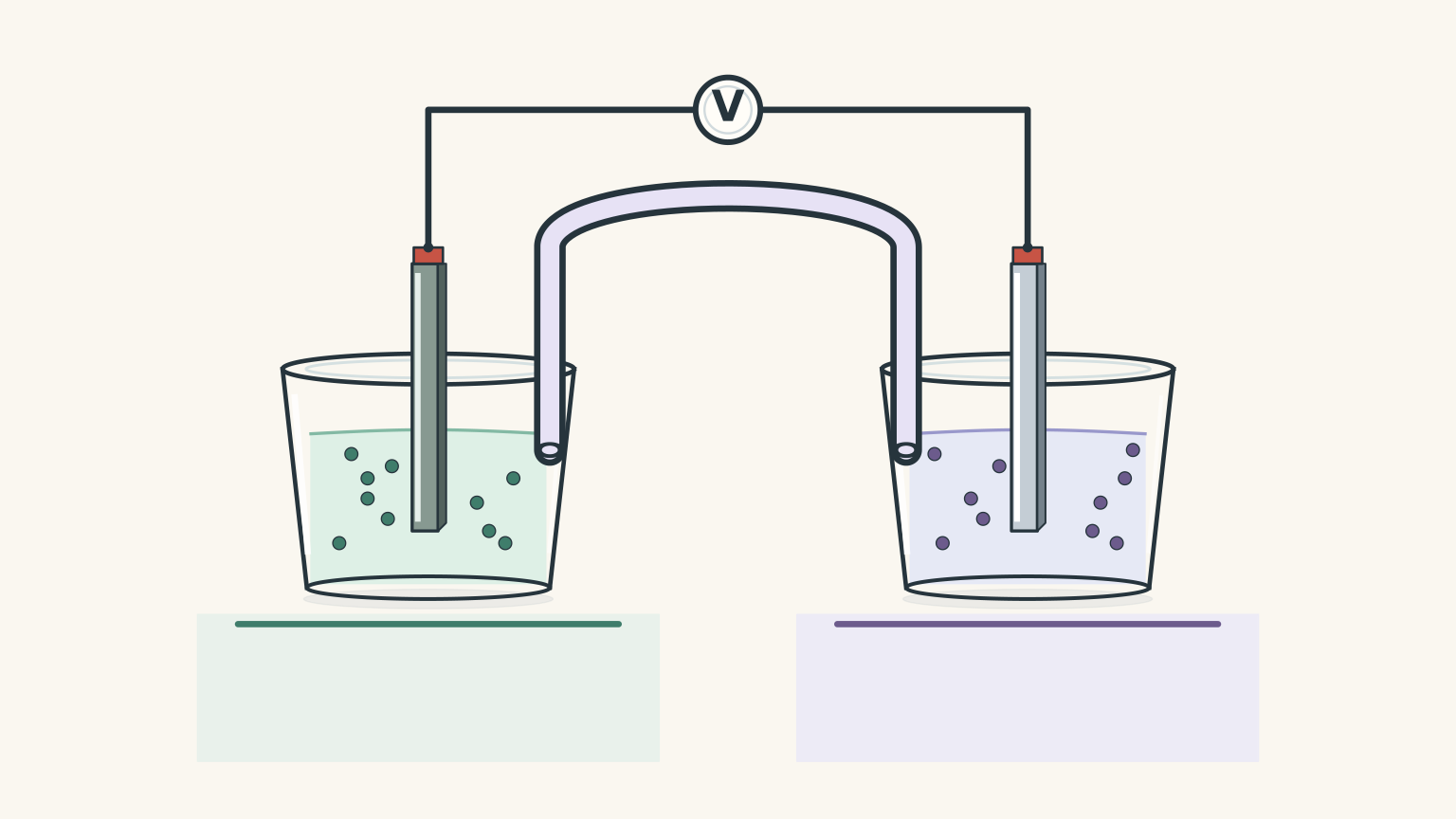
Due to technical limitations, this figure may display incorrectly or contain inaccuracies. Please check key details against your course materials.
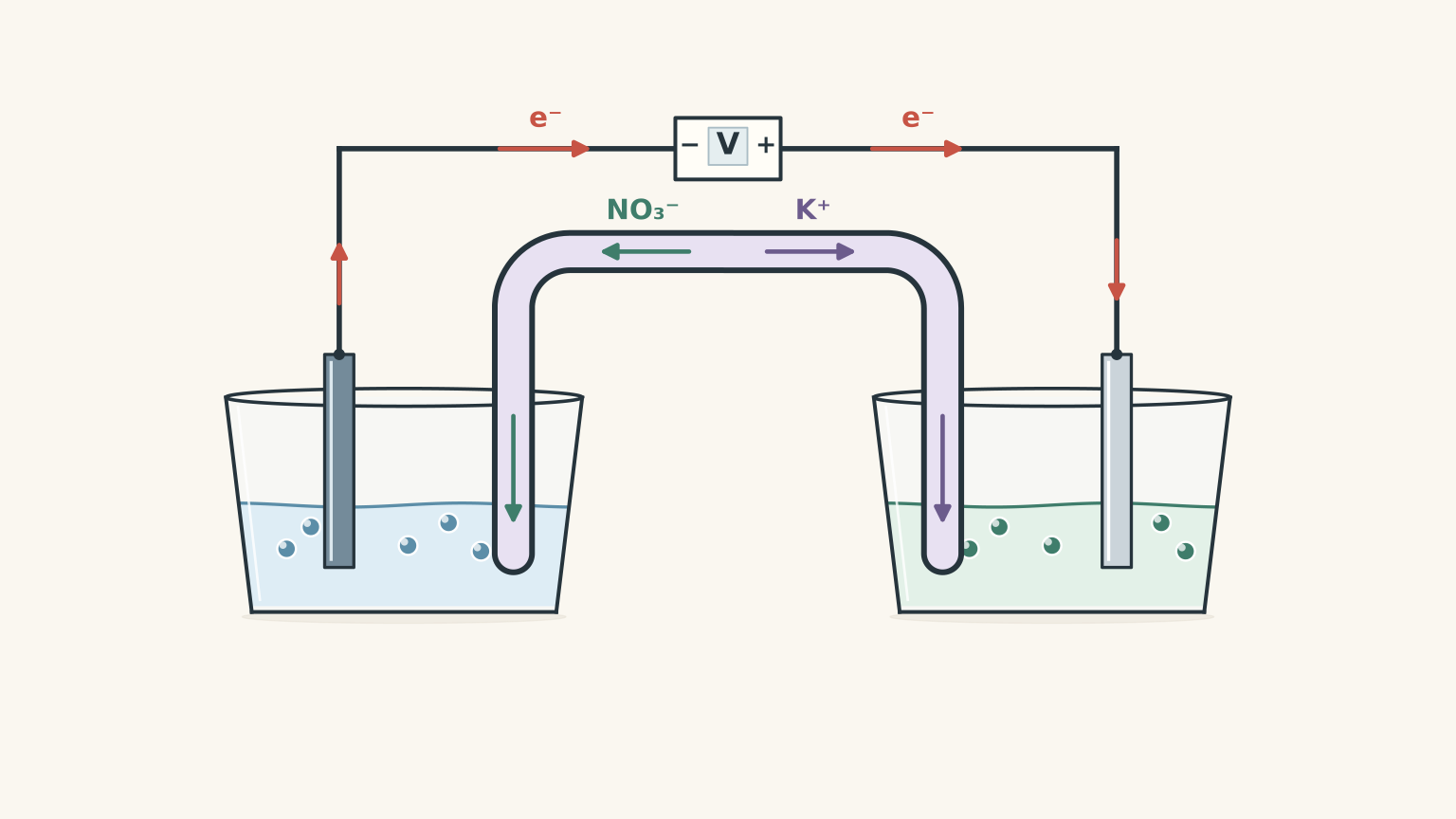
Due to technical limitations, this figure may display incorrectly or contain inaccuracies. Please check key details against your course materials.
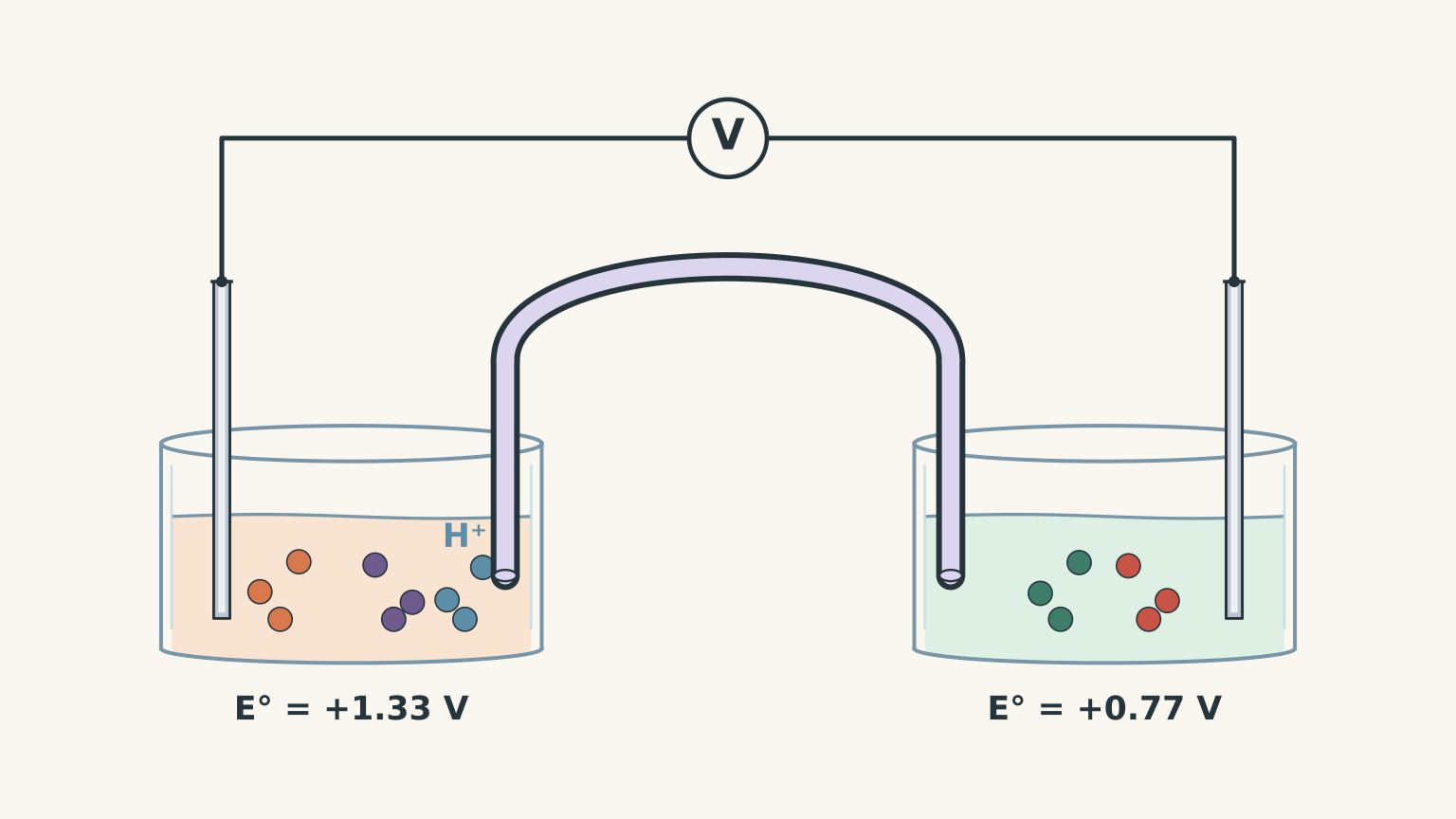
Worked example: A six-electron dichromate reaction
A galvanic cell contains two inert platinum electrodes.
One half-cell contains acidified dichromate ions and chromium(III) ions. The other contains iron(II) and iron(III) ions.
The standard reduction potentials are:
\[ \ce{Cr2O7^2- + 14H+ + 6e- -> 2Cr^3+ + 7H2O} \]
\[ E^\circ=+1.33\ \text{V} \]
\[ \ce{Fe^3+ + e- -> Fe^2+} \]
\[ E^\circ=+0.77\ \text{V} \]
Determine the balanced overall reaction, calculate the standard cell potential, and calculate the standard Gibbs free energy change. Then explain what happens to these quantities if the overall equation is multiplied by two.
Step 1
The dichromate half-cell has the more positive reduction potential:
\[ +1.33>+0.77 \]
Therefore, dichromate undergoes reduction at the cathode.
Iron(II) ions undergo oxidation at the anode.
Step 2
The original reduction half-equation is:
\[ \ce{Fe^3+ + e- -> Fe^2+} \]
Reverse it to represent oxidation:
\[ \ce{Fe^2+ -> Fe^3+ + e-} \]
Because the dichromate reaction requires six electrons, multiply the iron oxidation half-equation by six:
\[ \ce{6Fe^2+ -> 6Fe^3+ + 6e-} \]
The oxidation potential is \(-0.77\ \text{V}\). Multiplying the equation by six does not change this value.
Step 3
\[ \begin{aligned} &\ce{Cr2O7^2- + 14H+ + 6e-}\\ &\ce{-> 2Cr^3+ + 7H2O} \end{aligned} \]
Add the iron oxidation reaction:
\[ \ce{6Fe^2+ -> 6Fe^3+ + 6e-} \]
The balanced overall reaction is:
\[ \boxed{ \ce{Cr2O7^2- + 14H+ + 6Fe^2+} } \]
\[ \boxed{ \ce{-> 2Cr^3+ + 7H2O + 6Fe^3+} } \]
Step 4
\[ \begin{aligned} E^\circ_{\text{cell}} &=E^\circ_{\text{cathode}}-E^\circ_{\text{anode}}\\ &=1.33-0.77\\ &=\boxed{+0.56\ \text{V}} \end{aligned} \]
The standard cell potential is \(+0.56\ \text{V}\), not \(1.33-6(0.77)\).
Step 5
Use:
\[ \Delta G^\circ=-nFE^\circ_{\text{cell}} \]
There are six moles of electrons transferred per mole of the overall reaction as written.
\[ \begin{aligned} \Delta G^\circ &=-(6)(96\,485)(0.56)\\ &=-324\,190\ \text{J mol}^{-1}\\ &=\boxed{-324\ \text{kJ mol}^{-1}} \end{aligned} \]
The negative value indicates that the overall reaction is thermodynamically spontaneous under standard conditions.
Step 6
If the entire reaction is doubled:
- The number of electrons transferred increases from 6 to 12.
- The Gibbs free energy change doubles, becoming approximately \(-648\ \text{kJ mol}^{-1}\) per mole of the doubled reaction.
- The standard cell potential remains \(+0.56\ \text{V}\).
The total available energy has doubled, but the energy transferred per coulomb has not changed.
Due to technical limitations, this figure may display incorrectly or contain inaccuracies. Please check key details against your course materials.
Due to technical limitations, this figure may display incorrectly or contain inaccuracies. Please check key details against your course materials.
06Questions and solutions
The following questions move from standard balancing towards experimental interpretation and more demanding reasoning about what voltage actually represents.
Question 1
A galvanic cell is constructed using the following standard reduction half-equations:
\[ \ce{Au^3+ + 3e- -> Au} \qquad E^\circ=+1.50\ \text{V} \]
\[ \ce{Ag+ + e- -> Ag} \qquad E^\circ=+0.80\ \text{V} \]
Determine:
a) The cathode and anode.
b) The balanced overall reaction.
c) The standard cell potential.
d) Whether the silver standard reduction potential changes when its half-equation is multiplied by three.
Solution 1
The gold half-cell is the cathode, the silver half-cell is the anode, and the standard cell potential is \(+0.70\ \text{V}\). Multiplying the silver half-equation by three does not change its standard reduction potential.
Step 1: Identify the cathode.
Gold has the more positive reduction potential:
\[ +1.50>+0.80 \]
Therefore, gold ions undergo reduction:
\[ \ce{Au^3+ + 3e- -> Au} \]
Silver metal undergoes oxidation:
\[ \ce{Ag -> Ag+ + e-} \]
Step 2: Balance the electrons.
The gold reaction requires three electrons. Multiply the silver oxidation reaction by three:
\[ \ce{3Ag -> 3Ag+ + 3e-} \]
The potential associated with the silver oxidation reaction is \(-0.80\ \text{V}\), regardless of the coefficient.
Step 3: Write the overall reaction.
\[ \boxed{ \ce{Au^3+ + 3Ag -> Au + 3Ag+} } \]
Step 4: Calculate the standard cell potential.
\[ \begin{aligned} E^\circ_{\text{cell}} &=E^\circ_{\text{cathode}}-E^\circ_{\text{anode}}\\ &=1.50-0.80\\ &=\boxed{+0.70\ \text{V}} \end{aligned} \]
The reaction is thermodynamically spontaneous under standard conditions.
The tempting mistake is to calculate \(1.50-3(0.80)\). This incorrectly treats voltage as a total energy rather than energy transferred per unit of charge.
Question 2
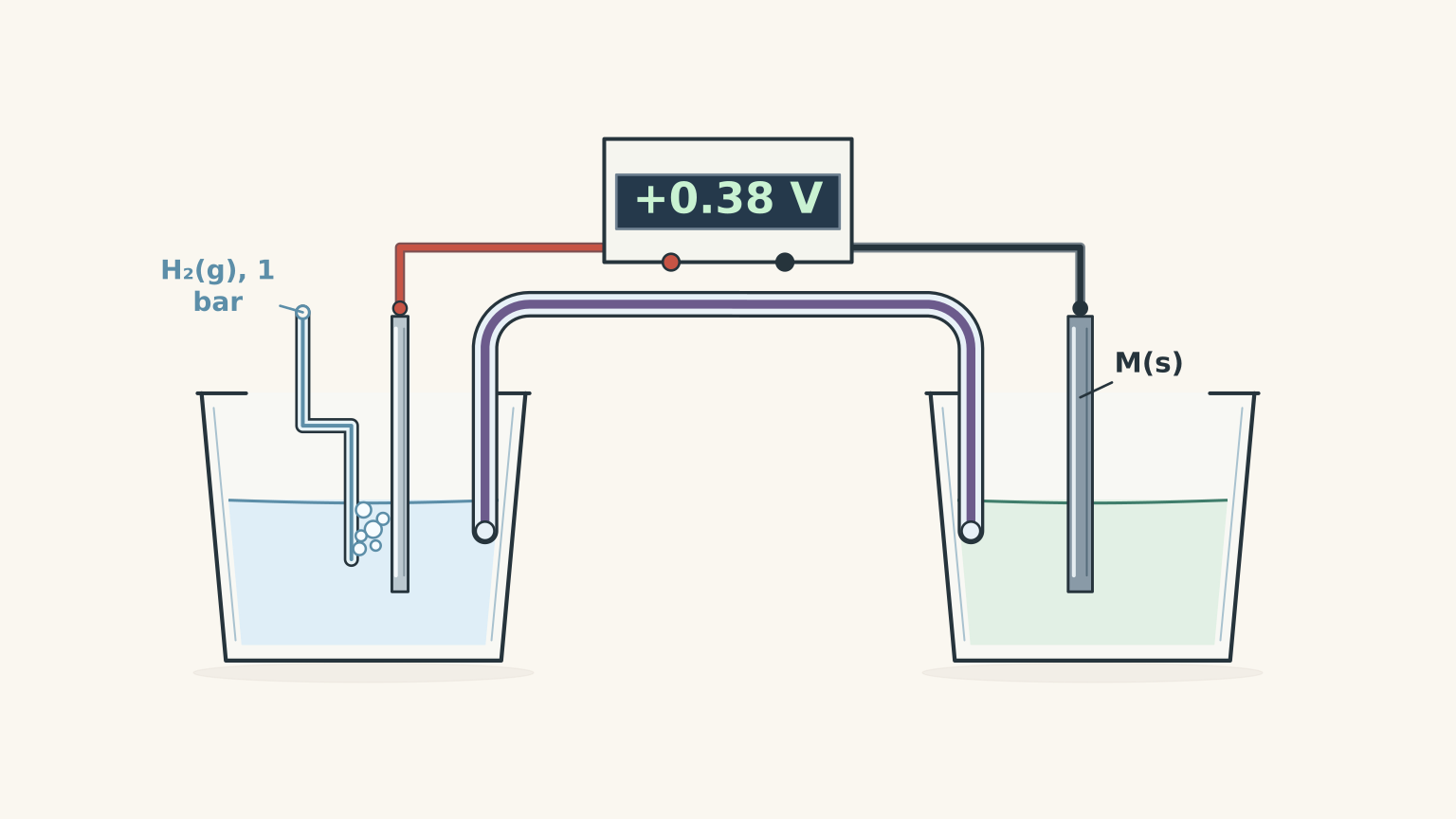
An unknown standard half-cell, \(\ce{M^2+/M}\), is connected to a standard hydrogen electrode.
The red (positive) voltmeter lead is connected to the platinum electrode in the standard hydrogen electrode. The black (negative) lead is connected to the metal electrode in the unknown half-cell.
The voltmeter reads:
\[ +0.38\ \text{V} \]
The salt bridge contains \(\ce{KNO3}\).
Determine:
a) The standard reduction potential of the unknown half-cell.
b) The anode and cathode.
c) The direction of electron flow.
d) The direction of ion movement through the salt bridge.
e) The oxidation potential if the oxidation half-equation is multiplied by three.
Due to technical limitations, this figure may display incorrectly or contain inaccuracies. Please check key details against your course materials.
Solution 2
The unknown metal half-cell has a standard reduction potential of \(-0.38\ \text{V}\). It is the anode, while the standard hydrogen electrode is the cathode. Electrons flow from M towards platinum.
Step 1: Interpret the voltmeter reading.
The positive reading means the red lead, connected to the hydrogen electrode, is at a higher potential than the unknown metal electrode.
Therefore, the hydrogen electrode is the cathode and M is the anode.
Step 2: Calculate the unknown standard reduction potential.
The standard hydrogen electrode has:
\[ E^\circ_{\text{SHE}}=0.00\ \text{V} \]
Using the cell potential equation:
\[ \begin{aligned} E^\circ_{\text{cell}} &=E^\circ_{\text{cathode}}-E^\circ_{\text{anode}}\\ 0.38&=0.00-E^\circ_{\ce{M^2+/M}} \end{aligned} \]
Therefore:
\[ \boxed{ E^\circ_{\ce{M^2+/M}}=-0.38\ \text{V} } \]
Step 3: Identify the electrode reactions and electron flow.
At the anode:
\[ \ce{M -> M^2+ + 2e-} \]
At the cathode:
\[ \ce{2H+ + 2e- -> H2} \]
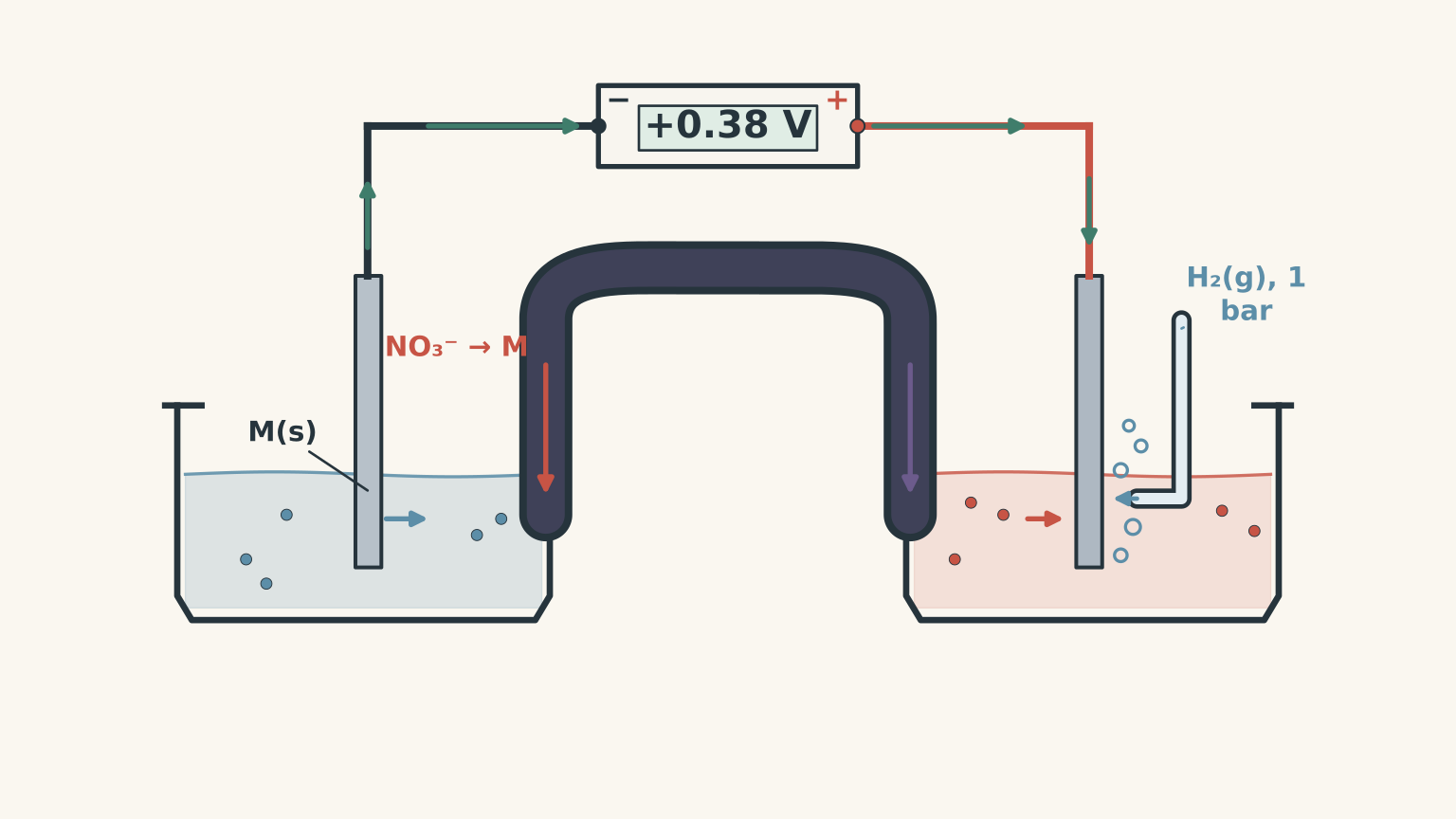
Electrons travel through the external wire from the M electrode towards the platinum electrode.
Due to technical limitations, this figure may display incorrectly or contain inaccuracies. Please check key details against your course materials.
Step 4: Determine salt bridge ion movement.
At the M anode, oxidation produces \(\mathrm{M}^{2+}\) ions. The solution becomes more positively charged, so \(\ce{NO3-}\) ions migrate towards this compartment.
At the hydrogen cathode, \(\mathrm{H}^{+}\) ions are consumed. Therefore, \(\mathrm{K}^{+}\) ions migrate towards this compartment to maintain electrical neutrality.
Step 5: Multiply the oxidation half-equation by three.
The original oxidation reaction is:
\[ \ce{M -> M^2+ + 2e-} \]
Multiplying by three gives:
\[ \ce{3M -> 3M^2+ + 6e-} \]
The oxidation potential remains:
\[ \boxed{E^\circ_{\text{ox}}=+0.38\ \text{V}} \]
It does not become \(+1.14\ \text{V}\).
The experiment establishes a potential difference relative to the reference electrode. Changing the coefficient in the chemical equation cannot change that reference measurement.
Question 3
A galvanic cell has the following standard reduction potentials:
\[ \ce{Br2(l) + 2e- -> 2Br-(aq)} \qquad E^\circ=+1.07\ \text{V} \]
\[ \ce{Fe^3+(aq) + e- -> Fe^2+(aq)} \qquad E^\circ=+0.77\ \text{V} \]
Determine:
a) The balanced overall reaction.
b) The standard cell potential.
c) The standard Gibbs free energy change for the reaction as written.
d) The new standard Gibbs free energy change if the overall reaction is multiplied by four.
e) Whether the standard cell potential changes.
Use \(F=96\,485\ \text{C mol}^{-1}\) of electrons.
Solution 3
The balanced reaction has a standard cell potential of \(+0.30\ \text{V}\) and a standard Gibbs free energy change of approximately \(-57.9\ \text{kJ mol}^{-1}\). Multiplying the overall reaction by four makes the Gibbs free energy change four times as large, but the cell potential remains \(+0.30\ \text{V}\).
Step 1: Identify the cathode and anode.
The bromine half-cell has the more positive reduction potential:
\[ +1.07>+0.77 \]
Therefore, bromine is reduced at the cathode.
Iron(II) is oxidised at the anode.
Step 2: Balance the electrons.
The bromine reduction half-equation uses two electrons:
\[ \ce{Br2 + 2e- -> 2Br-} \]
Reverse the iron reduction half-equation:
\[ \ce{Fe^2+ -> Fe^3+ + e-} \]
Multiply the iron oxidation reaction by two:
\[ \ce{2Fe^2+ -> 2Fe^3+ + 2e-} \]
Step 3: Write the overall reaction.
\[ \boxed{ \ce{Br2 + 2Fe^2+ -> 2Br- + 2Fe^3+} } \]
Two moles of electrons are transferred per mole of reaction as written.
Step 4: Calculate the standard cell potential.
\[ \begin{aligned} E^\circ_{\text{cell}} &=E^\circ_{\text{cathode}}-E^\circ_{\text{anode}}\\ &=1.07-0.77\\ &=\boxed{+0.30\ \text{V}} \end{aligned} \]
Step 5: Calculate the standard Gibbs free energy change.
\[ \begin{aligned} \Delta G^\circ &=-nFE^\circ_{\text{cell}}\\ &=-(2)(96\,485)(0.30)\\ &=-57\,891\ \text{J mol}^{-1}\\ &=\boxed{-57.9\ \text{kJ mol}^{-1}} \end{aligned} \]
Step 6: Multiply the overall reaction by four.
The new equation is:
\[ \ce{4Br2 + 8Fe^2+ -> 8Br- + 8Fe^3+} \]
The electron transfer increases from two to eight moles of electrons per mole of the multiplied reaction.
Therefore:
\[ \begin{aligned} \Delta G^\circ &=-(8)(96\,485)(0.30)\\ &=\boxed{-231.6\ \text{kJ mol}^{-1}} \end{aligned} \]
However:
\[ \boxed{E^\circ_{\text{cell}}=+0.30\ \text{V}} \]
The energy change and charge transferred have both increased by a factor of four. Their ratio, which determines the voltage, has not changed.
Question 4
A student constructs a galvanic cell using a standard copper half-cell and an iron(III)/iron(II) half-cell.
The standard reduction potentials are:
\[ \ce{Fe^3+ + e- -> Fe^2+} \qquad E^\circ=+0.77\ \text{V} \]
\[ \ce{Cu^2+ + 2e- -> Cu} \qquad E^\circ=+0.34\ \text{V} \]
However, the iron solution is not under standard conditions.
The experimental conditions are:
- \([\mathrm{Fe}^{3+}]=0.10\ \text{mol L}^{-1}\)
- \([\mathrm{Fe}^{2+}]=1.0\ \text{mol L}^{-1}\)
- \([\mathrm{Cu}^{2+}]=1.0\ \text{mol L}^{-1}\)
- Temperature is \(25^\circ\text{C}\).
The red voltmeter lead is connected to the iron electrode. The measured cell potential is \(+0.37\ \text{V}\).
Determine:
a) The cathode and anode.
b) The balanced overall reaction.
c) The actual reduction potential of the iron half-cell.
d) Why the measured cell potential differs from the standard cell potential.
e) Why multiplying the iron half-equation by two does not double its standard reduction potential.
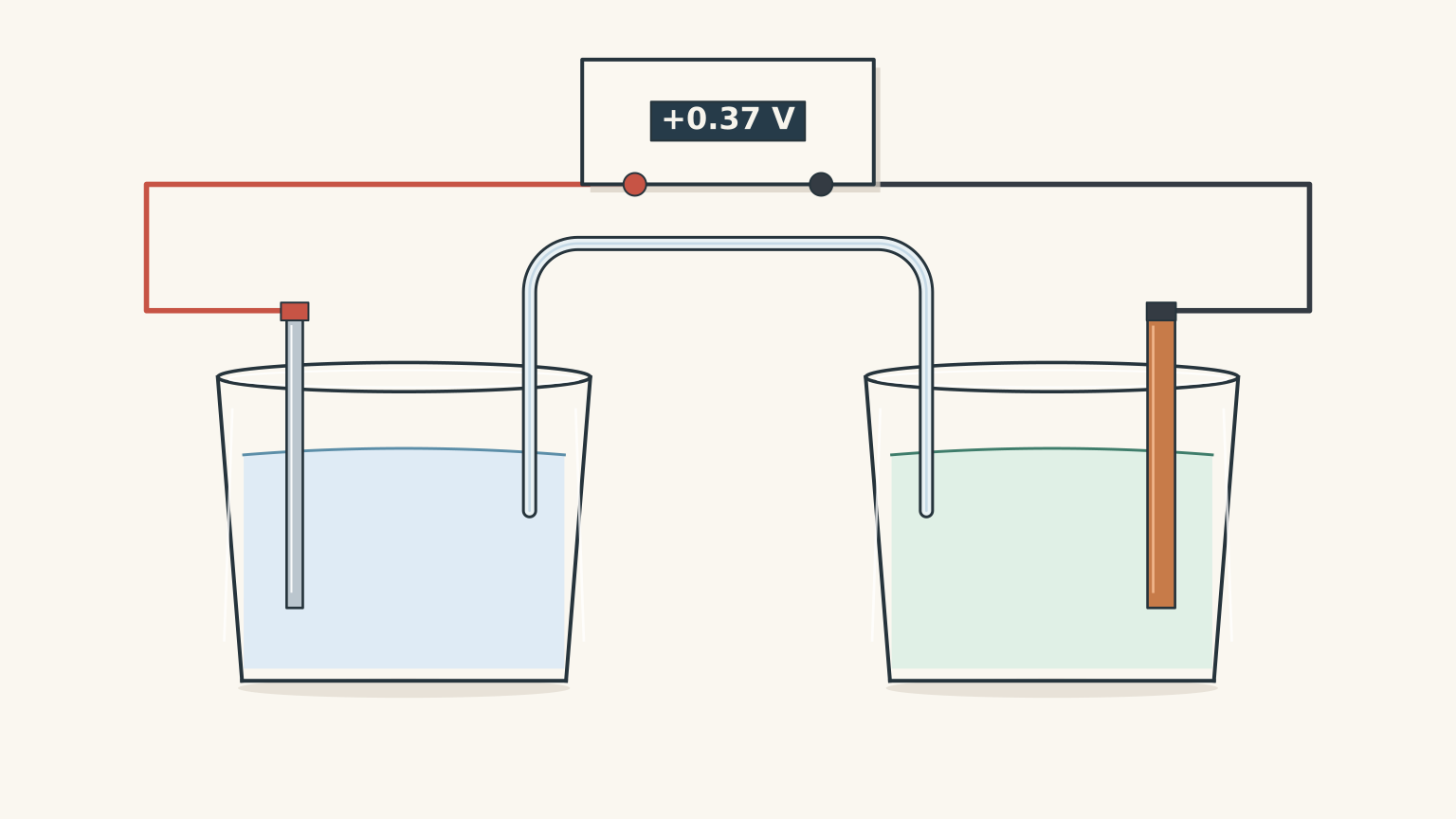
Due to technical limitations, this figure may display incorrectly or contain inaccuracies. Please check key details against your course materials.
Solution 4
The iron half-cell is the cathode, the copper half-cell is the anode, and the actual iron reduction potential is \(+0.71\ \text{V}\). The difference between the standard and measured cell potentials is caused by the non-standard iron-ion concentrations, not by balancing the half-equation.
Step 1: Identify the cathode.
The standard iron reduction potential is more positive:
\[ +0.77>+0.34 \]
The iron half-cell is therefore the cathode.
Copper undergoes oxidation at the anode.
Step 2: Write the balanced overall reaction.
Iron reduction:
\[ \ce{Fe^3+ + e- -> Fe^2+} \]
Multiply by two:
\[ \ce{2Fe^3+ + 2e- -> 2Fe^2+} \]
Copper oxidation:
\[ \ce{Cu -> Cu^2+ + 2e-} \]
The balanced overall reaction is:
\[ \boxed{ \ce{2Fe^3+ + Cu -> 2Fe^2+ + Cu^2+} } \]
Step 3: Calculate the standard cell potential.
\[ \begin{aligned} E^\circ_{\text{cell}} &=0.77-0.34\\ &=\boxed{+0.43\ \text{V}} \end{aligned} \]
This is the predicted potential under standard conditions.
Step 4: Calculate the actual iron reduction potential.
The copper half-cell remains under standard conditions, so its actual potential is \(+0.34\ \text{V}\).
The iron electrode is connected to the positive voltmeter lead, so:
\[ E_{\text{cell}} = E_{\text{Fe,actual}}-E_{\text{Cu,actual}} \]
Substitute the measured values:
\[ \begin{aligned} 0.37&=E_{\text{Fe,actual}}-0.34\\ E_{\text{Fe,actual}}&=0.37+0.34\\ &=\boxed{+0.71\ \text{V}} \end{aligned} \]
The actual iron reduction potential is \(+0.71\ \text{V}\), rather than its standard value of \(+0.77\ \text{V}\).
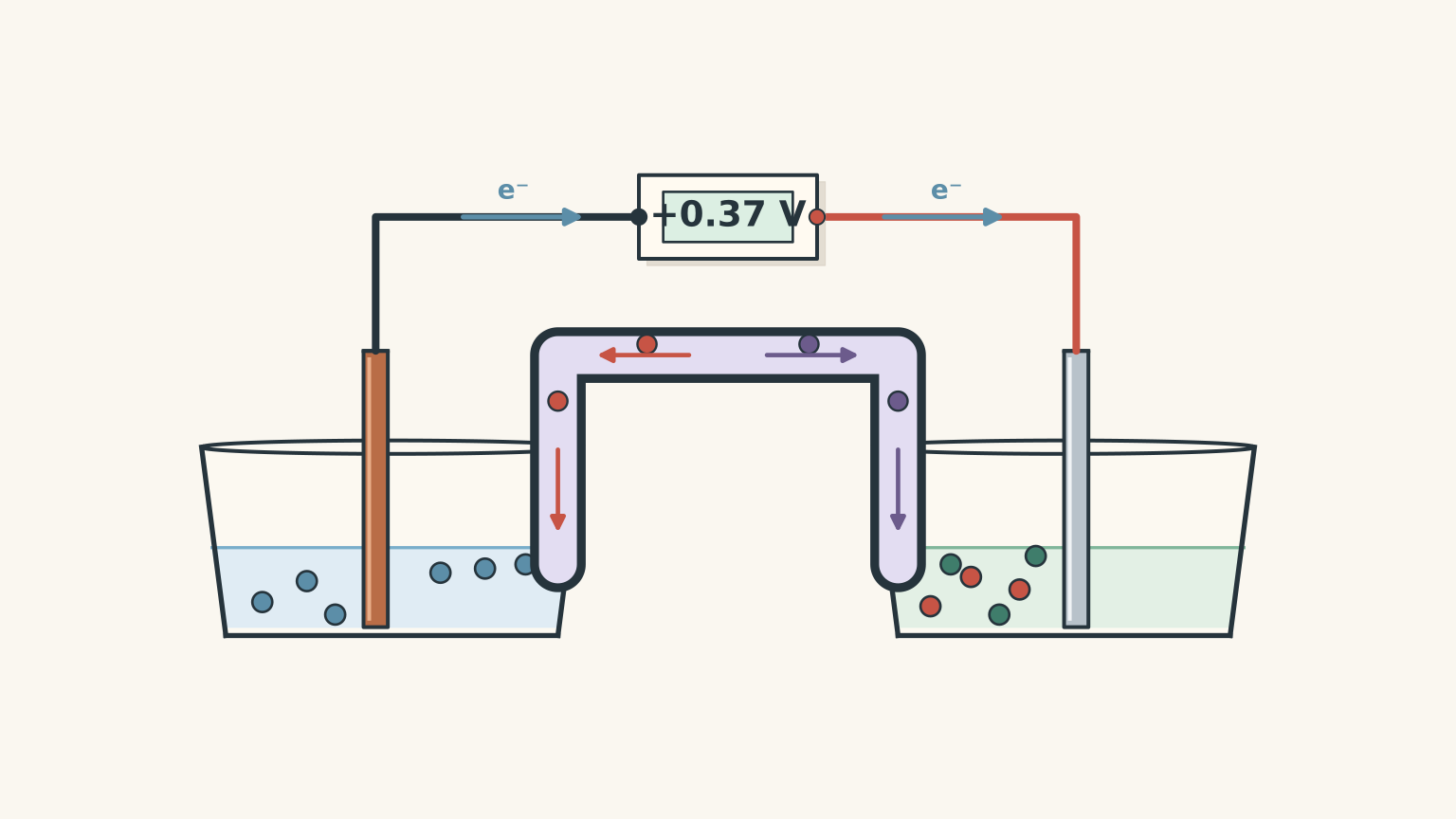
Due to technical limitations, this figure may display incorrectly or contain inaccuracies. Please check key details against your course materials.
Step 5: Explain the difference.
The iron solution contains a lower concentration of \(\mathrm{Fe}^{3+}\) than \(\mathrm{Fe}^{2+}\).
This makes the forward reduction:
\[ \ce{Fe^3+ + e- -> Fe^2+} \]
less thermodynamically favourable than it would be under standard conditions.
Consequently, the actual iron reduction potential is lower than its standard value.
The measured cell potential of \(+0.37\ \text{V}\) is therefore reasonable.
Step 6: Explain why the coefficient does not change the standard potential.
The iron reduction half-equation must be multiplied by two to balance the electrons:
\[ \ce{2Fe^3+ + 2e- -> 2Fe^2+} \]
However, its standard reduction potential remains:
\[ \boxed{E^\circ_{\ce{Fe^3+/Fe^2+}}=+0.77\ \text{V}} \]
The actual potential is lower because the solution concentrations are different from standard conditions, not because the half-equation has been multiplied.
This is an important distinction: changing the reaction coefficients on paper is not the same as changing the chemical conditions in the beaker.
Question 5
A standard zinc-copper galvanic cell has the overall reaction:
\[ \ce{Zn(s) + Cu^2+(aq) -> Zn^2+(aq) + Cu(s)} \]
Its standard cell potential is:
\[ E^\circ_{\text{cell}}=+1.10\ \text{V} \]
Two moles of electrons are transferred per mole of reaction as written.
Consider two arrangements.
Arrangement A: One galvanic cell contains enough reactants to undergo five moles of reaction as written.
Arrangement B: Five identical galvanic cells are connected in series, with all five cells oriented to reinforce one another. Each cell undergoes one mole of reaction as written.
Assume standard conditions throughout, negligible internal resistance, and ideal reversible operation.
Determine:
a) The standard potential of Arrangement A.
b) The standard potential of Arrangement B.
c) The total external charge delivered by each arrangement.
d) The maximum total electrical energy available from each arrangement.
e) Whether multiplying the reaction equation by five is equivalent to connecting five physical cells in series.
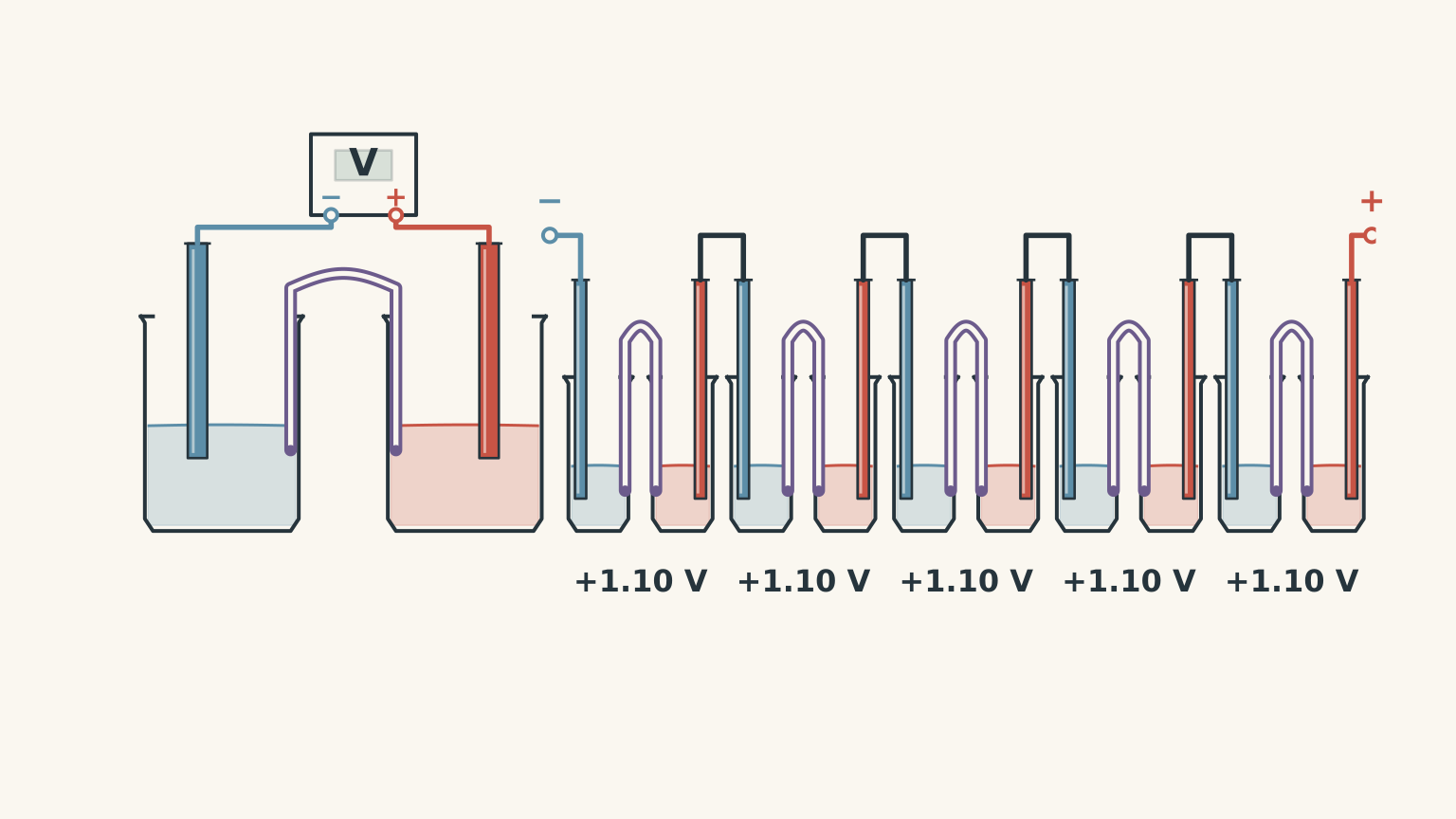
Due to technical limitations, this figure may display incorrectly or contain inaccuracies. Please check key details against your course materials.
Solution 5
Arrangement A has a standard cell potential of \(+1.10\ \text{V}\), while Arrangement B has a total standard potential of \(+5.50\ \text{V}\). Both arrangements can release the same total chemical free energy, but they deliver that energy through different combinations of voltage and charge.
This is the important distinction: multiplying a reaction equation changes the amount of reaction represented. Connecting physical cells in series adds their individual potential differences.
Step 1: Calculate the potential of Arrangement A.
Arrangement A contains one physical galvanic cell.
Its standard cell potential remains:
\[ \boxed{E^\circ_A=+1.10\ \text{V}} \]
Writing its reaction five times does not create five potential differences.
Step 2: Calculate the potential of Arrangement B.
The five cells are physically connected in series, with each cell oriented in the same direction.
Their potential differences add:
\[ \begin{aligned} E^\circ_B &=5(1.10)\\ &=\boxed{+5.50\ \text{V}} \end{aligned} \]
This is different from multiplying one cell’s reaction equation by five.
Here, five separate electrochemical cells are producing five separate potential differences.
Step 3: Calculate the charge delivered by Arrangement A.
For the original zinc-copper reaction:
\[ n=2 \]
One mole of reaction transfers two moles of electrons.
Five moles of reaction therefore transfer:
\[ 5\times2=10\ \text{mol e}^- \]
The total charge is:
\[ \begin{aligned} Q_A&=10F\\ &=10(96\,485)\\ &=\boxed{964\,850\ \text{C}} \end{aligned} \]
The single cell delivers a larger amount of charge because it undergoes five reaction units.
Step 4: Calculate the charge delivered by Arrangement B.
Each of the five cells undergoes one mole of reaction.
Each cell transfers two moles of electrons internally.
Because the cells are connected in series, the same charge passes through every cell and through the external circuit.
Therefore, the charge delivered by the entire arrangement is:
\[ \begin{aligned} Q_B&=2F\\ &=2(96\,485)\\ &=\boxed{192\,970\ \text{C}} \end{aligned} \]
Notice the difference:
- Arrangement A delivers \(10F\) of charge at \(1.10\ \text{V}\).
- Arrangement B delivers \(2F\) of charge at \(5.50\ \text{V}\).
The five individual cells in Arrangement B each undergo their own chemical reaction. The charge through their series connection is not the sum of the electron transfers inside all five cells.
Step 5: Compare the maximum electrical energy available.
For Arrangement A:
\[ W_A=Q_AE_A \]
\[ \begin{aligned} W_A &=964\,850\times1.10\\ &=1\,061\,335\ \text{J}\\ &\approx\boxed{1.06\ \text{MJ}} \end{aligned} \]
For Arrangement B:
\[ W_B=Q_BE_B \]
\[ \begin{aligned} W_B &=192\,970\times5.50\\ &=1\,061\,335\ \text{J}\\ &\approx\boxed{1.06\ \text{MJ}} \end{aligned} \]
The total available energy is the same because both arrangements undergo the same total amount of chemical reaction across their respective cells.
The difference is how that energy is delivered.
One cell provides a lower voltage and a larger amount of charge. Five cells in series provide a higher voltage and a smaller amount of charge.
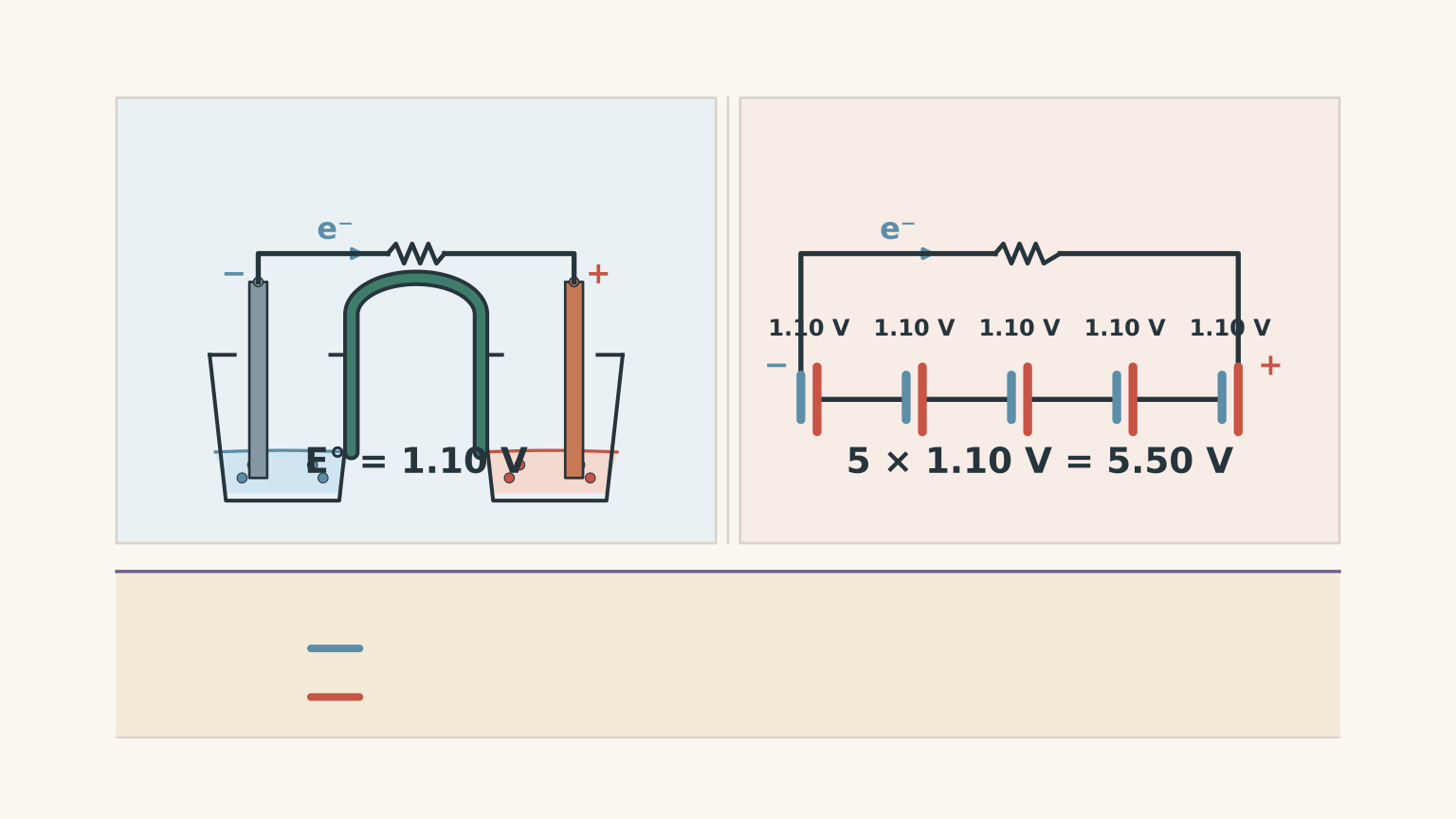
Due to technical limitations, this figure may display incorrectly or contain inaccuracies. Please check key details against your course materials.
The tempting conclusion is that five times the chemical equation must mean five times the voltage. The error is treating a stoichiometric multiplier as though it physically creates additional cells.
It does not.
A larger reaction extent in one cell increases the total charge and energy. Actual cells connected in series increase the total potential difference.
07The rule to remember
When you are working with standard reduction potentials, keep these three operations separate:
| What you change | What happens to the potential? |
|---|---|
| Multiply a half-equation to balance electrons | No change |
| Reverse a half-equation | The sign changes |
| Change actual concentrations, gas pressures or temperature | The actual electrode potential can change |
| Connect physical cells in series | Their cell potentials add |
The most useful equation to remember is:
\[ \boxed{\Delta G^\circ=-nFE^\circ_{\text{cell}}} \]
The electron coefficient affects the total free energy change because it determines how much charge is transferred. It does not multiply the voltage.
Once you understand this distinction, the next useful step is applying reduction potentials to predict spontaneous reactions and calculate cell potentials. See How to Calculate Cell Potential from Reduction Potentials.