
Converse and Contrapositive: HSC Mathematics Extension 2
Understand why a statement is equivalent to its contrapositive, but not necessarily its converse. Learn the logic behind the distinction, practise proof by contrapositive, and tackle challenging HSC-style questions.
Take a quadrilateral. If it is a square, its diagonals have equal lengths. Now reverse that statement: if a quadrilateral has equal diagonals, must it be a square?
Make a prediction before reading on.
No. A non-square rectangle also has equal diagonals. The original statement is true, but its converse is false.
Now consider a third statement: if a quadrilateral has unequal diagonals, it cannot be a square. This statement is also true. In fact, it must have exactly the same truth value as the original statement.
This third version is called the contrapositive. Understanding why it works, and why the converse behaves differently, is an important part of mathematical proof.
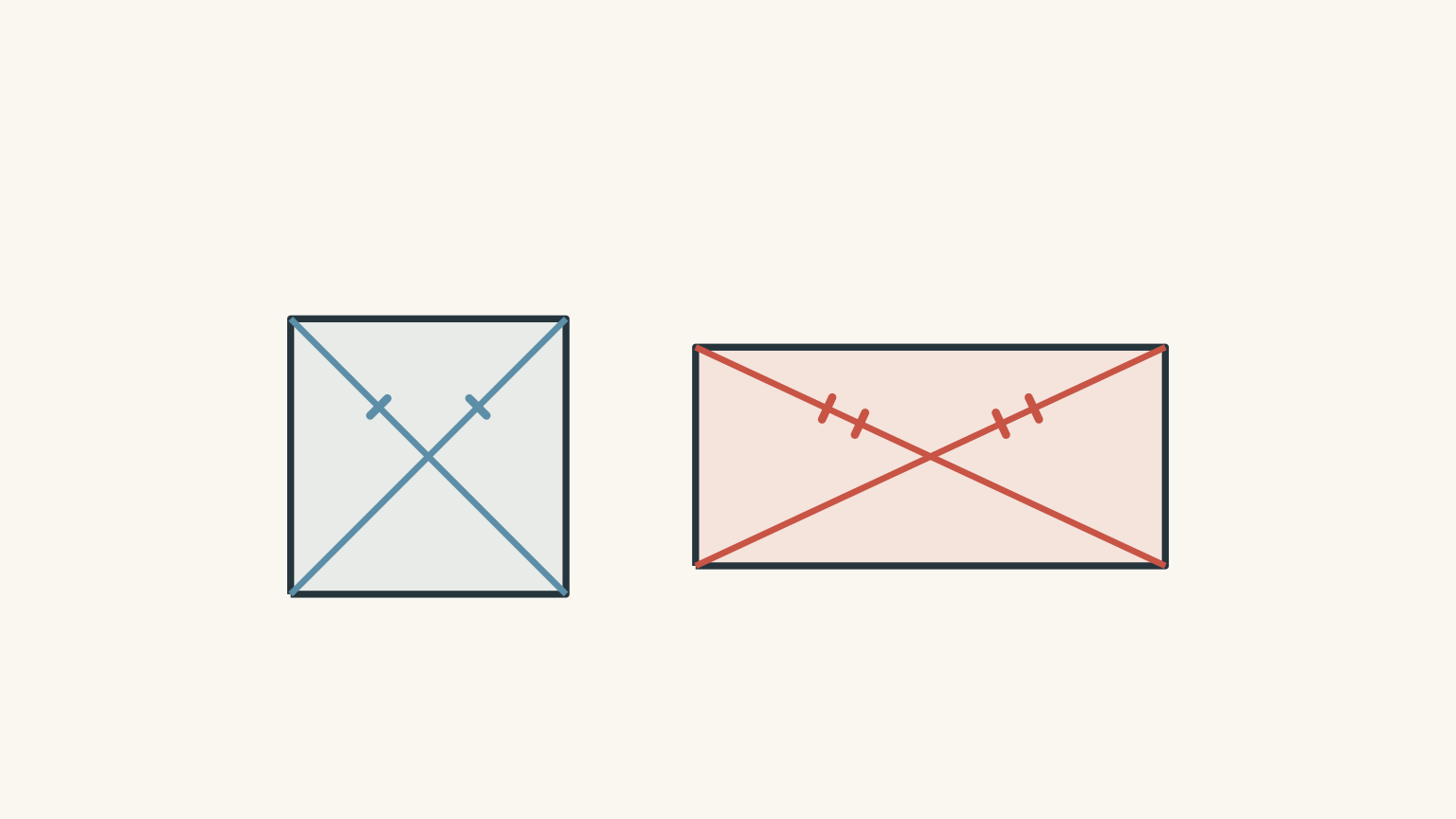
Due to technical limitations, this figure may display incorrectly or contain inaccuracies. Please check key details against your course materials.
01Understanding an implication
Start by giving the original statement a mathematical structure.
Let:
- \(P\): The quadrilateral is a square.
- \(Q\): The quadrilateral has equal diagonals.
The original statement is:
\[ P\Rightarrow Q \]
Read this as “if \(P\), then \(Q\)”.
An implication makes one specific promise: whenever \(P\) is true, \(Q\) must also be true.
It does not promise that \(P\) is the only way for \(Q\) to be true.
That distinction explains why the non-square rectangle is a counterexample to the converse. Equal diagonals do not guarantee that a quadrilateral is a square.
The key idea: when is an implication false?
An implication \(P\Rightarrow Q\) is false in exactly one situation:
- \(P\) is true.
- \(Q\) is false.
Every other combination makes the implication true.
Think about why. If the quadrilateral is a square, its diagonals must be equal. If it isn’t a square, the original statement makes no promise about its diagonals.
This is sometimes called vacuous truth. It simply means that an implication is not broken when its initial condition is false.
The truth table makes the rule precise.
| \(P\) | \(Q\) | \(P\Rightarrow Q\) |
|---|---|---|
| T | T | T |
| T | F | F |
| F | T | T |
| F | F | T |
There is only one false entry: \(P\) true and \(Q\) false.
Keep this pattern in mind. It is the key to understanding the contrapositive.
02Converse versus contrapositive
Starting with an implication \(P\Rightarrow Q\), we can construct three related statements.
| Statement | Logical form | What changes? |
|---|---|---|
| Original | \(P\Rightarrow Q\) | Starting statement |
| Converse | \(Q\Rightarrow P\) | Reverse the order |
| Inverse | \(\neg P\Rightarrow\neg Q\) | Negate both parts |
| Contrapositive | \(\neg Q\Rightarrow\neg P\) | Reverse and negate |
The symbol \(\neg\) means “not”.
The critical distinction is that the converse only reverses the order, while the contrapositive reverses the order and negates both parts.
Let’s return to the quadrilateral example.
Original:
If a quadrilateral is a square, then its diagonals are equal.
Converse:
If a quadrilateral has equal diagonals, then it is a square.
False. A non-square rectangle is a counterexample.
Inverse:
If a quadrilateral is not a square, then its diagonals are unequal.
False. Again, a non-square rectangle is a counterexample.
Contrapositive:
If a quadrilateral has unequal diagonals, then it is not a square.
True.
Notice something interesting: the converse and inverse have the same truth value as each other. However, neither is guaranteed to have the same truth value as the original.
The original and contrapositive are different.
Why must the contrapositive be equivalent?
Return to the truth table. We can extend it to include the contrapositive.
| \(P\) | \(Q\) | \(P\Rightarrow Q\) | \(\neg Q\) | \(\neg P\) | \(\neg Q\Rightarrow\neg P\) |
|---|---|---|---|---|---|
| T | T | T | F | F | T |
| T | F | F | T | F | F |
| F | T | T | F | T | T |
| F | F | T | T | T | T |
Look at the two implication columns. They are identical in every row.
This is not a coincidence.
For the original implication to fail, we need \(P\) true and \(Q\) false.
For the contrapositive to fail, we need \(\neg Q\) true and \(\neg P\) false.
But these conditions describe exactly the same situation.
Therefore, the original and contrapositive must always have the same truth value.
We can also express this using standard logical equivalences:
\[ P\Rightarrow Q\equiv\neg P\lor Q \]
For the contrapositive:
\[ \neg Q\Rightarrow\neg P \equiv Q\lor\neg P \]
These expressions are equivalent because the order of terms in a logical OR does not change its truth value.
The result is fundamental:
\[ \boxed{P\Rightarrow Q\equiv\neg Q\Rightarrow\neg P} \]
The converse does not have this guarantee.
03Using the contrapositive to prove mathematical statements
The equivalence gives us a useful proof technique.
Sometimes proving \(P\Rightarrow Q\) directly is awkward. However, proving \(\neg Q\Rightarrow\neg P\) may be much easier.
This is called proof by contrapositive.
The method follows four steps:
- Identify the original hypothesis \(P\) and conclusion \(Q\).
- Write the contrapositive, \(\neg Q\Rightarrow\neg P\).
- Assume that \(Q\) is false.
- Use algebra or mathematical definitions to establish that \(P\) must also be false.
Once the contrapositive is established, the original implication is proven.
A useful warning: don’t confuse this with proof by contradiction.
- A contrapositive proof assumes \(\neg Q\) and establishes \(\neg P\).
- A contradiction proof assumes \(P\) and \(\neg Q\), then derives an impossibility.
Both techniques are useful, but they start from different assumptions.
Worked example: If \(n^2\) is even, then \(n\) is even
Let \(n\) be an integer. Prove that if \(n^2\) is even, then \(n\) is even, using the contrapositive.
Step 1
The original statement is:
\[ n^2\text{ is even}\Rightarrow n\text{ is even} \]
Its contrapositive is:
\[ n\text{ is odd}\Rightarrow n^2\text{ is odd} \]
We need to prove this new statement.
Step 2
If \(n\) is odd, there exists an integer \(k\) such that:
\[ n=2k+1 \]
Square both sides:
\[ \begin{aligned} n^2&=(2k+1)^2\\ &=4k^2+4k+1\\ &=2(2k^2+2k)+1 \end{aligned} \]
Step 3
Since \(2k^2+2k\) is an integer, \(n^2\) has the form \(2m+1\), where \(m\) is an integer.
Therefore, \(n^2\) is odd.
The contrapositive is true, so the original statement is also true.
A useful observation: The converse is also true in this particular example. If \(n\) is even, then \(n=2k\), giving \(n^2=4k^2=2(2k^2)\), which is even.
So we can actually write:
\[ n^2\text{ is even} \iff n\text{ is even} \]
This is a special case. Don’t assume every implication has a true converse.
Worked example: An inequality involving squares
For real \(x\), prove that if \(x^2<9\), then \(x<3\), using the contrapositive. Then determine whether the converse is true.
Step 1
The original statement is:
\[ x^2<9\Rightarrow x<3 \]
The contrapositive is:
\[ x\geq3\Rightarrow x^2\geq9 \]
Notice that the negation of \(x<3\) is \(x\geq3\), not \(x>3\).
Step 2
Suppose \(x\geq3\).
Then:
\[ x-3\geq0 \]
and:
\[ x+3\geq6>0 \]
Multiplying these inequalities gives:
\[ (x-3)(x+3)\geq0 \]
Therefore:
\[ x^2-9\geq0 \]
So:
\[ x^2\geq9 \]
The contrapositive is true, which means the original implication is true.
Step 3
The converse is:
\[ x<3\Rightarrow x^2<9 \]
This is false.
Take \(x=-4\). Then:
\[ -4<3 \]
but:
\[ (-4)^2=16>9 \]
The converse fails.
The important detail is the domain. The condition \(x<3\) includes negative numbers of arbitrarily large magnitude.
If we restricted the domain to \(x\geq0\), the converse would become true as well. This is why you should always pay attention to the domain of a mathematical statement.
04Common mistakes to avoid
Before moving into exam-style questions, make sure these distinctions are clear.
Mistake 1: Assuming the converse is automatically true.
From \(P\Rightarrow Q\), you cannot conclude \(Q\Rightarrow P\).
A counterexample with \(Q\) true and \(P\) false is enough to disprove the converse.
Mistake 2: Only reversing the statement when writing the contrapositive.
The contrapositive requires two changes:
- Reverse the order.
- Negate both conditions.
For example:
\[ x>4\Rightarrow x^2>16 \]
has contrapositive:
\[ x^2\leq16\Rightarrow x\leq4 \]
It is not \(x^2>16\Rightarrow x>4\). That is the converse.
Mistake 3: Negating an inequality incorrectly.
Remember:
| Original statement | Negation |
|---|---|
| \(x>3\) | \(x\leq3\) |
| \(x<5\) | \(x\geq5\) |
| \(x=2\) | \(x\neq2\) |
| \(x\geq0\) | \(x<0\) |
| \(x\) is rational | \(x\) is irrational |
Be particularly careful with strict and non-strict inequalities. Missing the equality case can invalidate an otherwise correct proof.
Mistake 4: Forgetting the domain.
A statement about integers may be true but false for real numbers, or vice versa.
For example, if \(n\) is an integer and \(n^2\) is even, then \(n\) is even. This is true.
But the corresponding statement for real numbers does not work: \(x^2\) can be even as a real number without \(x\) being an integer at all.
Always identify the domain before choosing a proof.
05Questions and solutions
The following questions move from basic identification to more involved mathematical reasoning. Pay attention to the assumptions in each question, particularly when testing a converse.
Question 1
Let \(n\) be an integer. Consider the statement:
“If \(n\) is divisible by 8, then \(n\) is divisible by 4.”
(a) Write the converse and the contrapositive.
(b) Determine whether the converse is true. If it is false, provide a counterexample.
Solution 1
The converse is false, while the contrapositive is true.
(a) The original statement has:
- \(P\): \(n\) is divisible by 8.
- \(Q\): \(n\) is divisible by 4.
The converse is:
\[ n\text{ divisible by }4 \Rightarrow n\text{ divisible by }8 \]
The contrapositive is:
\[ n\text{ not divisible by }4 \Rightarrow n\text{ not divisible by }8 \]
(b) Take \(n=4\).
It is divisible by 4, but not by 8.
Therefore, the converse is false.
The original statement is true because if \(n=8k\), where \(k\) is an integer, then:
\[ n=4(2k) \]
Since \(2k\) is an integer, \(n\) must be divisible by 4.
The contrapositive is consequently true as well.
The important distinction is that reversing an implication creates a new statement that needs to be tested independently.
Question 2
Let \(x,y\in\mathbb R\). Consider the statement:
“If \(x+y\) is irrational, then at least one of \(x\) and \(y\) is irrational.”
(a) Write the contrapositive and prove the original statement using it.
(b) Determine whether the converse is true. Justify your answer with a counterexample if necessary.
(c) Suppose exactly one of \(x,y\) is irrational and the other is rational. Is their sum necessarily irrational? Prove your answer.
Solution 2
The original statement is true, but its converse is false. However, the converse becomes true under the additional condition that exactly one summand is irrational.
(a) The original statement is:
\[ x+y\text{ irrational} \Rightarrow \text{at least one of }x,y\text{ irrational} \]
The negation of “at least one is irrational” is “both are rational”.
Therefore, the contrapositive is:
\[ \begin{aligned} &x\text{ and }y\text{ are rational}\\ &\Rightarrow x+y\text{ is rational} \end{aligned} \]
Assume both numbers are rational.
We can write:
\[ x=\frac pq,\qquad y=\frac rs \]
where \(p,q,r,s\) are integers, with \(q,s\neq0\).
Adding:
\[ \begin{aligned} x+y &=\frac pq+\frac rs\\ &=\frac{ps+rq}{qs} \end{aligned} \]
The numerator and denominator are integers, and the denominator is non-zero.
Therefore, \(x+y\) is rational.
The contrapositive is proven, so the original statement is true.
(b) The converse is:
“If at least one of \(x,y\) is irrational, then \(x+y\) is irrational.”
This is false.
Choose:
\[ x=\sqrt2,\qquad y=-\sqrt2 \]
Both numbers are irrational, but:
\[ x+y=\sqrt2-\sqrt2=0 \]
Zero is rational.
The problem is cancellation. Two irrational numbers can have a rational sum.
(c) Yes, if exactly one number is irrational and the other is rational, their sum must be irrational.
Suppose \(x\) is irrational and \(y\) is rational.
Assume, for contradiction, that \(x+y\) is rational.
Then:
\[ x=(x+y)-y \]
The right-hand side is the difference of two rational numbers, so it must be rational.
This contradicts our assumption that \(x\) is irrational.
Therefore, \(x+y\) must be irrational.
The same reasoning applies if \(y\) is irrational and \(x\) is rational.
This question illustrates why the precise wording of a logical condition matters. “At least one” and “exactly one” are not interchangeable.
Question 3
Let \(x,y\in\mathbb R\). Consider the statement:
“If \(x+y=0\), then \(x^2=y^2\).”
(a) Write the contrapositive and prove the original statement.
(b) Determine all pairs \((x,y)\) that demonstrate the converse is false.
(c) Show that the converse becomes true if the additional condition \(x\neq y\) is imposed.
(d) Under the assumption \(x^2=y^2\), prove that the conditions \(x\neq y\) and \(xy<0\) are equivalent.
Solution 3
The converse is false precisely when \(x=y\neq0\). Under the original premise \(x^2=y^2\), either of the additional conditions \(x\neq y\) or \(xy<0\) is enough to make the converse true.
(a) The original statement is:
\[ x+y=0\Rightarrow x^2=y^2 \]
Its contrapositive is:
\[ x^2\neq y^2\Rightarrow x+y\neq0 \]
To see why the original statement is true, suppose:
\[ x+y=0 \]
Rearranging:
\[ y=-x \]
Squaring both sides:
\[ y^2=(-x)^2=x^2 \]
Therefore, the original implication is true.
Since the contrapositive is logically equivalent to the original, it is true as well.
(b) The converse is:
\[ x^2=y^2\Rightarrow x+y=0 \]
Factorise the difference of two squares:
\[ x^2-y^2=(x-y)(x+y) \]
Since \(x^2=y^2\):
\[ (x-y)(x+y)=0 \]
Therefore, at least one of the factors must be zero:
\[ x-y=0 \quad\text{or}\quad x+y=0 \]
This gives two possibilities:
\[ x=y\quad\text{or}\quad x=-y \]
The converse only requires \(x+y=0\), so the first possibility creates a problem.
If \(x=y\neq0\), then:
\[ x^2=y^2 \]
but:
\[ x+y=2x\neq0 \]
Therefore, every pair of the form
\[ \boxed{(x,y)=(t,t),\quad t\neq0} \]
is a counterexample.
(c) Now impose the additional condition:
\[ x\neq y \]
We already know:
\[ (x-y)(x+y)=0 \]
Since \(x\neq y\), the first factor cannot be zero.
Consequently, the second factor must be zero:
\[ x+y=0 \]
The converse is now true.
(d) We want to show that, under \(x^2=y^2\):
\[ x\neq y\iff xy<0 \]
First, suppose \(x\neq y\).
From part (b):
\[ (x-y)(x+y)=0 \]
Since \(x-y\neq0\), we must have:
\[ y=-x \]
Also, \(x\neq0\), because \(x=y=0\) would contradict \(x\neq y\).
Therefore:
\[ xy=x(-x)=-x^2<0 \]
Now consider the reverse direction.
Suppose:
\[ xy<0 \]
This means \(x\) and \(y\) have opposite signs.
But we also know:
\[ x^2=y^2 \]
So they have equal magnitudes. Numbers with opposite signs and equal magnitudes must satisfy:
\[ y=-x \]
Since \(xy<0\), neither number is zero. Hence \(x\neq y\).
Both directions have been proven:
\[ \boxed{x\neq y\iff xy<0} \]
under the assumption \(x^2=y^2\).
The important point is that the extra condition removes the unwanted \(x=y\) possibility. Without it, equal squares do not force the numbers to have opposite signs.
Question 4
Let \(f\) be differentiable on an open interval \(I\).
Consider the theorem:
“If \(f'(x)>0\) for every \(x\in I\), then \(f\) is strictly increasing on \(I\).”
(a) Write the contrapositive, including the correct quantifiers.
(b) Determine whether the converse is true. Consider the function:
\[ f(x)=x^3 \]
on \(\mathbb R\).
(c) Prove that if a differentiable function is strictly increasing, then:
\[ f'(a)\geq0 \]
at every interior point \(a\) of its domain.
Explain why this does not establish the stronger condition \(f'(a)>0\).
Solution 4
The converse is false: \(f(x)=x^3\) is strictly increasing even though its derivative is zero at \(x=0\).
The correct conclusion for a differentiable, strictly increasing function is that its derivative must be non-negative, not necessarily positive.
(a) The original theorem is:
\[ \left[f'(x)>0\text{ for all }x\in I\right] \Rightarrow \left[f\text{ is strictly increasing}\right] \]
Its contrapositive is:
\[ \boxed{ \begin{aligned} &f\text{ is not strictly increasing}\\ &\Rightarrow \exists c\in I:\ f'(c)\leq0 \end{aligned} } \]
Notice the change in quantifiers.
The negation of “the derivative is positive at every point” is that there is at least one point where the derivative is not positive.
That means:
\[ \exists c\in I:\ f'(c)\leq0 \]
It does not mean that the derivative is non-positive everywhere.
We can also understand why the original theorem works using the Mean Value Theorem.
For any \(a,b\in I\) with \(a<b\), there exists \(c\in(a,b)\) such that:
\[ \frac{f(b)-f(a)}{b-a}=f'(c) \]
Since \(f'(c)>0\) and \(b-a>0\):
\[ f(b)-f(a)>0 \]
Therefore:
\[ f(b)>f(a) \]
This is exactly the definition of a strictly increasing function.
(b) The converse would be:
“If \(f\) is strictly increasing, then \(f'(x)>0\) everywhere.”
Consider:
\[ f(x)=x^3 \]
Its derivative is:
\[ f'(x)=3x^2 \]
At the origin:
\[ f'(0)=0 \]
So the derivative is not strictly positive everywhere.
However, we still need to establish that the function is strictly increasing.
Take any two real numbers \(a,b\) such that \(a<b\).
Then:
\[ \begin{aligned} f(b)-f(a) &=b^3-a^3\\ &=(b-a)(b^2+ab+a^2) \end{aligned} \]
The first factor is positive because \(b>a\).
The second factor is also positive. In fact:
\[ b^2+ab+a^2 =\frac12\left[(a+b)^2+a^2+b^2\right] \]
This expression is positive unless \(a=b=0\), which is impossible when \(a<b\).
Therefore:
\[ f(b)-f(a)>0 \]
So:
\[ f(b)>f(a) \]
The function is strictly increasing, even though its derivative equals zero at one point.
The converse is false.
(c) Now suppose \(f\) is differentiable and strictly increasing.
We use the definition of the derivative:
\[ f'(a)= \lim_{h\to0} \frac{f(a+h)-f(a)}{h} \]
Consider the difference quotient.
When \(h>0\), strict increase gives:
\[ f(a+h)>f(a) \]
Therefore, the numerator and denominator are both positive, making the quotient positive.
When \(h<0\), strict increase gives:
\[ f(a+h)<f(a) \]
Now the numerator and denominator are both negative, so the quotient is still positive.
Thus, for every sufficiently small non-zero \(h\):
\[ \frac{f(a+h)-f(a)}{h}>0 \]
Taking the limit, we obtain:
\[ \boxed{f'(a)\geq0} \]
A limit of positive values can equal zero, even though the values approaching it are positive.
This explains the behaviour of \(f(x)=x^3\). Its derivative is positive everywhere except at the origin, where it is zero. The function still increases across that point.
The distinction is between a condition that guarantees strict increase and a condition that strict increase guarantees in return. They are not necessarily the same.
Question 5
Let \(z\in\mathbb C\), where \(\mathbb C\) is the set of complex numbers.
For non-zero \(z\), write:
\[ z=r(\cos\theta+i\sin\theta) \]
where \(r>0\) and \(0\leq\theta<2\pi\).
Consider the statement:
“If \(z\) is real, then \(z^3\) is real.”
(a) Write the contrapositive.
(b) Determine whether the converse is true. Give a counterexample if necessary.
(c) Determine every non-real complex number \(z\) for which \(z^3\) is real. Express your answer in polar form.
(d) A student argues that because \(z^3\) is real, \(3\theta=0\). Explain precisely why this reasoning is incorrect, and state the correct condition on \(\theta\).
Solution 5
The converse is false. There are four distinct non-real directions in the Argand plane for which \(z^3\) is real.
Finding all of them requires combining the logical structure of the statement with De Moivre’s theorem.
(a) The original statement is:
\[ z\in\mathbb R\Rightarrow z^3\in\mathbb R \]
Its contrapositive is:
\[ \boxed{z^3\notin\mathbb R\Rightarrow z\notin\mathbb R} \]
This is true because the cube of a real number is always real.
Therefore, if the cube is not real, the original number cannot have been real.
(b) The converse is:
\[ z^3\in\mathbb R\Rightarrow z\in\mathbb R \]
This is false.
Consider:
\[ z=\cos\frac{\pi}{3} +i\sin\frac{\pi}{3} \]
Then:
\[ z=\frac12+\frac{\sqrt3}{2}i \]
Clearly, \(z\) is not real.
However, using De Moivre’s theorem:
\[ z^3=\cos\pi+i\sin\pi \]
Therefore:
\[ z^3=-1 \]
which is real.
This is a counterexample to the converse.
(c) We now determine every non-real complex number whose cube is real.
Start with the polar representation:
\[ z=r(\cos\theta+i\sin\theta) \]
By De Moivre’s theorem:
\[ z^3=r^3(\cos3\theta+i\sin3\theta) \]
For \(z^3\) to be real, its imaginary component must equal zero.
Therefore:
\[ r^3\sin3\theta=0 \]
Since \(r>0\):
\[ \sin3\theta=0 \]
This occurs whenever:
\[ 3\theta=k\pi \]
where \(k\) is an integer.
Hence:
\[ \theta=\frac{k\pi}{3} \]
We are given:
\[ 0\leq\theta<2\pi \]
Therefore:
\[ 0\leq\frac{k\pi}{3}<2\pi \]
Multiplying through by 3:
\[ 0\leq k\pi<6\pi \]
So the possible integer values are:
\[ k=0,1,2,3,4,5 \]
This gives six possible directions:
\[ \theta\in \left\{ 0,\frac{\pi}{3},\frac{2\pi}{3}, \pi,\frac{4\pi}{3},\frac{5\pi}{3} \right\} \]
However, we only want non-real values of \(z\).
The angles \(0\) and \(\pi\) correspond to the positive and negative real axes. They must be excluded.
The remaining four angles give all non-real solutions:
\[ \boxed{ \begin{aligned} z=r\bigg(\cos\frac{k\pi}{3} +i\sin\frac{k\pi}{3}\bigg) \end{aligned} } \]
where:
\[ \boxed{k\in\{1,2,4,5\},\qquad r>0} \]
The complex number \(z=0\) is also real, but it is not included in this polar classification because its argument is undefined.
(d) The student’s error is assuming that a real complex number must have argument zero.
That is not correct.
A positive real number has argument zero (modulo \(2\pi\)), but a negative real number has argument \(\pi\) (modulo \(2\pi\)).
For example, when:
\[ \theta=\frac{\pi}{3} \]
we obtain:
\[ 3\theta=\pi \]
and therefore:
\[ z^3=-r^3 \]
which is negative and perfectly real.
The correct condition is:
\[ \boxed{3\theta=k\pi,\quad k\in\mathbb Z} \]
not \(3\theta=0\).
This is the subtle point that makes the converse false. A complex number can have a non-zero argument and still produce a real result when raised to the third power.
06Where this takes you next
The next important idea is the biconditional, written:
\[ P\iff Q \]
It means “if and only if”, and it requires two separate implications:
\[ P\Rightarrow Q \]
and:
\[ Q\Rightarrow P \]
Proving the contrapositive establishes the first direction. It does not automatically establish the second.
Whenever an Extension 2 question asks you to prove an equivalence, treat the two directions as separate jobs. Choose a direct proof or a contrapositive for each direction, depending on which gives you the cleaner mathematical argument.