
Should You Choose an HSC Subject Because It Scales Well?
HSC subjects that scale strongly won't automatically give you a better ATAR. Learn how scaling works and how to choose subjects based on your strengths, interests, workload, university prerequisites, and current UAC information.
You’re choosing between two HSC subjects. One genuinely interests you, matches your strengths, and has assessment tasks you can see yourself handling well. The other has a reputation for scaling strongly. If you choose the second, have you automatically improved your ATAR?
No. Scaling matters, but it isn’t a bonus multiplier attached to a subject name. The useful question is whether a particular subject, with your likely performance and your future plans, is a better choice for you.
Choose for fit, not scaling alone
| Scaling-led choice | Mainly follows a subject’s scaling reputation. Risks overlooking personal strengths and workload. |
|---|---|
| Evidence-led choice | Weighs interest, strengths, assessment style, prerequisites, and workload. Supports a more informed decision, not a guaranteed ATAR. |
01What scaling actually does
Imagine two students who both receive an HSC mark of 85. One earned that mark in a course where most students perform strongly across their other subjects. The other earned it in a course with a different pattern of overall academic achievement.
Should those two marks automatically have the same value when calculating an ATAR?
Not necessarily. The courses have different candidatures, and a mark in one course doesn’t always represent the same relative academic position as the same mark in another.
Scaling adjusts course marks so that students who have studied different combinations of HSC courses can be compared more fairly. It uses the demonstrated academic achievement of students in each course, including their performance across their other HSC courses.
Think of HSC marks as different currencies. Scaling converts them onto a common basis so they can be used in the same calculation. But there’s an important limit to this analogy: a subject doesn’t have a permanent exchange rate. Its scaling is recalculated each year using that year’s results.
Here is how the process works.
From HSC results to ATAR
- HSC course results
Results are determined for each course.
- Course scaling
Marks are scaled using the candidature’s demonstrated achievement across courses.
- Build the aggregate
Best 2 English units + best 8 eligible units from other courses.
- Determine the ATAR
The scaled aggregate determines the student’s relative rank.
For a standard NSW ATAR calculation, the aggregate uses:
- Your best 2 units of English.
- Your best 8 units from your remaining eligible HSC courses.
That gives you 10 units in total. The aggregate of scaled marks is then used to determine your ATAR, which represents your position relative to your age group in NSW.
Three terms are worth keeping separate:
| Term | What it tells you |
|---|---|
| HSC mark | Your result in a particular HSC course. |
| Scaled mark | Your course result after the scaling process. |
| ATAR | Your relative position, calculated using the aggregate of your scaled marks. |
An HSC mark of 90 is not an ATAR of 90, and your ATAR is not simply the average of your HSC marks. They measure different things.
For the official explanation, read UAC’s guide to how your ATAR is calculated.
02Why a high-scaling subject doesn’t guarantee a better ATAR
A subject’s scaling reputation tells you something about its historical results. It does not tell you how well you personally will perform in it.
UAC explains that courses such as Mathematics Extension 2 and Physics have traditionally scaled strongly because students taking them often demonstrate high academic achievement across their other courses. That doesn’t mean every student in those courses receives a high scaled mark.
You still need to perform well in the course itself.
Consider three important points.
1. Scaling doesn’t rescue a weak performance.
A student who struggles with a course’s content and assessment tasks shouldn’t assume that strong scaling will compensate for consistently low results. Scaling does not change the order of students within a course.
2. The same HSC mark can lead to different scaled marks.
A mark of 85 in one course may translate to a different scaled mark from an 85 in another. Your position in the course and the course’s scaling characteristics both matter.
Same HSC mark, different scaled marks
| Course A | HSC marks: 80 < 85 < 90; illustrative scaled mark for 85: 80. Relative order is preserved after scaling. |
|---|---|
| Course B | HSC marks: 80 < 85 < 90; illustrative scaled mark for 85: 88. Relative order is preserved after scaling. |
3. Scaling changes from year to year.
A subject’s results in previous years are not a guarantee of how it will scale in your HSC year. The academic achievement of its candidature can change, so historical scaling lists cannot predict your individual result with certainty.
UAC addressed this misconception directly in its July 2026 article, ATAR myths busted. Its advice is to base course choices on your interests, demonstrated abilities, and future plans rather than assumptions about scaling.
There is another detail students sometimes overlook: not every eligible unit necessarily contributes to the ATAR aggregate. If you study 12 eligible units, the calculation still uses 10 units. Depending on your scaled results, some units may not contribute directly to the aggregate.
That doesn’t automatically make those subjects pointless. A course can still help you meet HSC requirements, satisfy a university prerequisite, or prepare you for further study.
The important distinction is between a subject that helps your overall plans and a subject that you assume will improve your ATAR simply because it has a strong reputation.
03A better way to choose your HSC subjects
Before comparing scaling, work through the factors that determine whether a subject is a sensible choice for you.
| Factor | What to investigate |
|---|---|
| Future options | Does your intended university course have formal prerequisites, assumed knowledge, or recommended studies? |
| Genuine interest | Do you want to learn the actual syllabus content, including the less interesting parts? |
| Demonstrated strengths | What do your recent results, assessment feedback, and teacher comments show about your relevant skills? |
| Assessment style | Does the course rely on timed exams, extended responses, practical work, research, performances, or major projects? |
| Workload | How will its assessments fit alongside your other subjects and commitments? |
These factors aren’t equally important in every situation. If a university course has a formal prerequisite, that requirement needs to be addressed before you optimise anything else.
Check future requirements first
A prerequisite is a formal entry requirement. Assumed knowledge is different: it describes knowledge or skills that a university expects students to have, but it isn’t necessarily a condition of admission. Recommended studies can help you prepare without automatically being compulsory.
Check the requirements for the particular degree and institution you’re considering. Don’t rely on a general statement such as “you need Physics for engineering” or “you need Extension Maths for science”. Requirements can differ between courses and universities.
If you’re unsure about your future direction, consider which subjects preserve options you genuinely want to keep open. You don’t need to study every subject that might conceivably become useful.
Use your existing results as evidence
A subject’s reputation can make it seem like an obvious choice, but your own assessment history is more relevant to predicting how you’ll handle its demands.
Suppose you’re considering Physics because it scales strongly. Look beyond whether you enjoy watching demonstrations or understanding the big ideas. Can you use equations, interpret graphs, explain physical models, and solve unfamiliar problems under time pressure?
For a subject involving essays or research, ask whether you can construct a sustained argument, evaluate evidence, and manage a longer task independently.
You don’t need to be excellent at every skill before choosing a subject. You do need to know which skills you’ll have to develop and whether you’re willing to work on them.
Look at the assessment, not just the subject name
Two subjects can both sound interesting but demand very different kinds of work.
One might reward regular practice with short, structured exam questions. Another might require sustained research, planning, drafting, and a major project. Neither format is automatically easier.
Look at the syllabus, a real sample HSC paper, and your school’s assessment program. Your school’s task schedule and teaching arrangements also matter, because the workload you experience depends partly on how your subjects are organised.
A subject you understand well but consistently leave until the last minute can become a poor fit. Equally, a subject that feels difficult now may become a good choice if you enjoy its content and have a realistic plan to improve.
A better order for choosing HSC subjects
- Check requirements
Verify prerequisites and assumed knowledge for future courses.
- Assess your fit
Consider genuine interest and demonstrated strengths.
- Check demands
Inspect assessment formats, deadlines, and combined workload.
- Compare outcomes
Use current UAC information to test realistic marks and ATAR estimates; check scaling last.
A short self-check
Before you settle on a subject, ask yourself:
- What future course or career options do I want to preserve, and are any subjects formal prerequisites?
- Which relevant skills have I already demonstrated in tests, assignments, or practical work?
- Have I looked at a real assessment task, rather than relying on someone’s opinion about the subject?
- What will the workload look like alongside my other subjects, especially when major assessments overlap?
- If nobody had told me this subject scaled well, would I still have a good reason to choose it?
That last question is particularly useful. If the only reason you can give is scaling, you probably haven’t gathered enough evidence to make the decision yet.
For a more detailed comparison of assessment styles, workload, and prerequisites, see tutorgum’s guide to How to Compare HSC Subjects Before Making Your Choice.
04How to use UAC’s scaling information properly
You don’t need to ignore scaling. You need to use it for the question it can actually help answer.
As of October 2026, UAC’s latest full scaling report is the Report on the Scaling of the 2025 NSW Higher School Certificate, published in June 2026.
Use the report to understand historical scaling patterns and compare the results of different courses. Don’t treat it as a prediction of your individual outcome in the 2026 or 2027 HSC.
Use ATAR Compass to compare realistic options
UAC’s ATAR Compass estimates your ATAR using your selected HSC courses and your expected HSC marks. It uses scaling statistics from the previous five years, so the estimate is a guide rather than a guarantee of your eventual ATAR.
This makes it useful for testing possible subject combinations.
For example, you could compare two combinations using marks that reflect your current performance and realistic improvement. Then repeat the comparison with more conservative and more optimistic marks.
If one combination appears marginally better in one scenario but worse in another, the result isn’t robust enough to justify a confident decision on scaling alone.
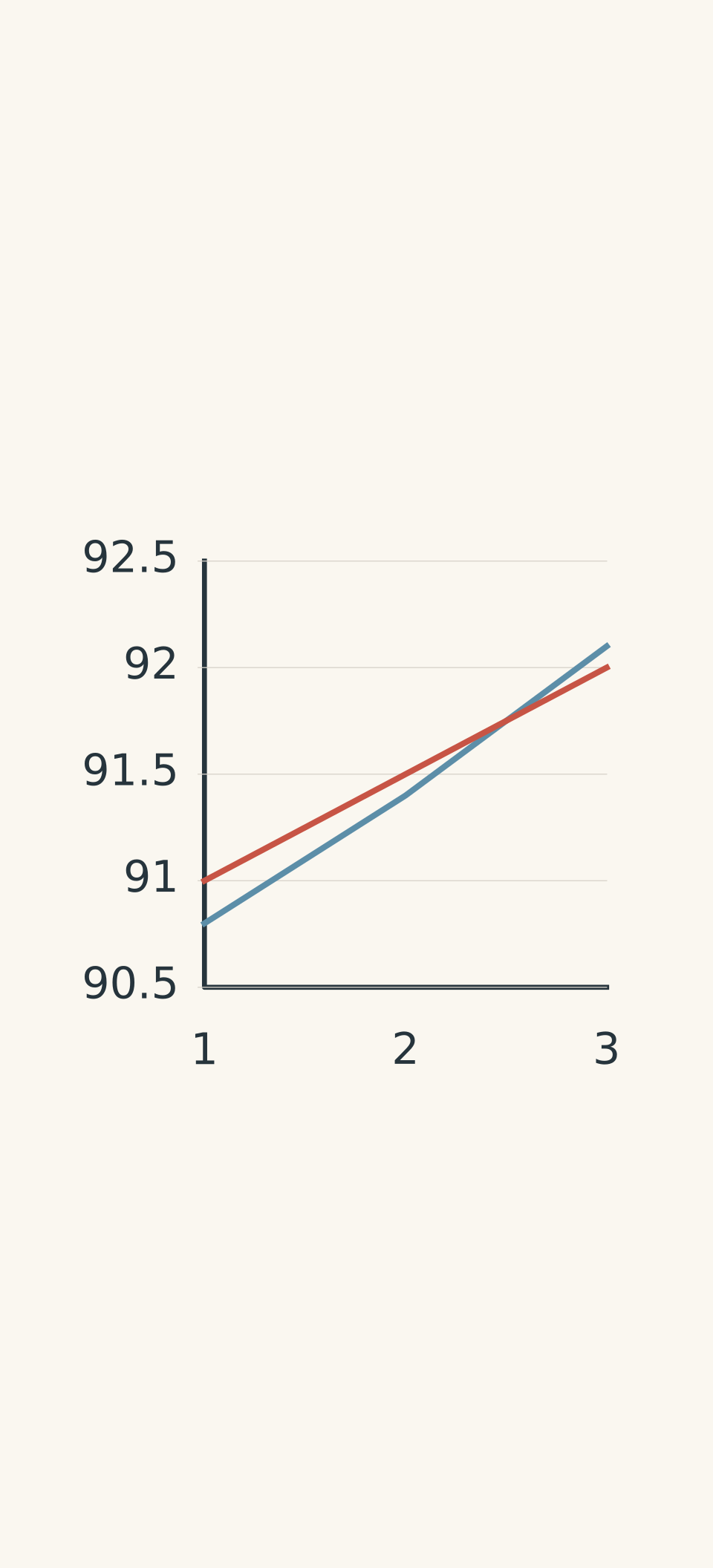
- Combination A
- Combination B
Keep these limits in mind:
- Your predicted marks are estimates, not known results.
- Historical scaling patterns may differ from those applied in your HSC year.
- A small difference between two estimated ATARs does not guarantee that one subject combination will outperform the other.
- The tool doesn’t decide whether a subject is worth studying for its prerequisites, preparation, or personal fit.
Use the results to test your thinking, not to replace it.
05Worked examples: Putting the decision framework into practice
Worked example: Should a student choose Physics for scaling?
Sam is choosing between Physics and Business Studies. Sam is already studying Mathematics Advanced and is considering an engineering degree that lists Mathematics Advanced as a prerequisite and Physics as assumed knowledge. Sam has stronger results in Business Studies case analyses than in multi-step Physics problems, but enjoys learning how physical systems work. Should Sam choose Physics because it traditionally scales strongly?
Step 1
Sam already studies Mathematics Advanced, so the stated mathematics prerequisite is covered. Physics is assumed knowledge rather than a formal prerequisite for this particular degree. That means Sam needs to consider the preparation Physics provides, but the information given doesn’t establish that Physics is compulsory for admission.
Step 2
Sam’s stronger Business Studies results are relevant evidence. So is the difficulty Sam currently has with multi-step Physics problems. Enjoying the ideas in Physics is a positive sign, but it doesn’t automatically mean the exam format will suit Sam.
Step 3
Sam could work through representative Physics questions, review the mathematical skills involved, and ask the Physics teacher which gaps are manageable with regular practice. Sam should also check how much the assumed knowledge matters for the intended degree.
Step 4
Sam should not choose Physics solely because of scaling. If the diagnostic work shows that the gaps are manageable and Sam wants the preparation Physics offers, it may be a sensible choice. If the subject remains a poor fit and the degree doesn’t require it, Business Studies may be more appropriate, provided Sam has a plan for any missing university preparation.
The important point is that neither subject is automatically better for Sam’s ATAR. The decision depends on likely performance, assessment fit, and future needs.
Worked example: Is a slightly higher ATAR estimate enough to switch?
Priya is choosing between two subject combinations. Both satisfy the formal prerequisites for her intended degree. Using realistic predicted marks, UAC ATAR Compass estimates an ATAR of 91.40 for Combination A and 91.50 for Combination B. Priya enjoys A more and has stronger assessment results in it. B has a reputation for scaling well. Should Priya switch to B?
Step 1
The estimated difference is 0.10 ATAR points. It does not establish that Priya will receive a higher ATAR with B. The result depends on her predicted marks and historical scaling statistics, while the actual scaling for her HSC year is not yet known.
Step 2
Priya should try reasonable variations in her expected marks for both combinations. If a small change in one subject reverses the result, the estimated advantage is fragile.
Step 3
Priya should check whether B has a more demanding assessment format, a major project that clashes with another subject, or content she is less prepared to study. She should also confirm that A doesn’t close off an important future option.
Step 4
Priya shouldn’t switch just to chase the 0.10 estimate. If A suits her strengths better and the combinations are close across realistic scenarios, A may be the more sensible choice. B could still be preferable if it offers a meaningful advantage for her future plans or turns out to fit her abilities better than expected.
A calculator can compare assumptions. It cannot make those assumptions reliable for you.
06Questions and solutions
Question 1
A student says, “Physics scales strongly, so even if I get a low HSC mark, it will boost my ATAR.”
Explain the main error in this reasoning.
Solution 1
The error is assuming that a subject’s scaling reputation guarantees a high scaled mark for every student.
Scaling depends on the course candidature’s demonstrated academic achievement, and an individual student’s scaled result still depends on their performance in that course. Scaling also does not change the order of students within a course.
A high-scaling course can be a sensible choice for a student who is well suited to it, but its reputation is not a substitute for achieving a strong result.
Question 2
Alex expects an HSC mark of 88 in Course A and 81 in Course B. An online scaling list suggests that Course B has historically scaled more strongly.
Alex concludes that Course A must contribute more to the ATAR because 88 is greater than 81.
Explain why Alex’s conclusion is not justified. Identify two useful next steps.
Solution 2
Alex cannot determine which course will contribute more to the ATAR by comparing the two predicted HSC marks alone.
HSC marks from different courses are not directly comparable. The scaled results depend on each course’s scaling characteristics and Alex’s position within the course. The historical reputation of Course B also does not guarantee how it will scale in Alex’s HSC year.
Two useful next steps are:
- Check UAC’s current scaling report to understand the historical results of both courses.
- Enter realistic expected marks and the relevant course combinations into UAC ATAR Compass, then test how the estimates change under different plausible marks.
Alex should also check prerequisites, assessment demands, and workload before making the final choice. The scaling comparison is only one part of the decision.
Question 3
Zoe studies 12 eligible ATAR units: 2 units of English and five other 2-unit courses. She expects one of the five non-English courses to produce her lowest scaled result.
Assume the five non-English courses are treated as standard 2-unit courses in the aggregate.
If that course has the lowest scaled result, will it contribute directly to Zoe’s ATAR aggregate? Should she drop it solely because of that prediction?
Solution 3
No, the lowest-scoring 2-unit course will not contribute directly to the aggregate if the other four non-English courses provide the best 8 non-English units. However, Zoe should not drop it solely because she expects it to be excluded.
The standard NSW ATAR calculation uses the best 2 units of English plus the best 8 units from the remaining courses. Zoe has 10 non-English units, so the lowest 2 units may be left out of the aggregate.
That doesn’t make the course automatically worthless. It may provide useful preparation, support a future course requirement, or contribute to meeting other HSC or ATAR eligibility rules. Zoe should verify the consequences of changing her pattern of study before making a decision.
The tempting assumption is that every extra unit must contribute directly to the ATAR. The actual calculation doesn’t work that way.
Question 4
Mia uses UAC ATAR Compass to compare two combinations. Combination X produces an estimated ATAR of 94.10, while Combination Y produces 94.25.
Both satisfy the formal prerequisites for her intended university course. However, Y is less interesting to Mia, and its major assessment is scheduled in the same fortnight as a major project in another subject.
What should Mia investigate before deciding that Y is the better option?
Solution 4
Mia should test whether the estimated advantage is robust, then compare the assessment demands and workload of both combinations.
The 0.15 difference is an estimate based on the marks Mia entered and historical scaling data. It is not a guarantee that Y will produce a higher ATAR. She should vary her predicted marks within realistic ranges and see whether the comparison changes.
She should then inspect the assessment tasks and deadlines for Y, considering whether the project overlap is manageable. Her genuine interest and demonstrated strengths also matter because they affect how realistically she can expect to perform.
If the estimated advantage disappears under small, plausible changes in her marks, Mia has little reason to treat it as decisive. If Y remains a strong option and its workload is manageable, it may still be worth choosing.
Question 5
Riley is choosing a final 2-unit subject. Riley’s current pattern consists of English, Mathematics Advanced, Chemistry, Economics, and Biology, all worth 2 units each. Riley must choose either Physics or Design and Technology as the final subject, giving a total of 12 units.
Riley is considering an engineering degree that requires Mathematics Advanced and lists Physics as assumed knowledge. The university confirms that Physics is not a formal prerequisite and that a bridging module is available for students who have not studied it.
Riley is equally interested in Physics and Design and Technology. Teacher feedback indicates that Riley is stronger at timed problem-solving than at managing long independent projects. The Design and Technology major project would overlap with a Chemistry research task.
Using realistic predicted HSC marks, UAC ATAR Compass estimates an ATAR of 91.40 with Physics and 91.50 with Design and Technology.
Riley argues:
“Physics traditionally scales well, so it must be the smarter ATAR choice. And because I’ll have 12 units, Physics will still add to my aggregate even if I get a low result.”
Which subject is the more defensible choice on the evidence given? Explain why the scaling argument is insufficient, and identify one condition that could change your recommendation.
Solution 5
On the facts given, Physics is the more defensible provisional choice, but the reason is its fit with Riley’s demonstrated strengths and future preparation, not its scaling reputation.
Step 1: Check the university requirement.
Mathematics Advanced is a formal prerequisite, and Riley already studies it. Physics is assumed knowledge rather than a formal prerequisite, so choosing Design and Technology would not automatically prevent admission to the stated degree. However, Physics would provide preparation that Riley would otherwise need to obtain through another route.
Step 2: Check which units actually enter the aggregate.
Riley has 12 units in total: 2 units of English and 10 non-English units. The ATAR aggregate uses the best 2 units of English and the best 8 non-English units.
Because Riley has five non-English 2-unit courses, one of those courses may be excluded from the aggregate, depending on the scaled results. If Physics produces the lowest scaled result, it may not contribute directly to the aggregate at all.
This is the key flaw in Riley’s argument. Having 12 units does not mean every unit contributes to the ATAR, and choosing a course with a strong scaling reputation does not guarantee that its marks will be included.
Step 3: Interpret the ATAR Compass comparison.
Design and Technology has the slightly higher estimate, at 91.50 compared with 91.40 for Physics. That difference is too small to treat as a reliable promise of a better outcome. The estimates use Riley’s predicted marks and historical scaling statistics, not the exact scaling that will apply in the HSC year.
The estimate is worth investigating, but it doesn’t settle the decision.
Step 4: Compare the subjects’ demands and future value.
Riley has stronger evidence of success with timed problem-solving than with long independent projects. Physics also provides useful preparation for the intended degree, whereas Design and Technology introduces a major project that overlaps with Chemistry.
Since Riley is equally interested in both, the available evidence favours Physics. The recommendation is based on the combination of demonstrated strengths, assessment fit, and preparation for university, not on an assumed scaling bonus.
Step 5: Identify what could change the recommendation.
If Riley’s engineering plans changed and a review of the Design and Technology task showed that the project workload was manageable, Design and Technology could become the more sensible choice. Likewise, if a diagnostic showed that Riley’s Physics skills were substantially below the required level and unlikely to improve with available support, the bridging route might make more sense.
The recommendation is provisional because it depends on Riley’s goals and evidence, not a universal rule about which subject is better.
The next step is to check the actual assessment schedules, review a representative task from each subject, and confirm the current university requirements before finalising the pattern. If you’re already in Year 12 and considering changing a subject, read tutorgum’s guide to Can You Drop a Subject in Year 12? HSC Rules to Check.