
Why Metal Reactivity Practicals Give Unexpected Results
Your metal reactivity practical doesn't match the activity series? Learn how oxide layers, concentration, reaction time, temperature, and contamination can affect observations, and how to troubleshoot results before drawing conclusions.
You put zinc into copper(II) sulfate solution and expect a reddish-brown copper coating. Nothing obvious happens. In another test, copper seems to react faster than aluminium, so you start wondering whether the metal activity series is wrong.
Before changing the order of the metals, make one distinction: does the activity series predict how quickly you will see a reaction, or which reaction is expected to occur? It predicts the relative tendency of metals to lose electrons. It does not guarantee an immediate, visible reaction from every metal sample under every set of conditions.
Predicted reaction versus visible evidence
| Zinc in copper(II) ions | Zn(s) + Cu²⁺(aq) → Zn²⁺(aq) + Cu(s) Reaction expected; reddish-brown copper may deposit. Surface oxide can delay visible change. |
|---|---|
| Copper in zinc ions | Cu(s) + Zn²⁺(aq) → no displacement No displacement expected; no zinc deposit. Surface condition cannot reverse the predicted reaction direction. |
| Aluminium in silver ions | Al(s) + 3Ag⁺(aq) → Al³⁺(aq) + 3Ag(s) Reaction expected; silver may deposit. Protective aluminium oxide can delay visible change. |
01What the activity series actually tells you
The metal activity series ranks metals by their tendency to undergo oxidation, which means losing electrons.
A more reactive metal can generally displace a less reactive metal from a solution containing its ions. For example, zinc displaces copper from copper(II) sulfate solution.
The net ionic equation is:
\[ \ce{Zn(s) + Cu^2+(aq) -> Zn^2+(aq) + Cu(s)} \]
Zinc atoms lose electrons and become zinc ions. Copper(II) ions gain those electrons and form solid copper.
You would expect a copper deposit to form on the zinc, and the concentration of copper(II) ions in solution to decrease. The solution may gradually become less intensely coloured, although it can remain coloured while copper(II) ions are still present.

- Zn(s)
- Cu²⁺(aq)
- Zn²⁺(aq)
- Cu(s)
Now consider copper placed in zinc sulfate solution. Copper is less reactive than zinc, so it cannot ordinarily displace zinc ions from solution. No displacement reaction is expected.
These predictions concern the direction of the reaction, not necessarily its speed.
Keep three separate questions in mind:
| Question | What determines the answer? |
|---|---|
| Is the reaction expected to occur? | The activity series, the reacting species, and the chemical conditions |
| How quickly does it occur? | Surface condition, concentration, temperature, surface area, and other kinetic factors |
| Can I see evidence of it? | How much product forms, the properties of the product, the observation time, and the sensitivity of the method |
A reaction can be chemically favourable but slow. It can also occur without producing an obvious visual change during a short practical.
That distinction is the starting point for troubleshooting.
02Six reasons your observations might disagree with the series
1. The metal has an oxide layer
A metal strip that looks clean may not have a chemically clean surface.
When metals are exposed to air, their surfaces can develop layers of oxides or other compounds. Some layers are thin and easily penetrated. Others protect the metal underneath.
Aluminium is a particularly important example. Its surface forms a thin, adherent aluminium oxide layer that can prevent the solution from reaching fresh aluminium metal.
The underlying aluminium is highly reactive, but the protective layer can slow the reaction dramatically.
Magnesium and zinc can also develop surface oxide layers. The extent to which these layers inhibit a reaction depends on the metal and the conditions.
This is called passivation when a surface layer substantially protects a metal from further reaction.
The tempting mistake: You see little or no change and conclude that the metal is less reactive than expected.
What actually matters: The experiment is testing the accessible surface of the sample, not just the theoretical reactivity of the metal beneath it.
To investigate:
- Use fresh metal samples where possible.
- Clean or abrade the surface using the same method for every comparable sample, following your laboratory’s safety instructions.
- Start the timing consistently when the metal contacts the solution.
- If a surface treatment is used, apply it consistently and record it.
- Repeat the test rather than assuming that a single unchanged strip proves anything about the activity series.
Do not assume that sanding aluminium in air guarantees a permanently oxide-free surface. The protective layer can reform quickly.
2. The reagent concentration is different from what you expected
A metal may react with a solution even when the reaction is too slow to produce an obvious change during your observation period.
Concentration affects the number of reacting particles present in a given volume. In many metal displacement and metal-acid reactions, increasing the relevant ion concentration increases the reaction rate under otherwise comparable conditions.
A dilute solution may therefore produce a smaller deposit or a less noticeable change over a fixed time.
Concentration also matters when preparing a fair comparison. If one metal is tested in concentrated copper(II) sulfate and another in a much more dilute solution, you cannot attribute the difference in their observed behaviour to the metals alone.
For dilution calculations, use:
\[ C_1V_1=C_2V_2 \]
Here, \(C_1\) and \(V_1\) are the concentration and volume of the original solution, while \(C_2\) and \(V_2\) are the concentration and total volume after dilution.
For example, diluting \(10.0\ \mathrm{mL}\) of a \(0.80\ \mathrm{mol\,L^{-1}}\) solution to a total volume of \(100.0\ \mathrm{mL}\) gives:
\[ C_2=\frac{0.80\times10.0}{100.0} =0.080\ \mathrm{mol\,L^{-1}} \]
The final solution is ten times more dilute than the original.
Within ordinary HSC displacement practicals, changing concentration usually affects the observed rate and extent of reaction over a given time. The activity series remains a useful guide to the expected direction, but it is not a guarantee that every reaction will be equally easy to observe under all conditions.
Fix: Use the same solution concentration and volume for comparable tests. Check dilution calculations, and use fresh aliquots so that an earlier reaction has not depleted the ions in a solution you intend to use again.
3. You have not allowed enough time
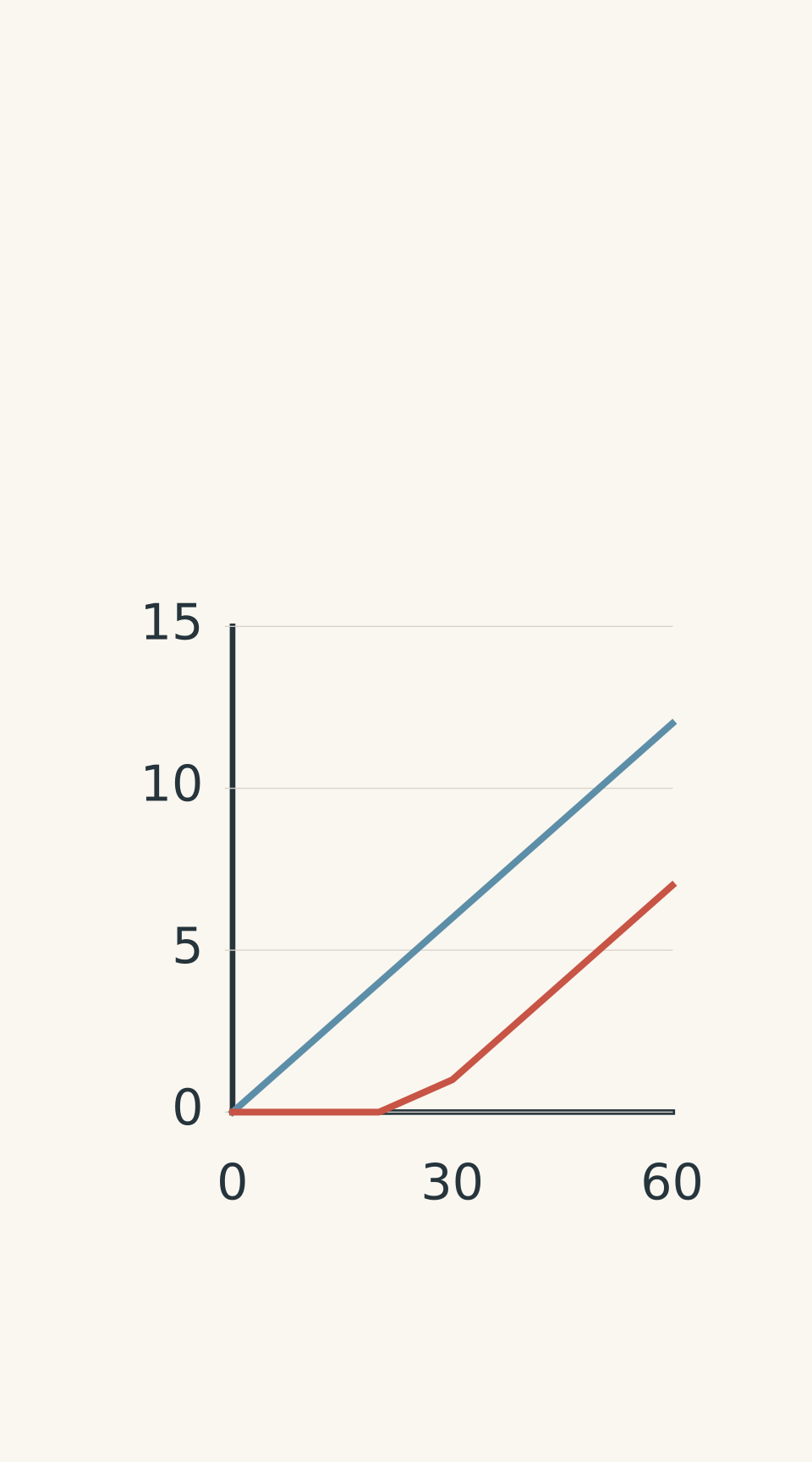
Suppose a magnesium strip produces no obvious bubbles for the first 20 seconds, then begins bubbling steadily.
Has the reaction started late, or was it occurring too slowly to observe at first?
Both surface effects and reaction kinetics can produce an initial delay. A reaction may also proceed slowly enough that the first visible product appears only after some time.
A short observation window can therefore create a false impression of no reaction.
- Clean metal surface
- Oxide-covered surface
The problem becomes worse when different samples are observed for different lengths of time. A metal observed for 30 seconds cannot fairly be compared with one observed for five minutes if you are using the visible amount of product to judge their behaviour.
Fix: Choose observation times in advance. For example, record observations at 0, 30, 60, and 180 seconds for every sample. Use the same starting point and record what happens at each interval.
Also distinguish between these statements:
- “No visible change occurred within 30 seconds.”
- “No reaction occurred.”
The first describes your observation. The second makes a chemical claim that your observation may not justify.
4. The temperature was not controlled
A warmer solution will often produce a faster reaction because a greater proportion of reacting particles have enough energy to overcome the activation energy barrier.
Imagine comparing zinc in copper(II) sulfate at \(35^\circ\mathrm{C}\) with iron in the same solution at \(20^\circ\mathrm{C}\). Even if the zinc reaction is faster, you cannot attribute the difference entirely to the metals.
Temperature is a separate variable.
It can also affect surface processes, including the removal of some surface layers, so it may influence more than the reaction rate alone.
Fix: Allow solutions to reach the same temperature before testing. Keep the volume, concentration, metal surface area, and observation time consistent as well.
Do not heat different samples by different amounts and then use their visible reaction rates to establish the activity series.
5. The samples or solutions are contaminated
Contamination can produce results that look chemically impossible.
Suppose you first place zinc in copper(II) sulfate. Copper deposits on the zinc. You then transfer that same strip, without cleaning it, into a solution labelled zinc sulfate.
If you see a reddish-brown coating, you have not demonstrated that zinc displaced zinc ions. The coating may simply be copper left from the previous test.
Residual copper(II) sulfate carried into the second solution could also allow further copper deposition:
\[ \ce{Zn(s) + Cu^2+(aq) -> Zn^2+(aq) + Cu(s)} \]
The zinc is reacting with copper(II) ions, not displacing zinc from zinc sulfate.
Other sources of contamination include:
- Reusing a dropper between different solutions.
- Using glassware with traces of a previous reagent.
- Leaving metal fragments on a sample or in a solution.
- Comparing samples of different purity or composition.
- Allowing two different metals to touch while immersed in an electrolyte, which can change their reaction rates through galvanic coupling.
Fix: Use fresh metal samples, clean glassware, separate droppers, and fresh solution aliquots. Inspect each solution before adding the metal, and keep different metal samples physically separate.
If an unexpected deposit appears, identify what it could be before deciding that the activity series has failed.
6. Your observation method cannot detect the change reliably
Not every reaction produces a dramatic colour change or a steady stream of bubbles.
For a displacement reaction involving copper(II) ions, a small amount of copper may deposit on a metal strip while the solution remains visibly coloured. The solution does not need to become colourless for the reaction to have occurred.
A darkened surface is not automatically evidence of a deposited metal, either. It could be an oxide layer or another surface product.
The absence of bubbles is especially unhelpful in a metal displacement test. Bubbles of hydrogen are relevant to certain metal-acid reactions, but they are not the expected evidence for zinc displacing copper from copper(II) sulfate.
Use several suitable indicators when possible:
- Formation of a new solid deposit.
- Changes in the metal’s appearance.
- Changes in solution colour or intensity.
- Gas evolution when the reaction is expected to produce a gas.
- A measurable change in mass, where the method is appropriate.
Mass measurements need care. If a metal dissolves while another metal deposits on its surface, the measured mass can increase or decrease depending on the amounts involved. Strip mass alone does not necessarily tell you how much of the original metal reacted.
Fix: Choose an observation method that can detect the expected change. If you use mass, gas volume, or another quantitative measurement, consider what the measurement actually represents and what uncertainties could affect it.
03Wording changes that break memorised shortcuts
A few common exam phrases need careful interpretation.
“The metal reacts faster.”
This describes a rate under particular conditions. It does not establish a universal numerical measure of reactivity. A passivated metal can react slowly even when the underlying metal has a strong tendency to oxidise.
“No reaction was observed.”
This means no evidence was detected using the method and observation period. It does not necessarily establish that no reaction occurred.
“The metal reacts with acid.”
The acid matters. Metals above hydrogen in the usual activity series generally release hydrogen when reacting with suitable dilute, non-oxidising acids. Copper does not ordinarily release hydrogen from dilute hydrochloric acid. Oxidising acids, such as nitric acid, can behave differently, so the simple hydrogen rule cannot be applied indiscriminately.
“Both metals displace copper.”
Suppose both zinc and iron produce copper deposits when placed in copper(II) sulfate. You have evidence that both metals can displace copper under those conditions. You have not established which is more reactive than the other from that fact alone.
To compare zinc and iron directly, a pairwise displacement test is more informative: test zinc in a solution containing iron ions and iron in a solution containing zinc ions, while controlling the surface conditions and other variables.
04A decision method for troubleshooting a practical
When your results look inconsistent, work through these steps in order rather than changing several things at once.

Step 1: Write the predicted reaction.
Use the activity series to identify whether displacement is expected. Write the net ionic equation and identify the product you should look for.
Step 2: Check the actual reagents.
Confirm the identity of the metal, the ions in solution, and the reagent concentration. Make sure you are not applying a rule for metal-acid reactions to a metal displacement reaction, or vice versa.
Step 3: Standardise the metal samples.
Use comparable exposed surface areas and the same cleaning procedure. Avoid comparing an oxide-covered strip with a freshly abraded strip unless surface condition is the variable you are deliberately investigating.
Step 4: Standardise the solution conditions.
Use the same concentration, volume, and temperature for comparable trials. Keep the samples in separate, fresh aliquots so that one reaction does not alter the conditions of another.
Step 5: Standardise the observation period.
Start timing consistently and record observations at fixed intervals. Do not rely on a single brief glance.
Step 6: Check for contamination and measurement problems.
Use clean equipment, inspect the solutions, and select an observation method that can detect the expected product. Where appropriate, include a positive control that should react and a negative control that should not.
Step 7: Repeat before drawing a conclusion.
Change one variable at a time to test a suspected cause. If the result remains inconsistent after reasonable controls, investigate the reagent identity, surface chemistry, and limitations of the model. Report the unexpected observation honestly rather than altering it to match the expected result.
05Worked examples
Worked example: A zinc strip appears not to react
A student dilutes \(10.0\ \mathrm{mL}\) of \(0.80\ \mathrm{mol\,L^{-1}}\) copper(II) sulfate solution to a total volume of \(100.0\ \mathrm{mL}\). They place a zinc strip in the solution and see no obvious copper deposit after 20 seconds. Calculate the final concentration and assess the claim that zinc is less reactive than copper.
Step 1
Zinc should displace copper from copper(II) ions:
\[ \ce{Zn(s) + Cu^2+(aq) -> Zn^2+(aq) + Cu(s)} \]
The expected solid product is copper.
Step 2
Using \(C_1V_1=C_2V_2\), where the subscripts 1 and 2 refer to the original and diluted solutions:
\[ \begin{aligned} C_2&=\frac{C_1V_1}{V_2}\\[4pt] &=\frac{(0.80)(10.0)}{100.0}\\[4pt] &=0.080\ \mathrm{mol\,L^{-1}} \end{aligned} \]
The final copper(II) sulfate concentration is \(0.080\ \mathrm{mol\,L^{-1}}\).
Step 3
The observation establishes that no obvious deposit was detected within 20 seconds. It does not establish that zinc cannot displace copper.
The diluted solution may produce a less noticeable deposit during that short interval. An oxide layer on the zinc could also inhibit the reaction. The observation alone cannot identify which factor, if any, caused the delay.
Step 4
Repeat the test using a freshly prepared zinc surface, the same temperature, and a fixed observation schedule. To investigate concentration specifically, compare otherwise identical trials using \(0.080\ \mathrm{mol\,L^{-1}}\) and \(0.80\ \mathrm{mol\,L^{-1}}\) copper(II) sulfate.
The corrected conclusion is that the original trial did not provide sufficient evidence to challenge the expected displacement reaction.
Worked example: Comparing copper deposition rates
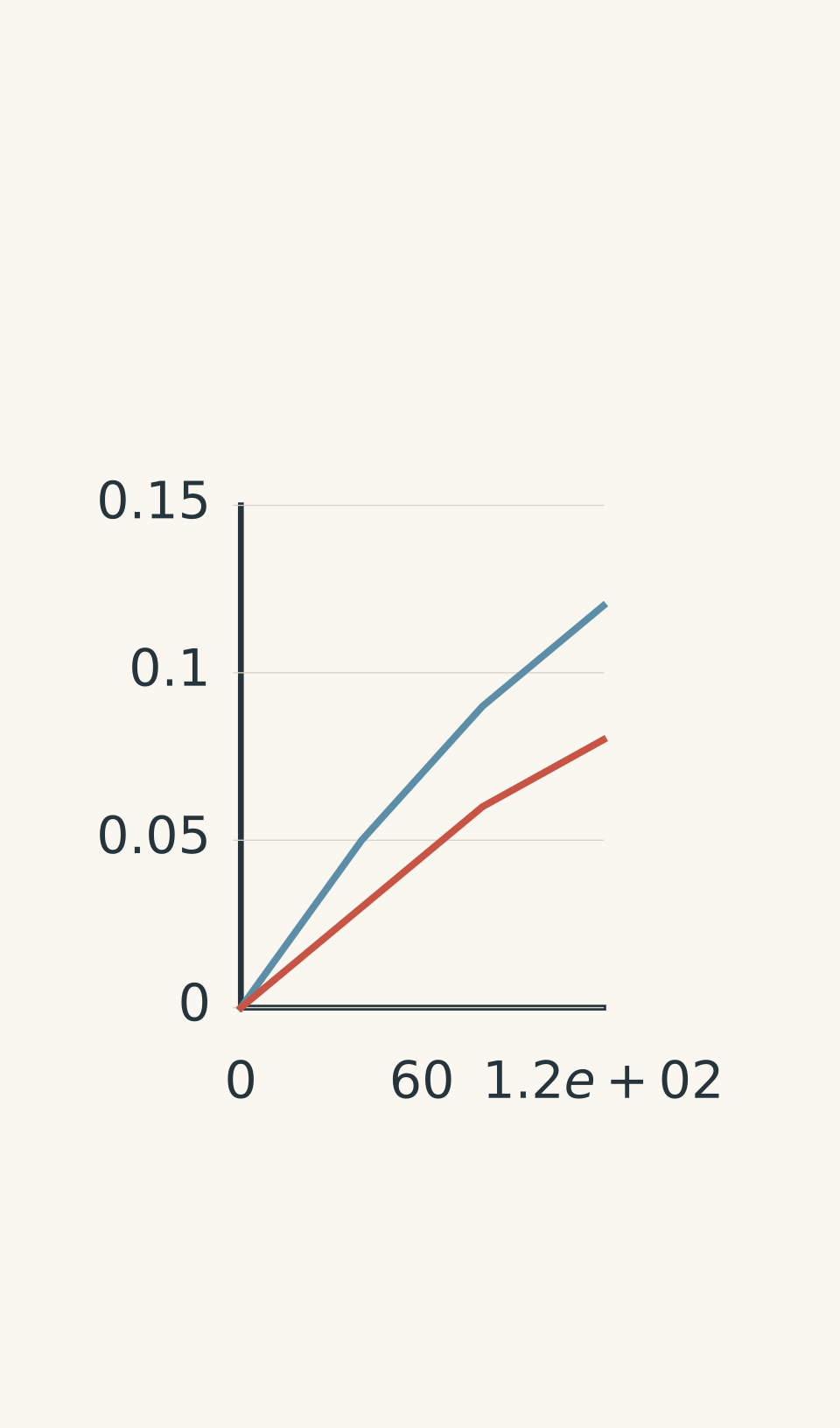
Clean zinc and iron strips with equal exposed surface areas are placed in separate \(50.0\ \mathrm{mL}\) aliquots of \(0.100\ \mathrm{mol\,L^{-1}}\) copper(II) sulfate at \(25^\circ\mathrm{C}\). The recovered copper deposits have the following masses.
| Time | Copper on zinc | Copper on iron |
|---|---|---|
| 0 s | 0.000 g | 0.000 g |
| 40 s | 0.050 g | 0.030 g |
| 80 s | 0.090 g | 0.060 g |
| 120 s | 0.120 g | 0.0800 g |
Calculate the average copper deposition rate over the first 120 seconds for each metal. Does the result mean zinc is exactly 1.5 times as reactive as iron?
Step 1
Average deposition rate is the mass of copper deposited divided by the elapsed time.
\[ \begin{aligned} r_{\mathrm{Zn}}&=\frac{\Delta m}{\Delta t}\\[4pt] &=\frac{0.120\ \mathrm{g}}{120\ \mathrm{s}}\\[4pt] &=1.00\times10^{-3}\ \mathrm{g\,s^{-1}} \end{aligned} \]
Step 2
\[ \begin{aligned} r_{\mathrm{Fe}}&=\frac{0.0800\ \mathrm{g}}{120\ \mathrm{s}}\\[4pt] &=6.67\times10^{-4}\ \mathrm{g\,s^{-1}} \end{aligned} \]
Step 3
The ratio is:
\[ \frac{r_{\mathrm{Zn}}}{r_{\mathrm{Fe}}} =\frac{1.00\times10^{-3}}{6.67\times10^{-4}} \approx1.50 \]
Zinc deposited copper at 1.50 times the average rate measured for iron under these conditions.
Step 4
The controlled results support the conclusion that copper deposition was faster on zinc in this trial. They are consistent with zinc being more reactive than iron.
However, the activity series is an ordering of relative reactivity, not a numerical scale. A rate ratio of 1.50 does not mean zinc is universally 1.50 times as reactive as iron. Reaction rates depend on the metal surface, the solution, and the conditions of the test.
A controlled rate comparison provides useful evidence, but a single rate ratio is not a universal measure of reactivity.
- Copper on zinc (g)
- Copper on iron (g)
06Before you write “no reaction”
Use this quick self-check when reviewing your practical results.
- Have I written the expected ionic equation and identified the product?
- Were the metal surfaces, exposed areas, solution concentrations, volumes, and temperatures comparable?
- Did I observe every sample for the same length of time?
- Could an oxide layer or contamination have prevented or disguised the expected change?
- Was my observation method sensitive enough to detect a small amount of product?
- Have I repeated the test or used an appropriate control before rejecting the predicted reaction?
If a result still disagrees with the expected series after these checks, investigate the remaining chemical and experimental possibilities. The next useful step is to write the balanced ionic equation and track the electron transfer: identify which species is oxidised, which is reduced, and whether the observed products support the proposed reaction.
07Questions and solutions
Question 1
A clean copper strip is placed in zinc sulfate solution. Predict the expected observation and explain it using the metal activity series.
Solution 1
No displacement reaction is expected under ordinary conditions. Copper is less reactive than zinc and cannot reduce zinc ions to zinc metal in this solution.
For a displacement reaction to occur, the solid metal must be able to supply electrons to the ions of the less reactive metal. Copper does not have the required relative reactivity to displace zinc from zinc sulfate.
No new zinc deposit should form on the copper strip. This is an expected negative result, not evidence that the practical has failed.
Question 2
A student compares two metal-acid trials.
- Trial A uses magnesium powder in \(0.10\ \mathrm{mol\,L^{-1}}\) hydrochloric acid at \(35^\circ\mathrm{C}\), with hydrogen collected for 60 seconds.
- Trial B uses a zinc strip in \(1.0\ \mathrm{mol\,L^{-1}}\) hydrochloric acid at \(20^\circ\mathrm{C}\), with observations recorded for 20 seconds.
The student reports that Trial B produces a more noticeable initial burst of bubbles and concludes that zinc is more reactive than magnesium.
Evaluate the conclusion and propose a fairer investigation.
Solution 2
The conclusion is not justified because the two trials differ in several variables that affect the observed reaction. The expected activity-series order is magnesium above zinc, but the student’s comparison does not fairly test that prediction.
The trials differ in:
- Concentration: Trial B uses acid ten times as concentrated.
- Temperature: Trial A is warmer, which can increase its reaction rate.
- Surface area: Magnesium powder generally exposes much more surface area than a strip of comparable mass.
- Observation time: Trial A is monitored for three times as long.
The initial burst of bubbles in Trial B cannot be compared directly with the overall gas evolution in Trial A. The concentrated acid may produce a more noticeable initial response even though magnesium is higher in the activity series.
A fairer investigation would use clean magnesium and zinc strips with equal exposed surface areas. Test them separately in equal volumes of hydrochloric acid at the same concentration and temperature, with acid in excess. Collect hydrogen using the same method and compare the gas volumes over identical time intervals.
Repeat each trial and record the results.
The controlled results can then be used to compare the observed reaction rates. The activity series predicts that magnesium is more reactive than zinc, but the rate ratio measured in one experiment should not be treated as a universal ratio of their reactivities.
Question 3
A zinc strip is placed in copper(II) sulfate solution and develops a reddish-brown copper coating. Without cleaning the strip, a student transfers it into a fresh beaker labelled zinc sulfate. More reddish-brown material is then observed.
The student concludes that zinc has displaced zinc from zinc sulfate.
Explain why this conclusion is invalid. Identify two possible sources of the misleading observation and describe a suitable repeat experiment.
Solution 3
The observation does not show that zinc has displaced zinc ions. The reddish-brown material could be copper left from the first test or copper deposited during further reaction with copper(II) ions carried into the second beaker.
Two plausible explanations are:
- An existing deposit: Copper formed in the first test remains attached to the zinc strip when it is transferred.
- Solution carryover: Drops of copper(II) sulfate solution remain on the strip and enter the zinc sulfate solution. The remaining copper(II) ions can react with exposed zinc to form additional copper.
The relevant reaction is still:
\[ \ce{Zn(s) + Cu^2+(aq) -> Zn^2+(aq) + Cu(s)} \]
It is not a displacement of zinc by zinc.
To repeat the investigation, use a fresh zinc strip, clean glassware, and a fresh zinc sulfate aliquot. Inspect the solution before adding the strip, and do not reuse contaminated droppers or stirring tools.
A separate zinc strip placed directly into clean zinc sulfate provides the appropriate test. Since the solid metal and dissolved metal ions are the same metal, no displacement reaction is expected.
The key lesson is that a visible deposit must be identified and traced to its source before it can be used as evidence for a chemical reaction.
Question 4
A student places excess clean zinc in \(25.0\ \mathrm{mL}\) of \(0.0800\ \mathrm{mol\,L^{-1}}\) copper(II) sulfate solution. After a fixed interval, \(0.0200\ \mathrm{g}\) of copper is recovered from the zinc strip.
Assume all deposited copper is recovered, no other reaction consumes copper(II) ions, and the solution volume remains unchanged. Use the molar mass of copper, \(63.55\ \mathrm{g\,mol^{-1}}\), to calculate:
(a) the initial amount of copper(II) ions;
(b) the amount and concentration of copper(II) ions remaining after the reaction;
(c) why the solution may remain visibly coloured even though a reaction has occurred.
Solution 4
The reaction has occurred, but most of the copper(II) ions remain in solution, so the solution can still appear coloured.
Step 1: Calculate the initial amount of copper(II) ions.
The amount \(n\), in moles, is calculated using concentration \(C\) multiplied by volume \(V\), with volume expressed in litres.
\[ \begin{aligned} n(\mathrm{Cu}^{2+})&=CV\\[4pt] &=(0.0800\ \mathrm{mol\,L^{-1}}) (0.0250\ \mathrm{L})\\[4pt] &=0.00200\ \mathrm{mol} \end{aligned} \]
The initial amount is \(0.00200\ \mathrm{mol}\).
Step 2: Calculate the amount of copper deposited.
The amount of copper deposited is its mass divided by its molar mass:
\[ \begin{aligned} n(\ce{Cu})&=\frac{m}{M}\\[4pt] &=\frac{0.0200\ \mathrm{g}} {63.55\ \mathrm{g\,mol^{-1}}}\\[4pt] &=3.15\times10^{-4}\ \mathrm{mol} \end{aligned} \]
The net ionic equation has a 1:1 ratio between copper(II) ions consumed and copper atoms formed. Therefore, \(3.15\times10^{-4}\ \mathrm{mol}\) of copper(II) ions have been consumed.
Step 3: Calculate the amount remaining.
\[ \begin{aligned} n_{\mathrm{remaining}}(\mathrm{Cu}^{2+}) &=0.00200-0.000315\\[4pt] &=0.001685\ \mathrm{mol} \end{aligned} \]
Approximately \(0.00169\ \mathrm{mol}\) of copper(II) ions remain.
Step 4: Calculate the remaining concentration.
Using the unchanged volume of \(0.0250\ \mathrm{L}\):
\[ \begin{aligned} C_{\mathrm{remaining}} &=\frac{n_{\mathrm{remaining}}}{V}\\[4pt] &=\frac{0.001685}{0.0250}\\[4pt] &=0.0674\ \mathrm{mol\,L^{-1}} \end{aligned} \]
The remaining copper(II) ion concentration is \(0.0674\ \mathrm{mol\,L^{-1}}\).
Step 5: Interpret the observation.
Only about \(15.7\%\) of the initial copper(II) ions have been consumed. The remaining concentration is still substantial, so the solution may retain much of its original colour.
The student’s failure to observe complete loss of colour would not justify a conclusion of no reaction. The recovered copper deposit provides direct evidence that copper(II) ions have been reduced to copper metal.
Question 5
Two separate tests use \(100.0\ \mathrm{mL}\) of \(0.100\ \mathrm{mol\,L^{-1}}\) silver nitrate solution at \(25^\circ\mathrm{C}\).
A clean copper strip develops a silver deposit within 10 seconds. Aluminium foil shows no visible change for three minutes, but scratching the aluminium while it is immersed causes silver to form. After eight minutes, \(0.540\ \mathrm{g}\) of silver is recovered from the aluminium trial.
Assume that all the recovered silver was produced by the reduction of silver ions by aluminium, that aluminium is oxidised only to \(\mathrm{Al}^{3+}\), and that no other reaction consumes silver ions.
Use \(M(\ce{Ag})=107.87\ \mathrm{g\,mol^{-1}}\) and \(M(\ce{Al})=26.98\ \mathrm{g\,mol^{-1}}\) to:
(a) calculate the initial amount of silver ions;
(b) calculate the amount and concentration of silver ions remaining after eight minutes, assuming negligible volume change;
(c) calculate the mass of aluminium consumed;
(d) assess the claim that copper is more reactive than aluminium because it reacted visibly sooner, and explain what further test would distinguish their relative reactivity.
Solution 5
The results do not establish that copper is more reactive than aluminium. The delayed aluminium reaction is consistent with surface passivation, and the recovered silver shows that aluminium can reduce silver ions under the stated conditions. However, because both metals can displace silver, this experiment alone cannot rank aluminium against copper.
Step 1: Calculate the initial amount of silver ions.
Using \(n=CV\), where \(n\) is amount in moles, \(C\) is concentration in \(\mathrm{mol\,L^{-1}}\), and \(V\) is volume in litres:
\[ \begin{aligned} n_{\mathrm{initial}}(\mathrm{Ag}^{+}) &=(0.100)(0.1000)\\[4pt] &=0.0100\ \mathrm{mol} \end{aligned} \]
The initial amount of silver ions is \(0.0100\ \mathrm{mol}\).
Step 2: Calculate the amount of silver deposited.
\[ \begin{aligned} n(\ce{Ag})&=\frac{m}{M}\\[4pt] &=\frac{0.540\ \mathrm{g}} {107.87\ \mathrm{g\,mol^{-1}}}\\[4pt] &=0.00501\ \mathrm{mol} \end{aligned} \]
The balanced net ionic equation for the aluminium reaction is:
\[ \ce{Al(s) + 3Ag+(aq) -> Al^3+(aq) + 3Ag(s)} \]
Three moles of silver ions are reduced for every mole of aluminium oxidised.
Step 3: Calculate the silver ions remaining.
The reaction consumes one mole of silver ions for every mole of silver deposited.
\[ \begin{aligned} n_{\mathrm{remaining}}(\mathrm{Ag}^{+}) &=0.0100-0.00501\\[4pt] &=0.00499\ \mathrm{mol} \end{aligned} \]
The remaining amount is approximately \(0.00499\ \mathrm{mol}\).
Since the volume remains \(0.1000\ \mathrm{L}\), the remaining concentration is:
\[ \begin{aligned} C_{\mathrm{remaining}} &=\frac{0.00499}{0.1000}\\[4pt] &=0.0499\ \mathrm{mol\,L^{-1}} \end{aligned} \]
The silver ion concentration has fallen to approximately \(0.0500\ \mathrm{mol\,L^{-1}}\).
Step 4: Calculate the mass of aluminium consumed.
From the balanced equation, three moles of silver are deposited for every mole of aluminium consumed.
\[ \begin{aligned} n(\ce{Al})&=\frac{n(\ce{Ag})}{3}\\[4pt] &=\frac{0.00501}{3}\\[4pt] &=0.00167\ \mathrm{mol} \end{aligned} \]
Convert the amount of aluminium to mass:
\[ \begin{aligned} m(\ce{Al})&=nM\\[4pt] &=(0.00167)(26.98)\\[4pt] &=0.0450\ \mathrm{g} \end{aligned} \]
Approximately \(0.0450\ \mathrm{g}\) of aluminium was consumed under the stated assumptions.
Step 5: Interpret the delayed reaction.
The absence of a visible deposit during the first three minutes does not prove that aluminium is less reactive than copper. Aluminium forms a protective oxide layer that can obstruct electron transfer at its surface. Scratching the foil while immersed exposes fresh metal and allows the reaction to become visible.
Copper can also displace silver from silver nitrate:
\[ \ce{Cu(s) + 2Ag+(aq) -> Cu^2+(aq) + 2Ag(s)} \]
Both reactions are consistent with the activity series. Both aluminium and copper are more reactive than silver.
The crucial limitation is that two metals can both displace the same metal without that experiment establishing their order relative to each other. The activity series places aluminium above copper, but the silver nitrate trials do not independently establish that comparison. Their different visible rates are also affected by the aluminium surface layer.
Step 6: Design a more direct comparison.
Test freshly exposed aluminium in a copper(II) ion solution, and test copper in an aluminium ion solution using separate, clean aliquots and controlled conditions. The activity series predicts that aluminium can displace copper from copper(II) ions, whereas copper cannot displace aluminium from aluminium ions.
The aluminium surface must be prepared consistently and its passivation considered. If no visible reaction occurs on aluminium, that result remains inconclusive until the surface limitation has been investigated.
The next step is to connect those observations to balanced ionic equations and electron transfer. That lets you distinguish a genuine difference in the tendency of metals to oxidise from a difference in how quickly a particular practical makes the reaction visible.