
Why a Faster Reaction Is Not Necessarily More Exothermic
Learn why reaction rate, activation energy, and enthalpy change describe different things. Use energy profiles, collision theory, and bond energies to avoid common HSC Chemistry mistakes and answer exam questions accurately.
You see a tall peak on a reaction energy profile and write, “This reaction is more exothermic because it needs more energy to get started.” Then you see a catalyst lower that peak and conclude that the reaction releases less energy. Both answers confuse the energy barrier with the energy change between reactants and products.
Before reading on, predict this: if a catalyst makes a reaction 20 times faster, does one mole of the reaction release 20 times more energy?
No. The reaction may release energy much faster per second, but the total enthalpy change per mole remains the same for the same reaction under the same conditions. The key is to separate three ideas: reaction rate, activation energy, and enthalpy change.
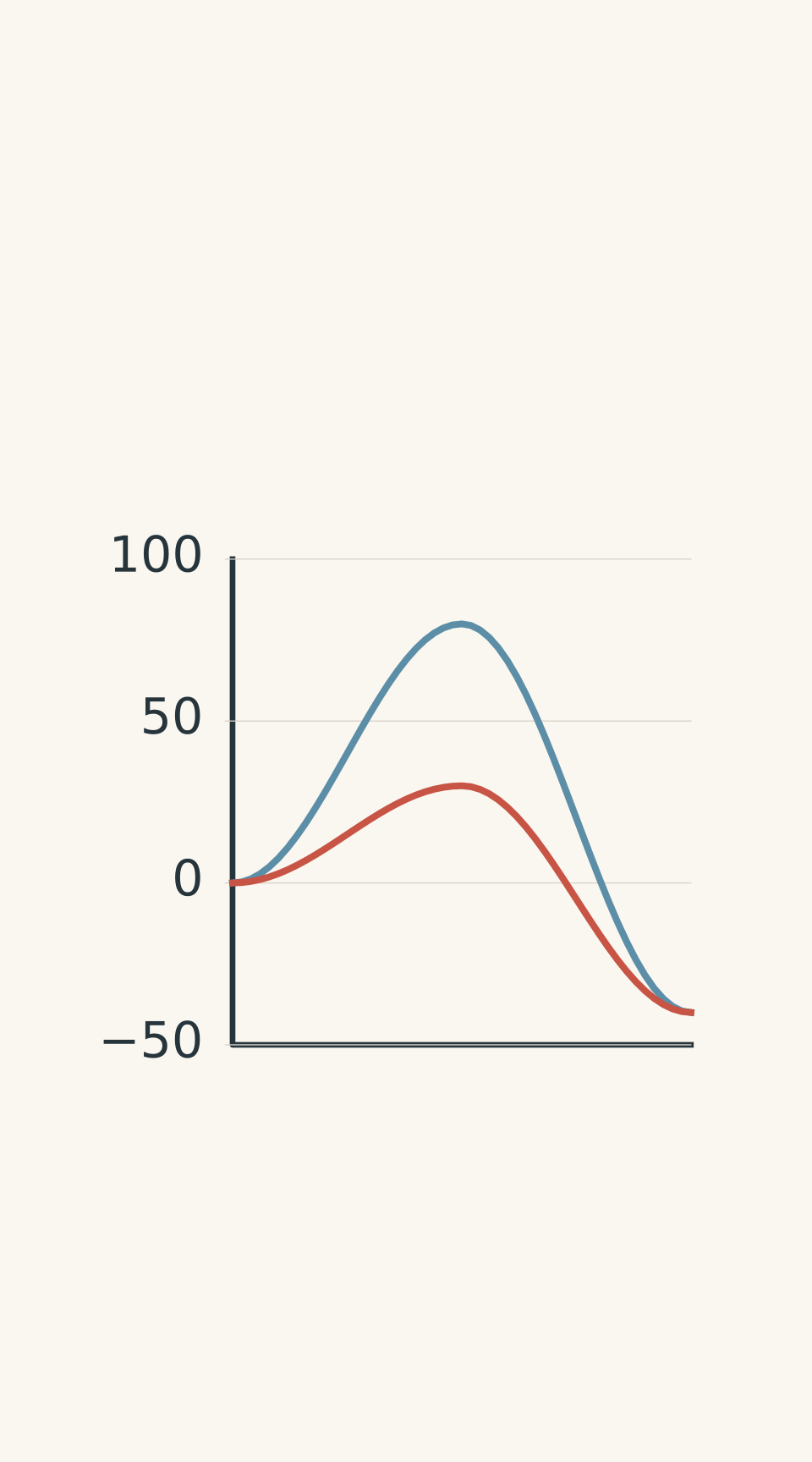
- Uncatalysed
- Catalysed
01Read the energy profile correctly
An energy profile shows how the energy of a reacting system changes as the reaction proceeds. The horizontal axis represents reaction progress, not time.
Three quantities matter here, and each answers a different question.
| Quantity | What it tells you | How to read it |
|---|---|---|
| Reaction rate | How quickly reactants are consumed or products form | Rate is not plotted directly on a standard energy profile. A lower activation energy often indicates a faster reaction under comparable conditions. |
| Activation energy, \(E_a\) | The energy barrier that must be overcome | Measure from the reactant energy level to the peak. |
| Enthalpy change, \(\Delta H\) | The energy difference between products and reactants | Compare the product and reactant energy levels. |
The two important equations are:
\[ \Delta H=H_P-H_R \]
\[ E_{a,f}=H_{\mathrm{TS}}-H_R \]
Here, \(H_P\) is the enthalpy of the products, \(H_R\) is the enthalpy of the reactants, and \(H_{\mathrm{TS}}\) is the enthalpy of the transition state at the peak. The symbol \(E_{a,f}\) means forward activation energy. Enthalpy differences and activation energies are commonly expressed in \(\mathrm{kJ\,mol^{-1}}\).
Notice that the equations use different pairs of energy levels.
- For \(\Delta H\), compare products with reactants.
- For \(E_a\), compare the peak with reactants.
That difference is the source of the mistake.
Exothermic does not mean fast
For an exothermic reaction, the products have lower enthalpy than the reactants, so \(\Delta H\) is negative.
For an endothermic reaction, the products have higher enthalpy than the reactants, so \(\Delta H\) is positive.
Neither sign tells you directly how quickly the reaction proceeds. A reaction can be strongly exothermic but slow because it has a large activation energy. Another reaction can be endothermic but relatively fast because its activation energy is low.
The peak and the product level describe different energy differences. Never use one as a substitute for the other.
Worked example: Reading a catalysed energy profile
An exothermic reaction has reactants at \(80\ \mathrm{kJ\,mol^{-1}}\), products at \(30\ \mathrm{kJ\,mol^{-1}}\), and an uncatalysed peak at \(140\ \mathrm{kJ\,mol^{-1}}\). A catalyst provides a pathway with a peak at \(105\ \mathrm{kJ\,mol^{-1}}\). Calculate the enthalpy change and both forward activation energies. Explain what the catalyst changes.
Step 1
\[ \begin{aligned} \Delta H &= H_P-H_R\\ &=30-80\\ &=-50\ \mathrm{kJ\,mol^{-1}} \end{aligned} \]
The negative result confirms that the reaction is exothermic.
Step 2
\[ \begin{aligned} E_{a,f}&=H_{\mathrm{TS}}-H_R\\ &=140-80\\ &=60\ \mathrm{kJ\,mol^{-1}} \end{aligned} \]
The barrier is \(60\ \mathrm{kJ\,mol^{-1}}\) above the reactants.
Step 3
\[ \begin{aligned} E_{a,f}&=105-80\\ &=25\ \mathrm{kJ\,mol^{-1}} \end{aligned} \]
The catalyst reduces the forward activation energy by \(35\ \mathrm{kJ\,mol^{-1}}\).
Step 4
The activation energy decreases from \(60\) to \(25\ \mathrm{kJ\,mol^{-1}}\), so the catalysed reaction is expected to proceed faster at the same temperature, all else being comparable.
However, \(\Delta H\) remains \(-50\ \mathrm{kJ\,mol^{-1}}\). The reactant and product energy levels have not changed.
The incorrect approach is to compare the two peaks and conclude that the enthalpy change has become less negative. The corrected approach is to calculate the peak-to-reactant difference for activation energy and the product-to-reactant difference for enthalpy change.
02Why a catalyst changes the rate, not \(\Delta H\)
A catalyst provides an alternative reaction pathway with a lower activation energy. It changes how the reaction can proceed, not the enthalpy of the original reactants or the final products.
Collision theory explains why this increases the reaction rate.
For a reaction to occur, reacting particles generally need to:
- collide with sufficient energy to overcome the activation energy;
- collide with a suitable orientation, so the necessary bonds can break and form.
At a fixed temperature, particles have a distribution of kinetic energies. Only a fraction of collisions have enough energy to overcome a given activation barrier.
A catalyst lowers that barrier. A greater fraction of collisions can now overcome it, so more successful collisions occur per unit time.
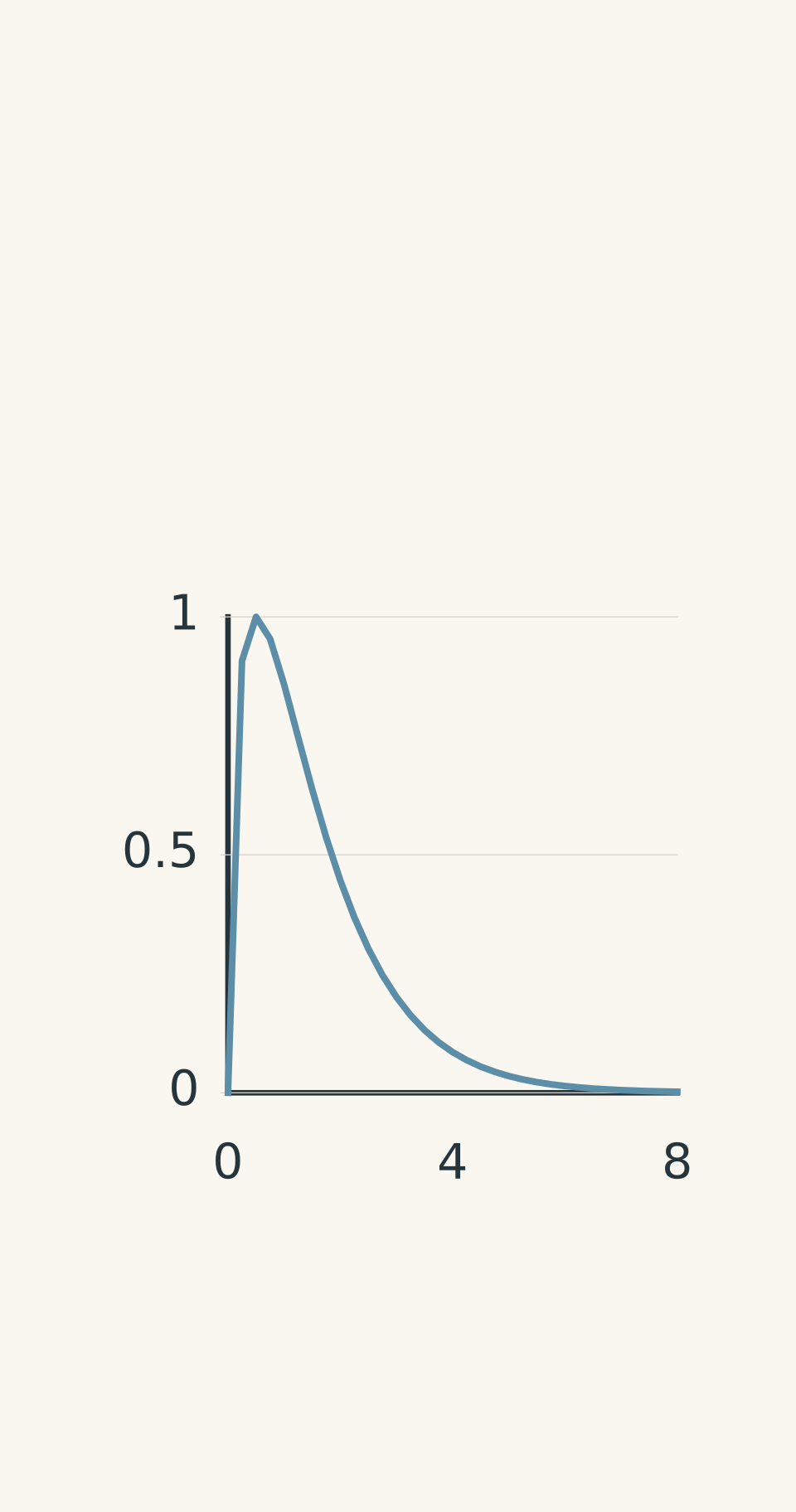
- Maxwell–Boltzmann distribution at fixed temperature
The important detail is that the catalyst does not need to increase the particles’ average kinetic energy. That would be a temperature change. Instead, it reduces the energy threshold required by the reaction pathway.
Think of two people trying to meet across a tall fence. The fence represents the activation barrier, while the starting and finishing positions represent the reactant and product energy levels. A catalyst opens a gate, making the journey easier without moving either person. The analogy breaks down because molecules do not choose routes; their reaction probabilities depend on molecular interactions, collision energies, and orientation.
The catalyst changes the peak, not the endpoints
Return to the energy profile. If the reactants and products are unchanged, their enthalpies remain unchanged.
The catalysed pathway has a lower peak, but the vertical difference between the reactants and products is identical.
This also applies to the reverse reaction. For a single-step pathway, the forward and reverse activation energies are measured from opposite ends to the same transition state.
\[ E_{a,r}=E_{a,f}-\Delta H \]
Here, \(E_{a,r}\) is the reverse activation energy. For an exothermic forward reaction, \(\Delta H\) is negative, so the reverse activation energy is greater than the forward activation energy.
If the catalyst lowers the transition-state energy while keeping both endpoint energies fixed, it lowers both activation energies. It does not make the forward reaction more exothermic.
For a reversible reaction, a catalyst also does not change the equilibrium constant or the equilibrium composition at a fixed temperature. It speeds up the approach to equilibrium by providing a lower-barrier pathway in both directions.
Faster heat release is not greater heat release per mole
There is one subtle point worth keeping: a faster exothermic reaction can release heat at a greater rate.
Imagine two reactions using the same starting amounts and forming the same final products. One is catalysed and finishes quickly; the other proceeds slowly.
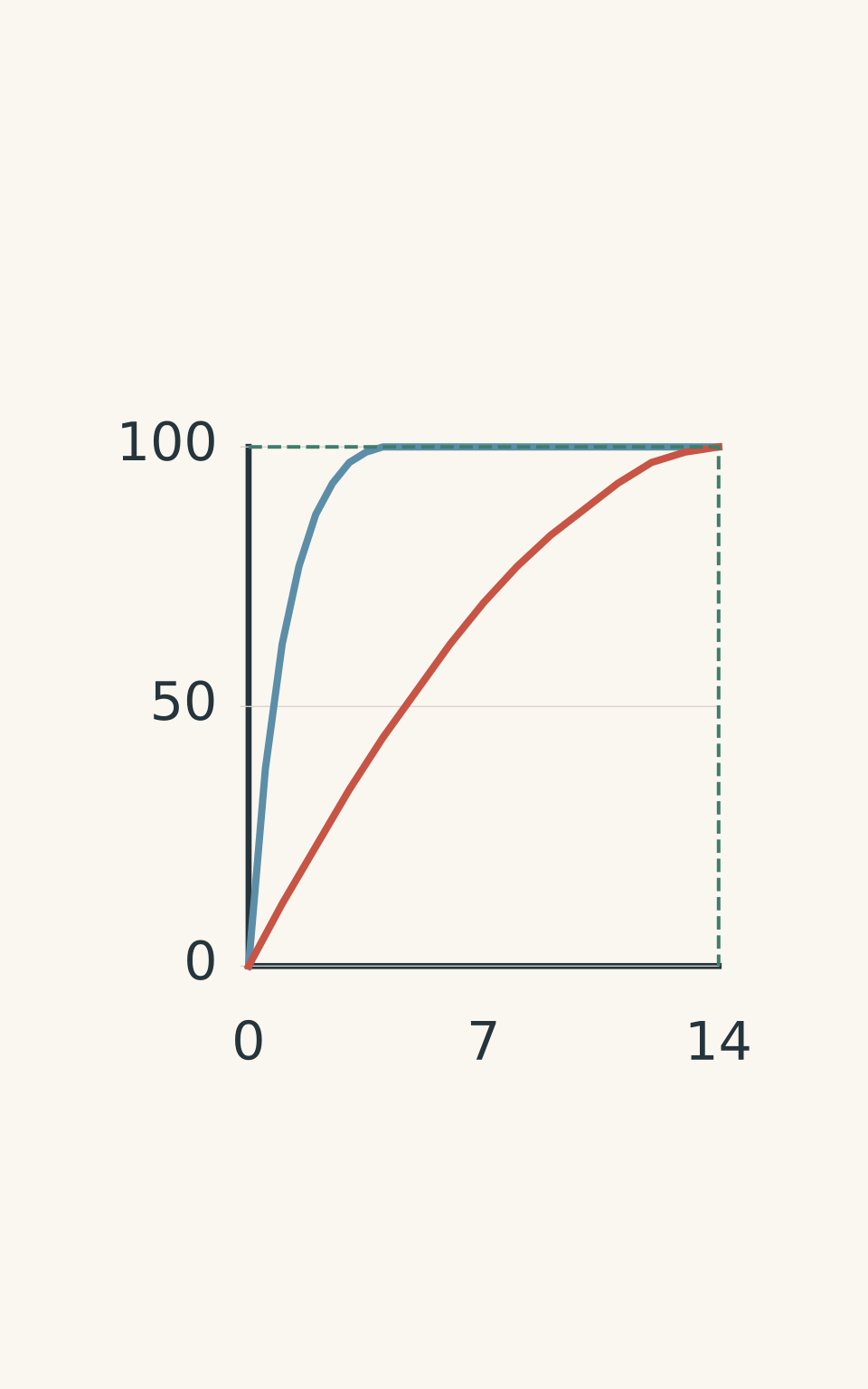
- Catalysed — steeper slope, faster heat release
- Uncatalysed — shallower slope, slower heat release
- Same final total heat released at the same reaction extent
The catalysed reaction releases heat over a shorter time. Its heat-release rate can therefore be greater, even though the total heat released for the same amount reacting to the same products is unchanged.
This is the difference between energy per unit time and energy per mole. A larger rate does not automatically mean a more negative \(\Delta H\).
03Use bond energies to estimate \(\Delta H\), not the reaction rate
Bond energies provide another way to estimate the enthalpy change. They do not tell you directly how fast a reaction will proceed.
First, remember two rules:
- Breaking bonds requires energy.
- Forming bonds releases energy.
For a reaction, the approximate enthalpy change is:
\[ \Delta H\approx \sum E_{\text{broken}} - \sum E_{\text{formed}} \]
The first sum is the energy required to break the bonds in the reactants. The second is the energy released when the product bonds form. Bond-energy calculations use mean bond enthalpies, so the result is an estimate rather than an exact value.
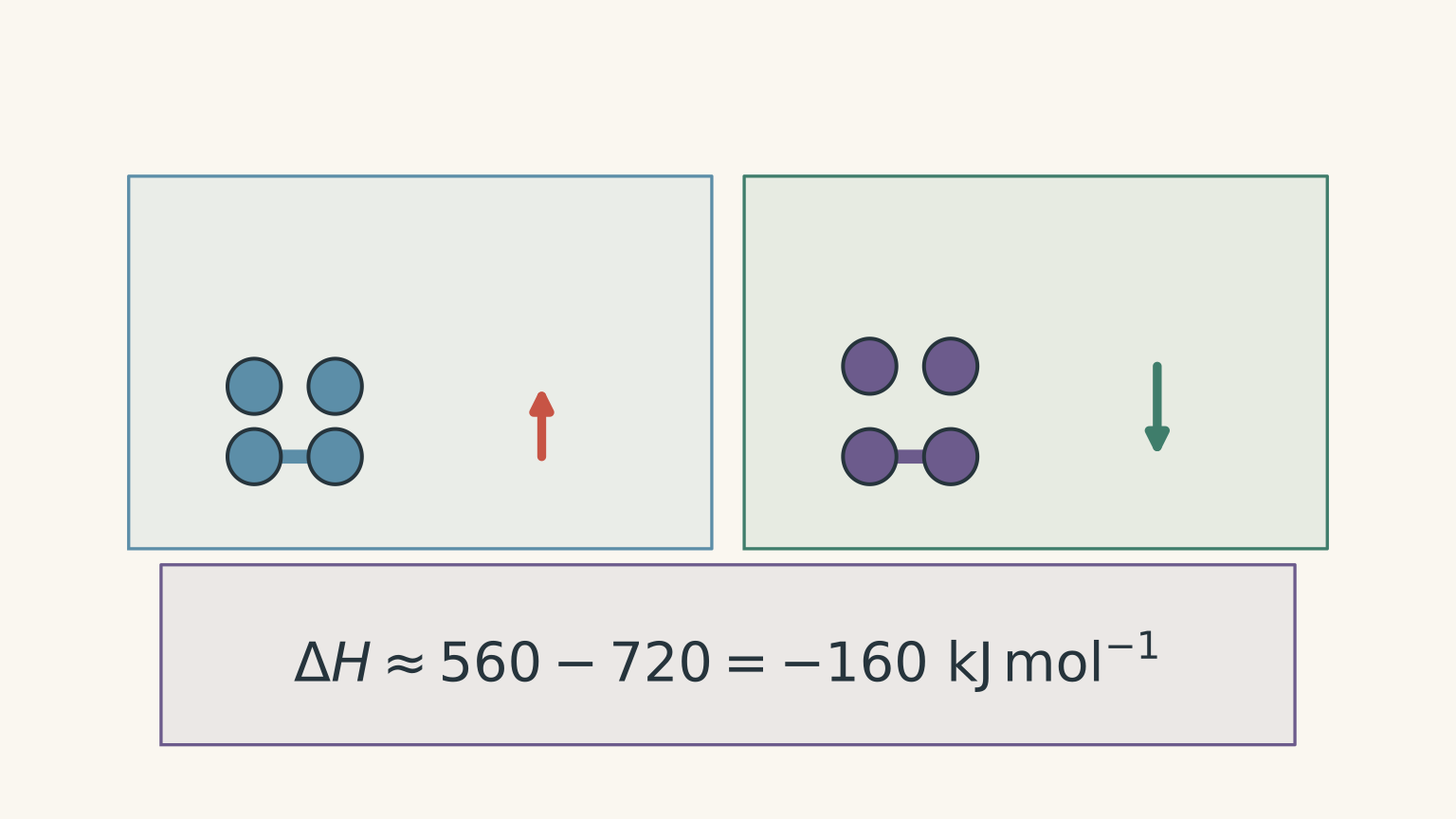
If forming the product bonds releases more energy than breaking the reactant bonds requires, the overall reaction is exothermic.
But this calculation compares the bonds in the initial and final states. It does not establish the height of the transition-state peak. Knowing the enthalpy change is therefore not enough to calculate the activation energy or determine the reaction rate.
Worked example: Bond energies and a catalyst
Breaking the reactant bonds in one mole of a reaction requires \(560\ \mathrm{kJ}\). Forming the product bonds releases \(720\ \mathrm{kJ}\). The uncatalysed forward activation energy is \(115\ \mathrm{kJ\,mol^{-1}}\), and a catalyst lowers it to \(50\ \mathrm{kJ\,mol^{-1}}\).
Estimate \(\Delta H\), then explain whether the catalyst makes the reaction more exothermic.
Step 1
\[ \begin{aligned} \Delta H&\approx E_{\text{broken}}-E_{\text{formed}}\\ &=560-720\\ &=-160\ \mathrm{kJ\,mol^{-1}} \end{aligned} \]
The reaction is exothermic, with an estimated enthalpy change of \(-160\ \mathrm{kJ\,mol^{-1}}\).
Step 2
The catalyst lowers the activation energy from \(115\) to \(50\ \mathrm{kJ\,mol^{-1}}\), a reduction of \(65\ \mathrm{kJ\,mol^{-1}}\).
At the same temperature, a lower activation barrier generally means that a greater fraction of collisions can overcome the barrier. The reaction is therefore expected to proceed faster, assuming other rate factors are comparable.
Step 3
It does not. The catalyst has changed the reaction pathway, not the reactant and product states or their bond-energy totals.
The enthalpy change remains approximately \(-160\ \mathrm{kJ\,mol^{-1}}\). The \(65\ \mathrm{kJ\,mol^{-1}}\) reduction in activation energy is not an extra \(65\ \mathrm{kJ\,mol^{-1}}\) released by the reaction.
04A decision method you can reuse in exams
When a question gives you an energy profile, bond energies, or experimental observations, use this sequence.
Step 1: Identify the quantity being asked about.
Look for the key wording.
- “How fast?” or “Which reaction has the greater rate?” asks about kinetics.
- “Calculate the activation energy” asks about the reactant-to-peak energy difference.
- “Calculate the enthalpy change” asks about the product-to-reactant energy difference.
- “How much heat was released?” may require calorimetry rather than simply reading an energy profile.
Step 2: Mark the correct energy levels.
For \(\Delta H\), mark the reactant and product levels. For forward \(E_a\), mark the reactant level and the peak. Do not measure activation energy from the horizontal axis unless that axis happens to represent the reactant energy level.
Step 3: Apply the catalyst rule.
For the same overall reaction, a catalyst lowers the activation barrier but does not change \(\Delta H\). It generally increases the rate at the same temperature.
Step 4: Apply the bond-energy rule.
Calculate the energy required to break bonds minus the energy released when product bonds form. Do not use the result to claim that the reaction must be fast or slow.
Step 5: Check whether the question involves an experiment.
A measured temperature rise is not automatically the true enthalpy change. Check whether heat was lost, whether the reaction went to completion, and whether the same amount of substance reacted.
One more detail matters when comparing diagrams: the vertical energy reference can be arbitrary. If an entire profile is shifted up or down on the page, its absolute height has no meaning by itself. Compare energy differences within the profile.
05Three incorrect explanations and how to fix them
These are the mistakes to look for when checking your own written response.
Incorrect explanation 1: “The catalyst adds energy, so the reaction becomes more exothermic.”
The correction: a catalyst provides a pathway with a lower activation energy. It does not supply the energy difference between reactants and products.
Using collision theory, explain that the lower barrier allows a greater fraction of particles to react successfully at the same temperature. The rate increases, but the enthalpy change for the same overall reaction remains unchanged.
If more heat is released per second, that is a rate effect. It does not mean more heat is released per mole of reaction.
Incorrect explanation 2: “The more exothermic reaction must be faster.”
The correction: exothermicity and reaction rate depend on different features of the reaction.
The enthalpy change compares the reactant and product energy levels. The activation energy measures the barrier that particles must overcome. A reaction can release a large amount of energy overall but still proceed slowly because its activation energy is high.
Use collision theory to explain the rate. At the same temperature, a lower activation energy generally means a greater fraction of collisions have enough energy to react, provided suitable orientation and other relevant factors are comparable.
Incorrect explanation 3: “Breaking bonds releases energy, and stronger product bonds automatically make the reaction faster.”
The correction: breaking bonds absorbs energy, while forming bonds releases energy.
Use the bond-energy relationship:
\[ \Delta H\approx \sum E_{\text{broken}} - \sum E_{\text{formed}} \]
This estimates the enthalpy change. It does not determine the activation energy or the rate.
To explain the rate, discuss the reaction pathway, activation energy, and successful collisions. Strong product bonds can contribute to a more negative \(\Delta H\), but they do not guarantee a low activation barrier.
When a temperature measurement seems to disagree
Suppose a catalysed reaction produces a larger observed temperature rise than an uncatalysed run. That result alone does not prove that the catalyst has made the reaction more exothermic.
A faster reaction may lose less heat to its surroundings before the maximum temperature is recorded. The slower reaction may lose more heat during the measurement, making its observed temperature rise smaller.
For a simple calorimetry calculation, the heat absorbed by the solution is estimated using:
\[ q_{\text{solution}}=mc\Delta T \]
Here, \(m\) is the solution mass, \(c\) is its specific heat capacity, and \(\Delta T\) is its temperature change. The heat absorbed by the calorimeter may also need to be included. Under constant-pressure conditions, the reaction’s enthalpy change is estimated from the heat released by the reaction divided by the amount that reacted, with the appropriate negative sign.
To compare the two runs reliably, control the initial conditions, use the same amounts of reactants, account for the calorimeter’s heat capacity, correct for heat loss, and check that both reactions reach the same final state.
For more on this experimental issue, see Calorimetry Heat Loss: Why Exothermic ΔH Looks Less Negative.
06Your final self-check
Before submitting an answer about reaction rates or energy profiles, check these five points:
- Have I calculated \(\Delta H\) as product enthalpy minus reactant enthalpy?
- Have I measured activation energy from the reactant level to the peak?
- If a catalyst is present, have I explained the lower barrier using collision theory without changing \(\Delta H\)?
- If bond energies are given, have I subtracted the energy released by bond formation from the energy required for bond breaking?
- If temperature measurements are given, have I considered heat loss and the amount of substance that actually reacted?
Now apply the method without relying on a memorised shortcut.
07Questions and solutions
Question 1
An energy profile has reactants at \(65\ \mathrm{kJ\,mol^{-1}}\), products at \(25\ \mathrm{kJ\,mol^{-1}}\), and an uncatalysed peak at \(110\ \mathrm{kJ\,mol^{-1}}\). A catalyst lowers the peak to \(85\ \mathrm{kJ\,mol^{-1}}\).
Calculate \(\Delta H\), the uncatalysed forward activation energy, and the catalysed forward activation energy. State whether the catalyst makes the reaction more exothermic.
Solution 1
The reaction has \(\Delta H=-40\ \mathrm{kJ\,mol^{-1}}\), and the catalyst lowers the forward activation energy from \(45\) to \(20\ \mathrm{kJ\,mol^{-1}}\) without changing the enthalpy change.
First, compare the product and reactant levels:
\[ \Delta H=25-65=-40\ \mathrm{kJ\,mol^{-1}} \]
Next, measure the uncatalysed barrier from the reactants to the peak:
\[ E_{a,f}=110-65=45\ \mathrm{kJ\,mol^{-1}} \]
For the catalysed pathway:
\[ E_{a,f}=85-65=20\ \mathrm{kJ\,mol^{-1}} \]
The activation energy decreases by \(25\ \mathrm{kJ\,mol^{-1}}\). This favours a faster reaction at the same temperature, assuming comparable collision factors.
The enthalpy change stays at \(-40\ \mathrm{kJ\,mol^{-1}}\) because the reactant and product energy levels are unchanged. A lower peak does not mean a less exothermic reaction.
Question 2
For one mole of a reaction, breaking the reactant bonds requires \(480\ \mathrm{kJ}\), while forming the product bonds releases \(610\ \mathrm{kJ}\). The uncatalysed forward activation energy is \(85\ \mathrm{kJ\,mol^{-1}}\).
Estimate \(\Delta H\). Then suppose a catalyst provides an alternative single-step pathway with a forward activation energy of \(40\ \mathrm{kJ\,mol^{-1}}\). Calculate the reverse activation energy before and after catalysis, assuming the same reactant and product states.
Solution 2
The estimated enthalpy change is \(-130\ \mathrm{kJ\,mol^{-1}}\), the uncatalysed reverse activation energy is \(215\ \mathrm{kJ\,mol^{-1}}\), and the catalysed reverse activation energy is \(170\ \mathrm{kJ\,mol^{-1}}\).
First, estimate the enthalpy change from the bond energies:
\[ \begin{aligned} \Delta H&\approx480-610\\ &=-130\ \mathrm{kJ\,mol^{-1}} \end{aligned} \]
For a single-step profile, the relationship between forward and reverse activation energies is:
\[ E_{a,r}=E_{a,f}-\Delta H \]
Before catalysis:
\[ E_{a,r}=85-(-130)=215\ \mathrm{kJ\,mol^{-1}} \]
After catalysis:
\[ E_{a,r}=40-(-130)=170\ \mathrm{kJ\,mol^{-1}} \]
The catalyst lowers the forward activation energy by \(45\ \mathrm{kJ\,mol^{-1}}\), and the reverse activation energy also decreases by \(45\ \mathrm{kJ\,mol^{-1}}\).
This is consistent with a single transition state being lowered while the endpoint energies remain fixed. The catalyst changes the reaction pathway, not the estimated enthalpy change.
Question 3
Two reactions occur at the same temperature and concentrations.
- Reaction A: \(\Delta H=-180\ \mathrm{kJ\,mol^{-1}}\), \(E_a=145\ \mathrm{kJ\,mol^{-1}}\).
- Reaction B: \(\Delta H=-35\ \mathrm{kJ\,mol^{-1}}\), \(E_a=55\ \mathrm{kJ\,mol^{-1}}\).
Assume their collision frequencies, orientation factors, and other relevant rate factors are comparable.
Which reaction is expected to be faster? Which is more exothermic? A catalyst lowers the activation energy of reaction A to \(40\ \mathrm{kJ\,mol^{-1}}\). Which reaction is now expected to be faster, and can you calculate the exact ratio of their rates from the information given?
Solution 3
Reaction B is expected to be faster before catalysis, while reaction A is more exothermic. After catalysis, reaction A is expected to be faster under the stated assumptions, but the exact rate ratio cannot be calculated from these values alone.
Before catalysis, reaction B has the lower activation energy:
\[ 55<145\ \mathrm{kJ\,mol^{-1}} \]
At the same temperature and with comparable rate factors, a greater fraction of collisions can overcome B’s lower barrier.
Reaction A is more exothermic because its enthalpy change is more negative:
\[ -180<-35\ \mathrm{kJ\,mol^{-1}} \]
That does not make A faster. Its higher activation energy can make it slower despite releasing more energy per mole.
After catalysis, A’s activation energy is \(40\ \mathrm{kJ\,mol^{-1}}\), which is lower than B’s \(55\ \mathrm{kJ\,mol^{-1}}\). Under the stated assumptions, A is now expected to be faster.
However, the exact rate ratio also depends on the temperature and the reactions’ kinetic factors. Activation energies and enthalpy changes alone do not supply enough information to calculate that ratio.
Question 4
Two calorimetry runs use the same initial amounts of reactants and are intended to produce the same final products. Both use identical cups, but the cups lose heat to the surroundings.
With a catalyst, the reaction finishes in \(25\) seconds and the observed maximum temperature rise is \(8.0^\circ\mathrm{C}\). Without a catalyst, the reaction takes \(3\) minutes and the observed maximum temperature rise is \(6.3^\circ\mathrm{C}\).
A student concludes that the catalysed reaction has a more negative enthalpy change. Evaluate the conclusion and explain how the experiment should be improved to compare \(\Delta H\) reliably.
Solution 4
The conclusion is not justified: the larger observed temperature rise does not establish that the catalysed reaction has a more negative \(\Delta H\).
The catalysed reaction releases its heat over a shorter time. Because the cup loses heat to the surroundings, the slower reaction may lose more energy before its maximum temperature is recorded. Its measured temperature rise can therefore be smaller even if the true enthalpy change per mole is identical.
To improve the comparison, the experiment should use the same initial conditions and reactant amounts, account for the calorimeter’s heat capacity, correct for heat loss, and verify that both runs reach the same final state.
The heat absorbed by the solution can be estimated from \(q=mc\Delta T\), where \(q\) is heat, \(m\) is solution mass, \(c\) is specific heat capacity, and \(\Delta T\) is the temperature change. The calorimeter’s heat absorption must also be considered. The corrected heat released by the reaction is then divided by the number of moles that reacted, with the appropriate sign for \(\Delta H\).
The key distinction is between the rate at which heat is released and the total heat released for a given amount of reaction. A catalyst can change the first without changing the second.
Question 5
An elementary reversible reaction, \(R \rightleftharpoons P\), has an enthalpy change of \(-50\ \mathrm{kJ\,mol^{-1}}\) in the forward direction.
Before catalysis, its forward activation energy is \(90\ \mathrm{kJ\,mol^{-1}}\), and its reverse activation energy is \(140\ \mathrm{kJ\,mol^{-1}}\).
After a catalyst is introduced, one team reports a forward activation energy of \(30\ \mathrm{kJ\,mol^{-1}}\). Another team reports a reverse activation energy of \(100\ \mathrm{kJ\,mol^{-1}}\).
Assume the reaction follows a single-transition-state pathway in both directions, the catalyst connects the same reactant and product states, and the reported activation energies are intended to describe that same catalysed pathway.
In a separate, poorly insulated calorimetry experiment, the catalysed reaction has a steeper temperature rise and a maximum temperature rise that is 10% greater. A report concludes that the catalyst has made the reaction more exothermic and shifted the equilibrium towards \(P\).
Determine whether the activation-energy measurements are consistent. Evaluate the report’s two conclusions, and explain what the calorimetry observation can establish.
Solution 5
The activation-energy measurements are inconsistent under the stated assumptions: if the catalysed forward activation energy is \(30\ \mathrm{kJ\,mol^{-1}}\), the reverse activation energy must be \(80\ \mathrm{kJ\,mol^{-1}}\), not \(100\ \mathrm{kJ\,mol^{-1}}\). The calorimetry observation does not establish a change in \(\Delta H\), and the catalyst does not shift the equilibrium composition at a fixed temperature.
Step 1: Check that the uncatalysed values are consistent.
For a single transition state, the forward and reverse activation energies obey:
\[ \Delta H=E_{a,f}-E_{a,r} \]
Using the uncatalysed values:
\[ \Delta H=90-140=-50\ \mathrm{kJ\,mol^{-1}} \]
These values agree with the stated enthalpy change.
Step 2: Calculate the reverse activation energy implied by the catalysed forward value.
Rearrange the relationship:
\[ E_{a,r}=E_{a,f}-\Delta H \]
Substitute the catalysed forward activation energy and the unchanged enthalpy change:
\[ \begin{aligned} E_{a,r}&=30-(-50)\\ &=80\ \mathrm{kJ\,mol^{-1}} \end{aligned} \]
The reverse activation energy must therefore be \(80\ \mathrm{kJ\,mol^{-1}}\) for the specified pathway.
The reported value of \(100\ \mathrm{kJ\,mol^{-1}}\) would instead imply:
\[ \Delta H=30-100=-70\ \mathrm{kJ\,mol^{-1}} \]
That conflicts with the stated \(-50\ \mathrm{kJ\,mol^{-1}}\). At least one reported value or modelling assumption must be wrong. The catalyst cannot independently assign incompatible forward and reverse barriers to the same single-transition-state profile while keeping the endpoint energies fixed.
Step 3: Evaluate the claim about equilibrium.
The claim that the catalyst shifts equilibrium towards \(P\) is incorrect.
At a fixed temperature, a catalyst does not change the equilibrium constant. It lowers the barrier for the catalysed pathway in both directions, allowing the system to approach equilibrium more quickly. At equilibrium, the forward and reverse reaction rates remain equal.
A faster initial formation of \(P\) does not mean that a greater proportion of \(P\) will be present at equilibrium.
Step 4: Evaluate the calorimetry result.
The steeper temperature rise is consistent with faster heat release. The 10% greater observed maximum temperature rise, however, does not prove that the reaction has become more exothermic.
Because the calorimeter is poorly insulated, the uncatalysed reaction may lose more heat to the surroundings before its maximum temperature is recorded. The difference in observed temperature rises could therefore reflect different heat losses rather than a different enthalpy change.
To test the enthalpy change, the experiment needs a reliable heat-loss correction and a comparison of the heat released per mole for the same overall reaction and final state.
The deeper lesson is that the three measurements answer different questions. Activation energies constrain the reaction pathway, equilibrium describes the final composition at a fixed temperature, and calorimetry estimates heat transfer. If these results appear to contradict one another, check the assumptions and measurements before claiming that the catalyst has changed the enthalpy change.