
Why Do I Forget What I Studied When I Open an HSC Question?
Understand why familiar revision questions feel easy but unfamiliar HSC questions leave you stuck. Learn to diagnose cue-dependent retrieval, recognise concepts in new contexts, and practise applying what you know independently.
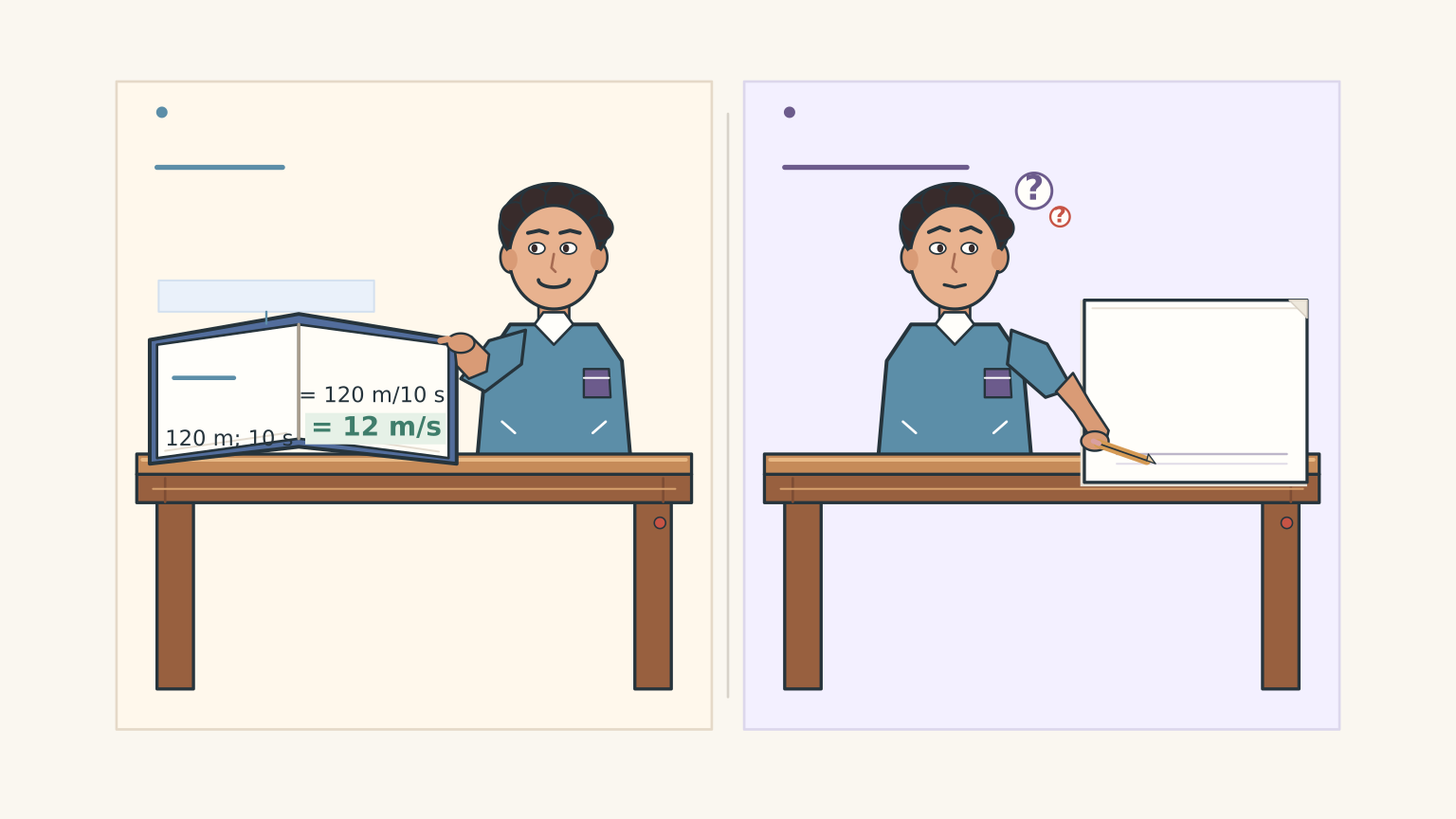
You can explain a topic perfectly while revising, then open an HSC question and feel as if you’ve never studied it. The knowledge hasn’t necessarily disappeared. Often, you’ve learnt to retrieve it when familiar cues are present: a chapter heading, a formula printed beside the question, or the layout of a worked example. When those cues change, you struggle to recognise which knowledge to use.
This is called cue-dependent retrieval. It helps explain why recognising a solution during revision is not the same as being able to produce one independently in an exam.
There is a second problem, too. Even if you remember the relevant concept, you might not recognise it when an unfamiliar question describes the same idea in different words. That’s a problem with transferring knowledge, not necessarily remembering it.
The important thing is to work out which problem you’re experiencing. Otherwise, you can spend hours rereading material that you already understand.
Due to technical limitations, this figure may display incorrectly or contain inaccuracies. Please check key details against your course materials.
01Why studying can feel easier than answering questions
Imagine hearing the first few notes of a song and immediately recognising it. Now imagine being asked to sing the same song without hearing its introduction.
The first situation gives you a retrieval cue. The second requires you to produce the information without that familiar starting point.
Studying can work in a similar way.
When you revise a topic, you often encounter the same cues repeatedly:
- A heading tells you which concept you’re studying.
- A worked example shows you which equation to use.
- Your notes place related information together.
- A familiar question format suggests the first step.
- A teacher’s explanation reminds you of the relevant principle.
These cues make information easier to access.
The problem arises when you become dependent on them. You might remember how to solve a question about Newton’s second law when the heading is visible, but struggle when an exam describes a trolley accelerating under several forces without mentioning Newton’s laws.
The underlying physics hasn’t changed. The route to recognising it has.
This is an example of cue-dependent retrieval: information can be easier to retrieve when the cues present during learning are also present during testing.
The analogy with recognising a song has limits. An HSC question isn’t completely without cues. It contains information about the situation, but you have to interpret that information and decide which details matter.
Recognition, recall, and transfer are different skills
These three abilities are closely related, but they aren’t interchangeable.
| Skill | What you’re doing | Example |
|---|---|---|
| Recognition | Identifying something familiar when you see it | Recognising \(F=ma\) in your revision notes |
| Recall | Producing information without being shown the answer | Writing Newton’s second law from memory |
| Transfer | Applying knowledge in a different context | Recognising that a question about a lift requires Newton’s second law |
You can be strong at recognition but weak at recall. You can also remember an equation perfectly but struggle to identify when it applies.
This explains an important distinction:
Knowing a formula and knowing when to use it are two separate achievements.
HSC questions frequently require both.
An unfamiliar context doesn’t necessarily mean the question requires unfamiliar knowledge. Often, the situation has changed while the underlying principle remains the same.
However, sometimes the conditions really have changed, and that can change which principle applies. You need to recognise that distinction as well.
02Diagnose what is actually going wrong
Before changing your revision routine, test where the problem occurs.
A useful diagnostic is to attempt three versions of a question about the same concept.
Choose something you’ve recently studied, such as Newton’s laws, equilibrium, differentiation, or limiting reagents.
The three-prompt test
Attempt A: Familiar and labelled
Find a straightforward question with the topic clearly identified.
For example:
Newton’s second law: A 2.0 kg trolley experiences a net force of 6.0 N. Calculate its acceleration.
This tests whether you can perform the familiar method.
Attempt B: Familiar concept, unfamiliar wording
Now remove the topic heading and change the wording without changing the underlying physics or mathematical difficulty.
For example:
A 2.0 kg trolley is pushed horizontally with a force of 8.0 N. Friction acts in the opposite direction with a force of 2.0 N. Determine the trolley’s acceleration.
The question now requires you to recognise that you need the net force before applying Newton’s second law.
Attempt C: A changed context
Try another question involving the same underlying principle, but change the physical situation or representation.
For example, consider an elevator accelerating upwards. You must identify the forces acting on it and determine the resultant force before calculating its acceleration.
This tests whether you can transfer the principle to a different situation.
Keep the mathematical difficulty similar. Don’t turn Attempt C into a much harder question involving several additional concepts. Otherwise, you won’t know what caused the difficulty.
If you’re testing recall, close your notes. However, if a formula sheet would normally be supplied in your assessment, keep that available consistently across all three attempts. You want to test your ability to recognise and apply the principle, not accidentally test something different.
Interpret your results
Your results can help identify the problem.
| Your result | What it suggests | What to work on |
|---|---|---|
| You struggle with A, even when the topic is named | The underlying knowledge may not be secure | Rebuild your understanding of the concept |
| You solve A but struggle with B | You may depend on familiar cues or struggle to interpret wording | Practise retrieving the same idea without topic headings |
| You solve B but struggle with C | Your transfer or problem-representation skills may need work | Practise applying the principle in different contexts |
| You identify the principle but choose the wrong equation or setup | You may not understand the conditions under which the principle applies | Focus on explaining why the method works |
| You set up the question correctly but make algebra, sign, or unit errors | The problem is more likely execution than retrieval | Practise checking calculations and working |
These patterns aren’t perfect diagnoses. One question can involve several difficulties at once.
The point is to identify the earliest step at which you get stuck.
For example, if you can explain a concept once someone mentions its name, that is useful evidence. It suggests the knowledge is accessible with a strong cue. Your next task is to learn to recognise the situation that calls for it.
03Two examples of unfamiliar wording in HSC subjects
Let’s see how this works in actual subject questions.
Worked example: Recognising Newton’s second law without the heading
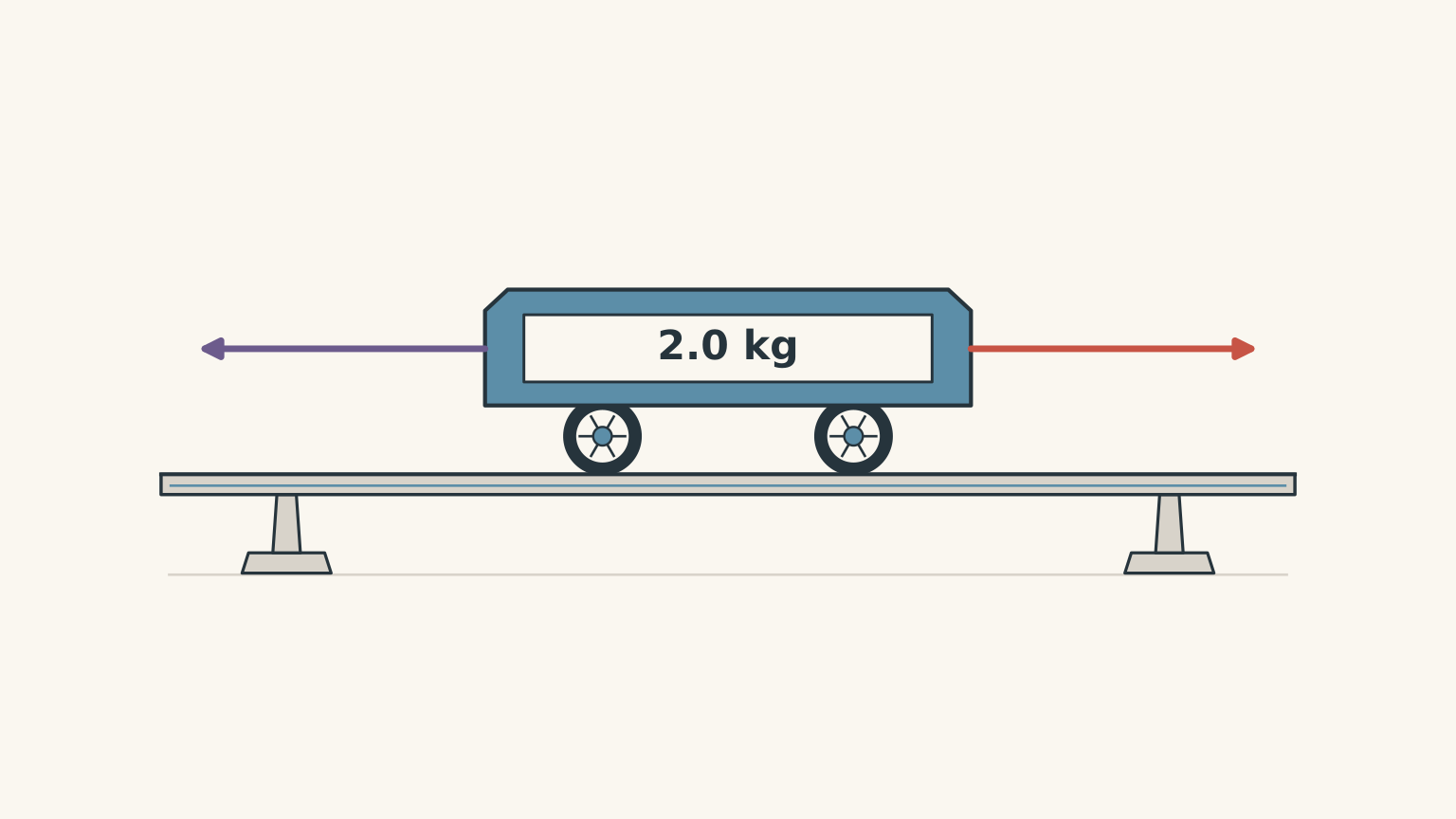
A 2.0 kg trolley is pushed horizontally to the right with a force of 8.0 N. Friction acts to the left with a force of 2.0 N. Determine the trolley’s acceleration.
Step 1
There are two horizontal forces:
- Applied force: 8.0 N to the right.
- Friction: 2.0 N to the left.
The forces act in opposite directions, so they cannot simply be added.
Step 2
Taking right as positive:
\[ F_{\text{net}}=8.0-2.0 \]
\[ F_{\text{net}}=6.0\text{ N} \]
The net force is 6.0 N to the right.
Step 3
Newton’s second law states that the net force on an object equals its mass multiplied by its acceleration:
\[ F_{\text{net}}=ma \]
Rearrange to make acceleration the subject:
\[ a=\frac{F_{\text{net}}}{m} \]
Substitute the values:
\[ a=\frac{6.0}{2.0} \]
\[ \boxed{a=3.0\text{ m s}^{-2}} \]
The trolley accelerates at 3.0 m s\(^{-2}\) to the right.
What does this tell us about cue dependence?
A student who remembers \(F=ma\) but calculates \(8.0/2.0=4.0\text{ m s}^{-2}\) has not necessarily forgotten the equation.
They have failed to identify the net force.
A student who can solve the question when it is labelled Newton’s second law but cannot start when the heading is removed may have a separate problem with cue-dependent retrieval.
These are different difficulties, so they need different practice.
Due to technical limitations, this figure may display incorrectly or contain inaccuracies. Please check key details against your course materials.
Worked example: Recognising limiting reagents without the familiar terminology
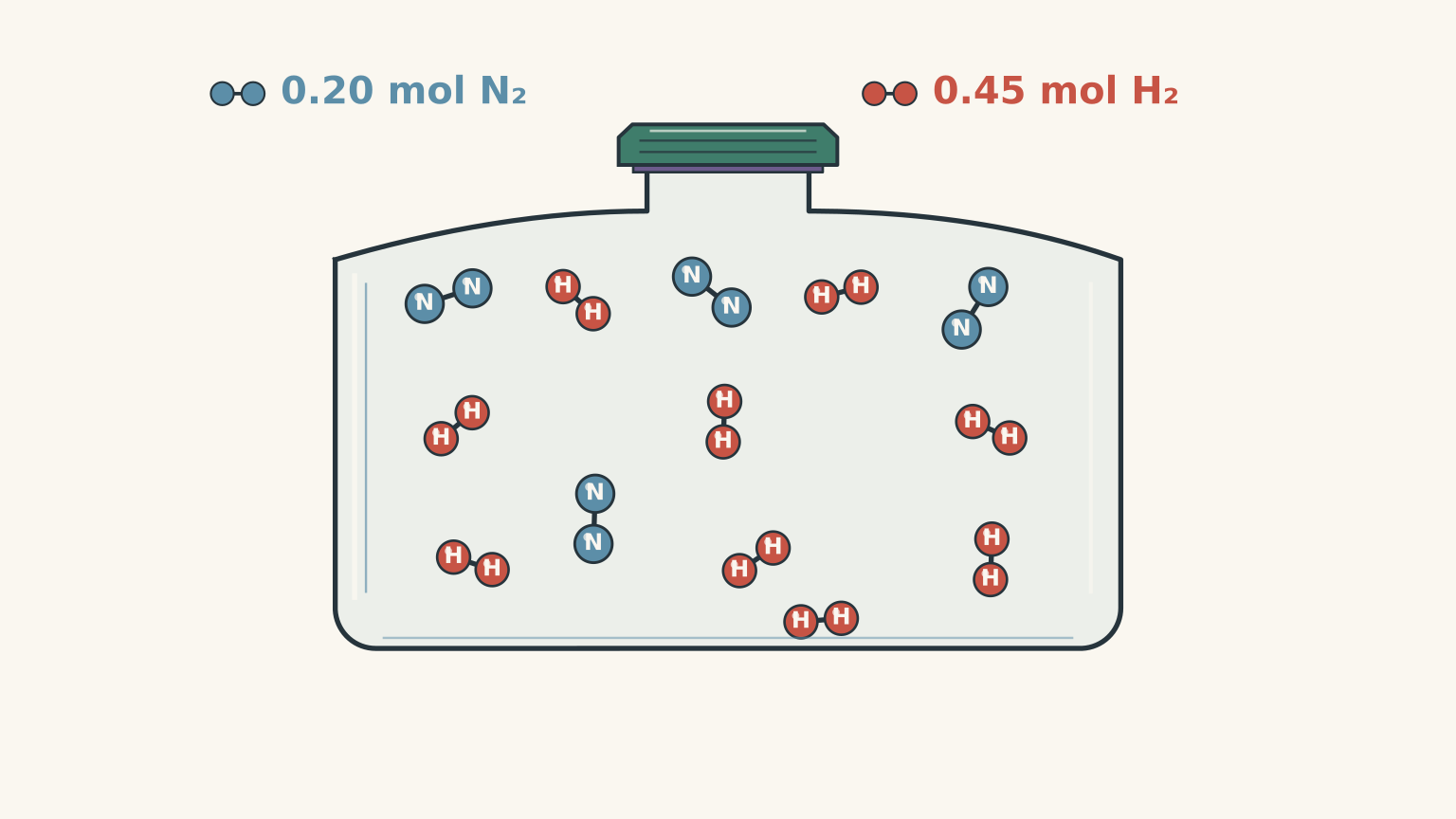
A sealed vessel contains 0.20 mol of nitrogen gas and 0.45 mol of hydrogen gas.
The gases react according to:
\[ \ce{N2 + 3H2 -> 2NH3} \]
Assuming the reaction proceeds to completion with no side reactions, determine which reactant is used up first and calculate the maximum amount of ammonia produced.
Step 1
The balanced equation tells us that:
- 1 mol of nitrogen reacts with 3 mol of hydrogen.
- 2 mol of ammonia are produced for every 3 mol of hydrogen consumed.
The ratio is important because the reactants are not consumed in equal amounts.
Step 2
We have 0.20 mol of nitrogen.
The required amount of hydrogen is:
\[ n(\ce{H2})=0.20\times 3 \]
\[ n(\ce{H2})=0.60\text{ mol} \]
However, the vessel only contains 0.45 mol of hydrogen.
Therefore, hydrogen will be used up first.
Step 3
Use the mole ratio between hydrogen and ammonia:
\[ n(\ce{NH3})=0.45\times\frac{2}{3} \]
\[ \boxed{n(\ce{NH3})=0.30\text{ mol}} \]
Step 4
The amount of nitrogen consumed is:
\[ n(\ce{N2})=0.45\times\frac{1}{3} \]
\[ n(\ce{N2})=0.15\text{ mol} \]
Therefore, the nitrogen remaining is:
\[ 0.20-0.15=0.05\text{ mol} \]
The result is consistent: hydrogen is completely consumed, while some nitrogen remains.
What does this tell us about cue dependence?
Notice that the question never uses the words limiting reagent.
Instead, it asks which reactant is used up first.
A student who can perform limiting-reagent calculations when the topic heading is provided might struggle to recognise the same task here.
The chemistry hasn’t changed. The student needs to connect the wording of the question to the underlying stoichiometric relationship.
For further help organising the knowledge needed to make these connections, see How to Make HSC Physics Revision Notes That Solve Questions and How to Organise HSC Chemistry Notes by Reactions, Evidence and Calculations.
Due to technical limitations, this figure may display incorrectly or contain inaccuracies. Please check key details against your course materials.
04A practical retrieval-to-transfer exercise
You can use this exercise after studying almost any HSC topic.
It takes approximately 15-20 minutes. Its purpose isn’t to replace your existing recall or spaced-retrieval routine. It adds a different test: can you use the knowledge when the question doesn’t look like your revision material?
Step 1: Retrieve the concept without notes
Choose one concept you’ve recently studied.
Close your notes and write down:
- The main principle or relationship.
- Any relevant equation.
- What each symbol represents.
- The conditions under which the principle applies.
- A simple example of when you would use it.
For example, if you’re revising Newton’s second law, you should be able to explain that acceleration depends on the resultant force and the object’s mass.
Don’t worry about making your explanation sound like a textbook. You want to establish whether you understand the idea.
Step 2: Solve a familiar question
Choose a standard question that looks similar to the examples you’ve studied.
Solve it without looking at the worked solution.
Pay attention to the first decision you make.
Did you immediately recognise the relevant principle? Did you know which quantities to identify? Could you explain why the equation applied?
Step 3: Remove the familiar cues
Now find another question testing the same concept.
Remove any topic heading or instruction that tells you which method to use.
Try to solve it independently.
If you get stuck, don’t immediately read the solution. Give yourself a short opportunity to work out what the question is asking.
Ask yourself:
- What situation is being described?
- What information have I been given?
- What am I trying to calculate or explain?
- Which principle connects the information to the required answer?
The aim is to make the connection yourself.
Step 4: Change the context
Now make the question slightly different.
You could:
- Change the physical situation while keeping the same physics principle.
- Present the same chemistry concept using different experimental observations.
- Give a mathematical relationship in graphical form instead of algebraic form.
- Ask for an unknown quantity that you haven’t calculated in the familiar example.
- Reverse the reasoning by giving the outcome and asking what caused it.
Only change one major feature at first.
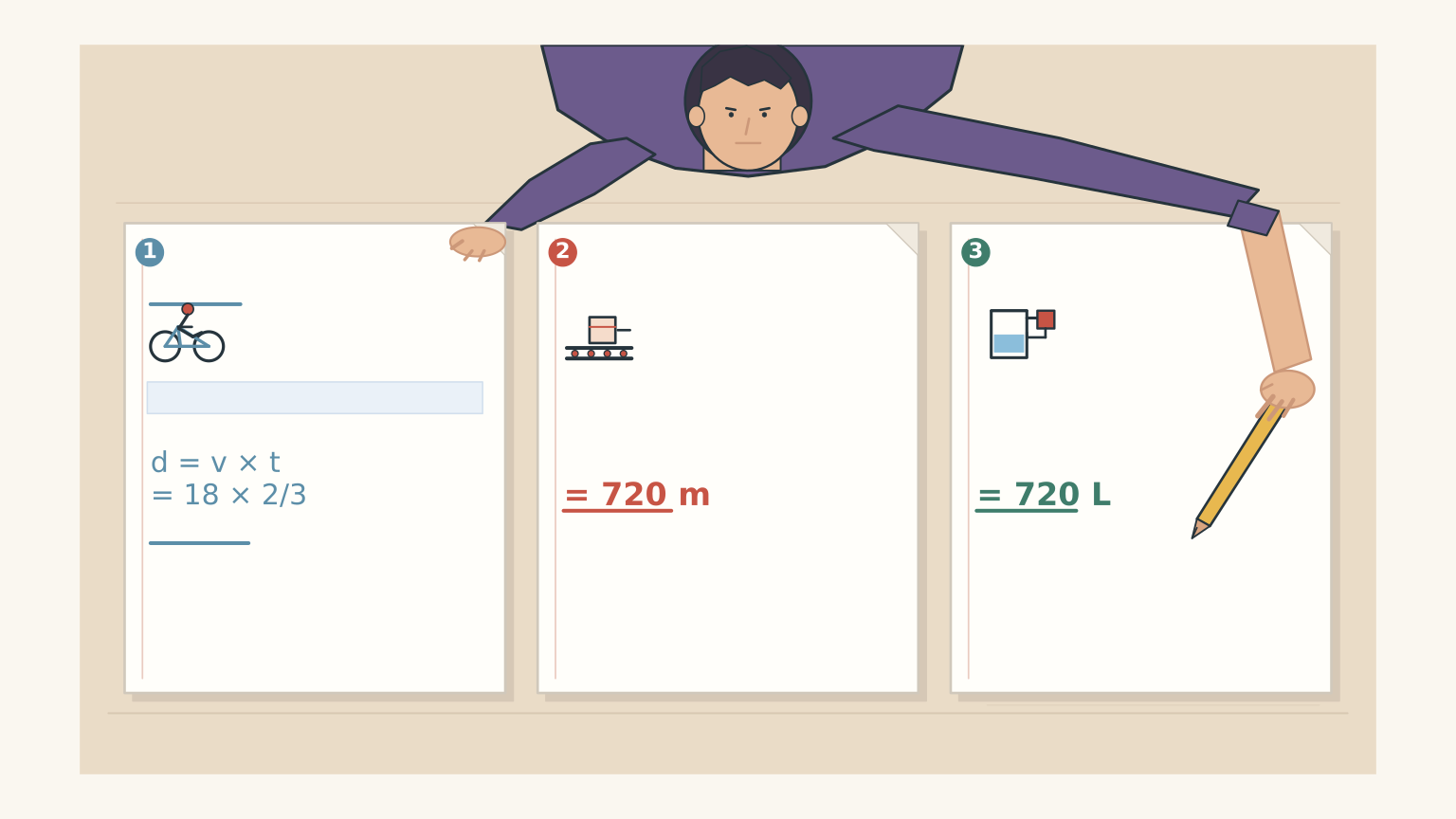
For example, if you understand acceleration questions involving a trolley, try an elevator or a cyclist. The objects change, but the underlying relationship between net force, mass, and acceleration can remain the same.
Step 5: Identify the exact point of failure
After checking your work, classify the problem.
| Code | Type of difficulty | What happened? |
|---|---|---|
| R | Retrieval | You couldn’t produce the relevant knowledge |
| S | Selection | You knew the principle but couldn’t identify that it applied |
| I | Interpretation | You misunderstood the question or its wording |
| E | Execution | You selected the correct method but made an error carrying it out |
You can have more than one type of error in the same question.
For example, you might initially struggle to recognise a Newton’s laws question, then make an algebra error after finding the correct equation.
Record both. Otherwise, you might incorrectly conclude that you need to revise Newton’s laws again when the remaining problem is actually mathematical execution.
Due to technical limitations, this figure may display incorrectly or contain inaccuracies. Please check key details against your course materials.
Step 6: Use the smallest useful hint
If you get stuck, try revealing one hint at a time.
For example:
- First hint: the general topic.
- Second hint: the relevant principle in words.
- Third hint: a diagram or representation.
- Fourth hint: the equation.
Notice which hint allows you to continue.
If seeing the topic name immediately unlocks the question, that’s evidence of cue dependence.
If you recognise the topic but still don’t understand which equation applies, you may have a problem with the underlying conditions or with translating the question into a mathematical model.
If you can set up the equation but cannot complete the calculation, you need to work on execution.
This is much more useful than immediately reading a complete worked solution and assuming you understand it because every step looks familiar.
Once you’ve corrected the problem, return to the question later as part of your usual spaced-retrieval practice.
05Questions and solutions
Question 1
A student is revising electricity.
When looking at a page headed Ohm’s law, they can immediately identify the equation \(V=IR\) and solve straightforward questions.
However, when they encounter an otherwise similar question without the topic heading, they struggle to begin.
They can still explain what voltage, current, and resistance mean.
What is the most likely problem? Suggest one fair test to confirm your explanation.
Solution 1
The student is most likely experiencing cue-dependent retrieval or difficulty selecting the relevant relationship independently.
They recognise Ohm’s law when the topic heading provides a strong cue, but they struggle when that cue is removed.
Their ability to explain voltage, current, and resistance suggests that some underlying understanding is present. However, this does not establish that they can independently retrieve and apply the relationship.
A fair test would use two questions with the same circuit information and numerical difficulty.
- In the first question, provide the heading Ohm’s law.
- In the second question, remove the heading and change only the wording.
Keep everything else as similar as possible.
If the student solves the first question but cannot identify the relationship in the second, that supports the cue-dependence explanation.
The next step is to practise identifying relationships from the information given, rather than relying on topic headings to make the decision.
Question 2
A lift has a mass of 60 kg and a weight of 600 N. Its cable exerts an upward tension of 720 N.
Assume \(g=10\text{ m s}^{-2}\).
The lift starts from rest.
Determine its acceleration. Then explain why a student who calculates \(720/60=12\text{ m s}^{-2}\) has made a mistake. Does this necessarily mean they have forgotten Newton’s second law?
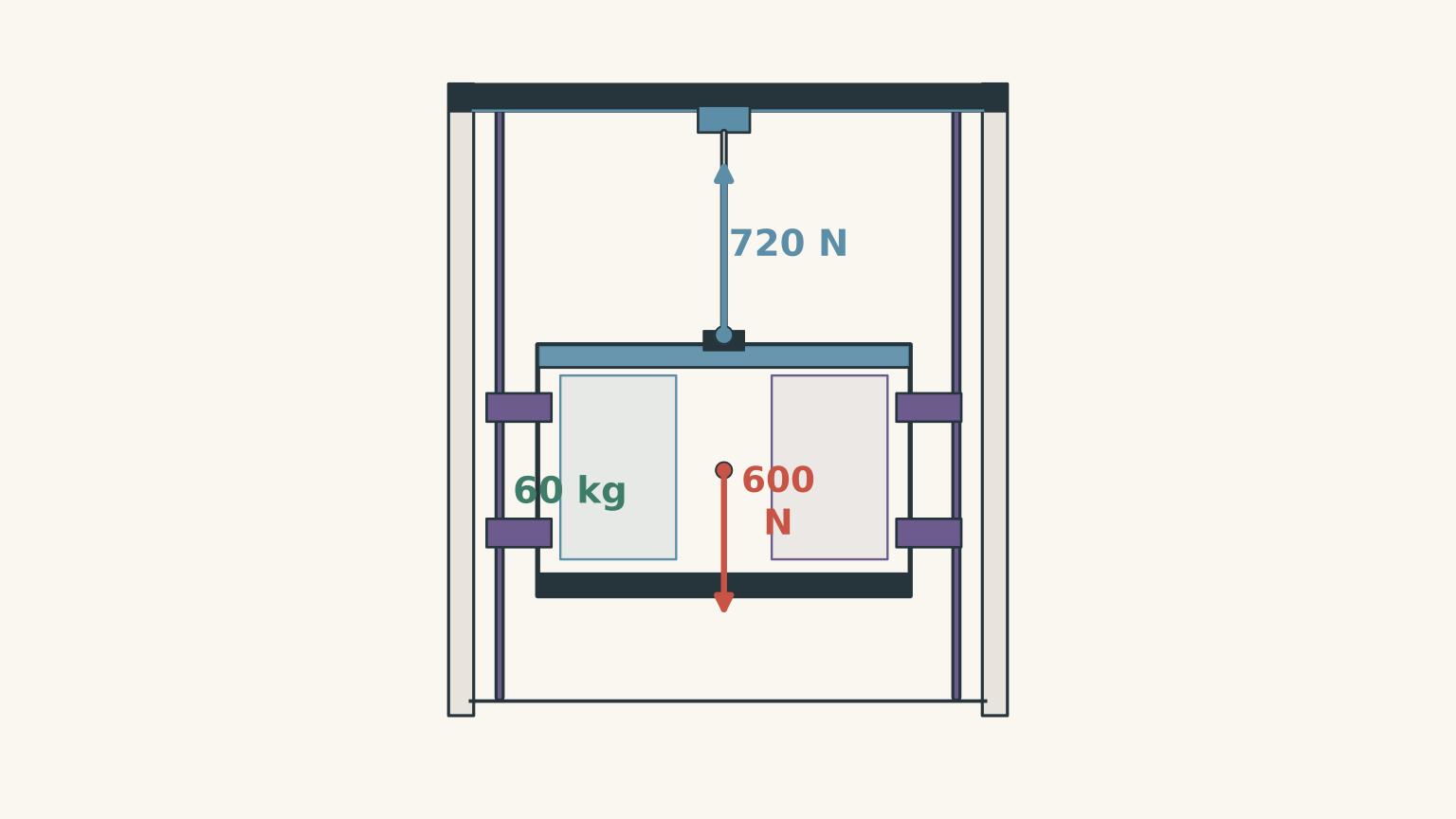
Due to technical limitations, this figure may display incorrectly or contain inaccuracies. Please check key details against your course materials.
Solution 2
The lift accelerates upwards at \(2.0\text{ m s}^{-2}\). The student has incorrectly treated the cable tension as the net force.
Start by identifying the forces acting on the lift.
There are two vertical forces:
- Tension: 720 N upwards.
- Weight: 600 N downwards.
Step 1: Calculate the resultant force.
Taking upwards as positive:
\[ F_{\text{net}}=720-600 \]
\[ F_{\text{net}}=120\text{ N} \]
The resultant force is 120 N upwards.
Step 2: Apply Newton’s second law.
\[ F_{\text{net}}=ma \]
Rearrange:
\[ a=\frac{F_{\text{net}}}{m} \]
Substitute:
\[ a=\frac{120}{60} \]
\[ \boxed{a=2.0\text{ m s}^{-2}} \]
The lift accelerates upwards at \(2.0\text{ m s}^{-2}\).
Step 3: Identify the student’s mistake.
The student has calculated:
\[ a=\frac{720}{60}=12\text{ m s}^{-2} \]
This calculation uses the tension force as though it were the resultant force.
However, the lift’s weight also acts on it. Newton’s second law requires the net force, not just one of the forces acting on the object.
The student may actually remember Newton’s second law perfectly. The problem is that they haven’t correctly represented the physical situation.
There is another detail worth noticing: the lift starts from rest.
This information is not needed to calculate its acceleration. It would become relevant if the question asked for its velocity after a specified time.
That is another useful exam skill: recognising which information matters and which information is unnecessary for the calculation.
Question 3
Two identical carts are released from rest at the same vertical height and travel down separate tracks. Both tracks have the same vertical drop of 1.2 m.
- Track A is frictionless.
- Track B is rough, and friction transfers some of the carts’ mechanical energy into thermal energy.
Ignore air resistance and assume no other energy is supplied to either cart.
A student can solve a question about Track A when explicitly told to use conservation of mechanical energy. However, without that instruction, they cannot identify the method.
When asked about Track B, they confidently predict that the cart will have exactly the same speed at the bottom as the cart on Track A, arguing that energy is always conserved.
Identify the two separate weaknesses in the student’s reasoning.
Then propose a pair of tests that would distinguish cue-dependent retrieval from a misunderstanding of when mechanical energy is conserved.
Do not calculate a numerical speed for Track B.
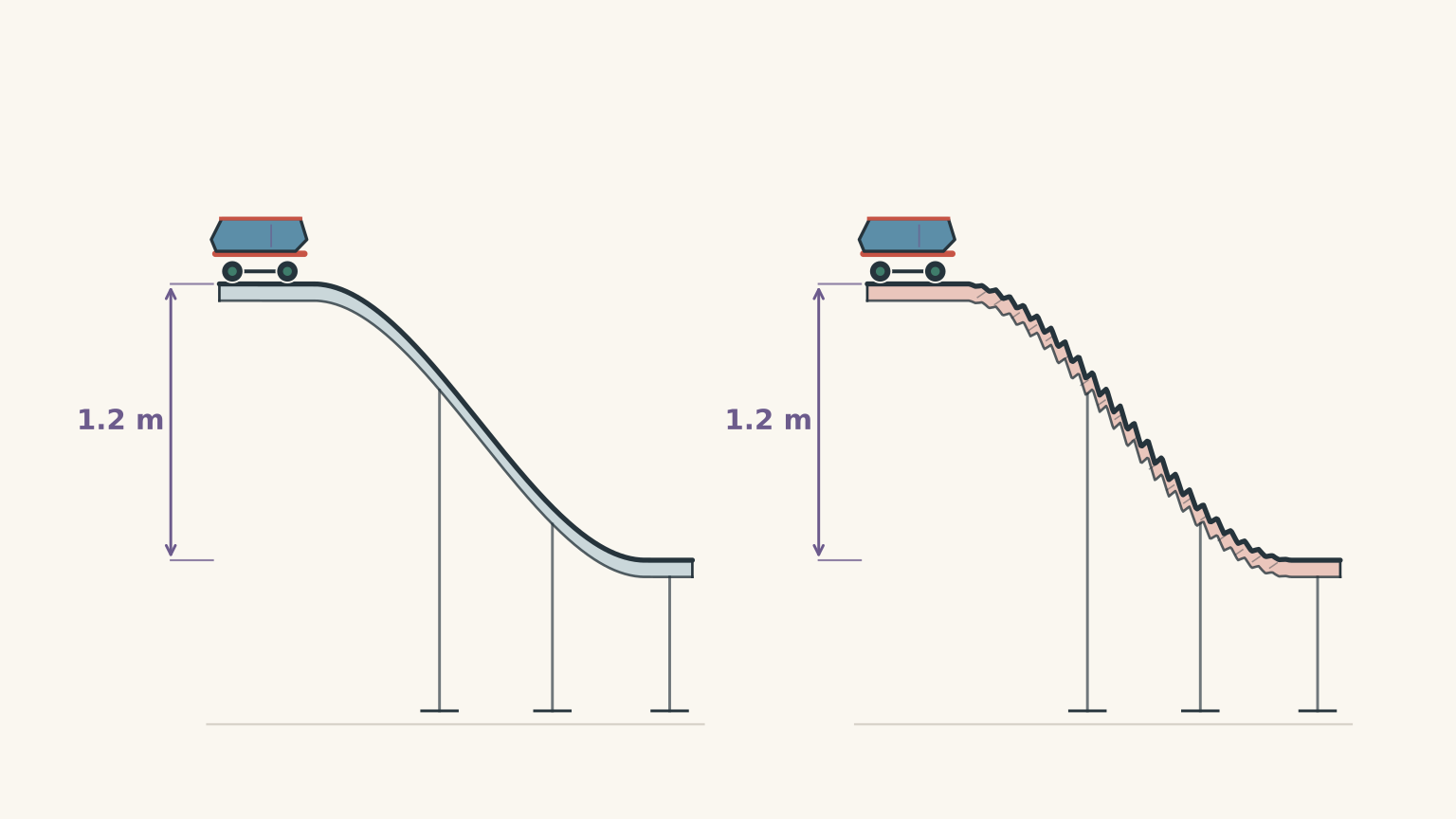
Due to technical limitations, this figure may display incorrectly or contain inaccuracies. Please check key details against your course materials.
Solution 3
The student has two separate problems: cue-dependent method selection and an incomplete understanding of the conditions for conservation of mechanical energy.
These problems are related, but they should not be treated as the same mistake.
Step 1: Identify the retrieval problem on Track A.
The student can solve the question when told to use conservation of mechanical energy.
However, they cannot independently identify that principle when the instruction is removed.
This suggests cue-dependent retrieval.
The student knows how to use the method once it has been identified, but struggles to recognise when it applies.
Step 2: Identify the conceptual problem on Track B.
The student argues that energy is conserved, so the cart must reach the same speed.
The tempting part of this argument is that energy conservation is a valid physical principle.
However, the student has confused conservation of total energy with conservation of mechanical energy.
On Track A, mechanical energy is conserved because the track is frictionless and there is no other energy transfer that changes the cart’s mechanical energy.
The gravitational potential energy lost becomes kinetic energy.
For a cart released from rest:
\[ mgh=\frac{1}{2}mv^2 \]
Rearranging:
\[ v=\sqrt{2gh} \]
For Track B, friction transfers some mechanical energy into thermal energy.
The total energy is still conserved, but the cart’s mechanical energy is not.
We can represent this as:
\[ mgh=\frac{1}{2}mv^2+E_{\text{thermal}} \]
Here, \(E_{\text{thermal}}\) represents the energy transferred into thermal energy.
Because some of the initial mechanical energy has been transferred elsewhere, the cart on Track B has less kinetic energy at the bottom.
Therefore, its final speed must be lower than the speed on Track A.
We cannot calculate the exact speed without additional information about the energy transferred through friction.
Step 3: Design two tests to separate the problems.
To test cue-dependent retrieval, give the student two versions of the Track A question.
- Version 1 explicitly says to use conservation of mechanical energy.
- Version 2 removes that instruction but keeps the physical situation and numerical information unchanged.
If the student succeeds only in Version 1, that supports the cue-dependence explanation.
To test their understanding of the conditions for mechanical energy conservation, give them two questions with identical wording and starting conditions, but change the track from frictionless to rough.
Ask them to explain which energy stores change before attempting any calculations.
If they predict identical final speeds despite understanding the first question, they have a separate problem with the conditions under which mechanical energy is conserved.
The important distinction is that remembering a principle is not the same as knowing its limitations.
A student can retrieve the correct equation and still apply it to a situation where its conditions are not satisfied.
This is why strong HSC responses require more than formula recall. You need to recognise the situation, select an appropriate model, and check that its assumptions hold.
Once you can retrieve a concept without its familiar heading, recognise it in a new context, and explain why the method applies, you’re ready for the next step: mixed-topic HSC questions under time pressure.
Those questions introduce another challenge. You must choose between several possible concepts without being told which topic you’re being tested on.
Practising that decision is what turns isolated topic knowledge into independent problem-solving.