
Why Mass Does Not Change Free-Fall Acceleration
Why does a heavier object experience more gravitational force but have the same free-fall acceleration as a lighter one? Learn how Newton’s second law explains the mass cancellation, and how air resistance changes the result.
You see a 6 kg ball and a 2 kg ball being dropped from the same height. You write, “The heavier ball experiences three times the gravitational force, so it accelerates three times as much.” The first part is correct. The conclusion is a classic HSC Physics mistake.
Before reading on, predict which ball reaches the ground first if both are released from rest at the same time and air resistance is removed. Neither wins: they reach the ground together. The heavier ball experiences a larger gravitational force, but it also has proportionally more inertia. These two effects cancel exactly.
More mass, greater force, same acceleration
| 2 kg object | Gravitational force: 19.6 N ▰ Ideal acceleration: 9.8 m/s² downward |
|---|---|
| 6 kg object | Gravitational force: 58.8 N ▰▰▰ Ideal acceleration: 9.8 m/s² downward |
The mistake is easy to make because you can see the gravitational force getting larger, but you might forget that Newton’s second law also involves mass. Let’s work through the cancellation, then see exactly what changes when air resistance enters the picture.
01Why the mass cancels
Start with two different ideas
Mass and weight are related, but they are not the same thing.
- Mass, \(m\), measures an object’s inertia: how much it resists a change in motion. Its unit is the kilogram (kg).
- Weight, \(F_g\), is the gravitational force acting on the object. Its unit is the newton (N).
Near Earth’s surface, the magnitude of the gravitational force is
\[ F_g=mg \]
Here, \(g\) is the gravitational field strength, approximately \(9.8\ \mathrm{N\,kg^{-1}}\) near Earth’s surface. This is numerically equivalent to a free-fall acceleration of \(9.8\ \mathrm{m\,s^{-2}}\).
Notice what the equation tells you. If you triple an object’s mass, you triple its gravitational force in the same gravitational field.
But a larger force does not automatically mean a larger acceleration. You must also account for the object’s inertia.
Apply Newton’s second law
Newton’s second law states that the net force on an object equals its mass multiplied by its acceleration:
\[ F_{\text{net}}=ma \]
The key word is net. It means the combined effect of all forces acting on the object.
In ideal free fall, gravity is the only force acting. Choose downward as the positive direction. The net downward force is therefore \(mg\).
Substitute this into Newton’s second law:
\[ \begin{aligned} F_{\text{net}} &= ma\\ mg &= ma\\ g &= a \end{aligned} \]
The mass \(m\) appears on both sides, so we divide both sides by \(m\). Since an object’s mass is non-zero, this gives
\[ \boxed{a=g} \]
That’s the entire derivation. In the same gravitational field, every object in ideal free fall has the same acceleration, regardless of its mass.
Why mass cancels in free fall
- Gravitational force
F_g = mg
Weight equals mass multiplied by gravitational field strength.
- Newton’s second law
F_net = ma
Net force equals mass multiplied by acceleration.
- Substitute for ideal free fall
mg = ma
Gravity is the only force, so F_net = F_g.
- Cancel the non-zero mass
a = g
Both sides divide by m; acceleration is independent of mass.
Why the cancellation makes physical sense
Imagine doubling both the gravitational force and the mass of an object. The force trying to accelerate it doubles, but the inertia resisting that change also doubles. The ratio of force to mass stays the same.
This is similar to doubling both the push on a trolley and the load being accelerated: if both scale together, the acceleration does not change.
The analogy has a limit, though. In a real situation, not every force acting on an object scales with its mass. Air resistance is the important example.
You can see the mathematical relationship in two ways:
Two separate graphs are required
| Graph 1: Gravitational force | F_g = mg Horizontal axis: mass (kg). Vertical axis: gravitational force (N). Straight line through the origin; slope g = 9.8 N/kg. |
|---|---|
| Graph 2: Free-fall acceleration | a = g Horizontal axis: mass (kg). Vertical axis: acceleration (m/s²). Horizontal line at 9.8 m/s² when air resistance is ignored. |
- Gravitational force increases in direct proportion to mass.
- Ideal free-fall acceleration remains constant as mass changes.
The result is not that gravity somehow ignores mass. Gravity pulls more strongly on a more massive object. The crucial point is that the object’s inertia increases in the same proportion.
02The tempting wrong approach
The incorrect reasoning usually looks like this:
- Object B has three times the mass of object A.
- Therefore, object B experiences three times the gravitational force.
- Therefore, object B has three times the acceleration.
Step 2 is correct. Step 3 ignores the mass in Newton’s second law.
To calculate acceleration, you need the net force divided by the mass, not the force alone.
Worked example: Triple the mass, triple the acceleration?
A 2.0 kg ball and a 6.0 kg ball are released from rest at the same height near Earth’s surface. Ignore air resistance. Calculate the gravitational force and acceleration of each ball.
Step 1
Use \(F_g=mg\), with \(g=9.8\ \mathrm{m\,s^{-2}}\).
For the 2.0 kg ball:
\[ F_{g,1}=(2.0)(9.8)=19.6\ \mathrm{N} \]
For the 6.0 kg ball:
\[ F_{g,2}=(6.0)(9.8)=58.8\ \mathrm{N} \]
The heavier ball experiences three times the gravitational force.
Step 2
Because gravity is the only force, \(F_{\text{net}}=F_g\).
For the 2.0 kg ball:
\[ a_1=\frac{19.6}{2.0} =9.8\ \mathrm{m\,s^{-2}} \]
For the 6.0 kg ball:
\[ a_2=\frac{58.8}{6.0} =9.8\ \mathrm{m\,s^{-2}} \]
Step 3
Both balls accelerate downward at \(9.8\ \mathrm{m\,s^{-2}}\). The heavier ball has three times the weight, but it also has three times the mass to accelerate.
Since both balls start from rest at the same height and have the same acceleration, they reach the ground together under these ideal conditions.
The exam lesson: never infer acceleration from force alone. Identify the net force, then apply \(a=F_{\text{net}}/m\).
03What changes when air resistance is present?
So far, we have assumed that gravity is the only force acting. That is what free fall means in the strict physics model.
An object falling through air is different. Air resistance, also called drag, acts against the object’s motion. For a falling object moving downward, drag acts upward.
Ideal free fall vs falling through air
| Ideal free fall | F_net = mg; a = g Gravity is the only force. Constant downward acceleration: 9.8 m/s² near Earth’s surface. |
|---|---|
| Falling through air | F_net = mg − D; a = g − D/m Weight acts downward; drag acts upward. When D < mg, acceleration is downward but less than g. |
Let \(D\) represent the magnitude of the upward drag force. Ignore buoyancy for this model.
Taking downward as positive, the net force is
\[ F_{\text{net}}=mg-D \]
Newton’s second law gives
\[ ma=mg-D \]
Divide every term by \(m\):
\[ \boxed{a=g-\frac{D}{m}} \]
This equation explains why you cannot blindly apply the mass-cancellation shortcut to a falling object in air.
The gravitational term still simplifies to \(g\), but the drag term, \(D/m\), remains. The mass no longer cancels out of the entire expression.
Why heavier objects can fall faster in air
Suppose two objects have the same shape and dimensions, and are moving through the same air at the same speed. Assume they experience the same drag force.
If one object has more mass, the drag force divided by its mass is smaller. Its acceleration is therefore closer to \(g\).
This can make a heavier object fall faster than a lighter object of identical shape and size. But mass alone does not determine how an object falls through air.
Consider a flat sheet of paper and the same sheet scrunched into a compact ball. Their masses and gravitational forces are equal, yet the flat sheet usually experiences much greater drag because of its shape and exposed area.
Same mass, different air resistance
| Broad, flat sheet | F_g = mg Same mass and weight as the crumpled sheet. Larger exposed area; greater upward air resistance. |
|---|---|
| Compact crumpled sheet | F_g = mg Same mass and weight as the flat sheet. Smaller exposed area; typically less upward air resistance. |
The crumpled sheet usually reaches the ground first in ordinary air. In a vacuum, however, the two sheets would have the same acceleration and would reach the ground together if released from rest at the same height.
The difference comes from the forces acting on them, not from gravity suddenly behaving differently for paper.
Worked example: Calculate acceleration with air resistance
Two spheres have the same shape and dimensions but different masses. At a particular instant, both are moving downward at the same speed through the same air. Each experiences an upward drag force of 9.0 N.
Sphere A has a mass of 3.0 kg, and sphere B has a mass of 6.0 kg. Calculate their accelerations, taking \(g=9.8\ \mathrm{m\,s^{-2}}\).
Step 1
For sphere A:
\[ F_{g,A}=(3.0)(9.8)=29.4\ \mathrm{N} \]
For sphere B:
\[ F_{g,B}=(6.0)(9.8)=58.8\ \mathrm{N} \]
Step 2
Drag acts upward, so subtract it from the downward gravitational force.
For sphere A:
\[ F_{\text{net},A}=29.4-9.0 =20.4\ \mathrm{N} \]
For sphere B:
\[ F_{\text{net},B}=58.8-9.0 =49.8\ \mathrm{N} \]
Both net forces point downward.
Step 3
For sphere A:
\[ a_A=\frac{20.4}{3.0} =6.8\ \mathrm{m\,s^{-2}} \]
For sphere B:
\[ a_B=\frac{49.8}{6.0} =8.3\ \mathrm{m\,s^{-2}} \]
Step 4
Sphere A accelerates downward at \(6.8\ \mathrm{m\,s^{-2}}\), while sphere B accelerates downward at \(8.3\ \mathrm{m\,s^{-2}}\).
Neither acceleration equals \(g\), because drag reduces the net downward force. Sphere B’s acceleration is closer to \(g\) because the same drag force has a smaller effect per kilogram.
Notice that the heavier sphere’s acceleration is not three times the lighter sphere’s acceleration, even though its net force is larger. You must account for both net force and mass.
04Terminal velocity: when acceleration becomes zero
As an object falls through air, its speed generally increases at first. As its speed increases, drag usually increases too.
The net downward force becomes smaller, so the object’s downward acceleration decreases.
Under the simplified model in which gravity and drag are the only forces, the object reaches terminal velocity when drag balances weight:
\[ D=mg \]
Therefore,
\[ F_{\text{net}}=mg-D=0 \]
and
\[ a=0 \]
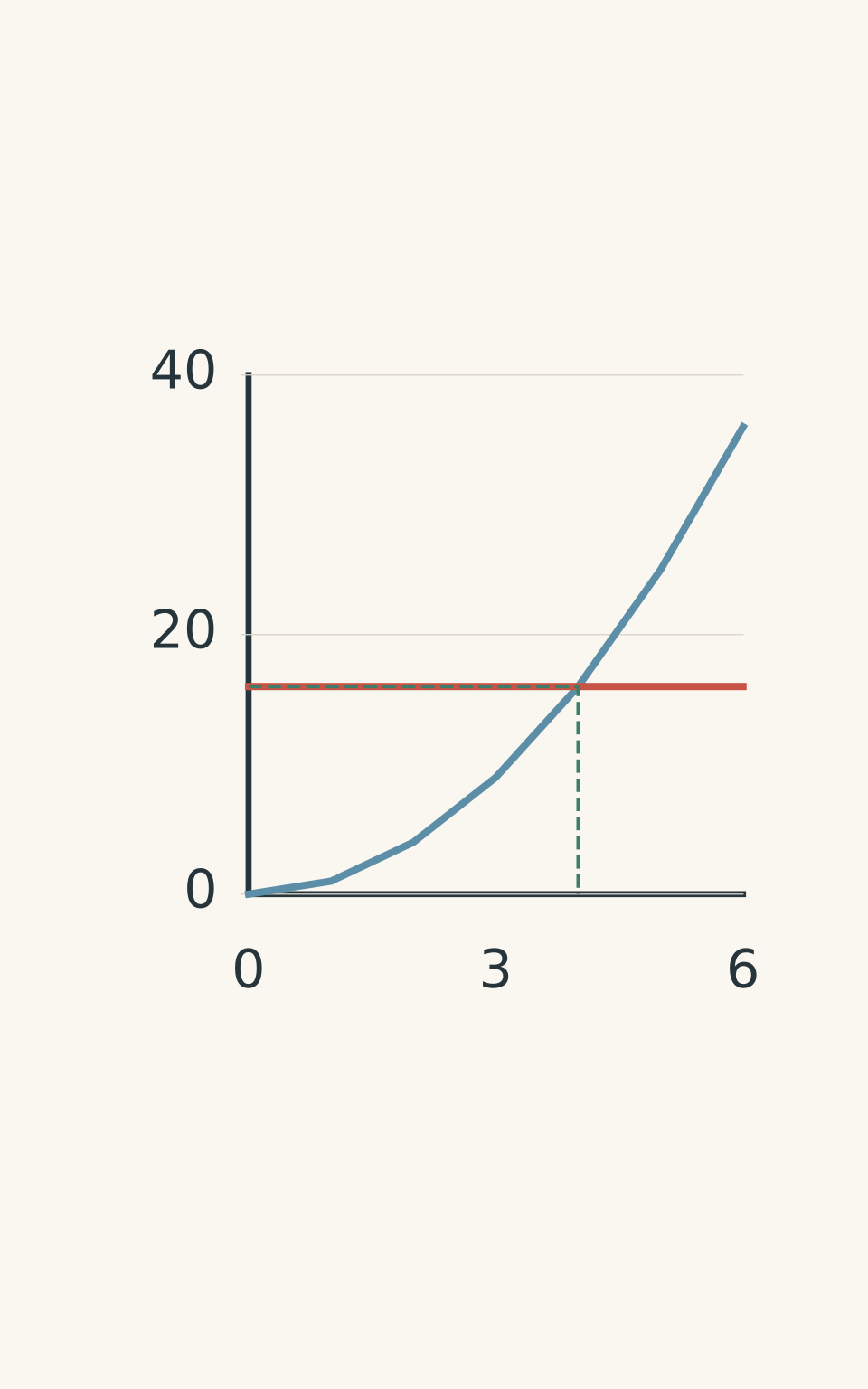
- Drag D = kv²
- Weight mg = 16 N
- Terminal speed: 4 m/s
At terminal velocity, the object is still moving. Its velocity is constant because its acceleration is zero.
This is another common exam trap: zero acceleration does not mean zero velocity.
Also, do not assume that every falling object has the same terminal velocity. Terminal velocity depends on the balance between weight and drag, which is affected by mass, shape, dimensions, orientation, and the properties of the air.
05A dependable method for exam questions
When a question asks you to compare falling objects, use this decision process rather than memorising “mass doesn’t matter”.
Step 1: Identify the conditions.
Does the question say to ignore air resistance, or does it explicitly include drag? In strict ideal free fall, gravity is the only force.
Step 2: Identify every force.
For a falling object, weight acts downward. Air resistance acts upward while the object is moving downward. Include any other relevant forces if the question requires them.
Step 3: Write Newton’s second law.
Start with \(F_{\text{net}}=ma\). Choose a positive direction and keep your force signs consistent.
Step 4: Substitute the force expressions.
If gravity is the only force, \(ma=mg\), so \(a=g\).
If upward drag is present while the object falls downward, \(ma=mg-D\), so \(a=g-D/m\).
Step 5: Interpret the result.
State the acceleration’s magnitude, direction, and units. If comparing objects, explain which force or term causes their accelerations to differ.
Three wording changes that matter
| Question wording | What it means |
|---|---|
| “In a vacuum” or “ignore air resistance” | Use ideal free fall: \(a=g\). |
| “Falling through air” | Consider drag and calculate the net force. |
| “Moving at terminal velocity” | Net force and acceleration are zero, but velocity is not zero. |
Two further details are worth remembering.
- Same acceleration does not always mean same velocity. If two objects have different initial velocities, they can have different velocities even when gravity gives them the same acceleration.
- The same gravitational field matters. Near Earth’s surface, \(g\) is approximately constant. At significantly different locations or altitudes, gravitational field strength can differ slightly. Mass independence still holds locally in ideal free fall.
Quick self-check before you submit
- [ ] Have I distinguished mass from weight?
- [ ] Have I identified all forces acting on the object?
- [ ] Have I calculated the net force rather than using weight automatically?
- [ ] Have I applied \(F_{\text{net}}=ma\) with the correct mass?
- [ ] Have I stated the direction and units of acceleration?
- [ ] If drag is present, have I explained why the mass does not cancel from the entire equation?
06Questions and solutions
Question 1
Two objects of masses 1.5 kg and 4.5 kg are released from rest at the same height near Earth’s surface. Assume ideal free fall and take \(g=9.8\ \mathrm{m\,s^{-2}}\).
Calculate the gravitational force on each object and compare their accelerations.
Solution 1
Both objects accelerate downward at \(9.8\ \mathrm{m\,s^{-2}}\), even though their gravitational forces differ.
For the 1.5 kg object:
\[ F_{g,1}=mg=(1.5)(9.8) =14.7\ \mathrm{N} \]
Its acceleration is
\[ a_1=\frac{14.7}{1.5} =9.8\ \mathrm{m\,s^{-2}} \]
For the 4.5 kg object:
\[ F_{g,2}=mg=(4.5)(9.8) =44.1\ \mathrm{N} \]
Its acceleration is
\[ a_2=\frac{44.1}{4.5} =9.8\ \mathrm{m\,s^{-2}} \]
The heavier object experiences three times the gravitational force, but also has three times the mass. The ratio of net force to mass is identical, so both objects have the same acceleration.
Because they start from rest at the same height and accelerate equally, they reach the ground together under the stated assumptions.
Question 2
A 2.5 kg object falls vertically downward through air. At a particular instant, its downward acceleration is \(4.0\ \mathrm{m\,s^{-2}}\). Take \(g=9.8\ \mathrm{m\,s^{-2}}\), and ignore buoyancy and all other forces.
Calculate the magnitude and direction of the air-resistance force. Can you determine the object’s terminal velocity from this information alone? Explain.
Solution 2
The air-resistance force is \(14.5\ \mathrm{N}\) upward, but the terminal velocity cannot be determined from the information provided.
First, calculate the net downward force using Newton’s second law:
\[ F_{\text{net}}=ma \]
\[ F_{\text{net}}=(2.5)(4.0) =10.0\ \mathrm{N} \]
Next, calculate the gravitational force:
\[ F_g=mg=(2.5)(9.8) =24.5\ \mathrm{N} \]
Weight acts downward, while drag acts upward. Therefore,
\[ F_{\text{net}}=F_g-D \]
Rearranging gives
\[ \begin{aligned} D&=F_g-F_{\text{net}}\\ &=24.5-10.0\\ &=14.5\ \mathrm{N} \end{aligned} \]
The drag force must point upward because it opposes the downward motion.
However, a single measurement of drag does not tell you the terminal velocity. You would need further information about how drag depends on speed, such as a drag-speed relationship and sufficient information to determine its constants. The current acceleration alone is not enough.
Question 3
A flat sheet of paper and a tightly crumpled version of the same sheet are released from rest at the same height and at the same time.
Assume the flat sheet remains broadside to the airflow and the crumpled sheet stays compact.
Which reaches the ground first in ordinary air? Would the result change in a vacuum? Explain using gravitational force, drag, and acceleration.
Solution 3
The crumpled sheet usually reaches the ground first in ordinary air, but both sheets reach the ground together in a vacuum under the stated release conditions.
The sheets have equal mass, so their gravitational forces are equal:
\[ F_g=mg \]
However, their shapes differ. The flat sheet presents a much larger area to the airflow and experiences greater drag under the stated conditions. This reduces its net downward force and acceleration more than it does for the compact sheet.
The crumpled sheet therefore tends to accelerate more strongly and fall faster.
In a vacuum, neither sheet experiences air resistance. Gravity is the only force, so
\[ a=g \]
for both sheets. Since they start from rest at the same height, they reach the ground together.
The trap is to assume that equal mass guarantees equal motion in every environment. Equal mass guarantees equal gravitational force in the same field, but the total forces can differ when drag is present.
Question 4
A 0.80 kg sphere is falling at terminal velocity through air. Ignore buoyancy and take \(g=9.8\ \mathrm{m\,s^{-2}}\).
A second sphere has the same shape and dimensions but a mass of 1.60 kg. At a particular instant, it is moving downward at the same speed as the first sphere’s terminal velocity.
Assuming both spheres experience the same drag at the same speed, calculate the second sphere’s acceleration at that instant. Explain why it is not at terminal velocity.
Solution 4
The second sphere accelerates downward at \(4.9\ \mathrm{m\,s^{-2}}\). It is not at terminal velocity because its weight exceeds the drag force.
The first sphere is at terminal velocity, so its acceleration is zero. Its net force must therefore be zero, which means its drag balances its weight.
For the first sphere,
\[ \begin{aligned} D&=mg\\ &=(0.80)(9.8)\\ &=7.84\ \mathrm{N} \end{aligned} \]
The second sphere has the same shape, dimensions, and speed at the specified instant. Under the stated assumptions, it experiences the same drag force of \(7.84\ \mathrm{N}\) upward.
Its gravitational force is
\[ F_{g,2}=(1.60)(9.8) =15.68\ \mathrm{N} \]
Its net downward force is therefore
\[ F_{\text{net},2}=15.68-7.84 =7.84\ \mathrm{N} \]
Apply Newton’s second law:
\[ \begin{aligned} a_2&=\frac{F_{\text{net},2}}{m_2}\\ &=\frac{7.84}{1.60}\\ &=4.9\ \mathrm{m\,s^{-2}} \end{aligned} \]
The second sphere is still moving at the first sphere’s terminal speed, but that does not make this speed its own terminal velocity. Its weight is twice as large while the drag at that instant is unchanged, leaving a net downward force.
Terminal velocity is determined by force balance, not simply by reaching a particular speed that another object happens to have.
Question 5
Two spheres have identical shapes and dimensions but masses \(m\) and \(4m\). They fall through the same air. Ignore buoyancy, and assume the drag force follows the model
\[ D=kv^2 \]
where \(D\) is the drag-force magnitude, \(v\) is the speed, and \(k\) is the same positive constant for both spheres.
At a particular instant, the heavier sphere is moving downward at twice the speed of the lighter sphere. They are not necessarily at the same stage of their falls.
(a) Compare their instantaneous accelerations.
(b) Derive the ratio of their terminal speeds.
(c) A student claims, “The heavier sphere has four times the weight, so it must have four times the acceleration.” Explain precisely why this reasoning fails.
Solution 5
(a) The two spheres have equal instantaneous accelerations at the specified instant.
Let the lighter sphere’s downward speed be \(v\). Its mass is \(m\), its weight is \(mg\), and its drag force is \(kv^2\).
Taking downward as positive,
\[ \begin{aligned} ma_{\text{light}}&=mg-kv^2\\ a_{\text{light}}&=g-\frac{kv^2}{m} \end{aligned} \]
The heavier sphere has mass \(4m\) and speed \(2v\). Its drag force is
\[ D_{\text{heavy}}=k(2v)^2 =4kv^2 \]
Its net downward force is \(4mg-4kv^2\). Therefore,
\[ \begin{aligned} 4m a_{\text{heavy}}&=4mg-4kv^2\\ a_{\text{heavy}}&=g-\frac{kv^2}{m} \end{aligned} \]
Comparing the two expressions,
\[ \boxed{a_{\text{heavy}}=a_{\text{light}}} \]
Their accelerations are equal, although their speeds differ. Depending on the specified speed, both accelerations may point downward, be zero, or point upward while the spheres are still moving downward.
(b) The heavier sphere’s terminal speed is twice the lighter sphere’s terminal speed.
At terminal velocity, drag balances weight. Let the terminal speeds be \(v_{t,\text{light}}\) and \(v_{t,\text{heavy}}\).
For the lighter sphere,
\[ mg=k v_{t,\text{light}}^2 \]
Rearranging,
\[ v_{t,\text{light}}=\sqrt{\frac{mg}{k}} \]
For the heavier sphere,
\[ 4mg=k v_{t,\text{heavy}}^2 \]
Therefore,
\[ v_{t,\text{heavy}}=\sqrt{\frac{4mg}{k}} \]
Taking the ratio gives
\[ \boxed{ \frac{v_{t,\text{heavy}}} {v_{t,\text{light}}}=2 } \]
The heavier sphere has four times the mass, but only twice the terminal speed. This follows from the square in the drag relationship \(D=kv^2\).
(c) The student’s reasoning fails because it compares gravitational forces without accounting for drag or dividing the net force by the mass.
The heavier sphere has four times the gravitational force. However, at the specified instant, its speed is twice as large, so its drag force is four times as large too.
Consequently, both the gravitational force and the drag force scale by a factor of four. Their difference, the net force, also scales by four. The heavier sphere’s mass scales by the same factor, so dividing net force by mass gives the same acceleration.
The result does not contradict ideal free fall. In a vacuum, drag is absent and the mass cancels from \(ma=mg\). In air, drag introduces another term whose value depends on speed as well as the conditions of motion.
The next useful step is to study how drag changes with speed. That relationship explains how a falling object’s acceleration decreases over time and how it approaches terminal velocity.