
Hess’s Law for Carbon, Carbon Monoxide and Carbon Dioxide
Learn how Hess's Law links the energy changes when carbon reacts through carbon monoxide to form carbon dioxide. Includes worked examples, common traps, and challenging HSC Chemistry questions.
A piece of carbon can burn straight to carbon dioxide, or it can stop first at carbon monoxide and then burn again. Here is the puzzle: if the carbon starts in the same state and eventually ends as the same carbon dioxide, should the total energy released depend on whether it took the direct route or the two-step route?
Predict before reading on. It is tempting to think the stepped route might release a different amount because two reactions happened instead of one.
It does not. Provided the initial and final states are the same, the total enthalpy change is the same. That single idea is what makes Hess’s Law useful.
01The carbon-oxygen pathway
Consider complete combustion of graphite:
\[ \ce{C(graphite) + O2(g) -> CO2(g)} \]
A representative standard enthalpy change is
\[ \Delta H = -393.5\ \mathrm{kJ\,mol^{-1}} \]
Here, \(\Delta H\) means the enthalpy change for the reaction as written. The unit \(\mathrm{kJ\,mol^{-1}}\) means kilojoules per mole of reaction.
The negative sign tells us energy is released to the surroundings. The products have a lower enthalpy than the reactants.
But carbon does not have to reach carbon dioxide in one chemical step. It can first form carbon monoxide:
\[ \ce{C(graphite) + 1/2O2(g) -> CO(g)} \]
with
\[ \Delta H = -110.5\ \mathrm{kJ\,mol^{-1}} \]
The carbon monoxide can then burn:
\[ \ce{CO(g) + 1/2O2(g) -> CO2(g)} \]
What should the enthalpy change of this second reaction be?
Do not calculate yet. Picture the energy pathway first.
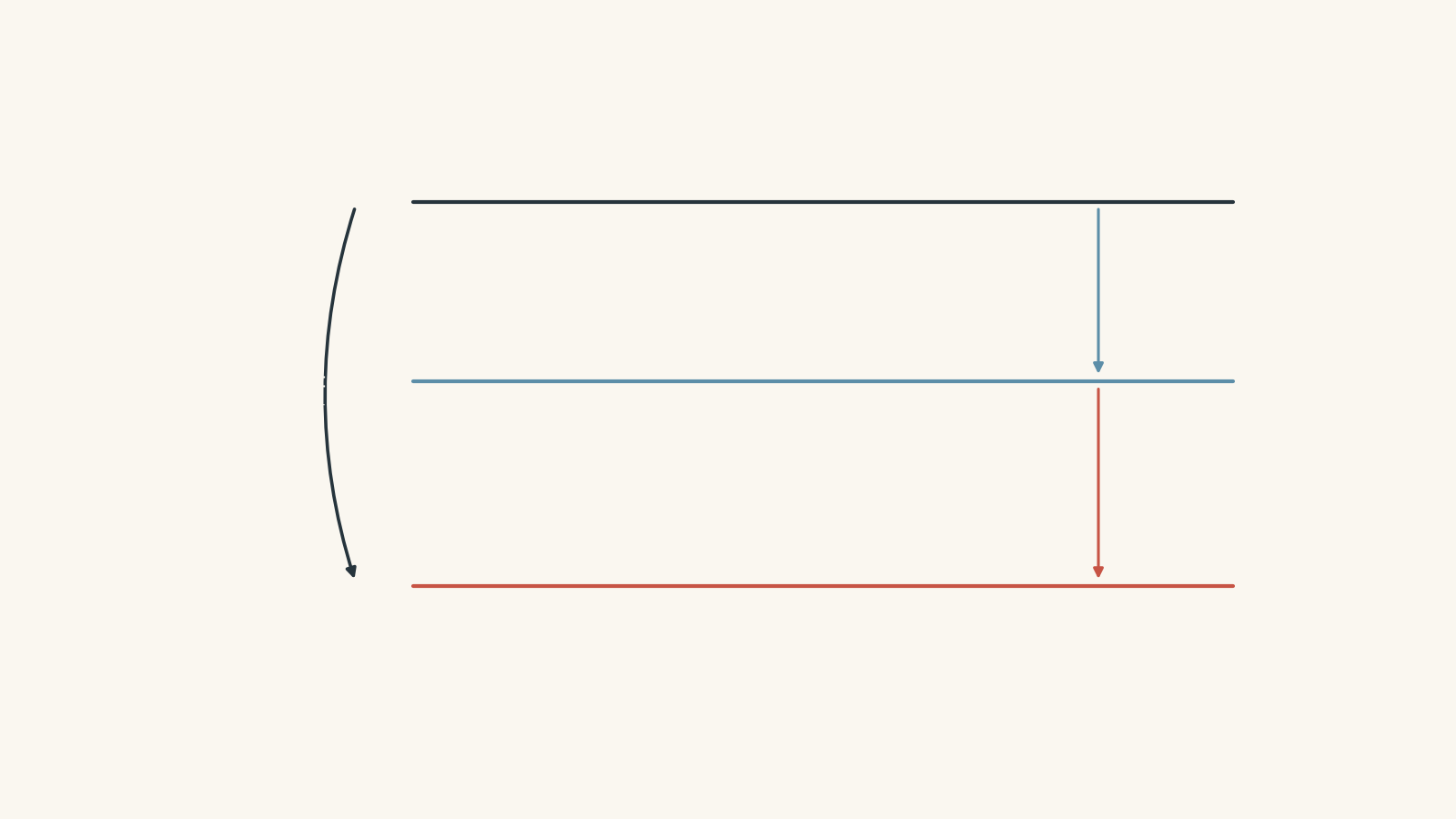
Think of an elevator travelling from the tenth floor to the ground floor. It can travel straight down, or stop awkwardly at the third floor while everyone wonders whether this is actually their floor. Either way, its total change in height is the same.
Enthalpy works similarly. The analogy is useful because only the starting and finishing levels matter for the total change. It breaks down because enthalpy is not literally height, and the reaction mechanism is not an elevator route.
The direct enthalpy change therefore has to equal the sum of the two steps:
\[ -393.5=-110.5+\Delta H_2 \]
so
\[ \Delta H_2=-283.0\ \mathrm{kJ\,mol^{-1}} \]
The oxidation of carbon monoxide is therefore
\[ \ce{CO(g) + 1/2O2(g) -> CO2(g)} \qquad \Delta H=-283.0\ \mathrm{kJ\,mol^{-1}} \]
Notice something important. Forming carbon monoxide uses half as much oxygen as forming carbon dioxide directly, but it does not release half as much energy.
That is a common trap.
02Why Hess’s Law works
Enthalpy is a state function. Its change depends on the initial and final states, not on the sequence of reactions used to travel between them.
For the direct route,
\[ \ce{C(graphite) + O2(g) -> CO2(g)} \]
and for the stepped route,
\[ \ce{C(graphite) + 1/2O2(g) -> CO(g)} \]
followed by
\[ \ce{CO(g) + 1/2O2(g) -> CO2(g)} \]
Adding the two stepped equations gives
\[ \ce{C(graphite) + 1/2O2(g) + CO(g) + 1/2O2(g) -> CO(g) + CO2(g)} \]
The \(\ce{CO(g)}\) appears on both sides, so it cancels. The two half-moles of oxygen combine:
\[ \ce{C(graphite) + O2(g) -> CO2(g)} \]
That is exactly the direct reaction.
The enthalpies must therefore add as well:
\[ \Delta H_{\text{direct}} = \Delta H_1+\Delta H_2 \]
This is Hess’s Law in its most useful HSC form.
For a broader treatment of constructing reaction pathways, see Hess’s Law for Stepped Reactions in HSC Chemistry.
03The equation is part of the enthalpy value
An enthalpy value does not belong vaguely to a substance. It belongs to a particular reaction equation.
Suppose
\[ \ce{CO(g) + 1/2O2(g) -> CO2(g)} \qquad \Delta H=-283.0\ \mathrm{kJ\,mol^{-1}} \]
If every coefficient is doubled,
\[ \ce{2CO(g) + O2(g) -> 2CO2(g)} \]
then twice as much reaction occurs, so
\[ \Delta H=-566.0\ \mathrm{kJ\,mol^{-1}} \]
for the doubled equation.
If the reaction is reversed,
\[ \ce{CO2(g) -> CO(g) + 1/2O2(g)} \]
energy that was previously released must now be supplied:
\[ \Delta H=+283.0\ \mathrm{kJ\,mol^{-1}} \]
These operations are worth treating as bookkeeping rules.
| Change made to the chemical equation | Change made to \(\Delta H\) |
|---|---|
| Reverse the equation | Reverse the sign |
| Multiply all coefficients by \(n\) | Multiply \(\Delta H\) by \(n\) |
| Add equations | Add their \(\Delta H\) values |
| Cancel a species from both sides | Its contribution disappears from the net equation |
Do the equation manipulation first. Then do the arithmetic.
Worked example: Find the enthalpy of carbon monoxide combustion
The following data are provided:
\[ \ce{C(graphite) + O2(g) -> CO2(g)} \qquad \Delta H=-393.5\ \mathrm{kJ\,mol^{-1}} \]
\[ \ce{C(graphite) + 1/2O2(g) -> CO(g)} \qquad \Delta H=-110.5\ \mathrm{kJ\,mol^{-1}} \]
Calculate the enthalpy change for
\[ \ce{CO(g) + 1/2O2(g) -> CO2(g)} \]
Step 1
The direct route must equal carbon-to-CO plus CO-to-\(\ce{CO2}\):
\[ -393.5=-110.5+\Delta H \]
Step 2
\[ \Delta H=-393.5-(-110.5) \]
\[ \Delta H=-283.0\ \mathrm{kJ\,mol^{-1}} \]
Step 3
The negative value means oxidation of one mole of CO according to the equation releases \(283.0\ \mathrm{kJ}\) of energy.
The result also passes a useful check:
\[ -110.5+(-283.0)=-393.5 \]
The two-step pathway gives exactly the direct enthalpy change.
04Sometimes the equation needs to be reversed first
Many Hess’s Law questions are harder only because the supplied equations point in inconvenient directions.
Suppose you know
\[ \ce{C(graphite) + O2(g) -> CO2(g)} \qquad \Delta H=-393.5\ \mathrm{kJ\,mol^{-1}} \]
and
\[ \ce{CO(g) + 1/2O2(g) -> CO2(g)} \qquad \Delta H=-283.0\ \mathrm{kJ\,mol^{-1}} \]
but you want
\[ \ce{C(graphite) + 1/2O2(g) -> CO(g)} \]
Look at the target. CO must be a product, but in the second supplied equation it is a reactant. That equation therefore needs to be reversed.
Worked example: Find the enthalpy of forming CO
Calculate \(\Delta H\) for
\[ \ce{C(graphite) + 1/2O2(g) -> CO(g)} \]
using the data above.
Step 1
\[ \ce{C(graphite) + O2(g) -> CO2(g)} \qquad \Delta H=-393.5\ \mathrm{kJ\,mol^{-1}} \]
Step 2
\[ \ce{CO2(g) -> CO(g) + 1/2O2(g)} \]
Reversing the equation reverses the sign:
\[ \Delta H=+283.0\ \mathrm{kJ\,mol^{-1}} \]
Step 3
\[ \begin{aligned} \ce{C(graphite) + O2(g)} &\ce{-> CO2(g)}\\ \ce{CO2(g)} &\ce{-> CO(g) + 1/2O2(g)} \end{aligned} \]
Cancel \(\ce{CO2(g)}\), then cancel half a mole of oxygen from both sides. The net equation becomes
\[ \ce{C(graphite) + 1/2O2(g) -> CO(g)} \]
Step 4
\[ \Delta H = -393.5+283.0 = -110.5\ \mathrm{kJ\,mol^{-1}} \]
The reaction is exothermic, but much less energy is released than when carbon is fully oxidised to carbon dioxide.
05Why half the oxygen does not mean half the energy
A student might reason like this:
Making CO uses \(0.5\) mol of \(\ce{O2}\), while making \(\ce{CO2}\) uses \(1.0\) mol, so the CO reaction should release half as much energy.
That sounds plausible because stoichiometric quantities often scale reaction values. The problem is that these are not the same reaction scaled by a factor of one-half.
Compare them:
\[ \ce{C(graphite) + 1/2O2(g) -> CO(g)} \]
and
\[ \ce{C(graphite) + O2(g) -> CO2(g)} \]
The products are different substances. CO still has the capacity to react further with oxygen and release another \(283.0\ \mathrm{kJ\,mol^{-1}}\).
So you cannot calculate reaction enthalpy just by looking at how many moles of oxygen appear.
The enthalpy change comes from the difference between the complete initial and final states.
This also explains why carbon monoxide is not simply “carbon dioxide with half the energy”. It is a distinct chemical substance with its own enthalpy.
06A useful energy-accounting check
Suppose \(0.240\) mol of carbon is first completely converted to CO and then all the CO is oxidised to carbon dioxide.
For the first step,
\[ q_1 = n\Delta H = (0.240\ \mathrm{mol})(-110.5\ \mathrm{kJ\,mol^{-1}}) = -26.52\ \mathrm{kJ} \]
Here, \(q_1\) is the enthalpy change for the \(0.240\) mol sample, and \(n\) is the amount reacting in moles.
For the second step,
\[ q_2 = (0.240\ \mathrm{mol})(-283.0\ \mathrm{kJ\,mol^{-1}}) = -67.92\ \mathrm{kJ} \]
The total is
\[ q_{\text{total}} = -26.52-67.92 = -94.44\ \mathrm{kJ} \]
Now calculate the direct route:
\[ q_{\text{direct}} = (0.240\ \mathrm{mol})(-393.5\ \mathrm{kJ\,mol^{-1}}) = -94.44\ \mathrm{kJ} \]
Same initial state. Same final state. Same overall enthalpy change.
That equality is a powerful error check in exam calculations.
07The states must really be the same
There is one important qualification hidden in the phrase “same initial and final states”.
States include more than chemical formulas.
For example,
\[ \ce{CO2(g)} \]
at \(298\ \mathrm{K}\) and \(\ce{CO2(g)}\) at \(600\ \mathrm{K}\) are not in the same thermodynamic state. The hotter carbon dioxide contains more thermal energy.
Likewise, \(\ce{H2O(l)}\) and \(\ce{H2O(g)}\) cannot simply be treated as identical in a Hess cycle. Changing physical state has an enthalpy change of its own.
So before adding equations, check:
- chemical formula,
- physical state,
- amount,
- direction of reaction, and
- any stated temperature or other conditions that affect the defined state.
Hess’s Law has not failed when two paths appear to disagree because their final states are different. The comparison itself is incomplete.
08Hess’s Law versus bond enthalpies
Hess’s Law and bond enthalpy calculations are related, but they are not the same method.
With Hess’s Law, you combine known reaction enthalpies so that unwanted species cancel and the target reaction remains.
With average bond enthalpies, you estimate an enthalpy change from energy required to break bonds and energy released when new bonds form. Because average bond enthalpies are averages across different molecules, those answers are normally estimates.
If that distinction is causing trouble, see Bond Enthalpy and Conservation of Energy in HSC Chemistry.
09Questions and solutions
Question 1
The following reactions have enthalpy changes:
\[ \ce{C(graphite) + O2(g) -> CO2(g)} \qquad \Delta H=-393.5\ \mathrm{kJ\,mol^{-1}} \]
\[ \ce{C(graphite) + 1/2O2(g) -> CO(g)} \qquad \Delta H=-110.5\ \mathrm{kJ\,mol^{-1}} \]
Calculate \(\Delta H\) for
\[ \ce{CO(g) + 1/2O2(g) -> CO2(g)} \]
Solution 1
The enthalpy change is \(-283.0\ \mathrm{kJ\,mol^{-1}}\).
The direct carbon-to-\(\ce{CO2}\) pathway equals the sum of the carbon-to-CO step and the CO-to-\(\ce{CO2}\) step:
\[ -393.5=-110.5+\Delta H \]
Therefore,
\[ \Delta H = -393.5+110.5 = -283.0\ \mathrm{kJ\,mol^{-1}} \]
The negative sign means the oxidation of CO is exothermic.
A tempting mistake is to halve \(-393.5\) because only half a mole of oxygen reacts. That does not work because the two equations have different products; one reaction ends at CO, while the other ends at \(\ce{CO2}\).
Question 2
A \(0.300\ \mathrm{mol}\) sample of graphite is converted completely to CO according to
\[ \ce{C(graphite) + 1/2O2(g) -> CO(g)} \qquad \Delta H=-110.5\ \mathrm{kJ\,mol^{-1}} \]
Only \(70.0\%\) of the CO then reacts further:
\[ \ce{CO(g) + 1/2O2(g) -> CO2(g)} \qquad \Delta H=-283.0\ \mathrm{kJ\,mol^{-1}} \]
Calculate:
a. the final amounts of CO and \(\ce{CO2}\),
b. the total enthalpy change for both stages, and
c. the additional enthalpy change if all remaining CO is later oxidised to \(\ce{CO2}\).
Solution 2
The final mixture contains \(0.0900\ \mathrm{mol}\) CO and \(0.210\ \mathrm{mol}\) \(\ce{CO2}\), the first two stages release \(92.58\ \mathrm{kJ}\), and complete oxidation of the remaining CO would release another \(25.47\ \mathrm{kJ}\).
First, all \(0.300\ \mathrm{mol}\) of carbon becomes CO.
The amount of CO that then reacts is
\[ n(\ce{CO\ reacted}) = 0.700(0.300) = 0.210\ \mathrm{mol} \]
Because CO and \(\ce{CO2}\) have a \(1:1\) mole ratio in the second equation,
\[ n(\ce{CO2})=0.210\ \mathrm{mol} \]
and the CO remaining is
\[ n(\ce{CO}) = 0.300-0.210 = 0.0900\ \mathrm{mol} \]
For the first reaction,
\[ q_1 = (0.300\ \mathrm{mol})(-110.5\ \mathrm{kJ\,mol^{-1}}) = -33.15\ \mathrm{kJ} \]
For the \(0.210\ \mathrm{mol}\) of CO that reacts,
\[ q_2 = (0.210\ \mathrm{mol})(-283.0\ \mathrm{kJ\,mol^{-1}}) = -59.43\ \mathrm{kJ} \]
Therefore,
\[ q_{\text{total}} = -33.15-59.43 = -92.58\ \mathrm{kJ} \]
The remaining \(0.0900\ \mathrm{mol}\) CO can still be oxidised:
\[ q_{\text{remaining}} = (0.0900\ \mathrm{mol})(-283.0\ \mathrm{kJ\,mol^{-1}}) = -25.47\ \mathrm{kJ} \]
A common wrong route is to use \(-393.5\ \mathrm{kJ\,mol^{-1}}\) for all \(0.300\ \mathrm{mol}\) immediately. That value applies only if all the carbon finishes as \(\ce{CO2}\). Here, some carbon is still present as CO after the second stage.
As a final check,
\[ -92.58-25.47=-118.05\ \mathrm{kJ} \]
and direct combustion of \(0.300\ \mathrm{mol}\) carbon would give
\[ (0.300)(-393.5) = -118.05\ \mathrm{kJ} \]
So the energy accounting is consistent.
Question 3
Use the following enthalpy data:
\[ \ce{C(graphite) + 1/2O2(g) -> CO(g)} \qquad \Delta H=-110.5\ \mathrm{kJ\,mol^{-1}} \]
\[ \ce{C(graphite) + O2(g) -> CO2(g)} \qquad \Delta H=-393.5\ \mathrm{kJ\,mol^{-1}} \]
Calculate the enthalpy change for
\[ \ce{C(graphite) + CO2(g) -> 2CO(g)} \]
and explain why the sign of your answer makes chemical sense in terms of the carbon-oxygen energy pathway.
Solution 3
The reaction has \(\Delta H=+172.5\ \mathrm{kJ\,mol^{-1}}\), so it is endothermic.
The target equation contains two moles of CO as products. Double the CO-formation equation:
\[ \ce{2C(graphite) + O2(g) -> 2CO(g)} \]
Its enthalpy must also be doubled:
\[ \Delta H = 2(-110.5) = -221.0\ \mathrm{kJ\,mol^{-1}} \]
The target also requires \(\ce{CO2}\) as a reactant, so reverse the complete-combustion equation:
\[ \ce{CO2(g) -> C(graphite) + O2(g)} \]
Reversing it changes the sign:
\[ \Delta H=+393.5\ \mathrm{kJ\,mol^{-1}} \]
Add the equations:
\[ \begin{aligned} \ce{2C(graphite) + O2(g)} &\ce{-> 2CO(g)}\\ \ce{CO2(g)} &\ce{-> C(graphite) + O2(g)} \end{aligned} \]
Cancel one mole of carbon and one mole of oxygen:
\[ \ce{C(graphite) + CO2(g) -> 2CO(g)} \]
Then
\[ \Delta H = -221.0+393.5 = +172.5\ \mathrm{kJ\,mol^{-1}} \]
The positive sign is reasonable because \(\ce{CO2}\) lies lower on the carbon-oxygen enthalpy pathway than CO. Producing CO from \(\ce{CO2}\) means moving part of the system back to a higher-enthalpy state, so energy must be supplied overall.
A tempting argument is that “forming CO releases energy”, so any reaction producing CO should be exothermic. That ignores what the other reactant is. Making CO from carbon and oxygen releases energy; making CO partly at the expense of very stable \(\ce{CO2}\) is a different reaction.
Question 4
One mole of graphite is partially burnt. After the reaction, all of the carbon is present as a mixture of only CO and \(\ce{CO2}\); no solid carbon remains.
The measured enthalpy change is \(-223.7\ \mathrm{kJ}\).
Use
\[ \ce{C(graphite) + 1/2O2(g) -> CO(g)} \qquad \Delta H=-110.5\ \mathrm{kJ\,mol^{-1}} \]
and
\[ \ce{C(graphite) + O2(g) -> CO2(g)} \qquad \Delta H=-393.5\ \mathrm{kJ\,mol^{-1}} \]
to determine:
a. the number of moles of CO and \(\ce{CO2}\) in the product mixture,
b. the number of moles of oxygen consumed, and
c. the additional enthalpy change when the mixture is later supplied with enough oxygen to convert all CO to \(\ce{CO2}\).
Assume the stated enthalpy values apply to the relevant states and conditions.
Solution 4
The mixture contains \(0.600\ \mathrm{mol}\) CO and \(0.400\ \mathrm{mol}\) \(\ce{CO2}\), \(0.700\ \mathrm{mol}\) of \(\ce{O2}\) was consumed, and complete oxidation of the remaining CO releases another \(169.8\ \mathrm{kJ}\).
Let \(x\) be the number of moles of CO and \(y\) the number of moles of \(\ce{CO2}\).
All \(1.00\ \mathrm{mol}\) of carbon is accounted for, so
\[ x+y=1.00 \]
Hess’s Law lets us calculate the enthalpy of the final mixture from its state, regardless of the detailed sequence by which that mixture formed:
\[ -110.5x-393.5y=-223.7 \]
Substitute \(x=1-y\):
\[ -110.5(1-y)-393.5y=-223.7 \]
\[ -110.5+110.5y-393.5y=-223.7 \]
\[ -283.0y=-113.2 \]
\[ y=0.400 \]
Therefore,
\[ x=1.00-0.400=0.600 \]
so
\[ n(\ce{CO})=0.600\ \mathrm{mol} \]
and
\[ n(\ce{CO2})=0.400\ \mathrm{mol} \]
Now calculate the oxygen used. Producing one mole of CO requires \(0.5\) mol of \(\ce{O2}\), while producing one mole of \(\ce{CO2}\) requires \(1.0\) mol:
\[ n(\ce{O2}) = (0.600)(0.5)+(0.400)(1.0) \]
\[ n(\ce{O2}) = 0.300+0.400 = 0.700\ \mathrm{mol} \]
Finally, the remaining \(0.600\ \mathrm{mol}\) CO can be oxidised:
\[ q = (0.600\ \mathrm{mol})(-283.0\ \mathrm{kJ\,mol^{-1}}) = -169.8\ \mathrm{kJ} \]
The tempting route is to interpret \(-223.7\ \mathrm{kJ}\) as a particular reaction mechanism. It does not tell us which molecular collisions occurred first. What it tells us, together with carbon conservation and the allowed products, is which final state is consistent with the measured enthalpy.
There is also a strong check:
\[ -223.7-169.8=-393.5\ \mathrm{kJ} \]
Once all one mole of carbon has reached \(\ce{CO2}\), the total enthalpy change agrees with complete combustion.
Question 5
At \(298\ \mathrm{K}\),
\[ \ce{C(graphite) + O2(g) -> CO2(g)} \qquad \Delta H=-393.5\ \mathrm{kJ\,mol^{-1}} \]
and
\[ \ce{C(graphite) + 1/2O2(g) -> CO(g)} \qquad \Delta H=-110.5\ \mathrm{kJ\,mol^{-1}} \]
A second experiment takes CO and oxygen initially at \(298\ \mathrm{K}\), burns the CO completely, but allows the resulting \(\ce{CO2(g)}\) to leave at \(600\ \mathrm{K}\).
Heating \(1.00\ \mathrm{mol}\) of \(\ce{CO2(g)}\) from \(298\ \mathrm{K}\) to \(600\ \mathrm{K}\) requires \(12.0\ \mathrm{kJ}\).
A student argues:
“Hess’s Law says the CO combustion step must release \(283.0\ \mathrm{kJ\,mol^{-1}}\), no matter what. If an experiment gives a different value, Hess’s Law has failed.”
Determine the enthalpy change for the step
\[ \ce{CO(g,298 K) + 1/2O2(g,298 K) -> CO2(g,600 K)} \]
Then determine the total enthalpy change for the route from \(\ce{C(graphite)}\) and \(\ce{O2(g)}\) at \(298\ \mathrm{K}\) to \(\ce{CO2(g)}\) at \(600\ \mathrm{K}\). Explain whether this result contradicts Hess’s Law.
Solution 5
The CO combustion step ending with \(\ce{CO2}\) at \(600\ \mathrm{K}\) has \(\Delta H=-271.0\ \mathrm{kJ\,mol^{-1}}\), the full carbon-to-hot-\(\ce{CO2}\) pathway has \(\Delta H=-381.5\ \mathrm{kJ\,mol^{-1}}\), and there is no contradiction with Hess’s Law.
First find the usual CO combustion enthalpy when the reactants and product are all in the specified \(298\ \mathrm{K}\) states.
From Hess’s Law,
\[ \Delta H_{\text{CO combustion}} = -393.5-(-110.5) = -283.0\ \mathrm{kJ\,mol^{-1}} \]
So
\[ \ce{CO(g,298 K) + 1/2O2(g,298 K) -> CO2(g,298 K)} \]
has
\[ \Delta H=-283.0\ \mathrm{kJ\,mol^{-1}} \]
Now add the heating step:
\[ \ce{CO2(g,298 K) -> CO2(g,600 K)} \]
with
\[ \Delta H=+12.0\ \mathrm{kJ\,mol^{-1}} \]
Therefore,
\[ \Delta H = -283.0+12.0 = -271.0\ \mathrm{kJ\,mol^{-1}} \]
Less energy appears as heat released because \(12.0\ \mathrm{kJ\,mol^{-1}}\) remains stored in the hotter product.
Now include the formation of CO from carbon:
\[ \Delta H_{\text{total}} = -110.5+(-271.0) \]
\[ \Delta H_{\text{total}} = -381.5\ \mathrm{kJ\,mol^{-1}} \]
At first this seems to disagree with the direct value of \(-393.5\ \mathrm{kJ\,mol^{-1}}\). The missing \(12.0\ \mathrm{kJ\,mol^{-1}}\) is exactly the energy needed to leave the carbon dioxide at \(600\ \mathrm{K}\) instead of \(298\ \mathrm{K}\).
If that hot carbon dioxide is cooled back to \(298\ \mathrm{K}\),
\[ \ce{CO2(g,600 K) -> CO2(g,298 K)} \]
then
\[ \Delta H=-12.0\ \mathrm{kJ\,mol^{-1}} \]
and the full pathway becomes
\[ -381.5-12.0=-393.5\ \mathrm{kJ\,mol^{-1}} \]
exactly as Hess’s Law requires.
The student’s mistake is subtle. Hess’s Law does not say that every route containing the same chemical formulas must have the same enthalpy change. It says routes between the same initial and final thermodynamic states must have the same enthalpy change.
\(\ce{CO2(g)}\) at \(600\ \mathrm{K}\) is not the same final state as \(\ce{CO2(g)}\) at \(298\ \mathrm{K}\).
That is the deeper lesson from the carbon-CO-\(\ce{CO2}\) pathway: Hess’s Law is not merely a trick for adding equations. It is energy conservation applied carefully to chemical states. Once that is clear, more complicated Hess cycles become a question of matching the exact starting and finishing states, then making the intermediate species cancel.