
Heat of Combustion: Calculations for HSC Chemistry
Learn how to calculate and interpret molar enthalpy of combustion using calorimetry data, fuel mass, efficiency, and complete combustion equations.
A spirit burner burns 1.20 g of ethanol beneath 200.0 g of water. The water warms by \(20.0^\circ\text{C}\), so it gains 16.7 kJ of energy. What should the enthalpy change for the combustion be: \(+16.7\) kJ, \(-16.7\) kJ, or something measured in \(\mathrm{kJ\,mol^{-1}}\)?
The reaction has lost energy while the water has gained it, so the combustion enthalpy is negative. But 16.7 kJ still isn’t the final answer. Heat of combustion compares fuels on a per-mole basis, so we also need to know how many moles actually burned.
That pair of ideas – energy direction and energy per mole – does most of the work in HSC heat-of-combustion questions.
01Start with the energy transfer
When a fuel burns, chemical energy is transferred from the reacting system to its surroundings.
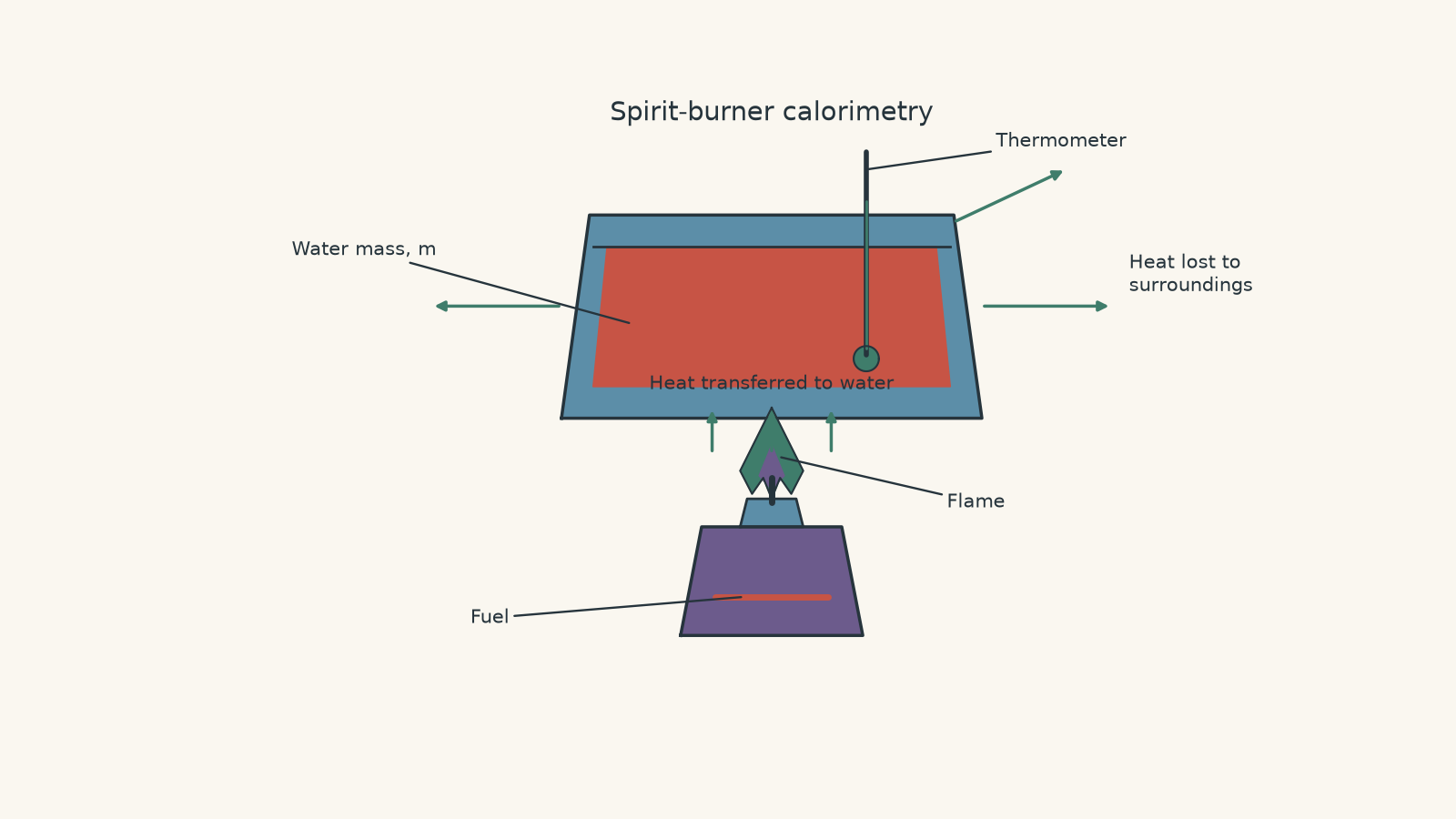
In a simple school calorimetry experiment, the surroundings we measure are usually some water above the flame. The water gets warmer, so its heat change is positive:
\[ q_{\text{water}} = mc\Delta T \]
where:
- \(q_{\text{water}}\) is the heat absorbed by the water, in joules, J
- \(m\) is the mass of water, in grams, g
- \(c\) is the specific heat capacity of water, usually \(4.18\ \mathrm{J\,g^{-1}\,^\circ C^{-1}}\)
- \(\Delta T\) is the temperature change, \(T_{\text{final}}-T_{\text{initial}}\), in \(^\circ\text{C}\) or K
If the water warms, \(\Delta T>0\), so \(q_{\text{water}}>0\).
Now predict the sign for the burning fuel. If the water gained energy, did the reaction gain or lose energy?
It lost energy. In an ideal calorimeter where all the heat released by the reaction reaches the measured surroundings,
\[ q_{\text{reaction}}=-q_{\text{surroundings}} \]
Think of it like two bank accounts. If the water’s energy balance goes up by 20 kJ, the reaction’s balance goes down by 20 kJ.
That picture is useful, but it has a limit. A real spirit burner has more than two “accounts”: the metal can, thermometer, air, burner, and nearby surroundings can all take some energy. The water rarely receives everything the fuel releases.
02From heat released to molar enthalpy of combustion
Suppose one sample of fuel releases 20 kJ and another releases 30 kJ. You still can’t say the second fuel has the larger molar enthalpy of combustion. Perhaps you simply burned more of it.
We therefore divide by the amount of fuel burned:
\[ \Delta H_c=\frac{q_{\text{reaction}}}{n_{\text{fuel}}} \]
where:
- \(\Delta H_c\) is the molar enthalpy change of combustion, usually in \(\mathrm{kJ\,mol^{-1}}\)
- \(q_{\text{reaction}}\) is the heat change of the reaction, in kJ
- \(n_{\text{fuel}}\) is the amount of fuel burned, in mol
For a simple water calorimetry experiment,
\[ \Delta H_c \approx -\frac{mc\Delta T}{n_{\text{fuel}}} \]
The approximation sign matters. It assumes the measured surroundings absorb all the energy released by combustion. Real school experiments usually lose some heat.
If the fuel mass is given, first convert it to moles:
\[ n=\frac{m}{M} \]
where \(m\) is the fuel mass in grams and \(M\) is its molar mass in \(\mathrm{g\,mol^{-1}}\).
Heat released and enthalpy change are not always written with the same sign
This wording causes unnecessary mistakes.
If a question says a reaction has an enthalpy change of combustion of \(-890\ \mathrm{kJ\,mol^{-1}}\), the negative sign tells you the reaction is exothermic.
If it asks for the amount of energy released by 1 mol, you would normally say 890 kJ is released.
So:
- enthalpy change: \(-890\ \mathrm{kJ\,mol^{-1}}\)
- magnitude of energy released: \(890\ \mathrm{kJ\,mol^{-1}}\)
Some school resources use “molar heat of combustion” for the positive magnitude of the energy released. Read the wording carefully. In this guide, \(\Delta H_c\) means the signed enthalpy change, so combustion values are negative.
03What does complete combustion mean?
Heat of combustion refers to complete combustion.
For a fuel containing carbon and hydrogen, complete combustion converts:
- carbon into \(\ce{CO2}\)
- hydrogen into \(\ce{H2O}\)
For ethanol,
\[ \ce{C2H5OH(l) + 3O2(g) -> 2CO2(g) + 3H2O(l)} \]
Complete combustion requires enough oxygen for the fuel to reach these fully oxidised products.
If oxygen is limited, carbon monoxide, \(\ce{CO}\), or solid carbon may form instead. That is incomplete combustion.
Why does this matter energetically? Imagine some carbon stops at \(\ce{CO}\). That \(\ce{CO}\) can still react:
\[ \ce{CO(g) + 1/2O2(g) -> CO2(g)} \]
and release more energy.
So incomplete combustion releases less energy than complete combustion of the same amount of fuel. Some chemical energy is still sitting in the partially oxidised products.
04The state of the products matters
An equation such as
\[ \ce{CH4(g) + 2O2(g) -> CO2(g) + 2H2O(l)} \]
does not describe exactly the same energy change as
\[ \ce{CH4(g) + 2O2(g) -> CO2(g) + 2H2O(g)} \]
The second reaction leaves the water as vapour. The first ends with liquid water.
Which would you expect to release more energy overall?
The reaction ending with liquid water is more exothermic. After water vapour forms, condensation releases additional energy as the water becomes liquid.
This is why physical-state symbols such as \((l)\) and \((g)\) are not decorative details in thermochemical equations.
A standard molar enthalpy of combustion, written \(\Delta H_c^\circ\), refers to one mole of a substance undergoing complete combustion with reactants and products in their standard states at the stated temperature. Data tables commonly use \(25^\circ\text{C}\).
Worked example: Finding an experimental enthalpy of combustion
1.20 g of ethanol is burned beneath 200.0 g of water. The water temperature rises from \(21.5^\circ\text{C}\) to \(41.5^\circ\text{C}\). Assume all measured heat is absorbed by the water. The specific heat capacity of water is \(4.18\ \mathrm{J\,g^{-1}\,^\circ C^{-1}}\), and the molar mass of ethanol is \(46.07\ \mathrm{g\,mol^{-1}}\). Calculate the experimental molar enthalpy of combustion.
Step 1
\[ \Delta T=41.5-21.5=20.0^\circ\text{C} \]
Step 2
\[ \begin{aligned} q_{\text{water}}&=mc\Delta T\\ &=(200.0)(4.18)(20.0)\\ &=16720\ \mathrm{J}\\ &=16.72\ \mathrm{kJ} \end{aligned} \]
The water gains 16.72 kJ.
Step 3
\[ \begin{aligned} n_{\text{ethanol}}&=\frac{m}{M}\\ &=\frac{1.20}{46.07}\\ &=0.02605\ \mathrm{mol} \end{aligned} \]
Step 4
The reaction loses the energy that the surroundings gain:
\[ \begin{aligned} \Delta H_c &=-\frac{q_{\text{water}}}{n_{\text{ethanol}}}\\ &=-\frac{16.72}{0.02605}\\ &=-642\ \mathrm{kJ\,mol^{-1}} \end{aligned} \]
The experimental molar enthalpy of combustion is therefore approximately
\[ \Delta H_c=-642\ \mathrm{kJ\,mol^{-1}} \]
The negative sign means combustion is exothermic. It does not mean the water should cool.
In a real spirit-burner experiment, this experimental value would usually be less negative than a reliable standard value because some heat escapes without being measured.
05Using a known enthalpy of combustion backwards
Sometimes the question runs in the opposite direction.
Instead of measuring a temperature rise and finding \(\Delta H_c\), you may be given \(\Delta H_c\) and asked how much fuel is needed to provide a certain amount of energy.
For \(n\) moles of fuel,
\[ q_{\text{reaction}}=n\Delta H_c \]
If the question asks how much energy is released, use the magnitude:
\[ \text{energy released}=n|\Delta H_c| \]
A real heater rarely transfers all of that energy into the object you care about. If the efficiency is \(\eta\),
\[ \eta=\frac{q_{\text{useful}}}{q_{\text{released}}} \]
so
\[ q_{\text{released}}=\frac{q_{\text{useful}}}{\eta} \]
An efficiency of 70% is written as \(0.70\), not 70.
Worked example: How much propane is needed?
A propane burner heats 2.00 kg of water by \(35.0^\circ\text{C}\). The burner transfers 70.0% of the combustion energy to the water. Propane has \(\Delta H_c=-2220\ \mathrm{kJ\,mol^{-1}}\) and a molar mass of \(44.10\ \mathrm{g\,mol^{-1}}\). Calculate the mass of propane required.
Step 1
Convert 2.00 kg to 2000 g.
\[ \begin{aligned} q_{\text{water}} &=mc\Delta T\\ &=(2000)(4.18)(35.0)\\ &=292600\ \mathrm{J}\\ &=292.6\ \mathrm{kJ} \end{aligned} \]
Step 2
Only 70.0% of the released energy reaches the water:
\[ \begin{aligned} q_{\text{released}} &=\frac{292.6}{0.700}\\ &=418.0\ \mathrm{kJ} \end{aligned} \]
Step 3
Each mole releases 2220 kJ:
\[ \begin{aligned} n_{\text{propane}} &=\frac{418.0}{2220}\\ &=0.1883\ \mathrm{mol} \end{aligned} \]
Step 4
\[ \begin{aligned} m&=nM\\ &=(0.1883)(44.10)\\ &=8.30\ \mathrm{g} \end{aligned} \]
About 8.30 g of propane is required.
Notice that we used \(2220\ \mathrm{kJ\,mol^{-1}}\) as a positive magnitude while calculating the amount of energy available. If we were writing the enthalpy change of the combustion reaction itself, it would remain \(-2220\ \mathrm{kJ\,mol^{-1}}\).
06The most common traps
A larger temperature rise does not automatically mean a fuel has a larger molar enthalpy of combustion.
Suppose fuel A raises the water temperature by \(20^\circ\text{C}\) and fuel B raises it by only \(15^\circ\text{C}\). Before comparing the fuels, you would still need to know:
- the mass of water heated
- the amount of each fuel burned
- whether the apparatus absorbed significant heat
- whether similar fractions of the released heat were actually measured
- whether combustion was complete
The temperature rise is evidence about heat transfer. It is not, by itself, a molar property of the fuel.
| Tempting move | What to do instead |
|---|---|
| Give \(q=mc\Delta T\) as the final heat of combustion | Divide by the moles of fuel if a molar value is required |
| Make \(\Delta H_c\) positive because the water gets hotter | The water gains energy; the combustion reaction loses it |
| Use the fuel mass in \(q=mc\Delta T\) | \(m\) in this equation is the mass of the substance being heated |
| Use fuel mass directly as though it were moles | Calculate \(n=m/M\) first |
| Leave \(q\) in J and divide as though it were kJ | Convert units before calculating \(\mathrm{kJ\,mol^{-1}}\) |
| Assume every gram lost from a spirit burner was burned | Some fuel may evaporate without combusting |
| Blame every low result on heat loss | Incomplete combustion can also reduce the energy released |
| Ignore \((l)\) and \((g)\) in a thermochemical equation | Product states affect the enthalpy change |
A quick sanity check
For ordinary fuel combustion:
- \(\Delta H_c\) should be negative
- more fuel gives more total energy, but should not change the molar value
- heat loss usually makes an experimental value less negative than the true value
- evaporation from the fuel container can make the calculated value less negative because you overestimate the amount that actually burned
- incomplete combustion releases less energy than complete combustion
One particularly useful check is this: if your experimental result is much more negative than a reliable accepted value, ordinary heat loss cannot explain it. Heat loss works in the opposite direction. Look for a unit error, an underestimated amount of fuel burned, an unaccounted heat source, or an incorrect calorimeter calculation.
07Questions and solutions
Question 1
A student burns 0.750 g of methanol and uses the energy to heat 150 g of water from \(19.0^\circ\text{C}\) to \(31.0^\circ\text{C}\).
The molar mass of methanol is \(32.04\ \mathrm{g\,mol^{-1}}\), and the specific heat capacity of water is \(4.18\ \mathrm{J\,g^{-1}\,^\circ C^{-1}}\).
Calculate the experimental molar enthalpy of combustion of methanol.
Solution 1
The experimental molar enthalpy of combustion is approximately \(-321\ \mathrm{kJ\,mol^{-1}}\).
First find the temperature change:
\[ \Delta T=31.0-19.0=12.0^\circ\text{C} \]
The heat absorbed by the water is
\[ \begin{aligned} q_{\text{water}} &=mc\Delta T\\ &=(150)(4.18)(12.0)\\ &=7524\ \mathrm{J}\\ &=7.524\ \mathrm{kJ} \end{aligned} \]
Now calculate the amount of methanol burned:
\[ \begin{aligned} n&=\frac{m}{M}\\ &=\frac{0.750}{32.04}\\ &=0.02341\ \mathrm{mol} \end{aligned} \]
Therefore,
\[ \begin{aligned} \Delta H_c &=-\frac{7.524}{0.02341}\\ &=-321\ \mathrm{kJ\,mol^{-1}} \end{aligned} \]
The tempting mistake is to report \(+7.524\) kJ because the water warmed. That is the heat gained by the water, not the molar enthalpy change of the combustion reaction.
Question 2
An ethanol spirit burner appears to lose 1.10 g during an experiment. It heats 180 g of water by \(22.0^\circ\text{C}\).
Later, the student determines that 0.15 g of the measured mass loss was ethanol that evaporated without burning.
The molar mass of ethanol is \(46.07\ \mathrm{g\,mol^{-1}}\), and \(c_{\text{water}}=4.18\ \mathrm{J\,g^{-1}\,^\circ C^{-1}}\).
Calculate:
a. the apparent experimental \(\Delta H_c\) if all 1.10 g is assumed to have burned
b. the corrected experimental \(\Delta H_c\)
c. why evaporation changes the answer in this direction.
Solution 2
The apparent value is \(-693\ \mathrm{kJ\,mol^{-1}}\), while the corrected value is \(-803\ \mathrm{kJ\,mol^{-1}}\). Correcting for evaporation makes the result more negative because fewer moles actually produced the measured heat.
The water absorbs
\[ \begin{aligned} q_{\text{water}} &=(180)(4.18)(22.0)\\ &=16552.8\ \mathrm{J}\\ &=16.5528\ \mathrm{kJ} \end{aligned} \]
For part a, assuming 1.10 g burned:
\[ \begin{aligned} n_{\text{apparent}} &=\frac{1.10}{46.07}\\ &=0.02388\ \mathrm{mol} \end{aligned} \]
so
\[ \begin{aligned} \Delta H_{c,\text{apparent}} &=-\frac{16.5528}{0.02388}\\ &=-693\ \mathrm{kJ\,mol^{-1}} \end{aligned} \]
For part b, only
\[ 1.10-0.15=0.95\ \mathrm{g} \]
actually burned.
Therefore,
\[ \begin{aligned} n_{\text{burned}} &=\frac{0.95}{46.07}\\ &=0.02062\ \mathrm{mol} \end{aligned} \]
and
\[ \begin{aligned} \Delta H_{c,\text{corrected}} &=-\frac{16.5528}{0.02062}\\ &=-803\ \mathrm{kJ\,mol^{-1}} \end{aligned} \]
The trap is to think that evaporation directly removes some of the heat being measured. Its main effect on this calculation is different: it makes the balance appear to have lost more fuel than actually underwent combustion.
That makes the denominator \(n\) too large. Dividing the measured heat by too many supposed moles produces a value whose magnitude is too small.
Question 3
The standard molar enthalpy of combustion of propane to form liquid water is
\[ \Delta H_c^\circ=-2220\ \mathrm{kJ\,mol^{-1}} \]
according to
\[ \ce{C3H8(g) + 5O2(g) -> 3CO2(g) + 4H2O(l)} \]
At the same temperature, assume the enthalpy required to vaporise water is \(44.0\ \mathrm{kJ\,mol^{-1}}\).
a. Determine the enthalpy change for complete combustion of propane if the product water remains as vapour.
b. Calculate the energy released when 0.0500 mol of propane burns and initially produces water vapour.
c. If all of that water vapour later condenses, calculate the total energy released from the original propane through to the final liquid-water state.
Solution 3
Combustion to water vapour has \(\Delta H=-2044\ \mathrm{kJ\,mol^{-1}}\). Burning 0.0500 mol initially releases 102.2 kJ, and subsequent condensation increases the total energy released to 111.0 kJ.
For each mole of propane, four moles of water form.
Changing the products from \(4\ce{H2O(l)}\) to \(4\ce{H2O(g)}\) requires
\[ 4(44.0)=176\ \mathrm{kJ} \]
So the combustion ending with vapour must be 176 kJ less exothermic:
\[ \begin{aligned} \Delta H &=-2220+176\\ &=-2044\ \mathrm{kJ\,mol^{-1}} \end{aligned} \]
For 0.0500 mol of propane,
\[ \begin{aligned} q_{\text{reaction}} &=n\Delta H\\ &=(0.0500)(-2044)\\ &=-102.2\ \mathrm{kJ} \end{aligned} \]
Therefore, 102.2 kJ is released during the combustion stage.
That amount of propane forms
\[ (0.0500)(4)=0.200\ \mathrm{mol} \]
of water vapour.
When it condenses, the additional energy released is
\[ (0.200)(44.0)=8.80\ \mathrm{kJ} \]
so the total energy released is
\[ 102.2+8.80=111.0\ \mathrm{kJ} \]
This also agrees directly with the liquid-water combustion value:
\[ (0.0500)(2220)=111.0\ \mathrm{kJ} \]
The tempting route is to treat “complete combustion” as though it automatically fixes one numerical enthalpy value. Complete combustion fixes the chemical oxidation products, but their physical states still affect the energy difference.
Question 4
A pure fuel undergoes complete combustion in the same calorimeter in two experiments.
- In experiment A, 0.0200 mol of fuel burns and the measured water and calorimeter absorb 20.0 kJ.
- In experiment B, 0.0400 mol burns and the measured water and calorimeter absorb 46.0 kJ.
Two models are proposed for the missing energy.
Model F says the calorimeter always captures the same fraction of the heat released.
Model L says a fixed amount of heat, \(L\), is lost in every experiment, regardless of how much fuel burns.
Assume that exactly one of these models describes the data.
a. Determine which model is consistent with both experiments.
b. Determine the fuel’s molar enthalpy of combustion and the heat loss per experiment.
c. Predict the measured heat absorption if 0.0300 mol of the fuel is burned under the same conditions.
Solution 4
Model L is consistent with the data. It gives \(\Delta H_c=-1300\ \mathrm{kJ\,mol^{-1}}\), a fixed loss of 6.0 kJ per experiment, and predicts a measured heat absorption of 33.0 kJ for 0.0300 mol.
First test Model F.
If the same fraction were captured every time, measured heat per mole would be constant.
For experiment A:
\[ \frac{20.0}{0.0200}=1000\ \mathrm{kJ\,mol^{-1}} \]
For experiment B:
\[ \frac{46.0}{0.0400}=1150\ \mathrm{kJ\,mol^{-1}} \]
These are not equal, so one constant capture fraction cannot satisfy both measurements exactly.
Now test Model L.
Let \(H\) be the positive magnitude of the true molar energy released. If \(L\) kJ is lost each time,
\[ 0.0200H-L=20.0 \]
and
\[ 0.0400H-L=46.0 \]
Subtract the first equation from the second:
\[ 0.0200H=26.0 \]
so
\[ H=1300\ \mathrm{kJ\,mol^{-1}} \]
Because combustion is exothermic,
\[ \Delta H_c=-1300\ \mathrm{kJ\,mol^{-1}} \]
Substitute \(H=1300\) into the first experiment:
\[ \begin{aligned} (0.0200)(1300)-L&=20.0\\ 26.0-L&=20.0\\ L&=6.0\ \mathrm{kJ} \end{aligned} \]
For 0.0300 mol, the fuel releases
\[ (0.0300)(1300)=39.0\ \mathrm{kJ} \]
before the fixed loss. The measured apparatus therefore receives
\[ 39.0-6.0=33.0\ \mathrm{kJ} \]
The tempting route is to calculate \(-1000\) and \(-1150\ \mathrm{kJ\,mol^{-1}}\) from the two experiments and simply average them. That produces a number, but it doesn’t test either proposed physical model.
The important clue is how the discrepancy changes when the amount of fuel doubles. A fixed absolute loss has a much larger fractional effect on the smaller experiment, so the apparent molar values need not match.
The fixed-loss model is deliberately simplified; real calorimeters do not usually lose exactly the same number of kilojoules in every run. The point is to use the measurements to test a model rather than automatically labelling every discrepancy “heat loss”.
Question 5
A student burns exactly 1.00 g of ethanol. The calorimeter records 21.0 kJ of heat absorption.
Gas analysis shows that combustion was incomplete: 0.00500 mol of \(\ce{CO}\) remains in the products. There is no soot or unburned ethanol.
Use the following data:
\[ \Delta H_c^\circ(\text{ethanol})=-1367\ \mathrm{kJ\,mol^{-1}} \]
for complete combustion to \(\ce{CO2(g)}\) and \(\ce{H2O(l)}\), and
\[ \ce{CO(g) + 1/2O2(g) -> CO2(g)} \]
has
\[ \Delta H=-283\ \mathrm{kJ\,mol^{-1}} \]
The molar mass of ethanol is \(46.07\ \mathrm{g\,mol^{-1}}\).
Assume that all other products have the same final states as in the complete-combustion equation.
a. Calculate the energy that would have been released if the ethanol had burned completely.
b. Determine how much less chemical energy was released because 0.00500 mol of \(\ce{CO}\) remained unoxidised.
c. Determine the actual chemical energy released by the incomplete combustion.
d. Determine how much of that released energy was not measured by the calorimeter.
e. A student says, “The difference between the accepted complete-combustion energy and the calorimeter reading is all heat loss.” Explain precisely why that conclusion is wrong.
Solution 5
Complete combustion would release 29.67 kJ. The formation of 0.00500 mol of \(\ce{CO}\) instead of fully oxidising that carbon reduces the chemical energy release by 1.415 kJ, so the actual incomplete combustion releases 28.26 kJ. Of this, 7.26 kJ is not measured by the calorimeter.
First calculate the amount of ethanol:
\[ \begin{aligned} n_{\text{ethanol}} &=\frac{1.00}{46.07}\\ &=0.02171\ \mathrm{mol} \end{aligned} \]
If it underwent complete combustion, the magnitude of the energy released would be
\[ \begin{aligned} q_{\text{complete}} &=(0.02171)(1367)\\ &=29.67\ \mathrm{kJ} \end{aligned} \]
Now consider the \(\ce{CO}\).
If the remaining 0.00500 mol of \(\ce{CO}\) were oxidised completely to \(\ce{CO2}\), it would release
\[ \begin{aligned} q_{\ce{CO}} &=(0.00500)(283)\\ &=1.415\ \mathrm{kJ} \end{aligned} \]
That 1.415 kJ has not yet been released because the carbon stopped at \(\ce{CO}\).
Therefore, the actual chemical energy released in the burner is
\[ \begin{aligned} q_{\text{actual}} &=29.67-1.415\\ &=28.26\ \mathrm{kJ} \end{aligned} \]
The calorimeter measures only 21.0 kJ, so the energy released chemically but not measured is
\[ \begin{aligned} q_{\text{unmeasured}} &=28.26-21.0\\ &=7.26\ \mathrm{kJ} \end{aligned} \]
The student’s claim confuses two different causes of the discrepancy.
Comparing the complete-combustion prediction directly with the calorimeter gives
\[ 29.67-21.0=8.67\ \mathrm{kJ} \]
but that entire 8.67 kJ is not heat that escaped from the calorimeter.
Of it:
- 1.415 kJ was never released in the first place because the \(\ce{CO}\) was not fully oxidised
- 7.26 kJ was released by the actual reaction but was not measured by the calorimeter
This distinction is the key conceptual point. Heat loss concerns where released energy goes. Incomplete combustion changes how much chemical energy is released at all.
08Where heat of combustion leads next
Once you can separate the chemical reaction from the heat measured by its surroundings, combustion data becomes useful for more than calorimetry.
You can combine known combustion reactions to calculate an enthalpy change for a reaction that is difficult to measure directly. That is the central idea behind Hess’s Law for stepped reactions: the overall enthalpy change depends on the initial and final states, not the route between them.
You can also move to the molecular level and ask why one reaction has a particular enthalpy change. That means comparing the energy needed to break bonds with the energy released when new bonds form, which is developed in Bond Enthalpy and Conservation of Energy in HSC Chemistry.
The useful habit carries across both topics: write the chemical change first, keep track of where the energy goes, and only then attach the numbers.