
Why Centripetal Force Does No Work in Uniform Circular Motion
Learn why centripetal force can continuously accelerate an object without changing its kinetic energy, and when that zero-work result stops applying.
A rubber stopper is whirling on a string at constant speed. The string is pulling inward the whole time, and the stopper is accelerating the whole time. After 20 laps, has that inward force given the stopper extra kinetic energy?
It feels as though it should have. There is a force. The stopper travels a large distance. Yet in ideal uniform circular motion, the centripetal force does no work at all.
The reason is not that the force is too small, or that the object somehow “cancels out” the work after each lap. The force is pointing in exactly the wrong direction to change the object’s speed.
01A force can change velocity without changing speed
Start with the motion itself.
At any instant in uniform circular motion:
- the object’s velocity points tangent to the circle,
- the centripetal acceleration points towards the centre,
- the net force points towards the centre, and
- the speed stays constant.
If the difference between speed and velocity is fuzzy, this is the key refresher: speed tells you how fast something moves. Velocity also includes direction.
An object travelling around a circle can therefore have constant speed while its velocity changes every instant.
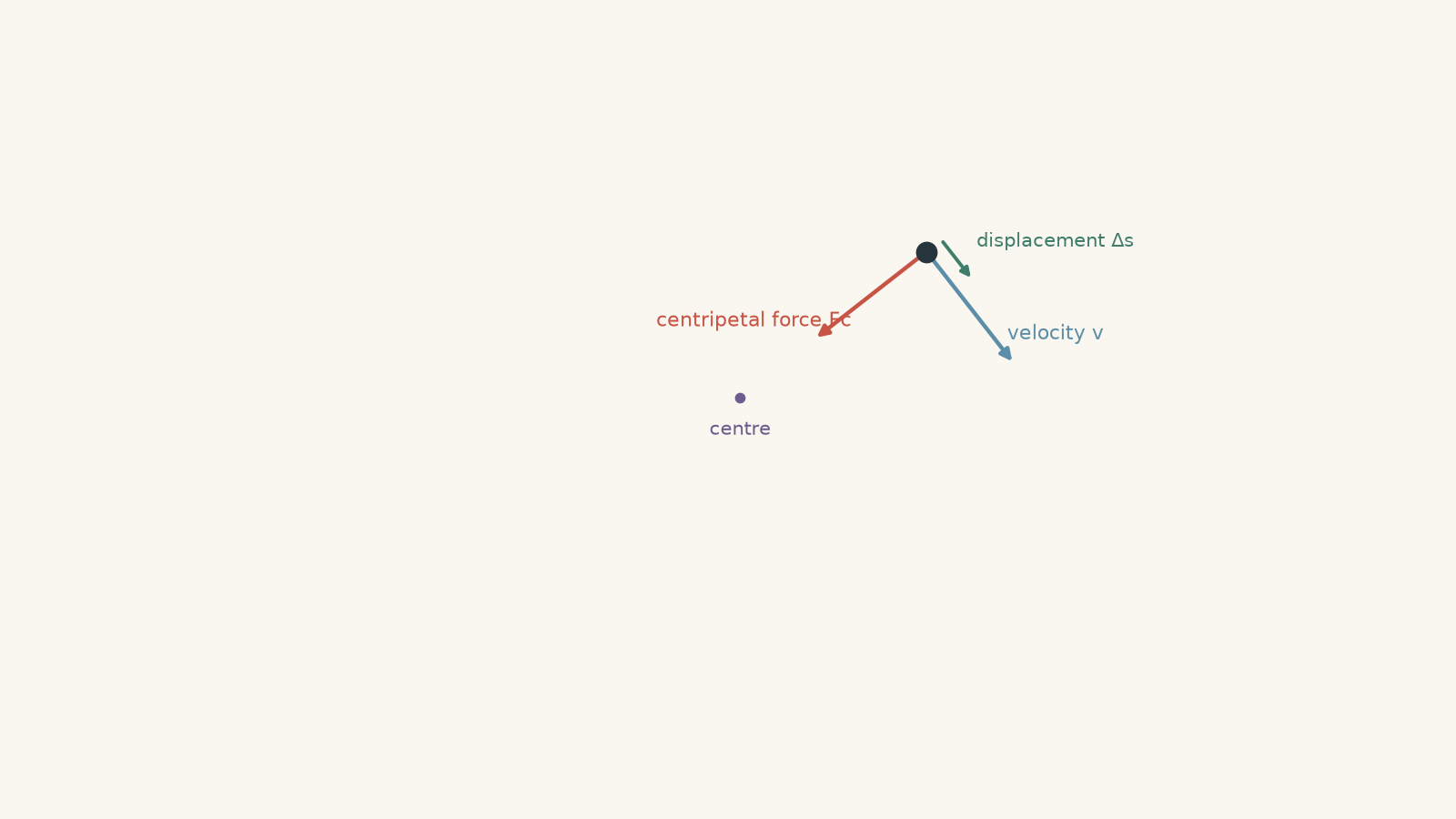
The inward acceleration is responsible for that change of direction. It keeps turning the velocity vector without making it longer or shorter.
If you want to rebuild why the acceleration points this way, see Centripetal Acceleration: Why It Points Inward in HSC Physics.
A rough mental model is a friend standing near you and continually tugging your backpack sideways while you run. If every tug is exactly sideways to your motion, they can bend your path without pushing you faster or dragging you slower.
The analogy breaks in real life because your friend probably won’t keep the force perfectly perpendicular, and friction will matter. The ideal physics case is cleaner.
02Work depends on the direction of the force
A force does work when it has a component along the object’s displacement.
For a constant force over a straight displacement,
\[
W = Fs\cos\theta
\]
where:
- \(W\) is work, measured in joules (J),
- \(F\) is the force magnitude, measured in newtons (N),
- \(s\) is the displacement magnitude, measured in metres (m), and
- \(\theta\) is the angle between the force and the displacement.
Suppose the force points in the same direction as the displacement. Then \(\theta=0^\circ\), so \(\cos 0^\circ=1\). The force does positive work.
Suppose the force points directly opposite the displacement. Then \(\theta=180^\circ\), so the force does negative work.
Now make a prediction. What happens when the force is exactly perpendicular to the displacement?
At \(90^\circ\),
\[
\cos 90^\circ=0
\]
so the work is zero.
That is exactly the geometry of ideal uniform circular motion. The instantaneous displacement is tangent to the circle, while the centripetal force is radial.
They are perpendicular.
03The important word is instantaneous
There is a small trap here.
Over a quarter of a circle, the object has obviously travelled a substantial distance. The line joining its starting and finishing positions is also not generally perpendicular to the force at the starting point.
So you cannot take one centripetal force vector, multiply it by the total distance travelled, and use \(W=Fs\cos\theta\) as though the force direction stayed fixed.
It doesn’t. The centripetal force turns continuously as the object moves.
Instead, picture the path as a huge number of tiny displacements. For each tiny displacement,
\[
dW = F_c\,ds\cos 90^\circ = 0
\]
where \(dW\) is a tiny amount of work, \(F_c\) is the centripetal force magnitude, and \(ds\) is a tiny distance along the path.
Every tiny contribution is zero. Adding them all still gives zero.
For HSC problems, there is often an even quicker way to see the same result: use the work-energy theorem.
\[
W_{\text{net}}=\Delta K
\]
The kinetic energy is
\[
K=\frac12mv^2
\]
where \(m\) is mass in kilograms (kg), and \(v\) is speed in metres per second (m s\(^{-1}\)).
Uniform circular motion has constant speed, so \(v\) does not change. Therefore \(K\) does not change.
Hence,
\[
\Delta K=0
\]
and therefore
\[
W_{\text{net}}=0
\]
These are two views of the same physics:
- geometrically, the net force is perpendicular to the motion;
- energetically, the speed and kinetic energy stay constant.
04Centripetal force is not an extra force
There is another common source of confusion.
“Centripetal force” does not mean a special new force that appears whenever something moves in a circle. It is the name for the net inward force required to produce the circular motion.
Its magnitude in uniform circular motion is
\[
F_c=\frac{mv^2}{r}
\]
where \(r\) is the radius of the circular path in metres.
The inward force might be supplied by:
- tension,
- gravity,
- a normal force,
- friction, or
- a combination of several real forces.
For example, gravity supplies the centripetal force for a satellite in a perfectly circular orbit. Tension can supply it for a mass moving in a horizontal circle on a string.
If one real force is entirely radial and supplies the centripetal force, that real force does no work in ideal uniform circular motion.
But be careful with the wording. It is possible for individual real forces to do positive or negative work while their total tangential effect cancels. What must be true in uniform circular motion is that the net force is radial, so the net work is zero.
For more on identifying which real force is playing the inward role, see Centripetal Force: How to Identify the Real Force in HSC Physics.
Worked example: A stopper completes a quarter-circle
A \(0.60\) kg rubber stopper moves at a constant speed of \(3.0\) m s\(^{-1}\) in a horizontal circle of radius \(1.2\) m. Find the centripetal force and the work done by that force while the stopper completes one-quarter of a revolution.
Step 1
\[
F_c=\frac{mv^2}{r}
=\frac{(0.60)(3.0)^2}{1.2}
=4.5\text{ N}
\]
The net force is \(4.5\) N towards the centre.
Step 2
At every instant, the stopper’s tiny displacement is tangent to the circle. The \(4.5\) N force points radially inward.
The angle between them is therefore \(90^\circ\).
Step 3
For each tiny part of the path,
\[
dW=F_c\,ds\cos90^\circ=0
\]
so over the whole quarter-circle,
\[
W=0\text{ J}
\]
Step 4
The stopper’s kinetic energy is
\[
K=\frac12mv^2
=\frac12(0.60)(3.0)^2
=2.7\text{ J}
\]
Its speed remains \(3.0\) m s\(^{-1}\), so its kinetic energy remains \(2.7\) J.
The result means the inward force has substantially changed the stopper’s velocity direction, but transferred no net energy to it.
05Why acceleration does not automatically mean work
Students often make this chain of reasoning:
There is a force, so there is acceleration. If there is acceleration, the object must gain energy.
The first step is correct. The second is not.
Acceleration means velocity is changing. There are two ways velocity can change:
- its magnitude can change, meaning the speed changes;
- its direction can change.
Centripetal acceleration in uniform circular motion does only the second.
This distinction becomes even clearer if you split acceleration into radial and tangential components.
The radial component changes direction. The tangential component changes speed.
So:
| Component | Direction | Main effect |
|---|---|---|
| Radial or centripetal | Towards the centre | Changes velocity direction |
| Tangential | Along or opposite the motion | Changes speed |
| Pure uniform circular motion | Radial only | Speed stays constant |
This gives you a useful exam decision rule: if the object is moving around a fixed circle but its speed is changing, there must be a tangential component of net force as well as the radial component.
Worked example: The object is speeding up around the circle
A \(1.5\) kg object moves around a circle of radius \(3.0\) m. At one instant, its speed is \(4.0\) m s\(^{-1}\), and its tangential acceleration is \(2.0\) m s\(^{-2}\). Find the radial force component, the tangential force component, and the instantaneous rate at which the net force is doing work.
Step 1
\[
a_r=\frac{v^2}{r}
=\frac{(4.0)^2}{3.0}
=5.33\text{ m s}^{-2}
\]
Step 2
\[
F_r=ma_r
=(1.5)(5.33)
=8.0\text{ N}
\]
This \(8.0\) N component points towards the centre. It changes the direction of the velocity but does no instantaneous work.
Step 3
\[
F_t=ma_t
=(1.5)(2.0)
=3.0\text{ N}
\]
The object is speeding up, so this component points in the direction of motion.
Step 4
Power tells us how quickly work is being done. For a force component parallel to the velocity,
\[
P=F_tv
\]
where \(P\) is power in watts (W).
Therefore,
\[
P=(3.0)(4.0)=12\text{ W}
\]
The net force is transferring energy to the object at \(12\) J each second at that instant.
The important point is that the \(8.0\) N centripetal component still does no work. The \(3.0\) N tangential component is responsible for the increasing kinetic energy.
06When does an inward force start doing work?
The statement “centripetal force does no work” relies on a condition that students sometimes forget: the inward force must be perpendicular to the object’s velocity.
That is guaranteed in ideal motion around a fixed circle because the velocity is tangent to the circle.
Change the radius, and the story can change.
Imagine a puck on a frictionless horizontal table attached to a string that passes through a hole at the centre. While the puck moves around a circle at constant radius, its velocity is tangent to the circle. Tension is radial, so tension does no work.
Now someone pulls the string down through the hole.
The puck begins moving inward as well as around.
Its velocity now has two components:
- a tangential component around the hole, and
- a radial component towards the hole.
Tension still points inward, but it is no longer perpendicular to the total velocity. It can now do positive work.
This is why “inward force means zero work” is not a safe rule.
The safe rule is:
A force does zero instantaneous work when it is perpendicular to the object’s instantaneous velocity.
For power, the same idea is written as
\[
P=\vec F\cdot\vec v
\]
If the force and velocity are perpendicular, the dot product is zero. If part of the velocity lies along the force, the power is not zero.
07The quickest way to decide in an exam
When you see work and circular motion together, check these conditions rather than memorising a slogan.
- Is the radius fixed?
- Is the speed constant?
- Is the force you are analysing entirely radial?
- Is that force perpendicular to the instantaneous velocity?
For ideal uniform circular motion, all four answers are yes. The radial net force does no work.
If the speed changes, look for a tangential force component.
If the radius changes, the velocity can gain a radial component, so even a radial force may do work.
If several real forces act, do not assume that every force individually does zero work just because the total speed is constant.
08Questions and solutions
Question 1
A \(0.75\) kg mass moves at a constant speed of \(6.0\) m s\(^{-1}\) in a horizontal circle of radius \(1.5\) m.
Calculate:
a. the centripetal force, and
b. the work done by the centripetal force during half a revolution.
Solution 1
The centripetal force is \(18\) N inward, and it does \(0\) J of work during the half-revolution.
For part a,
\[
F_c=\frac{mv^2}{r}
=\frac{(0.75)(6.0)^2}{1.5}
=18\text{ N}
\]
For part b, the instantaneous motion is tangent to the circle while the force is radial. They remain perpendicular throughout the motion.
Therefore each tiny contribution to the work is zero, so
\[
W=0\text{ J}
\]
The tempting mistake is to calculate the half-circle distance and multiply it by \(18\) N. That would ignore the fact that work depends on the direction of the force relative to each displacement, and that the force direction continuously changes.
The object’s kinetic energy also confirms the result:
\[
K=\frac12mv^2
=\frac12(0.75)(6.0)^2
=13.5\text{ J}
\]
The speed is unchanged, so the kinetic energy stays at \(13.5\) J.
Question 2
A \(500\) kg satellite travels in a circular orbit of radius \(7.0\times10^6\) m at a constant speed of \(7.5\times10^3\) m s\(^{-1}\). Assume gravity is the only force acting.
a. Calculate the magnitude of the gravitational force.
b. Determine the work done by gravity during half an orbit.
c. A student argues that the satellite’s overall displacement after half an orbit points through the centre, roughly in the same direction as its initial gravitational force, so gravity must have done positive work. Explain the flaw.
Solution 2
Gravity has a magnitude of about \(4.0\times10^3\) N, but it does \(0\) J of work during the half-orbit.
For part a,
\[
F_g=F_c=\frac{mv^2}{r}
=\frac{(500)(7.5\times10^3)^2}{7.0\times10^6}
\approx4.0\times10^3\text{ N}
\]
For part b, the satellite’s speed is constant, so its kinetic energy does not change.
Using the work-energy theorem,
\[
W_{\text{net}}=\Delta K=0
\]
Gravity is the only force, so
\[
W_g=0\text{ J}
\]
For part c, the student’s argument incorrectly treats gravity as though its direction were fixed throughout the half-orbit.
It is not. Gravity always points from the satellite towards Earth’s centre, so the force vector rotates continuously as the satellite travels.
The overall displacement from the starting point to the finishing point cannot be paired with the initial force vector in a single \(W=Fs\cos\theta\) calculation when the force changes direction throughout the path.
At every instant, gravity is radial and the satellite’s velocity is tangential. Their dot product is zero, so gravity does no work.
A second energy check reaches the same conclusion: the orbital radius is constant, so the satellite’s gravitational potential energy is constant, and its speed is constant, so its kinetic energy is constant too.
Question 3
A \(2.0\) kg object moves at a constant speed of \(4.0\) m s\(^{-1}\) around a circle of radius \(4.0\) m.
Two real forces, A and B, act on it. Relative to the object at every instant:
- force A has a \(6.0\) N inward component and an \(8.0\) N forward tangential component;
- force B has whatever components are required to maintain uniform circular motion.
Determine:
a. the radial and tangential components of force B,
b. the instantaneous power delivered by each force, and
c. whether the statement “neither force does work because the motion is uniform circular motion” is correct.
Solution 3
Force B must have a \(2.0\) N inward component and an \(8.0\) N backward tangential component; force A delivers \(+32\) W, force B delivers \(-32\) W, and the statement that neither force does work is false.
First find the required net radial force:
\[
F_c=\frac{mv^2}{r}
=\frac{(2.0)(4.0)^2}{4.0}
=8.0\text{ N}
\]
Force A already provides \(6.0\) N inward, so force B must provide the remaining
\[
F_{B,r}=8.0-6.0=2.0\text{ N inward}
\]
Uniform circular motion also requires zero net tangential force because the speed is constant.
Force A has an \(8.0\) N forward tangential component, so force B must have an \(8.0\) N backward tangential component.
For force A, only its tangential component contributes to power:
\[
P_A=F_{A,t}v
=(8.0)(4.0)
=32\text{ W}
\]
The sign is positive because this component points in the direction of motion.
For force B,
\[
P_B=(-8.0)(4.0)
=-32\text{ W}
\]
Its tangential component removes energy at the same rate.
Therefore,
\[
P_{\text{net}}=32-32=0\text{ W}
\]
The radial components do no work because they are perpendicular to the velocity.
The tempting route is to hear “uniform circular motion” and declare that every force must do zero work. What uniform circular motion actually guarantees is zero net work. Individual forces can transfer energy in opposite directions while the total kinetic energy remains unchanged.
Question 4
A \(0.50\) kg bead is driven at a constant speed around a smooth vertical circular track of radius \(1.20\) m. A motor can apply a force tangent to the track whenever required. The bead’s speed remains \(4.0\) m s\(^{-1}\) throughout the motion.
Take \(g=9.8\) m s\(^{-2}\).
a. Find the work done by gravity as the bead moves from the bottom of the circle to the top.
b. Find the work done by the motor over the same journey.
c. How much work does the normal force from the track do?
d. At the right-hand side of the circle, while the bead is moving upward, determine the tangential force the motor must apply.
e. The motor’s net work over a complete revolution is zero. Does that mean the motor never transfers energy to or from the bead?
Solution 4
Gravity does \(-11.8\) J of work from bottom to top, the motor does \(+11.8\) J, the normal force does \(0\) J, and at the right-hand side the motor must provide \(4.9\) N upward along the track. Zero motor work over the complete revolution does not mean zero energy transfer at every instant.
From the bottom to the top, the bead rises through a height equal to the circle’s diameter:
\[
\Delta h=2r=2(1.20)=2.40\text{ m}
\]
Gravity’s work is the negative change in gravitational potential energy:
\[
W_g=-mg\Delta h
=-(0.50)(9.8)(2.40)
=-11.76\text{ J}
\]
So,
\[
W_g\approx-11.8\text{ J}
\]
The bead’s speed is constant, so
\[
\Delta K=0
\]
and therefore the total work must be zero.
The normal force is always perpendicular to the bead’s instantaneous motion along the track, so
\[
W_N=0
\]
Hence the motor must replace exactly the energy removed by gravity:
\[
W_{\text{motor}}+W_g+W_N=0
\]
\[
W_{\text{motor}}-11.76+0=0
\]
so
\[
W_{\text{motor}}=+11.76\text{ J}
\]
At the right-hand side of the circle, the bead is moving vertically upward. Gravity acts vertically downward, exactly opposite the motion.
To keep the speed constant, the net tangential force must be zero. The motor therefore supplies an upward tangential force equal to the bead’s weight:
\[
F_{\text{motor}}=mg
=(0.50)(9.8)
=4.9\text{ N}
\]
Over the descending half of the loop, gravity does positive work. To prevent the bead from speeding up, the motor must remove that energy by doing negative work.
Over the full revolution, those positive and negative contributions cancel.
The tempting mistake is to reason that constant speed means every force does zero work. Constant speed only requires the total work to be zero. In this case, gravity and the motor exchange energy with the bead while the radial normal force does no work.
Question 5
A \(0.40\) kg puck moves on a frictionless horizontal table and is attached to a string passing through a small hole in the table.
Initially the puck moves around the hole. An experimenter then pulls the string downward. At one instant:
- the puck’s tangential velocity is \(3.0\) m s\(^{-1}\),
- its radial velocity is \(0.25\) m s\(^{-1}\) inward, and
- the string tension is \(18\) N inward.
During the next \(0.12\) m of inward radial motion, the tension rises linearly from \(18\) N to \(30\) N. Assume tension is the only force doing work on the puck.
a. Find the instantaneous power delivered by the tension at the initial instant.
b. Find the work done by tension during the \(0.12\) m inward motion.
c. Find the puck’s final speed.
d. Explain why this result does not contradict the statement that centripetal force does no work.
Solution 5
The tension initially delivers \(4.5\) W, it does \(2.88\) J of positive work during the inward motion, and the puck’s final speed is about \(4.84\) m s\(^{-1}\). There is no contradiction because the puck is no longer in uniform circular motion at fixed radius.
At the initial instant, tension points radially inward. The puck now has an inward radial velocity component of \(0.25\) m s\(^{-1}\).
Only the component of velocity along the force contributes to power, so
\[
P=Fv_r
=(18)(0.25)
=4.5\text{ W}
\]
The power is positive because the force and radial motion point in the same direction.
For the next \(0.12\) m, the tension changes linearly from \(18\) N to \(30\) N. Its average value over that displacement is therefore
\[
F_{\text{avg}}
=\frac{18+30}{2}
=24\text{ N}
\]
The force and radial displacement point in the same direction, so
\[
W=F_{\text{avg}}s
=(24)(0.12)
=2.88\text{ J}
\]
By the work-energy theorem,
\[
\Delta K=+2.88\text{ J}
\]
Now find the initial total speed. The radial and tangential velocity components are perpendicular, so
\[
v_i^2=(3.0)^2+(0.25)^2
=9.0625
\]
The initial kinetic energy is
\[
K_i=\frac12mv_i^2
=\frac12(0.40)(9.0625)
=1.8125\text{ J}
\]
Therefore,
\[
K_f=K_i+2.88
=4.6925\text{ J}
\]
Using \(K_f=\frac12mv_f^2\),
\[
4.6925=\frac12(0.40)v_f^2
\]
\[
v_f^2=\frac{2(4.6925)}{0.40}
=23.4625
\]
\[
v_f\approx4.84\text{ m s}^{-1}
\]
The tempting answer is \(0\) J because the tension “points towards the centre”. That would be correct only while the puck travelled around a fixed circle with purely tangential velocity.
Once the string is pulled inward, the puck has radial motion. Tension is therefore no longer perpendicular to the puck’s total velocity.
Calling a force “inward” does not automatically make its work zero. The zero-work result comes from perpendicular force and velocity in ideal fixed-radius circular motion.
09What this lets you analyse next
The useful distinction is not really “circular force versus ordinary force”. It is radial versus tangential.
A radial force component can turn the velocity vector without changing the speed. A tangential component changes the speed and therefore changes kinetic energy. If the radius itself begins changing, even a radial force can transfer energy because the object now has radial motion.
That split is what you need for harder circular-motion problems involving variable speed, vertical circles, orbital motion, and situations where several real forces contribute to the motion.