
The Proton-Proton Chain: HSC Physics Explained Clearly
Learn how hydrogen fusion powers Sun-like main-sequence stars through the proton-proton chain. Includes step-by-step reactions, mass-energy reasoning, worked examples, and challenging HSC-style questions.
The Sun has been shining for about 4.6 billion years, yet it has not run out of fuel or collapsed under its own gravity. Chemical burning cannot explain that. Gravitational contraction cannot keep supplying the observed power for billions of years either. Something in the Sun’s core must release far more energy per kilogram than ordinary chemistry can.
Here is the key puzzle. The Sun’s core is mostly hydrogen nuclei, which are just protons. Protons are positively charged, so they repel each other. Predict what should happen when two protons rush towards one another: fuse, or bounce apart?
Most bounce apart.
Yet a tiny fraction get close enough for the strong nuclear force to bind them. That slow, difficult beginning is what makes the Sun’s main energy-producing process possible: the proton-proton chain.
01The basic idea: four hydrogen nuclei become one helium nucleus
A useful first model is to imagine the proton-proton chain as a nuclear assembly line.
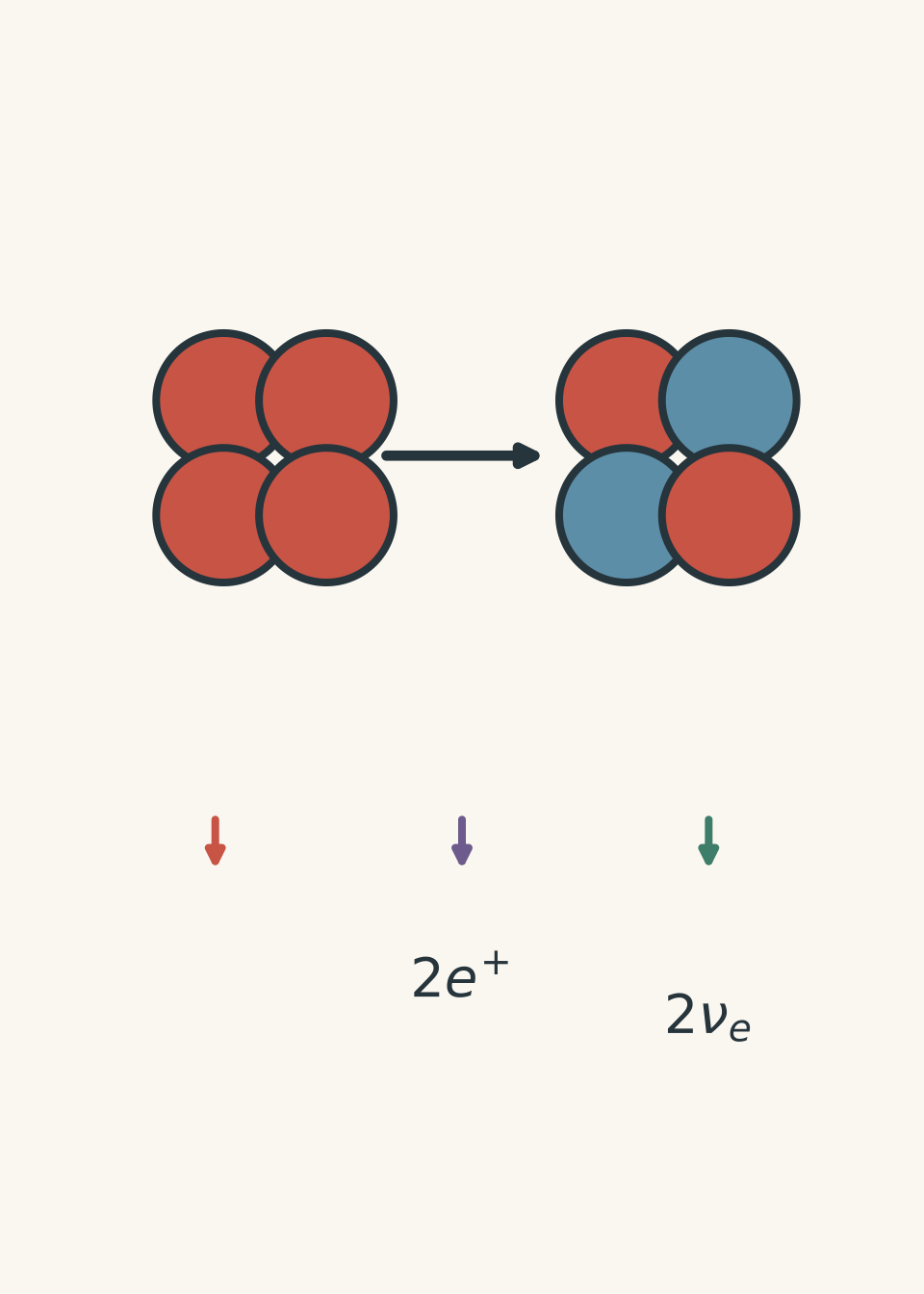
You start with hydrogen nuclei. Through several reactions, particles are rearranged until the final product is a helium-4 nucleus containing two protons and two neutrons.
The overall change is approximately:
\[ 4\,{}^{1}_{1}\mathrm{H} \rightarrow {}^{4}_{2}\mathrm{He} + \text{other particles} + \text{energy} \]
That equation hides an important complication. You cannot simply push four protons together and call the result helium. Two of those protons must become neutrons, and the reactions happen through intermediate nuclei.
So we need to unpack the chain.
02Why fusion is difficult in the first place
Two protons repel because they both have positive electric charge. This electrostatic repulsion is often described as the Coulomb barrier.
At the Sun’s core temperature of roughly \(1.5\times10^7\ \mathrm{K}\), nuclei move extremely quickly. Higher temperature means a greater average kinetic energy, so some protons can approach one another very closely. OpenStax
But there is a subtle point.
A simple classical model suggests the protons should still struggle to get close enough for the strong nuclear force to act. Solar fusion is possible partly because of quantum tunnelling: a proton has a small probability of passing through the electrostatic barrier even when classical physics would predict that it cannot. OpenStax
Think of the barrier as a locked front door. Classical physics says you either have enough energy to get through the door or you stay outside. Quantum mechanics is weirder: there is a small probability of appearing on the other side without going over the barrier.
The analogy breaks because a proton does not literally disappear and teleport through a door. Quantum tunnelling is a property of the proton’s quantum state, not a secret nuclear shortcut.
The important HSC idea is simpler: high temperature helps nuclei approach closely, and quantum tunnelling makes fusion possible at temperatures below those required by a purely classical model.
03Step 1: two protons make deuterium
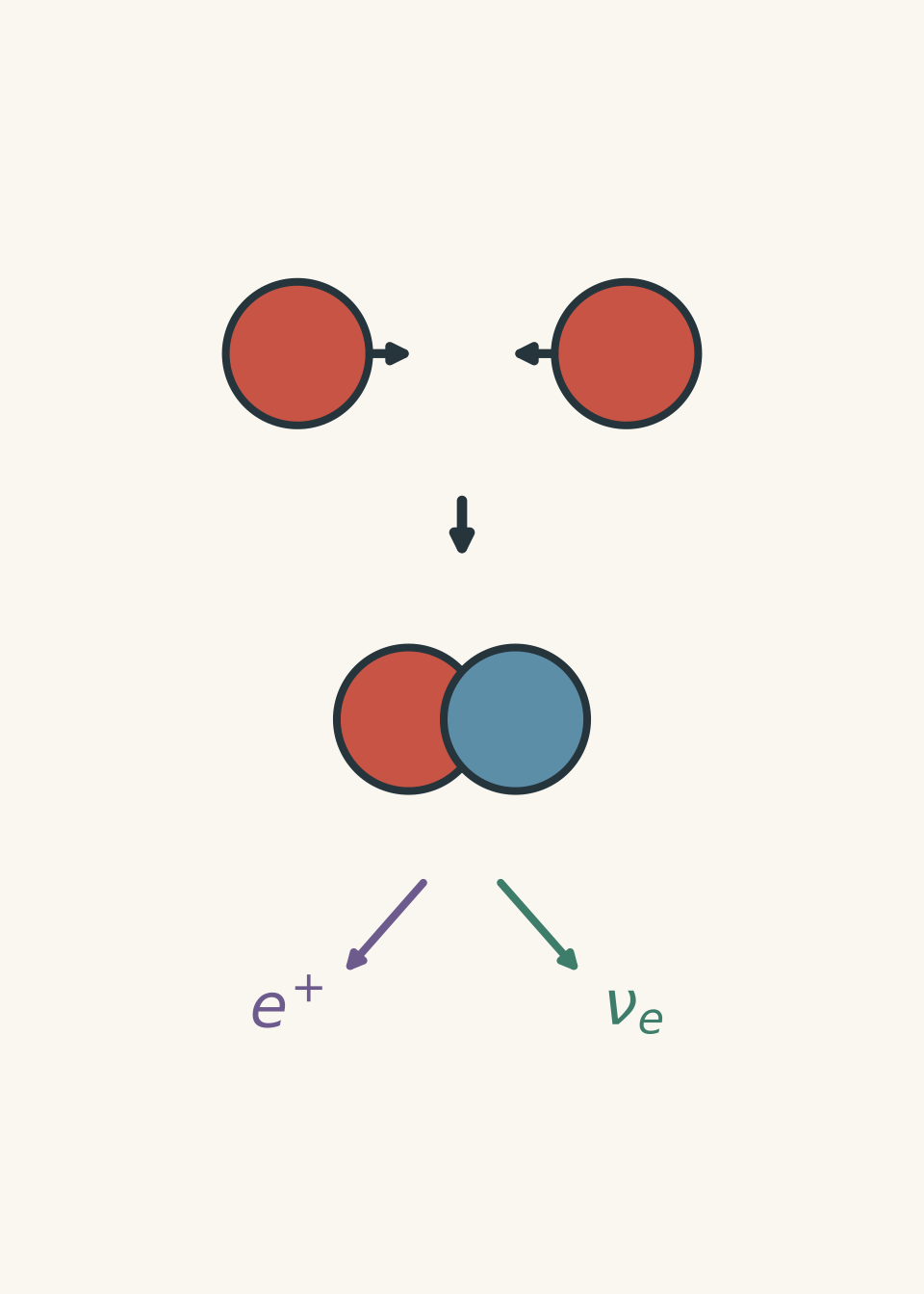
The first reaction is:
\[ {}^{1}_{1}\mathrm{H}+{}^{1}_{1}\mathrm{H} \rightarrow {}^{2}_{1}\mathrm{H}+e^{+}+\nu_e \]
Here:
- \({}^{1}_{1}\mathrm{H}\) is a proton, or ordinary hydrogen nucleus
- \({}^{2}_{1}\mathrm{H}\) is deuterium, a hydrogen isotope containing one proton and one neutron
- \(e^+\) is a positron
- \(\nu_e\) is an electron neutrino
Look closely at the nuclei.
We start with two protons. Deuterium contains one proton and one neutron. That means one proton has changed into a neutron during the interaction.
This occurs through the weak nuclear interaction.
That fact explains something surprisingly important about the Sun: this first reaction is extremely unlikely. The weak interaction is, appropriately, weak. The slowness of this step helps keep solar fusion steady over billions of years rather than letting the Sun burn through its hydrogen rapidly. OpenStax
A positron is the antimatter counterpart of an electron. It has the same mass as an electron but positive charge.
The neutrino interacts extremely weakly with matter and can escape from the Sun comparatively easily. That makes solar neutrinos useful evidence about nuclear reactions occurring deep inside the Sun.
A conservation check
Nuclear equations are not arbitrary. Charge and nucleon number must work.
Before the reaction:
- nucleon number \(=1+1=2\)
- charge \(=+1+1=+2\)
After the reaction:
- deuterium has nucleon number \(2\) and charge \(+1\)
- the positron has charge \(+1\)
- the neutrino has charge \(0\)
So:
\[ \text{nucleon number}: 2=2 \]
and
\[ \text{charge}: +2=(+1)+(+1)+0 \]
This is a useful exam habit. If you are unsure about a nuclear equation, check what must be conserved.
04Step 2: deuterium captures another proton
Once deuterium has formed, it can fuse with another proton:
\[ {}^{2}_{1}\mathrm{H}+{}^{1}_{1}\mathrm{H} \rightarrow {}^{3}_{2}\mathrm{He}+\gamma \]
The product is helium-3, containing two protons and one neutron.
A gamma-ray photon, \(\gamma\), carries away energy.
Notice that this nucleus is already helium because element identity depends on proton number. Anything with two protons is helium. The fact that it contains only one neutron makes it helium-3 rather than helium-4.
This second reaction releases about \(5.49\ \mathrm{MeV}\). OpenStax
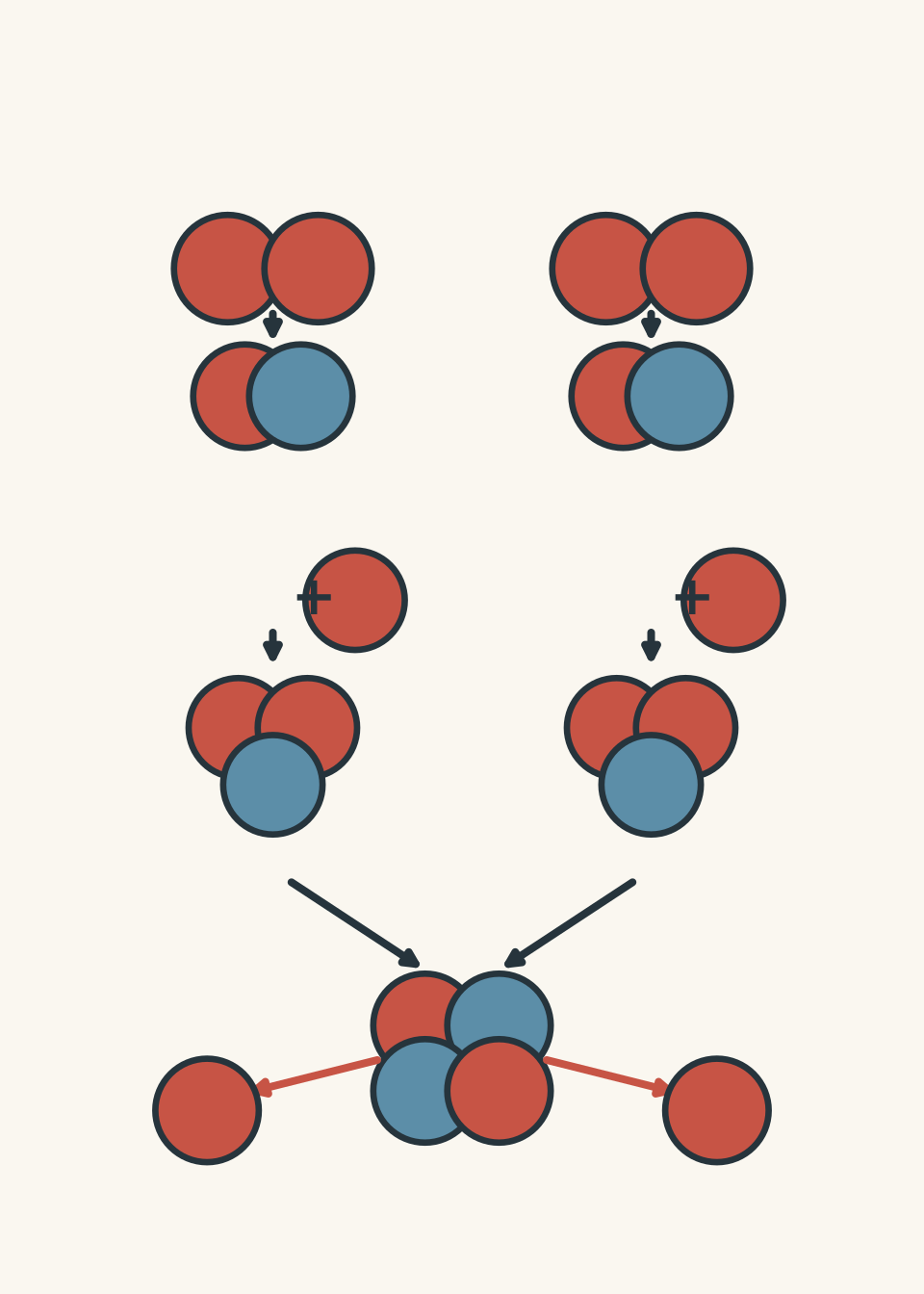
The first two stages must each occur twice before the most common final stage can occur, because the final reaction needs two helium-3 nuclei.
05Step 3: two helium-3 nuclei produce helium-4
The next reaction is:
\[ {}^{3}_{2}\mathrm{He}+{}^{3}_{2}\mathrm{He} \rightarrow {}^{4}_{2}\mathrm{He} +{}^{1}_{1}\mathrm{H} +{}^{1}_{1}\mathrm{H} \]
At first sight, this can look inefficient. Why does the reaction spit two protons back out?
Track the nucleons.
Before:
\[ 3+3=6 \]
After:
\[ 4+1+1=6 \]
The helium-4 nucleus keeps four nucleons, while two protons are returned and can participate in further reactions.
That means six protons appear as reactants across the full written sequence, but two are recycled. The net consumption is only four protons for every helium-4 nucleus produced. OpenStax
06The net reaction
Combining the reactions gives the important overall result:
\[ 4\,{}^{1}_{1}\mathrm{H} \rightarrow {}^{4}_{2}\mathrm{He} +2e^+ +2\nu_e +\text{energy} \]
The positrons soon encounter electrons in the solar plasma. A positron and electron annihilate, converting their mass into gamma-ray photons.
Including this energy, the complete proton-proton process releases about \(26.7\ \mathrm{MeV}\) for each helium-4 nucleus ultimately produced, although neutrinos carry some energy away from the Sun. OpenStax
Now we can answer the central question: where does that energy come from?
07The helium nucleus weighs less than the ingredients
Suppose you carefully measured the total mass before and after the chain.
You might predict that mass must be exactly conserved. That is close to the everyday picture, but not the full relativistic one.
The final products have slightly less rest mass than the initial particles. The difference in mass, called the mass defect, corresponds to released energy through Einstein’s relation:
\[ E=\Delta m c^2 \]
where:
- \(E\) is the released energy in joules
- \(\Delta m\) is the decrease in rest mass in kilograms
- \(c\) is the speed of light, approximately \(3.00\times10^8\ \mathrm{m\,s^{-1}}\)
The factor \(c^2\) is enormous:
\[ c^2=9.00\times10^{16}\ \mathrm{m^2\,s^{-2}} \]
So even a tiny mass defect corresponds to a large amount of energy.
The useful precision here is that mass alone is not conserved as a separate quantity. Total mass-energy is conserved.
Worked example: energy from a small mass defect
A fusion process has a mass defect of \(4.70\times10^{-29}\ \mathrm{kg}\). Estimate the energy released.
Step 1
\[ E=\Delta mc^2 \]
Step 2
\[ \begin{aligned} E &=(4.70\times10^{-29})(3.00\times10^8)^2\\ &=(4.70\times10^{-29})(9.00\times10^{16})\\ &=4.23\times10^{-12}\ \mathrm{J} \end{aligned} \]
Step 3
The energy from one microscopic reaction is only \(4.23\times10^{-12}\ \mathrm{J}\). That sounds tiny. A star, however, contains an astronomical number of reacting particles, so an enormous number of tiny releases can produce an enormous total power.
08Why fusion releases energy
It is easy to say “mass turns into energy”, but that can hide the physics.
The nucleons in a helium-4 nucleus are more tightly bound than four separate hydrogen nuclei. Forming this more strongly bound configuration lowers the system’s total rest energy.
The difference emerges as kinetic energy and radiation.
Another way to describe this is using binding energy. Binding energy is the energy required to separate a nucleus completely into its individual nucleons.
For relatively light nuclei, combining them into more tightly bound nuclei can increase binding energy per nucleon. That is why fusion of light nuclei can release energy.
This idea leads naturally to the binding-energy curve, which explains both why light nuclei can release energy through fusion and why very heavy nuclei can release energy through fission.
09Why the Sun does not explode from all this fusion
Fusion releases huge amounts of energy, so a reasonable prediction is that once it starts, the Sun should heat up, fusion should accelerate, and everything should run away.
That is not what happens in a stable main-sequence star.
Gravity pulls the Sun inward. The hot gas and radiation inside produce pressure that pushes outward. A main-sequence star can remain approximately stable when these effects balance.
There is also useful negative feedback.
Suppose the core becomes hotter. Fusion becomes faster, increasing the outward pressure. The core tends to expand. Expansion cools the gas, which reduces the fusion rate.
Now suppose the core cools slightly. Pressure falls. Gravity compresses the core, raising its temperature and increasing the fusion rate again.
This self-regulating behaviour helps explain how a main-sequence star can remain stable over very long times.
10The proton-proton chain is not one single reaction
A common misconception is to write:
\[ 4\,{}^{1}_{1}\mathrm{H}\rightarrow{}^{4}_{2}\mathrm{He} \]
and then imagine four protons colliding simultaneously.
That equation is useful as a net summary, but it is not the mechanism.
The actual chain contains several separate interactions:
\[ {}^{1}_{1}\mathrm{H}+{}^{1}_{1}\mathrm{H} \rightarrow {}^{2}_{1}\mathrm{H}+e^++\nu_e \]
\[ {}^{2}_{1}\mathrm{H}+{}^{1}_{1}\mathrm{H} \rightarrow {}^{3}_{2}\mathrm{He}+\gamma \]
\[ {}^{3}_{2}\mathrm{He}+{}^{3}_{2}\mathrm{He} \rightarrow {}^{4}_{2}\mathrm{He} +{}^{1}_{1}\mathrm{H} +{}^{1}_{1}\mathrm{H} \]
The first two reactions occur twice for each completion of this main branch.
For HSC questions, distinguish carefully between a net nuclear equation and a sequence describing the physical mechanism.
11Temperature matters, but not because nuclei simply “melt together”
Higher temperature increases the average kinetic energy of nuclei and increases the number of particles in the high-energy tail of the distribution.
That matters because faster nuclei can approach more closely despite electrostatic repulsion. Their tunnelling probability also increases strongly as the separation becomes smaller. OpenStax
So the useful chain is:
\[ \text{higher core temperature} \rightarrow \text{more energetic collisions} \rightarrow \text{greater fusion probability} \rightarrow \text{higher fusion rate} \]
Do not replace this with “high temperature overcomes the strong force”. The strong nuclear force is what binds nuclei once they are sufficiently close. The obstacle at larger separations is electrostatic repulsion.
Worked example: how many reactions are needed for a given power?
Suppose a small model star produces \(2.00\times10^{25}\ \mathrm{W}\) entirely through proton-proton fusion. Assume each completed chain releases \(26.7\ \mathrm{MeV}\). Estimate the number of completed chains per second.
Use:
\[ 1\ \mathrm{eV}=1.602\times10^{-19}\ \mathrm{J} \]
Step 1
Because
\[ 26.7\ \mathrm{MeV}=26.7\times10^6\ \mathrm{eV}, \]
the energy released per chain is
\[ \begin{aligned} E &=(26.7\times10^6)(1.602\times10^{-19})\\ &=4.28\times10^{-12}\ \mathrm{J} \end{aligned} \]
Step 2
Power is
\[ P=\frac{E_{\text{total}}}{t} \]
If \(N\) chains occur each second, then
\[ P=NE_{\text{chain}} \]
so
\[ N=\frac{P}{E_{\text{chain}}} \]
Step 3
\[ \begin{aligned} N &=\frac{2.00\times10^{25}\ \mathrm{J\,s^{-1}}} {4.28\times10^{-12}\ \mathrm{J}}\\ &=4.67\times10^{36}\ \mathrm{s^{-1}} \end{aligned} \]
So approximately
\[ 4.67\times10^{36} \]
completed proton-proton chains are required every second.
The useful lesson is the scale. Each individual reaction releases a microscopic amount of energy, but stars contain enough particles for roughly \(10^{36}\)-scale reaction rates to produce stellar luminosities.
12What neutrinos tell us about the Sun
Photons produced in the core do not travel straight to space. They interact repeatedly with matter inside the Sun, so the energy gradually works its way outward.
Neutrinos behave very differently. Because they interact so weakly with matter, many pass through the solar material and escape.
That means detecting solar neutrinos gives us evidence about nuclear processes occurring in the core rather than merely telling us what is happening at the visible surface. The proton-proton chain directly predicts neutrino production in its first step. OpenStax
This is an important piece of scientific reasoning:
- a model predicts an otherwise unusual observable particle,
- the particle is detected,
- its measured behaviour can be compared with the model.
A stellar model becomes stronger when it makes predictions that can be tested.
13Why this chain is associated with Sun-like main-sequence stars
The proton-proton chain is a major hydrogen-fusion mechanism in stars around the Sun’s mass and below. In hotter, more massive main-sequence stars, hydrogen fusion can be dominated by the carbon-nitrogen-oxygen, or CNO, cycle instead. OpenStax
Both mechanisms have essentially the same large-scale job: convert hydrogen into helium while releasing energy.
The difference is the route taken.
So when you use spectra, luminosity, and temperature to classify a star, you are not just sorting stars into boxes. Those properties give clues about the conditions inside the star and therefore about which fusion processes dominate. For more on connecting observed spectra with stellar properties, see Classifying Stars with Stellar Spectra: HSC Physics Guide.
14Questions and solutions
Question 1
The second stage of the proton-proton chain is
\[ {}^{2}_{1}\mathrm{H}+{}^{1}_{1}\mathrm{H} \rightarrow {}^{3}_{2}\mathrm{He}+\gamma \]
Explain how this equation conserves nucleon number and electric charge, and state the role of the gamma-ray photon.
Solution 1
The equation conserves both nucleon number and electric charge, while the gamma-ray photon carries away energy released by the reaction.
For nucleon number, the reactants contain
\[ 2+1=3 \]
nucleons. Helium-3 also contains three nucleons, while the photon has no nucleons.
For charge, deuterium has charge \(+1\) and the proton has charge \(+1\), giving a total charge of \(+2\). Helium-3 contains two protons, so its nuclear charge is also \(+2\). The photon is uncharged.
A tempting mistake is to treat the gamma ray as another nuclear particle needed to balance the nucleon count. It is not. It is electromagnetic radiation carrying energy and momentum from the reaction.
Question 2
A star produces \(8.0\times10^{25}\ \mathrm{W}\) through the proton-proton chain. Assume each completed chain releases \(26.7\ \mathrm{MeV}\).
Use \(1\ \mathrm{eV}=1.602\times10^{-19}\ \mathrm{J}\).
Calculate:
a. the energy released by one completed chain in joules
b. the number of completed chains occurring each second
c. the net number of protons consumed each second.
Solution 2
The star completes approximately \(1.87\times10^{37}\) chains each second and therefore consumes about \(7.48\times10^{37}\) protons per second.
For part a, convert the energy:
\[ \begin{aligned} E &=(26.7\times10^6)(1.602\times10^{-19})\\ &=4.28\times10^{-12}\ \mathrm{J} \end{aligned} \]
For part b, use
\[ P=NE \]
where \(P\) is power, \(N\) is the number of chains per second, and \(E\) is the energy released per chain.
Therefore,
\[ \begin{aligned} N &=\frac{P}{E}\\ &=\frac{8.0\times10^{25}} {4.28\times10^{-12}}\\ &=1.87\times10^{37}\ \mathrm{s^{-1}} \end{aligned} \]
For part c, each completed chain has a net consumption of four protons:
\[ \begin{aligned} N_p &=4(1.87\times10^{37})\\ &=7.48\times10^{37}\ \mathrm{protons\,s^{-1}} \end{aligned} \]
The tempting route is to count six proton reactants from the individual equations. That ignores the two protons produced again in the final step. They are recycled, so the net consumption is four.
Question 3
A student says:
The Sun’s core must be hot enough for protons to overcome the electrostatic barrier completely. Otherwise fusion could not occur.
Evaluate this statement. Your response should refer to electrostatic repulsion, temperature, the strong nuclear force, and quantum tunnelling.
Solution 3
The statement is incomplete because solar protons do not need enough classical kinetic energy to overcome the electrostatic barrier completely.
Two protons repel through the electrostatic force because both carry positive charge. Raising the core temperature increases their typical kinetic energies, so they approach one another more closely during collisions.
However, at the Sun’s core temperature, a purely classical description does not adequately explain the observed fusion rate. Quantum tunnelling gives protons a finite probability of penetrating the Coulomb barrier and reaching sufficiently small separations for the attractive strong nuclear force to become important. OpenStax
The tempting argument is that “higher temperature means overcoming the barrier”, because that is how an ordinary mechanical barrier behaves. The missing constraint is quantum mechanics. Temperature increases the probability of fusion, but tunnelling allows fusion even when the particles do not possess enough classical energy to pass over the entire barrier.
Question 4
Imagine two otherwise identical Sun-like stars, A and B. Both initially have the same mass, radius, and chemical composition.
For a short period, an unknown disturbance slightly raises the core temperature of star A above its equilibrium value without directly adding or removing mass. Assume the star remains intact and can adjust its radius.
A student predicts that the fusion rate will rise, which releases more energy, which raises the temperature further, so star A must undergo an uncontrollable thermal runaway.
Explain why this prediction is not generally correct for a stable main-sequence star. Trace the linked changes in fusion rate, pressure, radius, and temperature.
Solution 4
Star A will tend towards a new equilibrium rather than automatically entering an uncontrollable runaway, because expansion provides negative feedback on the temperature and fusion rate.
The initial temperature increase raises the kinetic energies of nuclei and increases the proton-proton fusion rate. Energy generation therefore increases.
The tempting argument stops here and assumes:
\[ T\uparrow\rightarrow\text{fusion}\uparrow\rightarrow T\uparrow \]
with no other response.
But the star is a gravitationally bound gas. Greater thermal pressure causes the core to expand. During expansion, the gas does work and cools. Its density also decreases. Both changes tend to reduce the fusion rate.
The linked response is therefore approximately:
\[ T_{\text{core}}\uparrow \rightarrow \text{fusion rate}\uparrow \rightarrow \text{pressure}\uparrow \rightarrow \text{expansion} \rightarrow T_{\text{core}}\downarrow \rightarrow \text{fusion rate}\downarrow \]
Gravity provides the restoring influence. If the core instead became too cool and pressure fell, gravity would compress it, raising its temperature.
The important constraint the runaway argument misses is that the core is not held at fixed volume. A star can expand and contract. That mechanical response couples nuclear energy generation to gravitational equilibrium and provides stabilising feedback during the main-sequence phase.
Question 5
A hypothetical universe is identical to ours except that the first step of the proton-proton chain,
\[ {}^{1}_{1}\mathrm{H}+{}^{1}_{1}\mathrm{H} \rightarrow {}^{2}_{1}\mathrm{H}+e^++\nu_e, \]
occurs \(10^8\) times more readily at the same temperature and density. All other nuclear forces, particle masses, and reaction energies are unchanged.
Consider a newly formed star with the same total mass and initial chemical composition as the Sun.
A student argues that because each completed chain still releases approximately the same energy, the star should have approximately the same luminosity and lifetime as the Sun.
Assess that argument. Do not assume that the star’s core temperature and radius remain fixed.
Solution 5
The argument is incorrect: the star would not simply run the same proton-proton chain \(10^8\) times faster at the Sun’s present core conditions, because the entire star would readjust structurally.
If the star initially had the same core temperature and density as the Sun, its nuclear energy generation would rise enormously because the normally slow first step could occur far more readily.
The immediate consequence would be increased heating and pressure. The star would expand. Expansion would lower the core temperature and density, reducing the reaction rate until nuclear energy production again became compatible with the star’s overall energy losses and gravitational structure.
So it is wrong to calculate a lifetime by simply dividing the Sun’s lifetime by \(10^8\). That assumes fixed solar conditions while changing the nuclear reaction rate, even though stellar structure responds to energy generation.
The deeper issue is that a main-sequence star’s luminosity is not determined only by the energy released per individual reaction. It emerges from an interacting system involving:
- nuclear reaction rates
- core temperature and density
- hydrostatic balance between gravity and pressure
- energy transport through the star
- the star’s radius and surface luminosity.
Making the first proton-proton reaction much easier would allow hydrogen fusion to supply the required power at a lower core temperature than in our Sun. The equilibrium star would therefore have a different internal structure, radius, and probably luminosity.
Its main-sequence lifetime would also change, but the exact factor cannot be obtained from the stated \(10^8\) reaction-rate increase alone. We would need a stellar-structure model describing how the star’s equilibrium luminosity, density, temperature, and accessible hydrogen fuel change.
The tempting route is to use
\[ \text{lifetime}\propto\frac{1}{\text{reaction rate}} \]
while freezing everything else. The constraint that breaks that reasoning is stellar feedback: changing nuclear physics changes the star’s equilibrium state, and that changed state alters the reaction rate again.
That connection is the useful next step. The proton-proton chain explains how hydrogen fusion supplies energy, but stellar physics asks a bigger question: how do nuclear reaction rates, gravity, pressure, temperature, luminosity, and observable stellar properties all adjust together?