
Gravimetric analysis: calculate analyte amounts from precipitates
Learn how HSC Chemistry gravimetric analysis uses precipitate mass and stoichiometry to determine analyte amounts and concentrations. Includes worked examples and practice questions.
A water sample is suspected of containing too much sulfate. You cannot see sulfate ions, and they are too small to weigh directly. So how could a chemist measure the amount present?
One clever solution is to turn the invisible ion into a solid that can be separated and weighed.
Imagine trying to count a jar full of tiny beads by weight. You do not need to see every bead individually. If you know the mass of the whole pile and the mass of one bead, you can work backwards. Gravimetric analysis uses the same idea: convert a dissolved substance into a measurable solid, then use chemistry to calculate the original amount.
01The basic idea: weigh something you can actually measure
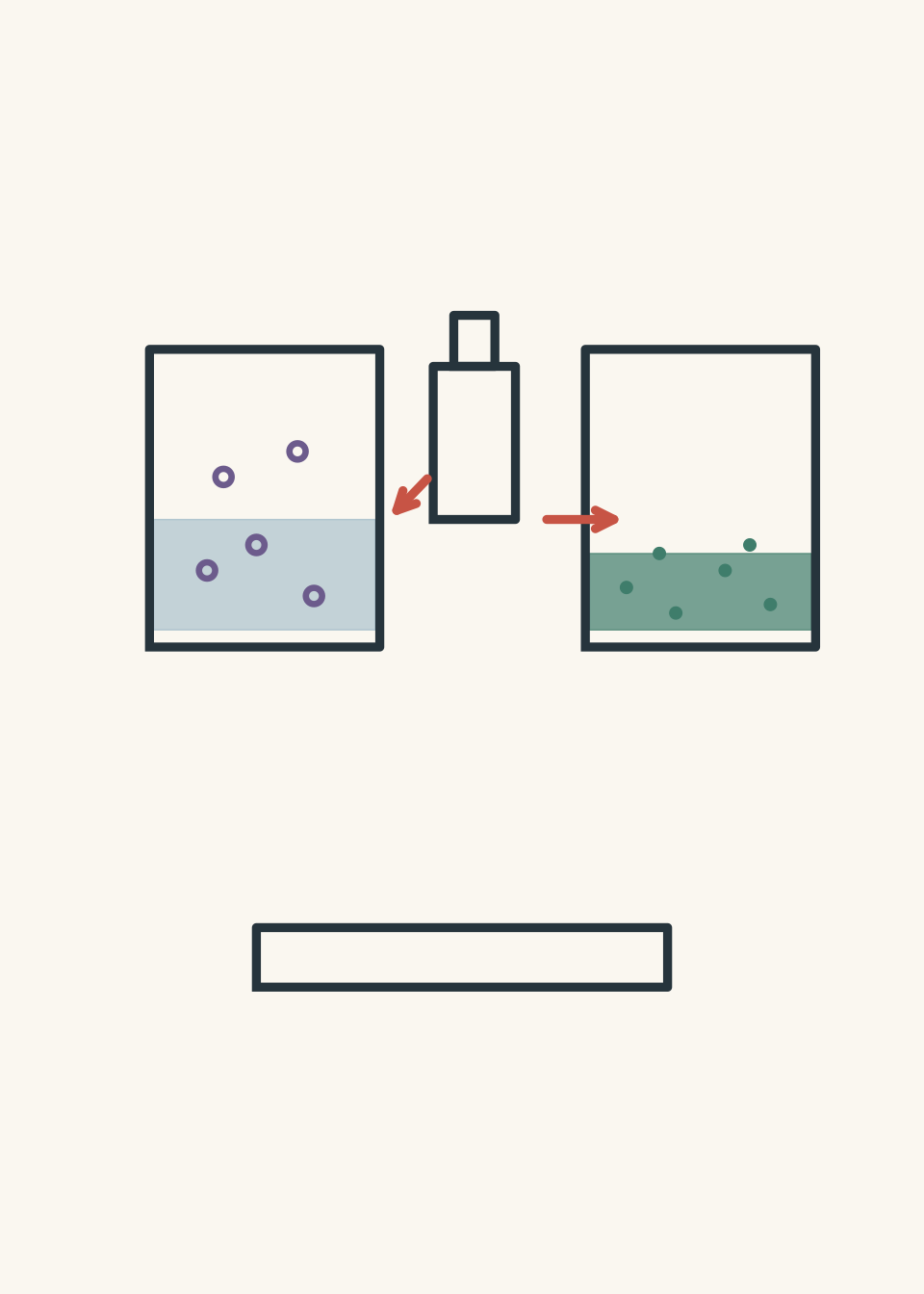
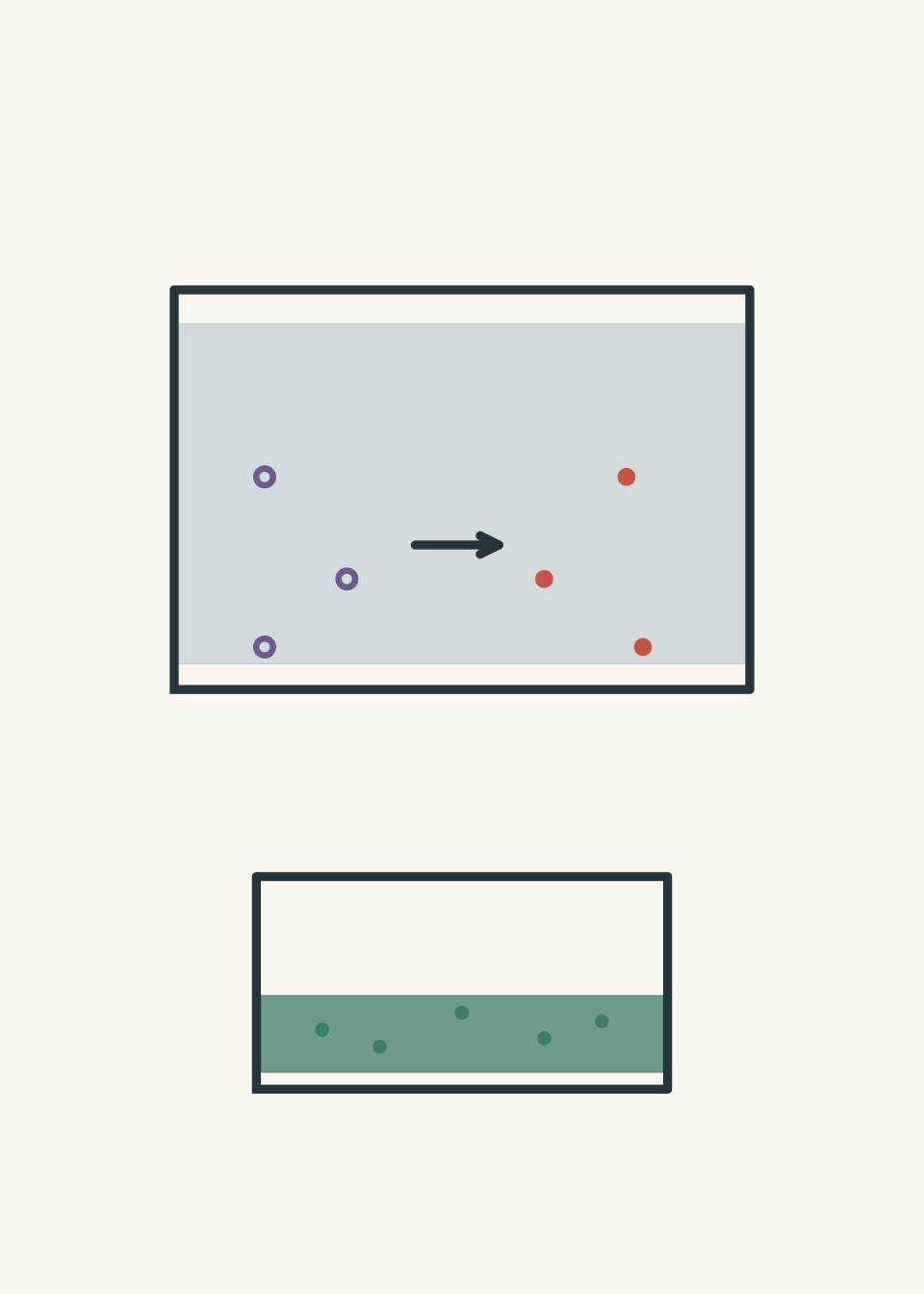
Suppose a sample contains an unknown amount of sulfate ions, \( \ce{SO4^2-} \). A chemist could add barium ions, \( \mathrm{Ba}^{2+} \), which react with sulfate to form insoluble barium sulfate:
\[ \ce{Ba^2+ (aq) + SO4^2- (aq) -> BaSO4(s)} \]
The barium sulfate forms a solid called a precipitate.
The key question is:
If the precipitate contains sulfate, can we use its mass to find the original amount of sulfate?
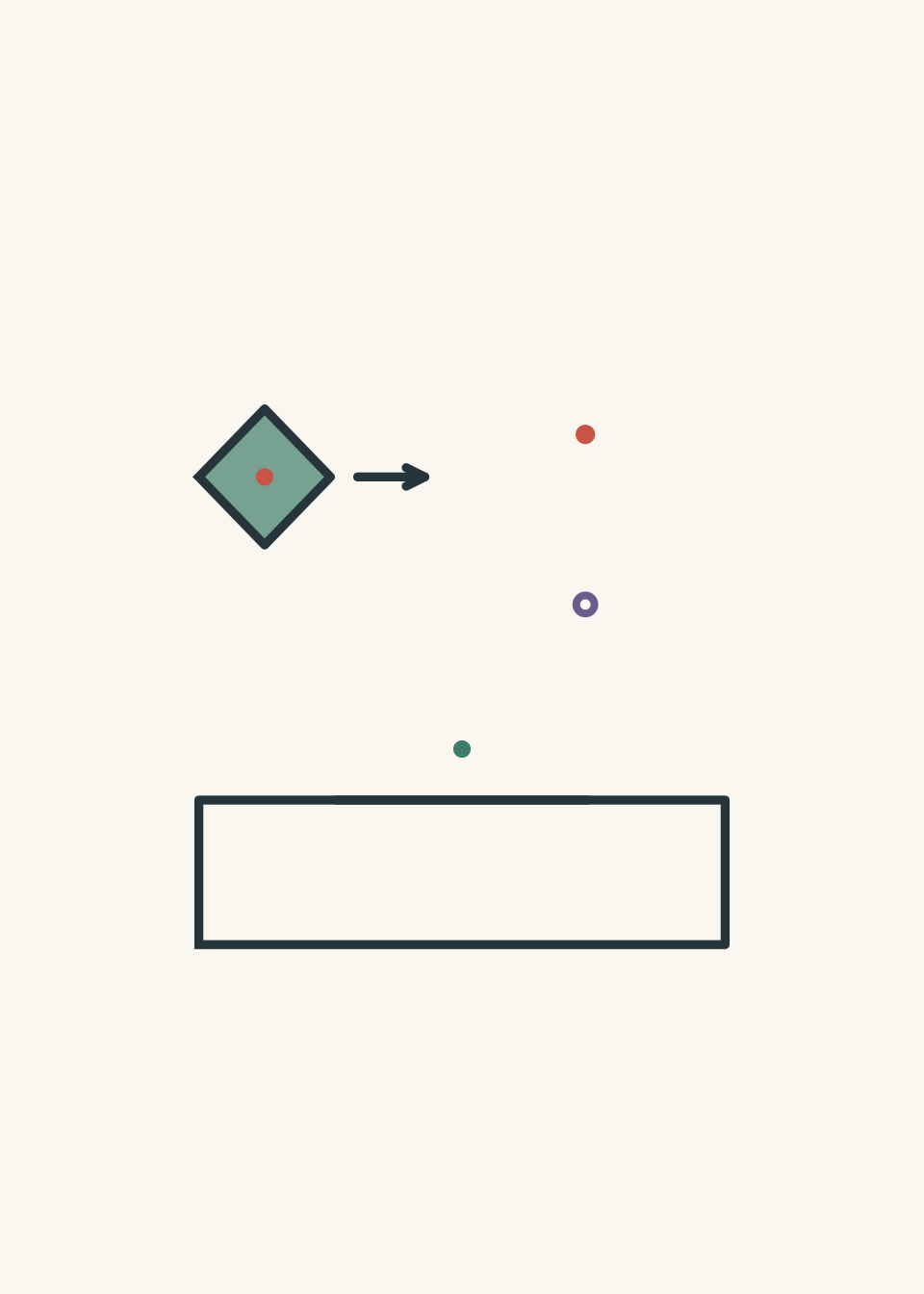
Yes, but only if we know the chemical relationship between the substances. The equation tells us that one mole of barium sulfate contains one mole of sulfate ions. The mass of the solid becomes a measurement that can be traced back to the original analyte.
The analyte is the substance being measured. In this example, the analyte is sulfate.
02Building the gravimetric analysis method
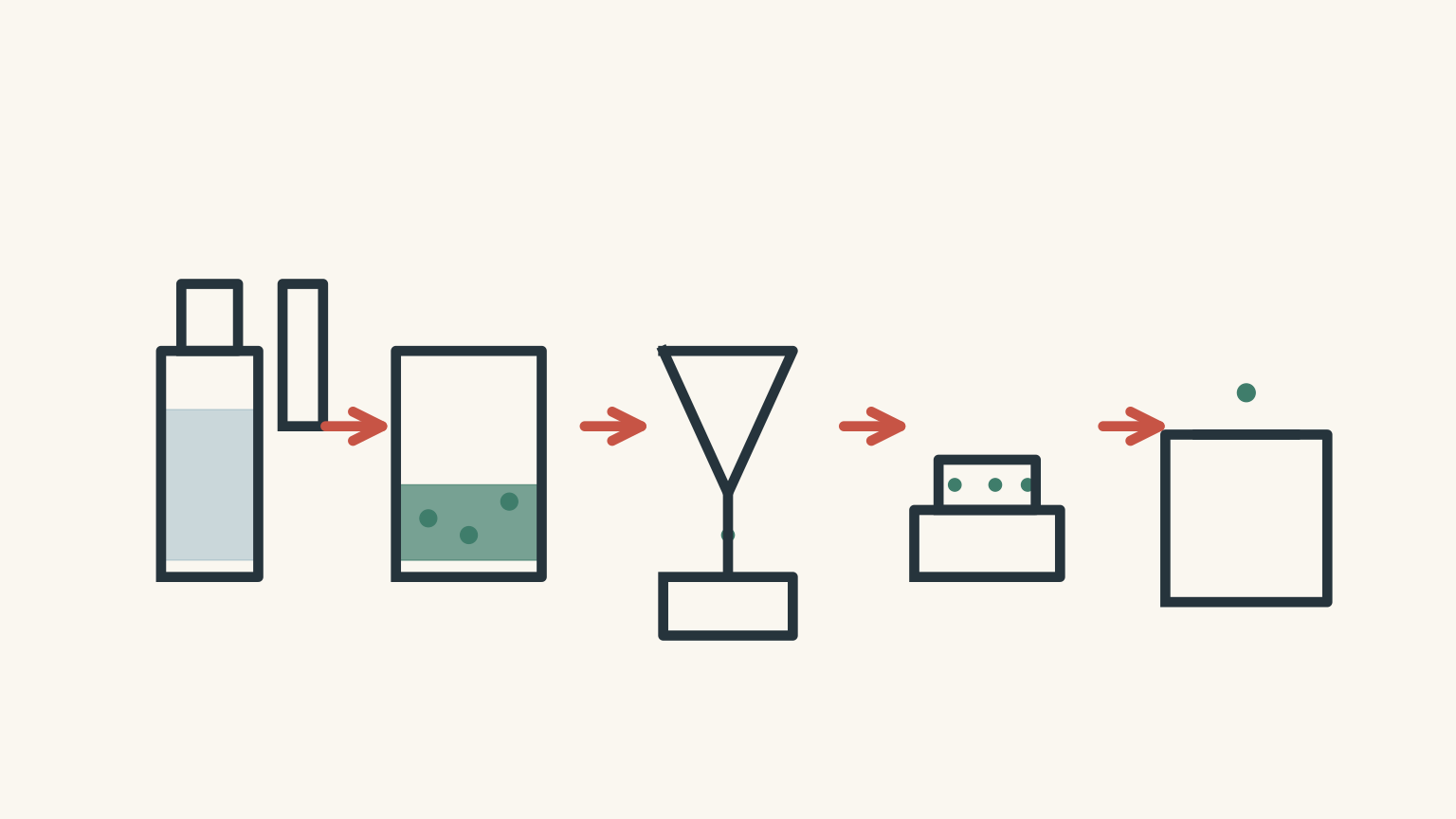
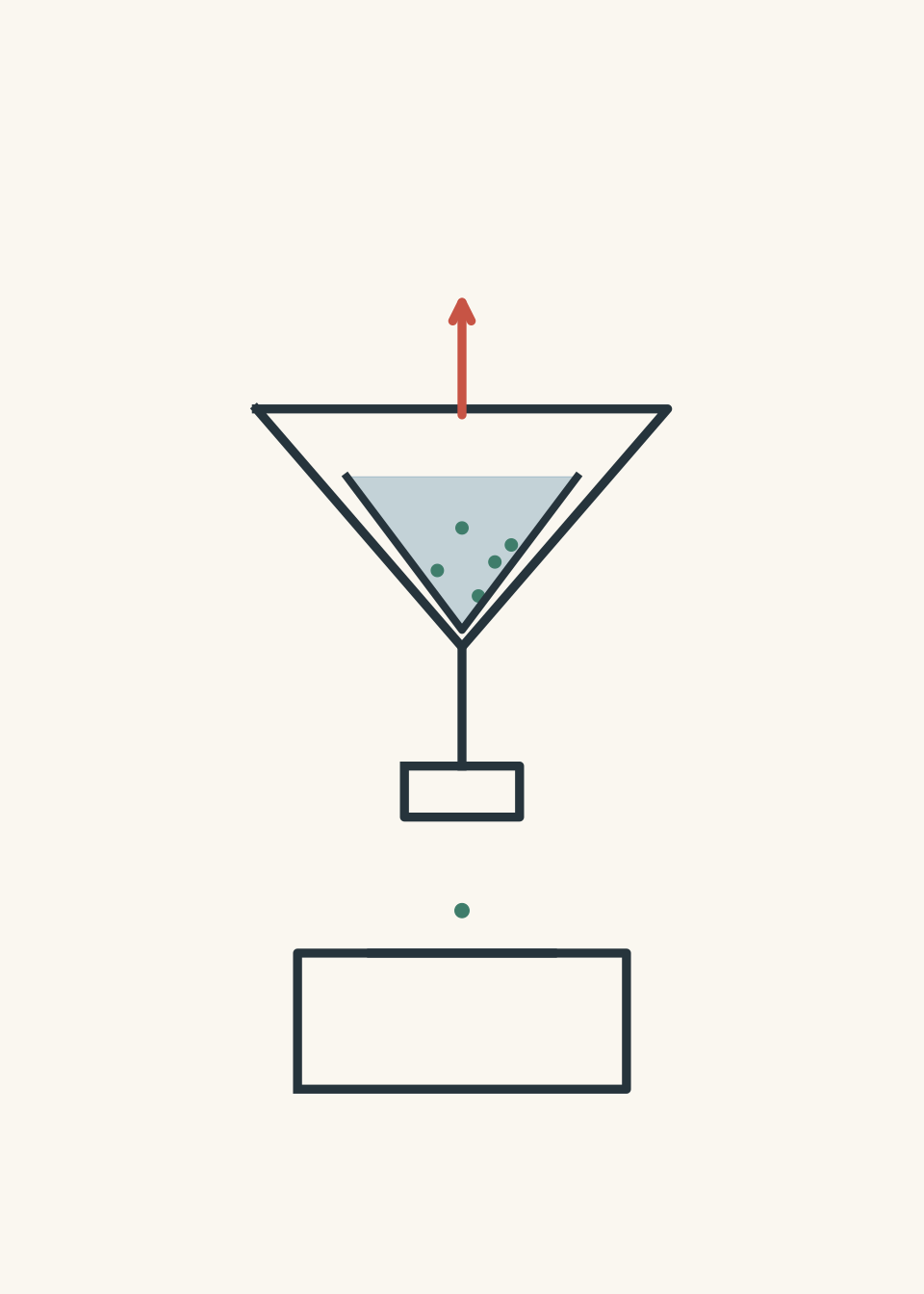
A gravimetric analysis usually follows this pattern:
- Dissolve the sample so the analyte ions are available.
- Add a reagent that reacts with the analyte to form an insoluble precipitate.
- Filter the mixture to separate the solid from the solution.
- Wash the precipitate to remove impurities.
- Dry the precipitate until its mass is constant.
- Measure the mass of the precipitate.
- Use stoichiometry to calculate the amount of analyte.
The balance is not measuring the analyte directly. It is measuring a new compound that contains the analyte.
A useful way to picture this is like identifying a person by their uniform. The uniform is not the person, but if every person wears exactly one matching uniform, counting uniforms tells you how many people are there.
The analogy breaks down because chemical reactions are not always perfectly complete. A precipitate might not form completely, impurities might remain attached, or some solid might be lost during filtration. That is why experimental technique matters.
03The first important prediction: what happens to the mass?
Imagine two students perform the same gravimetric analysis.
Student A carefully washes and dries the precipitate before weighing it.
Student B skips the washing step and weighs the wet filter paper containing the precipitate.
Who will probably calculate the higher analyte concentration?
Student B will likely get a higher value. The extra water and dissolved substances left in the sample add to the measured mass. The balance cannot tell the difference between useful precipitate and unwanted material.
This leads to an important rule:
The measured precipitate must represent only the analyte-containing compound.
A good gravimetric method depends on producing a precipitate that is:
- very insoluble, so most of it forms as a solid
- pure, so other substances do not add extra mass
- easy to filter and dry
- chemically stable during weighing
04From precipitate mass to analyte amount
The calculation is a chain:
\[ \text{mass of precipitate} \rightarrow \text{moles of precipitate} \rightarrow \text{moles of analyte} \rightarrow \text{mass or concentration of analyte} \]
The key tool is the mole.
The number of moles is calculated using:
\[ n=\frac{m}{M} \]
where:
- \(n\) is the amount of substance in moles (mol)
- \(m\) is the mass in grams (g)
- \(M\) is the molar mass in grams per mole (g mol\(^{-1}\))
After finding the moles of precipitate, use the balanced equation to find the moles of analyte.
05Worked example: Finding sulfate concentration from barium sulfate mass
A 250.0 mL water sample is analysed using gravimetric analysis. Excess barium chloride is added, producing 0.466 g of barium sulfate precipitate. Calculate the sulfate ion concentration in the sample.
Step 1
The molar mass of \( \ce{BaSO4} \) is:
\[ M(\ce{BaSO4}) = 137.3 + 32.1 + 4(16.0)=233.4\ \text{g mol}^{-1} \]
Use:
\[ n=\frac{m}{M} \]
\[ n(\ce{BaSO4})=\frac{0.466}{233.4}=0.001997\ \text{mol} \]
Step 2
From:
\[ \ce{Ba^2+ + SO4^2- -> BaSO4} \]
the ratio is 1:1.
\[ n(\ce{SO4^2-})=0.001997\ \text{mol} \]
Step 3
The volume is:
\[ 250.0\ \text{mL}=0.2500\ \text{L} \]
Concentration is:
\[ c=\frac{n}{V} \]
\[ c(\ce{SO4^2-})=\frac{0.001997}{0.2500} \]
\[ c(\ce{SO4^2-})=0.00799\ \text{mol L}^{-1} \]
The sulfate concentration is:
\[ \boxed{7.99\times10^{-3}\ \text{mol L}^{-1}} \]
This means the sample contained about 0.00800 moles of sulfate ions per litre.
06Why the mole ratio matters
A common mistake is to assume the mass of the precipitate equals the mass of the analyte.
That feels reasonable because the precipitate came from the analyte. However, the precipitate usually contains other atoms too.
For example, in barium sulfate:
- sulfate contributes part of the mass
- barium contributes the rest
The balance measures the entire \( \ce{BaSO4} \) compound, not just \( \ce{SO4^2-} \).
07Worked example: Finding the percentage of chloride in a salt sample
A 1.50 g sample of a chloride-containing salt is dissolved in water. Excess silver nitrate is added, producing 2.87 g of silver chloride precipitate. Calculate the percentage by mass of chloride in the original sample.
The reaction is:
\[ \ce{Ag+ (aq) + Cl- (aq) -> AgCl(s)} \]
Step 1
The molar mass of \( \ce{AgCl} \) is:
\[ M(\ce{AgCl})=107.9+35.5=143.4\ \text{g mol}^{-1} \]
\[ n(\ce{AgCl})=\frac{2.87}{143.4} \]
\[ n(\ce{AgCl})=0.0200\ \text{mol} \]
Step 2
The ratio is 1:1.
\[ n(\mathrm{Cl}^{-})=0.0200\ \text{mol} \]
Step 3
\[ m=nM \]
\[ m(\mathrm{Cl}^{-})=0.0200\times35.5 \]
\[ m(\mathrm{Cl}^{-})=0.710\ \text{g} \]
Step 4
\[ \text{percentage chloride}=\frac{0.710}{1.50}\times100 \]
\[ =47.3\% \]
The sample was:
\[ \boxed{47.3\% \text{ chloride by mass}} \]
The result does not mean the sample was 47.3% silver chloride. The silver chloride was only the measured form used to determine the chloride content.
08Accuracy: what can go wrong?
Gravimetric analysis looks simple because the final measurement is just a mass. The difficult part is making sure that mass means what you think it means.
If the precipitate is not completely formed
Some analyte remains dissolved in the solution.
The measured precipitate mass is too small, so the calculated analyte amount is too low.
If the precipitate is contaminated
Other substances add mass to the solid.
The measured precipitate mass is too large, so the calculated analyte amount is too high.
If the precipitate is not dry
Water contributes to the measured mass.
Again, the calculated analyte amount is too high.
This is why chemists often dry precipitates to constant mass. They repeat drying and weighing until the mass stops changing, showing that most removable water has gone.
09How gravimetric analysis fits with other HSC techniques
Gravimetric analysis is one way to determine concentration. It relies on measuring mass.
Other techniques measure different properties:
- Colourimetry uses the intensity of colour to estimate concentration. You can compare this approach with Colourimetry: Calculate Concentration and Evaluate Data.
- Atomic absorption spectroscopy measures the absorption of light by atoms to determine metal ion concentrations. See Atomic Absorption Spectroscopy for HSC Chemistry.
- Precipitation titrations also use insoluble products, but the measurement comes from the volume of reactant added rather than the mass of precipitate. See Precipitation Titrations: Calculate an Unknown Concentration.
The big decision is always the same: what property of the system can be measured accurately, and how can that measurement be connected back to the unknown quantity?
10Questions and solutions
Question 1
A sample containing chloride ions produces 1.435 g of silver chloride precipitate during gravimetric analysis. Calculate the number of moles of chloride ions present.
Use \(M(\ce{AgCl})=143.4\ \text{g mol}^{-1}\).
Solution 1
The number of moles of chloride ions is \(0.0100\ \text{mol}\).
The tempting mistake is to divide by the molar mass of chlorine only immediately. However, the measured mass belongs to silver chloride, so the first step must use the molar mass of \( \ce{AgCl} \).
\[ n(\ce{AgCl})=\frac{m}{M} \]
\[ n(\ce{AgCl})=\frac{1.435}{143.4} \]
\[ n(\ce{AgCl})=0.0100\ \text{mol} \]
The equation:
\[ \ce{Ag+ + Cl- -> AgCl} \]
has a 1:1 ratio, so:
\[ n(\mathrm{Cl}^{-})=0.0100\ \text{mol} \]
The chloride amount is therefore \(0.0100\ \text{mol}\).
Question 2
A 500.0 mL groundwater sample produces 1.167 g of \( \ce{BaSO4} \). Determine the sulfate concentration in the sample.
Use \(M(\ce{BaSO4})=233.4\ \text{g mol}^{-1}\).
Solution 2
The sulfate concentration is \(9.99\times10^{-3}\ \text{mol L}^{-1}\).
The calculation begins with the precipitate because that is what was measured.
\[ n(\ce{BaSO4})=\frac{1.167}{233.4} \]
\[ n(\ce{BaSO4})=0.00500\ \text{mol} \]
The reaction has a 1:1 ratio:
\[ \ce{Ba^2+ + SO4^2- -> BaSO4} \]
so:
\[ n(\ce{SO4^2-})=0.00500\ \text{mol} \]
The volume is \(0.5000\ \text{L}\).
\[ c=\frac{n}{V} \]
\[ c=\frac{0.00500}{0.5000} \]
\[ c=0.0100\ \text{mol L}^{-1} \]
The sulfate concentration is:
\[ \boxed{1.00\times10^{-2}\ \text{mol L}^{-1}} \]
The important reasoning step is recognising that the precipitate amount and analyte amount are linked by stoichiometry, not by equal mass.
Question 3
A student performs a gravimetric analysis for sulfate. Their first calculation gives a sulfate concentration of \(0.0150\ \text{mol L}^{-1}\). Later, they realise the precipitate was not washed before drying.
Explain whether the true sulfate concentration is likely higher or lower than the calculated value.
Solution 3
The true sulfate concentration is likely lower than \(0.0150\ \text{mol L}^{-1}\).
The student’s measured mass was probably too high because the precipitate contained impurities from the solution. Those impurities increased the mass placed on the balance, even though they were not sulfate-containing \( \ce{BaSO4} \).
The calculation assumes:
\[ \text{measured mass}=\text{pure precipitate mass} \]
but the actual situation was:
\[ \text{measured mass}=\text{precipitate mass}+\text{contaminants} \]
A larger measured mass gives more calculated moles of \( \ce{BaSO4} \), which gives an overestimated sulfate concentration.
Question 4
A chemist wants to measure the amount of calcium ions in a solution. They add carbonate ions and form calcium carbonate precipitate:
\[ \ce{Ca^2+ + CO3^2- -> CaCO3(s)} \]
After filtration and drying, the precipitate mass is found to be 0.500 g.
Explain why measuring the mass of \( \ce{CaCO3} \) is useful, but also explain why it cannot directly give the mass of calcium ions.
Solution 4
Measuring \( \ce{CaCO3} \) is useful because the precipitate provides a measurable link to the invisible calcium ions, but it cannot directly give the calcium mass because the solid also contains carbonate.
The tempting route is to say that 0.500 g of precipitate means 0.500 g of calcium. That would only work if the precipitate were pure calcium, which it is not.
The mass contains contributions from:
- calcium atoms
- carbon atoms
- oxygen atoms
The correct method is:
- Convert \( \ce{CaCO3} \) mass into moles of \( \ce{CaCO3} \).
- Use the 1:1 mole ratio to find moles of \( \mathrm{Ca}^{2+} \).
- Convert calcium moles into calcium mass if required.
The chemical equation provides the connection between what is weighed and what is measured.
Question 5
A student argues:
“Gravimetric analysis is always more accurate than colourimetry because a balance measures mass directly, while colourimetry only measures light.”
Evaluate this statement.
Assume both methods are performed carefully.
Solution 5
The statement is incorrect because accuracy depends on the whole measurement process, not whether the final instrument measures mass or light.
The tempting argument is that mass seems more direct. A balance gives a number in grams, while colourimetry involves converting light absorption into concentration. However, gravimetric analysis has its own possible errors.
A gravimetric result depends on:
- complete precipitation of the analyte
- purity of the precipitate
- effective washing
- complete drying
- accurate stoichiometric relationships
A colourimetric result depends on different factors:
- correct calibration
- appropriate wavelength selection
- avoiding interfering substances
- accurate measurement of absorbance
A carefully designed colourimetric method can be more accurate than a poorly performed gravimetric analysis, and a carefully performed gravimetric method can be extremely reliable.
The deeper idea is that every analytical technique creates a chain between an observation and an unknown quantity. The strongest method is the one where each link in that chain is controlled.
Understanding this chain is what allows you to compare gravimetric analysis with other analytical methods, including spectroscopy and environmental monitoring techniques.