
Pair Production and Early-Universe Matter: HSC Physics Guide
Learn how radiation can create matter and antimatter through pair production, and why cooling and annihilation left a matter-dominated Universe.
A gamma ray is light, but under the right conditions, its energy can produce an electron and a positron. That sounds like matter appearing from nowhere. The catch is that no energy is being created: the photon’s energy is being rearranged into rest mass, kinetic energy, and recoil. Rewind the Universe to its extremely hot early state, and this process becomes part of a much bigger question: if matter and antimatter could be created together, why didn’t they simply annihilate completely?
From hot radiation to surviving matter
- Very hot Universe
Radiation and particles are abundant
- Pair production
γ + γ → e⁻ + e⁺
Energy creates matched matter–antimatter pairs
- Cooling
Fewer high-energy photons → less pair production
- Annihilation
e⁻ + e⁺ → γ + γ
Matched pairs return their energy to radiation
- Matter excess remains
A tiny unmatched matter excess survives
01Start with a prediction
Imagine a gamma photon with an energy of \(1.00\) MeV approaching a nucleus.
Would you expect it to produce an electron-positron pair?
Not quite. The threshold for creating the two particles is about \(1.022\) MeV, because an electron and a positron each have a rest energy of \(0.511\) MeV. NIST Physics Lab
So the first rule is simple:
To create an electron and a positron, you need at least their combined rest energy: \(1.022\) MeV, apart from a tiny amount needed for nuclear recoil.
The important part is understanding why.
02What pair production actually does
An electron has mass. A positron has the same mass, but the opposite electric charge. If \(m_e\) is the electron mass, their combined rest energy is
\[ E_{\text{rest}} = 2m_ec^2. \]
Here, \(c\) is the speed of light.
Using \(m_ec^2 \approx 0.511\) MeV,
\[ E_{\text{rest}} =2(0.511) =1.022\ \text{MeV}. \]
This is pair production: energy is converted into a particle and its corresponding antiparticle.
A useful way to picture it is a very strict two-for-one entry rule. The Universe can use enough energy to bring an electron into existence, but the corresponding positron has to come with it. You don’t get to order “one electron, no positron”.
The analogy breaks here: there is no literal bouncer deciding what gets in. Pair production is a quantum process with a probability, and conservation laws determine whether it is allowed.
The laboratory version
In a material, a common pair-production process looks like
\[ \gamma + N \rightarrow e^- + e^+ + N, \]
where \(N\) represents a nearby nucleus.
The nucleus is important because energy conservation is only half the story. Momentum must also be conserved.
The incoming photon has momentum. The electron and positron leave with momentum. The nucleus takes a small amount of recoil momentum so the total momentum before and after the interaction can match.
Pair production: energy and momentum are conserved
- Incoming
γ + N
γ enters from the left with energy Eγ
N is the nearby nucleus
- Pair produced
γ + N → e⁻ + e⁺ + N
The interaction creates an electron and positron
The nucleus takes recoil momentum
- Outgoing particles
e⁻ + e⁺ + N
e⁻ and e⁺ leave in different directions
N recoils slightly; total momentum is conserved
The energy accounting is approximately
\[ E_\gamma = 2m_ec^2 + K_- + K_+ + K_N, \]
where:
- \(E_\gamma\) is the incoming photon energy,
- \(K_-\) is the electron’s kinetic energy,
- \(K_+\) is the positron’s kinetic energy,
- \(K_N\) is the nucleus’s recoil kinetic energy.
For most HSC calculations, \(K_N\) is small enough to neglect.
That gives
\[ K_-+K_+ \approx E_\gamma-2m_ec^2. \]
So the photon does two jobs at once. Its energy supplies the particles’ rest mass, and any energy left over becomes kinetic energy and recoil.
Where the gamma-ray energy goes
| Incoming gamma ray | Eγ = 1.50 MeV Total energy available |
|---|---|
| Electron + positron rest energy | 2mₑc² = 1.022 MeV 0.511 MeV per particle |
| Excess energy | 1.50 − 1.022 = 0.478 MeV Becomes kinetic energy and nuclear recoil Nuclear recoil is usually neglected |
This is the same mass-energy bookkeeping that appears in nuclear and stellar physics. You can connect it with mass-energy equivalence in stars: HSC Physics explained.
Three checks to make in an exam
When you see an electron-positron pair-production question, ask:
Is there enough energy?
For electron-positron production, you need at least \(1.022\) MeV.Can momentum be conserved?
A single photon cannot produce the pair in empty space. A nearby nucleus or another particle can take recoil momentum. Two photons can also interact in a suitable collision.What happens to excess energy?
Anything above the rest-energy requirement becomes kinetic energy and recoil, rather than disappearing.
One subtle point matters here: \(1.022\) MeV is a threshold, not a guarantee. A photon above the threshold has enough energy for pair production to be possible, but other photon interactions can also occur.
Worked example: a 1.50 MeV gamma ray produces a pair
A \(1.50\) MeV gamma photon undergoes electron-positron pair production near a nucleus. Neglect the recoil energy of the nucleus. Find the total kinetic energy of the electron and positron.
Step 1
Each particle has a rest energy of \(0.511\) MeV.
\[ E_{\text{rest}} = 2(0.511) = 1.022\ \text{MeV}. \]
Step 2
\[ K_-+K_+ = 1.50-1.022 = 0.478\ \text{MeV}. \]
Step 3
The electron and positron have \(0.478\) MeV of kinetic energy between them.
We cannot say that each gets exactly \(0.239\) MeV unless the question gives a reason to assume an equal split. The conservation laws determine the total available kinetic energy, not necessarily how it is divided.
03Why the early Universe changes the story
The laboratory picture is useful, but it is not the whole story.
The very early Universe was not a room full of atomic nuclei waiting for gamma rays to hit them. It was an extremely hot, dense environment containing radiation and many types of particles. As the Universe expanded, it cooled, and the balance between particle creation and annihilation changed. CERN
So pair production in the early Universe is better thought of as part of a busy network of particle interactions.
For example, two photons can interact to produce an electron and a positron:
\[ \gamma+\gamma\rightarrow e^-+e^+. \]
This is different from the single-photon laboratory picture. Two photons can have a total momentum that cancels, particularly when they collide head-on, allowing both energy and momentum to be conserved.
At threshold, two head-on photons with equal energies would each need about \(0.511\) MeV, giving \(1.022\) MeV in total.
The direction of the photons matters. Two photons travelling in almost the same direction do not simply get to add their energies as if they were two stationary lumps of energy. Their combined momentum matters too.
The temperature connection
In the early Universe, temperature gives us a measure of the energy scale of the thermal radiation.
It does not mean every photon has exactly the same energy. There is a distribution of photon energies, including some photons above and below any representative value.
For a rough estimate, we can take a representative photon energy to be
\[ E_\gamma\approx3k_BT, \]
where:
- \(k_B\) is the Boltzmann constant,
- \(T\) is temperature in kelvin,
- \(E_\gamma\) is the representative photon energy.
As the Universe expands, its temperature falls. That shifts the photon-energy distribution towards lower energies. The expansion itself is part of the evidence behind our picture of an evolving Universe; see Hubble’s Law and evidence for an expanding Universe: HSC Physics Guide.
Worked example: the temperature scale for electron-positron production
Use the approximation \(E_\gamma\approx3k_BT\) to estimate the temperature at which the representative photon energy reaches the \(1.022\) MeV electron-positron threshold.
Take
\[ k_B=1.38\times10^{-23}\ \text{J K}^{-1} \]
and
\[ 1\ \text{eV}=1.60\times10^{-19}\ \text{J}. \]
Step 1
Since \(1.022\) MeV is \(1.022\times10^6\) eV,
\[ E_\gamma = (1.022\times10^6) (1.60\times10^{-19}) \]
\[ E_\gamma \approx1.64\times10^{-13}\ \text{J}. \]
Step 2
\[ E_\gamma\approx3k_BT. \]
Therefore,
\[ T\approx\frac{E_\gamma}{3k_B}. \]
Step 3
\[ T \approx \frac{1.64\times10^{-13}} {3(1.38\times10^{-23})} \]
\[ T\approx3.95\times10^9\ \text{K}. \]
Step 4
The relevant temperature scale is about
\[ \boxed{4.0\times10^9\ \text{K}}. \]
This is not a precise temperature at which pair production suddenly switches off. It is a rough scale obtained from a representative photon energy. The actual thermal distribution has a high-energy tail.
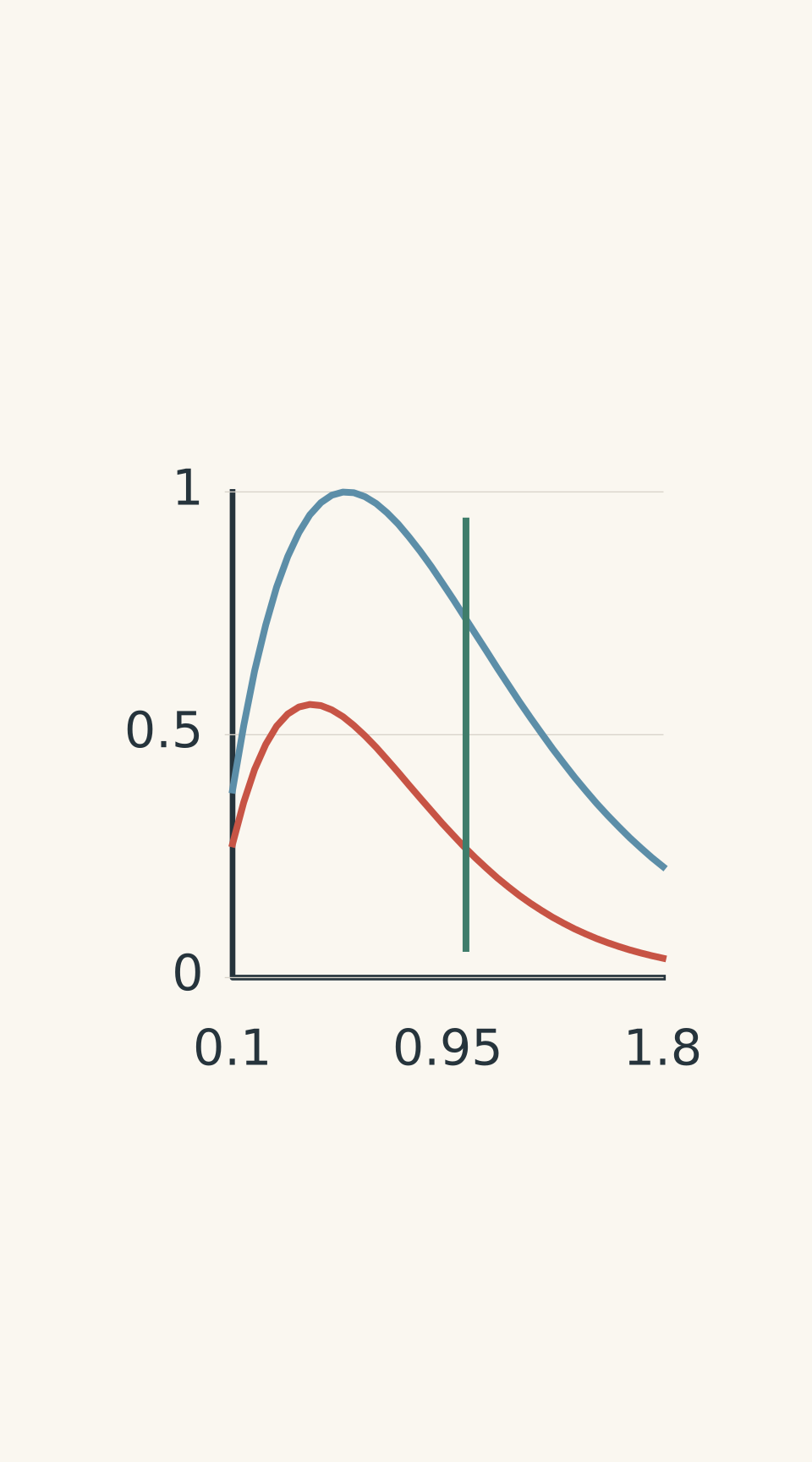
- T = 4.0×10⁹ K
- T = 3.0×10⁹ K
- Threshold: 1.022 MeV
04Cooling does not mean an instant switch-off
This is one of the easiest places to make a wrong prediction.
Suppose the representative photon energy has dropped below \(1.022\) MeV. You might say:
“The photons aren’t energetic enough, so pair production has stopped.”
That sounds reasonable, but it is too absolute.
The thermal radiation still contains a range of photon energies. Some photons can still have energies above the threshold. As the Universe cools, those high-energy photons become much less common, so pair production becomes increasingly suppressed.
At the same time, existing particles and antiparticles can still annihilate.
So the important competition is:
\[ \text{pair production} \quad\leftrightarrow\quad \text{annihilation}. \]
At very high temperatures, these processes can occur rapidly enough for a particle species to remain close to thermal equilibrium. As the Universe expands and reactions become too slow compared with the changing conditions, the species can fall out of equilibrium. This is often described as freeze-out.
The key idea is that freeze-out is about reaction rates, not a magical temperature where every photon suddenly has the same energy.
05Annihilation: matter back into radiation
The reverse-looking process is annihilation.
An electron and positron can combine, with their rest mass and kinetic energy converted into other forms of energy, commonly photons. CERN describes matter and antimatter as having matching masses and opposite electric charges, with annihilation converting their energy into other particles, predominantly photons in the relevant simple picture. CERN
If an electron and positron are both at rest, their total momentum is zero.
For the simple HSC case, two photons are produced:
\[ e^-+e^+\rightarrow\gamma+\gamma. \]
Each photon has an energy of \(0.511\) MeV if the particles were initially at rest and the two photons share the energy equally.
The photons must travel in opposite directions. Each photon has momentum, but the two momenta cancel, leaving the same total momentum as the original electron-positron pair: zero.
A single photon would carry non-zero momentum, so one photon could not satisfy momentum conservation in this situation.
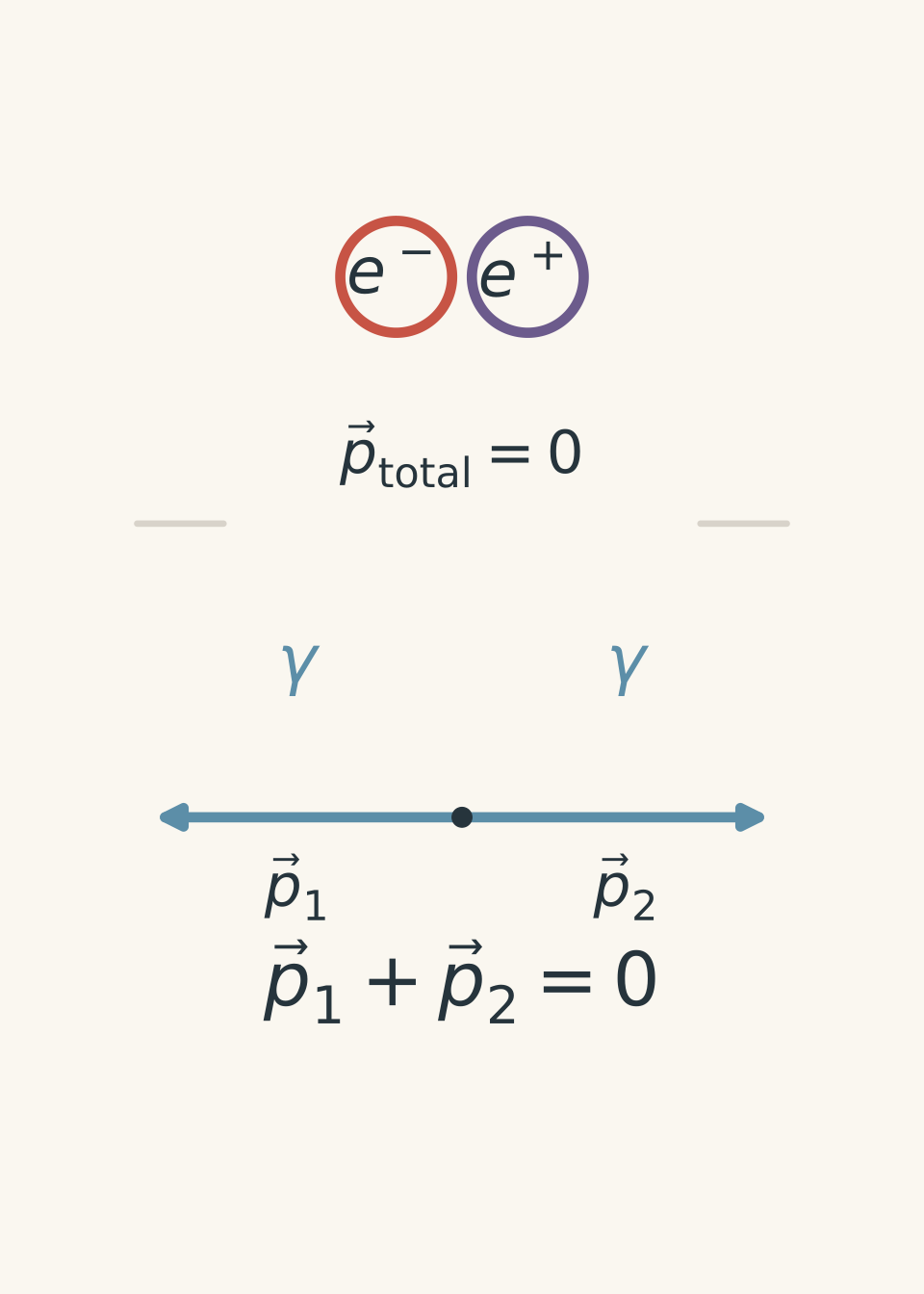
This gives another useful exam rule:
Never check only energy conservation. If particles disappear into photons, check momentum as well.
06So where did the matter in the Universe come from?
Here is the crucial distinction.
Pair production can create matter particles, but it creates the corresponding antimatter particles too.
For example,
\[ \gamma+\gamma\rightarrow e^-+e^+ \]
creates one electron and one positron.
That means pair production by itself does not increase the net amount of matter over antimatter.
The same is true in reverse. If an electron annihilates with a positron, one of each disappears.
So imagine the early Universe containing an enormous number of matched matter-antimatter pairs, plus a tiny excess of matter. As cooling makes new pair production less effective, matched particles can annihilate. The matched pairs disappear, but the unmatched excess has nothing of its opposite type to annihilate with.
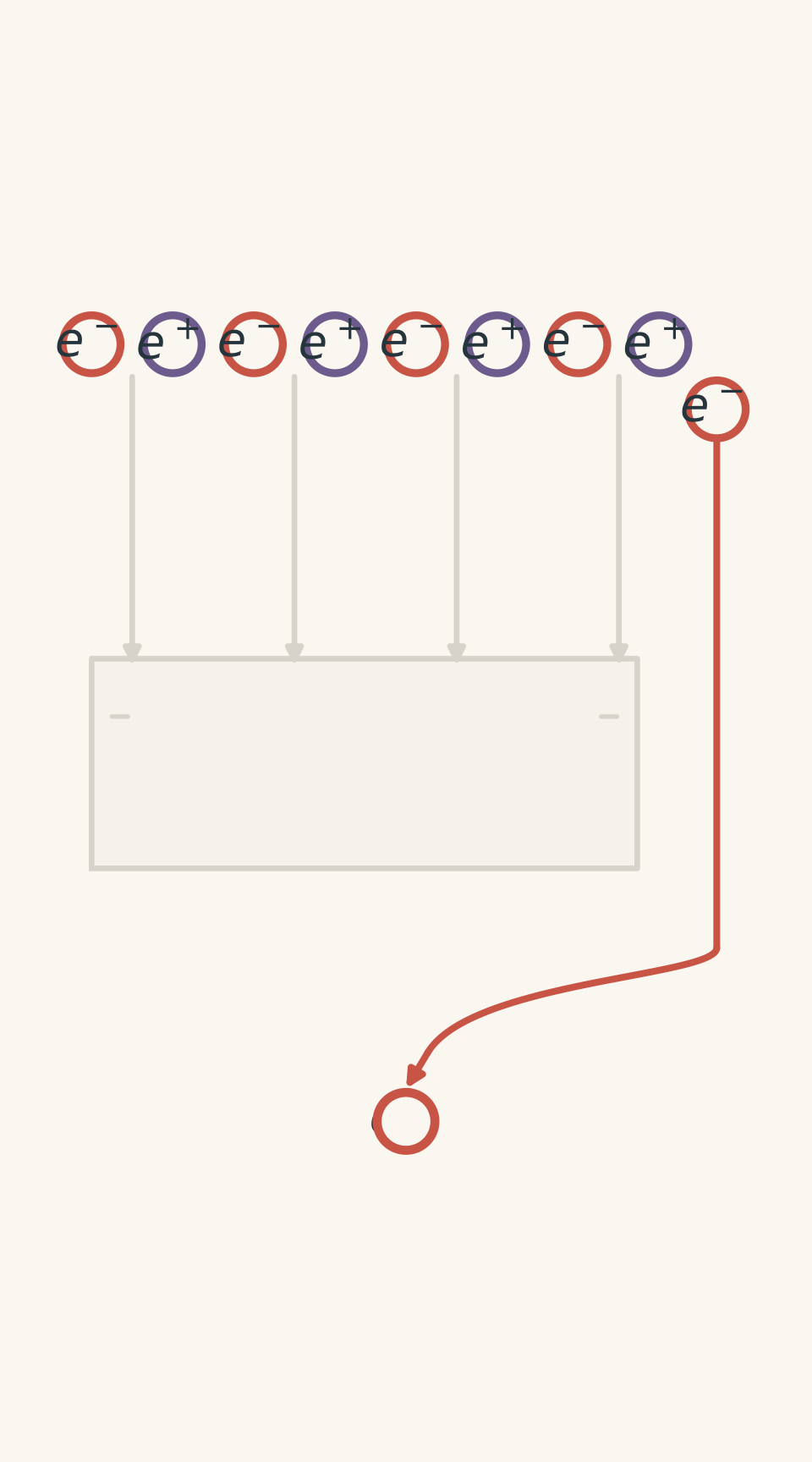
This tiny imbalance is the important part. The current Universe contains vastly more ordinary matter than antimatter, so some process must have produced or preserved a matter-antimatter asymmetry. The exact origin of that asymmetry remains an open problem in physics. CERN
Don’t make this leap
It would be wrong to conclude:
“Pair production made all the protons, which then became atoms.”
The \(1.022\) MeV threshold discussed here is specifically for an electron-positron pair. Different particles have different masses and therefore different energy requirements and interactions.
The early Universe contained quarks and other particles at much higher energies. As it cooled, quarks combined into protons and neutrons, and much later protons, neutrons, and electrons formed ordinary atoms. CERN
So the useful simplified chain is:
\[ \text{radiation energy} \rightarrow \text{particle--antiparticle pairs} \rightarrow \text{annihilation of matched pairs} \rightarrow \text{surviving matter} \rightarrow \text{nuclei and atoms}. \]
The first arrow is where pair production belongs. The survival of the final matter requires the second idea: matter-antimatter asymmetry.
07The HSC decision rules
| If the question asks… | Start by thinking… | Avoid this trap |
|---|---|---|
| Can a gamma ray create an \(e^-e^+\) pair? | Compare \(E_\gamma\) with \(2m_ec^2=1.022\) MeV | Treating the threshold as a guarantee |
| Why is a nucleus involved? | Momentum conservation | Saying the nucleus supplies the energy |
| What happens to excess photon energy? | It becomes kinetic energy and recoil | Making it disappear |
| Why does cooling matter? | Fewer high-energy photons, so production is suppressed | Assuming every photon has energy \(3k_BT\) |
| What happens to \(e^-e^+\) pairs? | They can annihilate into radiation | Thinking annihilation destroys energy |
| Why is today’s Universe matter-dominated? | A small matter excess must have survived | Claiming pair production itself creates net matter |
08Questions and solutions
Question 1
A \(1.40\) MeV gamma photon approaches a nucleus. Assume nuclear recoil energy is negligible.
Determine whether electron-positron pair production is energetically possible, and calculate the total kinetic energy of the electron and positron after the pair is produced.
Solution 1
Yes, pair production is energetically possible, and the electron and positron have \(0.378\) MeV of kinetic energy between them.
Step 1: Calculate the minimum rest energy of the pair.
\[ E_{\text{rest}} = 2(0.511) = 1.022\ \text{MeV}. \]
Step 2: Compare this with the photon energy.
\[ 1.40\ \text{MeV}>1.022\ \text{MeV}. \]
So the process is energetically allowed.
Step 3: Find the excess energy.
\[ K_-+K_+ = 1.40-1.022 = 0.378\ \text{MeV}. \]
Therefore,
\[ \boxed{K_-+K_+=0.378\ \text{MeV}}. \]
The tempting mistake is to subtract only one electron rest energy. Two massive particles have been created, so both \(0.511\) MeV rest energies must be supplied.
Question 2
For a rough early-Universe estimate, take a representative photon energy to be
\[ E_\gamma=3k_BT. \]
Estimate the temperature at which this representative photon energy equals the \(1.022\) MeV electron-positron pair-production threshold.
Use \(k_B=1.38\times10^{-23}\ \text{J K}^{-1}\) and \(1\ \text{eV}=1.60\times10^{-19}\ \text{J}\).
Solution 2
The estimated temperature is \(3.95\times10^9\) K, or about \(4.0\times10^9\) K.
Step 1: Convert the threshold energy to joules.
\[ 1.022\ \text{MeV} = 1.022\times10^6\ \text{eV} \]
\[ E_\gamma = (1.022\times10^6) (1.60\times10^{-19}) \]
\[ E_\gamma \approx1.64\times10^{-13}\ \text{J}. \]
Step 2: Rearrange \(E_\gamma=3k_BT\).
\[ T=\frac{E_\gamma}{3k_B}. \]
Step 3: Substitute.
\[ T = \frac{1.64\times10^{-13}} {3(1.38\times10^{-23})} \]
\[ T\approx3.95\times10^9\ \text{K}. \]
Therefore,
\[ \boxed{T\approx4.0\times10^9\ \text{K}}. \]
The important qualification is that this is a rough energy scale, not a sharp cutoff. A thermal distribution contains photons with a range of energies, so pair production becomes increasingly unlikely as the Universe cools rather than switching off at one exact temperature.
Question 3
An electron and positron have both slowed to rest before annihilating.
Explain why, in the simple two-photon case, they cannot produce just one photon. Then determine the energy of each photon if exactly two photons are produced.
Solution 3
They must produce at least two photons in this simple case, with each photon carrying \(0.511\) MeV.
Initially, the electron and positron are both at rest, so the total momentum is zero.
If only one photon were produced, that photon would have momentum
\[ p_\gamma=\frac{E_\gamma}{c}, \]
which is non-zero. There would be no other object to provide an opposite momentum, so momentum conservation would fail.
With two photons travelling in opposite directions, their momenta cancel.
Step 1: Find the total rest energy.
\[ E_{\text{total}} = 2(0.511) = 1.022\ \text{MeV}. \]
Step 2: Divide equally between the two photons.
\[ E_\gamma = \frac{1.022}{2} = 0.511\ \text{MeV}. \]
Therefore,
\[ \boxed{E_\gamma=0.511\ \text{MeV per photon}}. \]
The trap is to think that energy conservation alone allows one photon. It doesn’t. The total energy can work, but the momentum cannot.
Question 4
A \(1.50\) MeV gamma photon produces an electron-positron pair near a nucleus. The electron and positron then lose all their kinetic energy to the surrounding material before annihilating at rest.
Determine the total energy carried away by the annihilation photons. Explain where the rest of the original \(1.50\) MeV went.
Solution 4
The annihilation photons carry \(1.022\) MeV in total; the remaining \(0.478\) MeV was deposited in the surroundings as the particles lost their kinetic energy.
Step 1: Find the rest energy of the produced pair.
\[ E_{\text{rest}} = 2(0.511) = 1.022\ \text{MeV}. \]
Step 2: Find the kinetic energy initially given to the pair.
\[ K_-+K_+ = 1.50-1.022 = 0.478\ \text{MeV}. \]
Step 3: Follow that kinetic energy through the process.
The particles slow down before annihilation, so the \(0.478\) MeV is transferred to the surrounding material and can ultimately appear as thermal energy and other radiation.
By the time the electron and positron annihilate at rest, only their rest energy remains to be converted in the annihilation:
\[ E_{\text{annihilation}} = 1.022\ \text{MeV}. \]
So
\[ \boxed{E_{\text{annihilation}}=1.022\ \text{MeV}}. \]
The tempting answer is \(1.50\) MeV because that was the original photon energy. But the annihilation happens after the particles have already transferred their kinetic energy to the surroundings. Energy has not disappeared; it has simply been spread through the wider system.
Question 5
Consider a simplified model of the early Universe.
At one stage, take the representative photon energy to be \(0.78\) MeV, below the \(1.022\) MeV electron-positron threshold.
One student says:
“Pair production has completely stopped because the representative photon energy is below the threshold.”
Another says:
“Pair production can still happen, but it is much less common.”
Assume also that a toy model contains \(10^9+1\) matter particles and \(10^9\) corresponding antiparticles. Pair production always creates one matter particle and one antiparticle. Annihilation removes one of each. As the Universe continues to cool, suppose eventually all \(10^9\) matched pairs annihilate, and no other process changes the matter-minus-antimatter difference.
Which student’s reasoning is better? How many matter particles remain, what fraction of the original \(2\times10^9+1\) particles remains, and why can’t pair production by itself explain a matter-dominated Universe?
Solution 5
The second student’s reasoning is better, one matter particle remains in the toy model, and the surviving fraction is approximately \(5.0\times10^{-10}\). Pair production alone cannot create a net matter excess because it creates matter and antimatter together.
The first student’s mistake is treating the representative photon energy as though it were the maximum photon energy.
A thermal photon distribution contains a range of energies. Even when the representative energy is \(0.78\) MeV, some photons can have energies above \(1.022\) MeV. Pair production is therefore still possible, but it is strongly suppressed compared with a hotter Universe.
As cooling continues, high-energy photons become rarer, while existing matter-antimatter pairs can continue to annihilate. Eventually, reactions can become too slow to maintain thermal equilibrium as the Universe expands.
Now consider the particle counts.
Step 1: Identify the matched pairs.
There are
\[ 10^9 \]
matter-antimatter pairs.
There is also one extra matter particle.
Step 2: Annihilate the matched pairs.
Each annihilation removes one matter particle and one antiparticle.
Therefore,
\[ 10^9 \]
pairs disappear, leaving
\[ \boxed{1\text{ matter particle}}. \]
Step 3: Find the surviving fraction of the original particles.
Initially there were
\[ 2\times10^9+1 \]
particles in total.
So the surviving fraction is
\[ \frac{1}{2\times10^9+1} \approx5.0\times10^{-10}. \]
Thus,
\[ \boxed{\text{surviving fraction}\approx5.0\times10^{-10}}. \]
The deeper point is the difference between making pairs and creating a net excess.
Pair production changes the number of particles, but it adds one matter particle and one antimatter particle. The difference between the two populations therefore stays unchanged.
Annihilation does the opposite: it removes one of each.
So neither process, by itself, changes the matter-antimatter imbalance. A matter-dominated Universe requires some process that produced or preserved a small asymmetry in the early Universe. The exact origin of that asymmetry is still an open problem. CERN
The next useful step is to follow the surviving matter forward: quarks become bound into protons and neutrons, those particles participate in nuclear formation, and eventually electrons combine with nuclei to make atoms. Pair production gives you the energy-to-particles part of that story; conservation laws and the matter-antimatter asymmetry explain why the story did not end with a Universe containing only radiation.