
Why Primary and Secondary Alcohols Form Different Oxidation Products
Understand why primary alcohols oxidise to aldehydes and carboxylic acids, while secondary alcohols form ketones. Explore how molecular structure and reaction conditions determine the products, with worked examples and HSC Chemistry practice questions.
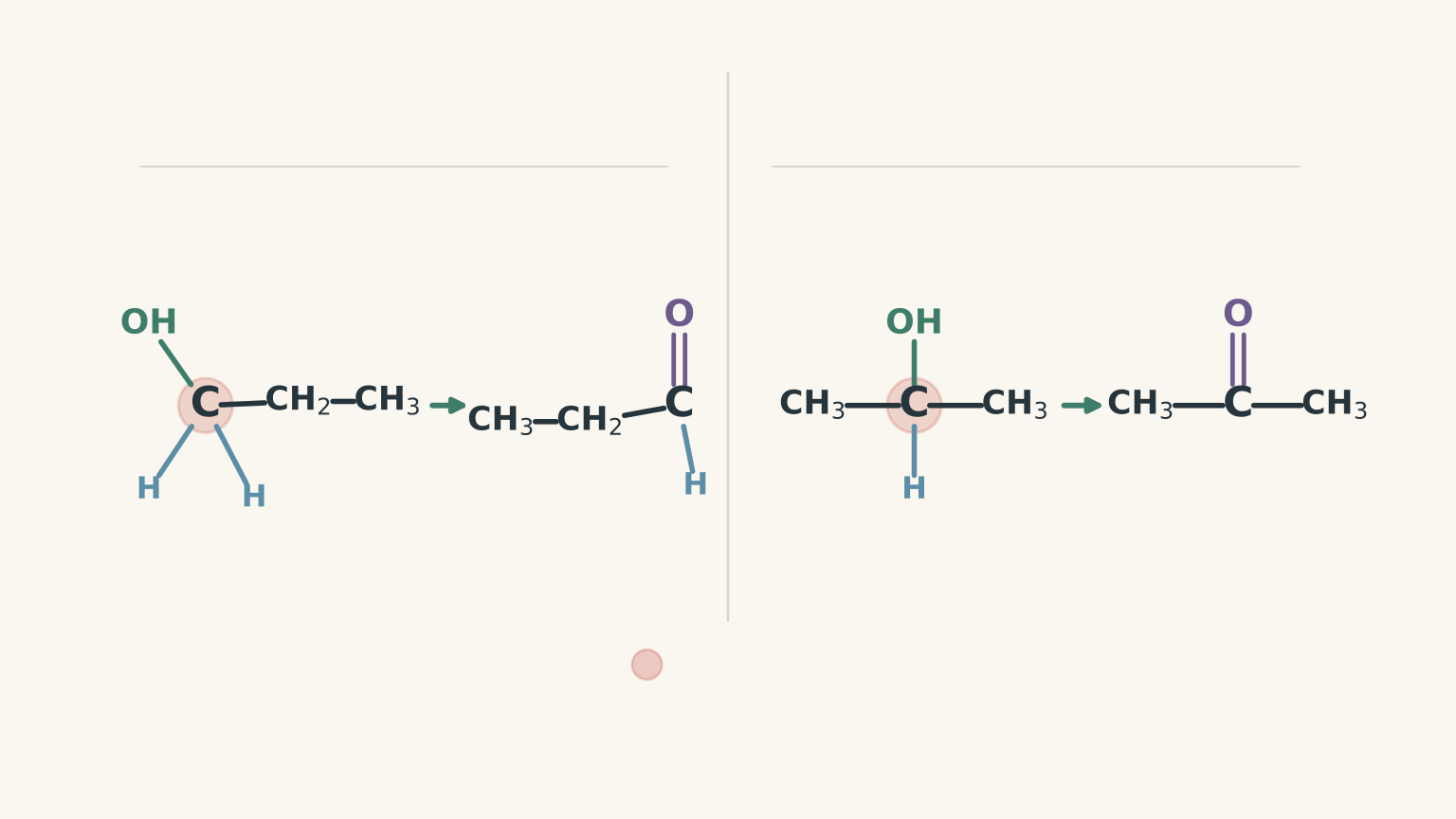
Put propan-1-ol and propan-2-ol into separate flasks. Add acidified potassium dichromate(VI), then warm both mixtures.
Both alcohols contain three carbon atoms and the same \(\ce{-OH}\) functional group. Would you expect them to produce the same oxidation product?
They don’t. Propan-1-ol produces propanal first, which can be oxidised further to propanoic acid. Propan-2-ol produces propanone, a ketone, which does not undergo further oxidation under ordinary HSC oxidation conditions.
The reason comes down to the number of hydrogen atoms attached to the carbon carrying the \(\ce{-OH}\) group. A primary alcohol has two such hydrogens, while a secondary alcohol has only one. That small structural difference determines the type of carbonyl compound formed.
Due to technical limitations, this figure may display incorrectly or contain inaccuracies. Please check key details against your course materials.
01Start with the carbon carrying the hydroxyl group
Before predicting an oxidation product, you need to identify whether the starting alcohol is primary, secondary, or tertiary.
Remember that classification depends on the number of carbon atoms directly bonded to the carbon carrying the \(\ce{-OH}\) group. It does not depend on the total number of carbon atoms in the molecule.
The three general structures are:
| Alcohol type | General structure | Carbon atoms directly attached to the C-OH carbon |
|---|---|---|
| Primary | \(\ce{R-CH2-OH}\) | 1 |
| Secondary | \(\ce{R-CH(OH)-R'}\) | 2 |
| Tertiary | \(\ce{R-C(OH)(R')-R''}\) | 3 |
Here, \(\ce{R}\), \(\ce{R'}\), and \(\ce{R''}\) represent carbon-containing groups.
For oxidation, there is another useful way to compare these structures: count the hydrogen atoms attached directly to the carbon carrying the hydroxyl group.
| Alcohol type | Hydrogen atoms on the C-OH carbon |
|---|---|
| Primary | 2 |
| Secondary | 1 |
| Tertiary | 0 |
Due to technical limitations, this figure may display incorrectly or contain inaccuracies. Please check key details against your course materials.
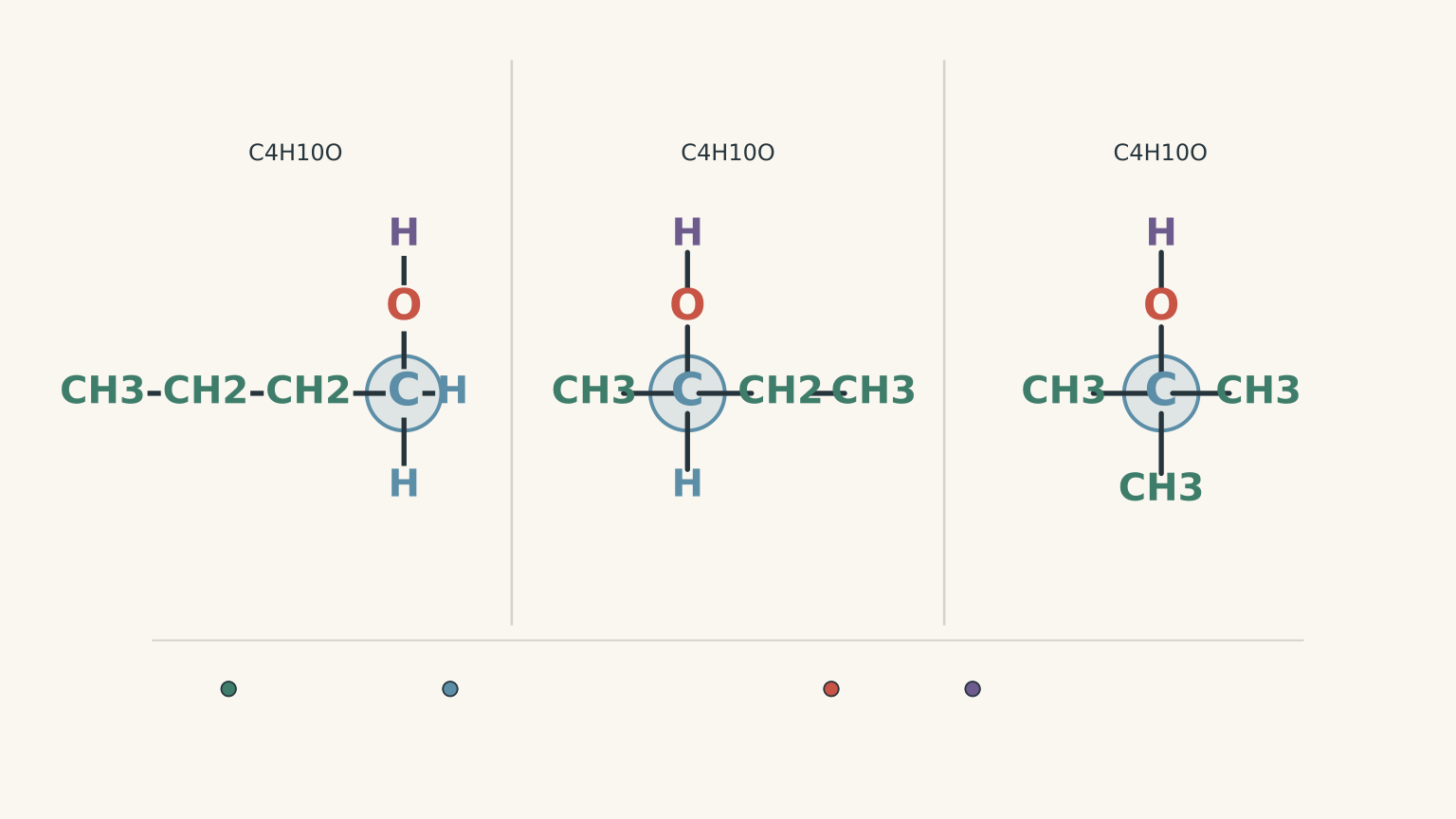
For example, consider these three four-carbon alcohols:
- Butan-1-ol, \(\ce{CH3CH2CH2CH2OH}\), is primary.
- Butan-2-ol, \(\ce{CH3CH(OH)CH2CH3}\), is secondary.
- 2-methylpropan-2-ol, \(\ce{(CH3)3COH}\), is tertiary.
Notice that all three have the molecular formula \(\ce{C4H10O}\). Their different oxidation behaviour comes from their different structural arrangements.
If classification is still difficult, see Primary, Secondary and Tertiary Alcohols for HSC Chemistry.
02What actually happens during alcohol oxidation?
Think about the bonds around the carbon carrying the \(\ce{-OH}\) group.
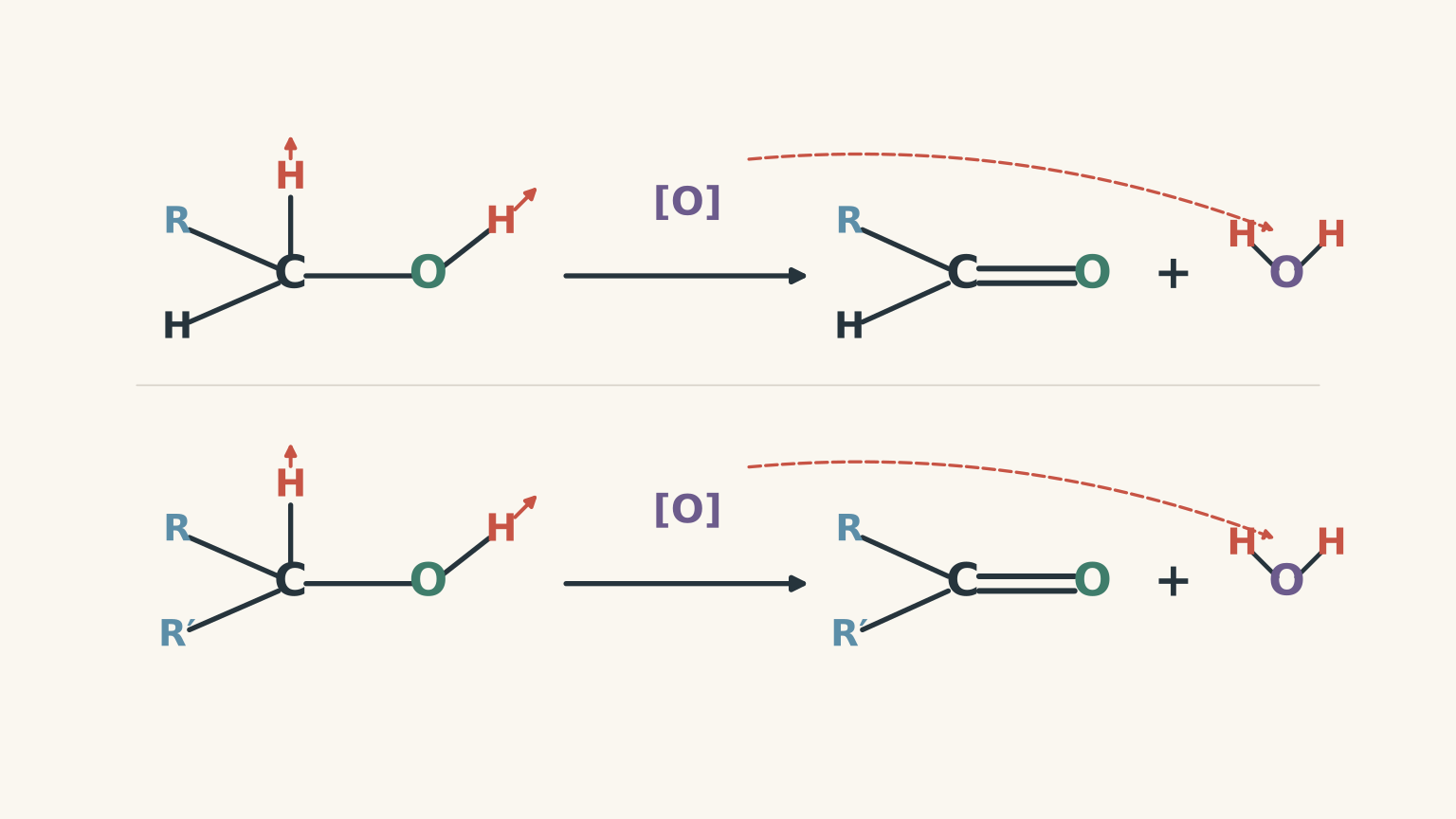
During ordinary oxidation of an alcohol to a carbonyl compound:
- One hydrogen is removed from the \(\ce{O-H}\) bond.
- One hydrogen is removed from the carbon carrying the \(\ce{-OH}\) group.
- The carbon-oxygen single bond becomes a carbon-oxygen double bond.
The resulting functional group contains a carbonyl bond, \(\ce{C=O}\).
This is an important point: oxidation does not always mean simply adding oxygen to a molecule. In alcohol oxidation, the formation of the carbonyl group involves the removal of hydrogen and an increase in the bonding between carbon and oxygen.
The symbol \(\ce{[O]}\), used in many HSC reaction equations, represents an oxidising equivalent. It is shorthand for the oxidation process, not necessarily a free oxygen atom being added directly.
Due to technical limitations, this figure may display incorrectly or contain inaccuracies. Please check key details against your course materials.
Now apply this to each alcohol class.
Primary alcohols produce aldehydes
A primary alcohol has the general structure:
\[ \ce{R-CH2OH} \]
The carbon carrying the \(\ce{-OH}\) group has two hydrogen atoms.
During oxidation, one hydrogen is removed from this carbon and another from the hydroxyl group. The carbon forms a double bond with oxygen.
The product is:
\[ \ce{R-CH2OH + [O] -> R-CHO + H2O} \]
The functional group \(\ce{-CHO}\) identifies an aldehyde.
Why an aldehyde rather than a ketone?
Look at what remains attached to the carbonyl carbon. It has one carbon-containing group, \(\ce{R}\), and one hydrogen.
That is the defining structure of an aldehyde.
For example, ethanol oxidises to ethanal:
\[ \ce{CH3CH2OH + [O] -> CH3CHO + H2O} \]
Secondary alcohols produce ketones
A secondary alcohol has the general structure:
\[ \ce{R-CH(OH)-R'} \]
The carbon carrying the hydroxyl group is attached to two other carbon-containing groups and one hydrogen.
Oxidation removes that single hydrogen and the hydrogen from the \(\ce{O-H}\) bond.
The result is:
\[ \ce{R-CH(OH)-R' + [O] -> R-C(=O)-R' + H2O} \]
The carbonyl carbon is now attached to two carbon-containing groups.
That makes the product a ketone.
For example, propan-2-ol oxidises to propanone:
\[ \ce{CH3CH(OH)CH3 + [O] -> CH3COCH3 + H2O} \]
The important difference is not that secondary alcohols somehow use a different oxidising agent. Both primary and secondary alcohols can be oxidised using acidified potassium dichromate.
The difference is the structure left behind after the carbonyl group forms.
What about tertiary alcohols?
A tertiary alcohol has three carbon-containing groups attached to the carbon carrying the \(\ce{-OH}\) group.
There are no hydrogen atoms attached directly to that carbon.
This creates a problem.
To form a carbonyl group through ordinary alcohol oxidation, the carbon must form an additional bond to oxygen. But it already has three carbon-carbon bonds and one carbon-oxygen bond.
Without removing a hydrogen from that carbon, forming a carbon-oxygen double bond would require breaking a carbon-carbon bond.
Therefore, tertiary alcohols do not undergo ordinary oxidation under the usual HSC conditions.
This does not mean they can never react. It means they cannot form a carbonyl compound through the standard alcohol oxidation pathway without disrupting the carbon skeleton.
03Why primary alcohols can oxidise further, but secondary alcohols usually cannot
So far, we have established:
\[ \text{Primary alcohol} \rightarrow \text{Aldehyde} \]
\[ \text{Secondary alcohol} \rightarrow \text{Ketone} \]
But there is another important difference.
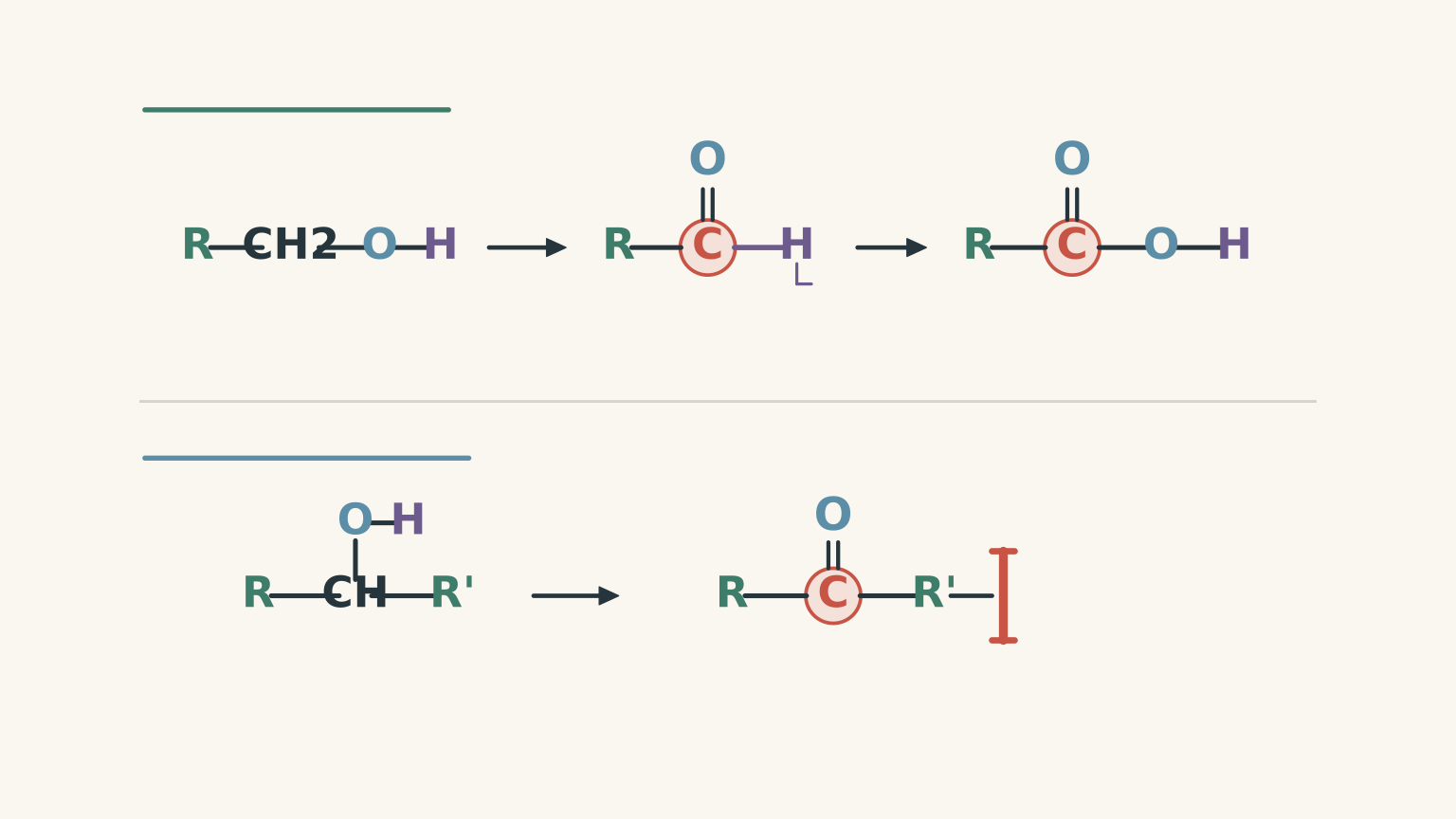
A primary alcohol’s aldehyde product can undergo a second oxidation to form a carboxylic acid.
A secondary alcohol’s ketone product does not undergo this further oxidation under ordinary HSC conditions.
The reason is the hydrogen attached to the carbonyl carbon.
The aldehyde can undergo another oxidation
Consider an aldehyde:
\[ \ce{R-CHO} \]
Its carbonyl carbon is attached to one hydrogen and one carbon-containing group.
That hydrogen allows the aldehyde to undergo further oxidation:
\[ \ce{R-CHO + [O] -> R-COOH} \]
The product is a carboxylic acid.
The complete pathway is therefore:
\[ \text{Primary alcohol} \rightarrow \text{Aldehyde} \rightarrow \text{Carboxylic acid} \]
For propan-1-ol:
\[ \ce{CH3CH2CH2OH} \]
the sequence is:
\[ \ce{CH3CH2CH2OH -> CH3CH2CHO -> CH3CH2COOH} \]
The products are propanal and then propanoic acid.
The ketone does not undergo the same further oxidation
Now consider a ketone:
\[ \ce{R-CO-R'} \]
Its carbonyl carbon is attached to two carbon-containing groups.
There is no hydrogen attached directly to the carbonyl carbon.
This means the ketone cannot undergo the same straightforward second oxidation as an aldehyde.
Further oxidation generally requires breaking carbon-carbon bonds, rather than simply converting the carbonyl group into a carboxylic acid.
That is not the normal oxidation pathway assessed for secondary alcohols in HSC Chemistry.
For example:
\[ \ce{CH3CH(OH)CH3 -> CH3COCH3} \]
Propan-2-ol produces propanone, but propanone does not continue to propanoic acid under ordinary alcohol oxidation conditions.
Due to technical limitations, this figure may display incorrectly or contain inaccuracies. Please check key details against your course materials.
This is the central distinction:
- Primary alcohols form aldehydes that can be oxidised further because the aldehyde carbon still carries hydrogen.
- Secondary alcohols form ketones, which resist further oxidation under ordinary conditions because their carbonyl carbon has no hydrogen attached.
Do not write that ketones can never be oxidised. Stronger oxidation conditions can break carbon-carbon bonds. That is a different process from the standard HSC alcohol oxidation reactions.
04How reaction conditions affect the products
The structure of the alcohol determines which type of carbonyl compound forms.
The reaction conditions determine whether a primary alcohol stops at the aldehyde stage or continues to the carboxylic acid.
A common oxidising agent in school chemistry is acidified potassium dichromate(VI), \(\ce{K2Cr2O7}\), usually acidified with sulfuric acid.
The solution changes from orange to green as dichromate(VI) ions are reduced to chromium(III) ions.
However, this colour change alone does not tell you which organic product has formed.
Consider the following comparison:
| Starting alcohol | Conditions | Main organic product |
|---|---|---|
| Primary | Acidified dichromate, controlled oxidation, distil product as it forms | Aldehyde |
| Primary | Excess acidified dichromate, heat under reflux | Carboxylic acid |
| Secondary | Acidified dichromate, warming | Ketone |
| Secondary | Acidified dichromate, heating under reflux | Ketone |
| Tertiary | Ordinary acidified dichromate conditions | No oxidation |
Why does reflux produce different results for primary and secondary alcohols?
For a primary alcohol, reflux keeps the aldehyde intermediate in contact with the oxidising mixture. It can therefore undergo further oxidation to a carboxylic acid.
For a secondary alcohol, reflux keeps the ketone in the reaction system, but the ketone does not undergo the same further oxidation under these conditions.
This is a useful exam distinction: reflux does not automatically mean a carboxylic acid will form. You must first identify the starting alcohol.
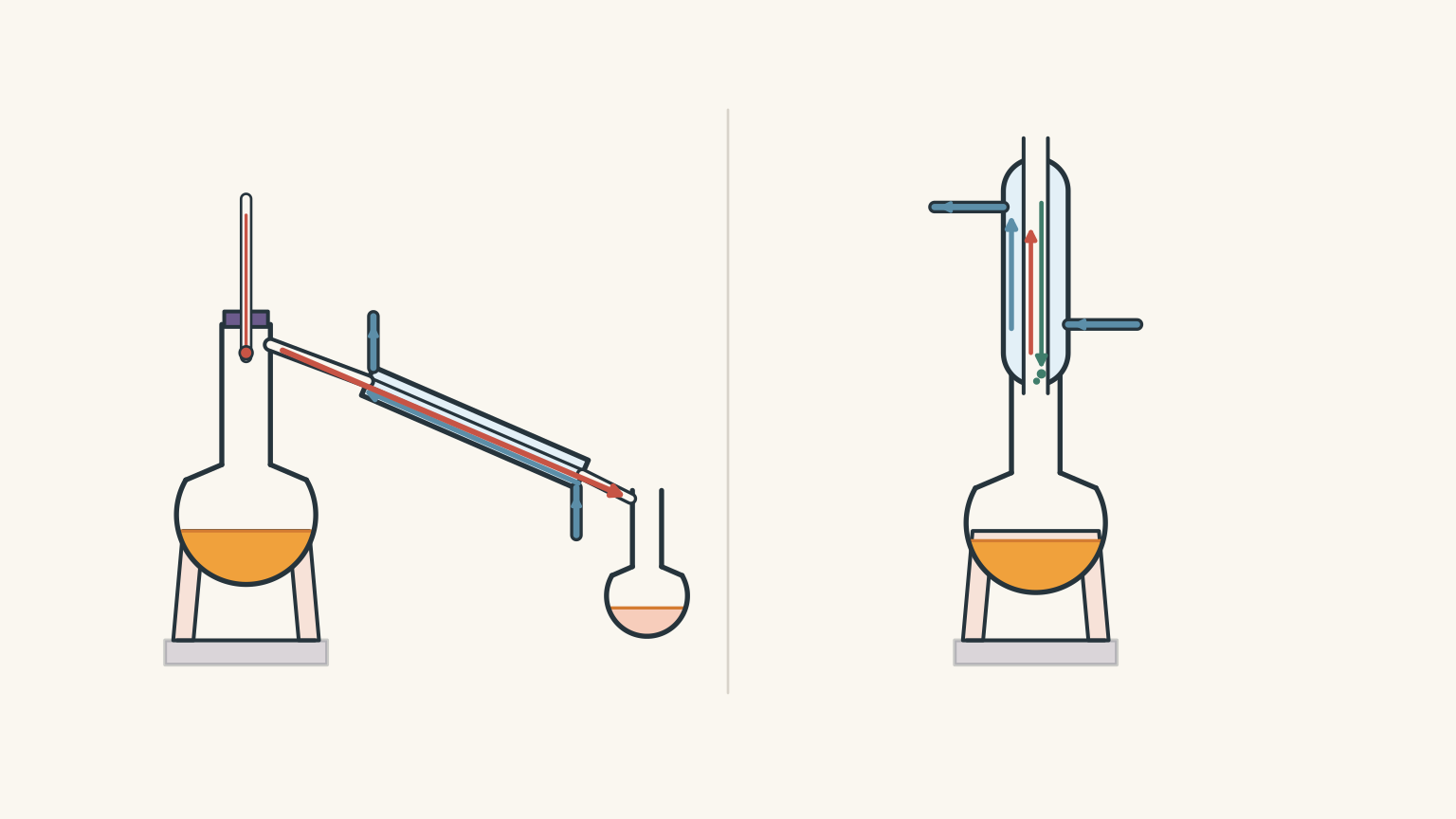
Due to technical limitations, this figure may display incorrectly or contain inaccuracies. Please check key details against your course materials.
For a more detailed explanation of why distillation and reflux produce different outcomes for primary alcohols, see Primary Alcohol Oxidation Products: Aldehydes and Acids.
05How would an experiment distinguish the products?
Imagine that you are given two unknown alcohol samples.
One is propan-1-ol, and the other is propan-2-ol.
You add equal amounts of acidified potassium dichromate to each sample and warm them.
Both solutions change from orange to green.
Can you conclude that both alcohols produced the same product?
No. The colour change shows that the oxidising agent has reacted. It does not identify the organic product.
This is a limitation of using dichromate colour change as the only measurement.
The first experimental design
The original test uses two reaction tubes:
- Tube A contains propan-1-ol and acidified potassium dichromate.
- Tube B contains propan-2-ol and acidified potassium dichromate.
Both are warmed.
The observation is an orange-to-green colour change in both tubes.
This supports the conclusion that both alcohols have undergone oxidation. However, it cannot distinguish an aldehyde from a ketone.
Improving the experiment
A better approach is to collect the organic products separately using distillation.
Each alcohol is placed in a separate reaction flask with acidified potassium dichromate. The flask is heated gently in a water bath.
The vapour travels from the reaction flask through a side-arm and into a water-cooled condenser. Cooling water enters at the bottom of the condenser and leaves at the top.
The vapour cools, condenses, and flows into a separate collection flask.
This removes the volatile organic product from the oxidising mixture as it forms.
The collected products can then be tested using Tollens’ reagent.
Tollens’ reagent contains silver(I) ions. An aldehyde can reduce these ions to metallic silver, producing a silver deposit or silver mirror.
An ordinary ketone does not produce this result.
The expected observations are:
| Sample | Dichromate observation | Tollens’ test on collected product | Product |
|---|---|---|---|
| Propan-1-ol | Orange to green | Silver deposit | Propanal |
| Propan-2-ol | Orange to green | No silver deposit | Propanone |
These are illustrative expected observations, not measurements from an actual experiment.
The revised experiment provides stronger evidence because it combines an oxidation test with a product-specific test.
One limitation to remember
A negative Tollens’ test does not automatically prove that a product is a ketone.
A carboxylic acid also does not give the characteristic silver mirror reaction.
For example, if propan-1-ol is heated under reflux with excess oxidant, the main product is propanoic acid. A negative Tollens’ test would not mean the starting alcohol was secondary.
You would need another test to distinguish the possibilities. Carboxylic acids react with sodium hydrogencarbonate to release carbon dioxide:
\[ \ce{RCOOH + NaHCO3 -> RCOONa + H2O + CO2} \]
Effervescence indicates the production of carbon dioxide and supports the presence of a carboxylic acid.
In an actual school practical, use a water bath rather than a naked flame when heating alcohols. Follow the required safety procedures for acidified dichromate and freshly prepared Tollens’ reagent.
06Worked examples
Worked example: Predicting the product from a secondary alcohol
Butan-2-ol is heated under reflux with acidified potassium dichromate(VI). Identify the main organic product and write a balanced oxidation equation.
Step 1
Butan-2-ol has the condensed structural formula:
\[ \ce{CH3CH(OH)CH2CH3} \]
The carbon carrying the \(\ce{-OH}\) group is attached to two other carbon atoms.
Therefore, butan-2-ol is a secondary alcohol.
Step 2
Secondary alcohols oxidise to ketones.
The carbon carrying the hydroxyl group loses its hydrogen and forms a double bond with oxygen.
Step 3
The carbonyl carbon remains attached to the two original carbon-containing groups.
The product is:
\[ \ce{CH3COCH2CH3} \]
Its name is butan-2-one.
Step 4
\[ \ce{CH3CH(OH)CH2CH3 + [O] -> CH3COCH2CH3 + H2O} \]
Step 5
The reaction occurs under reflux, but the product remains a ketone.
Unlike an aldehyde, the ketone does not undergo the same further oxidation under ordinary conditions.
The final answer is butan-2-one, not butanoic acid.
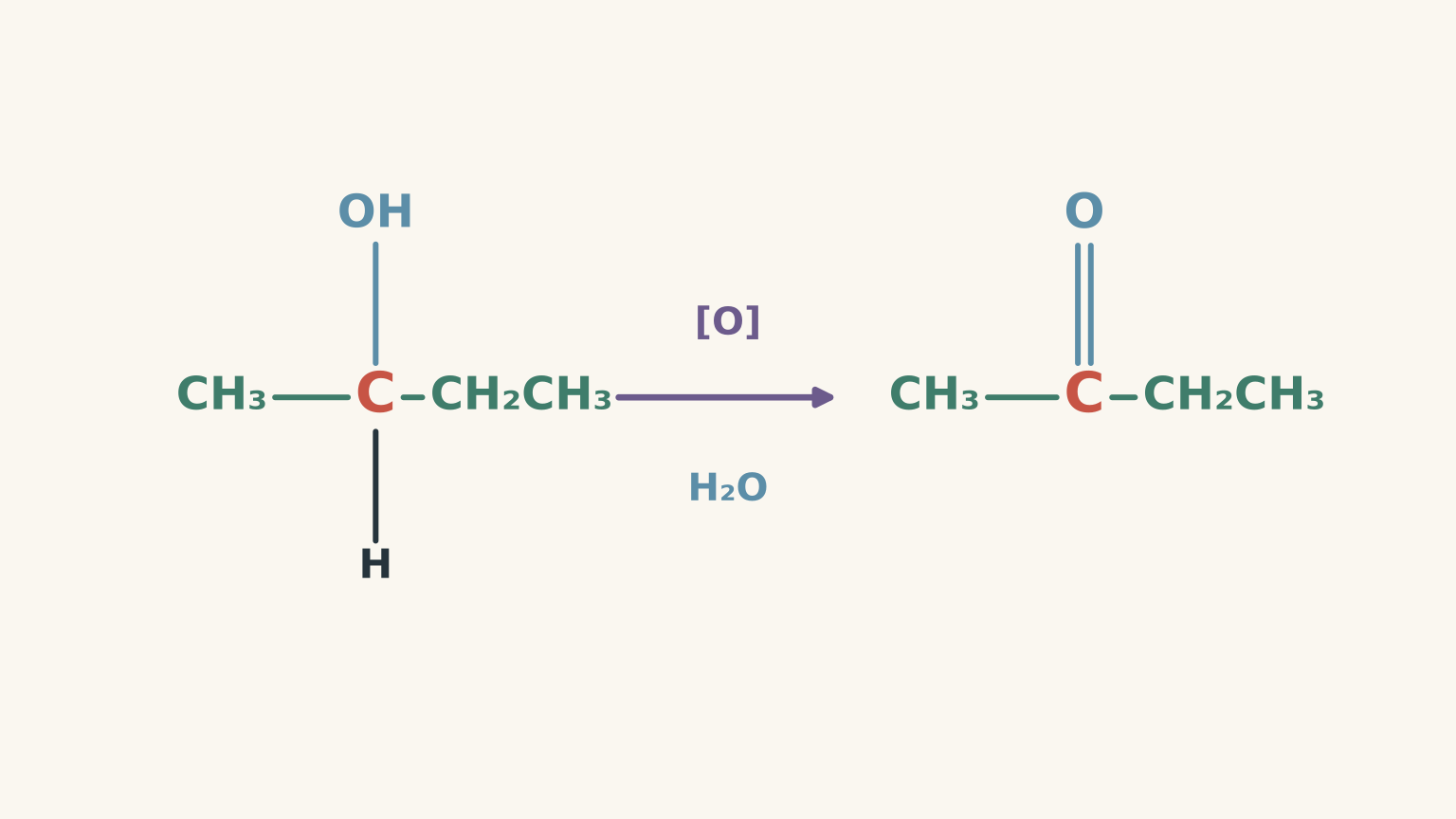
Due to technical limitations, this figure may display incorrectly or contain inaccuracies. Please check key details against your course materials.
Worked example: Calculating the mass of ketone produced
A sample containing \(0.0250\text{ mol}\) of butan-2-ol is completely oxidised to butan-2-one.
The reaction produces an actual yield of \(80.0\%\).
Calculate the mass of butan-2-one obtained.
Step 1
\[ \ce{CH3CH(OH)CH2CH3 + [O] -> CH3COCH2CH3 + H2O} \]
The mole ratio of butan-2-ol to butan-2-one is \(1:1\).
Step 2
Since the mole ratio is \(1:1\):
\[ n(\text{butan-2-one})=0.0250\text{ mol} \]
This is the theoretical amount before accounting for the percentage yield.
Step 3
Its molecular formula is \(\ce{C4H8O}\).
\[ \begin{aligned} M &=4(12.01)+8(1.008)+16.00\\ &=72.11\text{ g mol}^{-1} \end{aligned} \]
Step 4
Using \(m=nM\):
\[ \begin{aligned} m&=0.0250\times72.11\\ &=1.803\text{ g} \end{aligned} \]
Step 5
\[ \begin{aligned} m_{\text{actual}}&=0.800\times1.803\\ &=1.44\text{ g} \end{aligned} \]
The actual mass of butan-2-one is:
\[ \boxed{1.44\text{ g}} \]
This assumes that butan-2-one is the only organic product and that the percentage yield is calculated relative to the theoretical amount.
Notice that the oxidation reaction has a \(1:1\) mole ratio between alcohol and ketone. This is the same initial oxidation stoichiometry as a primary alcohol forming an aldehyde.
The difference is what happens to the carbonyl product afterwards.
07Connecting oxidation to substitution and elimination
Alcohol classification is also useful when predicting substitution and elimination reactions.
However, be careful: these reactions do not follow the same rules as oxidation.
The important question is which bonds are being broken and formed.
Substitution: Replacing the hydroxyl group
In a substitution reaction, the hydroxyl group is replaced by a halogen atom.
Alcohols can react with hydrogen halides, \(\ce{HX}\), where X represents a halogen.
A general equation is:
\[ \ce{R-OH + HX -> R-X + H2O} \]
For example, ethanol reacts with concentrated hydrogen bromide on warming to form bromoethane:
\[ \ce{CH3CH2OH + HBr -> CH3CH2Br + H2O} \]
The hydroxyl group is replaced by bromine.
No carbonyl group is formed, so this is not oxidation.
Elimination: Removing water to form an alkene
Alcohols can also undergo dehydration, which is an elimination reaction.
In this process:
- The \(\ce{-OH}\) group is removed from the carbon carrying the hydroxyl group.
- A hydrogen is removed from an adjacent carbon.
- A carbon-carbon double bond forms between those two carbons.
A common condition is concentrated sulfuric acid and heat.
For ethanol, heating with concentrated sulfuric acid at approximately \(170^\circ\text{C}\) produces ethene:
\[ \ce{CH3CH2OH -> CH2=CH2 + H2O} \]
The key distinction is that elimination uses a hydrogen from a neighbouring carbon, rather than the hydrogen directly attached to the carbon carrying the \(\ce{-OH}\) group.
This is particularly important for tertiary alcohols.
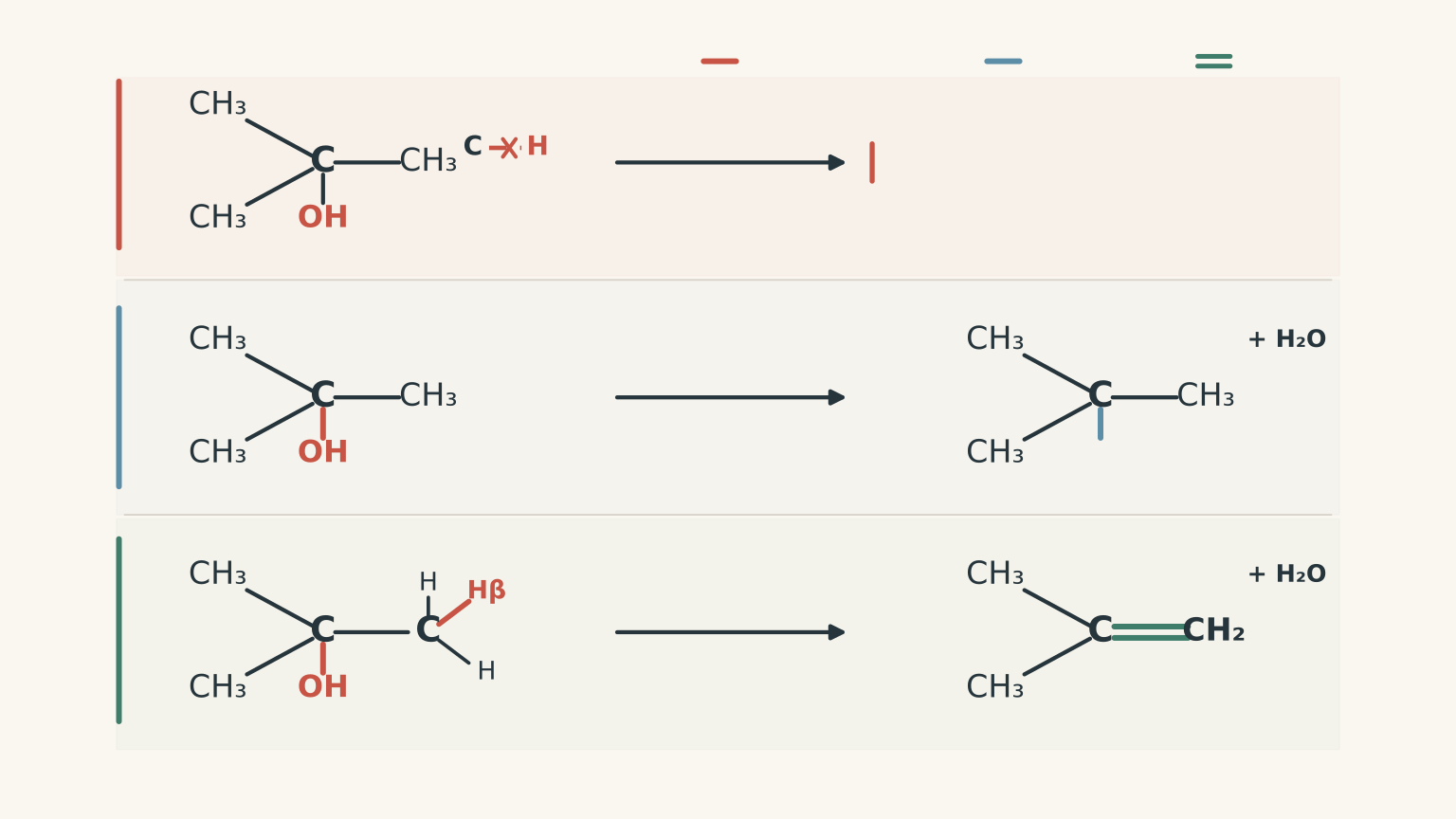
Due to technical limitations, this figure may display incorrectly or contain inaccuracies. Please check key details against your course materials.
Consider 2-methylpropan-2-ol:
\[ \ce{(CH3)3COH} \]
It has no hydrogen attached to the carbon carrying the hydroxyl group.
Therefore, it cannot undergo ordinary alcohol oxidation.
However, it can still undergo substitution:
\[ \ce{(CH3)3COH + HBr -> (CH3)3CBr + H2O} \]
The product is 2-bromo-2-methylpropane.
It can also undergo elimination:
\[ \ce{(CH3)3COH -> (CH3)2C=CH2 + H2O} \]
The product is 2-methylpropene.
Why is elimination possible?
The three methyl groups contain hydrogen atoms on carbons adjacent to the carbon carrying the hydroxyl group.
These are often called beta hydrogens.
Elimination removes one of these beta hydrogens, allowing a carbon-carbon double bond to form.
This gives you three different structural requirements:
| Reaction | What the reaction requires | Main structural change |
|---|---|---|
| Oxidation | A hydrogen on the carbon carrying OH | Formation of \(\ce{C=O}\) |
| Substitution with HX | Replacement of OH by a halogen | Formation of \(\ce{C-X}\) |
| Elimination (dehydration) | OH and a hydrogen on an adjacent carbon | Formation of \(\ce{C=C}\) |
A tertiary alcohol can therefore resist oxidation while still undergoing substitution and elimination.
Do not assume that a molecule which does not undergo one reaction must be unreactive in every other reaction.
08Questions and solutions
Question 1
Propan-1-ol is heated under reflux with excess acidified potassium dichromate(VI).
a. Name the final organic product.
b. Write the overall balanced oxidation equation using \(\ce{[O]}\).
c. Explain why the reaction does not stop at propanal.
Solution 1
The final organic product is propanoic acid, \(\ce{CH3CH2COOH}\), because propan-1-ol is a primary alcohol heated under reflux with excess oxidising agent.
The first oxidation produces propanal:
\[ \ce{CH3CH2CH2OH + [O] -> CH3CH2CHO + H2O} \]
Propanal is an aldehyde, and it can undergo further oxidation.
The second oxidation produces propanoic acid:
\[ \ce{CH3CH2CHO + [O] -> CH3CH2COOH} \]
Adding the two stages gives:
\[ \boxed{ \ce{CH3CH2CH2OH + 2[O] -> CH3CH2COOH + H2O} } \]
The reaction does not stop at propanal because reflux keeps the volatile intermediate within the reaction system. This allows it to remain in contact with the excess oxidising agent.
The tempting mistake is to assume that every primary alcohol oxidation produces an aldehyde as the final product. The aldehyde is the first product, but the conditions determine whether it undergoes further oxidation.
Question 2
Two separate \(0.0150\text{ mol}\) samples of alcohol are oxidised.
- Sample A contains butan-1-ol. The product is removed by distillation as it forms.
- Sample B contains butan-2-ol. It is heated under reflux with excess acidified potassium dichromate.
a. Identify the main organic product from each sample.
b. Write the oxidation equation for each sample.
c. Calculate the amount of \(\ce{[O]}\), in moles, required for each stated oxidation.
d. If sample A were instead heated under reflux with excess oxidant, calculate the amount of \(\ce{[O]}\) required for complete oxidation to the carboxylic acid.
Solution 2
Sample A produces butanal, while sample B produces butan-2-one. Both stated oxidation reactions require \(0.0150\text{ mol}\) of \(\ce{[O]}\).
Part (a): Identify the products
Butan-1-ol is primary, so distillation removes the aldehyde as it forms.
Its product is butanal:
\[ \ce{CH3CH2CH2CHO} \]
Butan-2-ol is secondary, so its oxidation product is a ketone.
Its product is butan-2-one:
\[ \ce{CH3COCH2CH3} \]
Part (b): Write the equations
For sample A:
\[ \ce{CH3CH2CH2CH2OH + [O] -> CH3CH2CH2CHO + H2O} \]
For sample B:
\[ \ce{CH3CH(OH)CH2CH3 + [O] -> CH3COCH2CH3 + H2O} \]
Part (c): Calculate the amount of oxidant
Both reactions have a \(1:1\) mole ratio between alcohol and \(\ce{[O]}\).
For sample A:
\[ n(\ce{[O]})=0.0150\text{ mol} \]
For sample B:
\[ n(\ce{[O]})=0.0150\text{ mol} \]
Part (d): Complete oxidation of sample A
If butan-1-ol is heated under reflux with excess oxidant, butanoic acid forms.
The overall equation is:
\[ \ce{CH3CH2CH2CH2OH + 2[O] -> CH3CH2CH2COOH + H2O} \]
The mole ratio is now \(1:2\).
Therefore:
\[ \begin{aligned} n(\ce{[O]})&=2\times0.0150\\ &=0.0300\text{ mol} \end{aligned} \]
The required amount is \(0.0300\text{ mol}\) of \(\ce{[O]}\).
The important distinction is that the primary alcohol can undergo a second oxidation, while the secondary alcohol produces a ketone that does not undergo the same further oxidation under these conditions.
Question 3
A student performs an experiment using two unknown alcohols.
Both samples are separately mixed with acidified potassium dichromate and warmed. Both solutions change from orange to green.
The student concludes:
Both alcohols must have produced the same organic functional group because the oxidising agent changed colour in both experiments.
a. Explain why this conclusion is incorrect.
b. Describe an improved experimental method that could distinguish an aldehyde product from a ketone product.
c. State the expected observations if the starting alcohols were propan-1-ol and propan-2-ol.
d. Explain why a negative Tollens’ test would not, by itself, prove that an unknown product is a ketone.
Solution 3
The student’s conclusion is incorrect because the orange-to-green colour change only demonstrates that the oxidising agent has been reduced. It does not identify the organic product.
Both primary and secondary alcohols can reduce acidified potassium dichromate during oxidation.
Part (a): Explain the limitation
Acidified potassium dichromate changes from orange to green as chromium(VI) ions are reduced to chromium(III) ions.
Both propan-1-ol and propan-2-ol can cause this change.
However, their organic products are different:
- Propan-1-ol forms propanal.
- Propan-2-ol forms propanone.
The dichromate colour change cannot distinguish these products.
Part (b): Improve the method
Use a distillation apparatus to collect the organic products separately as they form.
Place each alcohol and acidified potassium dichromate in a separate reaction flask. Heat gently using a water bath.
Connect each flask to a condenser. The volatile product travels through the condenser, cools, and collects in a separate receiving flask.
Test a small sample of each collected product using freshly prepared Tollens’ reagent.
Warm the test mixtures gently.
Part (c): Expected observations
For propan-1-ol, the collected product is propanal.
Propanal is an aldehyde, so it gives a positive Tollens’ test. A silver deposit should form.
For propan-2-ol, the collected product is propanone.
Propanone is a ketone, so it does not give the characteristic silver mirror reaction.
Both original dichromate solutions should still change from orange to green.
Part (d): Limitation of a negative Tollens’ test
A negative Tollens’ test indicates that an aldehyde has not been detected, but it does not distinguish a ketone from a carboxylic acid.
For example, a primary alcohol heated under reflux with excess oxidant may produce a carboxylic acid rather than an aldehyde.
A suitable additional test is sodium hydrogencarbonate. A carboxylic acid releases carbon dioxide, producing effervescence.
The key experimental principle is to distinguish evidence that oxidation occurred from evidence that identifies the actual oxidation product.
Question 4
Butan-2-ol is divided into three separate samples.
Each sample undergoes a different reaction:
- Sample A is warmed with concentrated hydrogen bromide.
- Sample B is heated with concentrated sulfuric acid.
- Sample C is warmed with acidified potassium dichromate.
a. Predict the main organic product from each reaction.
b. Write a balanced structural equation for each reaction.
c. For sample B, identify all possible structural alkene products. Ignore cis-trans stereoisomers.
d. Explain why these three reactions produce different products even though they start with the same alcohol.
Solution 4
Sample A produces 2-bromobutane, sample B can produce but-1-ene or but-2-ene, and sample C produces butan-2-one.
The different products result from substitution, elimination, and oxidation.
Part (a): Predict the products
Sample A undergoes substitution because the hydroxyl group is replaced by bromine.
Sample B undergoes elimination because water is removed and a carbon-carbon double bond forms.
Sample C undergoes oxidation because the alcohol is converted into a ketone.
Part (b): Write the equations
Sample A:
\[ \ce{CH3CH(OH)CH2CH3 + HBr -> CH3CH(Br)CH2CH3 + H2O} \]
The product is 2-bromobutane.
Sample B:
\[ \ce{CH3CH(OH)CH2CH3 -> CH3CH=CHCH3 + H2O} \]
or
\[ \ce{CH3CH(OH)CH2CH3 -> CH2=CHCH2CH3 + H2O} \]
The products are but-2-ene and but-1-ene.
Sample C:
\[ \ce{CH3CH(OH)CH2CH3 + [O] -> CH3COCH2CH3 + H2O} \]
The product is butan-2-one.
Part (c): Identify the alkene products
During dehydration, the hydroxyl group is removed from carbon 2.
A hydrogen can be removed from either adjacent carbon.
Removing a hydrogen from carbon 1 produces but-1-ene:
\[ \ce{CH2=CHCH2CH3} \]
Removing a hydrogen from carbon 3 produces but-2-ene:
\[ \ce{CH3CH=CHCH3} \]
Both are valid structural products.
Part (d): Explain the different reaction pathways
The reactions involve different chemical changes.
In substitution, bromine replaces the hydroxyl group.
In elimination, the hydroxyl group and a hydrogen on a neighbouring carbon are removed, forming a carbon-carbon double bond.
In oxidation, hydrogen is removed from the hydroxyl group and the carbon carrying it, allowing a carbon-oxygen double bond to form.
The same alcohol can undergo all three reactions because the reagents and conditions determine which pathway occurs.
A common mistake is to assume that heating an alcohol always causes oxidation or always causes dehydration. The reagent and reaction conditions must be considered together.
Question 5
An unknown pure alcohol, Z, has the molecular formula \(\ce{C4H10O}\).
It is tested using acidified potassium dichromate under conditions that oxidise both known primary and secondary alcohol controls.
The control samples change from orange to green, but sample Z remains orange.
Two further experiments are performed using separate portions of Z:
- When warmed with concentrated hydrogen bromide, Z produces 2-bromo-2-methylpropane.
- When heated with concentrated sulfuric acid, Z produces 2-methylpropene and water.
A student makes the following claims:
- Z cannot undergo oxidation because it has no hydrogen attached to the carbon carrying the hydroxyl group.
- Z cannot undergo elimination for the same reason.
- The absence of a dichromate colour change proves that Z cannot undergo any chemical reaction.
Evaluate all three claims.
Deduce the structure of Z, write the equations for its substitution and elimination reactions, and explain how its structure accounts for all the experimental observations.
Solution 5
Z is 2-methylpropan-2-ol, \(\ce{(CH3)3COH}\).
The first claim is correct under ordinary alcohol oxidation conditions. The second and third claims are incorrect.
The key is that oxidation and elimination require hydrogen atoms from different positions in the molecule.
Step 1: Deduce the structure of Z
The molecular formula is:
\[ \ce{C4H10O} \]
The substitution product is 2-bromo-2-methylpropane:
\[ \ce{(CH3)3CBr} \]
The hydroxyl group in the original alcohol must therefore have been attached to the carbon that now carries bromine.
This carbon is bonded to three methyl groups.
The starting alcohol is consequently:
\[ \boxed{\ce{(CH3)3COH}} \]
Its name is 2-methylpropan-2-ol.
It is a tertiary alcohol because the carbon carrying the hydroxyl group is directly attached to three other carbon atoms.
Step 2: Evaluate claim 1
Claim 1 is correct.
The carbon carrying the hydroxyl group has no hydrogen atoms attached to it.
Ordinary alcohol oxidation requires a hydrogen to be removed from this carbon so that a carbon-oxygen double bond can form.
Without that hydrogen, forming the carbonyl group would require breaking a carbon-carbon bond.
Therefore, 2-methylpropan-2-ol does not undergo ordinary oxidation with acidified potassium dichromate.
This explains why the solution remains orange.
Step 3: Evaluate claim 2
Claim 2 is incorrect.
Elimination does not require a hydrogen attached to the carbon carrying the hydroxyl group.
Instead, it requires a hydrogen on an adjacent carbon.
The carbon carrying the hydroxyl group in 2-methylpropan-2-ol is surrounded by three methyl groups. Each methyl group contains hydrogen atoms that can be removed during dehydration.
These are beta hydrogens.
The reaction removes the hydroxyl group and one beta hydrogen, forming a carbon-carbon double bond.
The equation is:
\[ \ce{(CH3)3COH -> (CH3)2C=CH2 + H2O} \]
The product is 2-methylpropene.
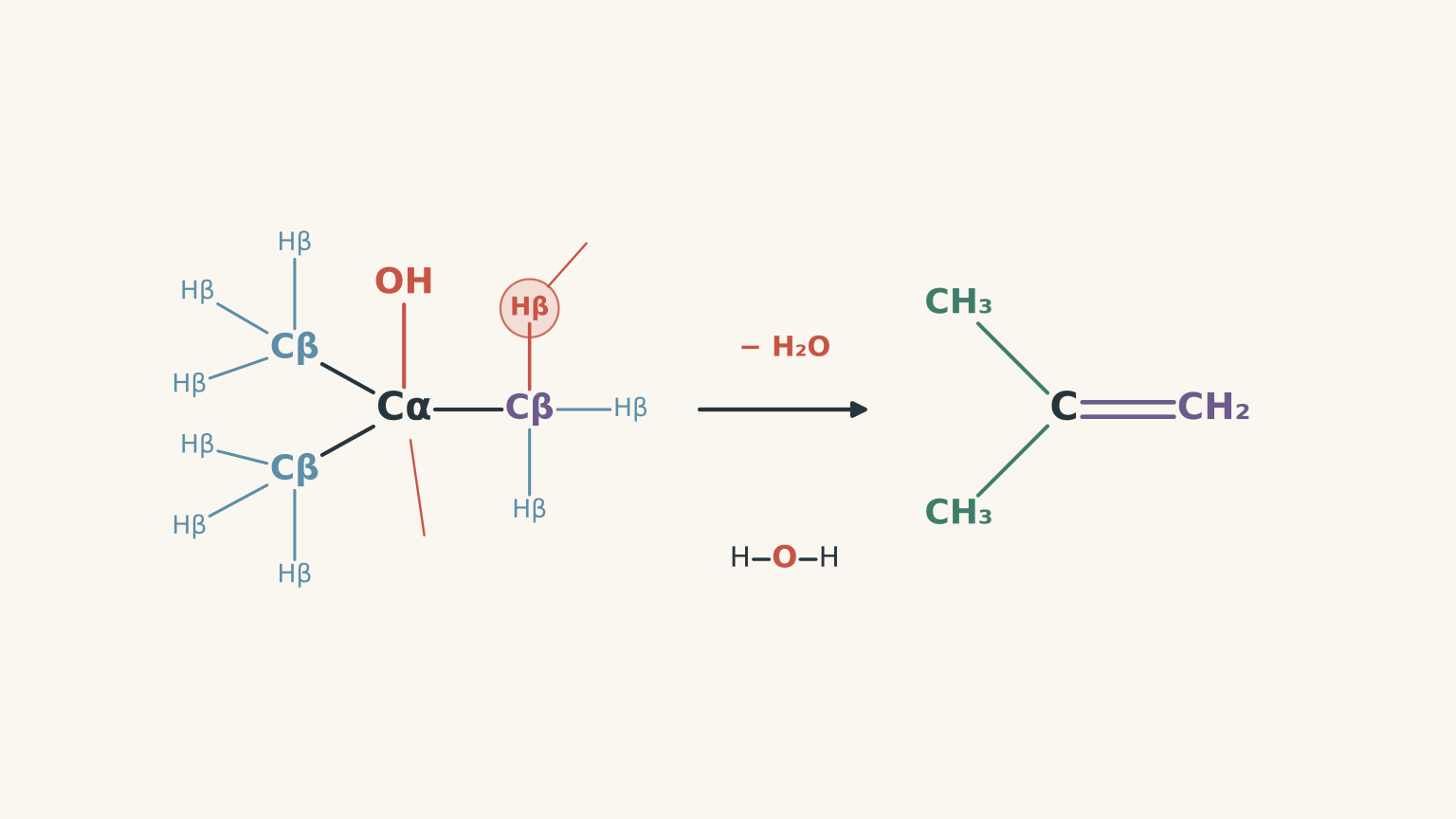
Due to technical limitations, this figure may display incorrectly or contain inaccuracies. Please check key details against your course materials.
The absence of an alpha hydrogen prevents ordinary oxidation, but the presence of beta hydrogens allows elimination.
These are different structural requirements.
Step 4: Evaluate claim 3
Claim 3 is incorrect.
The lack of a dichromate colour change only shows that the expected oxidation has not occurred under the test conditions.
It does not show that the alcohol is chemically unreactive.
The substitution experiment demonstrates this directly.
Concentrated hydrogen bromide replaces the hydroxyl group with bromine:
\[ \ce{(CH3)3COH + HBr -> (CH3)3CBr + H2O} \]
The product is 2-bromo-2-methylpropane.
The dehydration experiment also demonstrates that the alcohol can react under different conditions.
Step 5: Consider the experimental evidence as a whole
The three observations are consistent with the same tertiary alcohol:
| Experiment | Observation | Explanation |
|---|---|---|
| Acidified dichromate | Remains orange | No ordinary oxidation because there is no hydrogen on the C-OH carbon |
| Concentrated HBr | Forms 2-bromo-2-methylpropane | Substitution replaces OH with Br |
| Concentrated sulfuric acid and heat | Forms 2-methylpropene | Elimination removes OH and a neighbouring hydrogen |
The positive control reactions are important. They show that the dichromate solution was capable of oxidising primary and secondary alcohols under the conditions used.
The product evidence then supports the identification of Z as 2-methylpropan-2-ol.
The deeper lesson is that a molecule’s reaction behaviour depends on the particular bonds available to change, not simply on whether it contains a hydroxyl group.
A tertiary alcohol lacks the structural requirement for ordinary oxidation, but it still has the bonds needed for substitution and elimination.
The next time you encounter an alcohol reaction question, identify the bond that must change before predicting the product.
For oxidation, examine the hydrogen on the carbon carrying \(\ce{-OH}\). For substitution, look for replacement of the hydroxyl group by a halogen. For elimination, look for a hydrogen on an adjacent carbon.
That one structural decision will help you distinguish three reaction pathways that can otherwise look deceptively similar.