
How the Hydroxyl Group Affects Alcohol Solubility in Water
Learn why hydroxyl groups help alcohols dissolve in water, how carbon-chain length and branching affect solubility, and how molecular structure influences oxidation, substitution, and elimination. Includes experimental comparisons, worked examples, and challenging HSC Chemistry questions with solutions.
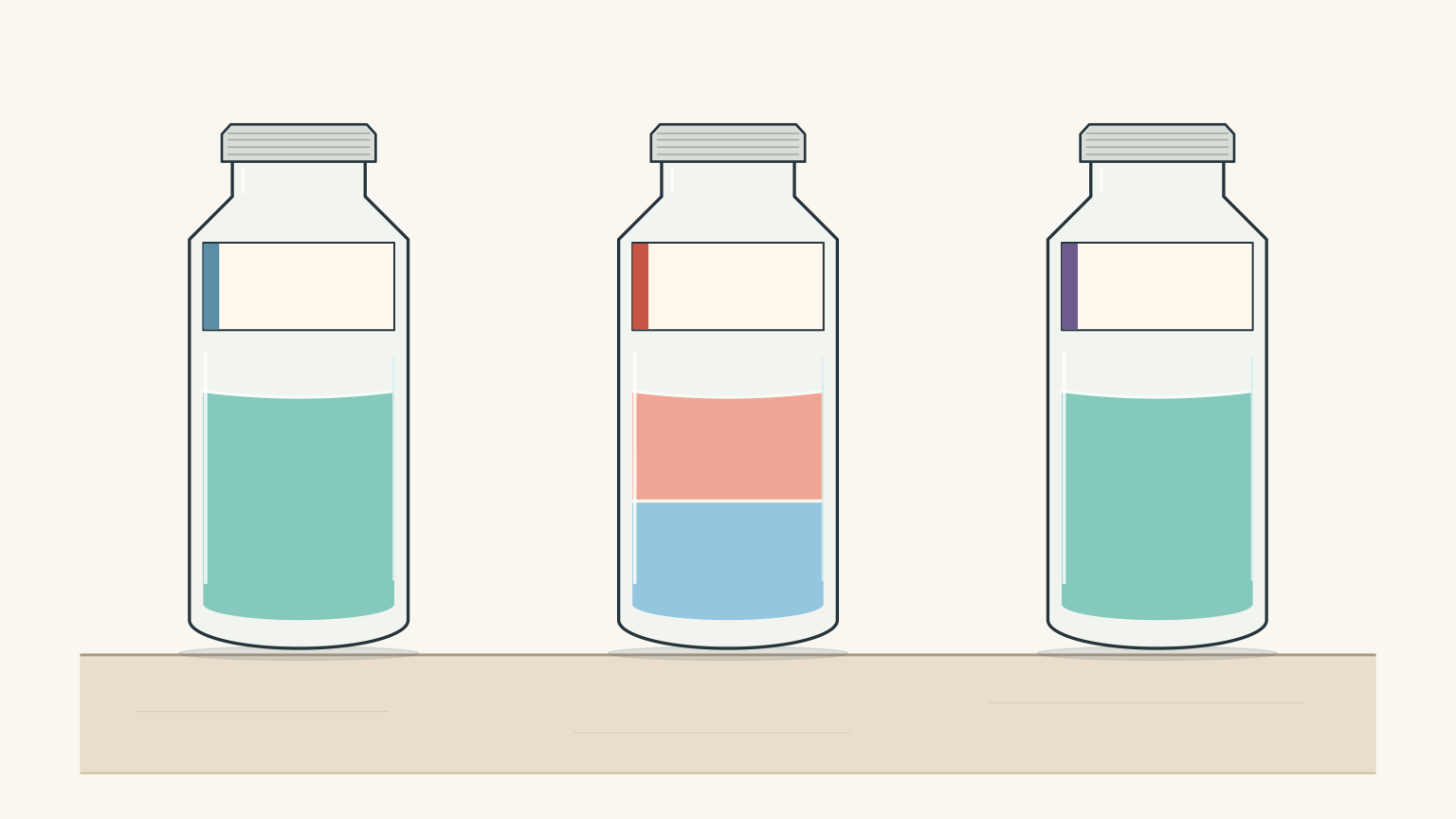
Pour 5 mL of ethanol into 5 mL of water, and the liquids mix into one uniform solution. Repeat the experiment with butan-1-ol, and two liquid layers remain after mixing and settling.
Both alcohols contain the same hydroxyl group, \(\ce{-OH}\). So why does one mix completely with water while the other doesn’t?
The hydroxyl group makes alcohols more water-soluble because it can form hydrogen bonds with water molecules. But every alcohol also contains a non-polar hydrocarbon region. As that region becomes larger, it generally becomes harder for the whole molecule to mix with water.
The important idea is that water solubility depends on the balance between these two parts of the molecule, not simply on whether an \(\ce{-OH}\) group is present.
Due to technical limitations, this figure may display incorrectly or contain inaccuracies. Please check key details against your course materials.
There’s another surprise. Butan-1-ol and 2-methylpropan-2-ol both contain four carbon atoms and one hydroxyl group. Yet 2-methylpropan-2-ol is miscible with water, meaning it can form one liquid phase with water in any proportion.
To explain that result, we need to understand what the hydroxyl group does, how molecular structure changes its effect, and what a careful solubility experiment can actually prove.
01Why the hydroxyl group allows alcohols to mix with water
Water molecules attract other polar molecules
A water molecule contains two hydrogen atoms bonded to an oxygen atom.
Oxygen attracts the shared bonding electrons more strongly than hydrogen does. This makes the oxygen end of each water molecule partially negative, while the hydrogen ends are partially positive.
The symbol \(\delta\) means a partial electrical charge. Water can therefore be represented as:
\[ \ce{H^{\delta+}-O^{\delta-}-H^{\delta+}} \]
The partially positive hydrogen of one water molecule is attracted to a lone pair of electrons on the oxygen of another.
This attraction is called a hydrogen bond.
Hydrogen bonds are intermolecular forces: they act between molecules. They are different from the covalent bonds holding the hydrogen and oxygen atoms together within each water molecule.
The hydroxyl group gives alcohols a way to hydrogen bond
Consider ethanol:
\[ \ce{CH3CH2OH} \]
Its hydroxyl group contains an oxygen-hydrogen bond, just like water does.
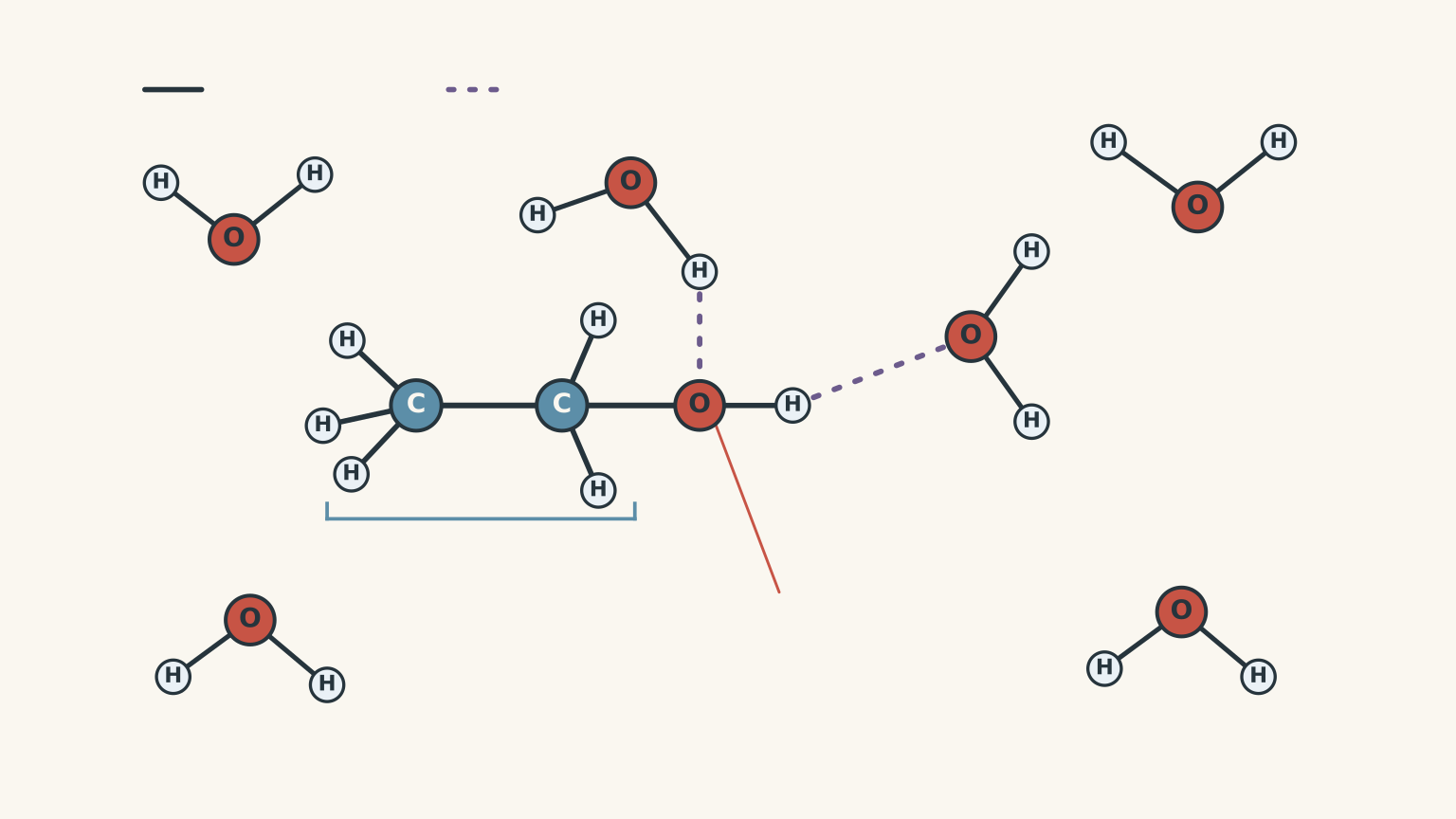
Because the oxygen is electronegative, ethanol can form hydrogen bonds with water in two ways:
- The hydrogen of ethanol’s \(\ce{-OH}\) group can form a hydrogen bond with the oxygen of a water molecule.
- The oxygen of ethanol’s \(\ce{-OH}\) group can accept a hydrogen bond from the hydrogen of a water molecule.
Due to technical limitations, this figure may display incorrectly or contain inaccuracies. Please check key details against your course materials.
Think of the hydroxyl group as a small Velcro patch attached to a strip of smooth plastic.
The patch represents the part of the molecule that can interact strongly with water through hydrogen bonding. The smooth plastic represents the hydrocarbon region, which cannot form the same hydrogen bonds.
Making the plastic strip longer doesn’t add another Velcro patch.
The analogy has a limit. Molecules aren’t physically fastening themselves together. Hydrogen bonds constantly break and reform, and dissolving depends on the overall favourability of mixing, including the rearrangement and disorder of surrounding molecules.
Nevertheless, it gives us a useful first prediction: a small alcohol with one hydroxyl group will generally be more water-compatible than a much larger alcohol with the same single hydroxyl group.
Why the hydrocarbon chain works against solubility
Compare ethanol with hexan-1-ol:
\[ \ce{CH3CH2OH} \]
\[ \ce{CH3(CH2)5OH} \]
Both molecules contain one hydroxyl group.
However, ethanol contains two carbon atoms, while hexan-1-ol contains six.
The carbon-hydrogen and carbon-carbon bonds in the hydrocarbon region are largely non-polar. This region cannot replace water-water hydrogen bonding with equally strong hydrogen bonds of its own.
As the hydrocarbon region grows, the interactions and molecular rearrangements needed to accommodate it in water become less favourable.
Consequently, within a comparable series of alcohols, water solubility generally decreases with increasing carbon-chain length.
This is a trend, not an exact rule that lets you calculate solubility from the number of carbons.
02The solubility experiment: testing the first prediction
Suppose we want to investigate whether increasing the hydrocarbon chain length changes alcohol solubility.
We could begin with three alcohols:
- Ethanol: \(\ce{CH3CH2OH}\)
- Propan-1-ol: \(\ce{CH3CH2CH2OH}\)
- Butan-1-ol: \(\ce{CH3CH2CH2CH2OH}\)
All three are primary alcohols. Their hydroxyl groups occupy the end of a straight carbon chain.
This makes them a useful comparison because the main structural change is the number of carbon atoms.
The apparatus and method
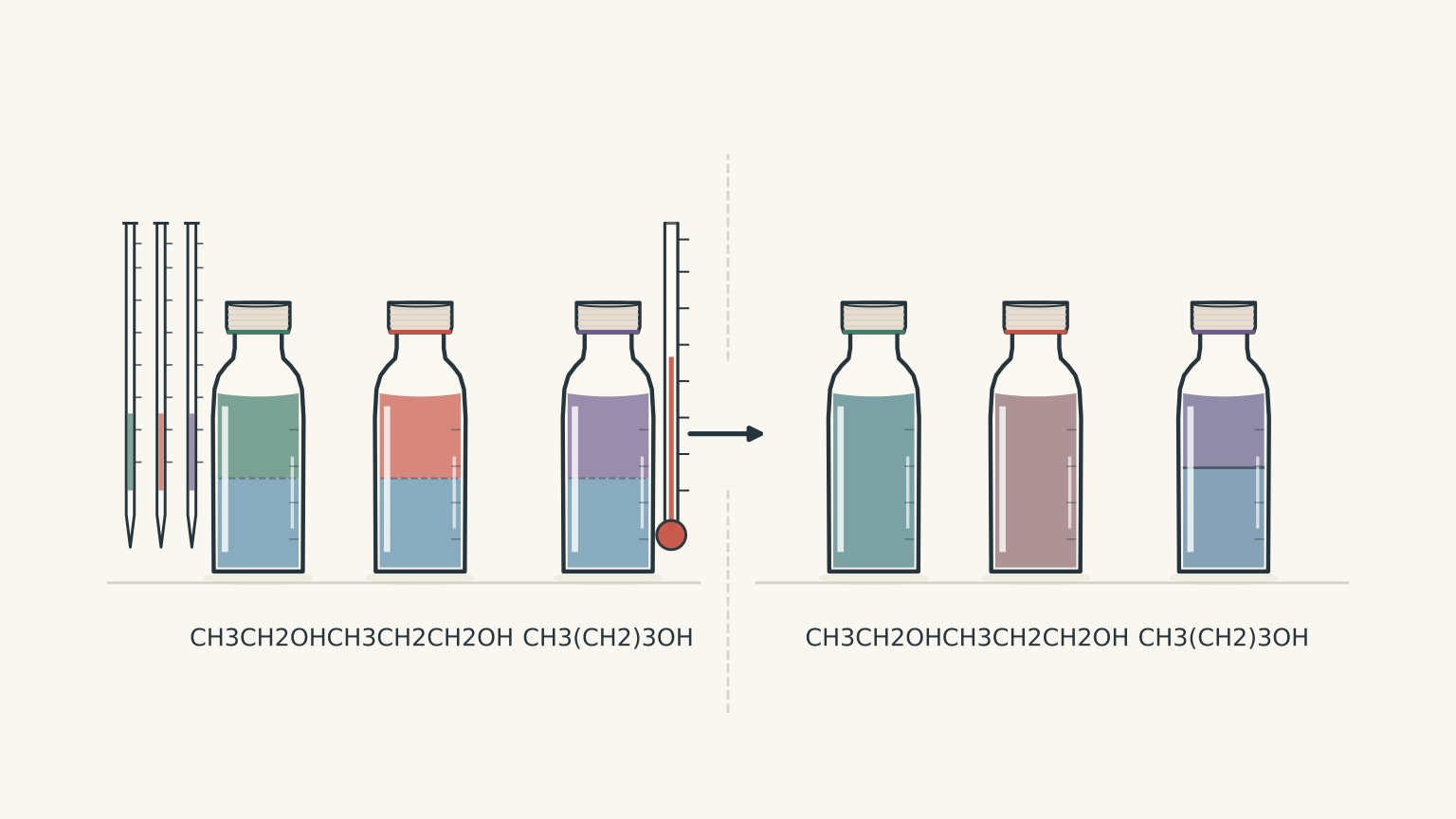
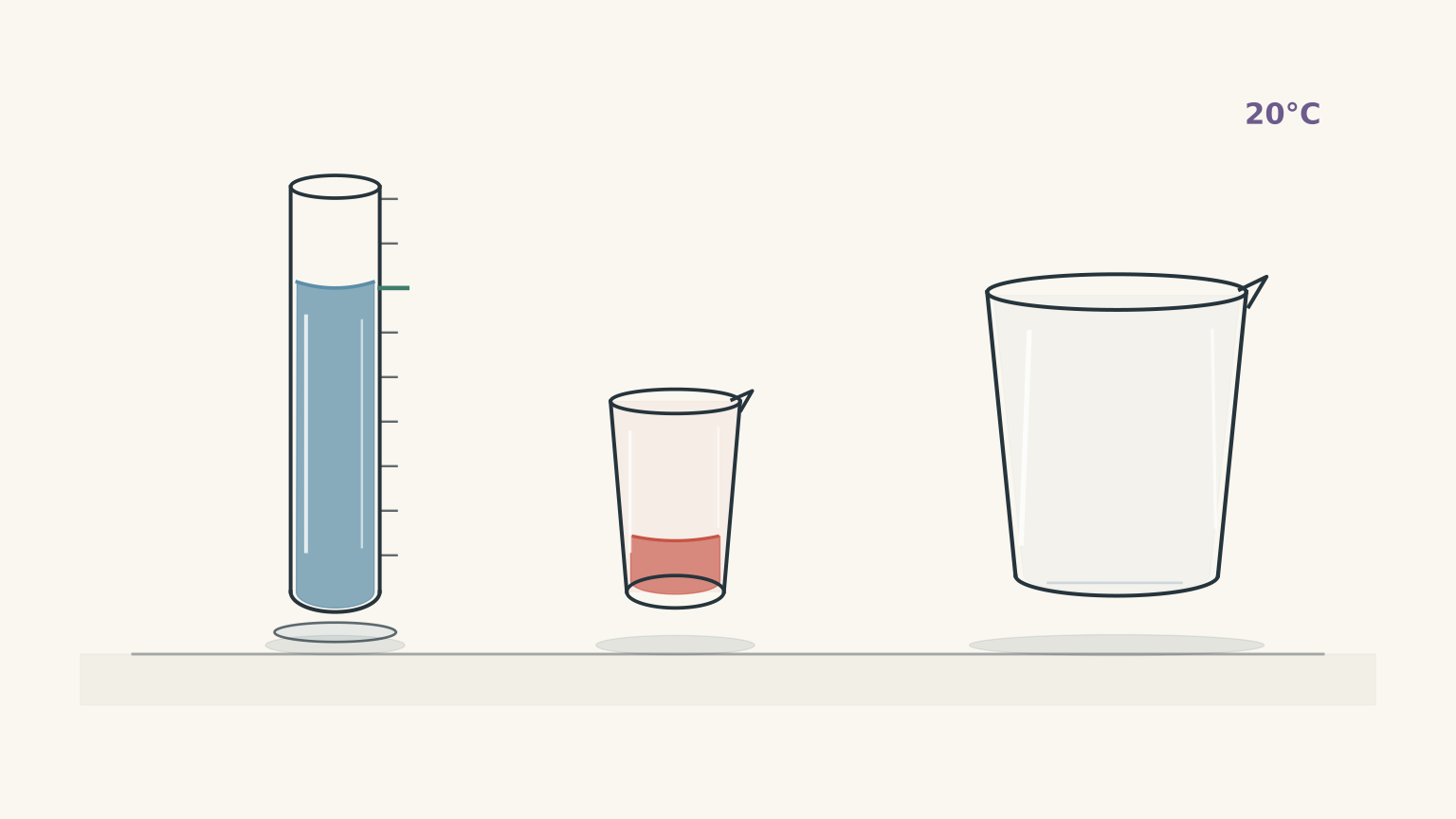
Imagine three identical transparent screw-cap vials arranged beside one another.
Each vial contains 5.0 mL of deionised water.
Using suitable measuring equipment, add 5.0 mL of a different alcohol to each vial. Cap the vials, invert them the same number of times, and leave them undisturbed for the same period.
Keep the temperature constant.
The observation is simple: does each sample form one liquid phase or two after reaching equilibrium?
Due to technical limitations, this figure may display incorrectly or contain inaccuracies. Please check key details against your course materials.
This is an experimental design, not a claim that tutorgum performed these measurements. The expected observations follow established physical-property data.
What should we predict?
If the hydroxyl group were the only factor controlling water solubility, all three alcohols might behave similarly.
But the hydrocarbon region becomes progressively larger.
The expected observations are:
| Alcohol | Carbon atoms | Expected behaviour with water |
|---|---|---|
| Ethanol | 2 | Completely miscible |
| Propan-1-ol | 3 | Completely miscible |
| Butan-1-ol | 4 | Partially miscible; two phases at sufficiently high concentrations |
Ethanol and propan-1-ol mix with water in all proportions.
Butan-1-ol dissolves to a limited extent. Once that limit is exceeded, the mixture separates into a water-rich phase and an alcohol-rich phase.
The upper phase is not pure butan-1-ol. It contains some dissolved water. Likewise, the lower phase contains some dissolved butan-1-ol.
This distinction is useful: two liquid layers don’t mean the substances are completely insoluble in one another.
Why the first experiment isn’t enough
The experiment supports the idea that a longer hydrocarbon chain reduces water solubility.
But it doesn’t tell us everything.
We’ve only compared straight-chain primary alcohols.
What happens if the number of carbon atoms stays constant, but we change the position of the hydroxyl group or the arrangement of the carbon skeleton?
That requires a revised comparison.
03A better comparison: four alcohols with the same molecular formula
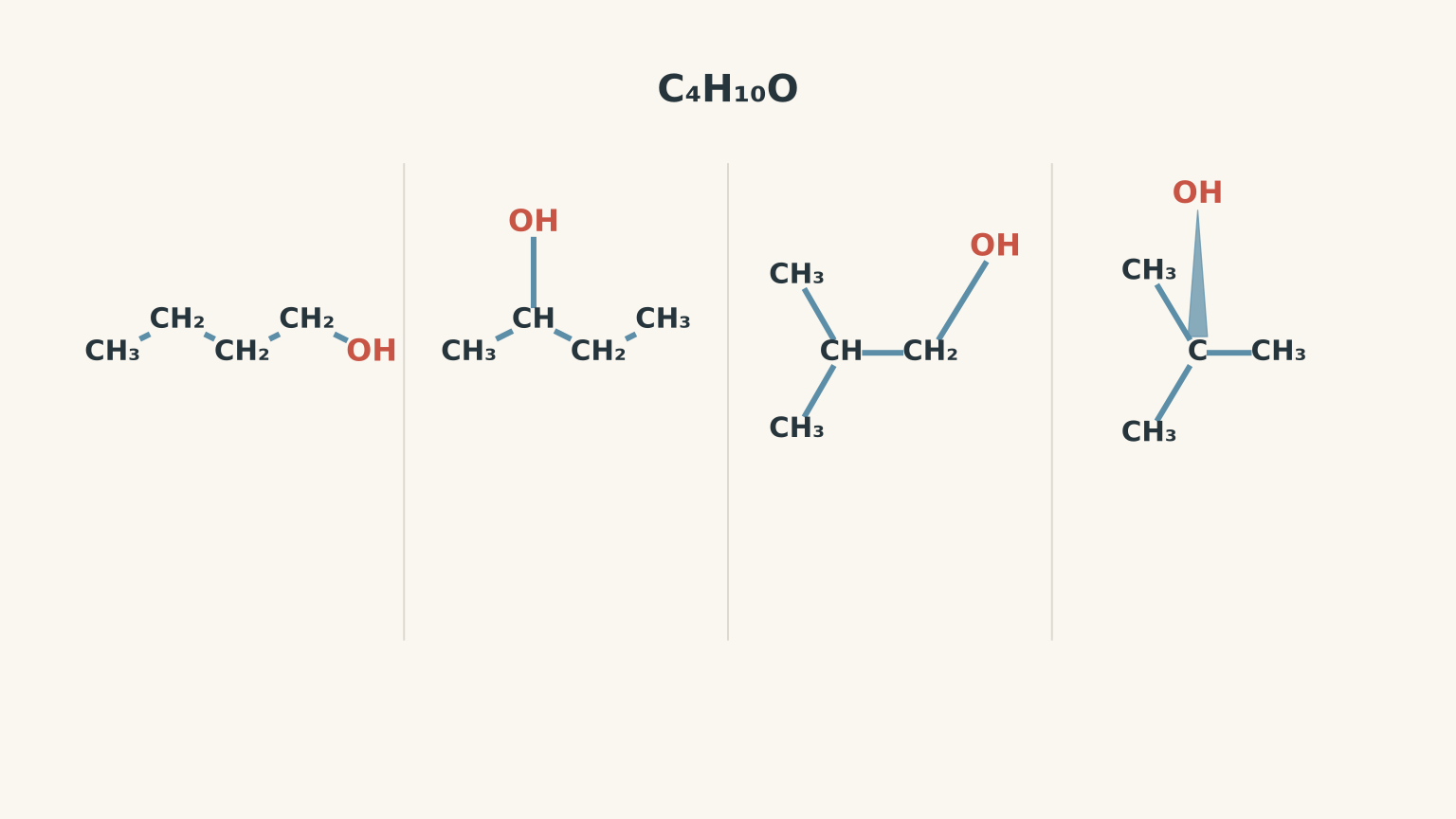
Consider four structural isomers of \(\ce{C4H10O}\).
Structural isomers have the same molecular formula but different arrangements of their atoms.
These four molecules all contain one hydroxyl group, yet their water solubilities differ considerably.
| Alcohol | Condensed structural formula | Classification | Water solubility |
|---|---|---|---|
| Butan-1-ol | \(\ce{CH3CH2CH2CH2OH}\) | Primary | 7.7 g per 100 mL water at 20°C |
| Butan-2-ol | \(\ce{CH3CH(OH)CH2CH3}\) | Secondary | Approximately 21 g per 100 mL water at 25°C |
| 2-Methylpropan-1-ol | \(\ce{(CH3)2CHCH2OH}\) | Primary | 8.7 g per 100 mL water at 20°C |
| 2-Methylpropan-2-ol | \(\ce{(CH3)3COH}\) | Tertiary | Miscible with water |
Published physical-property data: ILO/WHO International Chemical Safety Cards 0111, 0112, 0113, and 0114. The numerical values are reported at the indicated temperatures, so they should not be treated as an exact same-temperature ranking. They are reference data, not measurements from the proposed vial experiment.
Due to technical limitations, this figure may display incorrectly or contain inaccuracies. Please check key details against your course materials.
Notice three important comparisons.
1. Moving the hydroxyl group changes solubility
Butan-1-ol and butan-2-ol have the same straight carbon skeleton.
The main structural difference is the position of the hydroxyl group.
Butan-2-ol is substantially more water-soluble under the reported conditions.
Both molecules still contain one hydroxyl group. One hasn’t magically acquired an extra hydrogen-bonding functional group.
Instead, moving the hydroxyl group changes the molecule’s overall shape and how its polar and non-polar regions interact with surrounding water.
2. Branching can improve solubility
Butan-1-ol and 2-methylpropan-1-ol are both primary alcohols with four carbon atoms.
The second molecule has a branched carbon skeleton.
At 20°C, its reported water solubility is slightly higher: 8.7 g per 100 mL rather than 7.7 g per 100 mL.
Branching can change the non-polar surface presented to water and the way molecules interact.
However, the improvement here is modest. Branching doesn’t automatically make every alcohol completely miscible.
3. Alcohol classification alone doesn’t determine solubility
The tertiary alcohol 2-methylpropan-2-ol is miscible with water.
But this doesn’t mean all tertiary alcohols are water-soluble, or that all primary alcohols are poorly soluble.
Ethanol is primary and completely miscible.
Butan-1-ol is also primary and only partially miscible.
The classification tells us about the carbon bonded to the hydroxyl group. Water solubility depends on the properties of the entire molecule.
A useful experimental revision would compare all four isomers at the same temperature, allowing enough time for each mixture to equilibrate.
Rather than testing just one alcohol-to-water ratio, we would progressively investigate different compositions to determine the limits of single-phase behaviour.
That matters because a solution that looks uniform at one low alcohol concentration may still separate into two phases when more alcohol is added.
04Worked example: How much butan-1-ol can dissolve?
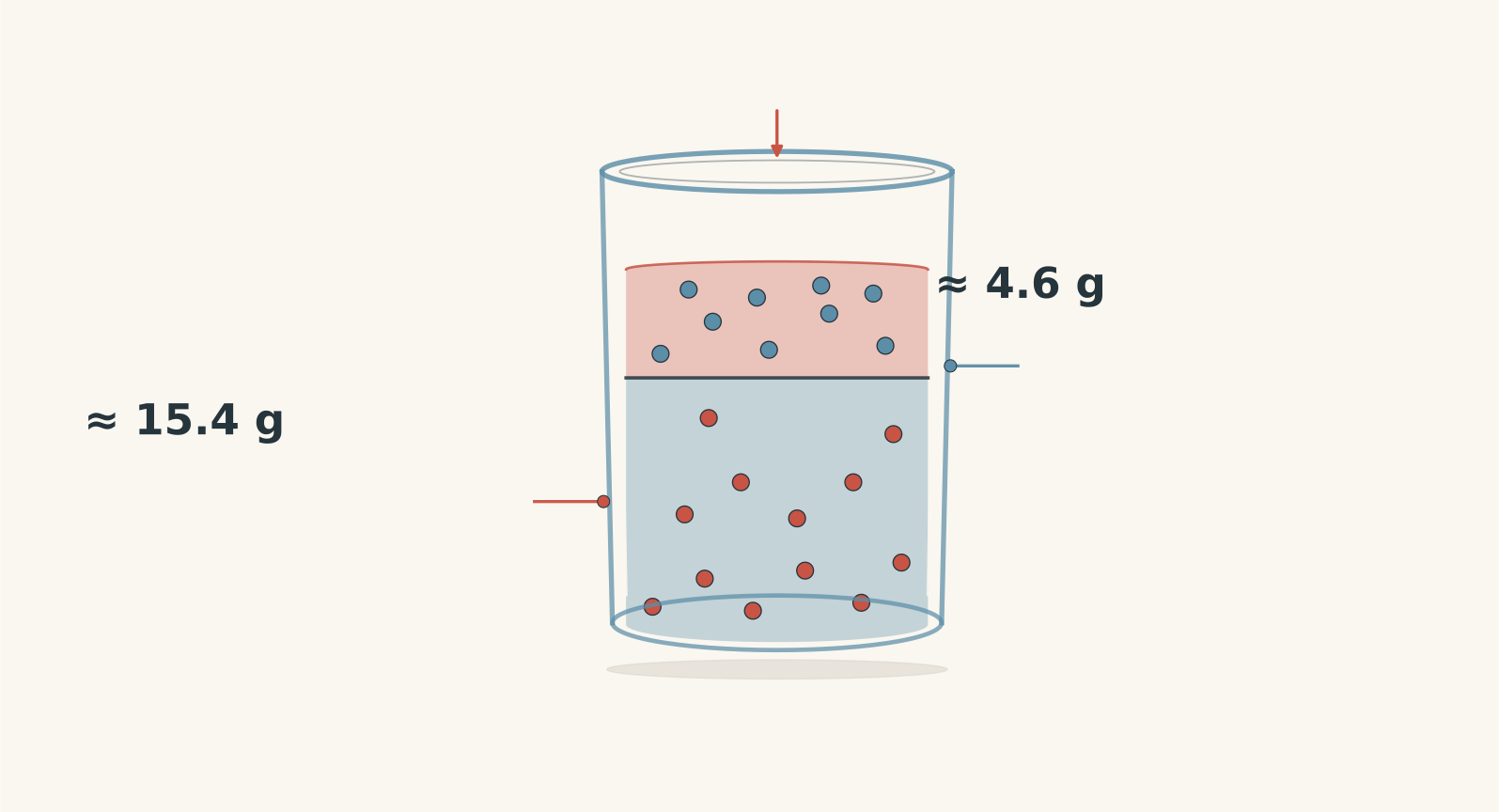
At 20°C, the reported solubility of butan-1-ol is approximately 7.7 g per 100 mL of water.
A student adds 20.0 g of butan-1-ol to 200 mL of water at 20°C.
Assuming the published solubility scales with the volume of water, and neglecting evaporation, volume changes, and the small amount of water entering the alcohol-rich phase, calculate:
(a) The maximum mass of butan-1-ol that can dissolve in the water-rich phase.
(b) The approximate mass of excess butan-1-ol.
(c) The expected appearance after mixing and settling.
Step 1
At 20°C, approximately 7.7 g of butan-1-ol can dissolve in every 100 mL of water.
We have twice that volume of water.
Step 2
Let \(m_d\) represent the maximum mass of dissolved butan-1-ol, measured in grams.
\[ \begin{aligned} m_d &=\frac{7.7\ \mathrm{g}}{100\ \mathrm{mL}} \times 200\ \mathrm{mL}\\ &=15.4\ \mathrm{g} \end{aligned} \]
Therefore, approximately 15.4 g can dissolve.
Step 3
Let \(m_x\) represent the mass of butan-1-ol that cannot remain in the water-rich phase.
\[ \begin{aligned} m_x&=20.0-15.4\\ &=4.6\ \mathrm{g} \end{aligned} \]
Step 4
Approximately 15.4 g of butan-1-ol dissolves in the water-rich phase, while 4.6 g remains outside that phase.
Because butan-1-ol is a liquid at 20°C, the excess doesn’t form a solid precipitate.
Instead, the system separates into two liquid phases.
The upper phase is butan-1-ol-rich, and the lower phase is water-rich.
This calculation uses an approximate solubility model.
Real liquid-liquid equilibrium is more complicated because both liquids dissolve into each other, and the volumes of mixed liquids aren’t necessarily additive.
For an HSC calculation where those complications are explicitly neglected, the proportional method is appropriate.
Due to technical limitations, this figure may display incorrectly or contain inaccuracies. Please check key details against your course materials.
Due to technical limitations, this figure may display incorrectly or contain inaccuracies. Please check key details against your course materials.
05The same hydroxyl group also changes chemical reactions
So far, we’ve considered what happens when an alcohol mixes with water.
That’s a physical process. The molecules remain alcohol molecules.
But the hydroxyl group can also participate in chemical reactions that change the substance into something else.
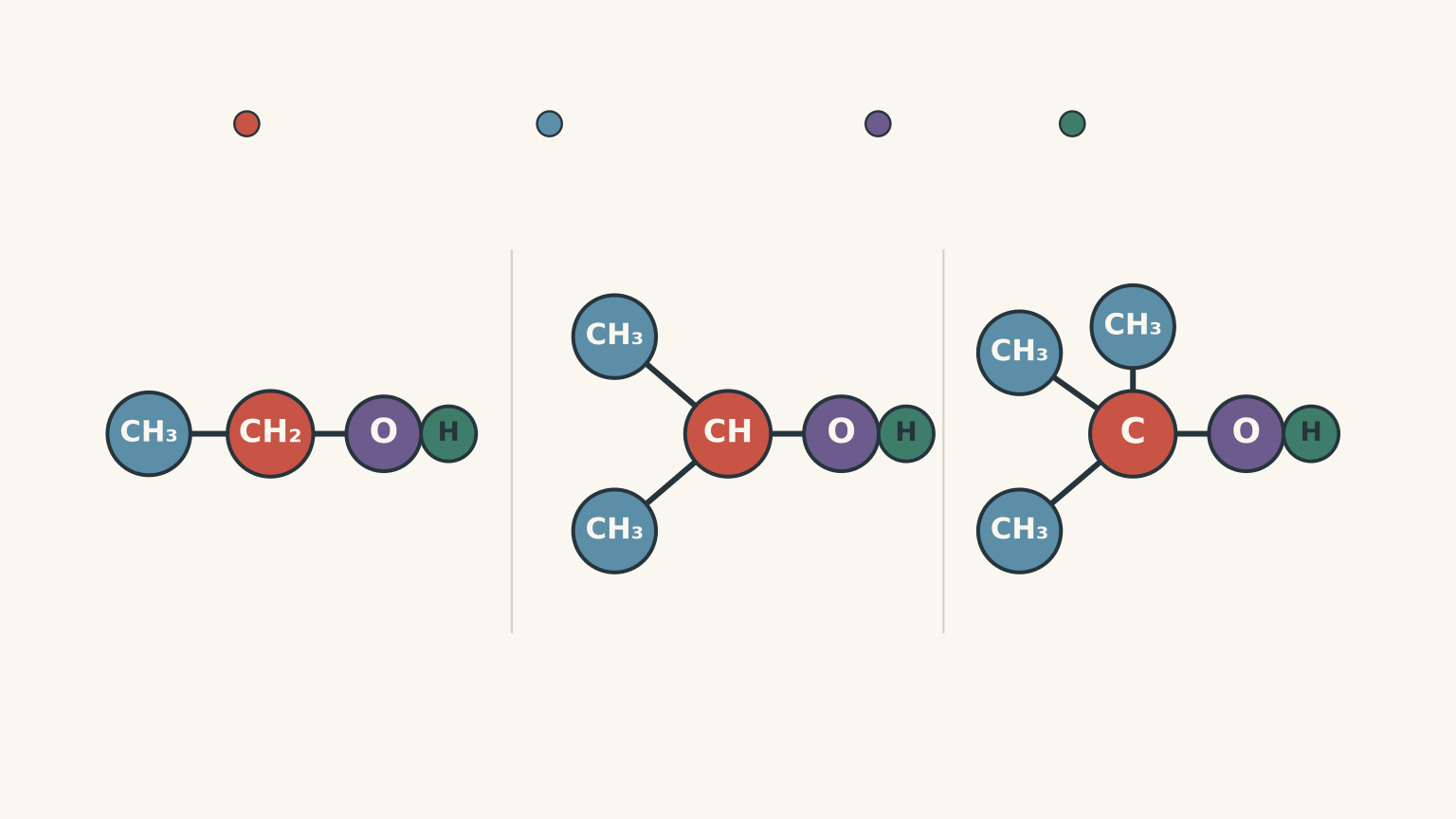
To predict those reactions, we need to distinguish primary, secondary, and tertiary alcohols.
How to classify an alcohol
Find the carbon atom directly bonded to the hydroxyl group.
Then count the other carbon atoms directly attached to that carbon.
| Classification | Carbon neighbours of the \(\ce{C-OH}\) carbon | Example |
|---|---|---|
| Primary | 1 | \(\ce{CH3CH2OH}\) |
| Secondary | 2 | \(\ce{CH3CH(OH)CH3}\) |
| Tertiary | 3 | \(\ce{(CH3)3COH}\) |
Methanol is a special case because its hydroxyl-bearing carbon has no carbon neighbours.
Due to technical limitations, this figure may display incorrectly or contain inaccuracies. Please check key details against your course materials.
The difference matters because oxidation depends on the hydrogen atoms attached to the carbon carrying the hydroxyl group.
Substitution and elimination depend on different features of the structure and reaction conditions.
These reaction families are studied in Module 7 of the NSW Chemistry Stage 6 Syllabus (2017).
Oxidation: changing the hydroxyl-bearing carbon
Under typical HSC oxidation conditions, an alcohol is heated with an oxidising agent such as acidified potassium dichromate(VI), \(\ce{K2Cr2O7}\).
The product depends on the alcohol’s classification.
| Alcohol | Typical oxidation behaviour | Important condition |
|---|---|---|
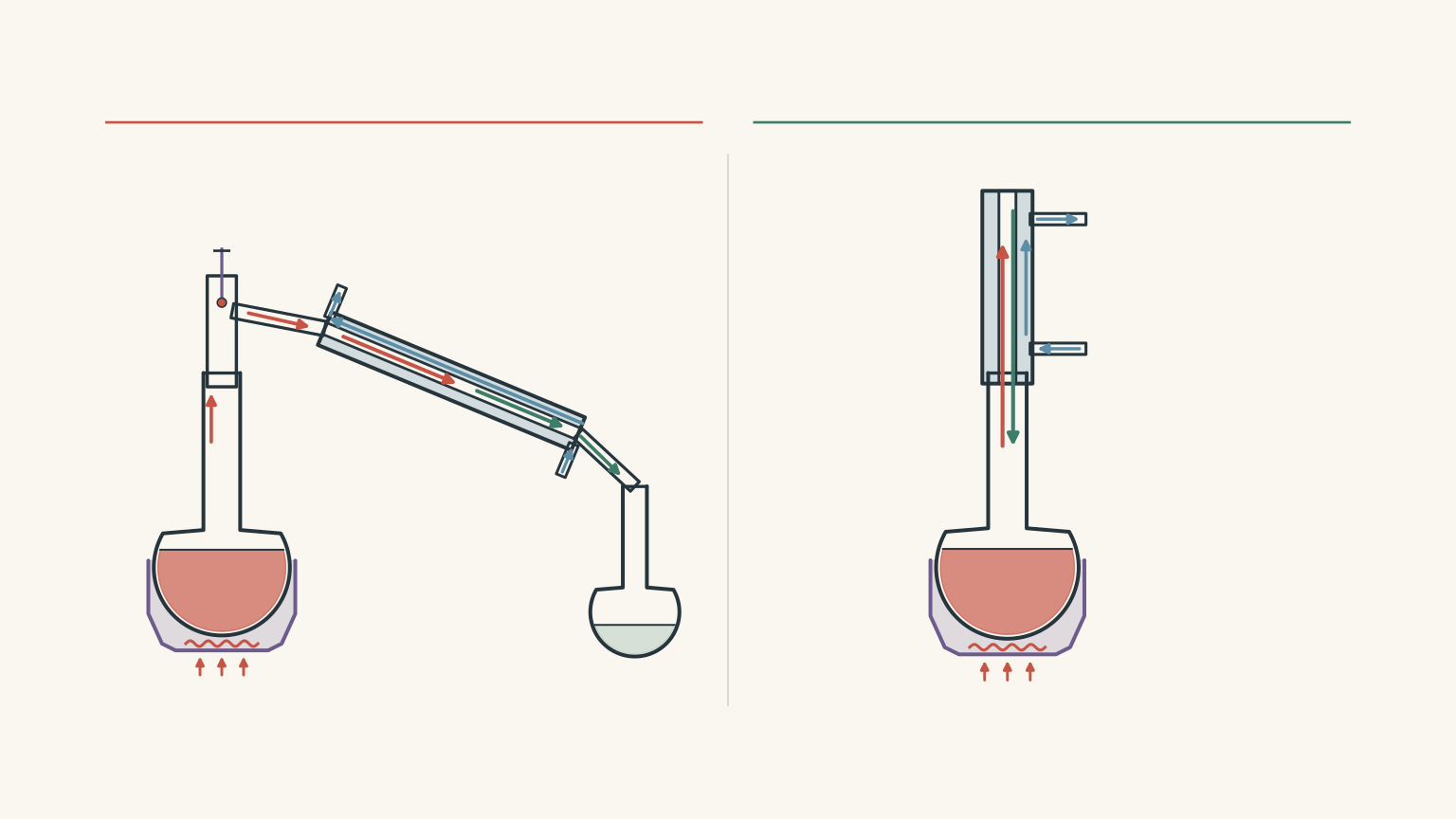
| Primary | Aldehyde, then carboxylic acid | Distil to help collect the aldehyde; heat under reflux with excess oxidant to favour the acid |
| Secondary | Ketone | Heat with acidified oxidant |
| Tertiary | No oxidation under these ordinary conditions | The hydroxyl-bearing carbon has no attached hydrogen |
For example, ethanol is a primary alcohol.
Its initial oxidation produces ethanal:
\[ \ce{CH3CH2OH + [O] -> CH3CHO + H2O} \]
Here, \(\ce{[O]}\) represents oxygen supplied by the oxidising agent. It is a convenient shorthand for the overall oxidation, not a free oxygen atom added directly to the molecule.
With further oxidation:
\[ \ce{CH3CHO + [O] -> CH3COOH} \]
The product is ethanoic acid.
To favour ethanal, a distillation apparatus removes the volatile aldehyde from the oxidising mixture. To favour ethanoic acid, heating under reflux with excess oxidant keeps the intermediate in contact with the reagent.
Due to technical limitations, this figure may display incorrectly or contain inaccuracies. Please check key details against your course materials.
A secondary alcohol follows a different pathway.
Propan-2-ol, for instance, forms propanone:
\[ \ce{CH3CH(OH)CH3 + [O] -> CH3COCH3 + H2O} \]
A tertiary alcohol doesn’t have a hydrogen directly attached to its hydroxyl-bearing carbon.
Under ordinary acidified dichromate conditions, it therefore doesn’t undergo the simple oxidation that produces an aldehyde or ketone.
This is not a claim that tertiary alcohols can never be oxidised under any conditions. Much harsher processes can break carbon-carbon bonds.
Substitution: replacing the hydroxyl group
An alcohol can react with a hydrogen halide such as hydrogen bromide, \(\ce{HBr}\), to form a haloalkane.
For example:
\[ \ce{CH3CH2OH + HBr -> CH3CH2Br + H2O} \]
The organic product is bromoethane.
The hydroxyl group has effectively been replaced by bromine.
Suitable concentrated hydrogen halide conditions are needed. Primary alcohols may require warming, while tertiary alcohols often react more readily. The precise conditions and competing reactions depend on the alcohol and hydrogen halide.
Why doesn’t the hydroxyl group simply leave as \(\mathrm{OH}^{-}\)?
Because hydroxide is a poor leaving group. In acidic conditions, the hydroxyl group can accept a proton, allowing it to leave as water.
This helps explain the difference between two situations:
- In ordinary water, the hydroxyl group helps an alcohol dissolve through intermolecular hydrogen bonding.
- In a suitable acidic substitution reaction, the hydroxyl group participates in a chemical transformation, and the carbon-oxygen bond is broken.
For more on writing these equations, see How to Write Alcohol and Hydrogen Halide Reaction Equations.
Elimination: removing water to form an alkene
An alcohol can also undergo dehydration.
Under suitable conditions, such as heating with concentrated phosphoric acid, the alcohol loses the elements of water and forms an alkene.
For ethanol:
\[ \ce{CH3CH2OH -> CH2=CH2 + H2O} \]
The product is ethene.
The reaction involves removing the hydroxyl group and a hydrogen from an adjacent carbon, allowing a carbon-carbon double bond to form.
For larger alcohols, more than one alkene may be possible. The preferred product depends on the structure and conditions.
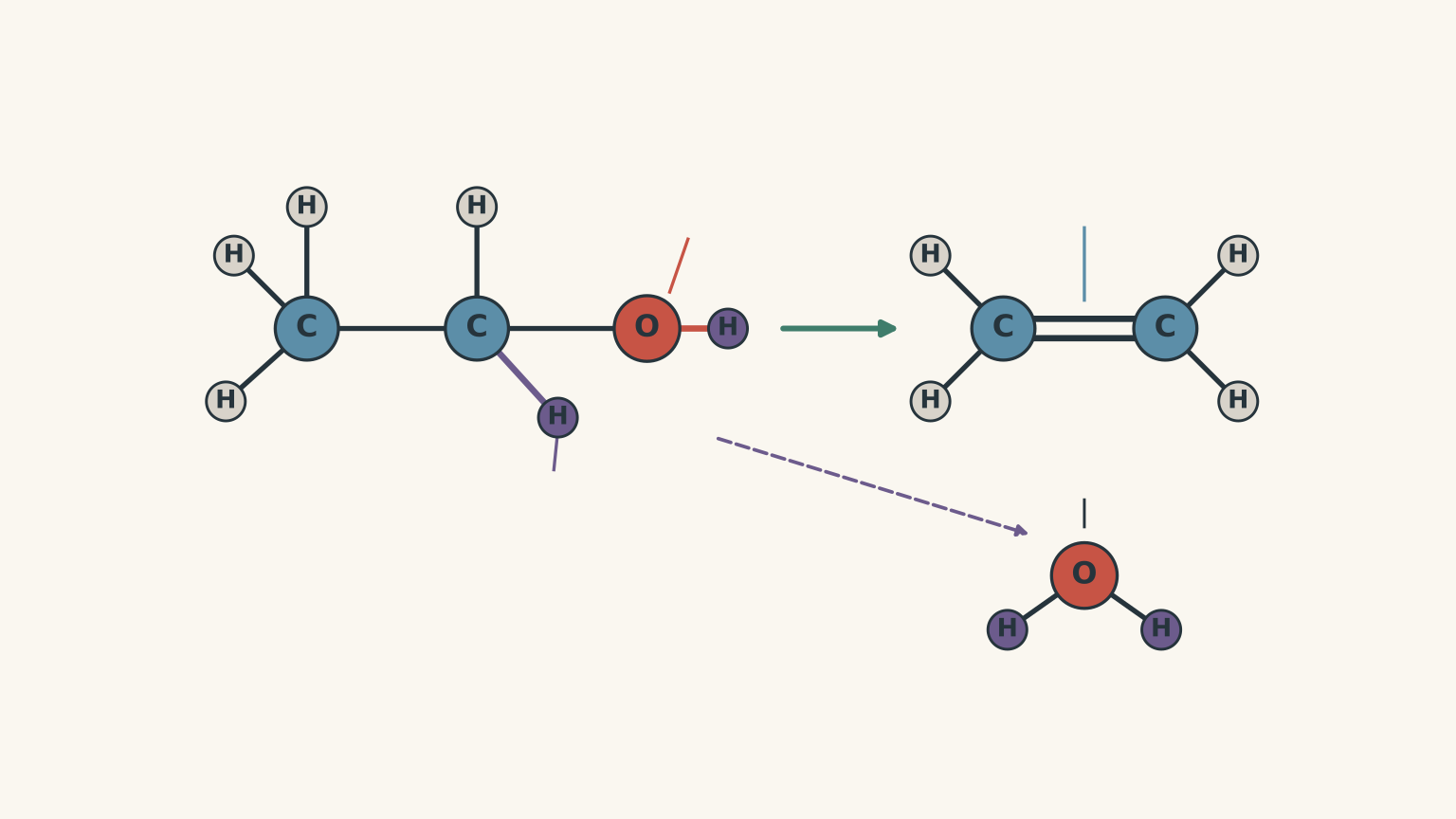
Due to technical limitations, this figure may display incorrectly or contain inaccuracies. Please check key details against your course materials.
Notice the connection to solubility.
The starting alcohol has a hydroxyl group that can form hydrogen bonds with water.
The resulting alkene has no hydroxyl group and is generally much less water-compatible.
The chemical reaction has removed the part of the molecule that made hydrogen bonding with water particularly favourable.
A useful reaction decision
When an HSC question gives you an alcohol and asks for a product, make three decisions.
- Identify the hydroxyl-bearing carbon. This establishes whether the alcohol is primary, secondary, or tertiary.
- Read the reagent and conditions. Acidified oxidant, hydrogen halide, and heated concentrated acid indicate different reactions.
- Check which bonds change. Oxidation changes bonding around the hydroxyl-bearing carbon; substitution replaces the hydroxyl group; elimination removes water and creates a carbon-carbon double bond.
Don’t use water solubility to guess the reaction product.
A highly soluble primary alcohol can still be oxidised, substituted, or dehydrated. The chemical conditions determine which reaction is favoured.
06Worked example: Two alcohols that both dissolve but react differently
A student has two unlabelled samples containing either butan-2-ol or 2-methylpropan-2-ol.
Both have molecular formula \(\ce{C4H10O}\).
At approximately 25°C, the student adds 10.0 g of each alcohol separately to 100 mL of water.
Both form uniform mixtures.
Fresh samples are then heated with excess acidified potassium dichromate(VI) under reflux.
One produces a ketone. The other shows no oxidation under these conditions.
Identify the two alcohols and explain why the initial water-solubility observations were insufficient.
Step 1
Butan-2-ol has a reported water solubility of approximately 21 g per 100 mL at 25°C.
The amount added is only 10.0 g.
Since:
\[ 10.0\ \mathrm{g}<21\ \mathrm{g} \]
the butan-2-ol sample can dissolve completely.
2-Methylpropan-2-ol is miscible with water, so its sample also mixes.
Both observations are consistent with the known properties.
A single clear solution doesn’t prove that an alcohol is miscible in every proportion.
Step 2
Butan-2-ol is:
\[ \ce{CH3CH(OH)CH2CH3} \]
Its hydroxyl-bearing carbon has two carbon neighbours.
It is secondary.
2-Methylpropan-2-ol is:
\[ \ce{(CH3)3COH} \]
Its hydroxyl-bearing carbon has three carbon neighbours.
It is tertiary.
Step 3
Butan-2-ol undergoes oxidation to butan-2-one, a ketone:
\[ \ce{CH3CH(OH)CH2CH3 + [O] -> CH3COCH2CH3 + H2O} \]
The tertiary alcohol does not undergo this ordinary oxidation reaction because its hydroxyl-bearing carbon has no hydrogen attached.
Step 4
The sample producing butan-2-one must be butan-2-ol, assuming the samples are pure and the reaction conditions are effective.
The sample that resists oxidation is consistent with 2-methylpropan-2-ol.
The oxidation result distinguishes their structures. The water-solubility observation alone does not.
This is the important separation between physical and chemical evidence: solubility tells us how substances mix, while oxidation products provide information about their molecular bonding.
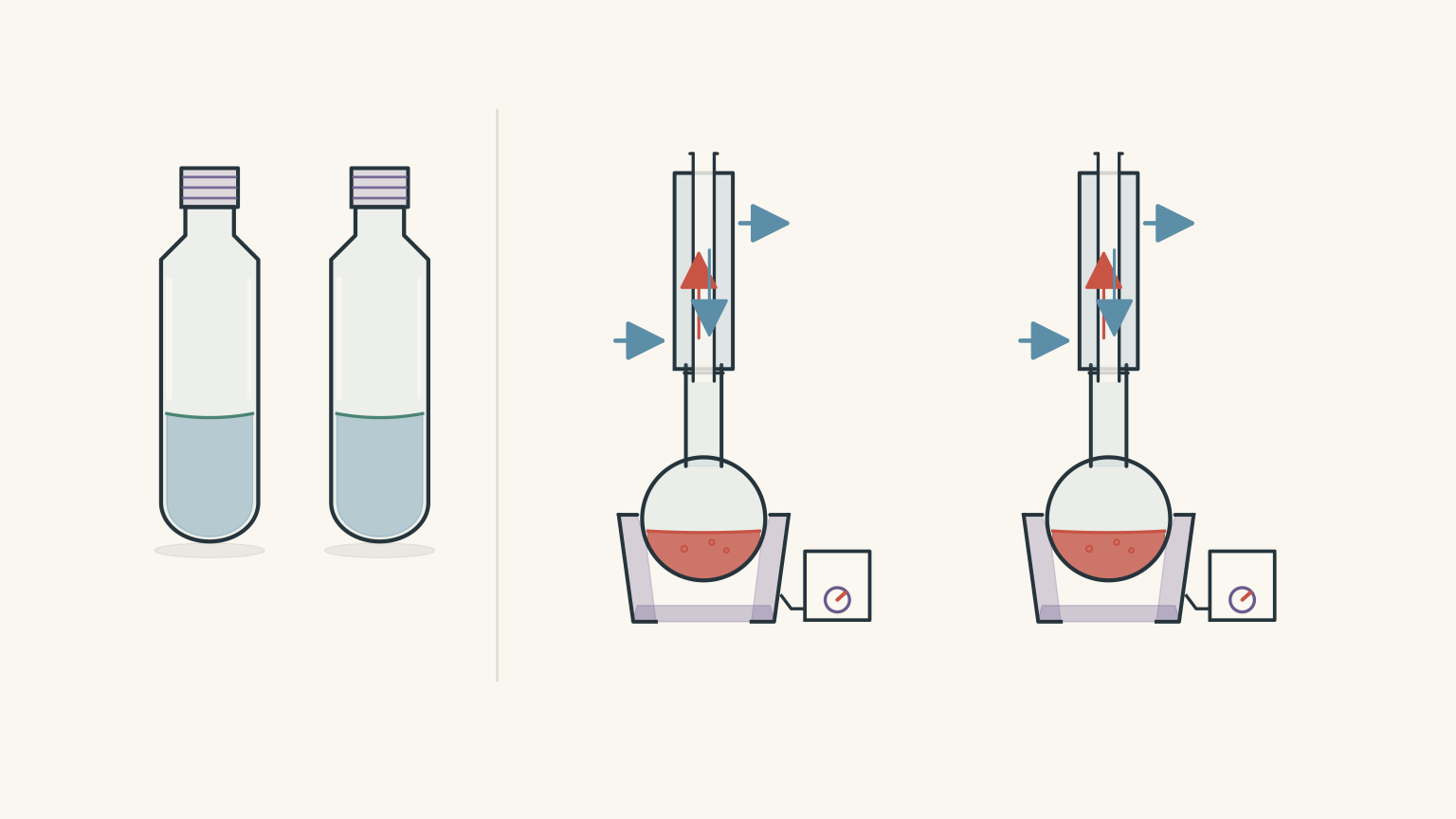
Due to technical limitations, this figure may display incorrectly or contain inaccuracies. Please check key details against your course materials.
07Questions and solutions
Question 1
Ethanol and butan-1-ol both contain one hydroxyl group.
(a) State which alcohol is completely miscible with water at room temperature.
(b) Explain why the other alcohol has more limited water solubility, referring to intermolecular forces and molecular structure.
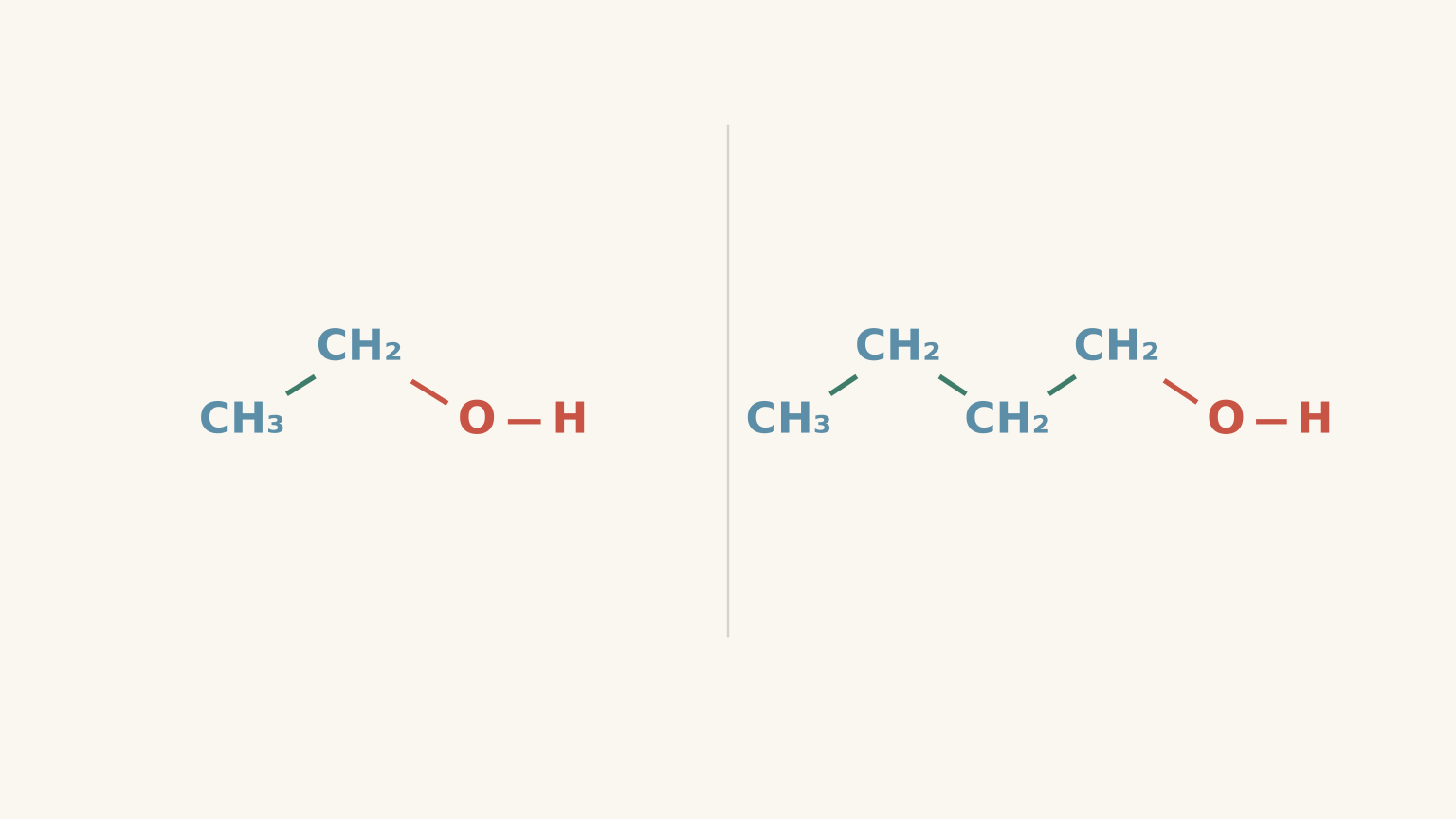
Due to technical limitations, this figure may display incorrectly or contain inaccuracies. Please check key details against your course materials.
Solution 1
Ethanol is completely miscible with water, while butan-1-ol is only partially miscible.
Both alcohols can form hydrogen bonds with water through their hydroxyl groups.
However, butan-1-ol has a larger non-polar hydrocarbon region.
This region cannot form the same strong hydrogen bonds with water as the hydroxyl group can. Its larger size makes the overall mixing process less favourable.
Ethanol has a much smaller hydrocarbon region relative to its hydroxyl group, allowing it to mix with water in all proportions.
The tempting mistake is to assume that every molecule containing \(\ce{-OH}\) must be completely soluble. The whole molecular structure matters.
Question 2
A student compares two primary alcohols at 20°C:
- Butan-1-ol, with a water solubility of 7.7 g per 100 mL.
- 2-Methylpropan-1-ol, with a water solubility of 8.7 g per 100 mL.
The student adds 9.0 g of each alcohol separately to 100 mL of water.
Assume the solubility values apply directly, the water-rich phase retains approximately 100 mL of water, and evaporation and mutual dissolution of water into the alcohol-rich phase can be neglected for the calculation.
(a) Calculate the approximate mass of each alcohol that can remain in the water-rich phase.
(b) Determine the approximate excess mass of each alcohol.
(c) Predict the appearance of both samples after mixing and settling.
(d) The student claims that if both samples form two layers, their solubilities must be identical. Explain why that conclusion is incorrect.
(e) Predict what would happen if the student instead added only 5.0 g of each alcohol to separate 100 mL portions of water. Would this prove the two alcohols have identical solubilities?
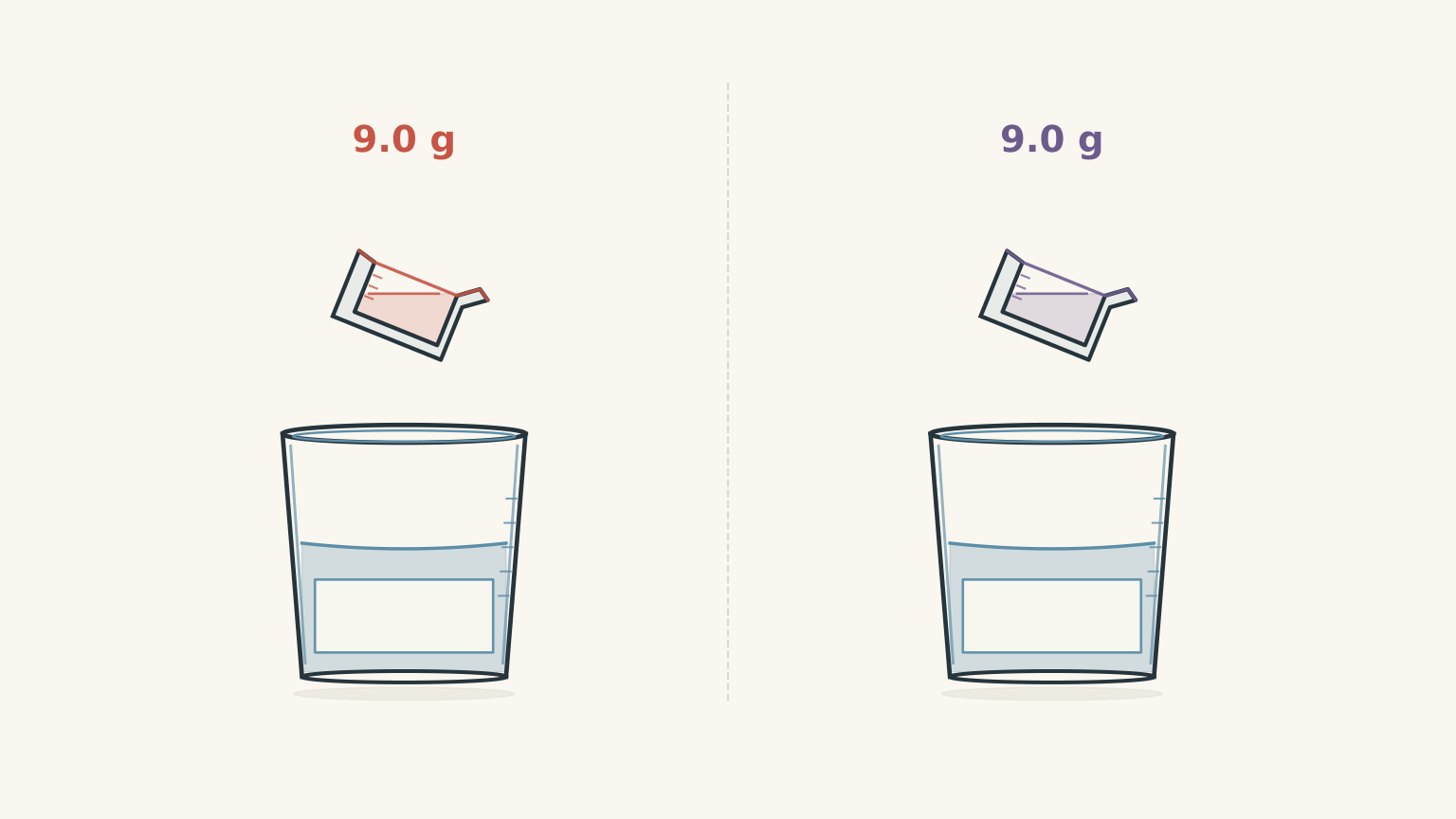
Due to technical limitations, this figure may display incorrectly or contain inaccuracies. Please check key details against your course materials.
Solution 2
Both 9.0 g samples will form two liquid phases, but butan-1-ol will have a greater excess mass outside the water-rich phase.
(a) Mass dissolved
The reported solubilities give the approximate maximum dissolved masses directly for 100 mL of water.
For butan-1-ol:
\[ m_d=7.7\ \mathrm{g} \]
For 2-methylpropan-1-ol:
\[ m_d=8.7\ \mathrm{g} \]
Here, \(m_d\) is the maximum mass dissolved in the water-rich phase.
(b) Excess mass
Let \(m_x\) be the excess mass of alcohol in grams.
For butan-1-ol:
\[ \begin{aligned} m_x&=9.0-7.7\\ &=1.3\ \mathrm{g} \end{aligned} \]
For 2-methylpropan-1-ol:
\[ \begin{aligned} m_x&=9.0-8.7\\ &=0.3\ \mathrm{g} \end{aligned} \]
Approximately 1.3 g and 0.3 g, respectively, cannot remain in the water-rich phases under the stated assumptions.
(c) Appearance
Both samples should separate into two liquid phases after reaching equilibrium.
The water-rich phases are saturated with the respective alcohols, and the excess alcohol contributes to an alcohol-rich upper phase.
The calculated excess masses are approximations, not exact masses of the upper layers, because real upper layers also contain some dissolved water.
(d) Why the student’s conclusion fails
Observing two layers only shows that each sample exceeds its solubility limit under the tested conditions.
It does not tell us that the limits are identical.
The calculated excess masses are different, reflecting the different solubilities.
Both alcohols are primary, but 2-methylpropan-1-ol has a branched carbon skeleton. This structural difference contributes to its slightly greater water solubility.
(e) Adding only 5.0 g
Both samples should form a single liquid phase because 5.0 g is below both reported solubility limits.
However, that observation doesn’t prove their solubilities are equal.
It establishes only that both can dissolve at least 5.0 g in 100 mL of water at 20°C.
The trap is confusing “dissolves completely at this concentration” with “has the same maximum solubility”.
Question 3
A student finds the following published data:
| Alcohol | Reported water solubility |
|---|---|
| Butan-1-ol | 7.7 g per 100 mL at 20°C |
| Butan-2-ol | Approximately 21 g per 100 mL at 25°C |
The student makes this claim:
“Secondary alcohols form more hydrogen bonds with water than primary alcohols because they have two carbon groups attached to the hydroxyl-bearing carbon. Therefore, butan-2-ol is exactly 2.7 times as soluble as butan-1-ol at any temperature.”
(a) Identify two problems with the student’s reasoning.
(b) Design a fair experiment to compare the solubilities of these two alcohols. State what must be controlled and what must be measured.
(c) Predict the organic products when separate samples of each alcohol are heated under reflux with excess acidified potassium dichromate(VI). Write the organic oxidation equations.
(d) Explain why the oxidation observations cannot, by themselves, explain the difference in water solubility.
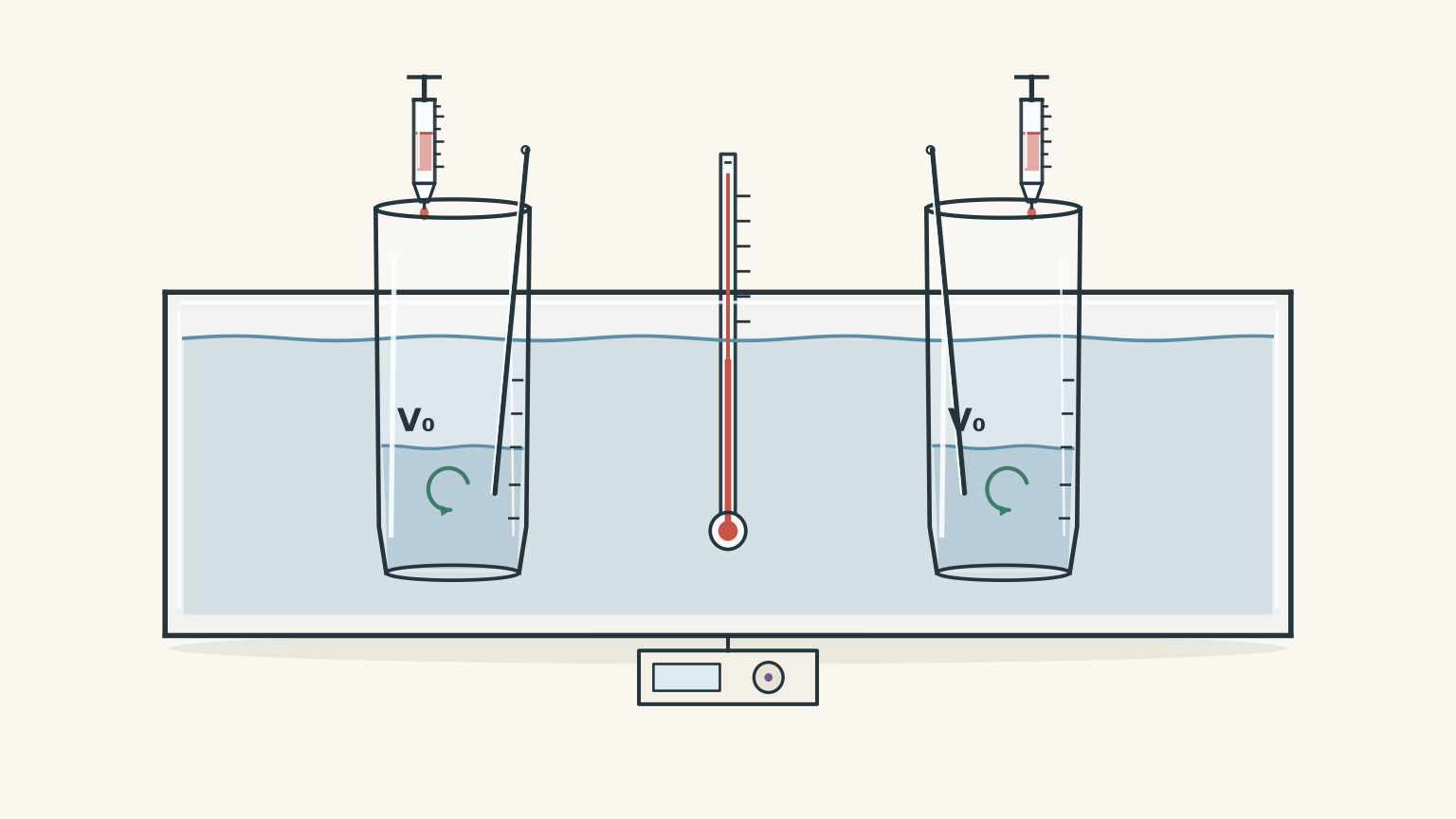
Due to technical limitations, this figure may display incorrectly or contain inaccuracies. Please check key details against your course materials.
Solution 3
The student has incorrectly linked alcohol classification to the number of hydroxyl groups and has treated measurements at different temperatures as an exact universal solubility ratio.
(a) Problems with the reasoning
Both butan-1-ol and butan-2-ol contain exactly one hydroxyl group.
The secondary alcohol has two carbon atoms directly attached to the hydroxyl-bearing carbon, but it does not contain an additional \(\ce{-OH}\) group.
Both can donate and accept hydrogen bonds with water through their hydroxyl groups.
Their different solubilities arise from changes in molecular structure and how their polar and non-polar regions interact with water, not from simply counting carbon neighbours as hydrogen-bonding sites.
The reported measurements also come from different temperatures.
Even though the numbers suggest that butan-2-ol is substantially more soluble near room temperature, dividing them does not establish an exact ratio at one common temperature, let alone at every temperature.
(b) Improved experiment
Use separate identical vessels containing equal volumes of water.
Maintain both mixtures at the same controlled temperature, such as 25°C.
Add carefully measured masses of each alcohol to separate water samples, mix consistently, allow equilibrium to be reached, and record whether one or two phases remain.
Repeat using different alcohol masses.
The independent variable is the identity of the alcohol.
The dependent variable is the maximum mass dissolving in a fixed volume of water at the chosen temperature.
Important controls include temperature, water volume, alcohol purity, mixing procedure, and time allowed to reach equilibrium.
The first appearance of a persistent second phase helps locate the solubility limit. Using several concentrations is more informative than testing a single mixture.
(c) Oxidation products
Butan-1-ol is primary.
With excess acidified potassium dichromate(VI) under reflux, its main organic product is butanoic acid:
\[ \ce{CH3CH2CH2CH2OH + 2[O] -> CH3CH2CH2COOH + H2O} \]
Butan-2-ol is secondary.
Its oxidation produces butan-2-one:
\[ \ce{CH3CH(OH)CH2CH3 + [O] -> CH3COCH2CH3 + H2O} \]
The primary alcohol can undergo oxidation through an aldehyde intermediate to a carboxylic acid.
The secondary alcohol forms a ketone under these conditions.
(d) What the oxidation results establish
The oxidation results show different bonding environments around the hydroxyl-bearing carbons.
They do not directly measure the intermolecular interactions involved in dissolving the original alcohols.
The student might conclude that butan-2-ol dissolves better because it forms a ketone on oxidation.
That reverses the logic.
Oxidation behaviour and water solubility are different consequences of molecular structure. One doesn’t cause the other.
Question 4
Hexan-1-ol has the structure:
\[ \ce{CH3(CH2)5OH} \]
It is only slightly soluble in water.
A student observes that a substantial quantity of hexan-1-ol forms a separate organic layer when mixed with water.
A fresh sample of pure hexan-1-ol is then completely oxidised using excess acidified potassium dichromate(VI) under reflux.
The organic oxidation product is isolated from the acidic oxidising mixture.
The student shakes this isolated product with excess aqueous sodium hydrogencarbonate, \(\ce{NaHCO3}\). Most of the organic material enters the aqueous phase.
When the aqueous solution is subsequently acidified to pH 2 using dilute hydrochloric acid, an organic layer reappears.
Assume the oxidation goes to completion, the sodium salt is sufficiently soluble under the conditions used, and enough organic acid is present to exceed its solubility after acidification.
(a) Name the oxidation product and write the overall organic oxidation equation.
(b) Explain why adding sodium hydrogencarbonate causes the organic material to enter the aqueous phase. Write the reaction equation.
(c) Explain why acidifying the aqueous phase causes an organic layer to reappear.
(d) A student claims that these observations prove the original hydroxyl group “became stronger” after oxidation. Explain what actually changed.
(e) Predict how the result would differ if the initial oxidation had been controlled to collect the aldehyde by distillation instead.
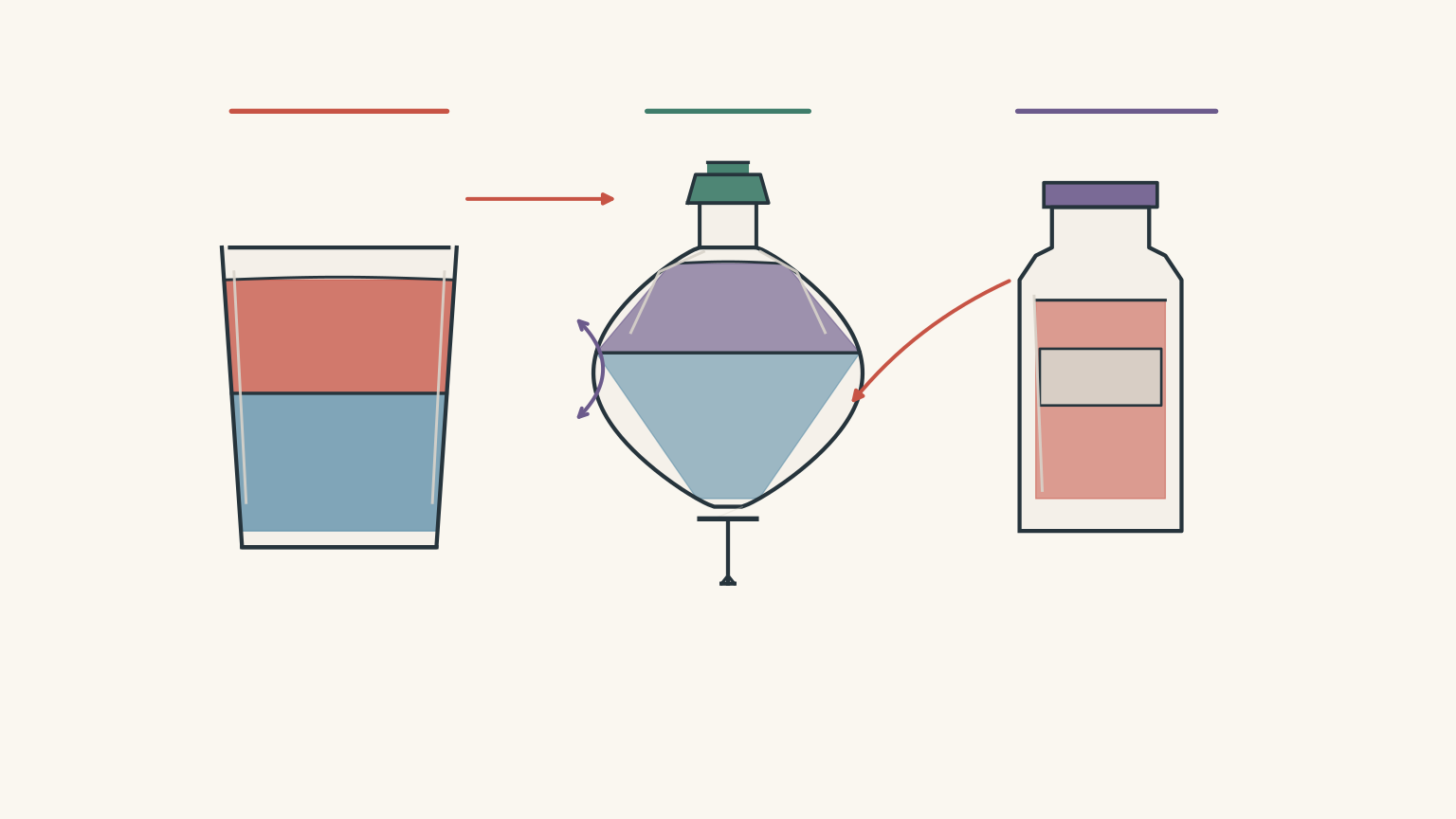
Due to technical limitations, this figure may display incorrectly or contain inaccuracies. Please check key details against your course materials.
Solution 4
The oxidation produces hexanoic acid, which reacts with sodium hydrogencarbonate to form water-compatible sodium hexanoate. Acidification converts the salt back into the less water-soluble neutral acid.
The key change is not stronger hydrogen bonding by the original alcohol group. It is a sequence of chemical reactions that changes the functional group and then the electrical charge of the dissolved species.
(a) Oxidation product
Hexan-1-ol is a primary alcohol because its hydroxyl-bearing carbon is bonded to only one other carbon.
Complete oxidation under reflux with excess acidified dichromate produces hexanoic acid:
\[ \ce{CH3(CH2)5OH + 2[O] -> CH3(CH2)4COOH + H2O} \]
The carbon skeleton still contains six carbon atoms.
The terminal alcohol group has been converted into a carboxylic acid group.
(b) Reaction with sodium hydrogencarbonate
Hexanoic acid reacts with sodium hydrogencarbonate:
\[ \ce{CH3(CH2)4COOH + NaHCO3 -> CH3(CH2)4COONa + CO2 + H2O} \]
The products are sodium hexanoate, carbon dioxide, and water.
The sodium hexanoate dissociates in water to form sodium ions and hexanoate ions.
The negatively charged carboxylate group interacts strongly with water through ion-dipole attractions.
These interactions make the salt much more water-compatible than the neutral hexanoic acid.
Carbon dioxide production would also cause effervescence.
(c) Acidification
Adding hydrochloric acid protonates the hexanoate ion, regenerating hexanoic acid.
The overall reaction can be represented as:
\[ \ce{CH3(CH2)4COONa + HCl -> CH3(CH2)4COOH + NaCl} \]
At pH 2, hexanoic acid is predominantly in its neutral molecular form.
Under the stated conditions, the amount of neutral hexanoic acid exceeds what the water can dissolve, so a separate organic phase forms.
The system hasn’t returned to hexan-1-ol.
It now contains hexanoic acid, which is a different substance.
(d) Why the hydroxyl-group explanation is wrong
The original alcohol contained a hydroxyl group attached to a saturated carbon.
Oxidation converted that functional group into a carboxylic acid.
Reaction with sodium hydrogencarbonate then produced a charged carboxylate species.
The substantial change in water compatibility comes largely from forming an ion, not simply from improving the original alcohol’s hydrogen bonding.
This is why treating every group containing an oxygen-hydrogen bond as equivalent leads to incorrect predictions.
(e) If the aldehyde were collected instead
Careful oxidation with prompt distillation could favour hexanal:
\[ \ce{CH3(CH2)5OH + [O] -> CH3(CH2)4CHO + H2O} \]
Hexanal is an aldehyde, not a carboxylic acid.
A clean hexanal sample would not react with sodium hydrogencarbonate to produce a carboxylate salt or release carbon dioxide.
It would therefore not undergo the same acid-base-driven transfer into the aqueous phase.
The deeper point is that solubility can change dramatically after a chemical reaction, particularly when a neutral molecule is converted into an ionic species.
Question 5
Two different alcohols, A and B, have molecular formula \(\ce{C4H10O}\).
Each is one of the following structural isomers:
- Butan-1-ol
- Butan-2-ol
- 2-Methylpropan-1-ol
- 2-Methylpropan-2-ol
Several experiments are used to identify them.
Experiment 1: Water solubility
At 20°C, 3.0 g of A is added to 100 mL of water, and 3.0 g of B is added to a separate 100 mL portion.
Both form uniform solutions after mixing and equilibration.
The published water solubility of 2-methylpropan-1-ol at 20°C is 8.7 g per 100 mL. The other relevant solubility values are given in the earlier table.
Experiment 2: Oxidation
Fresh samples are heated with excess acidified potassium dichromate(VI) under reflux.
A produces a carboxylic acid without changing its carbon skeleton.
B undergoes no detectable oxidation under these conditions.
The oxidising reagent is confirmed to be active using a suitable control sample.
Experiment 3: Dehydration
Separate fresh samples of A and B are heated with concentrated phosphoric acid under conditions that favour dehydration.
Both produce the same alkene, X.
Analysis identifies X as 2-methylpropene:
\[ \ce{(CH3)2C=CH2} \]
Assume no carbon-skeleton rearrangements or competing side reactions in this experiment.
Experiment 4: Hydration
Alkene X is reacted with water using an acid catalyst.
Assume the major product follows the usual addition rule: the hydroxyl group becomes attached to the more substituted carbon of the original double bond.
A student argues:
“Because A and B form the same alkene, they must originally have had the same structure. Hydrating X should regenerate whichever alcohol was used to produce it.”
(a) Identify A and B, giving their names, condensed structural formulae, and classifications.
(b) Explain why Experiment 1 could not distinguish the alcohols.
(c) Write the dehydration equations for A and B and explain why they produce the same alkene.
(d) Identify the major alcohol formed when X is hydrated. Explain why the student’s claim about regenerating the starting alcohol is incorrect.
(e) Predict the products obtained when separate fresh samples of A and B undergo substitution with concentrated hydrogen bromide under conditions favouring substitution. Explain whether these products are identical.
(f) Suggest one additional water-solubility comparison, without chemical reaction tests, that could distinguish A from B. Justify your prediction using the supplied data.
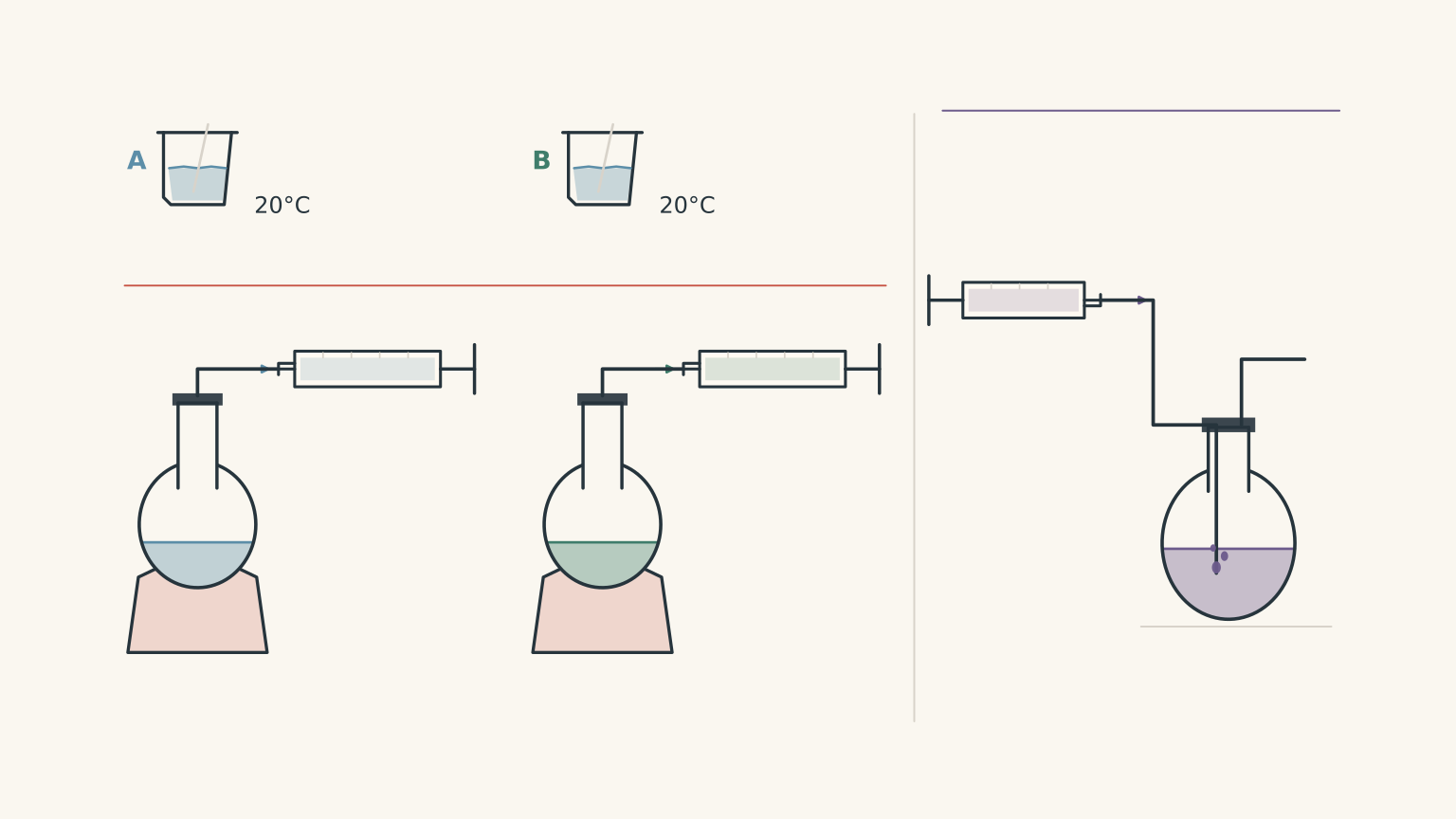
Due to technical limitations, this figure may display incorrectly or contain inaccuracies. Please check key details against your course materials.
Solution 5
A is 2-methylpropan-1-ol, a primary alcohol. B is 2-methylpropan-2-ol, a tertiary alcohol. Both can dehydrate to 2-methylpropene, but acid-catalysed hydration of that alkene favours B, not A.
This means a dehydration-hydration sequence can change one structural isomer into another. The student’s assumption that reversing the reaction type must restore the original alcohol is incorrect.
(a) Identifying A and B
Experiment 2 gives the decisive chemical evidence.
A produces a carboxylic acid on oxidation under reflux.
That indicates a primary alcohol.
B resists oxidation under the stated conditions.
Combined with the verified oxidant activity and the dehydration evidence, that is consistent with a tertiary alcohol.
The four possible structures include two primary alcohols, one secondary alcohol, and one tertiary alcohol.
B must be 2-methylpropan-2-ol:
\[ \ce{(CH3)3COH} \]
A must be a primary alcohol capable of producing 2-methylpropene by dehydration without changing its carbon skeleton.
Butan-1-ol has a straight four-carbon skeleton. Under the assumed no-rearrangement conditions, it cannot produce the branched alkene 2-methylpropene.
The remaining possibility is 2-methylpropan-1-ol:
\[ \ce{(CH3)2CHCH2OH} \]
Its hydroxyl-bearing carbon has one carbon neighbour, confirming that it is primary.
(b) Why the water-solubility test doesn’t distinguish them
The amount of alcohol added was 3.0 g per 100 mL of water.
For A, the stated solubility is:
\[ 8.7\ \mathrm{g\ per\ 100\ mL} \]
Since:
\[ 3.0\ \mathrm{g}<8.7\ \mathrm{g} \]
A can dissolve completely.
B is miscible with water, so it can also form a uniform mixture.
The same visible observation has two different explanations.
A is dissolved below its finite solubility limit.
B can mix with water in any proportion.
A single uniform solution cannot distinguish these situations.
(c) Why dehydration gives the same alkene
For A, 2-methylpropan-1-ol:
\[ \ce{(CH3)2CHCH2OH -> (CH3)2C=CH2 + H2O} \]
The hydroxyl group is removed from the terminal carbon.
A hydrogen is removed from the adjacent carbon.
The resulting double bond forms between those two carbons.
For B, 2-methylpropan-2-ol:
\[ \ce{(CH3)3COH -> (CH3)2C=CH2 + H2O} \]
Here, the hydroxyl group is attached to the central carbon.
Removal of water creates a double bond between that carbon and one of the equivalent neighbouring methyl carbons.
Both reactions produce 2-methylpropene.
This is why identifying a dehydration product doesn’t always uniquely identify the original alcohol.
Different reactant structures can converge on the same product.
(d) What happens when X is hydrated?
The major hydration product is 2-methylpropan-2-ol, which is B.
The overall reaction is:
\[ \ce{(CH3)2C=CH2 + H2O -> (CH3)3COH} \]
Under the supplied acid-catalysed addition rule, the hydroxyl group attaches to the more substituted carbon of the double bond.
That produces the tertiary alcohol.
Now consider the full sequence starting from A:
\[ \ce{(CH3)2CHCH2OH -> (CH3)2C=CH2} \]
followed by:
\[ \ce{(CH3)2C=CH2 -> (CH3)3COH} \]
The starting substance was a primary alcohol.
The final substance is a tertiary alcohol.
The two alcohols have the same molecular formula, but their hydroxyl groups occupy different positions.
The student’s argument fails because a reaction is not necessarily a one-to-one mapping between structures.
Dehydration can remove the structural information that distinguished the positions of the hydroxyl groups.
Once A and B have both become the same alkene, the alkene doesn’t retain a record of which alcohol produced it.
Hydration is governed by the structure of the alkene and the reaction conditions, not by its history.
Although hydration and dehydration are opposite types of transformation, they don’t guarantee the recovery of a particular structural isomer.
(e) Substitution with hydrogen bromide
For A:
\[ \ce{(CH3)2CHCH2OH + HBr -> (CH3)2CHCH2Br + H2O} \]
The product is 1-bromo-2-methylpropane.
For B:
\[ \ce{(CH3)3COH + HBr -> (CH3)3CBr + H2O} \]
The product is 2-bromo-2-methylpropane.
The substitution products are different structural isomers.
In each case, bromine replaces the hydroxyl group at the carbon where it was originally attached.
Unlike the dehydration reactions, these idealised substitutions preserve the information about which carbon originally carried the hydroxyl group.
This also exposes a second problem with the student’s reasoning.
The fact that A and B yield the same alkene doesn’t imply that they yield the same haloalkane.
Different reaction types preserve or remove different structural features.
(f) A better solubility comparison
Increase the mass of each alcohol to 10.0 g per 100 mL of water at 20°C, allow enough time for equilibrium, and compare the mixtures.
For A, the solubility limit is 8.7 g per 100 mL.
The approximate excess is:
\[ \begin{aligned} m_x&=10.0-8.7\\ &=1.3\ \mathrm{g} \end{aligned} \]
Under the same simplified solubility assumptions, A would exceed its solubility limit and form two liquid phases.
B is miscible with water, so it should dissolve completely and form one phase.
This is a more informative test because the chosen composition lies above A’s solubility limit but within B’s unrestricted miscibility range.
The original test used too little alcohol to reveal the difference.
The most important conclusion from these experiments is that no single observation tells us everything about an alcohol.
Water solubility depends on the balance between polar and non-polar molecular regions. Oxidation depends strongly on the bonding around the hydroxyl-bearing carbon. Substitution can preserve the hydroxyl group’s original position, while elimination can erase that information.
When the starting alcohol is unknown, the next useful skill is learning which observations genuinely distinguish possible structures. That is the basis of identifying an unknown alcohol from its oxidation product without mistaking a plausible structure for the only possible one.