
How to Prepare for Maths Extension 2 Before the Course Starts
Starting Maths Extension 2 soon? Use this prerequisite diagnostic to identify gaps in your algebra, trigonometry, calculus, and mathematical reasoning. Includes worked examples, practice questions, and a realistic three-week preparation plan.
Suppose you simplify \(\frac{x^2-9}{x-3}=6\). Cancelling the common factor gives \(x+3=6\), so \(x=3\). Looks straightforward. Except \(x=3\) makes the original denominator zero, meaning your answer is invalid.
This is the sort of mistake worth fixing before Mathematics Extension 2. The course introduces genuinely new mathematics, but much of the difficulty comes from applying familiar skills accurately across longer, more demanding problems.
The best preparation isn’t teaching yourself the entire Extension 2 syllabus over summer. It’s making your algebra, trigonometry, calculus, and mathematical reasoning reliable enough that you can concentrate on the new ideas when they arrive.
01Know what you’re preparing for
If you’re entering Year 12 in 2027, you’ll be studying the new NSW Mathematics Extension 2 11-12 Syllabus (2024). This is the first HSC cohort for the new syllabus.
NESA’s implementation timeline started teaching the new Year 12 syllabus in Term 4, 2026, with the first HSC examination scheduled for 2027.
The course is organised into five areas of study:
- Proof: The nature of proof and further mathematical induction.
- Vectors: Further work with vectors.
- Complex numbers: Introduction to complex numbers.
- Calculus: Further integration.
- Mechanics: Applications of calculus to mechanics.
Extension 2 assumes you’ve studied Mathematics Advanced and Mathematics Extension 1 in Year 11. You’ll also study Mathematics Advanced and Extension 1 concurrently in Year 12.
This distinction matters when planning your preparation.
For example, the new Extension 1 Year 11 course includes further work with functions, polynomials, trigonometry, permutations and combinations, and the binomial theorem. These are useful areas to revisit.
However, you aren’t expected to arrive already knowing complex numbers, advanced vector techniques, or the new applications of calculus to mechanics. These are part of what you’ll learn.
Similarly, some Extension 1 Year 12 material, including mathematical induction, introductory vectors, and further calculus, is studied alongside Extension 2.
Your preparation should strengthen the foundations, not attempt to complete the course before it starts.
02The five foundations worth revising
Before opening a new textbook, check how comfortable you are with these skills.
| Foundation | What you should be able to do |
|---|---|
| Algebra and functions | Factorise, rearrange expressions, solve equations, manipulate fractions, and understand domains and ranges. |
| Trigonometry | Work confidently in radians, use exact values, apply identities, and solve equations over specified intervals. |
| Calculus | Differentiate using standard rules, combine differentiation techniques, and interpret derivatives geometrically. |
| Mathematical reasoning | Construct logical arguments, recognise counterexamples, prove inequalities, and distinguish implication from equivalence. |
| Coordinate geometry | Calculate distances, gradients, and vector components using coordinates and right-angle trigonometry. |
You don’t need to be exceptional at every skill before starting. You do need to recognise which ones currently slow you down.
Let’s look at the most important areas.
01Make your algebra reliable
Algebra is involved in almost every Extension 2 topic.
You might understand the mathematical idea perfectly, but if you struggle to factorise an expression, rearrange an equation, or simplify a fraction, the working becomes unnecessarily difficult.
Start by checking whether you can:
- Expand and factorise quadratic and higher-degree polynomials.
- Solve quadratic equations without relying entirely on a calculator.
- Simplify algebraic fractions.
- Work with indices, surds, logarithms, and exponentials.
- Rearrange complicated expressions without changing their meaning.
- Identify restrictions on variables.
That final point deserves particular attention.
When you cancel a factor, divide by an expression, or square both sides of an equation, you must consider whether you’ve changed the conditions under which the equation is valid.
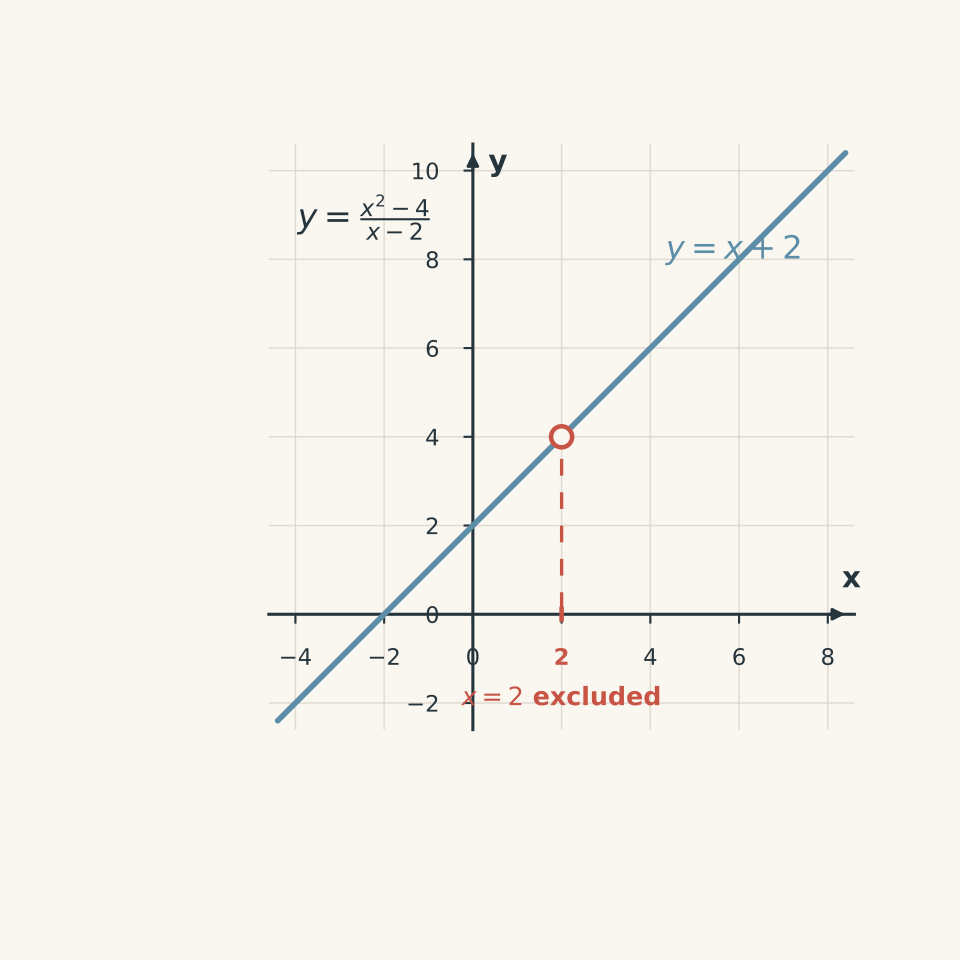
Worked example: solve an equation without losing restrictions
Solve
\[ \frac{x^2-4}{x-2}=5 \]
Step 1
The denominator cannot equal zero.
\[ x-2\neq 0 \]
Therefore,
\[ x\neq 2 \]
Step 2
\[ \frac{(x-2)(x+2)}{x-2}=5 \]
Since \(x\neq 2\), we can cancel the common factor.
\[ x+2=5 \]
Step 3
\[ x=3 \]
Step 4
Our solution satisfies \(x\neq 2\), so it is valid.
The final answer is
\[ \boxed{x=3} \]
The important habit is recording the restriction before cancelling anything.
This is a small example, but the same discipline matters when manipulating more complicated expressions in proofs, complex numbers, and calculus.
Due to technical limitations, this figure may display incorrectly or contain inaccuracies. Please check key details against your course materials.
02Refresh trigonometry, particularly radians
Trigonometry becomes much easier when you understand the relationships rather than memorising isolated formulas.
You should be comfortable with:
- Converting between degrees and radians.
- Exact trigonometric values.
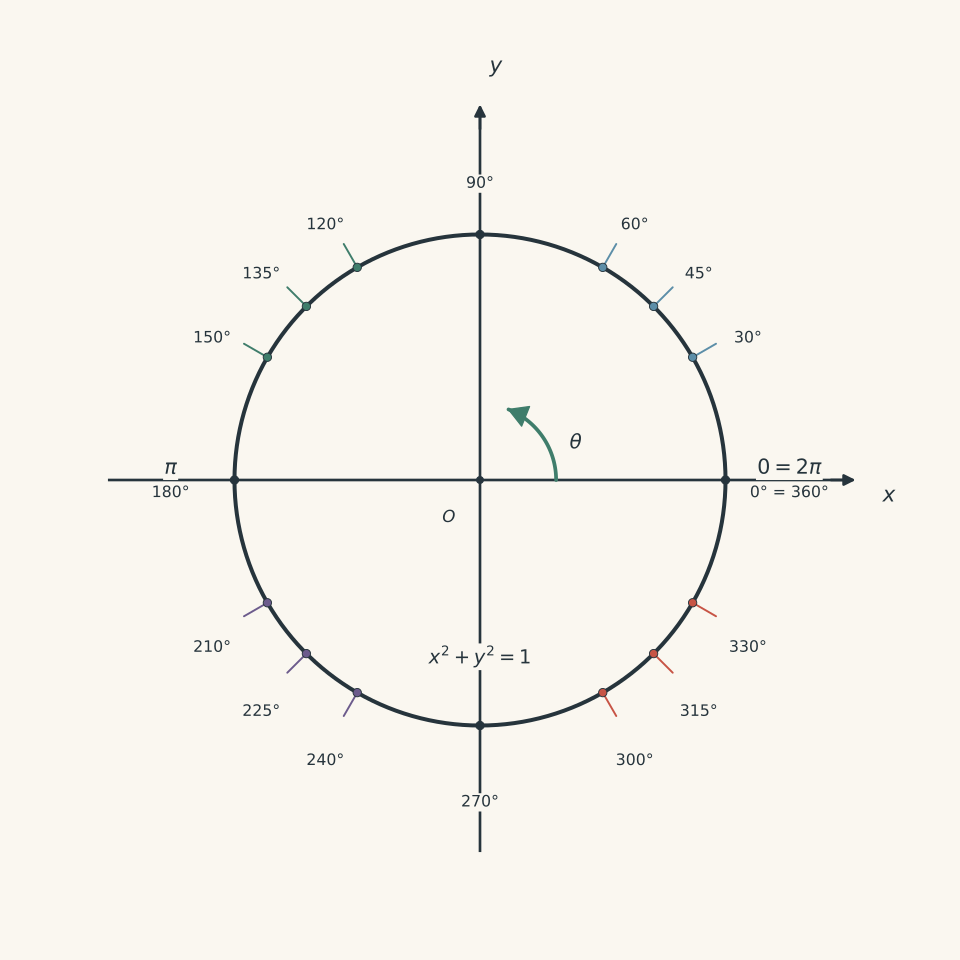
- The unit circle.
- Fundamental trigonometric identities.
- Double-angle identities.
- Solving trigonometric equations over a specified interval.
- Understanding periodicity and general solutions.
One common problem is finding the correct solutions to a trigonometric equation.
For example, suppose you have
\[ 2\sin\theta\cos\theta=1 \]
You can use the double-angle identity
\[ \sin 2\theta=2\sin\theta\cos\theta \]
Therefore,
\[ \sin 2\theta=1 \]
The solutions depend on the interval given in the question.
This is why memorising one answer isn’t enough. You need to understand how the unit circle, periodicity, and the interval work together.
Due to technical limitations, this figure may display incorrectly or contain inaccuracies. Please check key details against your course materials.
A useful test is whether you can solve a trigonometric equation without immediately reaching for your calculator.
If exact values and general solutions still feel unfamiliar, spend time revising them before starting the new course content.
03Get comfortable with differentiation and integration
Calculus is particularly important because Extension 2 takes ideas from earlier courses and applies them in more sophisticated situations.
You should be confident with differentiation rules, including:
- The power rule.
- The product rule.
- The quotient rule.
- The chain rule.
- Differentiating exponential and trigonometric functions.
You should also understand what a derivative represents.
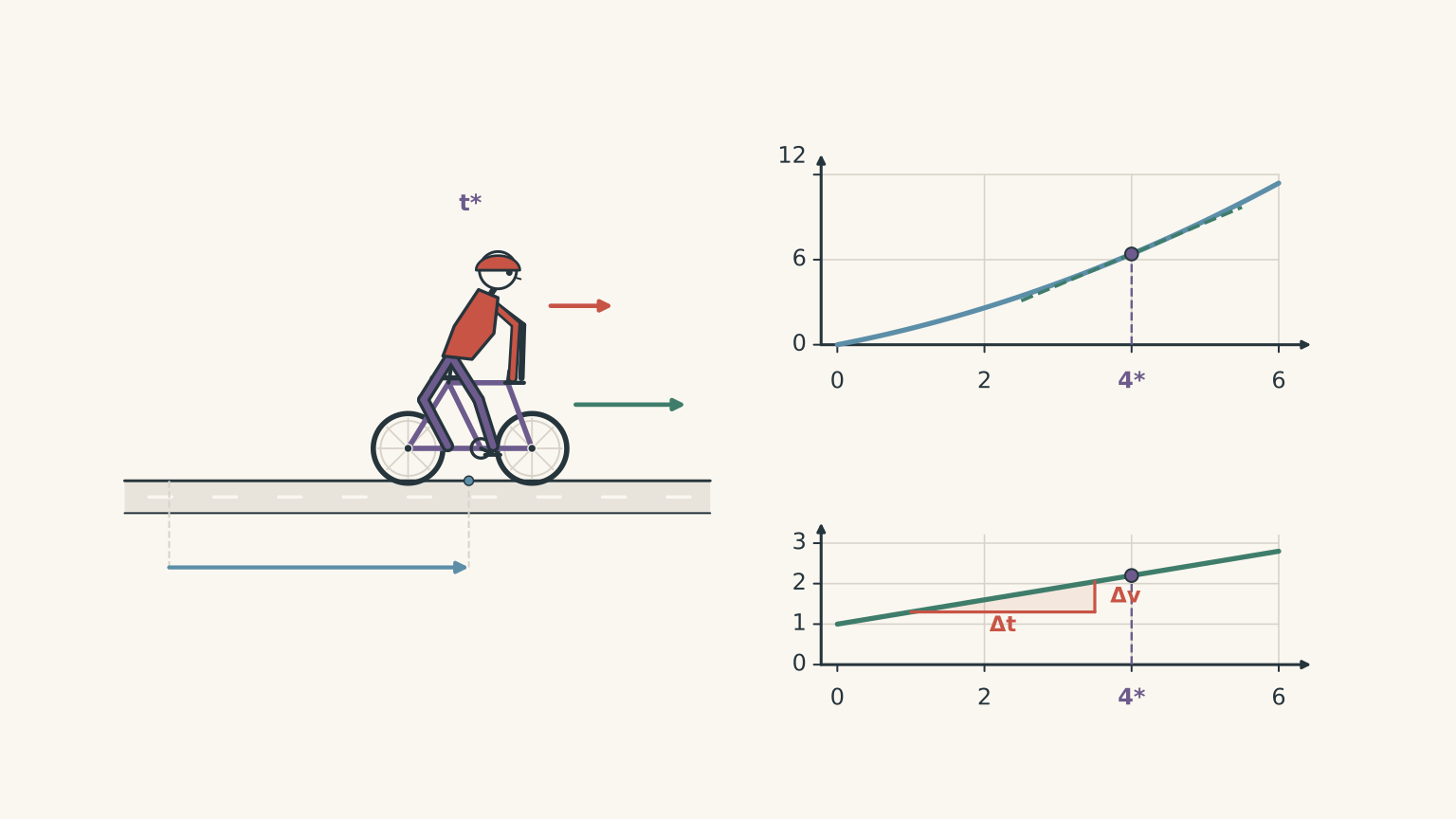
Think about a car travelling along a road. Its position changes over time. The derivative of its position function gives its instantaneous velocity.
If position is represented by \(s(t)\), then
\[ v(t)=\frac{ds}{dt} \]
Differentiating velocity gives acceleration:
\[ a(t)=\frac{d^2s}{dt^2} \]
This relationship becomes particularly useful when studying the applications of calculus to mechanics.
Due to technical limitations, this figure may display incorrectly or contain inaccuracies. Please check key details against your course materials.
Worked example: combine the product and chain rules
Differentiate
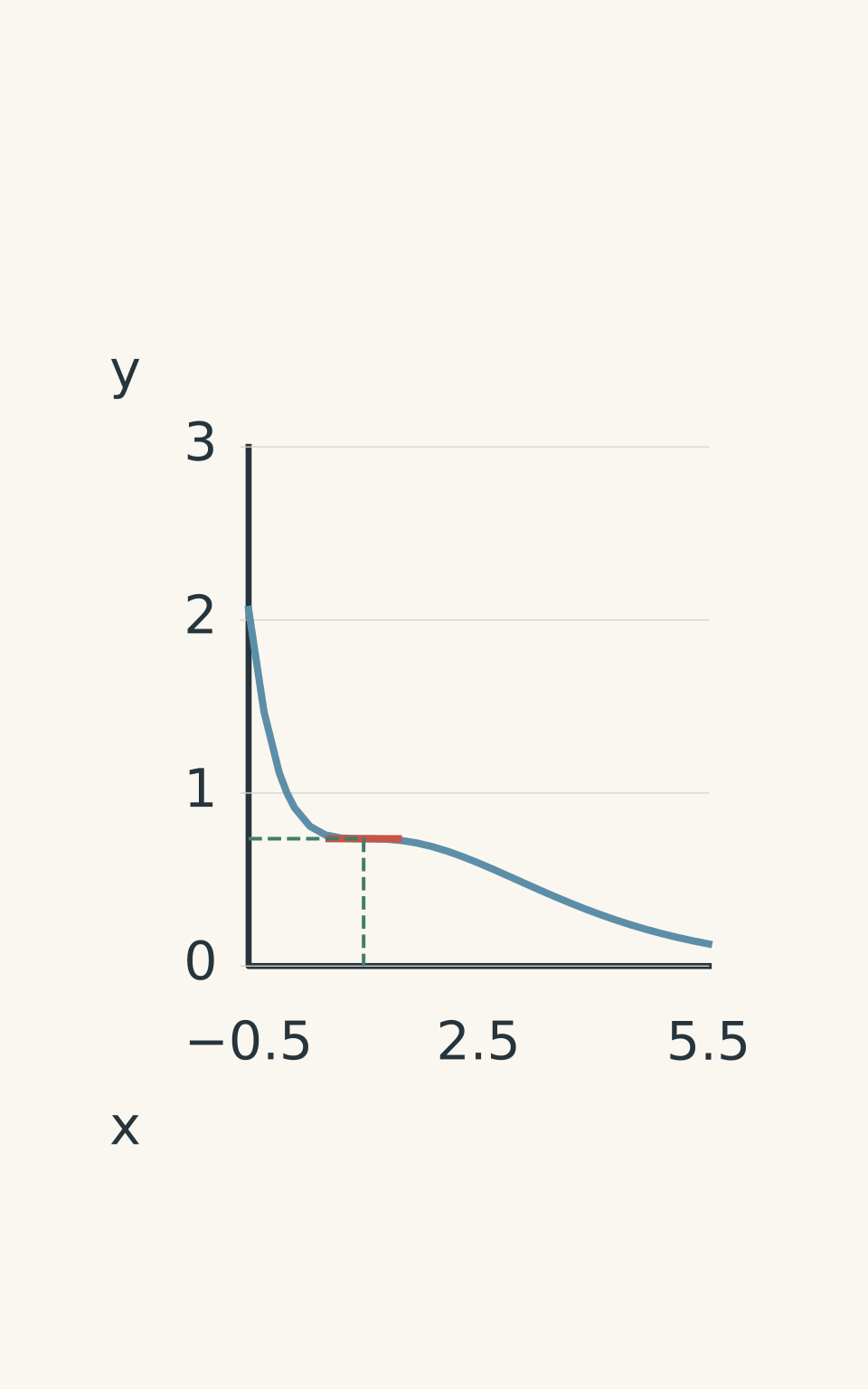
\[ y=(x^2+1)e^{-x} \]
Step 1
We need the product rule:
\[ \frac{d}{dx}(uv)=u'v+uv' \]
Let
\[ u=x^2+1,\qquad v=e^{-x} \]
Step 2
\[ u'=2x \]
Using the chain rule,
\[ v'=-e^{-x} \]
Step 3
\[ \begin{aligned} \frac{dy}{dx} &=2xe^{-x}-(x^2+1)e^{-x}\\ &=e^{-x}(2x-x^2-1) \end{aligned} \]
Therefore,
\[ \boxed{\frac{dy}{dx}=-e^{-x}(x-1)^2} \]
Step 4
Since \(e^{-x}\) is always positive and \((x-1)^2\) is always non-negative, the derivative is never positive.
It equals zero only when \(x=1\).
This gives a stationary point, but does it necessarily give a maximum or minimum?
No. The derivative is negative on both sides of \(x=1\). The function continues decreasing through this point, so it is a stationary point of inflection rather than a turning point.
This is a useful distinction to understand before studying more complicated calculus problems. A derivative of zero identifies a stationary point, not automatically a maximum or minimum.
You should also revise basic integration:
- Finding antiderivatives.
- Using standard integration rules.
- Evaluating definite integrals.
- Understanding the relationship between differentiation and integration.
You don’t need to master further integration before the course begins. You do need a solid understanding of the calculus you’ve already studied.
- y=(x^2+1)e^(-x)
- Horizontal tangent at x=1
- Stationary point (1, 2/e)
Due to technical limitations, this figure may display incorrectly or contain inaccuracies. Please check key details against your course materials.
04Develop better mathematical reasoning
Extension 2 places considerable emphasis on proof.
A question might ask you to establish that a statement is true for all real numbers, demonstrate an inequality, or explain why a mathematical result follows from an earlier condition.
These questions require more than finding an answer.
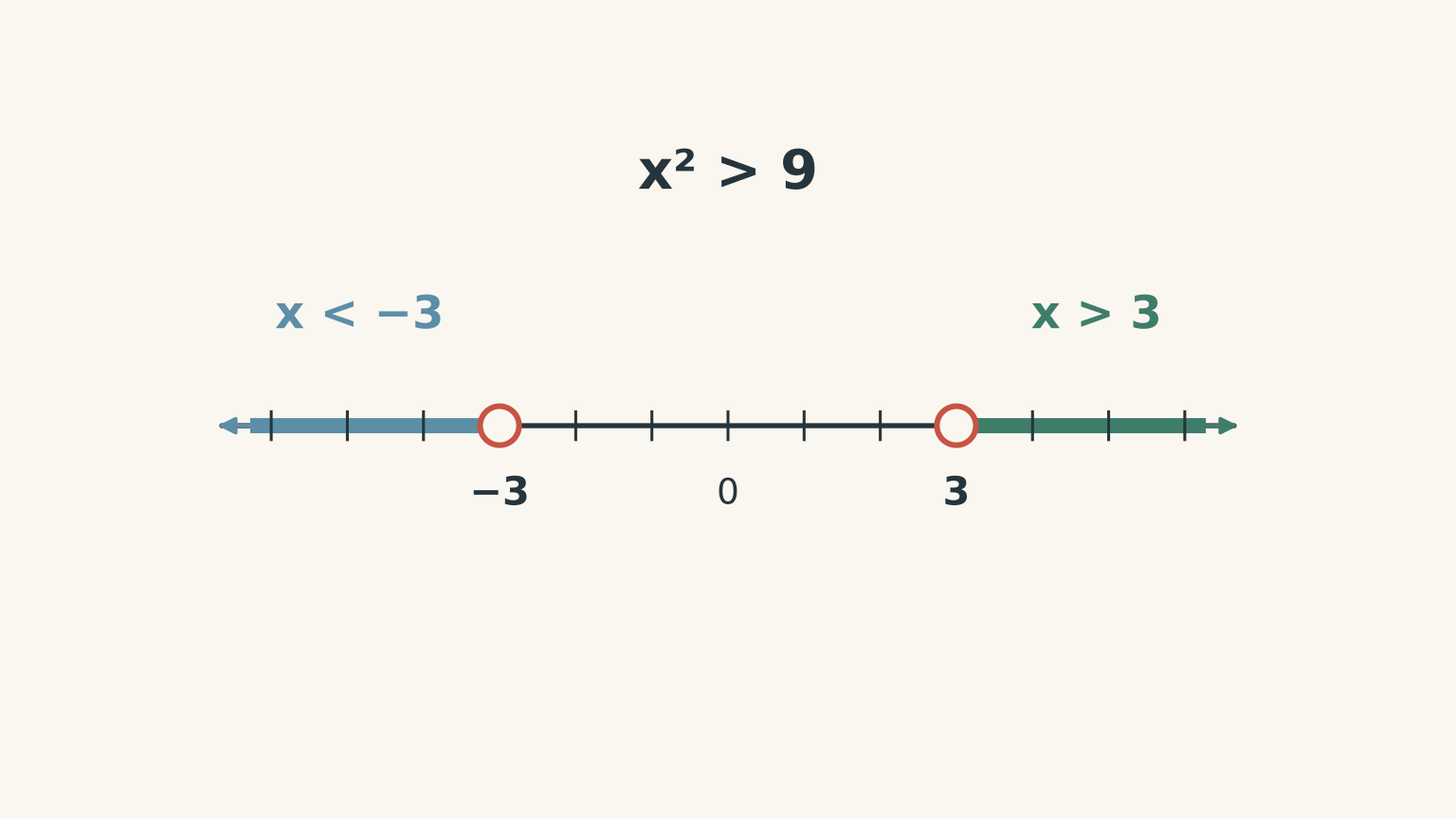
Consider the statement:
\[ x^2>9\implies x>3 \]
Is it true?
It might seem reasonable because taking the square root of a number greater than 9 gives a value greater than 3.
But there’s a problem.
If \(x=-4\), then
\[ (-4)^2=16>9 \]
Yet \(-4\) is not greater than 3.
The original implication is false.
In fact, the correct condition is
\[ x<-3\quad\text{or}\quad x>3 \]
This illustrates an important idea: squaring a number removes information about its sign.
Due to technical limitations, this figure may display incorrectly or contain inaccuracies. Please check key details against your course materials.
Worked example: prove an inequality for all real numbers
Prove that
\[ x^2-6x+11>0 \]
for every real value of \(x\).
Step 1
Complete the square:
\[ x^2-6x+11=(x-3)^2+2 \]
Step 2
The square of any real number is non-negative.
Therefore,
\[ (x-3)^2\geq 0 \]
Adding 2 gives
\[ (x-3)^2+2\geq 2 \]
Step 3
Since \(2>0\),
\[ \boxed{x^2-6x+11>0} \]
for all real \(x\).
Notice that we haven’t tested a handful of values and assumed the result works everywhere. We’ve established why the inequality must be true for every real number.
A particularly useful skill is knowing when a statement needs a proof and when a single counterexample is enough to disprove it.
You can develop this through the following two tutorgum resources:
- Examples and Counterexamples in HSC Mathematics Extension 2
- When to Use ⇒, ⇔ and = in HSC Mathematics Extension 2
You don’t need to memorise every possible proof technique before starting. Focus on understanding why an argument works and being able to explain each step.
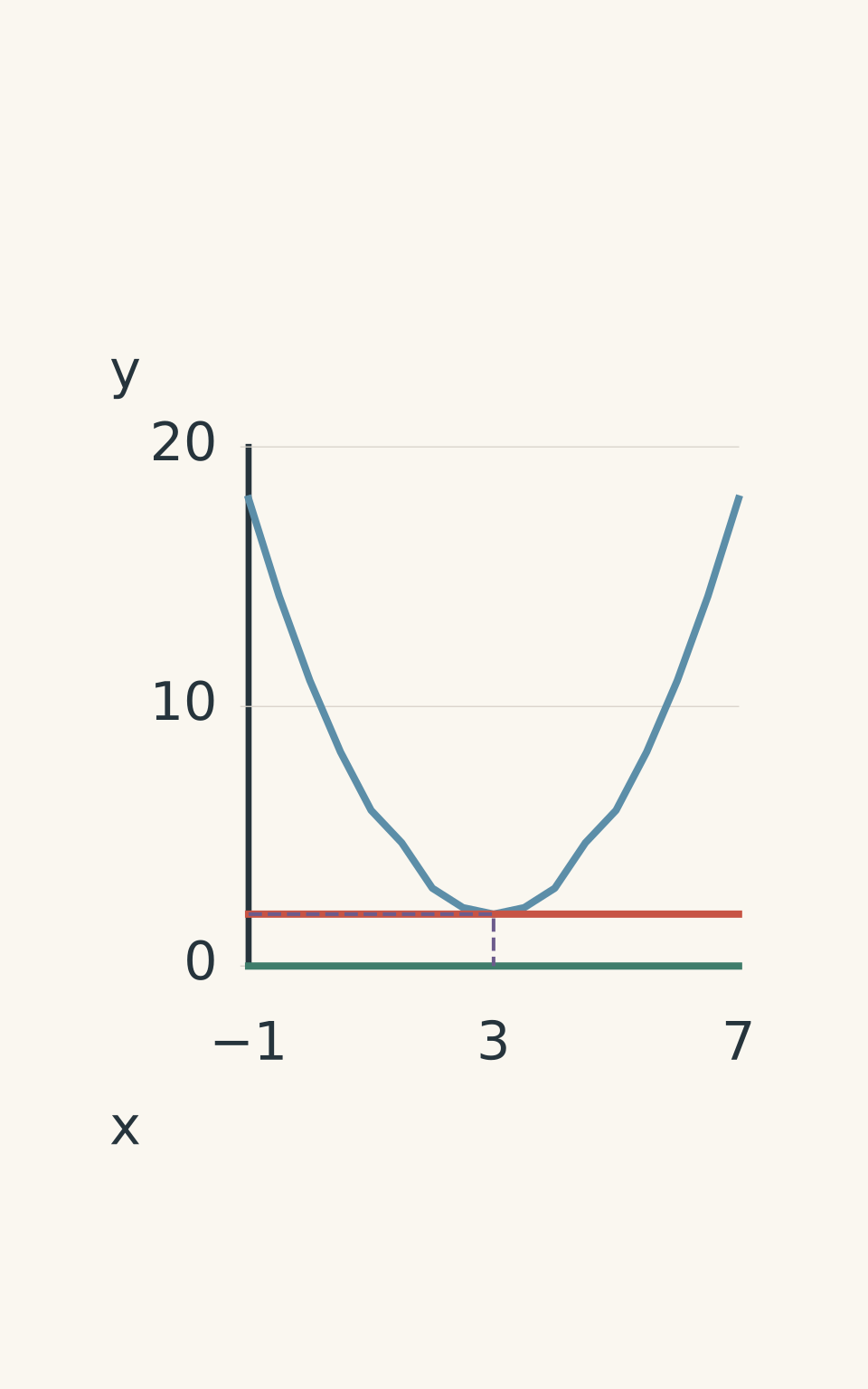
- y = x² − 6x + 11
- Minimum y = 2
- x-axis (y = 0)
- Vertex (3, 2)
Due to technical limitations, this figure may display incorrectly or contain inaccuracies. Please check key details against your course materials.
05Don’t neglect coordinate geometry
Vectors are one of the five Extension 2 areas of study.
You don’t need to teach yourself the entire vectors topic in advance. However, coordinate geometry is worth revisiting.
Make sure you can:
- Calculate the distance between two points.
- Find the gradient of a straight line.
- Determine the equation of a line.
- Resolve a displacement into horizontal and vertical components.
- Use Pythagoras’ theorem and trigonometry confidently.
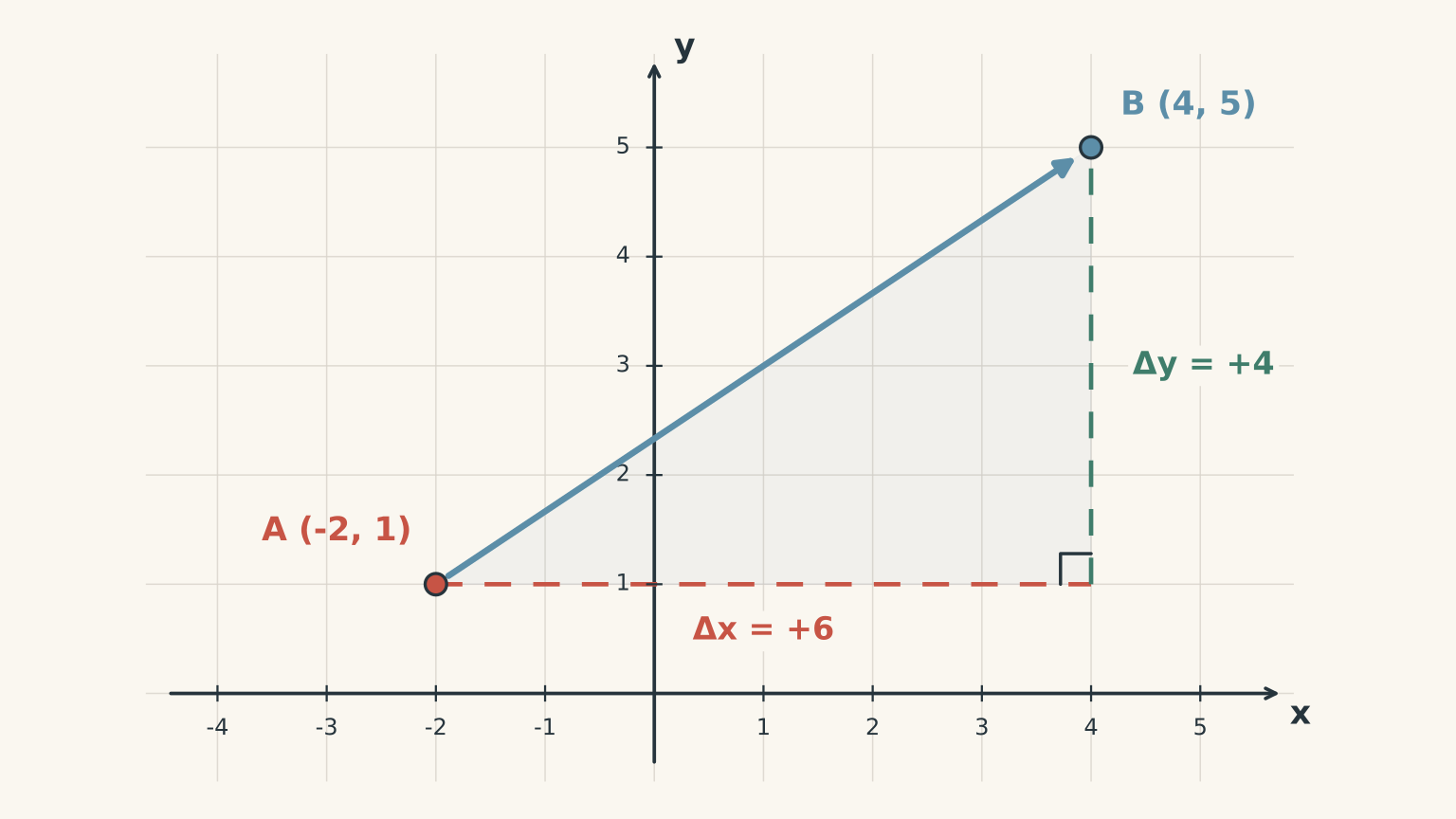
For example, consider two points:
\[ A=(-2,1),\qquad B=(4,5) \]
The displacement from A to B is
\[ \overrightarrow{AB}= \begin{pmatrix} 4-(-2)\\ 5-1 \end{pmatrix} = \begin{pmatrix} 6\\ 4 \end{pmatrix} \]
Its magnitude is
\[ \begin{aligned} |\overrightarrow{AB}| &=\sqrt{6^2+4^2}\\ &=\sqrt{52}\\ &=2\sqrt{13} \end{aligned} \]
You don’t need advanced vector theory to understand this calculation. You need to be comfortable working with coordinates, differences, and lengths.
Due to technical limitations, this figure may display incorrectly or contain inaccuracies. Please check key details against your course materials.
These skills provide a useful starting point when your class introduces the more advanced vector concepts.
08Questions and solutions
The following diagnostic checks the foundations we’ve discussed. Try the questions without notes before reading the solutions.
Allow approximately 20-25 minutes. Show your working, even if you can calculate the answer mentally.
Question 1
Solve the quadratic equation
\[ 2x^2-5x-3=0 \]
Solution 1
The two solutions are
\[ \boxed{x=3\quad\text{or}\quad x=-\frac12} \]
We can find them by factorising.
We need two factors whose product gives \(2x^2-5x-3\).
\[ 2x^2-5x-3=(2x+1)(x-3) \]
Therefore,
\[ (2x+1)(x-3)=0 \]
A product equals zero when at least one factor equals zero.
So,
\[ 2x+1=0 \]
or
\[ x-3=0 \]
Hence,
\[ x=-\frac12\quad\text{or}\quad x=3 \]
This question checks whether you can factorise and solve a quadratic accurately.
Question 2
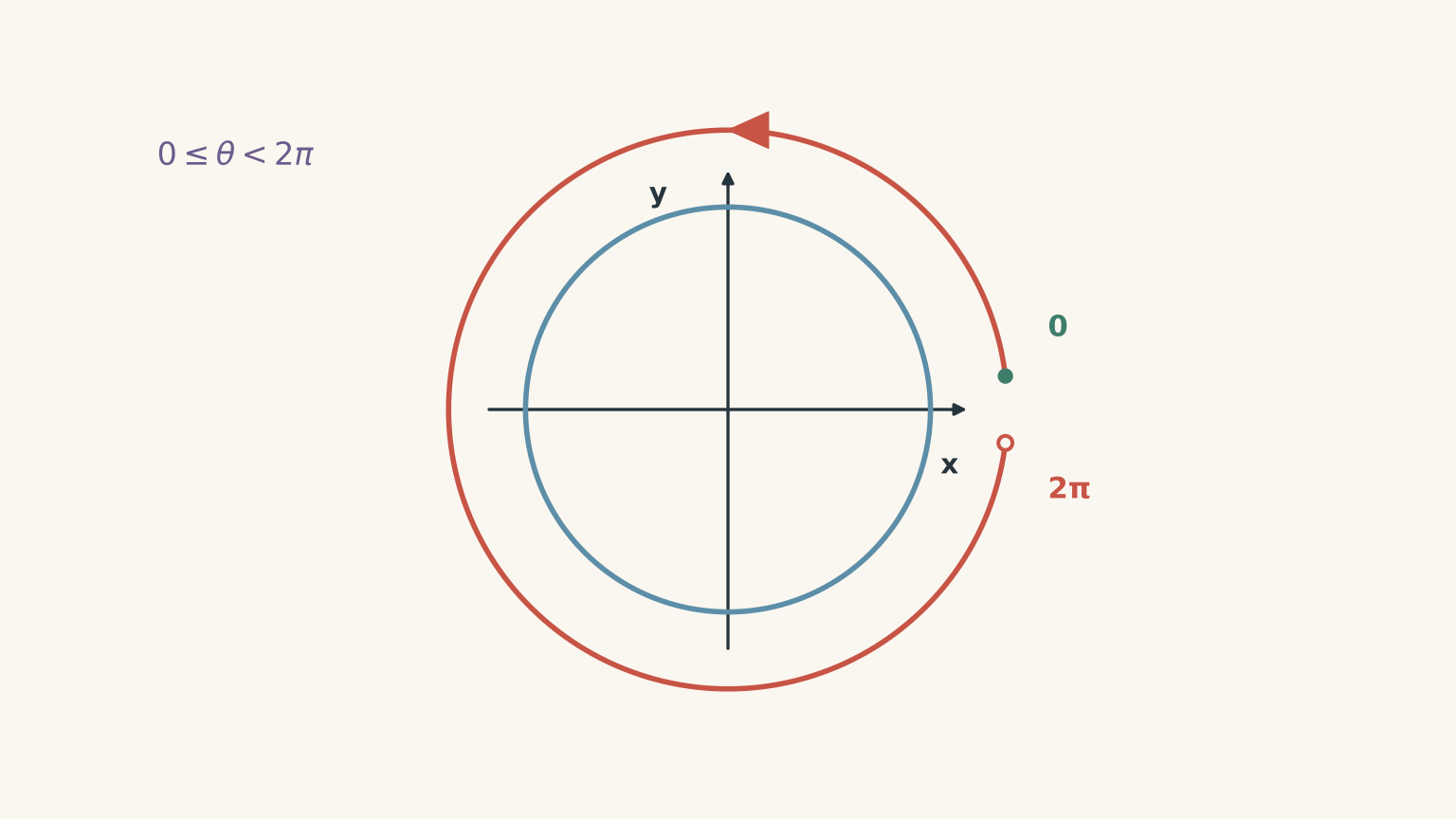
Solve the equation
\[ 2\sin\theta\cos\theta=\cos\theta \]
for
\[ 0\leq\theta<2\pi \]
Give your answers in radians.
Due to technical limitations, this figure may display incorrectly or contain inaccuracies. Please check key details against your course materials.
Solution 2
The four solutions are
\[ \boxed{ \theta=\frac{\pi}{6}, \frac{\pi}{2}, \frac{5\pi}{6}, \frac{3\pi}{2} } \]
Step 1: Rearrange the equation.
\[ 2\sin\theta\cos\theta-\cos\theta=0 \]
Factorise:
\[ \cos\theta(2\sin\theta-1)=0 \]
Step 2: Consider both possible cases.
First,
\[ \cos\theta=0 \]
Within the given interval,
\[ \theta=\frac{\pi}{2},\frac{3\pi}{2} \]
Second,
\[ 2\sin\theta-1=0 \]
Therefore,
\[ \sin\theta=\frac12 \]
Within the same interval,
\[ \theta=\frac{\pi}{6},\frac{5\pi}{6} \]
Step 3: Combine the solutions.
All four values satisfy the original equation.
A common mistake is dividing both sides by \(\cos\theta\) immediately. Doing so would remove the solutions where \(\cos\theta=0\).
Always consider whether dividing by an expression could exclude valid solutions.
Question 3
Differentiate
\[ y=x^2\sin(3x) \]
Then calculate \(\frac{dy}{dx}\) when
\[ x=\frac{\pi}{6} \]
Solution 3
The derivative is
\[ \boxed{ \frac{dy}{dx} = 2x\sin(3x)+3x^2\cos(3x) } \]
At \(x=\frac{\pi}{6}\),
\[ \boxed{\frac{dy}{dx}=\frac{\pi}{3}} \]
Step 1: Identify the product.
The function contains \(x^2\) multiplied by \(\sin(3x)\).
We need the product rule:
\[ (uv)'=u'v+uv' \]
Step 2: Differentiate each factor.
\[ \frac{d}{dx}(x^2)=2x \]
Using the chain rule,
\[ \frac{d}{dx}\sin(3x)=3\cos(3x) \]
Step 3: Apply the product rule.
\[ \frac{dy}{dx} = 2x\sin(3x)+3x^2\cos(3x) \]
Step 4: Substitute the given value.
When \(x=\frac{\pi}{6}\),
\[ 3x=\frac{\pi}{2} \]
Using
\[ \sin\frac{\pi}{2}=1,\qquad \cos\frac{\pi}{2}=0 \]
we obtain
\[ \begin{aligned} \frac{dy}{dx} &=2\left(\frac{\pi}{6}\right)(1)\\ &\quad+3\left(\frac{\pi}{6}\right)^2(0)\\ &=\frac{\pi}{3} \end{aligned} \]
This question checks whether you can combine the product rule and chain rule without losing factors.
Question 4
Let \(P\) be the statement
\[ x^2>9 \]
and let \(Q\) be the statement
\[ x>3 \]
where \(x\) is real.
Determine whether each of the following statements is true:
- \(P\Rightarrow Q\)
- \(Q\Rightarrow P\)
Then write a condition equivalent to \(P\).
Solution 4
The first implication is false, the second is true, and the equivalent condition is
\[ \boxed{x<-3\quad\text{or}\quad x>3} \]
Step 1: Test the first implication.
We are asking whether every real number satisfying \(x^2>9\) must also satisfy \(x>3\).
Choose \(x=-4\).
Then,
\[ (-4)^2=16>9 \]
but
\[ -4\not>3 \]
Therefore,
\[ P\Rightarrow Q \]
is false.
Step 2: Test the second implication.
If \(x>3\), then squaring both positive sides gives
\[ x^2>9 \]
Therefore,
\[ Q\Rightarrow P \]
is true.
Step 3: Find an equivalent condition.
Starting with
\[ x^2>9 \]
we can write
\[ |x|>3 \]
This means that the distance of \(x\) from zero is greater than 3.
Consequently,
\[ x<-3\quad\text{or}\quad x>3 \]
This is equivalent to the original statement because it covers both possible signs of \(x\).
The important distinction is that an implication only needs to work in one direction. An equivalence requires both directions to be true.
09How to interpret your diagnostic
Don’t treat this as a test of whether you’re capable of studying Extension 2. It’s a way to identify which foundations deserve attention.
| Question | What it tests | If you struggled |
|---|---|---|
| 1 | Factorisation and algebra | Revise quadratic factorisation and equation solving. |
| 2 | Trigonometric identities and intervals | Revisit the unit circle, exact values, and trigonometric equations. |
| 3 | Product rule and chain rule | Practise differentiating products and composite functions. |
| 4 | Mathematical reasoning | Work on counterexamples, implications, and equivalent statements. |
If you struggled with several questions, that’s useful information. Start with the relevant Year 11 material rather than jumping into unfamiliar Extension 2 topics.
Also check your coordinate geometry independently. Being able to calculate distances, gradients, and components is an important foundation for vectors.
10A realistic three-week preparation plan
You don’t need to study for hours every day.
A useful target is three sessions per week, with each session lasting approximately 35-45 minutes. This gives you a structured preparation period without turning the holidays into another full school term.
Week 1: Algebra and functions
Focus on making your algebraic manipulation automatic.
| Session | What to revise |
|---|---|
| 1 | Factorisation, expanding, quadratic equations, and algebraic fractions. |
| 2 | Functions, domains, ranges, transformations, and inverse functions. |
| 3 | Indices, logarithms, exponentials, and mixed algebra problems. |
By the end of the week, you should be able to manipulate unfamiliar expressions without constantly checking basic algebra rules.
Week 2: Trigonometry and calculus
Focus on the skills you’ll repeatedly use in later topics.
| Session | What to revise |
|---|---|
| 1 | Radians, exact values, trigonometric identities, and equations. |
| 2 | Differentiation, including product and chain rules. |
| 3 | Basic integration, definite integrals, and interpreting derivatives. |
Don’t just practise calculating derivatives. Look at their graphs and understand what the results tell you.
Week 3: Proof and geometry
Now focus on mathematical reasoning and spatial relationships.
| Session | What to revise |
|---|---|
| 1 | Counterexamples, implications, equivalence, and direct proofs. |
| 2 | Inequalities, coordinate geometry, distances, and vector components. |
| 3 | Mixed problems combining algebra, trigonometry, calculus, and reasoning. |
For the final session, try working without notes. Write complete explanations and check whether every mathematical step is justified.
Keep a short error log
One of the most useful habits you can develop is recording why you got a question wrong.
A simple table is enough:
| Original mistake | What caused it? | What I’ll do differently |
|---|---|---|
| Lost a solution in a trig equation | Divided by a variable expression | Factorise first and check every case. |
| Incorrect derivative | Forgot the chain rule | Identify the inner function before differentiating. |
| Invalid algebraic solution | Forgot a domain restriction | Record restrictions before simplifying. |
Revisit these questions a few days later.
Getting a question correct immediately after reading its solution doesn’t necessarily mean you’ve mastered the method. Being able to solve it again independently is much better evidence.
11What you should avoid doing
It’s tempting to download an Extension 2 textbook, open the first chapter, and start working through everything.
That isn’t necessarily productive.
In particular, avoid:
- Trying to teach yourself complex numbers from scratch before your class introduces them.
- Memorising advanced vector formulas without understanding their foundations.
- Spending weeks on difficult integration techniques before revising basic integration.
- Completing dozens of difficult questions while making the same algebraic mistakes.
- Comparing your preparation with students who have already started studying the new course content.
There is a difference between preparing for a subject and trying to complete it early.
Your goal is to make the prerequisite material familiar enough that new concepts don’t become unnecessarily difficult.
If you have already started the Term 4 Year 12 course, use this plan to identify and repair gaps alongside your regular lessons rather than putting your current coursework aside.
12Getting help with your preparation
If you’re finding that the same problems keep appearing in your working, targeted help can make your preparation more efficient.
For example, you might understand differentiation conceptually but consistently struggle with the algebra after applying the chain rule. Spending an entire session learning more differentiation techniques won’t necessarily fix that problem.
A useful tutor should help identify the underlying gap, explain why the mistake occurs, and give you opportunities to correct it independently.
At tutorgum, online Maths Extension 2 tutoring can provide that additional support. You can also use the diagnostic and preparation plan in this guide independently.
13What comes next?
Once your foundations are reasonably secure, allow your Extension 2 course to introduce the new mathematics in a sensible sequence.
You’ll move into more formal mathematical proof, further vector techniques, complex numbers, further integration, and applications of calculus to mechanics.
The common thread is mathematical reasoning: understanding what a question is asking, selecting an appropriate method, and being able to justify why your working is valid.
That’s the habit worth developing before the course gets going.