
Examples and Counterexamples in HSC Mathematics Extension 2
Learn how examples illustrate mathematical claims and how a single counterexample can disprove a universal statement. Develop your reasoning through proofs, worked examples, and challenging HSC Extension 2 questions.
A student checks \(x=-2,0,2,5\) and finds that \(x^2+1>2x\) is true every time. They conclude that the inequality must hold for every real number \(x\).
Would you accept that conclusion?
Before deciding, try a value where the two sides might be equal. At \(x=1\),
\[ 1^2+1=2(1) \]
Both sides equal 2. The strict inequality is false.
One carefully chosen value has disproved a claim that survived four tests. That’s the power of a counterexample. It also shows why testing a few numbers is not the same as proving a mathematical statement.
There’s a useful extra observation here. Although the strict inequality is false, the corrected statement
\[ x^2+1\geq 2x \]
is true for every real number, because
\[ x^2+1-2x=(x-1)^2\geq 0. \]
The difference between \(>\) and \(\geq\) changes the entire conclusion.
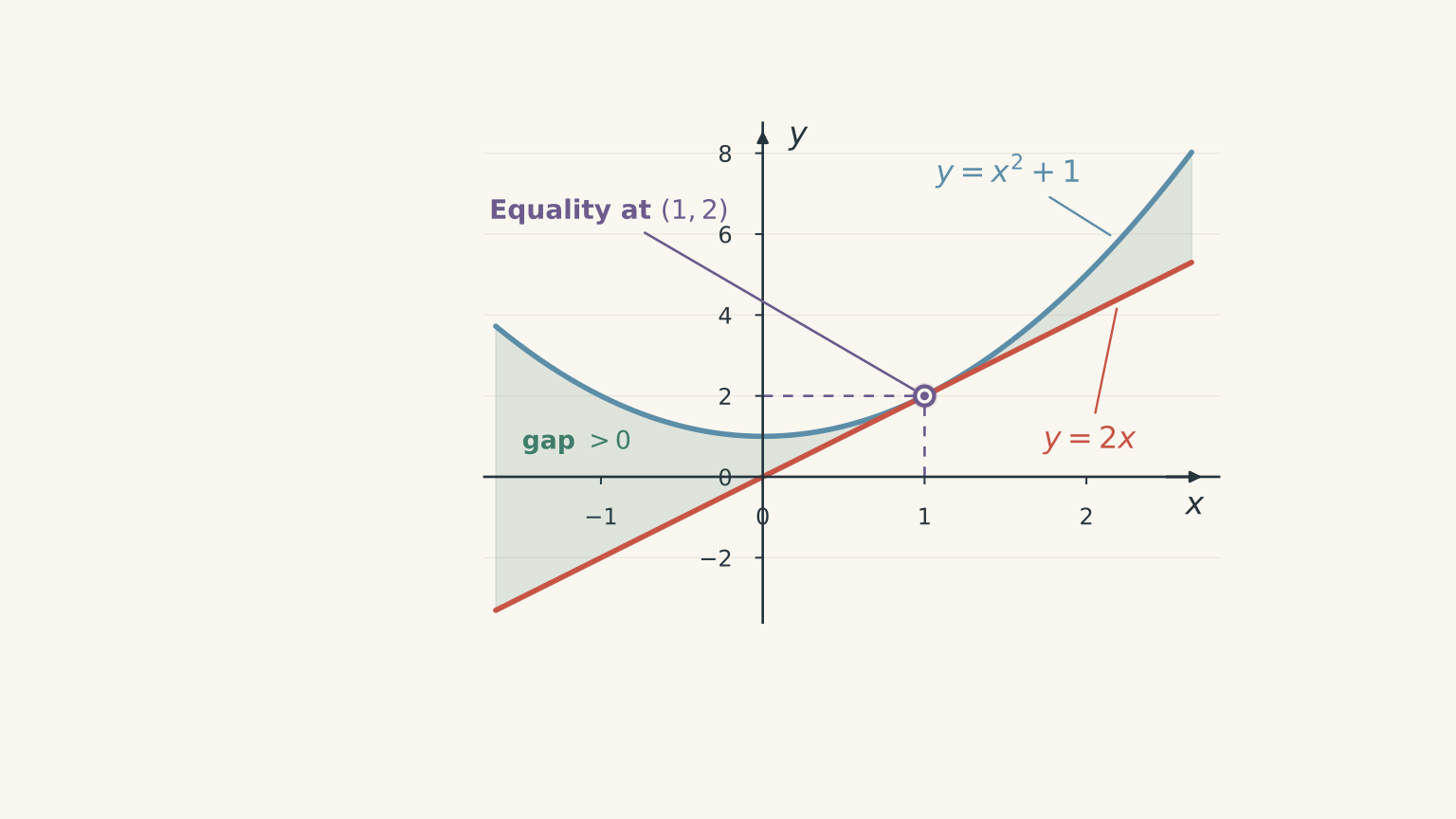
Due to technical limitations, this figure may display incorrectly or contain inaccuracies. Please check key details against your course materials.
01What examples and counterexamples actually prove
In mathematics, a statement often makes a claim about every member of a particular set.
For example:
- Every integer has a square that is non-negative.
- Every real number has a square root.
- Every stationary point of a differentiable function is a maximum or minimum.
- Every non-zero complex number has a multiplicative inverse.
These are universal statements. They claim that something is true for every permitted value, not just the values we’ve happened to test.
We can represent a universal statement using the symbol \(\forall\), meaning ‘for all’:
\[ \forall x\in D,\quad P(x) \]
Here:
- \(D\) is the specified domain.
- \(x\) is an arbitrary member of that domain.
- \(P(x)\) is the property we claim is true.
For example, the statement
\[ x^2\geq 0\quad \text{for all }x\in\mathbb R \]
has the real numbers as its domain.
An example supports a claim
Suppose we want to investigate whether
\[ n^2+n+1 \]
is odd for every integer \(n\).
We might test:
| \(n\) | \(n^2+n+1\) | Result |
|---|---|---|
| 0 | 1 | Odd |
| 1 | 3 | Odd |
| 2 | 7 | Odd |
| 3 | 13 | Odd |
| 4 | 21 | Odd |
These examples suggest that the statement is true.
However, they only establish that it works for five particular integers. There are infinitely many integers left to consider.
An example can:
- Illustrate a mathematical property.
- Suggest a pattern or conjecture.
- Help identify a useful algebraic identity.
- Check whether a proposed result is plausible.
It cannot establish a universal statement over an infinite domain.
To do that, we need a proof that works for an arbitrary member of the domain.
A counterexample disproves a claim
A counterexample is a particular value that satisfies the original assumptions but makes the claimed conclusion false.
Symbolically, to disprove
\[ \forall x\in D,\quad P(x), \]
we need just one value \(x_0\) such that
\[ x_0\in D \quad\text{and}\quad P(x_0)\text{ is false}. \]
Notice the two requirements.
First, the value must belong to the specified domain. Second, it must genuinely violate the conclusion.
For instance, suppose someone claims:
\[ n^2>n\quad\text{for every positive integer }n. \]
Taking \(n=1\) gives
\[ 1^2>1, \]
which is false.
This single counterexample is enough. We don’t need to test another integer.
The important distinction: an example demonstrates that a statement works in one case. A counterexample proves that a universal statement does not always work.
There is one qualification. If the domain contains only finitely many elements, checking every element can establish the statement by exhaustion. The problem with checking examples is that a handful of tests cannot cover an infinite domain.
Make sure your counterexample is allowed
This is an easy detail to overlook in an examination.
Suppose the claim is:
\[ \frac{x^2-1}{x-1}=x+1 \quad\text{for all }x\neq 1. \]
You cannot use \(x=1\) as a counterexample. The original expression is undefined there, so \(x=1\) is outside the domain.
A valid counterexample must respect every condition in the question.
Before choosing a value, identify:
- Whether the variable is real, integer, positive, or non-zero.
- Whether there are restrictions from denominators or square roots.
- Whether the statement includes equality or requires strict inequality.
- Whether additional assumptions apply to the variables.
A value that violates an assumption is not a counterexample.
02How to find a useful counterexample
You don’t need to test random numbers. Some values are much more revealing than others.
When investigating a universal statement, try the following.
1. Start with simple values.
Try \(0\), \(1\), and \(-1\), provided they belong to the domain.
These values often simplify expressions enough to expose a problem.
2. Check boundary cases.
If a statement involves an inequality, investigate where equality might occur.
For example, a claim involving \(x^2\geq 1\) deserves a closer look when \(x=0\) or \(x=\pm1\).
3. Test negative values.
A pattern that works for positive numbers may fail when signs change.
4. Look for special cases.
In complex numbers, try values such as \(i\), \(-i\), and real multiples of \(i\).
In calculus, try simple polynomials such as \(x^2\), \(x^3\), and \(x^4\).
5. Look for the exact point where the reasoning changes.
A counterexample is most useful when it reveals which assumption is missing or which part of the conclusion is too strong.
Finding a counterexample is often the first step towards writing a better mathematical statement.
03Worked examples
Worked example: Proving a statement using the contrapositive
Prove that if \(n\) is an integer and \(n^2\) is even, then \(n\) must be even.
Step 1
Testing \(n=2,4,6\) would show that their squares are even, but it would not establish the statement for all integers.
A useful approach is to prove the contrapositive.
The contrapositive of
“If \(n^2\) is even, then \(n\) is even”
is
“If \(n\) is odd, then \(n^2\) is odd.”
These statements are logically equivalent, so proving the second establishes the first.
Step 2
If \(n\) is odd, we can write
\[ n=2k+1,\qquad k\in\mathbb Z. \]
Step 3
\[ \begin{aligned} n^2&=(2k+1)^2\\ &=4k^2+4k+1\\ &=2(2k^2+2k)+1. \end{aligned} \]
Since \(2k^2+2k\) is an integer, \(n^2\) has the form \(2m+1\), where \(m\) is an integer.
Therefore, \(n^2\) is odd whenever \(n\) is odd.
Step 4
The contrapositive is true, so the original statement is also true:
\[ \boxed{n^2\text{ even}\implies n\text{ even}.} \]
The key difference between this proof and checking examples is that \(k\) represents an arbitrary integer. The argument therefore covers every possible value of \(n\).
Worked example: Finding equality in the triangle inequality
For a complex number \(z\), determine all values for which
\[ |z+1|=|z|+1. \]
Does this equality hold for every complex number?
Step 1
For any two complex numbers \(z\) and \(w\),
\[ |z+w|\leq |z|+|w|. \]
Taking \(w=1\), we obtain
\[ |z+1|\leq |z|+1. \]
The proposed equality is therefore not guaranteed. It is a special case of the triangle inequality.
Step 2
Choose \(z=i\).
Then
\[ |i+1|=|1+i|=\sqrt{2}, \]
whereas
\[ |i|+1=1+1=2. \]
Since
\[ \sqrt{2}\neq 2, \]
equality does not hold for every complex number.
Step 3
Write
\[ z=x+iy, \]
where \(x,y\in\mathbb R\).
The modulus of \(z+1\) is
\[ |z+1|^2=(x+1)^2+y^2. \]
Expanding gives
\[ |z+1|^2=x^2+y^2+2x+1. \]
On the other hand,
\[ (|z|+1)^2 =x^2+y^2+2\sqrt{x^2+y^2}+1. \]
For the original equality to hold, these squared expressions must be equal.
Cancelling common terms gives
\[ 2x=2\sqrt{x^2+y^2}. \]
Therefore,
\[ x=\sqrt{x^2+y^2}. \]
Since the right-hand side is non-negative, \(x\geq0\).
Squaring both sides gives
\[ x^2=x^2+y^2, \]
so
\[ y=0. \]
Step 4
The equality holds precisely when
\[ \boxed{z=x,\qquad x\geq0.} \]
In other words, \(z\) must be a non-negative real number.
This also makes geometric sense. A complex number can be represented as a vector in the Argand plane. Equality in the triangle inequality occurs when the two vectors point in the same direction.
Since the number \(1\) points along the positive real axis, \(z\) must point along that same axis.
04A common calculus misconception: A stationary point must be a turning point
Consider the following claim:
“If the derivative of a function is zero at a point, the function must have a local maximum or minimum there.”
It sounds reasonable. At a maximum or minimum, the graph often has a horizontal tangent.
But does the reverse always follow?
Consider
\[ f(x)=x^3. \]
Differentiating,
\[ f'(x)=3x^2. \]
At \(x=0\),
\[ f'(0)=0. \]
However, the function does not have a maximum or minimum at the origin.
For negative \(x\), \(x^3\) is negative. For positive \(x\), \(x^3\) is positive. The graph passes through the origin and continues increasing.
The point is a stationary point of inflection, not a turning point.
Now compare this with
\[ g(x)=x^2. \]
Here,
\[ g'(0)=0, \]
but \(g(x)>0\) for every \(x\neq0\). Therefore, the origin is a strict local minimum.
Both functions have a stationary point at zero, but their behaviour is different.
The derivative at one point tells us the instantaneous gradient. It does not, by itself, tell us what the function does on either side.
This is why we examine the sign of the derivative around a stationary point.
For polynomial functions, the second derivative test provides another useful result:
- If \(f'(a)=0\) and \(f''(a)>0\), there is a local minimum.
- If \(f'(a)=0\) and \(f''(a)<0\), there is a local maximum.
- If \(f'(a)=0\) and \(f''(a)=0\), the test is inconclusive.
The last case is particularly important. A zero second derivative does not mean there is no extremum. It means we need more information.
We’ll return to this distinction in the questions.
05Questions and solutions
Question 1
An answer claims that
\[ n^2+n \]
is odd for every integer \(n\).
(a) Give a counterexample to disprove the claim.
(b) Determine whether the revised statement
\[ n^2+n+1 \]
is odd for every integer \(n\). Justify your answer.
Solution 1
(a) The original claim is false.
Take \(n=1\).
\[ n^2+n=1+1=2. \]
Since 2 is even, this is a valid counterexample.
One integer is enough to disprove the universal statement.
(b) The revised statement is true for every integer.
Factor the first two terms:
\[ n^2+n+1=n(n+1)+1. \]
Since \(n\) and \(n+1\) are consecutive integers, one of them must be even.
Their product \(n(n+1)\) is therefore even.
Adding 1 gives an odd integer.
Hence,
\[ \boxed{n^2+n+1\text{ is odd for all }n\in\mathbb Z.} \]
Notice how the second part requires a general argument. Checking a few integers would only provide supporting examples, not a proof.
Question 2
A student claims:
“For every polynomial \(f\), if \(f'(a)=0\), then \(f\) has a local maximum or minimum at \(x=a\).”
(a) Disprove this statement using a polynomial.
(b) Construct another polynomial \(g\) such that
\[ g'(0)=g''(0)=0, \]
but \(g\) has a strict local minimum at \(x=0\).
(c) Explain what your two examples demonstrate about using the second derivative test when \(f''(a)=0\).
Solution 2
The claim is false. A stationary point does not necessarily correspond to a local maximum or minimum.
(a) Consider
\[ f(x)=x^3. \]
Differentiating,
\[ f'(x)=3x^2. \]
At the origin,
\[ f'(0)=0. \]
However, \(x^3\) is negative for negative \(x\) and positive for positive \(x\).
There are values arbitrarily close to zero with function values both below and above \(f(0)=0\).
Therefore, \(x=0\) is not a local maximum or minimum.
It is a stationary point of inflection.
(b) Consider
\[ g(x)=x^4. \]
Its first derivative is
\[ g'(x)=4x^3, \]
and its second derivative is
\[ g''(x)=12x^2. \]
At \(x=0\),
\[ g'(0)=0,\qquad g''(0)=0. \]
However,
\[ g(x)=x^4>0 \]
for every \(x\neq0\).
Since \(g(0)=0\), the origin is a strict local minimum.
(c) The two examples have the same first and second derivative values at the origin, but different local behaviour.
| Function | \(f'(0)\) | \(f''(0)\) | Behaviour at zero |
|---|---|---|---|
| \(x^3\) | 0 | 0 | Stationary inflection |
| \(x^4\) | 0 | 0 | Strict local minimum |
Therefore, the condition \(f''(0)=0\) is inconclusive.
It does not prove that an extremum exists, and it does not prove that one is absent.
You must investigate further, perhaps by examining higher derivatives or the sign of the first derivative on either side of the stationary point.
Question 3
Let
\[ z=x+iy, \]
where \(x,y\in\mathbb R\).
A student claims:
“If \(z^2\) is real, then \(z\) must be real.”
(a) Disprove the claim with a counterexample.
(b) Determine the complete set of complex numbers \(z\) for which \(z^2\) is real.
Solution 3
The claim is false. A non-real complex number can have a real square.
(a) Take
\[ z=i. \]
Then
\[ z^2=i^2=-1. \]
Since \(-1\) is real but \(i\) is not real, this is a valid counterexample.
(b) To determine every possible value, we must work with an arbitrary complex number.
Write
\[ z=x+iy. \]
Squaring,
\[ \begin{aligned} z^2&=(x+iy)^2\\ &=x^2+2xyi-y^2\\ &=(x^2-y^2)+2xyi. \end{aligned} \]
For \(z^2\) to be real, its imaginary component must be zero.
Therefore,
\[ 2xy=0. \]
This gives two possibilities:
\[ x=0 \quad\text{or}\quad y=0. \]
If \(x=0\), then \(z=iy\), which is purely imaginary.
If \(y=0\), then \(z=x\), which is real.
Both possibilities produce a real square.
Hence, the complete solution is
\[ \boxed{z\text{ is real or purely imaginary}.} \]
The origin belongs to both sets.
The important lesson is that a counterexample can expose a missing category. Testing only real values would never reveal the purely imaginary solutions.
Question 4
Let \(P\) be a non-zero polynomial with real coefficients, satisfying
\[ P(x)\geq0 \]
for every real number \(x\).
(a) Prove that every real root of \(P\) must have even multiplicity.
(b) Does the same conclusion necessarily apply to non-real roots? Justify your answer with a counterexample.
Solution 4
Every real root must have even multiplicity, but non-real roots do not necessarily have even multiplicity.
(a) Let \(r\) be an arbitrary real root of \(P\).
Suppose its multiplicity is \(m\). By polynomial factorisation, we can write
\[ P(x)=(x-r)^mQ(x), \]
where \(Q\) is a polynomial and
\[ Q(r)\neq0. \]
Because \(Q\) is continuous and \(Q(r)\neq0\), it retains the same sign in a sufficiently small neighbourhood of \(r\).
Now consider what happens to the factor
\[ (x-r)^m \]
on either side of \(r\).
If \(m\) is odd, this factor changes sign when \(x\) passes through \(r\).
Since \(Q(x)\) retains its sign near \(r\), the product \(P(x)\) must also change sign.
That means \(P(x)\) would be negative on one side of \(r\), contradicting the condition
\[ P(x)\geq0 \]
for every real \(x\).
Therefore, \(m\) cannot be odd.
We conclude that
\[ \boxed{\text{Every real root has even multiplicity.}} \]
(b) Non-real roots do not have to have even multiplicity.
Consider
\[ P(x)=x^2+1. \]
For every real \(x\),
\[ x^2+1>0. \]
So the polynomial satisfies the given condition.
However, solving
\[ x^2+1=0 \]
gives
\[ x=\pm i. \]
Both roots have multiplicity 1.
This is a valid counterexample to the claim that every root must have even multiplicity.
There is an important additional property here: a polynomial with real coefficients has non-real roots in conjugate pairs, with equal multiplicities.
The roots \(i\) and \(-i\) form such a pair.
However, being a conjugate pair does not mean that each root must have even multiplicity.
Question 5
A monic polynomial \(P\) with real coefficients satisfies
\[ P(x)\geq0 \]
for every real number \(x\).
It has exactly two distinct real roots:
\[ x=-2,\qquad x=1, \]
and each root has multiplicity exactly 2.
A student claims that these conditions force \(P\) to be a perfect square of a real polynomial:
\[ P(x)=Q(x)^2. \]
Their reasoning is:
- Non-negativity means real roots have even multiplicity.
- Real coefficients mean non-real roots occur in conjugate pairs.
- Therefore, every root has even multiplicity, so the polynomial must be a square.
Is this reasoning correct?
If not, construct a counterexample of the smallest possible degree satisfying all the conditions.
Finally, explain precisely which parts of the student’s reasoning fail.
Solution 5
The student’s conclusion is false. The smallest-degree counterexample has degree 6:
\[ \boxed{ P(x)=(x+2)^2(x-1)^2(x^2+1). } \]
We need to establish that this polynomial satisfies every condition, and then explain why it cannot be a perfect square.
Step 1: Check the degree and leading coefficient.
The polynomial is monic because each factor is monic.
Its degree is
\[ 2+2+2=6. \]
Step 2: Verify non-negativity.
For every real \(x\),
\[ (x+2)^2\geq0, \]
\[ (x-1)^2\geq0, \]
and
\[ x^2+1>0. \]
The product of these factors is therefore non-negative for every real number.
Thus,
\[ P(x)\geq0 \]
for all \(x\in\mathbb R\).
Step 3: Check the real roots and their multiplicities.
The factors give the roots
\[ x=-2,\qquad x=1,\qquad x=\pm i. \]
The two real roots are:
- \(x=-2\), with multiplicity 2.
- \(x=1\), with multiplicity 2.
The remaining roots are non-real.
Both conditions concerning the real roots are satisfied.
Step 4: Show that the polynomial is not a perfect square.
The complex roots are
\[ i\quad\text{and}\quad -i. \]
Each has multiplicity 1.
If \(P(x)=Q(x)^2\) for some real polynomial \(Q\), every complex root of \(P\) would have even multiplicity.
Why?
When a polynomial is squared, every factor is squared as well. In particular, a factor \((x-i)\) appearing \(m\) times in \(Q\) would appear \(2m\) times in \(Q^2\).
But our polynomial contains the factors
\[ x^2+1=(x-i)(x+i), \]
with each complex root appearing exactly once.
Therefore, \(P\) cannot be the square of a real polynomial.
Step 5: Prove that degree 6 is the smallest possible degree.
We have constructed a counterexample of degree 6. We still need to establish that a smaller degree is impossible.
The two specified real roots each have multiplicity exactly 2.
Consequently, the polynomial must have degree at least 4.
If its degree were exactly 4, its monic factorisation would have to be
\[ P(x)=(x+2)^2(x-1)^2. \]
But this is already a perfect square:
\[ P(x)=\left((x+2)(x-1)\right)^2. \]
A degree-5 polynomial cannot satisfy the non-negativity condition for every real number. Any non-zero polynomial of odd degree has opposite signs as \(x\) tends towards positive and negative infinity.
Therefore, degree 5 is impossible.
Degree 6 is the first possible degree for a counterexample, and our construction achieves it.
Hence, the minimum degree is
\[ \boxed{6}. \]
Where exactly did the student’s reasoning fail?
The student confused two different properties:
- Non-real roots of a real polynomial must occur in conjugate pairs.
- Every root of a polynomial square must have even multiplicity.
The first property does not imply the second.
For example, the pair \(i,-i\) contributes two roots in total, but each individual root has multiplicity 1.
A pair of simple conjugate roots is perfectly compatible with real coefficients. It is not compatible with being a perfect square.
This is the important distinction: pairing roots and doubling root multiplicities are different mathematical conditions.
06Turning counterexamples into better mathematics
Finding a counterexample should not always be the end of your reasoning.
The most useful next step is to identify exactly what went wrong and determine whether the original statement can be repaired.
For example:
| Incorrect or incomplete claim | More accurate statement |
|---|---|
| \(x^2+1>2x\) for all real \(x\) | \(x^2+1\geq2x\) for all real \(x\) |
| Every stationary point is a maximum or minimum | A stationary point may also be a stationary point of inflection |
| If \(z^2\) is real, then \(z\) is real | \(z\) must be real or purely imaginary |
| Every root of a non-negative real polynomial has even multiplicity | Every real root must have even multiplicity |
| Every non-negative real polynomial is a perfect square | Non-negativity alone does not guarantee a polynomial square |
When you encounter a statement in Mathematics Extension 2, develop the habit of checking its domain, identifying its quantifier, and testing the cases most likely to expose a missing condition.
If the statement survives those tests, you still need a general proof.
If it fails, one valid counterexample is enough to establish that failure. Your job then becomes understanding why it failed and how the statement should be refined.
This approach connects directly to proof by contradiction, proof by contrapositive, complex root theory, and the derivative tests used in calculus. In each case, the real mathematical skill is knowing exactly what your evidence establishes-and what it doesn’t.