
Can an HSC Exam Ask About Something You’ve Never Seen?
Yes. HSC exams can introduce unfamiliar situations, substances, data, and mathematical models. Learn what NESA expects you to know, how unfamiliar questions relate to syllabus content, and how to prepare effectively.
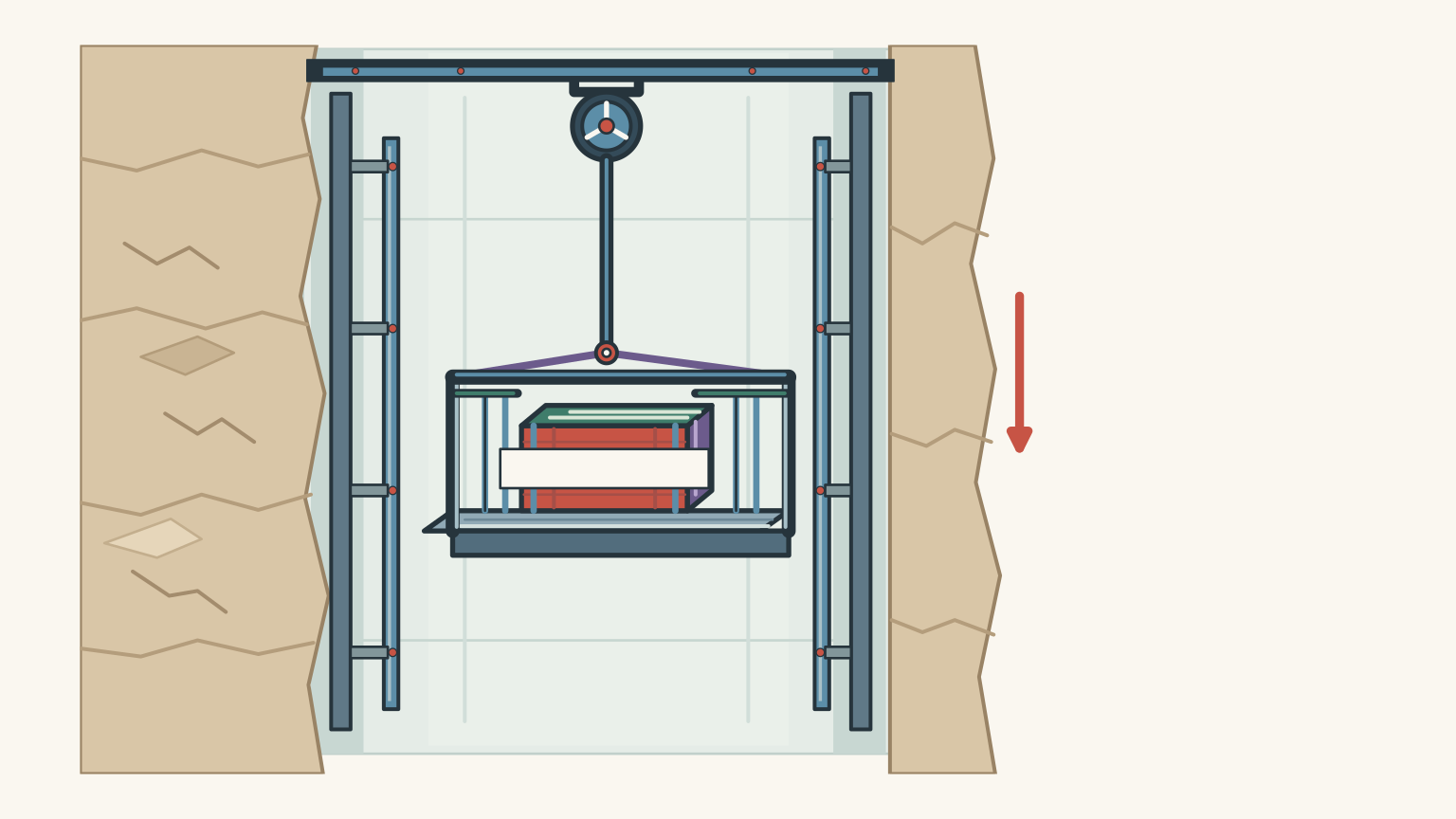
A service lift is carrying equipment down a mine shaft. It is travelling downwards, but slowing down. An HSC Physics question asks you to determine the direction of the resultant force.
You have never studied mine lifts. Does that matter?
Not really. The unfamiliar setting is hiding a familiar physics concept: acceleration and Newton’s second law. Because the lift is moving downwards while slowing, its acceleration is upwards. The resultant force must therefore act upwards.
This is exactly the kind of thinking an HSC exam can test.
Yes, an HSC exam can ask you to apply your knowledge to a situation you have never encountered before. However, that is different from expecting you to know an entirely untaught scientific principle, mathematical technique, or specialist fact.
Understanding that distinction makes a big difference to how you prepare.
Due to technical limitations, this figure may display incorrectly or contain inaccuracies. Please check key details against your course materials.
01What does NESA actually expect?
Unfamiliar questions aren’t an accident or a loophole in the NSW HSC.
NESA explicitly includes the ability to apply knowledge to unfamiliar situations in its performance band descriptions.
For example:
- Physics: The 2017 Stage 6 Physics Band 5 and Band 6 descriptions include applying knowledge and information to unfamiliar situations to explain scientific scenarios.
- Chemistry: The 2017 Stage 6 Chemistry Band 5 and Band 6 descriptions include applying knowledge to unfamiliar situations to develop scientific explanations and solutions.
- Mathematics Extension 1: The new syllabus describes sophisticated, multi-step reasoning in familiar and unfamiliar situations as characteristic of E4 performance.
- Mathematics Extension 2: The new syllabus includes solving problems and proving results in familiar and unfamiliar situations in its E4 performance description.
You can read these expectations directly in NESA’s Physics performance band descriptions, Chemistry performance band descriptions, Mathematics Extension 1 performance band descriptions, and Mathematics Extension 2 performance band descriptions.
These descriptions summarise typical achievement. They aren’t a promise that every examination will contain unfamiliar scenarios.
The important point is that NESA expects students to do more than reproduce an example they have memorised. They need to understand the underlying ideas well enough to use them in different circumstances.
There is also an important distinction in NESA’s HSC examination specifications.
For the current 2017 Physics and Chemistry syllabuses, NESA states that:
- The external examination measures achievement against syllabus outcomes.
- Questions may require students to integrate knowledge, understanding, and skills developed throughout the course.
- The Year 11 course is assumed knowledge for the Year 12 course.
- Working Scientifically skills are integrated throughout the examination.
You can find these requirements in the official Physics examination specifications and Chemistry examination specifications.
So, yes, a question might combine ideas from different parts of your course or introduce a situation that looks completely unfamiliar.
That doesn’t mean the examiner expects you to have studied every possible application of those ideas.
02What can be unfamiliar, and what should you already know?
It helps to separate the information presented in a question from the knowledge needed to answer it.
| Part of the question | Can it be unfamiliar? | What you need to demonstrate |
|---|---|---|
| Setting or scenario | Yes | Recognise which course concepts are relevant |
| Object, device, or material | Yes | Understand the information provided about it |
| Graphs and experimental data | Yes | Interpret data, identify relationships, and draw conclusions |
| Combination of concepts | Yes | Connect ideas from different parts of the syllabus |
| New variable or mathematical model | Yes, if defined or explained | Apply the supplied information using mathematical skills |
| Core syllabus knowledge | It can be unfamiliar to you personally, but it is examinable | Recall and apply the relevant course content |
| Year 11 assumed knowledge | It may not have been revised recently | Use the prerequisite knowledge developed earlier |
The last two rows are particularly important.
A question might look completely new because you haven’t revised the relevant Year 11 material for several months. That doesn’t make it outside the syllabus.
Similarly, a question can introduce a new object or chemical without introducing a new principle.
Let’s look at how this works across your subjects.
03Physics: a new situation, familiar laws
Return to the service lift from the opening example.
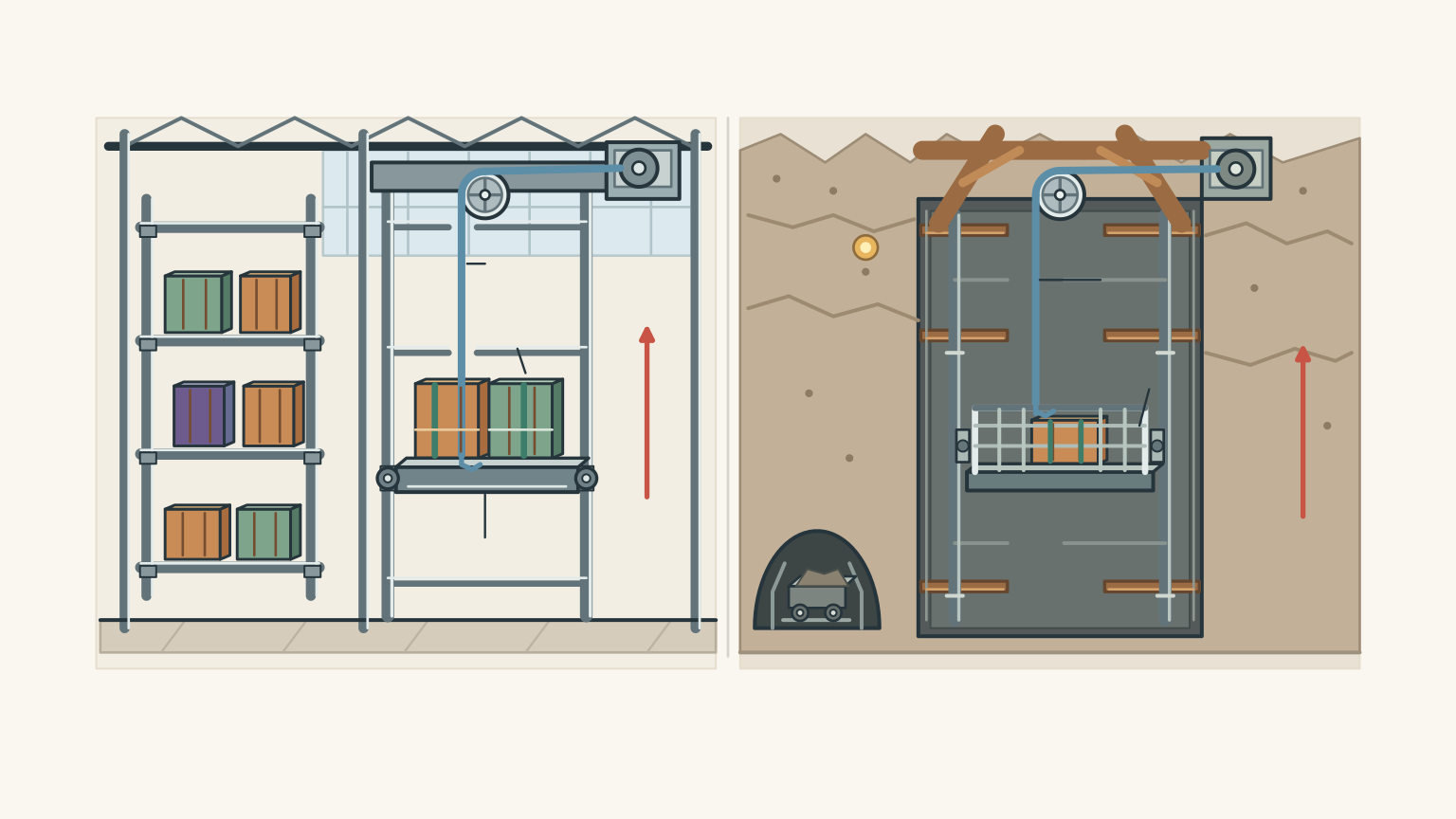
The question might describe a robotic platform transporting equipment vertically through a warehouse. You’ve never studied that particular machine.
However, the question gives you its mass, acceleration, and direction of motion.
You already know the relevant relationship:
\[ F_{\mathrm{net}}=ma \]
Here:
- \(F_{\mathrm{net}}\) is the resultant force, measured in newtons.
- \(m\) is the mass, measured in kilograms.
- \(a\) is the acceleration, measured in metres per second squared.
Newton’s second law tells you that the resultant force acts in the same direction as the acceleration.
The machine’s design is irrelevant if the question only asks you to calculate its resultant force.
This is an important distinction: you are being assessed on your understanding of physics, not your knowledge of industrial machinery.
Due to technical limitations, this figure may display incorrectly or contain inaccuracies. Please check key details against your course materials.
The same principle applies to other areas of Physics.
A question could introduce:
- A new type of satellite and ask you to apply circular motion.
- An unfamiliar electromagnetic device and ask you to analyse the forces on a charged particle.
- A new optical instrument and ask you to apply the wave model of light.
- An unfamiliar experimental arrangement and ask you to interpret its results.
You don’t need to know the technical history of the device. You need to recognise the relevant physics and understand the conditions under which the governing principles apply.
04Chemistry: an unfamiliar substance doesn’t mean unfamiliar chemistry
Chemistry provides another useful example.
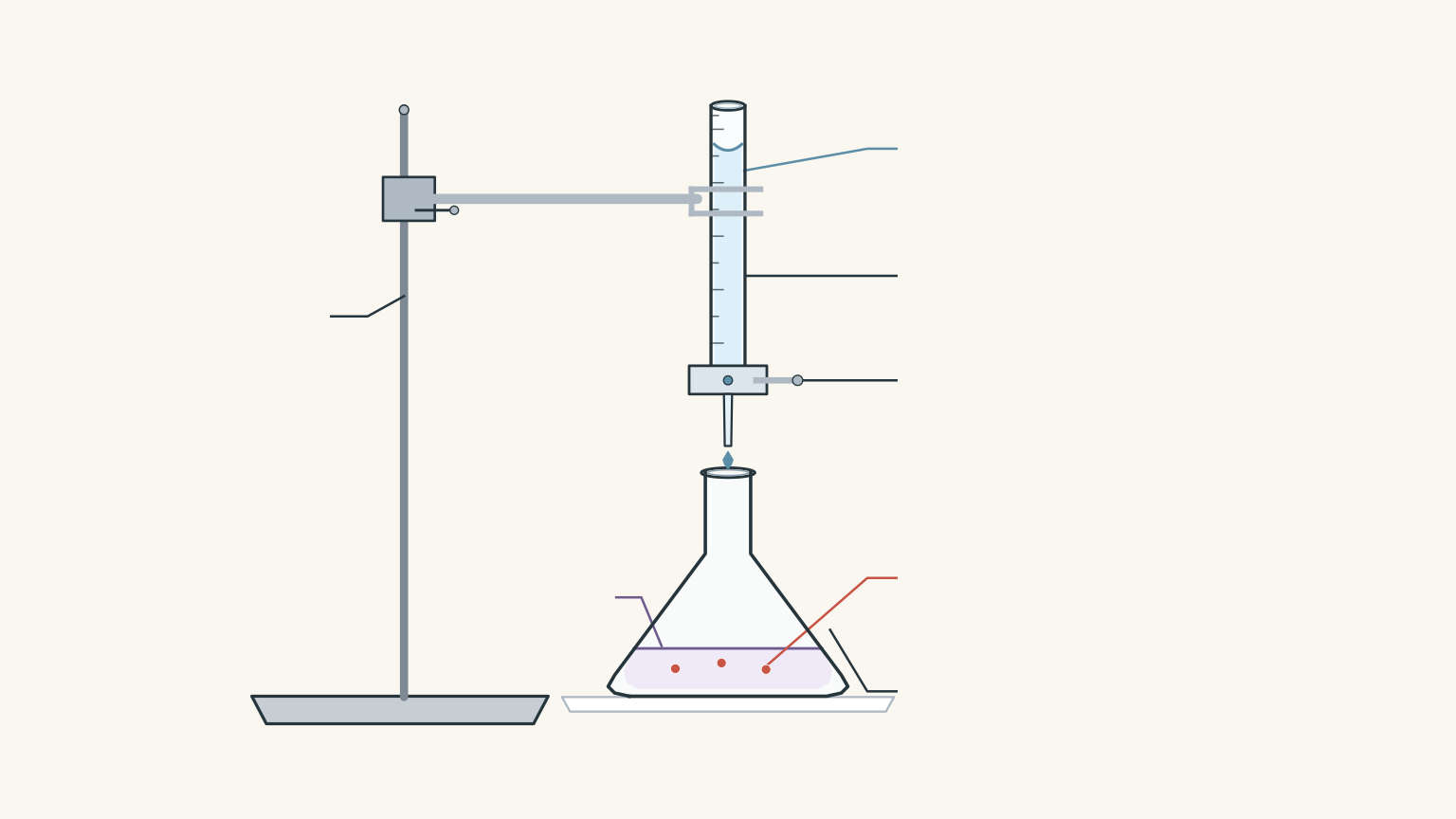
Imagine an examination question introduces a cleaning solution containing a chemical called HX. You’ve never encountered this particular acid.
The question provides its balanced reaction with sodium hydroxide:
\[ \ce{HX + NaOH -> NaX + H2O} \]
It then asks you to calculate the concentration of the acid using titration results.
What do you need to know?
You need to understand:
- How acid-base reactions work.
- How to interpret a balanced chemical equation.
- How to calculate the amount of substance using \(n=cV\).
- How to use mole ratios to relate reactants.
The name of the acid isn’t important to this calculation.
The equation tells you that one mole of HX reacts with one mole of NaOH. You can therefore use the familiar stoichiometric relationship even though the chemical itself is unfamiliar.
Due to technical limitations, this figure may display incorrectly or contain inaccuracies. Please check key details against your course materials.
This example also highlights something students sometimes overlook.
An HSC question can provide information that you haven’t memorised. You are expected to read that information and use it appropriately.
The supplied equation is not necessarily a test of whether you remember the reaction. It provides the chemical relationship needed to apply your existing knowledge.
The same applies to unfamiliar reaction data, experimental results, and chemical structures.
05Mathematics: you might be given a completely new model
In Mathematics Extension 1, an unfamiliar question might introduce a mathematical model describing the output of a solar sensor.
Suppose its output is represented by:
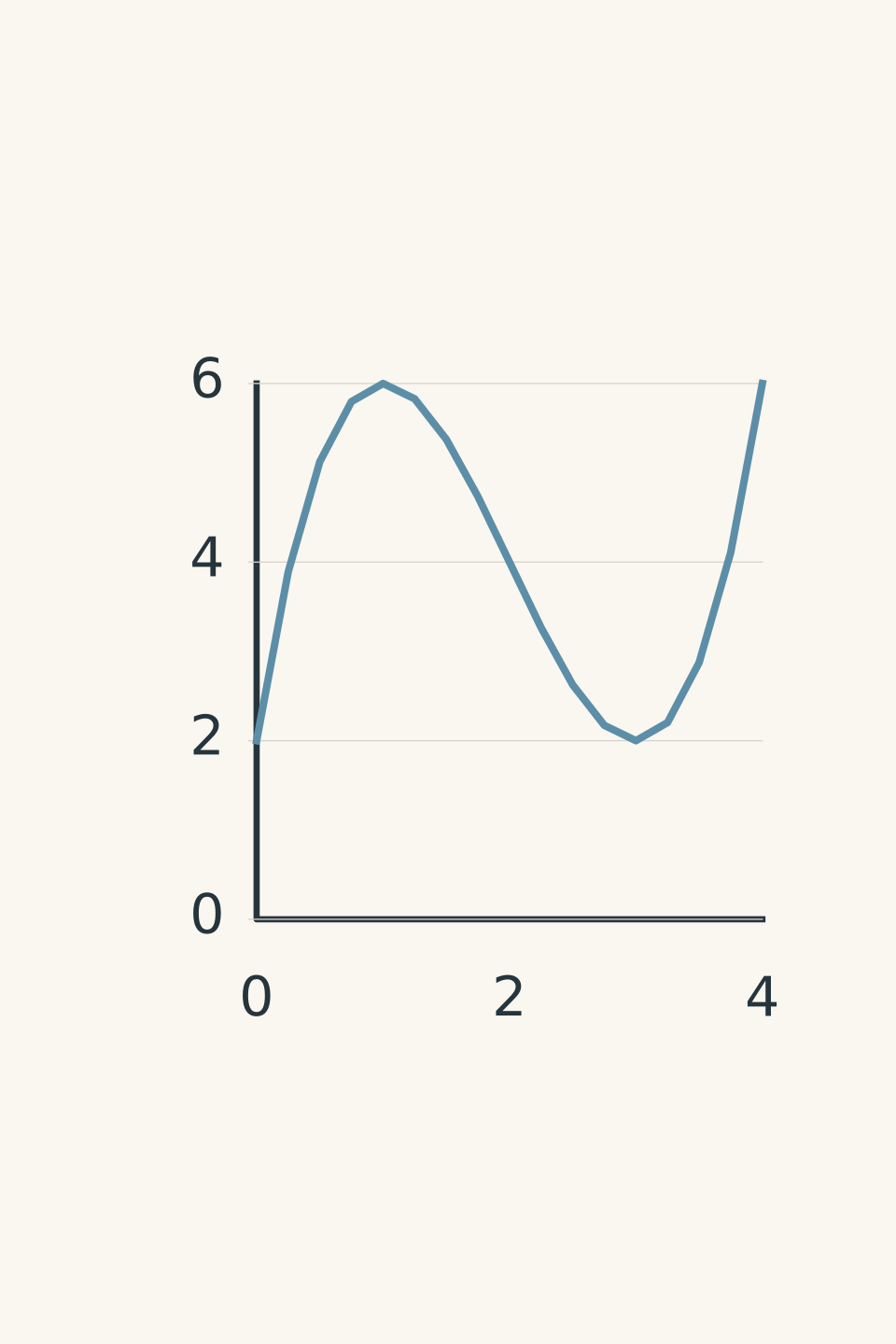
\[ S(t)=t^3-6t^2+9t+2 \]
Here, \(S(t)\) is the sensor’s output in arbitrary units, and \(t\) is time in seconds.
The question asks you to determine when the output is stationary.
You might never have encountered this sensor or its particular mathematical model. That doesn’t matter.
You recognise that stationary points occur when the derivative is zero.
Differentiate:
\[ S'(t)=3t^2-12t+9 \]
Factorise:
\[ S'(t)=3(t-1)(t-3) \]
Set the derivative equal to zero:
\[ 3(t-1)(t-3)=0 \]
Therefore:
\[ t=1 \quad \text{or} \quad t=3 \]
The sensor’s output is stationary at 1 second and 3 seconds.
The unfamiliar part was the application. The mathematical technique was familiar.
- S(t)
Due to technical limitations, this figure may display incorrectly or contain inaccuracies. Please check key details against your course materials.
Mathematics Extension 2 takes this idea further.
A question might present an unfamiliar mathematical statement, a new arrangement of vectors, or a particular algebraic relationship and ask you to prove something about it.
The statement itself might be new. The reasoning tools, however, come from the course: proof, vectors, complex numbers, calculus, and mechanics.
This is why memorising worked solutions has limitations. You need to understand why a mathematical technique works and when it can be used.
06Can an exam introduce information you haven’t been taught?
Yes. This is an important part of the distinction.
An examination question can introduce new information through what is commonly called stimulus material.
This might include:
- A short description of an unfamiliar scientific process.
- A graph showing experimental results.
- A table containing measurements.
- A new mathematical relationship.
- A diagram of an unfamiliar apparatus.
- A definition of a variable or quantity.
The question then asks you to interpret that information using your existing knowledge.
For example, imagine a Physics question gives you a graph showing the velocity of an unfamiliar vehicle over time.
You don’t need to know how the vehicle operates. You need to understand that the gradient of a velocity-time graph represents acceleration.
Or imagine a Chemistry question provides an unfamiliar equilibrium reaction and tells you whether the forward reaction is endothermic or exothermic.
You can use that information alongside Le Chatelier’s principle to predict how changing the temperature affects the equilibrium position.
The new information gives you something to reason about. It doesn’t replace the underlying syllabus knowledge.
There is a boundary, though.
A question should not normally require you to recall a specialist scientific principle that is neither part of your applicable syllabus and assumed knowledge nor explained in the question.
If a completely new relationship is required, the question needs to provide the information necessary to use it.
That is different from being expected to memorise an unlimited amount of material outside your course.
07What about Year 11 content?
This is where students can sometimes misjudge whether a question is out of syllabus.
The HSC course builds on what you studied in Year 11. You cannot assume that everything from the Preliminary course becomes irrelevant when you start Year 12.
For example:
Physics
Your Year 12 understanding of advanced mechanics relies on earlier knowledge of motion, forces, and energy.
Chemistry
Your understanding of equilibrium, acid-base reactions, and organic chemistry builds on earlier knowledge of chemical reactions, bonding, and quantitative chemistry.
Mathematics Extension 1 and 2
Your Year 12 work relies on mathematical skills and concepts developed in Mathematics Advanced and earlier Extension study.
NESA explicitly identifies Year 11 knowledge as assumed knowledge in its Physics and Chemistry HSC examination specifications. The new Mathematics Extension 1 syllabus also identifies the Year 11 course as assumed knowledge for Year 12.
This means an unfamiliar-looking question might actually be testing something you learned much earlier.
Before deciding that a question is outside the syllabus, check whether it draws on assumed knowledge or a prerequisite technique.
08Which syllabus applies to your HSC cohort?
There is another reason to be careful when using past examination questions: NSW is currently transitioning to new Stage 6 syllabuses.
Importantly, Physics and Chemistry have different implementation dates.
As at 15 November 2026, the relevant transition schedule is:
| Subject | Syllabus for the 2027 HSC | First HSC examination under the new syllabus |
|---|---|---|
| Physics | 2017 Stage 6 | 2028 |
| Chemistry | 2017 Stage 6 | 2029 |
| Mathematics Extension 1 | 2024 syllabus | 2027 |
| Mathematics Extension 2 | 2024 syllabus | 2027 |
The differences are worth understanding.
Physics: The new Physics 11-12 Syllabus (2025) begins for Year 11 in Term 1, 2027. The existing 2017 syllabus continues for Year 12 during 2027. The first HSC examination under the new syllabus is in 2028.
Chemistry: The new Chemistry 11-12 Syllabus (2025) begins for Year 11 in Term 1, 2028. The existing 2017 syllabus continues for Year 12 during 2028. The first HSC examination under the new syllabus is in 2029.
Mathematics Extension 1 and 2: The new 2024 syllabuses are implemented from 2026, with the first HSC examinations under the new syllabuses in 2027. The 2017 Extension 1 and Extension 2 syllabuses have their final HSC examinations in 2026.
You can check the official transition information here:
- NESA Physics Stage 6 syllabus and implementation schedule
- NESA Chemistry Stage 6 syllabus and implementation schedule
- NESA Mathematics Extension 1 syllabus
- NESA Mathematics Extension 2 syllabus
Why does this matter?
A past HSC paper might contain content or terminology from an older syllabus that doesn’t apply to your cohort.
Use examination papers and marking guidelines that match the syllabus you’re studying. An unfamiliar question is much easier to judge fairly when you know exactly what NESA expects your cohort to learn.
09How should you prepare for unfamiliar questions?
You don’t need to predict every possible scenario an examiner might invent.
In fact, trying to memorise hundreds of unfamiliar applications is a poor use of study time.
Instead, focus on three things.
1. Understand the syllabus concepts, not just their worked examples
If you’ve learned Newton’s second law, make sure you understand how it relates to acceleration and resultant force.
If you’ve learned chemical equilibrium, understand how changing temperature, concentration, or pressure affects an equilibrium system.
If you’ve learned differentiation, understand what the derivative represents and how it helps you analyse a function.
Knowing the underlying concept gives you more flexibility than remembering one particular question.
2. Practise with different representations
Don’t only practise questions that look exactly like your textbook examples.
Get comfortable working with:
- Graphs and tables.
- Experimental data.
- Unfamiliar diagrams.
- Mathematical models.
- Questions combining multiple syllabus concepts.
For Physics and Chemistry, pay particular attention to Working Scientifically skills, including interpreting data, evaluating investigations, and drawing evidence-based conclusions.
These skills are integrated throughout the HSC examinations.
3. Understand why you got a question wrong
When marking a difficult question, don’t simply write down the correct answer and move on.
Work out what actually caused the mistake.
Was it:
- A concept you hadn’t learned properly?
- A Year 11 skill you had forgotten?
- Difficulty interpreting the information provided?
- An incorrect assumption about the situation?
- A calculation or mathematical error?
- An explanation that didn’t establish the required scientific reasoning?
These problems need different solutions.
If you misunderstood equilibrium, revise equilibrium. If you understood the chemistry but misread the graph, practise interpreting graphs.
That distinction makes your revision much more efficient.
You can also use your teacher’s feedback, NESA examination papers, and marking guidelines to improve without paying for additional support. tutorgum has a guide to getting useful HSC support without paying for tutoring.
10Questions and solutions
Question 1
An automated delivery cart travels along a straight track towards the east.
At \(t=0\), its velocity is \(12.0\ \mathrm{m\,s^{-1}}\) east. After 4.0 seconds, its velocity is \(4.0\ \mathrm{m\,s^{-1}}\) east.
Assume its velocity changes uniformly.
Calculate its average acceleration, including its direction.
The cart uses a braking system you have never studied. Do you need to understand how that system operates to answer the question?
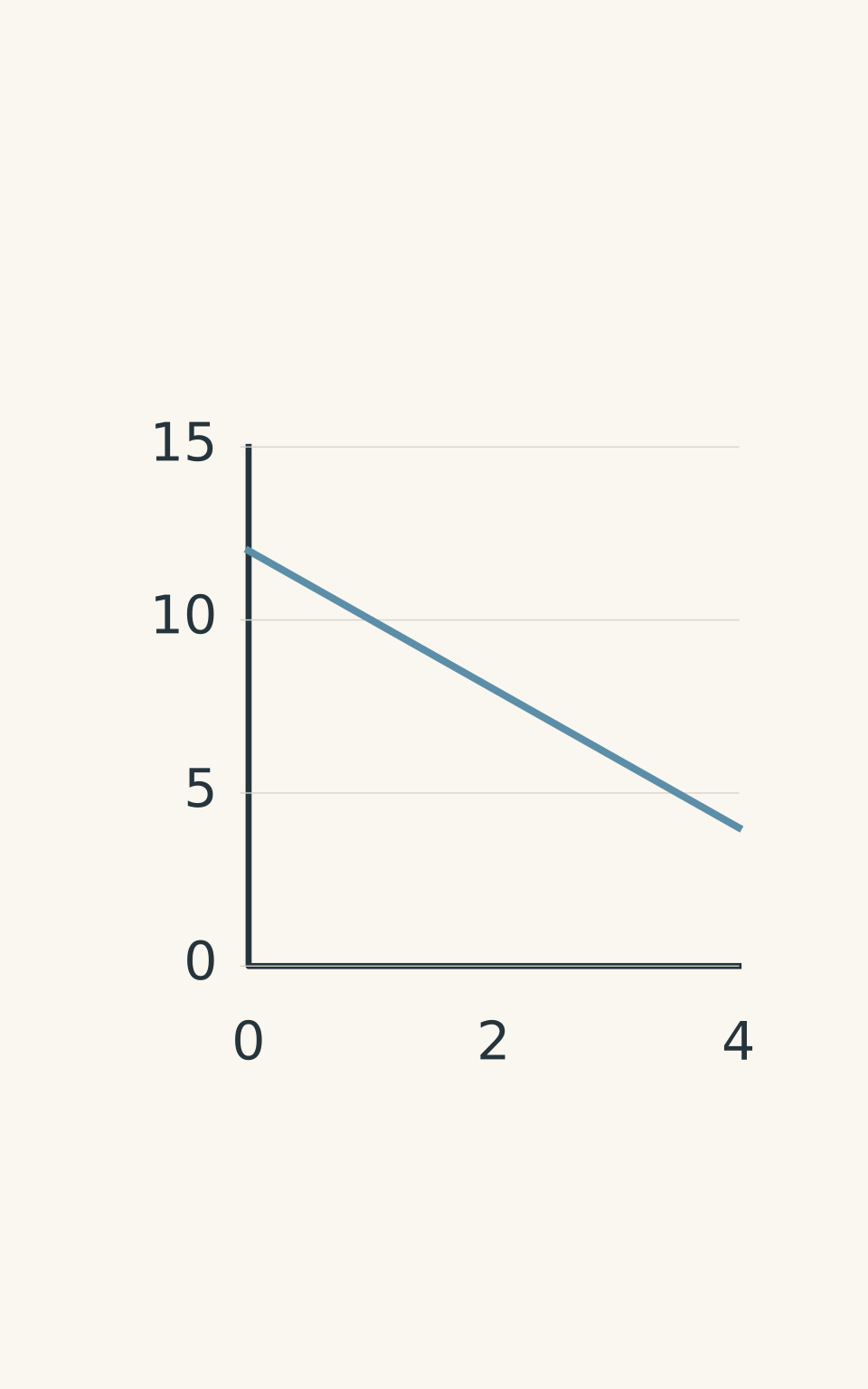
- Cart velocity
Due to technical limitations, this figure may display incorrectly or contain inaccuracies. Please check key details against your course materials.
Solution 1
The average acceleration is \(2.0\ \mathrm{m\,s^{-2}}\) west. You do not need to know how the braking system operates.
Step 1: Identify the initial and final velocities.
Taking east as the positive direction:
- Initial velocity, \(u=+12.0\ \mathrm{m\,s^{-1}}\).
- Final velocity, \(v=+4.0\ \mathrm{m\,s^{-1}}\).
- Time interval, \(\Delta t=4.0\ \mathrm{s}\).
Step 2: Apply the average acceleration formula.
\[ a_{\mathrm{avg}}=\frac{v-u}{\Delta t} \]
Substitute:
\[ a_{\mathrm{avg}}= \frac{4.0-12.0}{4.0} \]
\[ a_{\mathrm{avg}}=-2.0\ \mathrm{m\,s^{-2}} \]
Step 3: Interpret the negative sign.
We defined east as positive. Therefore, the negative acceleration indicates that acceleration acts towards the west.
The cart is still travelling east, but its speed is decreasing because its acceleration acts in the opposite direction.
The braking mechanism is irrelevant to the calculation. The supplied velocity data and the definition of acceleration are sufficient.
Question 2
An unfamiliar diprotic acid, \(\ce{H2X}\), is titrated with sodium hydroxide.
The examination provides the following balanced equation:
\[ \ce{H2X + 2NaOH -> Na2X + 2H2O} \]
A \(25.0\ \mathrm{mL}\) sample of the acid requires \(30.0\ \mathrm{mL}\) of \(0.100\ \mathrm{mol\,L^{-1}}\) sodium hydroxide to reach the endpoint.
Calculate the concentration of the acid.
Explain why you do not need to know the common name or industrial uses of \(\ce{H2X}\) to complete the calculation.

Due to technical limitations, this figure may display incorrectly or contain inaccuracies. Please check key details against your course materials.
Solution 2
The concentration of the acid is \(0.0600\ \mathrm{mol\,L^{-1}}\). Its common name and industrial applications are unnecessary because the balanced equation supplies the stoichiometric relationship.
Step 1: Calculate the amount of sodium hydroxide used.
Use:
\[ n=cV \]
where \(n\) is the amount of substance in moles, \(c\) is concentration in \(\mathrm{mol\,L^{-1}}\), and \(V\) is volume in litres.
Convert the volume:
\[ 30.0\ \mathrm{mL}=0.0300\ \mathrm{L} \]
Substitute:
\[ n(\ce{NaOH})=0.100\times0.0300 \]
\[ n(\ce{NaOH})=0.00300\ \mathrm{mol} \]
Step 2: Use the mole ratio.
The balanced equation shows that two moles of sodium hydroxide react with one mole of \(\ce{H2X}\).
Therefore:
\[ n(\ce{H2X})=\frac{0.00300}{2} \]
\[ n(\ce{H2X})=0.00150\ \mathrm{mol} \]
Step 3: Calculate the acid concentration.
Convert the acid volume:
\[ 25.0\ \mathrm{mL}=0.0250\ \mathrm{L} \]
Use:
\[ c=\frac{n}{V} \]
\[ c(\ce{H2X})= \frac{0.00150}{0.0250} \]
\[ \boxed{c=0.0600\ \mathrm{mol\,L^{-1}}} \]
The important information was supplied in the balanced equation. You needed to recognise the mole ratio and apply the titration calculations you had already learned.
This is a good example of how an examination can introduce unfamiliar information without requiring unfamiliar prior knowledge.
11What to take away
An HSC examination can absolutely present you with a situation, object, chemical, mathematical model, or set of data that you’ve never encountered before.
That doesn’t mean you need to know everything about it.
The distinction is between knowing the subject and knowing every possible application of the subject. NESA expects you to develop the first, not memorise the second.
Your preparation should therefore focus on understanding syllabus concepts, recognising how they connect, and practising their application in different situations.
The next useful skill to develop is interpreting stimulus material: graphs, experimental data, diagrams, and unfamiliar mathematical models. That’s often the bridge between a question that initially looks completely new and the knowledge you already have.