
Electric Potential and Equipotential Lines for HSC Physics
Learn how electric potential relates to potential energy, how equipotential lines show field direction and strength, and how charge sign affects motion.
Imagine two large parallel plates creating an electric field. You place a tiny positive charge between them, then move it sideways, across the gap but without getting any closer to either plate.
Does its electric potential energy change?
It might feel as though any movement in an electric field should change the energy. But sideways movement can require no work from the electric field at all. The charge can move through several centimetres while staying at exactly the same electric potential.
That is the point of equipotential lines. They show where a charge can move without changing its electric potential energy per coulomb.
01Start with energy per coulomb
Suppose moving a charge from one position to another changes its electric potential energy by \(\Delta U\).
A 1 C charge might experience a large energy change. A much smaller charge experiences a proportionally smaller one. So the energy change by itself does not tell us everything about the electric field.
We want a quantity describing the two positions, rather than depending on whichever test charge we happened to use.
So we divide the change in electric potential energy by the charge:
\[ \Delta V = \frac{\Delta U}{q} \]
where:
- \(\Delta V\) is the electric potential difference, measured in volts (V)
- \(\Delta U\) is the change in electric potential energy, measured in joules (J)
- \(q\) is the charge, measured in coulombs (C)
You will also often see this written as:
\[ V = \frac{\Delta U}{q} \]
when \(V\) is being used for the potential difference between two points.
One volt means one joule of energy change per coulomb:
\[ 1\text{ V} = 1\text{ J C}^{-1} \]
So a potential difference of 12 V means that the electric potential energy changes by 12 J for every coulomb of positive charge moved between those two positions.
This is why voltage is often described as electric potential energy per unit charge.
There is one precision worth keeping straight. The electric potential at a single point is usually written \(V\), relative to some chosen reference. The difference between two points is \(\Delta V\). In many HSC calculations, the word “voltage” refers to this potential difference.
If you need a refresher on how electric potential energy changes when charges move, see Electric Potential Energy and Work in Electric Fields.
02Potential belongs to the position, not the test charge
Here is an important distinction.
Electric potential energy \(U\) depends on the charge placed in the field.
Electric potential \(V\) describes the position in the field.
Think of a hill. The height of a particular point on the hill does not depend on whether you stand there holding a backpack, a brick, or nothing at all. But the gravitational potential energy of the object does depend on its mass.
Electric potential works similarly.
The analogy is useful, but not exact. Gravitational mass is always positive, while electric charge can be positive or negative. That sign difference causes some behaviour that initially feels backwards.
From
\[ \Delta V = \frac{\Delta U}{q} \]
we can rearrange:
\[ \Delta U = q\Delta V \]
This form is extremely useful because it tells us how a particular charge responds to a potential difference.
For a positive charge, \(\Delta U\) has the same sign as \(\Delta V\).
For a negative charge, \(\Delta U\) has the opposite sign to \(\Delta V\).
That will matter when we connect potential to electric field direction.
Worked example: Energy change across a potential difference
A \(3.0\times10^{-6}\text{ C}\) positive charge moves to a point that is 250 V lower in electric potential. Find the change in its electric potential energy.
Step 1
The final position is 250 V lower, so:
\[ \Delta V = -250\text{ V} \]
Step 2
\[ \Delta U=(3.0\times10^{-6})(-250) \]
\[ \Delta U=-7.5\times10^{-4}\text{ J} \]
Step 3
The answer is:
\[ \boxed{\Delta U=-7.5\times10^{-4}\text{ J}} \]
The negative sign means the charge has lost electric potential energy. A positive charge moving to lower electric potential has lower electric potential energy.
03What is an equipotential line?
Now imagine drawing a map of an electric field and marking every point with the same electric potential.
Join points that have equal potential. The result is an equipotential line.
In three dimensions, these would really be equipotential surfaces. HSC diagrams usually show a two-dimensional slice, so we draw lines.
Suppose every point on one line is at 80 V. Moving a charge from one position on that line to another gives:
\[ \Delta V=0 \]
Therefore:
\[ \Delta U=q\Delta V=q(0)=0 \]
So moving along an equipotential causes no change in electric potential energy, regardless of the value or sign of the charge.
That gives us the key meaning:
An equipotential line joins points with the same electric potential.
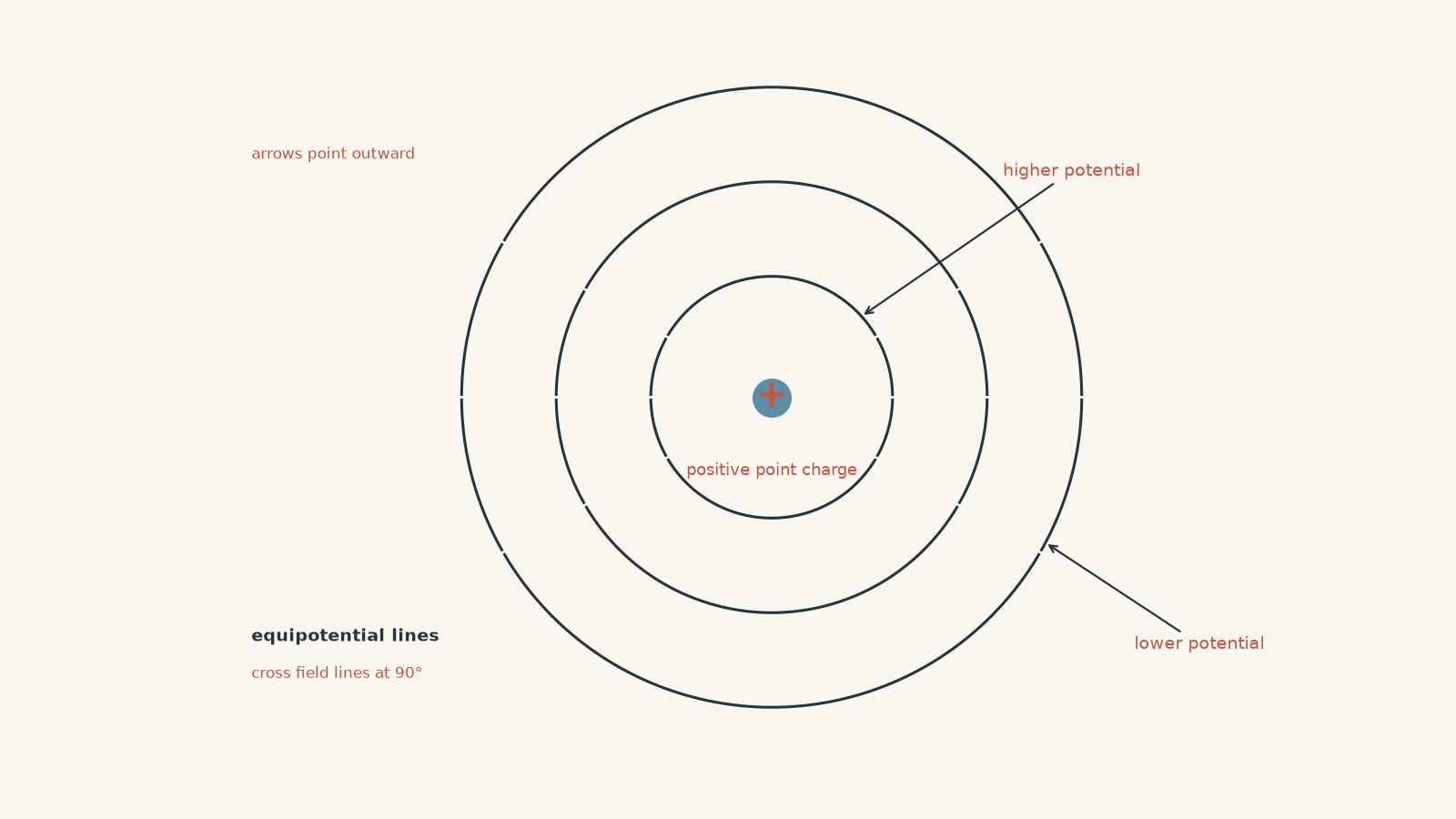
For a positive point charge, the electric field points radially outwards. Its equipotential lines are concentric circles in a two-dimensional diagram.
Every point on one circle is the same distance from the charge, so every point has the same potential.
04Why must electric field lines cross equipotentials at 90 degrees?
Here is the important prediction.
Suppose an electric field line crossed an equipotential line at an angle other than \(90^\circ\). What would that imply?
The electric field would have some component pointing along the equipotential.
A positive test charge would then feel a force along the equipotential. The field would do work as the charge moved along it.
But we have already shown that movement along an equipotential has:
\[ \Delta V=0 \]
and therefore:
\[ \Delta U=0 \]
The electric field cannot do net work along that path.
So the electric field cannot have a component parallel to an equipotential.
Therefore:
Electric field lines meet equipotential lines at right angles.
This is not just a diagram convention. It follows from the relationship between electric force, work, and potential energy.
05Which way does the electric field point?
Knowing that the field is perpendicular to equipotentials gives us the angle, but we still need the direction.
The electric field points from higher electric potential towards lower electric potential.
For example, suppose neighbouring equipotential lines are labelled:
- 120 V
- 100 V
- 80 V
- 60 V
The electric field points from the 120 V line towards the 60 V line.
Why?
Imagine releasing a small positive test charge. The electric force on a positive charge points in the direction of the electric field.
As the positive charge accelerates, its kinetic energy increases. That energy has to come from somewhere, so its electric potential energy decreases.
For a positive charge:
\[ \Delta U=q\Delta V \]
Since \(q>0\), decreasing \(U\) means decreasing \(V\).
So the field direction is:
\[ \boxed{\text{high potential} \rightarrow \text{low potential}} \]
If you want to connect this directly to ordinary electric field-line diagrams, see Electric Field Lines Around a Point Charge: HSC Physics Guide.
06The negative-charge trap
A very tempting conclusion is:
“Charges always move from high potential to low potential.”
That is not correct.
Electric field direction is always from higher potential towards lower potential.
But the force on a charge depends on the sign of the charge:
\[ \vec F=q\vec E \]
A positive charge feels force in the field direction.
A negative charge feels force opposite the field direction.
So a freely released electron can accelerate towards higher electric potential.
Does that mean its electric potential energy increases?
Predict before continuing.
For an electron, \(q<0\). If it moves to higher potential, then \(\Delta V>0\), but:
\[ \Delta U=q\Delta V \]
A negative number multiplied by a positive number is negative. Therefore:
\[ \Delta U<0 \]
Its electric potential energy still decreases.
This is the part worth remembering:
- electric field points towards lower \(V\)
- positive charges are forced in the field direction
- negative charges are forced opposite the field direction
- a freely accelerating charge can lose potential energy in either case
The sign of \(q\) connects potential to potential energy.
07Equipotential spacing tells you about field strength
Equipotential diagrams can tell you more than field direction.
Suppose two neighbouring equipotential lines differ by 10 V.
In one region they are 1 mm apart. Somewhere else they are 5 cm apart.
Which region has the stronger electric field?
The 1 mm region.
The same change in potential is occurring over a much shorter distance. That means the potential is changing more rapidly with position.
For a uniform electric field, the magnitude is:
\[ E=\frac{|\Delta V|}{d} \]
where:
- \(E\) is electric field strength in \(\text{V m}^{-1}\), equivalent to \(\text{N C}^{-1}\)
- \(|\Delta V|\) is the magnitude of the potential difference in volts
- \(d\) is the distance measured in the field direction, in metres
For a non-uniform field, this equation can still describe the field approximately over a very small distance. More generally, the field is stronger where equal-potential lines are closer together.
So an equipotential diagram gives two pieces of information:
| Feature of the diagram | What it tells you |
|---|---|
| Direction perpendicular to equipotentials | Electric field direction |
| Arrow from high \(V\) to low \(V\) | Sense of the electric field |
| Closely spaced equipotentials | Stronger electric field |
| Widely spaced equipotentials | Weaker electric field |
| Movement along one equipotential | \(\Delta V=0\) and \(\Delta U=0\) |
Worked example: Reading field strength from equipotentials
Two straight parallel equipotential lines are labelled 90 V and 30 V. They are separated by 4.0 cm, and the potential changes uniformly between them. Determine the electric field magnitude and direction.
Step 1
\[ |\Delta V|=|30-90|=60\text{ V} \]
Step 2
\[ 4.0\text{ cm}=0.040\text{ m} \]
Step 3
\[ E=\frac{|\Delta V|}{d} =\frac{60}{0.040} =1.5\times10^3\text{ V m}^{-1} \]
Step 4
The field points from higher potential to lower potential, so it points from the 90 V line towards the 30 V line.
Therefore:
\[ \boxed{E=1.5\times10^3\text{ V m}^{-1}} \]
directed from the 90 V equipotential towards the 30 V equipotential.
The number tells us how quickly potential changes with distance in the field direction. Here, moving 1 m in that direction would correspond to a 1500 V change if the uniform field continued that far.
08Why distance must be measured perpendicular to the equipotentials
Suppose the same 90 V and 30 V equipotential lines are 4.0 cm apart, but you travel diagonally between them along a 7.0 cm path.
Should you calculate:
\[ E=\frac{60}{0.070}? \]
No.
The electric field is perpendicular to the equipotential lines. Only displacement in that direction changes the potential.
The extra sideways motion does not contribute to the potential difference.
This is the same reason that walking sideways along a contour line on a topographic map does not change your height. The contour-line analogy is useful because each contour has one height, just as each equipotential has one voltage.
But the analogy breaks when charge sign becomes important. Height does not reverse its effect because you swapped a positive object for a negative one. Electric potential energy can.
For a uniform field, use the perpendicular separation between equipotential lines:
\[ E=\frac{|\Delta V|}{d_\perp} \]
That geometrical detail is an easy place to lose marks.
09A more difficult example: Negative charge crossing equipotentials
Worked example: An electron moves towards higher potential
An electron moves from a 40 V equipotential to a 190 V equipotential. The electron has charge \(q=-1.60\times10^{-19}\text{ C}\). Calculate the change in its electric potential energy, and state whether the electric field does positive or negative work on the electron.
Step 1
\[ \Delta V=190-40=150\text{ V} \]
Step 2
Use:
\[ \Delta U=q\Delta V \]
Substituting:
\[ \Delta U=(-1.60\times10^{-19})(150) =-2.40\times10^{-17}\text{ J} \]
So:
\[ \boxed{\Delta U=-2.40\times10^{-17}\text{ J}} \]
The electron loses electric potential energy even though it moves towards higher electric potential.
Step 3
Work done by the electric field is related to potential energy by:
\[ W_{\text{field}}=-\Delta U \]
Therefore:
\[ W_{\text{field}}=+2.40\times10^{-17}\text{ J} \]
The field does positive work on the electron.
That result is a good test of whether you are keeping potential and potential energy separate. The electron moves to higher \(V\), but because its charge is negative, its \(U\) decreases.
10A reliable way to read an equipotential diagram
When you are given an unfamiliar diagram, use this order.
- Read the voltage labels first. Identify which regions have higher and lower potential.
- Draw the electric field perpendicular to the equipotentials.
- Point the field from high \(V\) to low \(V\).
- Compare spacing. Closer equipotentials mean a larger field magnitude.
- Only then think about a charged particle. Positive charges feel force along \(\vec E\), while negative charges feel force opposite \(\vec E\).
- Use \(\Delta U=q\Delta V\) if the question asks about energy.
This order prevents one of the most common mistakes: using the motion of an electron to decide which way the electric field points. Field direction is defined using a positive test charge, not an electron.
11Questions and solutions
Question 1
A \(2.5\times10^{-6}\text{ C}\) positive charge moves from a point at 70 V to a point at 20 V.
Calculate the change in its electric potential energy, and state whether its potential energy increases or decreases.
Solution 1
The electric potential energy decreases by \(1.25\times10^{-4}\text{ J}\).
First calculate the potential change:
\[ \Delta V=V_f-V_i=20-70=-50\text{ V} \]
Use:
\[ \Delta U=q\Delta V \]
Substituting:
\[ \Delta U=(2.5\times10^{-6})(-50) =-1.25\times10^{-4}\text{ J} \]
Therefore:
\[ \boxed{\Delta U=-1.25\times10^{-4}\text{ J}} \]
The negative sign means the positive charge has lost electric potential energy. This makes sense because a positive charge has lower potential energy at lower electric potential.
Question 2
Three parallel equipotential lines are labelled 180 V, 120 V, and 60 V. The perpendicular distance from the 180 V line to the 120 V line is 2.0 cm. The distance from the 120 V line to the 60 V line is 5.0 cm.
Compare the average electric field magnitudes in the two regions, and state the field direction.
Solution 2
The electric field is stronger between 180 V and 120 V. In both regions, it points towards decreasing potential, from 180 V towards 60 V.
For the first region:
\[ |\Delta V|=60\text{ V} \]
and:
\[ d=2.0\text{ cm}=0.020\text{ m} \]
Therefore:
\[ E_1=\frac{60}{0.020} =3.0\times10^3\text{ V m}^{-1} \]
For the second region:
\[ |\Delta V|=60\text{ V} \]
and:
\[ d=5.0\text{ cm}=0.050\text{ m} \]
Therefore:
\[ E_2=\frac{60}{0.050} =1.2\times10^3\text{ V m}^{-1} \]
So:
\[ \boxed{E_1=3.0\times10^3\text{ V m}^{-1}} \]
and:
\[ \boxed{E_2=1.2\times10^3\text{ V m}^{-1}} \]
The first region has the greater field magnitude because the same 60 V potential change occurs over a shorter distance.
The field direction is perpendicular to the equipotentials and from higher to lower potential.
Question 3
A negatively charged particle is released from rest in an electric field. It begins moving from a 25 V equipotential towards a 55 V equipotential.
A student says, “That cannot happen naturally because electric fields always push charges towards lower voltage.”
Explain what is wrong with the student’s reasoning. State what happens to the particle’s electric potential energy as it moves.
Solution 3
The particle can naturally accelerate towards the 55 V equipotential, and its electric potential energy decreases.
The student’s mistake is confusing electric field direction with force direction for every charge.
The electric field points from higher potential to lower potential. In this case, that means the field points from 55 V towards 25 V.
However:
\[ \vec F=q\vec E \]
For a negative charge, \(q<0\), so the force is opposite to the electric field. The negative particle can therefore accelerate from 25 V towards 55 V.
Its potential change is positive:
\[ \Delta V=55-25=+30\text{ V} \]
But:
\[ \Delta U=q\Delta V \]
Since \(q\) is negative and \(\Delta V\) is positive:
\[ \Delta U<0 \]
Therefore its electric potential energy decreases.
The tempting misconception is that “lower potential” and “lower potential energy” always mean the same thing. They do for a positive charge, but not for a negative charge.
Question 4
An equipotential map contains two lines labelled 100 V and 60 V. At one location their shortest separation is 1.5 cm.
A particle travels from the 100 V line to the 60 V line along a curved path of total length 6.0 cm.
A student calculates the electric field as:
\[ E=\frac{40}{0.060}=6.7\times10^2\text{ V m}^{-1} \]
Explain why this calculation is not justified. If the field can be treated as approximately uniform in the small region where the lines are 1.5 cm apart, estimate its magnitude there.
Solution 4
The student’s use of the 6.0 cm path length is incorrect. The local field magnitude is approximately \(2.7\times10^3\text{ V m}^{-1}\).
Potential changes according to displacement in the electric field direction. The electric field is perpendicular to the equipotential lines, so the relevant distance is their perpendicular separation, not the total distance travelled by the particle.
The potential difference is:
\[ |\Delta V|=|60-100|=40\text{ V} \]
The perpendicular separation is:
\[ d=1.5\text{ cm}=0.015\text{ m} \]
If the field is approximately uniform over that small region:
\[ E=\frac{|\Delta V|}{d} =\frac{40}{0.015} =2.67\times10^3\text{ V m}^{-1} \]
Therefore:
\[ \boxed{E\approx2.7\times10^3\text{ V m}^{-1}} \]
The deeper point is that voltage difference depends only on the starting and finishing positions, not on the route taken between them. A long curved path does not automatically imply a smaller electric field.
Question 5
A diagram shows several curved equipotential lines. Two neighbouring lines are labelled 20 V and 40 V. They are very close together at point P but much farther apart at point Q.
A positive charge and an electron are separately released from rest near P.
Without knowing the exact shape of the lines, state:
- how the electric field magnitude near P compares with that near Q
- the direction of the electric field near P
- which way the positive charge initially accelerates
- which way the electron initially accelerates
- whether each particle initially tends towards higher or lower electric potential energy
Solution 5
The field is stronger near P, points from the 40 V equipotential towards the 20 V equipotential, the positive charge accelerates towards lower potential, the electron accelerates towards higher potential, and both particles can lose electric potential energy.
First, closer equipotential spacing means a larger change in potential per unit distance. Therefore:
\[ \boxed{E_P>E_Q} \]
The electric field is perpendicular to the equipotential lines and points from high potential to low potential. So near P it points from the 40 V line towards the 20 V line.
For the positive charge:
\[ \vec F=q\vec E \]
with \(q>0\), so its force and acceleration are in the electric field direction. It initially accelerates towards the 20 V line.
Its potential is decreasing, so \(\Delta V<0\). Because \(q>0\):
\[ \Delta U=q\Delta V<0 \]
Its electric potential energy decreases.
For the electron, \(q<0\), so its force is opposite the electric field direction. It initially accelerates towards the 40 V line, which is higher electric potential.
For the electron, \(\Delta V>0\), but \(q<0\), so:
\[ \Delta U=q\Delta V<0 \]
Its electric potential energy also decreases.
This is why field direction, particle motion, electric potential, and electric potential energy must be kept as separate ideas. Once those four are separated, equipotential diagrams become much easier to read.
The next useful connection is the quantitative relationship between potential difference and electric field strength. In a uniform field, equipotentials are equally spaced and the relationship becomes \(E=|\Delta V|/d\), which is developed further in Electric Field and Potential Difference Using E = V/d.