
Metal Reactivity with Dilute Acids: HSC Chemistry Guide
Learn how metal reactivity affects the rate of reaction with dilute acids, hydrogen gas production, and fair experimental comparisons.
Two identical flasks contain the same volume and concentration of dilute hydrochloric acid. You drop magnesium into one and zinc into the other. Both metals have the same number of moles.
Which flask produces hydrogen gas faster? And which produces more hydrogen gas in total?
It is tempting to answer “magnesium” to both. The first answer is right. The second is not.
Magnesium reacts faster because it is more reactive than zinc. But if the acid is in excess, equal amounts in moles of magnesium and zinc produce the same final amount of hydrogen gas. Reaction rate and total gas produced tell you different things.
That distinction is the key to comparing metal reactivity with dilute acids.
01What you actually observe
Place a reactive metal into dilute hydrochloric acid and you may see bubbles forming on its surface. The metal gradually disappears, and the test tube can become warmer.
For example:
\[
\ce{Mg(s) + 2HCl(aq) -> MgCl2(aq) + H2(g)}
\]
The bubbles are hydrogen gas, \(\ce{H2}\).
Now imagine repeating the experiment with equal-sized samples of several metals under the same conditions.
| Metal | Typical observation with dilute hydrochloric acid | Relative reaction rate |
|---|---|---|
| Magnesium | Rapid bubbling, metal disappears quickly | Fast |
| Zinc | Steady bubbling | Moderate |
| Iron | Slower bubbling | Slow |
| Copper | No observable reaction | Essentially none |
This gives a practical way to compare their relative reactivities:
\[
\ce{Mg > Zn > Fe > H > Cu}
\]
Here, the order means magnesium has the greatest tendency of these metals to react by oxidation, while copper is below hydrogen and does not normally displace \(\mathrm{H}^{+}\) from a dilute non-oxidising acid such as hydrochloric acid.
This ordering also connects with how metals behave in other situations. For comparison, see metal reactivity with water.
02Why hydrogen gas forms
Before using the formal chemistry, picture what has to happen.
A metal atom begins as a neutral atom in the solid. To enter solution as a positive ion, it must lose electrons.
For magnesium:
\[
\ce{Mg(s) -> Mg^2+(aq) + 2e^-}
\]
Those electrons are accepted by hydrogen ions from the acid:
\[
\ce{2H+(aq) + 2e^- -> H2(g)}
\]
Combine the two half-equations:
\[
\ce{Mg(s) + 2H+(aq) -> Mg^2+(aq) + H2(g)}
\]
This is a redox reaction.
- Magnesium is oxidised because it loses electrons.
- Hydrogen ions are reduced because they gain electrons.
A useful mental model is that a more reactive metal is more willing to “hand over” electrons.
Think of two people trying to get rid of an awkward group-chat responsibility. Magnesium is desperate to hand it off. Copper would rather keep it. The analogy helps with the direction of electron transfer, but it breaks down because atoms do not make choices, and actual reactivity comes from energetic and electrochemical factors.
03Why more reactive metals usually react faster
Suppose magnesium and zinc are placed separately into identical samples of dilute hydrochloric acid.
Predict the result before reading on: which produces the steeper rise in hydrogen volume during the first 20 seconds?
Magnesium.
Under otherwise identical conditions, magnesium reacts more rapidly with \(\mathrm{H}^{+}\) than zinc. Hydrogen gas is therefore produced at a greater rate.
If hydrogen volume is plotted against time, a faster reaction has a steeper initial gradient.
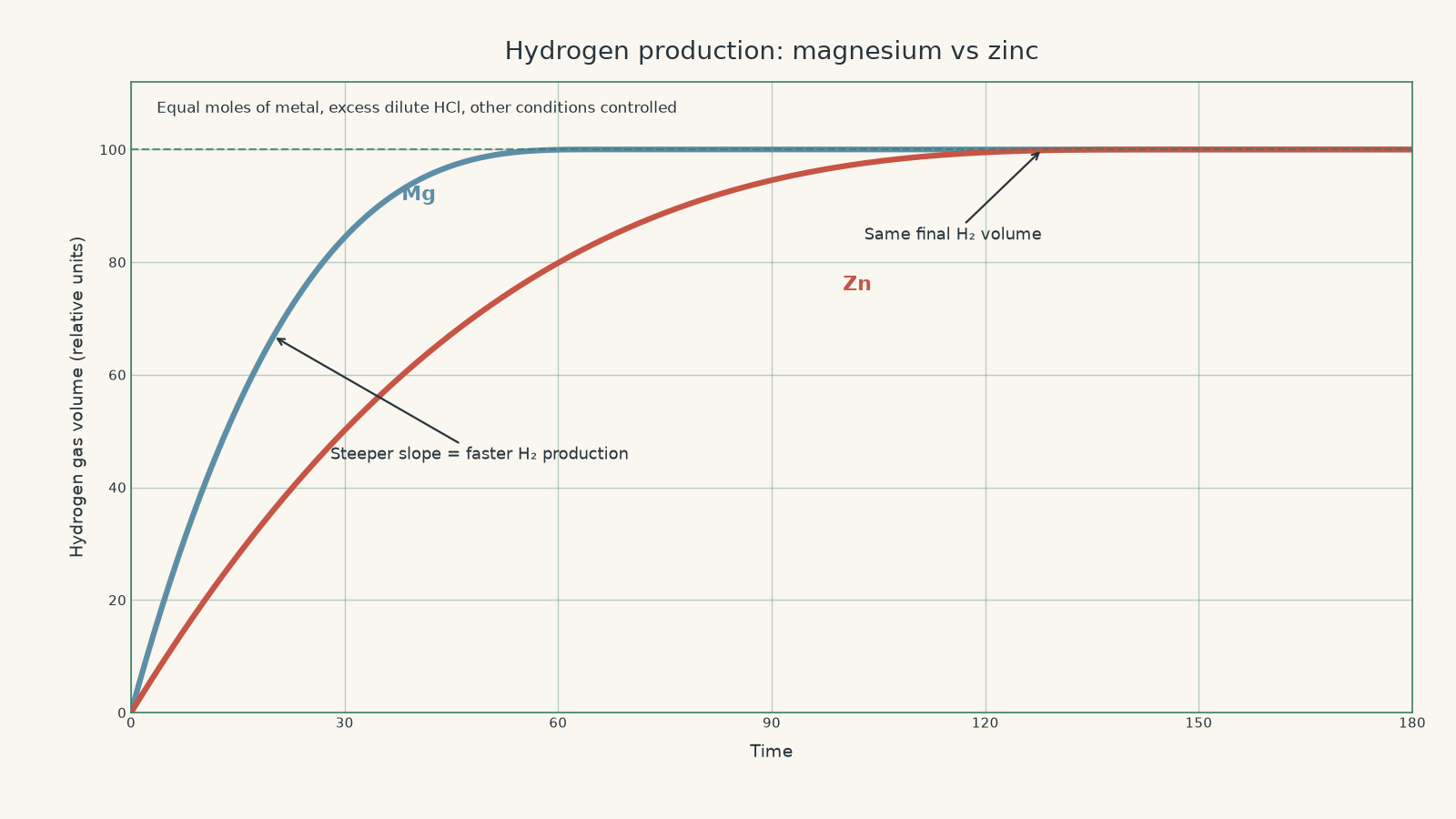
The important word here is rate.
A more reactive metal generally gives:
- more vigorous bubbling
- a greater volume of hydrogen produced per unit time
- a steeper gas-volume versus time graph
- a shorter time to consume the same amount of metal
Those observations can be used to rank relative reactivity, provided other factors affecting rate are controlled.
04Rate is not the same as total gas produced
This is the most common trap.
Suppose \(0.0100\) mol of magnesium and \(0.0100\) mol of zinc each react completely with excess hydrochloric acid.
Their equations are:
\[
\ce{Mg + 2HCl -> MgCl2 + H2}
\]
\[
\ce{Zn + 2HCl -> ZnCl2 + H2}
\]
In both equations:
\[
1\text{ mol metal} : 1\text{ mol }\ce{H2}
\]
So each metal produces:
\[
0.0100\text{ mol }\ce{H2}
\]
Magnesium gets there faster. It does not get to a larger final amount.
Imagine two people filling identical buckets, except one tap runs much faster. The faster tap reaches the top first, but both buckets still contain the same amount when full.
That analogy works only when the final amount is fixed by the same limiting quantity. Change the amount of metal, its stoichiometry, or which reactant is limiting, and the final gas volumes can differ.
Worked example: Magnesium reacting with excess acid
A student adds \(0.120\) g of magnesium to excess dilute hydrochloric acid. Calculate the amount of hydrogen gas produced. Use a molar mass of \(24.3\text{ g mol}^{-1}\) for magnesium.
Step 1
\[
\ce{Mg(s) + 2HCl(aq) -> MgCl2(aq) + H2(g)}
\]
The equation shows a \(1:1\) mole ratio between magnesium and hydrogen gas.
Step 2
Using
\[
n=\frac{m}{M}
\]
where \(n\) is amount in moles, \(m\) is mass in grams, and \(M\) is molar mass in \(\text{g mol}^{-1}\):
\[
n(\ce{Mg})=\frac{0.120}{24.3}=4.94\times10^{-3}\text{ mol}
\]
Step 3
\[
n(\ce{H2})=4.94\times10^{-3}\text{ mol}
\]
So the reaction produces:
\[
\boxed{4.94\times10^{-3}\text{ mol }\ce{H2}}
\]
The result tells us the final amount of hydrogen. It tells us nothing about how quickly that hydrogen is produced.
05Comparing gas volumes properly
Gas-volume comparisons are useful, but only when you know what has been held constant.
Suppose magnesium produces 80 mL of hydrogen in 20 seconds, while zinc produces 35 mL under otherwise identical conditions. That is good evidence that magnesium is reacting faster.
But suppose you simply find that one sample eventually produces more gas than another. Can you conclude that it is the more reactive metal?
No.
The larger final gas volume might be caused by:
- more moles of metal
- a different metal-to-hydrogen stoichiometric ratio
- a different amount of acid
- one experiment having acid as the limiting reagent
- incomplete reaction
- gas escaping from the apparatus
You need to separate kinetics, which concerns rate, from stoichiometry, which determines how much product can ultimately form.
Worked example: Equal masses can give different final gas volumes
Equal \(0.500\) g samples of magnesium and zinc are separately added to excess dilute hydrochloric acid. The gas is collected under conditions where the molar gas volume is \(24.8\text{ L mol}^{-1}\).
Magnesium reacts faster. Which metal produces the larger final volume of hydrogen?
Use:
- \(M(\ce{Mg})=24.3\text{ g mol}^{-1}\)
- \(M(\ce{Zn})=65.4\text{ g mol}^{-1}\)
Step 1
The masses are equal, but the numbers of moles are not. Magnesium atoms have a lower molar mass, so \(0.500\) g of magnesium contains more moles of metal.
Step 2
For magnesium:
\[
n(\ce{Mg})=\frac{0.500}{24.3}=2.06\times10^{-2}\text{ mol}
\]
For zinc:
\[
n(\ce{Zn})=\frac{0.500}{65.4}=7.65\times10^{-3}\text{ mol}
\]
Step 3
Both reactions have a \(1:1\) mole ratio between metal and hydrogen:
\[
\ce{Mg + 2HCl -> MgCl2 + H2}
\]
\[
\ce{Zn + 2HCl -> ZnCl2 + H2}
\]
Therefore:
\[
n(\ce{H2,\ from\ Mg})=2.06\times10^{-2}\text{ mol}
\]
\[
n(\ce{H2,\ from\ Zn})=7.65\times10^{-3}\text{ mol}
\]
Step 4
Using
\[
V=nV_m
\]
where \(V\) is gas volume in litres and \(V_m=24.8\text{ L mol}^{-1}\):
\[
\begin{aligned}
V(\ce{H2,\ from\ Mg})&=(2.06\times10^{-2})(24.8)\\
&=0.510\text{ L}
\end{aligned}
\]
\[
\begin{aligned}
V(\ce{H2,\ from\ Zn})&=(7.65\times10^{-3})(24.8)\\
&=0.190\text{ L}
\end{aligned}
\]
So:
\[
\boxed{V_{\ce{Mg}}=0.510\text{ L}}
\]
\[
\boxed{V_{\ce{Zn}}=0.190\text{ L}}
\]
Magnesium produces more hydrogen here, but not simply because it is more reactive. It produces more because the equal-mass magnesium sample contains more moles.
Its greater reactivity explains why the hydrogen is produced faster.
06How to compare metals fairly
If the aim is to compare relative reactivity using reaction rate, other variables should be controlled.
A sensible comparison could use:
- equal moles of each metal
- the same acid
- the same acid concentration
- the same acid volume
- acid in excess
- similar metal surface areas
- the same temperature
- the same gas-collection apparatus
Why does surface area matter?
A powdered metal can react faster than a lump of the same metal because more metal surface is exposed to the acid. If powdered zinc reacts faster than a magnesium ribbon, you cannot immediately conclude that zinc is intrinsically more reactive. You changed two variables at once.
The same issue occurs with acid concentration. More concentrated acid contains more reacting particles per unit volume, so increasing concentration can increase collision frequency and reaction rate.
A fair reactivity comparison changes the identity of the metal while keeping these other factors as similar as possible.
07Using a gas-volume graph
A gas-volume graph can reveal two different pieces of information.
The gradient tells you about rate
The average rate of hydrogen production over a time interval can be calculated using:
\[
\text{average rate}=\frac{\Delta V}{\Delta t}
\]
where \(\Delta V\) is the change in gas volume and \(\Delta t\) is the corresponding change in time.
For example, if hydrogen volume rises from \(12\) mL at \(10\) s to \(42\) mL at \(25\) s:
\[
\text{average rate}
=
\frac{42-12}{25-10}
=
\frac{30}{15}
=
2.0\text{ mL s}^{-1}
\]
A steeper graph means a greater rate of gas production.
The plateau tells you about total product
When the graph becomes horizontal, hydrogen is no longer being produced.
The plateau height represents the final gas volume collected.
Two metals can therefore produce curves with:
- different initial gradients but the same plateau
- different gradients and different plateaus
- similar gradients but different plateaus
You cannot interpret the graph correctly by looking at only one feature.
08Why copper behaves differently
What happens if copper is placed in dilute hydrochloric acid?
A student may reason that all metals should release hydrogen because hydrochloric acid contains \(\mathrm{H}^{+}\). But copper does not normally react with dilute hydrochloric acid to produce hydrogen.
For the reaction
\[
\ce{Cu(s) + 2H+(aq) -> Cu^2+(aq) + H2(g)}
\]
to occur spontaneously under these conditions, copper would need to reduce hydrogen ions while being oxidised itself.
Copper lies below hydrogen in the usual metal reactivity series. It is not sufficiently reactive to displace hydrogen from a dilute non-oxidising acid.
So no sustained hydrogen bubbling is expected.
This also shows why “metal + acid always gives hydrogen” is not a safe rule. It applies only when the metal is sufficiently reactive and the acid behaves in the expected way.
09A caution about the word “acid”
At HSC level, comparisons of metal reactivity using hydrogen production are commonly made with dilute non-oxidising acids such as hydrochloric acid or sufficiently dilute sulfuric acid.
Do not blindly transfer the simple rule to every acid.
Nitric acid, for example, is an oxidising acid and can produce nitrogen oxides rather than hydrogen under many conditions. Its reactions need to be considered separately.
So the useful rule is not simply:
metal + acid = salt + hydrogen
A better version is:
A metal above hydrogen in the reactivity series can generally reduce \(\mathrm{H}^{+}\) from a dilute non-oxidising acid, producing hydrogen gas.
10The decision rule to remember
When comparing metals reacting with dilute acid, ask two separate questions.
| Question | What controls it? |
|---|---|
| Which metal produces hydrogen faster? | Reaction rate, strongly related to relative metal reactivity when conditions are controlled |
| Which produces more hydrogen in total? | Amounts of reactants, limiting reagent, and reaction stoichiometry |
A faster reaction is evidence of greater relative reactivity only when the experimental conditions allow a fair comparison.
A larger final gas volume, by itself, is not.
11Questions and solutions
Question 1
Equal amounts in moles of magnesium and zinc are separately added to excess dilute hydrochloric acid under identical conditions.
State which metal is expected to produce hydrogen faster, and compare the final amounts of hydrogen produced.
Solution 1
Magnesium should produce hydrogen faster, but both metals should produce the same final amount in moles of hydrogen.
Magnesium is more reactive than zinc, so under comparable conditions its reaction with hydrogen ions is faster.
Both metals react according to the same relevant stoichiometric ratio:
\[
\ce{M + 2H+ -> M^2+ + H2}
\]
where \(\ce{M}\) represents magnesium or zinc.
One mole of either metal produces one mole of \(\ce{H2}\). Because equal moles of metal are used and the acid is in excess, the final hydrogen amounts are equal.
The trap is to assume that greater reactivity automatically means more total product. Reactivity explains the faster rate here, not a larger stoichiometric yield.
Question 2
A \(0.243\) g sample of magnesium reacts completely with excess dilute hydrochloric acid.
Calculate the amount of hydrogen produced and its volume if the molar gas volume under the experimental conditions is \(24.8\text{ L mol}^{-1}\).
Use \(M(\ce{Mg})=24.3\text{ g mol}^{-1}\).
Solution 2
The reaction produces \(0.0100\) mol of hydrogen, corresponding to \(0.248\) L, or \(248\) mL.
The balanced equation is:
\[
\ce{Mg + 2HCl -> MgCl2 + H2}
\]
First calculate the amount of magnesium:
\[
\begin{aligned}
n(\ce{Mg})
&=\frac{m}{M}\\
&=\frac{0.243\text{ g}}{24.3\text{ g mol}^{-1}}\\
&=0.0100\text{ mol}
\end{aligned}
\]
The mole ratio between \(\ce{Mg}\) and \(\ce{H2}\) is \(1:1\), so:
\[
n(\ce{H2})=0.0100\text{ mol}
\]
Now use \(V=nV_m\):
\[
\begin{aligned}
V(\ce{H2})
&=(0.0100\text{ mol})(24.8\text{ L mol}^{-1})\\
&=0.248\text{ L}
\end{aligned}
\]
Therefore:
\[
\boxed{V(\ce{H2})=248\text{ mL}}
\]
This is the final volume expected if the magnesium reacts completely and the hydrogen is collected without significant loss.
Question 3
Two students compare zinc and iron by reacting each with dilute hydrochloric acid.
The zinc is supplied as small granules. The iron is supplied as one large strip. The zinc produces hydrogen more rapidly.
Can the students conclude from this experiment alone that zinc is more reactive than iron? Explain.
Solution 3
No. The result is consistent with zinc being more reactive, but the experiment does not isolate metal identity as the only cause of the faster reaction.
The zinc granules may have a greater total surface area exposed to the acid than the iron strip. Greater surface area can increase reaction rate because more metal particles are available at the metal-acid interface.
Therefore, two variables may be affecting the measured rate:
- the identity of the metal
- the exposed surface area
A valid comparison of relative reactivity should keep surface area, acid concentration, acid volume, temperature, and other relevant conditions as similar as possible.
The tempting mistake is to treat any difference in observed rate as proof of a difference in intrinsic reactivity. Rate is useful evidence only when competing explanations have been controlled.
Question 4
Metal X and metal Y both form \(2+\) ions when reacting with dilute hydrochloric acid.
Equal moles of X and Y are reacted separately with excess acid under identical conditions. The hydrogen-volume data are:
| Time (s) | Hydrogen from X (mL) | Hydrogen from Y (mL) |
|---|---|---|
| 0 | 0 | 0 |
| 20 | 38 | 18 |
| 40 | 70 | 35 |
| 60 | 90 | 51 |
| 80 | 100 | 66 |
| 100 | 100 | 79 |
| 140 | 100 | 96 |
| 160 | 100 | 100 |
Compare the relative reactivities of X and Y, and explain why the final gas volumes do not provide the same information as the early parts of the curves.
Solution 4
Metal X is more reactive than metal Y under these conditions, while the equal final gas volumes show that equal amounts in moles of hydrogen were ultimately produced.
During the first \(20\) s, the average rate for X is:
\[
\begin{aligned}
\text{rate}_X
&=\frac{38-0}{20-0}\\
&=1.9\text{ mL s}^{-1}
\end{aligned}
\]
For Y:
\[
\begin{aligned}
\text{rate}_Y
&=\frac{18-0}{20-0}\\
&=0.90\text{ mL s}^{-1}
\end{aligned}
\]
X therefore produces hydrogen more than twice as rapidly over this initial interval. Because the experiments use equal moles of metal under identical conditions, this faster rate is evidence that X is more reactive.
Both reactions eventually produce \(100\) mL of hydrogen. Since both metals form \(2+\) ions, their reactions have the form:
\[
\ce{M + 2H+ -> M^2+ + H2}
\]
Equal moles of X and Y therefore produce equal moles of hydrogen when the acid is in excess.
The plateau height tells us the amount of product formed. The slope tells us the rate of product formation. Only the rate difference distinguishes their relative reactivity in this experiment.
Question 5
A student wants to rank metals P and Q by reactivity.
In experiment 1, \(0.50\) g of P reacts with excess dilute hydrochloric acid and produces \(210\) mL of hydrogen in total.
In experiment 2, \(0.50\) g of Q reacts with excess dilute hydrochloric acid and produces \(150\) mL of hydrogen in total.
The student concludes:
“Metal P is more reactive because it produced more hydrogen.”
Evaluate this conclusion. Assume both metals react completely and each forms \(2+\) ions.
Solution 5
The conclusion is not justified. The different final hydrogen volumes do not, by themselves, show that P is more reactive than Q.
For either metal:
\[
\ce{M + 2H+ -> M^2+ + H2}
\]
so one mole of metal produces one mole of hydrogen.
However, the experiments use equal masses, not equal moles.
The number of moles in a sample is:
\[
n=\frac{m}{M}
\]
where \(M\) is the metal’s molar mass.
If P has a lower molar mass than Q, then \(0.50\) g of P contains more moles of metal. It could therefore produce more moles of hydrogen even if P were not the more reactive metal.
To compare relative reactivity, the student should use rate evidence under controlled conditions, such as the initial rate of hydrogen production for equal moles and comparable surface areas of the two metals.
The hidden assumption in the student’s claim is that equal masses represent equal amounts of reacting particles. They do not.
Question 6
Three metals, R, S, and T, are tested separately with the same dilute hydrochloric acid.
- R produces rapid hydrogen bubbling.
- S produces slow hydrogen bubbling.
- T produces no detectable hydrogen.
- A student later crushes S into a fine powder and finds that powdered S initially produces hydrogen faster than a large piece of R.
Another student concludes that S must therefore be more reactive than R.
Assess the evidence and give the strongest reactivity conclusions that can be justified.
Solution 6
The original controlled observations support R being more reactive than S, while T is the least able of the three to reduce hydrogen ions under the tested conditions. The powdered-S result does not overturn the R versus S comparison because surface area has changed.
In the original comparison, assuming the conditions and exposed metal surfaces were appropriately controlled, R produced hydrogen faster than S. Faster reaction with the same dilute acid is evidence of greater relative reactivity:
\[
\boxed{\ce{R > S}}
\]
T produced no detectable hydrogen. This suggests that T does not readily displace hydrogen from the dilute hydrochloric acid under those conditions. It may lie below hydrogen in the relevant reactivity ordering, although “no detectable reaction” should be treated as an experimental observation rather than proof that absolutely no reaction occurs.
The second experiment changes the surface area. Crushing S exposes many more metal particles to the acid. Its reaction can therefore become faster even though the intrinsic relative reactivity of the element has not changed.
So the observation
\[
\text{powdered S reacts faster than a large piece of R}
\]
does not justify
\[
\ce{S > R}
\]
because reaction rate is being affected by both metal identity and surface area.
This is why metal-acid experiments become much more useful when you separate two ideas carefully: reactivity determines a metal’s tendency to undergo the redox reaction, while experimental conditions determine how quickly that tendency is expressed. That distinction leads directly into collision theory, activation energy, and more quantitative ways of comparing redox behaviour.