
Standard Reduction Potentials for Metal Reactions in HSC Chemistry
Learn how to use standard reduction potentials to predict whether a metal will react in a solution. Includes worked examples, common traps, and challenging HSC-style questions.
Put a strip of zinc into blue \(\ce{CuSO4(aq)}\) and copper can coat the zinc. Put copper into \(\ce{ZnSO4(aq)}\), and the obvious reverse reaction does not happen. Same two elements, opposite setup. What decides the direction?
Predict before using any numbers: in the first beaker, which species should take electrons – \(\ce{Zn(s)}\) or \(\ce{Cu^2+(aq)}\)? The copper ions take them. Zinc atoms lose electrons and enter the solution as \(\mathrm{Zn}^{2+}\), while \(\mathrm{Cu}^{2+}\) gains those electrons and becomes copper metal.
A standard reduction-potential table turns that idea into a numerical test.
01What a standard reduction potential is telling you
Every half-equation in the table is written as a reduction: electrons appear on the left.
For example,
\[
\ce{Cu^2+(aq) + 2e- <=> Cu(s)}
\qquad E^\circ = +0.34\ \text{V}
\]
and
\[
\ce{Zn^2+(aq) + 2e- <=> Zn(s)}
\qquad E^\circ = -0.76\ \text{V}
\]
The symbol \(E^\circ\) is the standard reduction potential, measured in volts, V. The little degree sign means the value refers to standard-state conditions.
The key comparison is simple:
- a more positive \(E^\circ\) means the reduction on the page has a greater thermodynamic tendency to occur
- the species being reduced is the oxidising agent
- a metal from a sufficiently negative reduction pair tends to run its listed half-equation backwards, so the metal is oxidised and acts as a reducing agent
Think of the table as a slightly awkward dating app for electrons. The species on the left are competing to be the electron receiver. A more positive \(E^\circ\) is a stronger application.
The analogy breaks quickly. Reduction potential is not a permanent personality trait. Concentration, temperature, other possible reactions, and kinetic barriers can affect what actually happens in a real beaker.
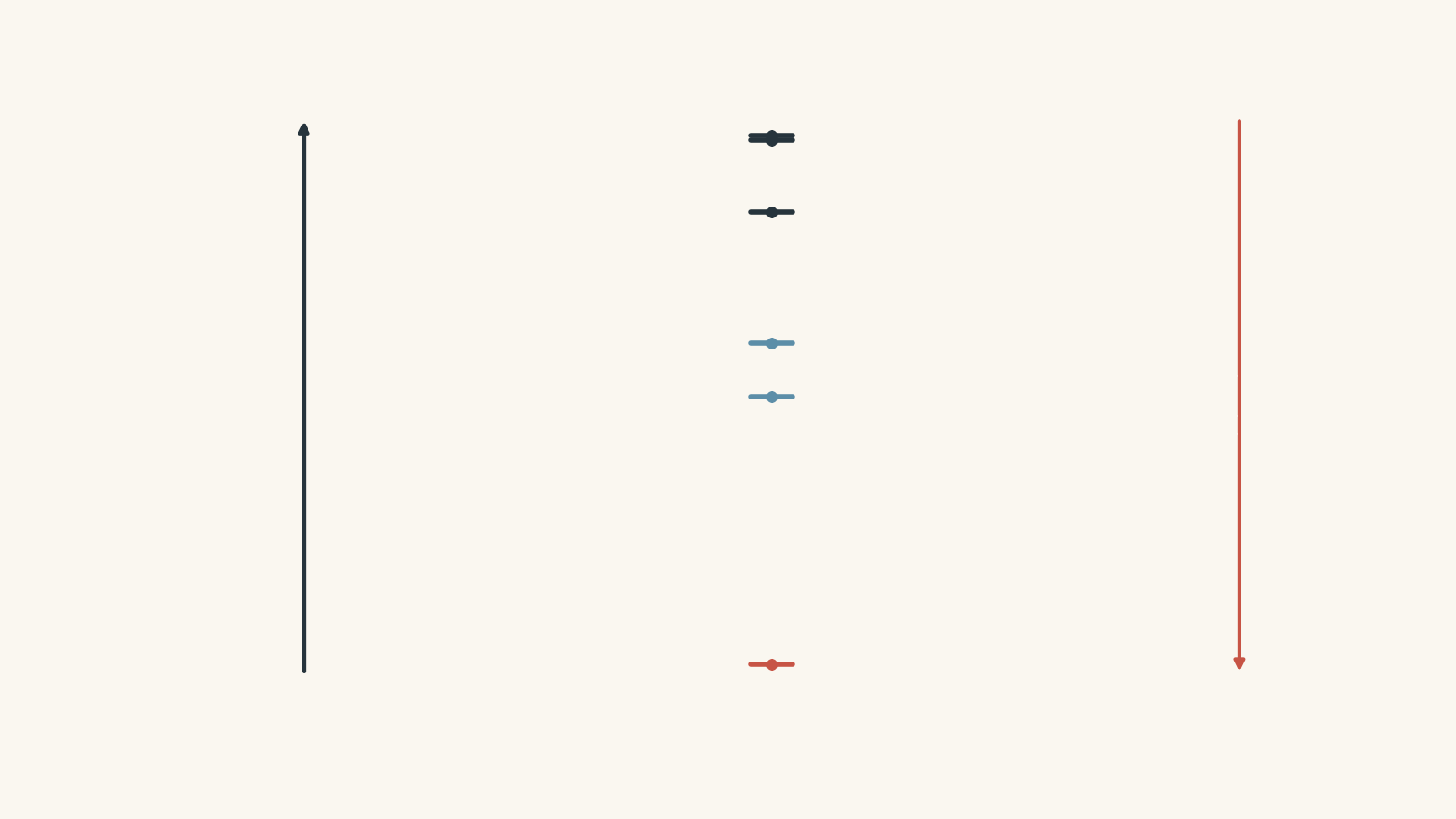
Here are some particularly useful HSC values. They are selected from the standard-potential data sheet supplied with the 2025 NSW HSC Chemistry examination. :chatgpt-content-reference{index=”0″}
| Reduction half-equation | \(E^\circ\) (V) |
|---|---|
| \(\ce{Mg^2+ + 2e- <=> Mg}\) | \(-2.36\) |
| \(\ce{Al^3+ + 3e- <=> Al}\) | \(-1.68\) |
| \(\ce{Zn^2+ + 2e- <=> Zn}\) | \(-0.76\) |
| \(\ce{Fe^2+ + 2e- <=> Fe}\) | \(-0.44\) |
| \(\ce{Pb^2+ + 2e- <=> Pb}\) | \(-0.13\) |
| \(\ce{H+ + e- <=> \frac{1}{2}H2}\) | \(0.00\) |
| \(\ce{Cu^2+ + 2e- <=> Cu}\) | \(+0.34\) |
| \(\ce{Fe^3+ + e- <=> Fe^2+}\) | \(+0.77\) |
| \(\ce{Ag+ + e- <=> Ag}\) | \(+0.80\) |
02The decision rule for a metal in a solution
Suppose a piece of metal \(\ce{M(s)}\) is placed in a solution containing another species that might be reduced.
You are looking for two processes:
- something in the solution gains electrons: reduction
- the solid metal loses electrons: oxidation
The least error-prone way to use a reduction-potential table is to leave both tabulated values exactly as they are and calculate
\[
E^\circ_{\text{cell}}
=
E^\circ_{\text{reduction}}
–
E^\circ_{\text{metal being oxidised}}
\]
Here, both numbers on the right are the reduction potentials printed in the table.
Then:
| \(E^\circ_{\text{cell}}\) | Prediction under standard conditions |
|---|---|
| positive | reaction is thermodynamically spontaneous as written |
| negative | reaction is not thermodynamically spontaneous as written |
| zero | no net standard thermodynamic driving force |
For a simple metal-displacement reaction,
\[
\ce{M(s) + X^{n+}(aq) -> M^{m+}(aq) + X(s)}
\]
the shortcut is:
The metal \(\ce{M}\) can reduce \(\ce{X^{n+}}\) if the reduction potential for the \(\ce{X^{n+}/X}\) pair is more positive than the reduction potential for the \(\ce{M^{m+}/M}\) pair.
That is basically the metal activity series with the numbers exposed.
If balancing the electron transfer itself is still shaky, revise redox half-equations before trying to memorise shortcuts.
Worked example: Will zinc react with copper(II) ions?
A zinc strip is placed in \(\ce{CuSO4(aq)}\). Use standard reduction potentials to predict whether a reaction occurs, calculate \(E^\circ_{\text{cell}}\), and write the net ionic equation.
Step 1
Copper(II) ions can gain electrons:
\[
\ce{Cu^2+ + 2e- -> Cu}
\qquad E^\circ = +0.34\ \text{V}
\]
Step 2
The table lists
\[
\ce{Zn^2+ + 2e- <=> Zn}
\qquad E^\circ = -0.76\ \text{V}
\]
but our beaker contains \(\ce{Zn(s)}\), so zinc would need to run this process backwards and lose electrons.
Step 3
\[
E^\circ_{\text{cell}}
=
0.34-(-0.76)
=
+1.10\ \text{V}
\]
Because \(E^\circ_{\text{cell}}\) is positive, the reaction is thermodynamically spontaneous under standard conditions.
Step 4
\[
\ce{Zn(s) -> Zn^2+(aq) + 2e-}
\]
\[
\ce{Cu^2+(aq) + 2e- -> Cu(s)}
\]
so
\[
\ce{Zn(s) + Cu^2+(aq) -> Zn^2+(aq) + Cu(s)}
\]
The sulfate ion is a spectator, so it does not appear in the net ionic equation.
The result means zinc can transfer electrons to copper(II) ions. Zinc dissolves, while copper metal is deposited.
Worked example: Will lead react with iron(II) ions?
A lead strip is placed in \(\ce{Fe(NO3)2(aq)}\). Predict whether lead will displace iron from the solution.
Step 1
For iron to be deposited,
\[
\ce{Fe^2+ + 2e- -> Fe}
\qquad E^\circ = -0.44\ \text{V}
\]
Step 2
Lead comes from the pair
\[
\ce{Pb^2+ + 2e- <=> Pb}
\qquad E^\circ = -0.13\ \text{V}
\]
Step 3
\[
E^\circ_{\text{cell}}
=
-0.44-(-0.13)
=
-0.31\ \text{V}
\]
Step 4
The proposed reaction
\[
\ce{Pb(s) + Fe^2+(aq) -> Pb^2+(aq) + Fe(s)}
\]
has a negative standard cell potential, so it is not spontaneous under standard conditions.
Notice the trap: both reduction potentials were negative. That fact by itself tells you almost nothing. It is their difference that decides the direction.
The reverse process, \(\ce{Fe(s) + Pb^2+(aq)}\), would have
\[
E^\circ_{\text{cell}}
=
-0.13-(-0.44)
=
+0.31\ \text{V}
\]
and is therefore predicted to occur.
03Four traps worth catching before the exam does
A negative reduction potential does not mean “no reaction”
Individual \(E^\circ\) values are measured relative to the standard hydrogen electrode. A negative value is not a ban on reaction.
For example, both \(\ce{Fe^2+/Fe}\) and \(\ce{Zn^2+/Zn}\) have negative potentials, but iron(II) ions can still oxidise zinc:
\[
E^\circ_{\text{cell}}
=
-0.44-(-0.76)
=
+0.32\ \text{V}
\]
The cell potential is positive, so the reaction is feasible.
Do not multiply \(E^\circ\) when you multiply a half-equation
Suppose you multiply
\[
\ce{Ag+ + e- -> Ag}
\]
by 2 to balance electrons. The reduction potential remains \(+0.80\ \text{V}\), not \(+1.60\ \text{V}\).
Potential does not scale with the amount of substance. You may multiply atoms, ions, and electrons when balancing equations, but not the electrode potential.
“The highest reduction potential wins” is incomplete
A more positive reduction potential identifies the stronger oxidising agent under the stated conditions. It does not prove that every other possible reduction is impossible.
If a metal can reduce two different species and both calculated cell potentials are positive, both reactions are thermodynamically possible. Standard potentials alone do not tell you their exact rates or the proportions of products formed.
A positive \(E^\circ_{\text{cell}}\) does not guarantee a fast visible reaction
Standard potentials tell you about thermodynamic feasibility, not reaction speed.
Aluminium is a classic example. Its very negative reduction potential suggests that aluminium metal should be a strong reducing agent. Yet an aluminium surface is normally protected by a thin, adherent oxide layer. A favourable underlying redox reaction can therefore be slow or apparently absent until that barrier is disrupted.
Real solutions can also differ from standard conditions. Standard-state values generally refer to dissolved species at standard concentration, gases at standard pressure, and pure solids at a specified temperature. Changing concentrations can change the actual cell potential.
04Questions and solutions
Question 1
A magnesium strip is placed in \(\ce{CuSO4(aq)}\).
Using
\[
E^\circ(\ce{Cu^2+/Cu})=+0.34\ \text{V}
\]
and
\[
E^\circ(\ce{Mg^2+/Mg})=-2.36\ \text{V},
\]
predict whether a reaction occurs, calculate \(E^\circ_{\text{cell}}\), and write the net ionic equation.
Solution 1
The reaction occurs spontaneously under standard conditions, with \(E^\circ_{\text{cell}}=+2.70\ \text{V}\).
Copper(II) ions are reduced:
\[
\ce{Cu^2+ + 2e- -> Cu}
\]
and magnesium is oxidised:
\[
\ce{Mg -> Mg^2+ + 2e-}
\]
Using the tabulated reduction potentials,
\[
E^\circ_{\text{cell}}
=
0.34-(-2.36)
=
+2.70\ \text{V}
\]
The net ionic equation is
\[
\ce{Mg(s) + Cu^2+(aq) -> Mg^2+(aq) + Cu(s)}
\]
Magnesium therefore dissolves while copper is deposited.
A tempting shortcut is to look only at magnesium’s negative \(E^\circ\) and say it is “unstable”. That misses the actual comparison. The prediction comes from pairing the magnesium oxidation with a possible reduction and checking that the overall potential is positive.
Question 2
A zinc strip is placed in an acidic solution containing both \(\ce{Cu^2+(aq)}\) and \(\ce{H+(aq)}\).
Use
\[
E^\circ(\ce{Cu^2+/Cu})=+0.34\ \text{V},
\]
\[
E^\circ(\ce{H+/H2})=0.00\ \text{V},
\]
and
\[
E^\circ(\ce{Zn^2+/Zn})=-0.76\ \text{V}.
\]
Identify two different redox reactions that are thermodynamically possible according to the standard-potential model, calculate \(E^\circ_{\text{cell}}\) for each, and assess the statement:
“Copper(II) has the more positive reduction potential, so copper deposition is the only possible reaction.”
Solution 2
Both copper deposition and hydrogen-gas formation are thermodynamically possible; their standard cell potentials are \(+1.10\ \text{V}\) and \(+0.76\ \text{V}\), respectively. The statement that only copper deposition is possible is therefore not justified by standard potentials.
For copper deposition, zinc is oxidised while \(\mathrm{Cu}^{2+}\) is reduced:
\[
\ce{Zn(s) + Cu^2+(aq) -> Zn^2+(aq) + Cu(s)}
\]
The cell potential is
\[
E^\circ_{\text{cell}}
=
0.34-(-0.76)
=
+1.10\ \text{V}
\]
For hydrogen formation, double the hydrogen half-equation to balance the two electrons:
\[
\ce{2H+ + 2e- -> H2(g)}
\]
Its potential remains \(0.00\ \text{V}\). It is not doubled.
Combining it with zinc oxidation gives
\[
\ce{Zn(s) + 2H+(aq) -> Zn^2+(aq) + H2(g)}
\]
and
\[
E^\circ_{\text{cell}}
=
0.00-(-0.76)
=
+0.76\ \text{V}
\]
Both values are positive.
The copper reaction has the larger standard cell potential, so it has the larger thermodynamic driving force for these two-electron reactions under the standard model. But “larger” does not turn the other positive value into a negative one.
The tempting route is to treat the reduction-potential table as a winner-takes-all ranking. It is not. The table tells you which pairings are thermodynamically feasible. It does not, by itself, tell you that only one feasible surface reaction will occur or predict their relative rates.
Question 3
An aluminium strip with its normal oxide coating is placed in \(\ce{CuSO4(aq)}\). Little visible change occurs at first. The aluminium is then scratched beneath the solution, and a reddish deposit appears around the scratched region.
The relevant standard reduction potentials are
\[
E^\circ(\ce{Al^3+/Al})=-1.68\ \text{V}
\]
and
\[
E^\circ(\ce{Cu^2+/Cu})=+0.34\ \text{V}.
\]
Explain the apparent contradiction between the standard-potential prediction and the initial observation. Write the balanced net ionic equation and calculate \(E^\circ_{\text{cell}}\).
A student also argues that the aluminium potential must be doubled because the balanced reaction contains two aluminium atoms. Evaluate that claim.
Solution 3
The aluminium-copper(II) reaction is strongly thermodynamically favourable, with \(E^\circ_{\text{cell}}=+2.02\ \text{V}\), but the intact aluminium oxide layer can kinetically block the reaction. Scratching the surface exposes aluminium metal, allowing copper deposition to occur locally. The aluminium potential must not be doubled.
The reduction is
\[
\ce{Cu^2+ + 2e- -> Cu}
\qquad E^\circ=+0.34\ \text{V}
\]
Aluminium undergoes oxidation. Its reduction potential is listed as
\[
\ce{Al^3+ + 3e- <=> Al}
\qquad E^\circ=-1.68\ \text{V}
\]
Using the subtraction method,
\[
E^\circ_{\text{cell}}
=
0.34-(-1.68)
=
+2.02\ \text{V}
\]
To balance the electrons,
\[
\ce{2Al -> 2Al^3+ + 6e-}
\]
and
\[
\ce{3Cu^2+ + 6e- -> 3Cu}
\]
giving
\[
\ce{2Al(s) + 3Cu^2+(aq) -> 2Al^3+(aq) + 3Cu(s)}
\]
A positive \(E^\circ_{\text{cell}}\) says the reaction is thermodynamically favourable under standard conditions. It does not say the reaction can cross every kinetic barrier quickly.
The surface \(\ce{Al2O3}\) layer separates much of the aluminium metal from the solution. Scratching breaks that barrier at the scratched region, so electron transfer can occur there much more readily.
The student’s doubling argument confuses electrode potential with quantities in a chemical equation. Multiplying
\[
\ce{Al -> Al^3+ + 3e-}
\]
by 2 changes the number of moles reacting, but not the potential. Electrode potential is an intensive quantity: it does not double just because twice as much material is represented.
The exact constraint that changes the initial prediction is therefore not the sign of \(E^\circ_{\text{cell}}\). It is whether the reacting aluminium surface is actually accessible.
Question 4
A \(100.0\ \text{mL}\) solution contains both \(0.100\ \text{mol L}^{-1}\) \(\mathrm{Ag}^{+}\) and \(0.100\ \text{mol L}^{-1}\) \(\mathrm{Cu}^{2+}\).
You have only copper metal, iron metal, and filtration equipment. Assume ideal behaviour: each chosen displacement reaction proceeds to completion, exactly measured amounts of metal can be added, and kinetic effects can be ignored.
Use
\[
E^\circ(\ce{Ag+/Ag})=+0.80\ \text{V},
\]
\[
E^\circ(\ce{Cu^2+/Cu})=+0.34\ \text{V},
\]
and
\[
E^\circ(\ce{Fe^2+/Fe})=-0.44\ \text{V}
\]
to design a two-step procedure that produces solid copper without silver mixed into the final solid.
Calculate the amount, in moles, of metal that should be added at each step and the amount of copper finally produced.
Solution 4
First use exactly \(0.00500\ \text{mol}\) of copper metal to remove all \(\mathrm{Ag}^{+}\) as silver, filter off that silver, then add exactly \(0.0150\ \text{mol}\) of iron to the remaining solution. This produces \(0.0150\ \text{mol}\) of copper without silver in the final solid under the assumptions given.
Initially,
\[
n(\mathrm{Ag}^{+})
=
cV
=
0.100\ \text{mol L}^{-1}\times0.1000\ \text{L}
=
0.0100\ \text{mol}
\]
and
\[
n(\mathrm{Cu}^{2+})
=
0.100\ \text{mol L}^{-1}\times0.1000\ \text{L}
=
0.0100\ \text{mol}
\]
The important strategic decision is not to add iron first. Iron can reduce both \(\mathrm{Ag}^{+}\) and \(\mathrm{Cu}^{2+}\), so doing that would risk producing a mixed silver-copper solid.
Instead, add copper first. Silver ions can oxidise copper because
\[
E^\circ_{\text{cell}}
=
0.80-0.34
=
+0.46\ \text{V}
\]
The reaction is
\[
\ce{2Ag+(aq) + Cu(s) -> 2Ag(s) + Cu^2+(aq)}
\]
Two moles of \(\mathrm{Ag}^{+}\) require one mole of Cu, so the \(0.0100\ \text{mol}\) of silver ions require
\[
n(\ce{Cu})
=
\frac{0.0100}{2}
=
0.00500\ \text{mol}
\]
Under the stated ideal assumption, exactly \(0.00500\ \text{mol}\) Cu is consumed and all \(0.0100\ \text{mol}\) of \(\mathrm{Ag}^{+}\) becomes silver metal.
Filter the silver away.
The first reaction has also created \(0.00500\ \text{mol}\) of extra \(\mathrm{Cu}^{2+}\). The solution therefore now contains
\[
0.0100+0.00500
=
0.0150\ \text{mol Cu}^{2+}
\]
Now add iron.
\[
E^\circ_{\text{cell}}
=
0.34-(-0.44)
=
+0.78\ \text{V}
\]
so
\[
\ce{Fe(s) + Cu^2+(aq) -> Fe^2+(aq) + Cu(s)}
\]
is spontaneous under the standard-potential model.
The stoichiometric ratio is \(1:1\), so add
\[
0.0150\ \text{mol Fe}
\]
to consume \(0.0150\ \text{mol}\) of \(\mathrm{Cu}^{2+}\).
This produces
\[
0.0150\ \text{mol Cu(s)}
\]
The tempting route is to choose iron immediately because it has the most negative reduction potential of the available metals. Iron certainly has enough reducing power, but that is exactly the problem: it can reduce the silver ions as well as the copper ions.
The separation works because the first metal is chosen selectively enough to remove the stronger oxidising agent, \(\mathrm{Ag}^{+}\), before the second reduction is attempted.
In a real separation, standard potentials alone would not guarantee perfectly quantitative completion or perfect purity. Those were assumptions supplied by the question.
Question 5
A copper wire is placed into a solution containing both \(\mathrm{Fe}^{3+}\) and \(\mathrm{Fe}^{2+}\).
A student argues:
“Copper is less reactive than iron in the metal activity series, so copper cannot react with iron ions.”
The standard-potential table gives
\[
\ce{Fe^3+ + e- <=> Fe^2+}
\qquad E^\circ=+0.77\ \text{V}
\]
\[
\ce{Fe^2+ + 2e- <=> Fe}
\qquad E^\circ=-0.44\ \text{V}
\]
and
\[
\ce{Cu^2+ + 2e- <=> Cu}
\qquad E^\circ=+0.34\ \text{V}
\]
Determine whether copper reacts. If it does, write the balanced net ionic equation, calculate \(E^\circ_{\text{cell}}\), and state whether iron metal forms.
Then predict what would happen if all the \(\mathrm{Fe}^{3+}\) were removed and the copper wire were placed in a solution containing only \(\mathrm{Fe}^{2+}\).
Solution 5
Copper does react with \(\mathrm{Fe}^{3+}\): copper is oxidised to \(\mathrm{Cu}^{2+}\), while \(\mathrm{Fe}^{3+}\) is reduced only to \(\mathrm{Fe}^{2+}\). The standard cell potential is \(+0.43\ \text{V}\), and no iron metal is produced.
The crucial choice is the iron half-equation.
It is tempting to see “iron ions” and immediately use
\[
\ce{Fe^2+ + 2e- -> Fe}
\]
because that is the half-equation involved in a simple metal-displacement comparison.
But the solution contains \(\mathrm{Fe}^{3+}\), which has another available reduction:
\[
\ce{Fe^3+ + e- -> Fe^2+}
\qquad E^\circ=+0.77\ \text{V}
\]
Copper can provide the electrons:
\[
\ce{Cu -> Cu^2+ + 2e-}
\]
Double the iron half-equation to balance the electrons:
\[
\ce{2Fe^3+ + 2e- -> 2Fe^2+}
\]
The potential remains \(+0.77\ \text{V}\).
Now calculate
\[
E^\circ_{\text{cell}}
=
0.77-0.34
=
+0.43\ \text{V}
\]
so the net reaction is
\[
\ce{2Fe^3+(aq) + Cu(s) -> 2Fe^2+(aq) + Cu^2+(aq)}
\]
No \(\ce{Fe(s)}\) forms. The iron(III) ions only gain enough electrons to become iron(II) ions.
This is where a simple activity-series shortcut reaches its limit. The usual statement that copper cannot “displace iron” refers to trying to reduce \(\mathrm{Fe}^{2+}\) all the way to \(\ce{Fe(s)}\). That is not the reaction occurring here.
If \(\mathrm{Fe}^{3+}\) is completely absent and only \(\mathrm{Fe}^{2+}\) remains, the possible metal-displacement reaction would be
\[
\ce{Cu(s) + Fe^2+(aq) -> Cu^2+(aq) + Fe(s)}
\]
Its standard cell potential is
\[
E^\circ_{\text{cell}}
=
-0.44-(+0.34)
=
-0.78\ \text{V}
\]
so that reaction is not spontaneous under standard conditions.
The fair trap is that both situations contain “iron ions”, but oxidation state matters. A reduction-potential table compares specific redox couples, not element names.
05What this lets you predict next
Once you can choose the correct half-reactions and compare their reduction potentials, you can do more than predict whether a metal reacts in a solution. The same reasoning tells you which electrode is oxidised, which is reduced, which way electrons flow, and what voltage a galvanic cell should produce.
That is the next step in using reduction potentials of galvanic half-cells: the beaker reaction and the electrochemical cell are the same redox competition, just arranged differently.