
Angular Velocity in HSC Physics: From Rotation to Linear Speed
Learn how angular velocity measures rotational motion, how to use omega = delta theta divided by time, and how it connects to linear speed through v = r omega.
A point on the edge of a spinning wheel moves much faster than a point near the axle. Yet both points complete each revolution in exactly the same time. So are they moving at the same rate, or not?
Before reading on, predict this: a large gear and a small mark near its centre are part of the same rigid disc. After 0.50 s, the disc turns through \(90^\circ\). Which mark has the greater angular velocity?
They have the same angular velocity. They turn through the same angle in the same time. The outer mark travels a greater distance, so it has a greater linear speed.
That difference – same rotation, different distance travelled – is the reason angular velocity is useful.
01Measuring rotation with an angle
For straight-line motion, velocity tells us how quickly position changes.
For rotational motion, we track how quickly the angle changes instead.
Imagine drawing a line from the centre of a wheel to a point on its rim. As the wheel rotates, that line sweeps through an angle \(\Delta\theta\).
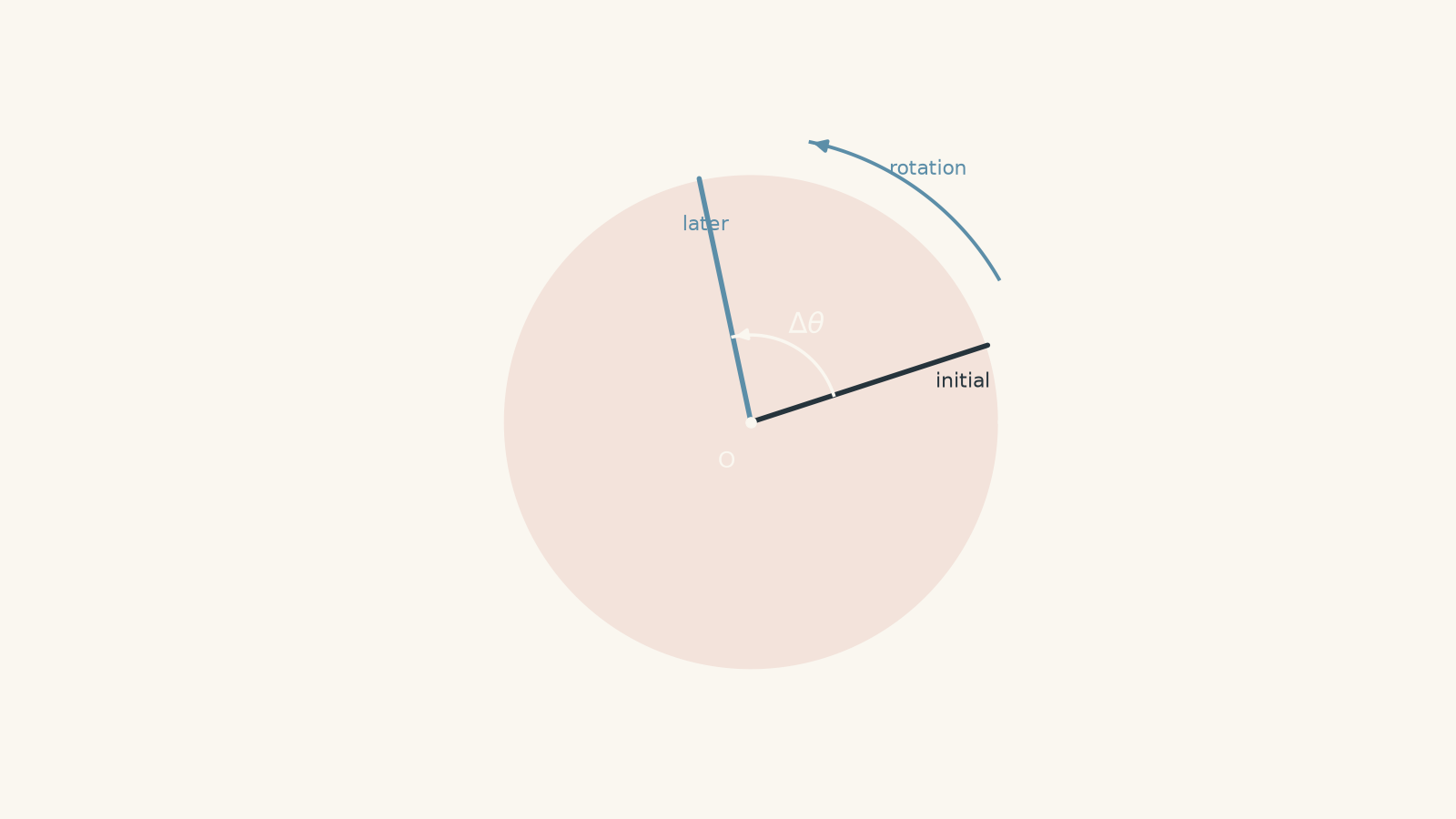
If the wheel rotates through an angular displacement \(\Delta\theta\) during a time interval \(\Delta t\), its average angular velocity is
\[
\omega = \frac{\Delta\theta}{\Delta t}
\]
where:
- \(\omega\) is angular velocity, measured in radians per second (\(\text{rad s}^{-1}\))
- \(\Delta\theta\) is angular displacement, measured in radians (\(\text{rad}\))
- \(\Delta t\) is the time interval, measured in seconds (\(\text{s}\))
The symbol \(\omega\) is the Greek letter omega.
The idea is simple: angular velocity tells you how many radians of rotation occur each second.
02Why angles need to be in radians
You may be used to measuring angles in degrees. A full revolution is \(360^\circ\).
In circular-motion equations, radians are much more useful. A full revolution is
\[
2\pi \text{ rad}
\]
so
\[
360^\circ = 2\pi \text{ rad}
\]
and therefore
\[
180^\circ = \pi \text{ rad}
\]
For example,
\[
90^\circ = \frac{\pi}{2}\text{ rad}
\]
and
\[
60^\circ = \frac{\pi}{3}\text{ rad}
\]
Why bother changing units? Because radians connect angle directly to distance travelled around a circle.
For an object moving through an angle \(\theta\) at radius \(r\), the arc length \(s\) is
\[
s=r\theta
\]
where \(s\) and \(r\) are measured in metres and \(\theta\) is measured in radians.
That equation works this cleanly because the radian is defined using the circle itself.
Worked example: finding angular velocity from an angle
A turntable rotates through \(135^\circ\) in \(0.75\text{ s}\). Calculate its average angular velocity.
Step 1
\[
\Delta\theta
=135^\circ\times\frac{\pi}{180^\circ}
=\frac{3\pi}{4}\text{ rad}
\]
Step 2
\[
\omega=\frac{\Delta\theta}{\Delta t}
=\frac{3\pi/4}{0.75}
=\pi\text{ rad s}^{-1}
\]
So the angular velocity is
\[
\omega \approx 3.14\text{ rad s}^{-1}
\]
The turntable sweeps through about \(3.14\) radians every second.
A common mistake is to substitute \(135\) directly into \(\omega=\Delta\theta/\Delta t\). That would give \(180\), but the unit would be degrees per second, not the SI form normally used in circular-motion equations.
03Angular velocity and linear velocity are not the same thing
Now return to the spinning disc.
Place one dot \(0.10\text{ m}\) from the centre and another dot \(0.40\text{ m}\) from the centre. Because the disc is rigid, both dots rotate through the same angle during any given time interval.
So they have the same angular velocity.
But do they travel the same distance?
No. The outer dot follows a much larger circle.
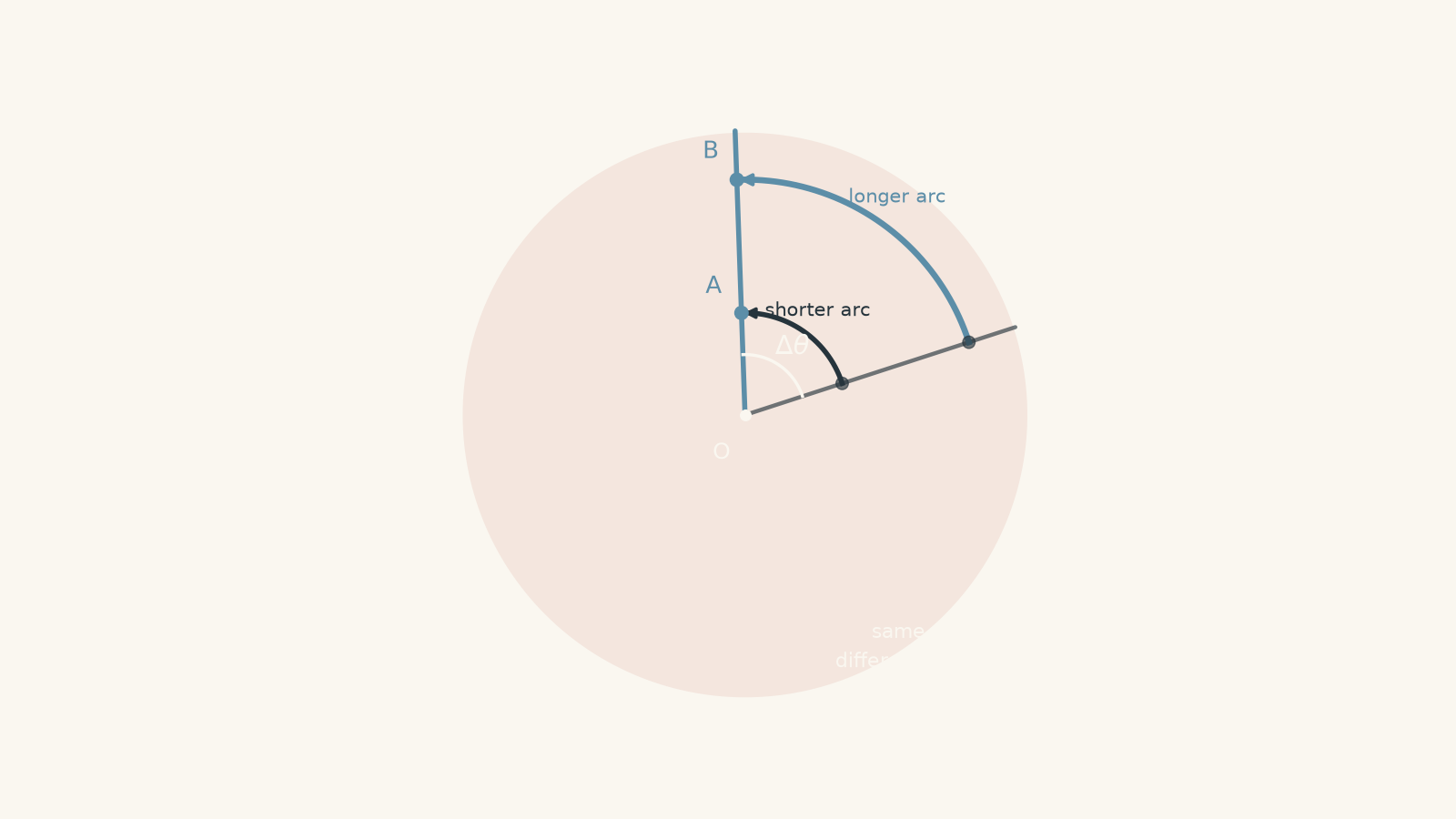
Using
\[
s=r\theta
\]
divide both sides by the time interval:
\[
\frac{s}{\Delta t}
=r\frac{\theta}{\Delta t}
\]
For uniform circular motion, \(s/\Delta t\) is the linear speed \(v\), while \(\theta/\Delta t\) is the angular speed \(\omega\). Therefore,
\[
v=r\omega
\]
where:
- \(v\) is tangential or linear speed in \(\text{m s}^{-1}\)
- \(r\) is the distance from the axis of rotation in metres
- \(\omega\) is angular speed in \(\text{rad s}^{-1}\)
This equation is the bridge between rotational and linear motion.
A useful mental model
Imagine four friends standing on different parts of a giant rotating platform. They are all stuck to the floor, which saves us from several workplace health and safety problems.
They all turn through the same angle each second. That is their shared angular velocity.
But the person near the outer edge has to cover much more ground during that second. Their linear speed is therefore greater.
The analogy has a limit: real people are not rigidly attached parts of a disc. They could walk relative to the platform. The equation \(v=r\omega\) applies directly when points share the same rotation about an axis.
04The most tempting misconception
Suppose two points on a rotating wheel have the same angular velocity.
A student might think, “Same velocity means same speed.”
That sounds reasonable because in straight-line motion we normally use one velocity for one object. But angular velocity and linear velocity measure different changes.
Angular velocity asks:
How quickly is the angle changing?
Linear speed asks:
How quickly is distance along the path changing?
For the same \(\omega\),
\[
v=r\omega
\]
so increasing the radius increases the linear speed.
Double the radius, and the linear speed doubles.
The centre of the wheel gives a useful boundary case. At \(r=0\),
\[
v=r\omega=0
\]
even though the wheel itself may have a non-zero angular velocity. The exact point on the rotation axis does not travel around a circular path.
05One revolution gives another useful form
Suppose an object takes a period \(T\) to complete one revolution.
One full revolution corresponds to an angular displacement of \(2\pi\text{ rad}\), so
\[
\omega=\frac{2\pi}{T}
\]
where \(T\) is the period in seconds.
Because frequency \(f\) is the number of revolutions per second,
\[
f=\frac{1}{T}
\]
we can also write
\[
\omega=2\pi f
\]
This means three quantities describe the same rotational rate in different ways:
| Quantity | Meaning | Relationship |
|---|---|---|
| Period \(T\) | time for one revolution | \(T=\frac{2\pi}{\omega}\) |
| Frequency \(f\) | revolutions per second | \(f=\frac{\omega}{2\pi}\) |
| Angular speed \(\omega\) | radians swept per second | \(\omega=\frac{2\pi}{T}=2\pi f\) |
If you need more practice connecting period, radius, and speed, see Speed, Radius and Period in Uniform Circular Motion.
Worked example: from rotational period to linear speed
A laboratory centrifuge spins with a period of \(0.040\text{ s}\). A sample is located \(0.12\text{ m}\) from the axis.
Calculate:
- the angular speed of the centrifuge
- the linear speed of the sample
Step 1
One revolution is \(2\pi\text{ rad}\), so
\[
\omega=\frac{2\pi}{T}
=\frac{2\pi}{0.040}
=157\text{ rad s}^{-1}
\]
Step 2
\[
v=r\omega
=(0.12)(157)
=18.8\text{ m s}^{-1}
\]
The sample has an angular speed of about \(157\text{ rad s}^{-1}\) and a linear speed of \(18.8\text{ m s}^{-1}\).
Notice what would happen to another sample at \(0.060\text{ m}\) from the axis. It would still have the same \(\omega\), because both samples are attached to the same rotating centrifuge, but its linear speed would be only half as large.
06Angular velocity includes direction
So far, we have mostly dealt with the size of the angular velocity.
Strictly, angular velocity is a vector. Its direction lies along the axis of rotation, determined using the right-hand rule.
Curl the fingers of your right hand in the direction of rotation. Your thumb points in the direction of the angular velocity vector.
For many HSC calculations involving motion in one plane, clockwise and anticlockwise rotation can instead be distinguished using a sign convention. For example:
- anticlockwise: positive
- clockwise: negative
You could choose the opposite convention, provided you use it consistently.
Suppose a wheel changes from an angular velocity of \(+5.0\text{ rad s}^{-1}\) to \(-3.0\text{ rad s}^{-1}\). Its final angular speed is only \(3.0\text{ rad s}^{-1}\), but the change in angular velocity is
\[
\Delta\omega=-3.0-(+5.0)=-8.0\text{ rad s}^{-1}
\]
The negative sign matters because the wheel has reversed its direction of rotation.
This distinction becomes important when you later study angular acceleration.
07What \(v=r\omega\) does – and does not – tell you
The equation
\[
v=r\omega
\]
gives the magnitude of the instantaneous tangential velocity for a point moving around a circle.
The velocity itself is tangent to the circular path, not pointing away from the centre.
This creates another prediction worth making. An object in uniform circular motion has constant speed. Does that mean its velocity is constant?
No. Its direction changes continuously, so its velocity changes continuously even if its speed does not.
A changing velocity means acceleration. In circular motion, that acceleration points towards the centre. That leads directly into centripetal acceleration.
08A compact method for angular-velocity problems
When a circular-motion question mentions revolutions, period, radius, or speed, use this sequence:
- Decide whether the given information describes an angle, a time for one revolution, or a linear distance.
- Convert angles to radians if needed.
- Find angular velocity using \(\omega=\Delta\theta/\Delta t\) or \(\omega=2\pi/T\).
- If you need linear speed, use \(v=r\omega\).
- Check the result physically. A point further from the axis should have a greater linear speed if \(\omega\) is unchanged.
- Keep angular and linear quantities separate. Radians per second and metres per second are not interchangeable.
09Questions and solutions
Question 1
A wheel rotates uniformly through \(4.8\text{ rad}\) in \(1.6\text{ s}\).
Calculate:
a. its angular velocity
b. the linear speed of a point \(0.25\text{ m}\) from the axis
Solution 1
The angular velocity is \(3.0\text{ rad s}^{-1}\), and the point moves at \(0.75\text{ m s}^{-1}\).
For part a, use
\[
\omega=\frac{\Delta\theta}{\Delta t}
\]
Substituting,
\[
\omega=\frac{4.8}{1.6}
=3.0\text{ rad s}^{-1}
\]
For part b, use
\[
v=r\omega
\]
so
\[
v=(0.25)(3.0)
=0.75\text{ m s}^{-1}
\]
The point travels \(0.75\text{ m}\) along its circular path each second.
A tempting mistake is to treat \(3.0\text{ rad s}^{-1}\) and \(0.75\text{ m s}^{-1}\) as two different descriptions of exactly the same quantity. They are linked, but they measure different things: one is the rate of angular change, while the other is the rate of distance travelled.
Question 2
Two points, A and B, are fixed to the same rigid rotating disc. A is \(0.15\text{ m}\) from the centre and B is \(0.45\text{ m}\) from the centre.
The disc rotates through \(120^\circ\) in \(0.40\text{ s}\).
Calculate:
a. the angular velocity of A and B
b. the linear speed of each point
c. the ratio \(v_B:v_A\)
Solution 2
Both points have an angular velocity of \(5.24\text{ rad s}^{-1}\); A moves at \(0.785\text{ m s}^{-1}\), B moves at \(2.36\text{ m s}^{-1}\), and \(v_B:v_A=3:1\).
First convert the angle:
\[
120^\circ\times\frac{\pi}{180^\circ}
=\frac{2\pi}{3}\text{ rad}
\]
For both points,
\[
\omega=\frac{\Delta\theta}{\Delta t}
=\frac{2\pi/3}{0.40}
=5.24\text{ rad s}^{-1}
\]
They have the same \(\omega\) because they are fixed to the same rigid disc and therefore sweep through the same angle in the same time.
For A,
\[
v_A=r_A\omega
=(0.15)(5.24)
=0.785\text{ m s}^{-1}
\]
For B,
\[
v_B=r_B\omega
=(0.45)(5.24)
=2.36\text{ m s}^{-1}
\]
Therefore,
\[
\frac{v_B}{v_A}
=\frac{2.36}{0.785}
\approx3.00
\]
so
\[
v_B:v_A=3:1
\]
The tempting route is to say that B must also have three times the angular velocity because it moves three times as fast. That is incorrect. Its larger speed comes entirely from its radius being three times larger:
\[
v=r\omega
\]
The angular velocity stays the same.
Question 3
A circular platform of radius \(2.0\text{ m}\) completes one revolution every \(8.0\text{ s}\).
A student stands \(0.50\text{ m}\) from the centre and then walks radially outward until they are \(1.5\text{ m}\) from the centre while remaining at rest relative to the platform.
The platform continues rotating with the same period.
Compare the student’s angular speed and linear speed before and after moving outward.
Solution 3
The student’s angular speed remains \(0.785\text{ rad s}^{-1}\), while their linear speed increases from \(0.393\text{ m s}^{-1}\) to \(1.18\text{ m s}^{-1}\).
The platform’s angular speed is
\[
\omega=\frac{2\pi}{T}
=\frac{2\pi}{8.0}
=0.785\text{ rad s}^{-1}
\]
Because the student remains at rest relative to the platform, they rotate through the same angle as the platform during each time interval. Changing radius does not, by itself, change their angular speed.
Initially,
\[
v_i=r_i\omega
=(0.50)(0.785)
=0.393\text{ m s}^{-1}
\]
Finally,
\[
v_f=r_f\omega
=(1.5)(0.785)
=1.18\text{ m s}^{-1}
\]
The radius has tripled, so the linear speed also triples.
A plausible but incorrect argument is that moving farther from the centre must make each revolution take longer because the circular path is longer. That would be true if the student’s linear speed were somehow kept constant. Here, the condition that is fixed is the platform’s period. The student therefore has to move faster along the larger circular path to complete each revolution in the same time.
Question 4
Two separate horizontal discs rotate about fixed central axes.
Disc X has radius \(0.20\text{ m}\) and angular speed \(8.0\text{ rad s}^{-1}\). Disc Y has radius \(0.40\text{ m}\) and angular speed \(4.0\text{ rad s}^{-1}\).
At one instant, a point on the rim of each disc is moving east.
A student makes three claims:
- The two rim points have the same instantaneous linear velocity.
- They will take the same time to complete one revolution.
- Their centripetal accelerations have the same magnitude.
Determine which claims are correct and justify each decision quantitatively.
Solution 4
Only claim 1 is correct. The two points have the same instantaneous linear velocity at the stated instant, but Disc X has half the period of Disc Y and twice the centripetal acceleration at its rim.
For claim 1,
\[
v=r\omega
\]
For X,
\[
v_X=(0.20)(8.0)
=1.6\text{ m s}^{-1}
\]
For Y,
\[
v_Y=(0.40)(4.0)
=1.6\text{ m s}^{-1}
\]
The question also states that both rim points are moving east at that instant. Their velocity magnitudes and directions are therefore identical, so claim 1 is correct.
For claim 2, use
\[
T=\frac{2\pi}{\omega}
\]
For X,
\[
T_X=\frac{2\pi}{8.0}
=0.785\text{ s}
\]
For Y,
\[
T_Y=\frac{2\pi}{4.0}
=1.57\text{ s}
\]
So claim 2 is false.
For claim 3, the centripetal acceleration can be written as
\[
a_c=\frac{v^2}{r}
\]
Both points have the same \(v\), but their radii are different.
For X,
\[
a_{cX}=\frac{(1.6)^2}{0.20}
=12.8\text{ m s}^{-2}
\]
For Y,
\[
a_{cY}=\frac{(1.6)^2}{0.40}
=6.4\text{ m s}^{-2}
\]
Therefore claim 3 is also false.
The tempting shortcut is to notice that the two linear speeds are equal and assume the motions must be equivalent. They are not. The same tangential speed can arise from different combinations of radius and angular speed.
Disc X has the smaller radius but the greater angular speed. It changes the direction of its velocity more quickly, giving it the greater centripetal acceleration.
Question 5
Two beads, A and B, are attached to different points on the same rigid rotating arm. A is \(0.20\text{ m}\) from the axis, and B is \(0.50\text{ m}\) from the axis.
At a particular instant, the arm has angular speed \(6.0\text{ rad s}^{-1}\).
A student reasons:
“B has a greater linear speed than A. Therefore B’s velocity is changing faster. So B must have the greater angular velocity as well.”
Another student replies:
“No. Because both beads are on the same arm, everything about their motion is the same except their radius.”
Evaluate both arguments. Determine which quantities must be the same for A and B, which must be different, and explain why neither student’s statement is completely correct.
Assume the arm is rotating uniformly at this instant.
Solution 5
A and B have the same angular velocity, but B has greater linear speed and greater centripetal acceleration. Neither student’s complete argument is correct because angular motion can be shared while linear motion depends on radius.
Since A and B are fixed to the same rigid arm, they sweep through the same angular displacement during every time interval. Therefore,
\[
\omega_A=\omega_B=6.0\text{ rad s}^{-1}
\]
Their linear speeds are found from
\[
v=r\omega
\]
For A,
\[
v_A=(0.20)(6.0)
=1.2\text{ m s}^{-1}
\]
For B,
\[
v_B=(0.50)(6.0)
=3.0\text{ m s}^{-1}
\]
So the first student is correct that B has the greater linear speed.
However, the next step in that student’s reasoning fails. Greater linear speed does not imply greater angular velocity. Here, the angular velocities are exactly equal because the beads share one rigid rotation.
Now consider how quickly each velocity vector changes. Under uniform circular motion, each bead has centripetal acceleration
\[
a_c=\frac{v^2}{r}
\]
For A,
\[
a_{cA}
=\frac{(1.2)^2}{0.20}
=7.2\text{ m s}^{-2}
\]
For B,
\[
a_{cB}
=\frac{(3.0)^2}{0.50}
=18\text{ m s}^{-2}
\]
So B’s velocity is indeed changing more rapidly in magnitude-per-second terms, even though A and B have the same angular velocity.
The second student is therefore also only partly correct. Sharing a rigid arm guarantees the same angular displacement, angular velocity, and period. It does not make “everything” else the same.
The radius changes several linear quantities:
\[
v=r\omega
\]
and, because
\[
a_c=\frac{v^2}{r}
\]
substituting \(v=r\omega\) gives
\[
a_c=r\omega^2
\]
At a fixed angular speed, both linear speed and centripetal acceleration increase with radius.
That is the key constraint. A rigid rotating object can share one angular motion across all of its points while those points experience quite different linear motion.
Once that distinction is secure, angular velocity stops being an isolated formula. It becomes the link between rotation and the rest of circular motion: \(v=r\omega\) connects it to tangential speed, and from there \(a_c=v^2/r\) explains why an object moving at constant speed around a circle must still accelerate towards the centre.