
Redox Half-Equations: Balancing HSC Chemistry Reactions
Learn how to construct oxidation and reduction half-equations, balance them in acidic and alkaline conditions, and combine them into complete redox equations.
A zinc strip can sit in a blue copper(II) solution and gradually become coated with copper. At first glance, the ionic equation looks almost too easy:
\[
\ce{Zn + Cu^2+ -> Zn^2+ + Cu}
\]
The atoms are balanced. The charge is balanced too. So what exactly has happened?
Before reading on, predict where the electrons went. Zinc starts neutral and finishes as \(\mathrm{Zn}^{2+}\). Copper starts as \(\mathrm{Cu}^{2+}\) and finishes neutral. That change in charge is the clue: zinc must release electrons, and copper ions must receive them.
Half-equations make that hidden electron transfer visible.
01Redox equations are really electron bookkeeping
Split the zinc-copper reaction into two processes:
\[
\ce{Zn -> Zn^2+ + 2e^-}
\]
\[
\ce{Cu^2+ + 2e^- -> Cu}
\]
Here, \(\ce{e^-}\) means an electron.
The zinc atom loses two electrons. This is oxidation.
The copper(II) ion gains two electrons. This is reduction.
A useful memory aid is OIL RIG:
- oxidation is loss of electrons
- reduction is gain of electrons
But don’t stop at the mnemonic. The more useful idea is that a redox reaction is an electron handover. Whatever number of electrons one species loses, another species must gain.
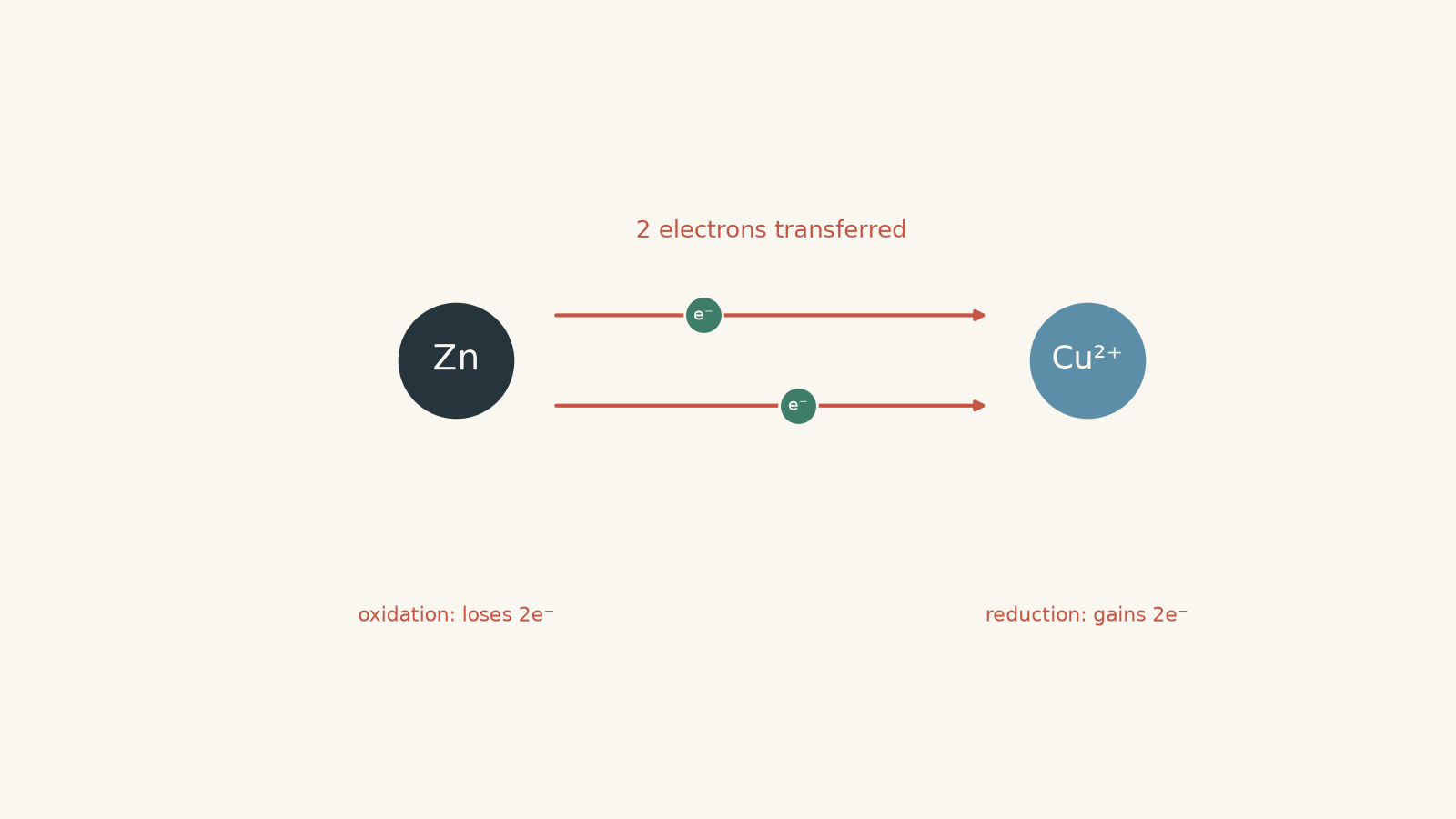
Think of the electrons like two concert tickets being handed from one person to another. If zinc hands over two tickets, copper cannot somehow receive three. The numbers must match.
The analogy breaks because electrons are not little labelled objects travelling through a solution from one particular zinc atom to one particular copper ion. The equation is bookkeeping for the overall change.
02What makes a half-equation balanced?
A half-equation has two separate requirements:
- the number of atoms of each element must be the same on both sides
- the total electric charge must be the same on both sides
Consider:
\[
\ce{Zn -> Zn^2+}
\]
The zinc atoms balance, but the charge does not. The left side has charge \(0\), while the right side has charge \(+2\).
Adding two electrons to the right fixes the charge:
\[
\ce{Zn -> Zn^2+ + 2e^-}
\]
The right-hand charge is now:
\[
+2 + 2(-1) = 0
\]
So both atoms and charge balance.
This gives you a quick diagnostic rule: if your atoms balance but your charges do not, you have not finished the half-equation.
03Oxidation and reduction: which side do the electrons go on?
You do not need to guess.
If electrons appear on the right, they are being produced:
\[
\ce{Fe^2+ -> Fe^3+ + e^-}
\]
That is oxidation.
If electrons appear on the left, they are being consumed:
\[
\ce{Ag^+ + e^- -> Ag}
\]
That is reduction.
You can also check the oxidation state.
In \(\ce{Fe^2+ -> Fe^3+}\), iron becomes more positive. It has lost an electron.
In \(\ce{Ag^+ -> Ag}\), silver changes from \(+1\) to \(0\). It has gained an electron.
Worked example: Aluminium reacting with silver ions
Write the oxidation and reduction half-equations, then construct the balanced overall equation for aluminium reacting with \(\mathrm{Ag}^{+}\) ions to form \(\mathrm{Al}^{3+}\) and silver metal.
Step 1
Aluminium changes from oxidation state \(0\) to \(+3\), so each aluminium atom loses three electrons:
\[
\ce{Al -> Al^3+ + 3e^-}
\]
This is oxidation.
Step 2
Each silver ion gains one electron:
\[
\ce{Ag^+ + e^- -> Ag}
\]
This is reduction.
Step 3
The aluminium half-equation produces three electrons, while the silver half-equation consumes only one. Multiply the entire silver half-equation by \(3\):
\[
\ce{3Ag^+ + 3e^- -> 3Ag}
\]
Do not multiply only the electron. Every coefficient in the half-equation must be multiplied.
Step 4
\[
\begin{aligned}
\ce{Al} &\ce{-> Al^3+ + 3e^-}\\
\ce{3Ag^+ + 3e^-} &\ce{-> 3Ag}
\end{aligned}
\]
Therefore:
\[
\ce{Al + 3Ag^+ -> Al^3+ + 3Ag}
\]
Step 5
There is one Al atom and three Ag atoms on each side.
The left side has charge \(+3\). The right side also has charge \(+3\).
The coefficients tell us something physical too: one mole of aluminium atoms can supply enough electrons to reduce three moles of silver ions.
This electron-transfer view is also what sits underneath metal displacement reactions and the metal activity series.
04When oxygen and hydrogen appear, use a fixed method
Half-equations become more awkward when species such as \(\ce{MnO4^-}\), \(\ce{Cr2O7^2-}\), or \(\ce{H2O2}\) appear.
Trying to balance everything at once usually creates a mess. In acidic solution, use this order:
- balance every element except H and O
- balance O using \(\ce{H2O}\)
- balance H using \(\mathrm{H}^{+}\)
- balance charge using \(\ce{e^-}\)
- check both atoms and charge
The order matters because each step fixes one problem without wrecking the previous ones.
Worked example: Permanganate reacting with iron(II) ions
In acidic solution, permanganate ions, \(\ce{MnO4^-}\), are reduced to \(\mathrm{Mn}^{2+}\), while \(\mathrm{Fe}^{2+}\) ions are oxidised to \(\mathrm{Fe}^{3+}\). Construct the balanced overall ionic equation.
Step 1
\[
\ce{MnO4^- -> Mn^2+}
\]
Manganese is already balanced.
Step 2
There are four oxygen atoms on the left, so add four water molecules to the right:
\[
\ce{MnO4^- -> Mn^2+ + 4H2O}
\]
Step 3
Four water molecules contain eight hydrogen atoms, so add \(8\mathrm{H}^{+}\) to the left:
\[
\ce{MnO4^- + 8H^+ -> Mn^2+ + 4H2O}
\]
Step 4
Before adding electrons, the left-hand charge is
\[
-1 + 8 = +7
\]
while the right-hand charge is \(+2\).
To reduce the left-hand charge from \(+7\) to \(+2\), add five electrons to the left:
\[
\ce{MnO4^- + 8H^+ + 5e^- -> Mn^2+ + 4H2O}
\]
The electrons are reactants, so this is a reduction half-equation.
Step 5
\[
\ce{Fe^2+ -> Fe^3+ + e^-}
\]
Each iron(II) ion releases one electron.
Step 6
The permanganate half-equation consumes five electrons. Multiply the iron half-equation by \(5\):
\[
\ce{5Fe^2+ -> 5Fe^3+ + 5e^-}
\]
Step 7
\[
\ce{MnO4^- + 8H^+ + 5Fe^2+ -> Mn^2+ + 4H2O + 5Fe^3+}
\]
Check the charge:
Left:
\[
-1 + 8 + 5(2) = +17
\]
Right:
\[
2 + 5(3) = +17
\]
So the equation is balanced.
Notice what the coefficient \(5\) is really telling you: reducing one permanganate ion to \(\mathrm{Mn}^{2+}\) requires five electrons, so five \(\mathrm{Fe}^{2+}\) ions are needed to supply them.
05What changes in alkaline solution?
Using \(\mathrm{H}^{+}\) in a strongly alkaline solution would be a strange final answer. There is very little free \(\mathrm{H}^{+}\) present.
A reliable method is:
- balance the half-equation as though it were acidic
- add enough \(\ce{OH^-}\) to both sides to react with every \(\mathrm{H}^{+}\)
- replace each \(\ce{H^+ + OH^-}\) pair with \(\ce{H2O}\)
- cancel any water appearing on both sides
For example, suppose permanganate is reduced to manganese dioxide, \(\ce{MnO2}\).
Start by balancing in acidic conditions:
\[
\ce{MnO4^- + 4H^+ + 3e^- -> MnO2 + 2H2O}
\]
Now add \(4\ce{OH^-}\) to both sides:
\[
\ce{MnO4^- + 4H^+ + 4OH^- + 3e^- -> MnO2 + 2H2O + 4OH^-}
\]
Since \(\ce{H^+ + OH^- -> H2O}\):
\[
\ce{MnO4^- + 4H2O + 3e^- -> MnO2 + 2H2O + 4OH^-}
\]
Cancel two water molecules:
\[
\ce{MnO4^- + 2H2O + 3e^- -> MnO2 + 4OH^-}
\]
Now the equation fits alkaline conditions.
06Combining half-equations: the non-negotiable rule
The electrons must cancel completely.
Suppose one half-equation produces two electrons and the other consumes three:
\[
\ce{A -> B + 2e^-}
\]
\[
\ce{C + 3e^- -> D}
\]
You cannot simply add them. Two electrons would be produced while three were consumed.
The lowest common multiple of \(2\) and \(3\) is \(6\), so multiply the first half-equation by \(3\) and the second by \(2\).
Only then can you add them.
This is the same logic as matching denominators in fractions. The chemistry is different, but the bookkeeping problem is similar: the quantities have to be made compatible before they can be combined.
07A five-point check before you accept a redox equation
A balanced-looking equation can still be wrong. Check all five points.
| Check | What to ask |
|---|---|
| Atoms | Is every element present in equal numbers on both sides? |
| Charge | Is the total charge identical on both sides? |
| Electrons | If half-equations were combined, have all electrons cancelled? |
| Formulas | Did I keep each chemical species intact instead of changing subscripts to force a balance? |
| Conditions | Are species such as \(\mathrm{H}^{+}\), \(\ce{OH^-}\), \(\mathrm{Mn}^{2+}\), or \(\ce{MnO2}\) appropriate for the stated conditions? |
The last check is easy to overlook. Mathematical balance is necessary, but it does not prove that the equation represents the chemistry actually occurring.
08The most tempting mistakes
Changing a chemical formula to make the atoms balance
Suppose you need two chloride ions. Write:
\[
\ce{2Cl^-}
\]
Do not turn \(\mathrm{Cl}^{-}\) into \(\ce{Cl2^-}\).
A coefficient changes how many particles you have. A subscript changes the identity of the substance.
Balancing atoms but forgetting charge
This is especially common when oxygen and hydrogen are involved. Always calculate the total charge on each side after balancing the atoms.
Multiplying only part of a half-equation
If
\[
\ce{Fe^2+ -> Fe^3+ + e^-}
\]
must be multiplied by \(5\), the result is:
\[
\ce{5Fe^2+ -> 5Fe^3+ + 5e^-}
\]
not:
\[
\ce{Fe^2+ -> Fe^3+ + 5e^-}
\]
The second equation does not conserve charge and does not describe the same process.
Assuming a balanced redox equation must occur spontaneously
Half-equation balancing answers a stoichiometric question: if these oxidation and reduction processes occur together, what ratio is required?
It does not, by itself, tell you whether that reaction is energetically favourable. That requires extra chemical information, such as reduction potentials.
09Questions and solutions
Question 1
Aluminium metal reacts with \(\mathrm{Cu}^{2+}\) ions to form \(\mathrm{Al}^{3+}\) ions and copper metal.
Write the oxidation half-equation, the reduction half-equation, and the balanced overall ionic equation.
Solution 1
The balanced overall equation is
\[
\ce{2Al + 3Cu^2+ -> 2Al^3+ + 3Cu}
\]
Aluminium is oxidised:
\[
\ce{Al -> Al^3+ + 3e^-}
\]
Copper(II) ions are reduced:
\[
\ce{Cu^2+ + 2e^- -> Cu}
\]
The tempting move is to add these equations immediately because both half-equations are individually balanced. That fails because three electrons are produced by aluminium while only two are consumed by copper.
The lowest common multiple of \(3\) and \(2\) is \(6\).
Multiply the aluminium half-equation by \(2\):
\[
\ce{2Al -> 2Al^3+ + 6e^-}
\]
Multiply the copper half-equation by \(3\):
\[
\ce{3Cu^2+ + 6e^- -> 3Cu}
\]
Adding and cancelling the six electrons gives:
\[
\ce{2Al + 3Cu^2+ -> 2Al^3+ + 3Cu}
\]
The left-hand charge is \(3(+2)=+6\), and the right-hand charge is \(2(+3)=+6\), so charge is conserved as well as atoms.
Question 2
In acidic solution, dichromate ions, \(\ce{Cr2O7^2-}\), oxidise iodide ions, \(\mathrm{I}^{-}\), to iodine, \(\ce{I2}\). The dichromate is reduced to \(\mathrm{Cr}^{3+}\).
Construct both half-equations and the balanced overall ionic equation.
Solution 2
The balanced overall equation is
\[
\ce{Cr2O7^2- + 14H^+ + 6I^- -> 2Cr^3+ + 3I2 + 7H2O}
\]
Begin with the reduction of dichromate:
\[
\ce{Cr2O7^2- -> 2Cr^3+}
\]
Seven oxygen atoms require seven water molecules on the right:
\[
\ce{Cr2O7^2- -> 2Cr^3+ + 7H2O}
\]
Those seven water molecules contain fourteen hydrogen atoms, so add \(14\mathrm{H}^{+}\) to the left:
\[
\ce{Cr2O7^2- + 14H^+ -> 2Cr^3+ + 7H2O}
\]
The left-hand charge is
\[
-2+14=+12
\]
while the right-hand charge is
\[
2(+3)=+6
\]
Add six electrons to the left:
\[
\ce{Cr2O7^2- + 14H^+ + 6e^- -> 2Cr^3+ + 7H2O}
\]
For iodide oxidation:
\[
\ce{2I^- -> I2 + 2e^-}
\]
A common trap is to write \(\ce{I^- -> I2}\) and then balance only the charge. The iodine atoms must be balanced first: one \(\ce{I2}\) molecule contains two iodine atoms.
Multiply the iodide half-equation by \(3\):
\[
\ce{6I^- -> 3I2 + 6e^-}
\]
Now add the half-equations and cancel the six electrons:
\[
\ce{Cr2O7^2- + 14H^+ + 6I^- -> 2Cr^3+ + 3I2 + 7H2O}
\]
The total charge on the left is
\[
-2+14-6=+6
\]
and the total charge on the right is \(+6\).
Question 3
Hypochlorite ions, \(\ce{ClO^-}\), oxidise iodide ions to iodine in alkaline solution. Hypochlorite is reduced to chloride ions.
Construct the balanced overall ionic equation and identify the oxidising agent and reducing agent.
Solution 3
The balanced overall equation is
\[
\ce{ClO^- + H2O + 2I^- -> Cl^- + I2 + 2OH^-}
\]
The oxidising agent is \(\ce{ClO^-}\), and the reducing agent is \(\mathrm{I}^{-}\).
First balance the reduction of hypochlorite. It is easiest to begin as though the solution were acidic:
\[
\ce{ClO^- -> Cl^-}
\]
Balance oxygen with water:
\[
\ce{ClO^- -> Cl^- + H2O}
\]
Balance hydrogen:
\[
\ce{ClO^- + 2H^+ -> Cl^- + H2O}
\]
Now balance charge. The left side has charge \(+1\), while the right side has charge \(-1\), so add two electrons to the left:
\[
\ce{ClO^- + 2H^+ + 2e^- -> Cl^- + H2O}
\]
Because the reaction occurs in alkaline solution, add \(2\ce{OH^-}\) to both sides:
\[
\ce{ClO^- + 2H^+ + 2OH^- + 2e^- -> Cl^- + H2O + 2OH^-}
\]
Convert \(\ce{2H^+ + 2OH^-}\) to \(2\ce{H2O}\) and cancel one water molecule:
\[
\ce{ClO^- + H2O + 2e^- -> Cl^- + 2OH^-}
\]
Iodide is oxidised:
\[
\ce{2I^- -> I2 + 2e^-}
\]
The electron numbers already match, so the half-equations can be added directly:
\[
\ce{ClO^- + H2O + 2I^- -> Cl^- + I2 + 2OH^-}
\]
The tempting misconception is to identify the oxidising agent as iodine because iodine appears as a product. An oxidising agent is the species that causes another species to be oxidised and is itself reduced. Here, \(\ce{ClO^-}\) gains electrons, so it is the oxidising agent.
Question 4
In acidic solution, permanganate ions react with hydrogen peroxide. Permanganate is reduced to \(\mathrm{Mn}^{2+}\), while hydrogen peroxide is oxidised to \(\ce{O2}\).
Construct the balanced overall ionic equation. Then determine the mole ratio \(\ce{MnO4^- : H2O2}\).
A student argues that one \(\ce{H2O2}\) molecule releases only one electron because oxygen changes from oxidation state \(-1\) in hydrogen peroxide to \(0\) in oxygen gas. Explain the error.
Solution 4
The balanced equation is
\[
\ce{2MnO4^- + 6H^+ + 5H2O2 -> 2Mn^2+ + 8H2O + 5O2}
\]
so the mole ratio \(\ce{MnO4^- : H2O2}\) is \(2:5\). Each \(\ce{H2O2}\) molecule releases two electrons, not one.
The permanganate reduction half-equation is:
\[
\ce{MnO4^- + 8H^+ + 5e^- -> Mn^2+ + 4H2O}
\]
Now construct the hydrogen peroxide oxidation half-equation.
Start with:
\[
\ce{H2O2 -> O2}
\]
The oxygen atoms already balance. Balance hydrogen by adding \(2\mathrm{H}^{+}\) to the right:
\[
\ce{H2O2 -> O2 + 2H^+}
\]
The right-hand side now has charge \(+2\). Add two electrons to the right:
\[
\ce{H2O2 -> O2 + 2H^+ + 2e^-}
\]
The two half-equations transfer five and two electrons respectively. Their lowest common multiple is \(10\).
Multiply the permanganate half-equation by \(2\):
\[
\ce{2MnO4^- + 16H^+ + 10e^- -> 2Mn^2+ + 8H2O}
\]
Multiply the peroxide half-equation by \(5\):
\[
\ce{5H2O2 -> 5O2 + 10H^+ + 10e^-}
\]
Add them:
\[
\ce{2MnO4^- + 16H^+ + 5H2O2 -> 2Mn^2+ + 8H2O + 5O2 + 10H^+}
\]
Cancel \(10\mathrm{H}^{+}\) from both sides:
\[
\ce{2MnO4^- + 6H^+ + 5H2O2 -> 2Mn^2+ + 8H2O + 5O2}
\]
The student’s oxidation-state reasoning notices the change from \(-1\) to \(0\), but counts only one oxygen atom. A molecule of \(\ce{H2O2}\) contains two oxygen atoms.
Each oxygen changes from \(-1\) to \(0\), corresponding to the loss of one electron per oxygen atom. Therefore, one \(\ce{H2O2}\) molecule accounts for two electrons overall.
This is why oxidation numbers are useful, but you still have to connect the change per atom to the number of those atoms in the species.
Question 5
Permanganate ions react with sulfite ions, \(\ce{SO3^2-}\), in a strongly alkaline solution. A brown solid of \(\ce{MnO2}\) is observed, while sulfite is converted to sulfate, \(\ce{SO4^2-}\).
Construct the balanced overall ionic equation.
Another student starts with an acidic equation in which permanganate forms \(\mathrm{Mn}^{2+}\), adds \(\ce{OH^-}\) to remove the \(\mathrm{H}^{+}\), and obtains an equation that balances both atoms and charge. They argue that their equation must therefore be just as valid for this alkaline reaction.
Explain precisely why that conclusion does not follow.
Solution 5
The equation consistent with the stated alkaline conditions and the observed \(\ce{MnO2}\) product is
\[
\ce{2MnO4^- + 3SO3^2- + H2O -> 2MnO2 + 3SO4^2- + 2OH^-}
\]
The other student’s equation may be algebraically balanced, but atom and charge balance alone do not prove that the assumed chemical species are the products under the stated conditions.
Begin with the permanganate reduction half-equation in alkaline solution:
\[
\ce{MnO4^- + 2H2O + 3e^- -> MnO2 + 4OH^-}
\]
Now balance sulfite oxidation.
Starting in acidic form:
\[
\ce{SO3^2- -> SO4^2-}
\]
Add water to supply the extra oxygen:
\[
\ce{SO3^2- + H2O -> SO4^2-}
\]
Balance hydrogen:
\[
\ce{SO3^2- + H2O -> SO4^2- + 2H^+}
\]
Now balance charge with two electrons on the right:
\[
\ce{SO3^2- + H2O -> SO4^2- + 2H^+ + 2e^-}
\]
Convert this to alkaline conditions by adding \(2\ce{OH^-}\) to both sides:
\[
\ce{SO3^2- + H2O + 2OH^- -> SO4^2- + 2H2O + 2e^-}
\]
Cancel one water molecule:
\[
\ce{SO3^2- + 2OH^- -> SO4^2- + H2O + 2e^-}
\]
The permanganate half-equation consumes three electrons, while the sulfite half-equation produces two. The lowest common multiple is \(6\).
Multiply the permanganate half-equation by \(2\):
\[
\ce{2MnO4^- + 4H2O + 6e^- -> 2MnO2 + 8OH^-}
\]
Multiply the sulfite half-equation by \(3\):
\[
\ce{3SO3^2- + 6OH^- -> 3SO4^2- + 3H2O + 6e^-}
\]
Add them:
\[
\ce{2MnO4^- + 4H2O + 3SO3^2- + 6OH^- -> 2MnO2 + 8OH^- + 3SO4^2- + 3H2O}
\]
Cancel six \(\ce{OH^-}\) and three \(\ce{H2O}\):
\[
\ce{2MnO4^- + 3SO3^2- + H2O -> 2MnO2 + 3SO4^2- + 2OH^-}
\]
Now for the harder point.
It is possible to take a different, acid-appropriate permanganate half-equation,
\[
\ce{MnO4^- + 8H^+ + 5e^- -> Mn^2+ + 4H2O}
\]
combine it with sulfite oxidation, and then algebraically remove the \(\mathrm{H}^{+}\) using \(\ce{OH^-}\). The resulting equation can conserve both atoms and charge.
That does not prove it describes this experiment.
The student has silently assumed that \(\mathrm{Mn}^{2+}\) remains the reduction product in strongly alkaline conditions. But the question gives direct evidence about the actual product: a brown \(\ce{MnO2}\) solid forms. The half-equation therefore has to represent reduction to \(\ce{MnO2}\), not reduction to \(\mathrm{Mn}^{2+}\).
This is the important boundary of half-equation balancing. It can tell you whether proposed oxidation and reduction processes can be combined with consistent electron and atom bookkeeping. It cannot, by itself, decide which chemically possible half-reaction will actually occur under a particular set of conditions.
That next decision requires information about the reaction environment and the relative tendency of species to be reduced. In electrochemistry, that is where reduction potentials of galvanic half-cells become useful.