
SI Prefix Conversions for HSC Physics and Chemistry
Learn how to convert SI prefixes from femto to peta using powers of ten. Includes worked Physics and Chemistry examples covering length, area, volume, and mixed-unit calculations.
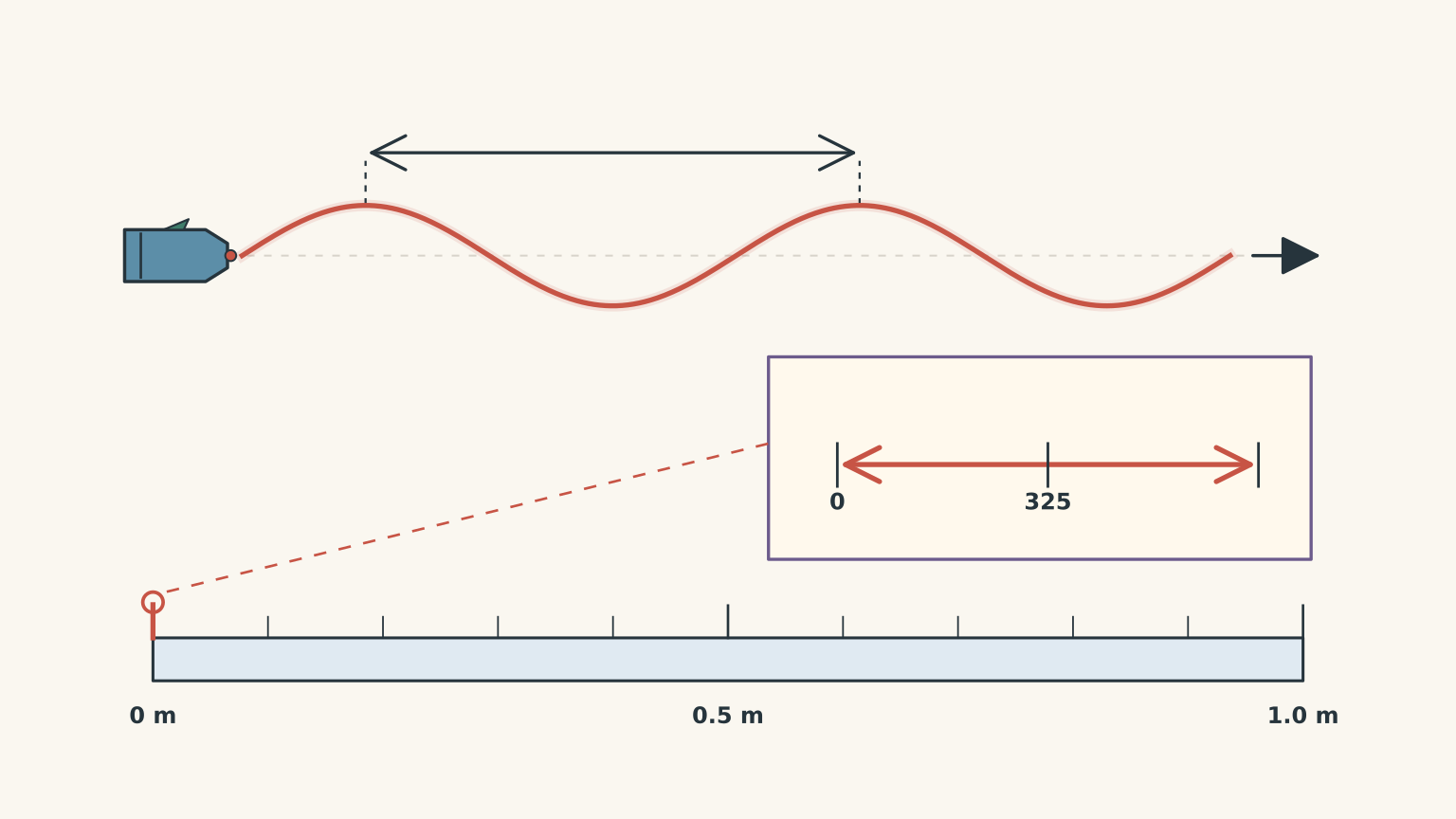
A red laser has a wavelength of \(650\ \mathrm{nm}\), but the wave equation you’re using expects metres. If you enter 650 as though it were metres, your calculation will be wrong by a factor of one billion.
What should the number become when you convert nanometres to metres? It must get smaller, because a metre is much larger than a nanometre. The wavelength itself hasn’t changed. Only the unit you’re using to describe it has.
This is the basic idea behind SI prefixes. Once you understand how they work, converting between femtometres, nanometres, micrometres, millimetres, and kilometres becomes a straightforward process. The tricky part is knowing what happens when the unit is squared or cubed.
01The SI prefix ladder
An SI prefix tells you how large or small a unit is compared with its unprefixed version.
For example:
- A kilometre is 1,000 metres.
- A millimetre is one-thousandth of a metre.
- A nanometre is one-billionth of a metre.
Each prefix represents a specific power of ten. You need to recognise these powers rather than memorise a collection of unrelated conversion factors.
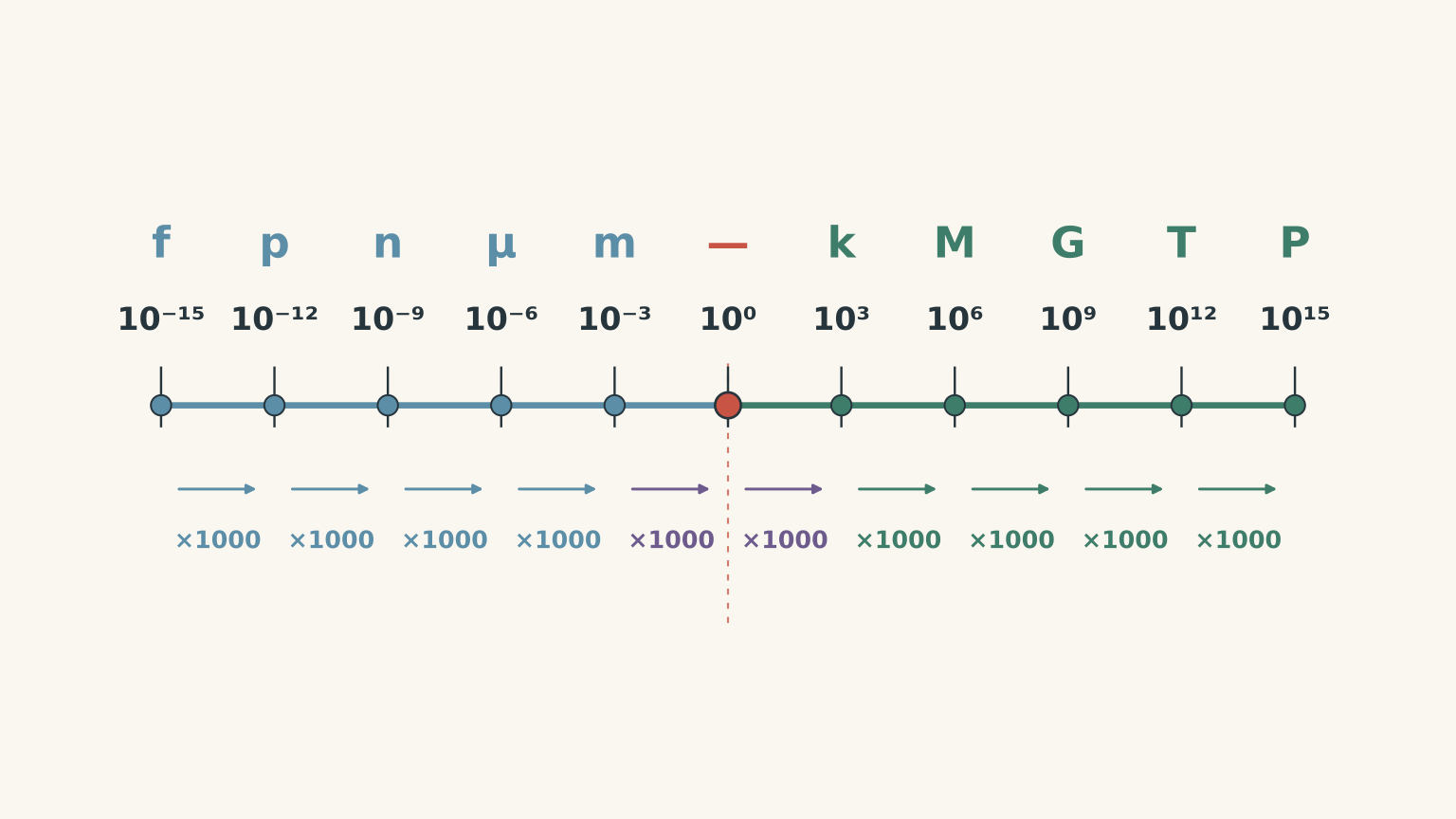
Here is the complete prefix range covered in this guide.
| Prefix | Symbol | Power of ten | Example |
|---|---|---|---|
| femto | f | \(10^{-15}\) | femtosecond (fs) |
| pico | p | \(10^{-12}\) | picometre (pm) |
| nano | n | \(10^{-9}\) | nanometre (nm) |
| micro | µ | \(10^{-6}\) | microsecond (µs) |
| milli | m | \(10^{-3}\) | milligram (mg) |
| No prefix | – | \(10^0\) | metre (m) |
| kilo | k | \(10^3\) | kilometre (km) |
| mega | M | \(10^6\) | megawatt (MW) |
| giga | G | \(10^9\) | gigahertz (GHz) |
| tera | T | \(10^{12}\) | terahertz (THz) |
| peta | P | \(10^{15}\) | petawatt (PW) |
Notice the pattern. Each successive prefix is 1,000 times larger than the previous one.
The negative powers describe fractions of a unit. The positive powers describe multiples of a unit.
For example:
\[ 1\ \mathrm{nm}=10^{-9}\ \mathrm{m} \]
\[ 1\ \mathrm{km}=10^3\ \mathrm{m} \]
The prefix tells you the conversion factor. You don’t need a separate rule for every individual unit.
Watch the capital letters
SI prefix symbols are case-sensitive. A capital letter can completely change the meaning of a measurement.
Two particularly important pairs are:
| Symbol | Meaning | Multiplier |
|---|---|---|
| m | milli | \(10^{-3}\) |
| M | mega | \(10^6\) |
| p | pico | \(10^{-12}\) |
| P | peta | \(10^{15}\) |
Consider these two measurements:
\[ 1\ \mathrm{mW}=10^{-3}\ \mathrm{W} \]
\[ 1\ \mathrm{MW}=10^6\ \mathrm{W} \]
A milliwatt and a megawatt differ by a factor of \(10^9\). That is a rather expensive typing mistake if you’re calculating the power output of a generator.
Also remember:
kis kilo, notK.Gis giga.Tis tera.µis the Greek letter mu, used for micro.
Write a space between the numerical value and the unit, but keep the prefix attached to the unit. For example, write \(5.0\ \mathrm{\mu s}\), not \(5.0\ \mathrm{\mu\ s}\).
One small detail about mass: the SI base unit is the kilogram, but prefixes are commonly attached to the gram in laboratory measurements. Therefore,
\[ 1\ \mathrm{mg}=10^{-3}\ \mathrm{g}=10^{-6}\ \mathrm{kg} \]
02Converting between prefixes
Imagine measuring the same length with two different rulers.
A ruler marked in metres gives you a smaller numerical value than a ruler marked in millimetres. This is because each millimetre is much smaller than a metre, so you need more of them to describe the same length.
The physical length stays exactly the same.
This gives us an important rule:
- Converting to a larger unit makes the numerical value smaller.
- Converting to a smaller unit makes the numerical value larger.
For example, converting nanometres to metres makes the numerical value smaller. Converting metres to nanometres makes it larger.
The conversion formula
You can convert between any two prefixes using their powers of ten.
\[ \boxed{x_{\mathrm{target}}= x_{\mathrm{start}}\times10^{a-b}} \]
Where:
- \(x_{\mathrm{start}}\) is the original numerical value.
- \(x_{\mathrm{target}}\) is the converted numerical value.
- \(a\) is the power of ten for the starting prefix.
- \(b\) is the power of ten for the target prefix.
For a unit without a prefix, use an exponent of zero.
For example, converting from nanometres to metres uses:
- Nano: \(a=-9\).
- No prefix: \(b=0\).
Therefore, the conversion factor is \(10^{-9-0}=10^{-9}\).
You multiply the original number by \(10^{-9}\).
Worked example: Converting a wavelength
A laser has a wavelength of \(650\ \mathrm{nm}\). Express this wavelength in metres and micrometres.
Step 1
\[ \begin{aligned} \mathrm{nano}&=10^{-9}\\ \mathrm{micro}&=10^{-6}\\ \mathrm{no\ prefix}&=10^0 \end{aligned} \]
Step 2
\[ \begin{aligned} 650\ \mathrm{nm} &=650\times10^{-9}\ \mathrm{m}\\ &=6.50\times10^{-7}\ \mathrm{m} \end{aligned} \]
Step 3
Using the conversion formula:
\[ \begin{aligned} 650\ \mathrm{nm} &=650\times10^{-9-(-6)}\ \mathrm{\mu m}\\ &=650\times10^{-3}\ \mathrm{\mu m}\\ &=0.650\ \mathrm{\mu m} \end{aligned} \]
The final answers are:
- \(6.50\times10^{-7}\ \mathrm{m}\)
- \(0.650\ \mathrm{\mu m}\)
Both describe exactly the same wavelength.
Notice that converting from nanometres to micrometres made the number smaller because a micrometre is 1,000 times larger than a nanometre.
03What changes when units are squared or cubed?
This is where students often lose marks.
Suppose you know that:
\[ 1\ \mathrm{mm}=10^{-3}\ \mathrm{m} \]
You might assume that:
\[ 1\ \mathrm{mm^2}=10^{-3}\ \mathrm{m^2} \]
That looks reasonable because milli means \(10^{-3}\). However, it is incorrect.
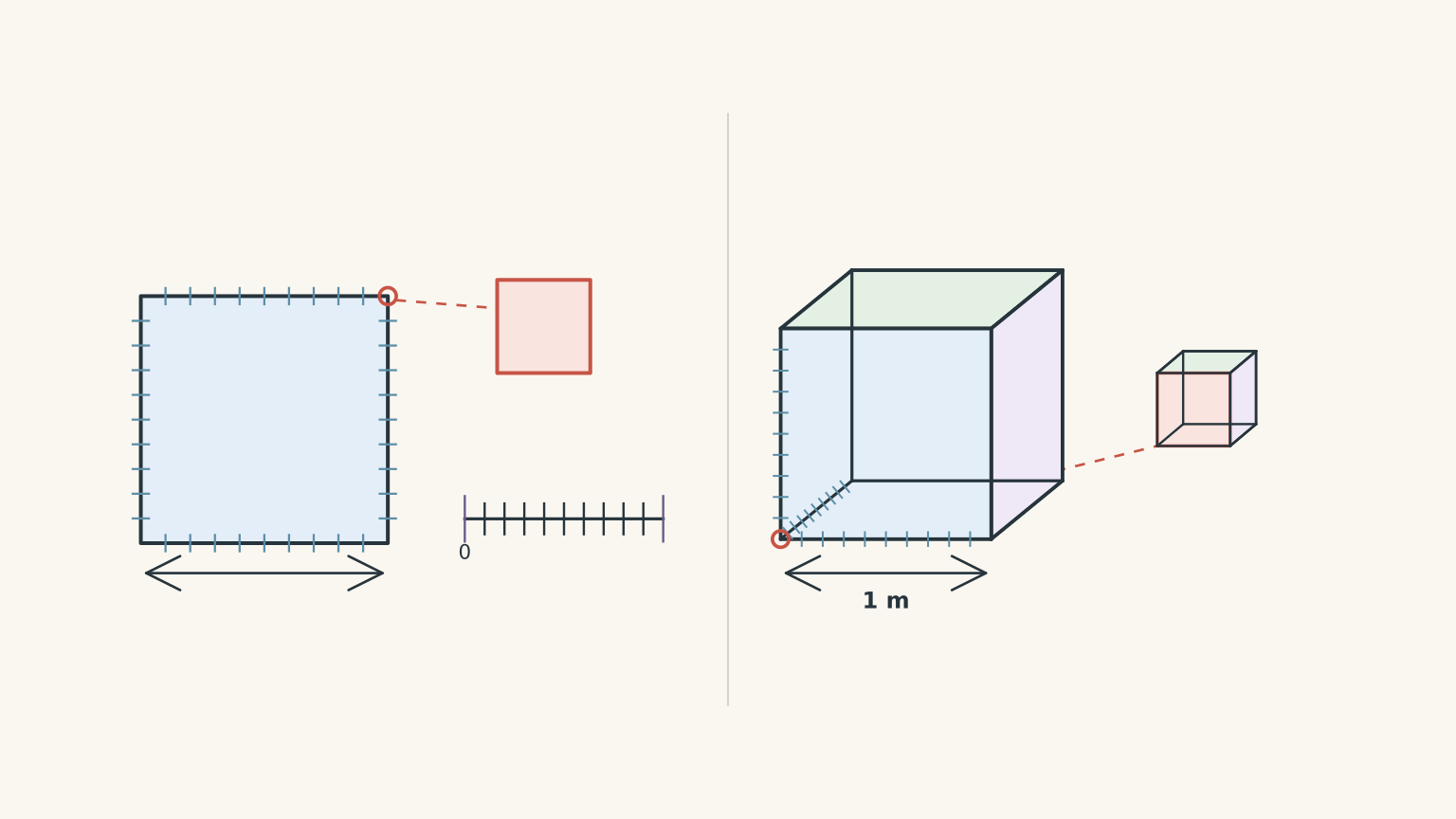
The problem is that area involves two dimensions, not one.
Squared quantities: area
Imagine a square with sides measuring \(1\ \mathrm{mm}\).
To find its area in square metres, you must convert both sides into metres before multiplying.
\[ \begin{aligned} 1\ \mathrm{mm^2} &=(1\ \mathrm{mm})^2\\ &=(10^{-3}\ \mathrm{m})^2\\ &=10^{-6}\ \mathrm{m^2} \end{aligned} \]
The conversion factor must also be squared.
This means:
\[ \boxed{1\ \mathrm{mm^2}=10^{-6}\ \mathrm{m^2}} \]
The same principle applies to other prefixes.
For example:
\[ 1\ \mathrm{\mu m^2}=10^{-12}\ \mathrm{m^2} \]
because:
\[ (10^{-6})^2=10^{-12} \]
Cubed quantities: volume
Volume involves three dimensions: length, width, and height.
Imagine a cube with sides measuring \(1\ \mathrm{mm}\).
You must convert all three dimensions into metres.
\[ \begin{aligned} 1\ \mathrm{mm^3} &=(1\ \mathrm{mm})^3\\ &=(10^{-3}\ \mathrm{m})^3\\ &=10^{-9}\ \mathrm{m^3} \end{aligned} \]
Therefore:
\[ \boxed{1\ \mathrm{mm^3}=10^{-9}\ \mathrm{m^3}} \]
For micrometres:
\[ 1\ \mathrm{\mu m^3}=10^{-18}\ \mathrm{m^3} \]
The exponent is multiplied by three because the length conversion factor appears three times.
Here’s the rule worth remembering:
| Quantity | What happens to the conversion factor? |
|---|---|
| Length | Use the factor once |
| Area | Square the factor |
| Volume | Cube the factor |
If you see \(\mathrm{mm^2}\), don’t use the millimetre conversion factor once. If you see \(\mathrm{mm^3}\), don’t use it twice.
The power of the unit determines what you do.
Worked example: Surface area and volume of a small cube
An ideal cubic sensor element has an edge length of \(0.30\ \mathrm{mm}\). Calculate its surface area in \(\mathrm{m^2}\) and its volume in \(\mathrm{m^3}\).
Step 1
Since milli represents \(10^{-3}\):
\[ \begin{aligned} L&=0.30\times10^{-3}\ \mathrm{m}\\ &=3.0\times10^{-4}\ \mathrm{m} \end{aligned} \]
Step 2
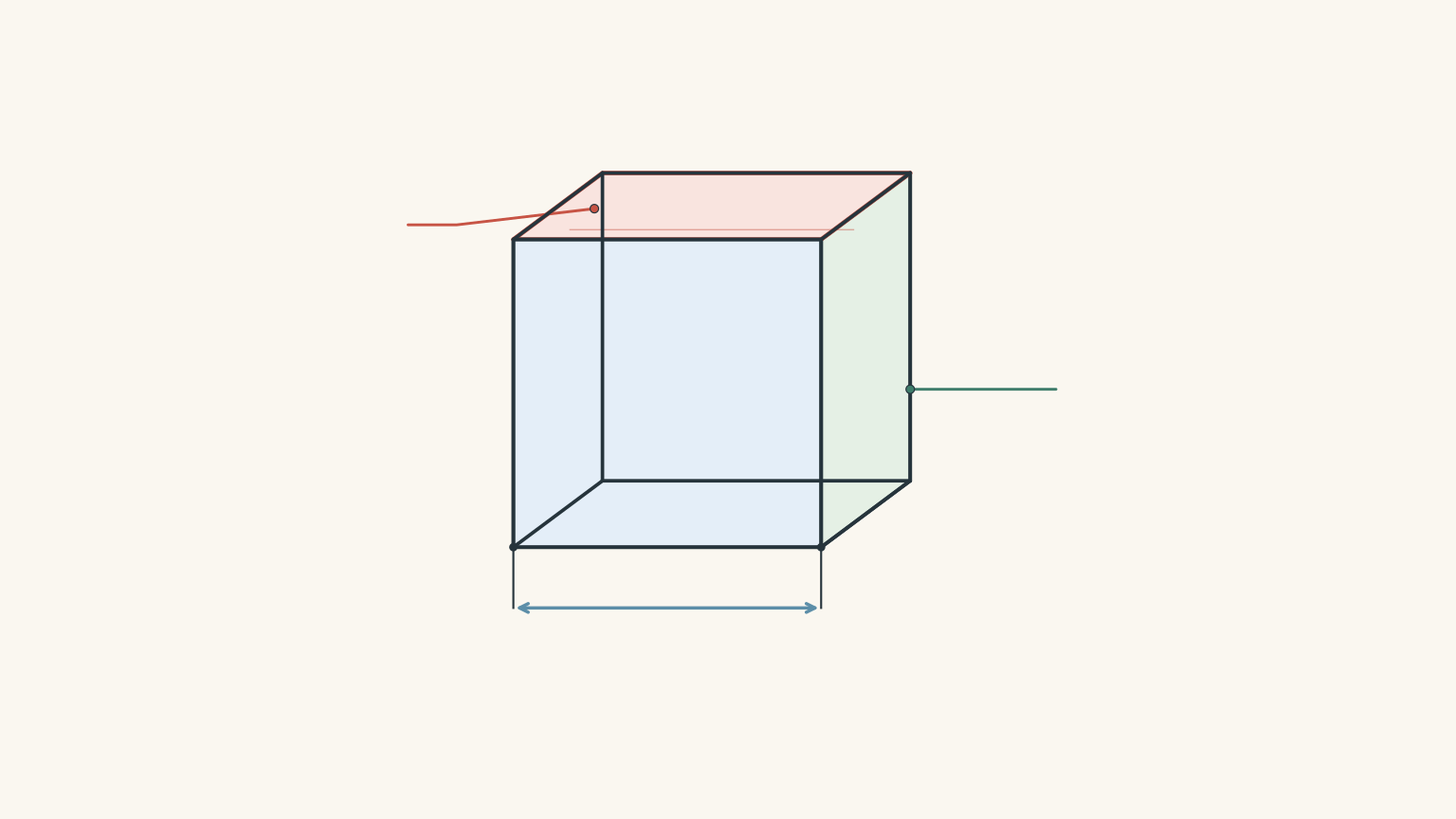
A cube has six identical square faces.
Its surface area is:
\[ A=6L^2 \]
Substitute the converted edge length:
\[ \begin{aligned} A&=6(3.0\times10^{-4})^2\\ &=6(9.0\times10^{-8})\\ &=5.4\times10^{-7}\ \mathrm{m^2} \end{aligned} \]
Notice that the length conversion factor was squared.
Step 3
The volume of a cube is:
\[ V=L^3 \]
Substitute:
\[ \begin{aligned} V&=(3.0\times10^{-4})^3\\ &=27\times10^{-12}\\ &=2.7\times10^{-11}\ \mathrm{m^3} \end{aligned} \]
The final answers are:
- Surface area: \(5.4\times10^{-7}\ \mathrm{m^2}\)
- Volume: \(2.7\times10^{-11}\ \mathrm{m^3}\)
The important difference is that surface area uses a squared conversion factor, while volume uses a cubed conversion factor.
04Using prefixes inside Physics and Chemistry equations
Converting a single measurement is relatively straightforward. The harder part is converting measurements before substituting them into an equation.
You might be given a mass in micrograms and a volume in millilitres, but asked for a concentration in milligrams per litre.
You cannot simply substitute the original numbers and hope the prefixes sort themselves out.
Convert each measurement into the units you want to use in the final answer first.
Worked example: Calculating a mass concentration
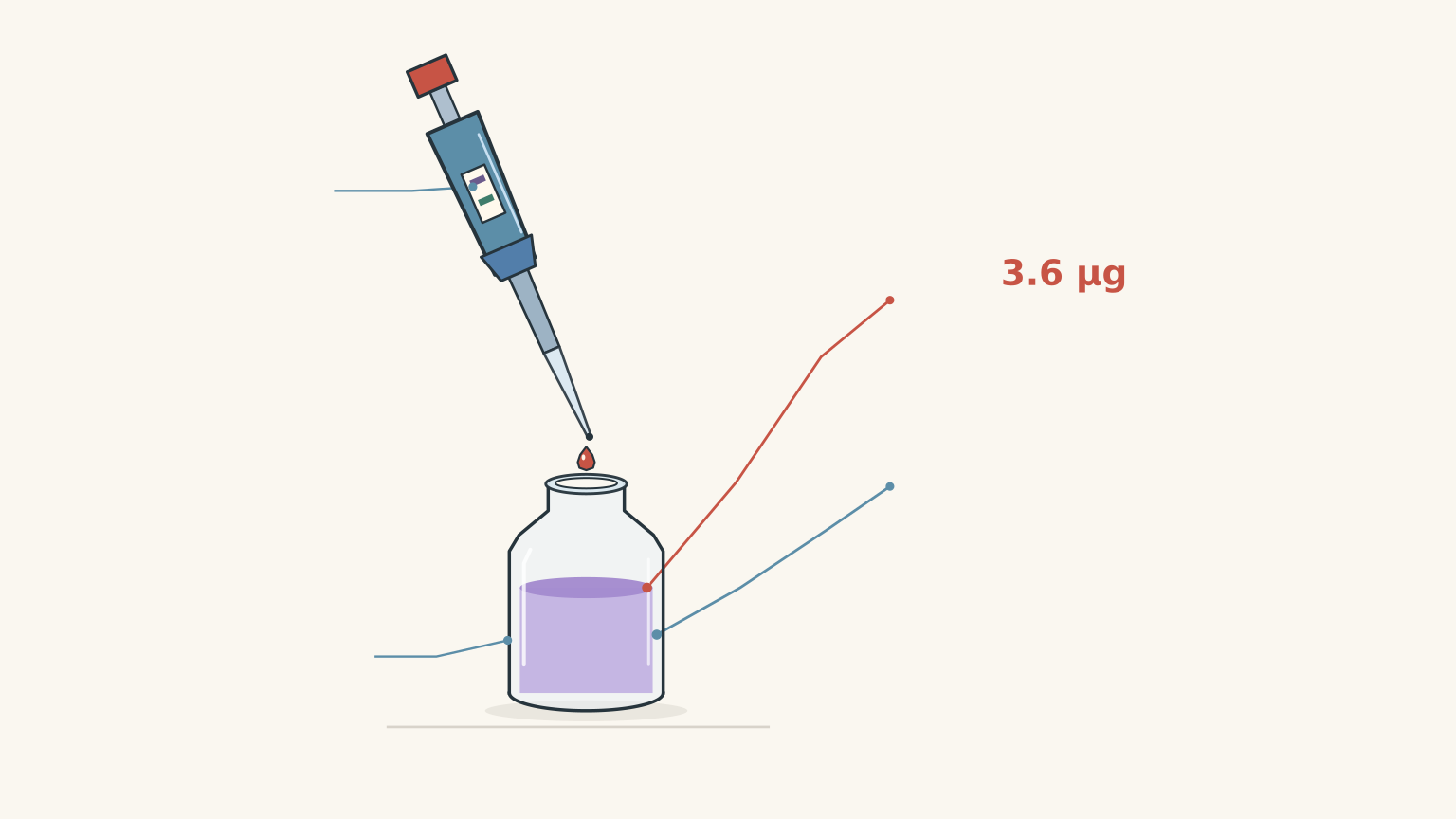
A solution contains \(3.6\ \mathrm{\mu g}\) of dissolved dye in \(0.12\ \mathrm{mL}\) of solution.
Calculate its mass concentration in \(\mathrm{mg/L}\).
Step 1
Mass concentration is the mass of dissolved substance divided by the volume of solution.
\[ c_m=\frac{m}{V} \]
Where:
- \(c_m\) is mass concentration.
- \(m\) is the mass of dissolved substance.
- \(V\) is the solution volume.
Step 2
Micro represents \(10^{-6}\), while milli represents \(10^{-3}\).
Therefore:
\[ \begin{aligned} 3.6\ \mathrm{\mu g} &=3.6\times10^{-3}\ \mathrm{mg}\\ &=0.0036\ \mathrm{mg} \end{aligned} \]
Step 3
\[ \begin{aligned} 0.12\ \mathrm{mL} &=0.12\times10^{-3}\ \mathrm{L}\\ &=1.2\times10^{-4}\ \mathrm{L} \end{aligned} \]
Step 4
\[ \begin{aligned} c_m&=\frac{m}{V}\\ &=\frac{0.0036\ \mathrm{mg}} {1.2\times10^{-4}\ \mathrm{L}}\\ &=30\ \mathrm{mg/L} \end{aligned} \]
The final answer is:
\[ \boxed{c_m=30\ \mathrm{mg/L}} \]
This means there are 30 milligrams of dissolved dye per litre of solution.
Notice that both measurements needed converting, even though they appeared in different parts of the equation.
This is a useful habit for HSC calculations: convert the quantities into the units required by your equation before substituting.
05Common conversion mistakes
Before moving on to the questions, check these four mistakes.
| Mistake | Why it is wrong |
|---|---|
Treating m and M as interchangeable | Milli is \(10^{-3}\), while mega is \(10^6\). |
| Applying the conversion factor only once to an area | Area requires the factor to be squared. |
| Applying the conversion factor only once or twice to a volume | Volume requires the factor to be cubed. |
| Assuming the physical quantity changes when the prefix changes | Only the numerical value and unit have changed. |
A useful final check is to think about the size of the unit.
If you convert \(4\ \mathrm{km}\) into metres, should the number increase or decrease?
It must increase because metres are smaller than kilometres. The answer is \(4,000\ \mathrm{m}\).
If you convert \(4,000\ \mathrm{mm}\) into metres, the number must decrease. The answer is \(4\ \mathrm{m}\).
If your conversion moves in the opposite direction, check your exponent.
06Questions and solutions
Try each question before reading its solution. The questions start with straightforward prefix conversions and gradually introduce more complicated combinations of measurements.
Question 1
Convert \(7.2\ \mathrm{ms}\) into microseconds (\(\mathrm{\mu s}\)).
Solution 1
The answer is \(7.2\times10^3\ \mathrm{\mu s}\), or \(7,200\ \mathrm{\mu s}\).
To convert from milliseconds to microseconds, identify the two prefix powers:
\[ \mathrm{milli}=10^{-3} \]
\[ \mathrm{micro}=10^{-6} \]
Apply the conversion formula:
\[ \begin{aligned} x_{\mathrm{target}} &=7.2\times10^{-3-(-6)}\\ &=7.2\times10^3 \end{aligned} \]
Therefore:
\[ \boxed{7.2\ \mathrm{ms}=7,200\ \mathrm{\mu s}} \]
The numerical value increases because a microsecond is smaller than a millisecond.
Question 2
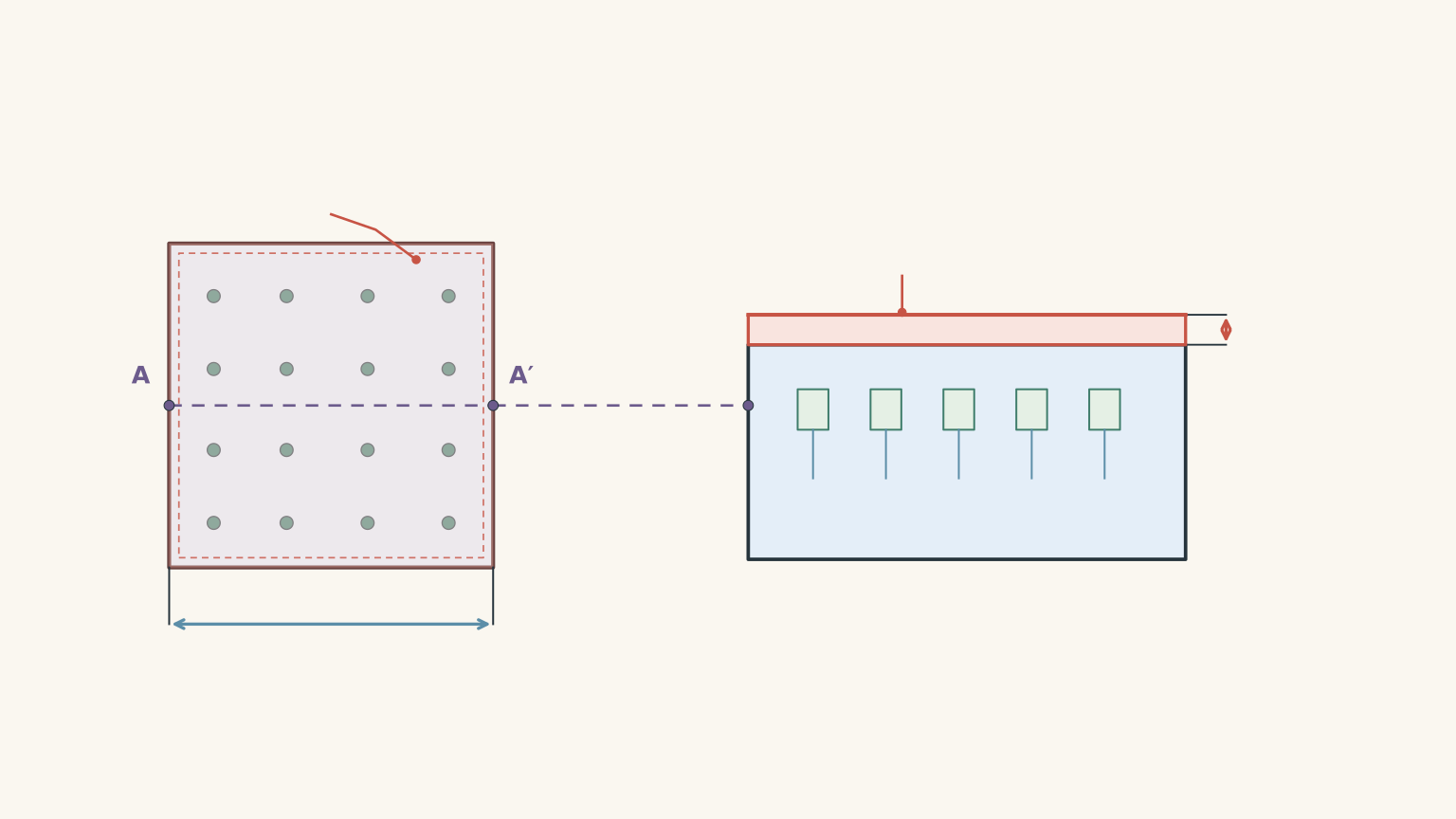
A square sensor has a side length of \(0.40\ \mathrm{mm}\). It is covered by a uniform coating with a thickness of \(75\ \mathrm{nm}\).
Calculate the volume of the coating in \(\mathrm{m^3}\).
Assume the coating covers the entire square and has a uniform thickness.
Solution 2
The coating volume is \(1.2\times10^{-14}\ \mathrm{m^3}\).
We need to calculate the area of the square sensor and multiply it by the coating thickness.
Step 1: Convert the sensor’s side length into metres.
\[ \begin{aligned} s&=0.40\ \mathrm{mm}\\ &=0.40\times10^{-3}\ \mathrm{m}\\ &=4.0\times10^{-4}\ \mathrm{m} \end{aligned} \]
Step 2: Convert the coating thickness into metres.
\[ \begin{aligned} t&=75\ \mathrm{nm}\\ &=75\times10^{-9}\ \mathrm{m}\\ &=7.5\times10^{-8}\ \mathrm{m} \end{aligned} \]
Step 3: Calculate the surface area of the sensor.
The sensor is square, so:
\[ A=s^2 \]
\[ \begin{aligned} A&=(4.0\times10^{-4})^2\\ &=1.6\times10^{-7}\ \mathrm{m^2} \end{aligned} \]
Step 4: Calculate the coating volume.
Volume is the surface area multiplied by the coating thickness.
\[ V=At \]
Substitute:
\[ \begin{aligned} V&=(1.6\times10^{-7}) (7.5\times10^{-8})\\ &=12\times10^{-15}\\ &=1.2\times10^{-14}\ \mathrm{m^3} \end{aligned} \]
Therefore:
\[ \boxed{V=1.2\times10^{-14}\ \mathrm{m^3}} \]
The important part of this calculation was converting the side length before squaring it. Converting the length correctly but forgetting to square its conversion factor would produce an incorrect surface area and, consequently, an incorrect volume.
Question 3
A chemist prepares a solution containing \(0.060\ \mathrm{mmol}\) of solute in a final solution volume of \(1.50\times10^2\ \mathrm{\mu L}\).
Calculate the amount concentration of the solution in \(\mathrm{mol\,L^{-1}}\).
Solution 3
The amount concentration is \(0.40\ \mathrm{mol\,L^{-1}}\).
We use the amount concentration equation:
\[ c=\frac{n}{V} \]
Where:
- \(c\) is amount concentration in \(\mathrm{mol\,L^{-1}}\).
- \(n\) is the amount of solute in moles.
- \(V\) is the solution volume in litres.
Step 1: Convert the amount of solute into moles.
Milli represents \(10^{-3}\).
\[ \begin{aligned} n&=0.060\ \mathrm{mmol}\\ &=0.060\times10^{-3}\ \mathrm{mol}\\ &=6.0\times10^{-5}\ \mathrm{mol} \end{aligned} \]
Step 2: Convert the solution volume into litres.
Micro represents \(10^{-6}\).
\[ \begin{aligned} V&=1.50\times10^2\ \mathrm{\mu L}\\ &=1.50\times10^2\times10^{-6}\ \mathrm{L}\\ &=1.50\times10^{-4}\ \mathrm{L} \end{aligned} \]
Step 3: Substitute into the concentration equation.
\[ \begin{aligned} c&=\frac{n}{V}\\ &=\frac{6.0\times10^{-5}} {1.50\times10^{-4}}\\ &=0.40\ \mathrm{mol\,L^{-1}} \end{aligned} \]
Therefore:
\[ \boxed{c=0.40\ \mathrm{mol\,L^{-1}}} \]
The key was converting both the amount of solute and the solution volume before substitution.
A common mistake would be to use 0.060 and 150 directly in the equation. Those numbers describe measurements in different units, so the resulting concentration would be incorrect.
Question 4
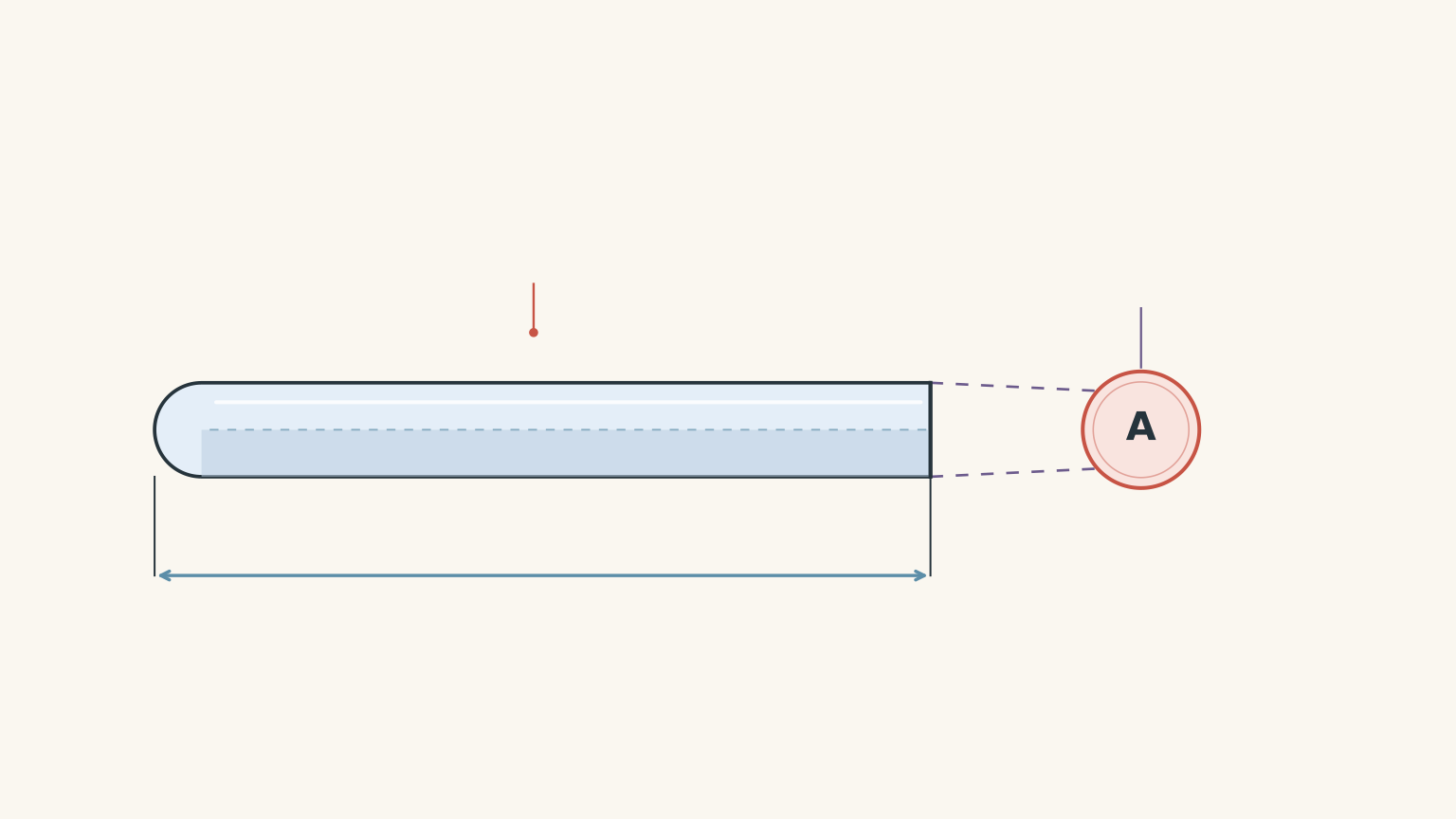
A uniform cylindrical nanowire has a volume of \(90\ \mathrm{\mu m^3}\) and a length of \(0.25\ \mathrm{mm}\).
Calculate its cross-sectional area in \(\mathrm{nm^2}\).
A student obtains \(360\ \mathrm{nm^2}\). Explain why this result is incorrect.
Solution 4
The correct cross-sectional area is \(3.6\times10^5\ \mathrm{nm^2}\). The student’s answer is 1,000 times too small.
We need to work backwards from the volume and length to find the cross-sectional area.
Step 1: Write the volume equation.
For a uniform wire:
\[ V=AL \]
Rearrange to make the area the subject:
\[ A=\frac{V}{L} \]
Step 2: Convert the wire’s length into micrometres.
We know:
\[ 1\ \mathrm{mm}=1,000\ \mathrm{\mu m} \]
Therefore:
\[ \begin{aligned} L&=0.25\times1,000\\ &=250\ \mathrm{\mu m} \end{aligned} \]
Step 3: Calculate the cross-sectional area in square micrometres.
Substitute the volume and length:
\[ \begin{aligned} A&=\frac{90\ \mathrm{\mu m^3}} {250\ \mathrm{\mu m}}\\ &=0.36\ \mathrm{\mu m^2} \end{aligned} \]
Notice that dividing cubic micrometres by micrometres leaves square micrometres.
Step 4: Convert the area into square nanometres.
We know:
\[ 1\ \mathrm{\mu m}=10^3\ \mathrm{nm} \]
However, we are converting an area, not a length. We must square the conversion factor.
\[ \begin{aligned} 1\ \mathrm{\mu m^2} &=(10^3)^2\ \mathrm{nm^2}\\ &=10^6\ \mathrm{nm^2} \end{aligned} \]
Therefore:
\[ \begin{aligned} A&=0.36\times10^6\ \mathrm{nm^2}\\ &=3.6\times10^5\ \mathrm{nm^2} \end{aligned} \]
The correct answer is:
\[ \boxed{A=3.6\times10^5\ \mathrm{nm^2}} \]
Why was the student’s answer wrong?
The student multiplied by \(10^3\) rather than \(10^6\).
They treated the area conversion as though it were a length conversion. Because the quantity was squared, the conversion factor also needed to be squared.
This is a particularly common mistake when working with microscopic measurements.
Question 5
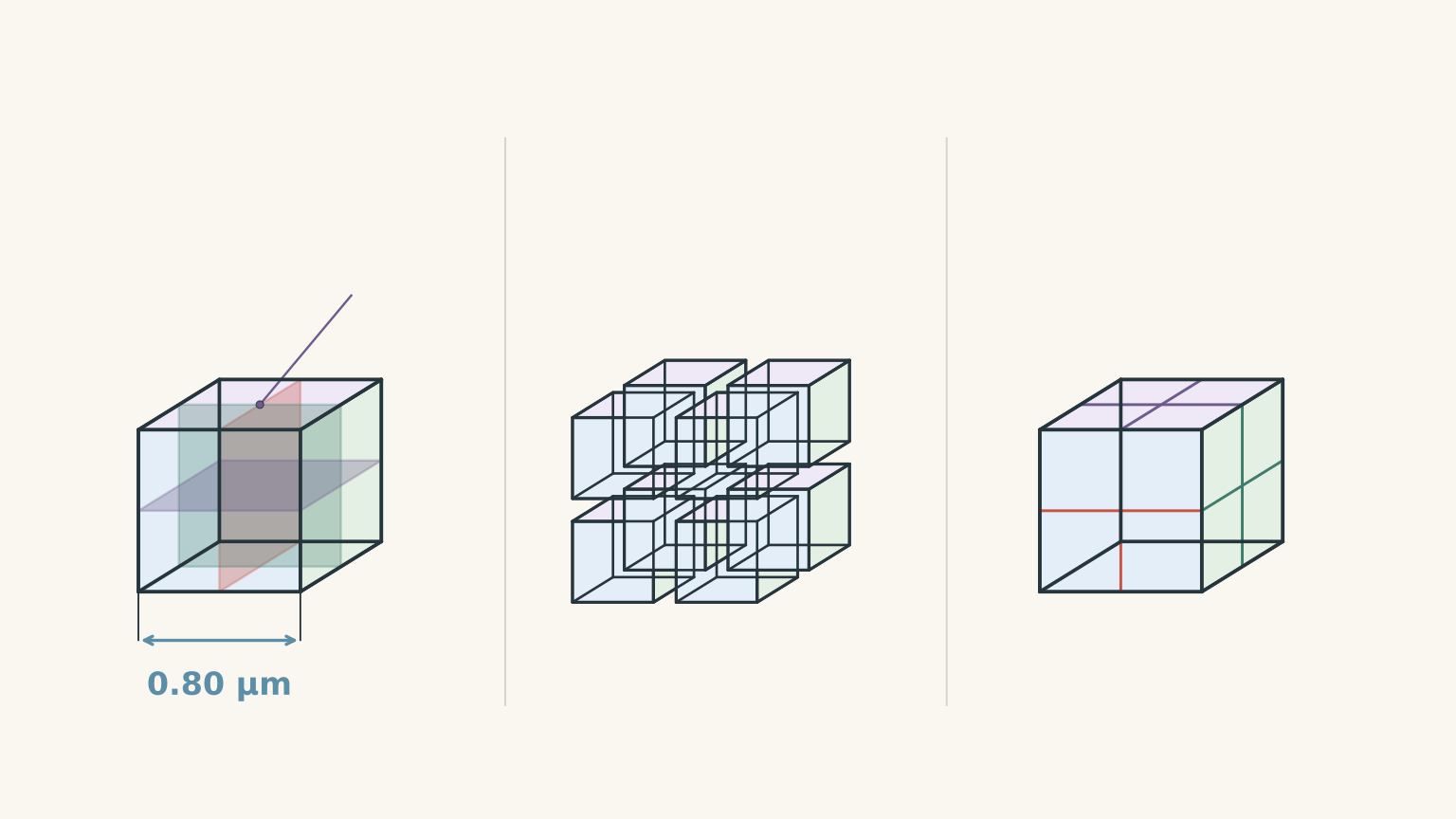
A perfect cube has an edge length of \(0.80\ \mathrm{\mu m}\).
Three instruments report the following measurements for the cube:
- Edge length: \(0.80\ \mathrm{\mu m}\)
- Volume: \(5.12\times10^8\ \mathrm{nm^3}\)
- Surface area: \(3.84\times10^6\ \mathrm{nm^2}\)
A student argues that the measurements cannot all describe the same cube because the numerical values are so different.
Determine whether the three measurements are consistent.
The cube is then cut exactly in half along each of its three perpendicular mid-planes, producing eight equal cubes. Assume no material is lost during cutting.
Calculate:
(a) The edge length of each smaller cube in nanometres.
(b) The total volume of all eight smaller cubes in \(\mathrm{nm^3}\).
(c) The total surface area of the eight cubes when they are completely separated.
(d) The external surface area when the eight cubes are pushed back together tightly to recreate the original cube, with no gaps.
Solution 5
All three original measurements are consistent.
After cutting, each smaller cube has an edge length of \(400\ \mathrm{nm}\). The total volume remains \(5.12\times10^8\ \mathrm{nm^3}\). The total surface area is \(7.68\times10^6\ \mathrm{nm^2}\) when separated, but returns to \(3.84\times10^6\ \mathrm{nm^2}\) as the external surface area when the pieces are reassembled.
This question tests something more important than simply knowing the prefixes: it tests whether you understand the difference between volume and surface area.
Step 1: Convert the original edge length into nanometres.
Micro represents \(10^{-6}\), while nano represents \(10^{-9}\).
Therefore:
\[ \begin{aligned} L&=0.80\ \mathrm{\mu m}\\ &=0.80\times10^3\ \mathrm{nm}\\ &=800\ \mathrm{nm} \end{aligned} \]
Step 2: Check the reported volume.
The volume of a cube is:
\[ V=L^3 \]
Substitute the converted edge length:
\[ \begin{aligned} V&=(800)^3\\ &=512,000,000\ \mathrm{nm^3}\\ &=5.12\times10^8\ \mathrm{nm^3} \end{aligned} \]
This agrees with the instrument reading.
Step 3: Check the reported surface area.
A cube has six identical square faces.
\[ A=6L^2 \]
Substitute:
\[ \begin{aligned} A&=6(800)^2\\ &=6(640,000)\\ &=3.84\times10^6\ \mathrm{nm^2} \end{aligned} \]
This also agrees with the instrument reading.
Therefore, all three measurements describe the same original cube.
Step 4: Calculate the edge length of each smaller cube.
The original cube is divided into two equal sections along each dimension.
Therefore, each smaller cube has half the original edge length.
\[ \begin{aligned} L_{\mathrm{small}}&=\frac{800}{2}\\ &=400\ \mathrm{nm} \end{aligned} \]
Step 5: Calculate the total volume of the eight smaller cubes.
First, calculate the volume of one smaller cube.
\[ \begin{aligned} V_{\mathrm{small}}&=400^3\\ &=64,000,000\ \mathrm{nm^3}\\ &=6.4\times10^7\ \mathrm{nm^3} \end{aligned} \]
There are eight identical cubes.
\[ \begin{aligned} V_{\mathrm{total}} &=8\times6.4\times10^7\\ &=5.12\times10^8\ \mathrm{nm^3} \end{aligned} \]
The total volume is unchanged.
This makes sense because cutting the original cube does not remove any material. It simply separates the same material into smaller pieces.
Step 6: Calculate the total surface area when the cubes are separated.
The surface area of one smaller cube is:
\[ A_{\mathrm{small}}=6L^2 \]
\[ \begin{aligned} A_{\mathrm{small}} &=6(400)^2\\ &=960,000\ \mathrm{nm^2} \end{aligned} \]
There are eight cubes, so:
\[ \begin{aligned} A_{\mathrm{separated}} &=8\times960,000\\ &=7.68\times10^6\ \mathrm{nm^2} \end{aligned} \]
Therefore:
\[ \boxed{A_{\mathrm{separated}}=7.68\times10^6\ \mathrm{nm^2}} \]
Notice that this is twice the original surface area.
Why?
Cutting the cube creates new faces. When the eight smaller cubes are separated, every face is exposed.
Step 7: Calculate the external surface area when the cubes are reassembled.
Now imagine pushing the eight smaller cubes together so that they form the original cube again.
The external dimensions are unchanged. The reassembled object is still an \(800\ \mathrm{nm}\) cube.
Therefore:
\[ \begin{aligned} A_{\mathrm{external}} &=6(800)^2\\ &=3.84\times10^6\ \mathrm{nm^2} \end{aligned} \]
Thus:
\[ \boxed{A_{\mathrm{external}}=3.84\times10^6\ \mathrm{nm^2}} \]
The internal faces are touching one another, so they are not exposed and do not contribute to the external surface area.
The important distinction
A tempting argument is that surface area should remain constant because the amount of material has not changed.
That is incorrect. Volume measures the amount of space occupied by the material, while surface area measures the boundary exposed at the object’s surface.
Cutting the cube conserves its total volume but creates additional exposed surfaces. Reassembling the pieces hides those surfaces again.
This is why the total surface area depends on how the pieces are arranged, even though the total volume remains unchanged.
07Where to use this next
SI prefix conversions appear throughout HSC Physics and Chemistry.
You’ll use them when working with:
- Wavelength and frequency in wave calculations.
- Electrical quantities such as charge, current, and capacitance.
- Small masses and volumes in chemical experiments.
- Concentrations in \(\mathrm{mol\,L^{-1}}\) and \(\mathrm{mg/L}\).
- Surface areas and volumes of microscopic objects.
The next step is applying these conversions to compound units such as \(\mathrm{m\,s^{-1}}\), \(\mathrm{kg\,m^{-3}}\), and \(\mathrm{mol\,L^{-1}}\).
The same principle still applies: convert the numerical values and their units together, and pay attention to whether a unit is raised to a power.