
Static vs Dynamic Equilibrium in HSC Chemistry
Learn how static and dynamic equilibrium differ, why equal forward and reverse rates matter, and how closed systems maintain constant composition.
A reaction mixture has stopped changing colour. Has the reaction stopped?
That is the trap.
In a completed reaction, the chemical change really can stop. But in a reversible reaction inside a closed system, reactants may still be turning into products while products turn back into reactants. If those two processes happen at the same rate, the visible composition stays constant even though reactions continue at the particle level.
Before going further, predict this: if 50 particles change from A to B each second, while 50 particles change from B to A each second, what happens to the total amount of A and B?
Neither amount changes. There is plenty happening, but the changes cancel.
That is the central idea behind dynamic equilibrium.
01Start with the traffic, not the amounts
Imagine two rooms at a party. People can move through a doorway in either direction.
At first, Room A has 80 people and Room B has 20. After a while, four people per minute move from A to B, while four people per minute move from B to A.
The room populations stay at 80 and 20.
Notice what did not have to happen: the rooms did not become equally crowded. Equal movement rates do not require equal populations.
A reversible chemical reaction can behave in the same way:
\[
\ce{A <=> B}
\]
The forward reaction converts A into B. The reverse reaction converts B back into A.
At dynamic equilibrium,
\[
r_{\text{forward}} = r_{\text{reverse}} \neq 0
\]
where \(r\) represents reaction rate.
The analogy has a limit. Molecules are not people choosing which room looks less awkward. Reaction rates depend on factors such as particle concentrations, collision frequency, energy, and reaction pathways. The useful part of the analogy is simply that equal movement in opposite directions can produce no overall change.
02What makes the equilibrium dynamic?
Suppose a closed container begins with plenty of A and almost no B.
For
\[
\ce{A <=> B}
\]
the forward reaction can occur immediately because A is present. The reverse reaction is initially very slow, or possibly zero, because there is little or no B available.
As A is converted into B:
- the amount of A decreases,
- the amount of B increases,
- the forward rate generally decreases in this simple model, and
- the reverse rate increases because more B is available to react.
Eventually the two rates become equal.
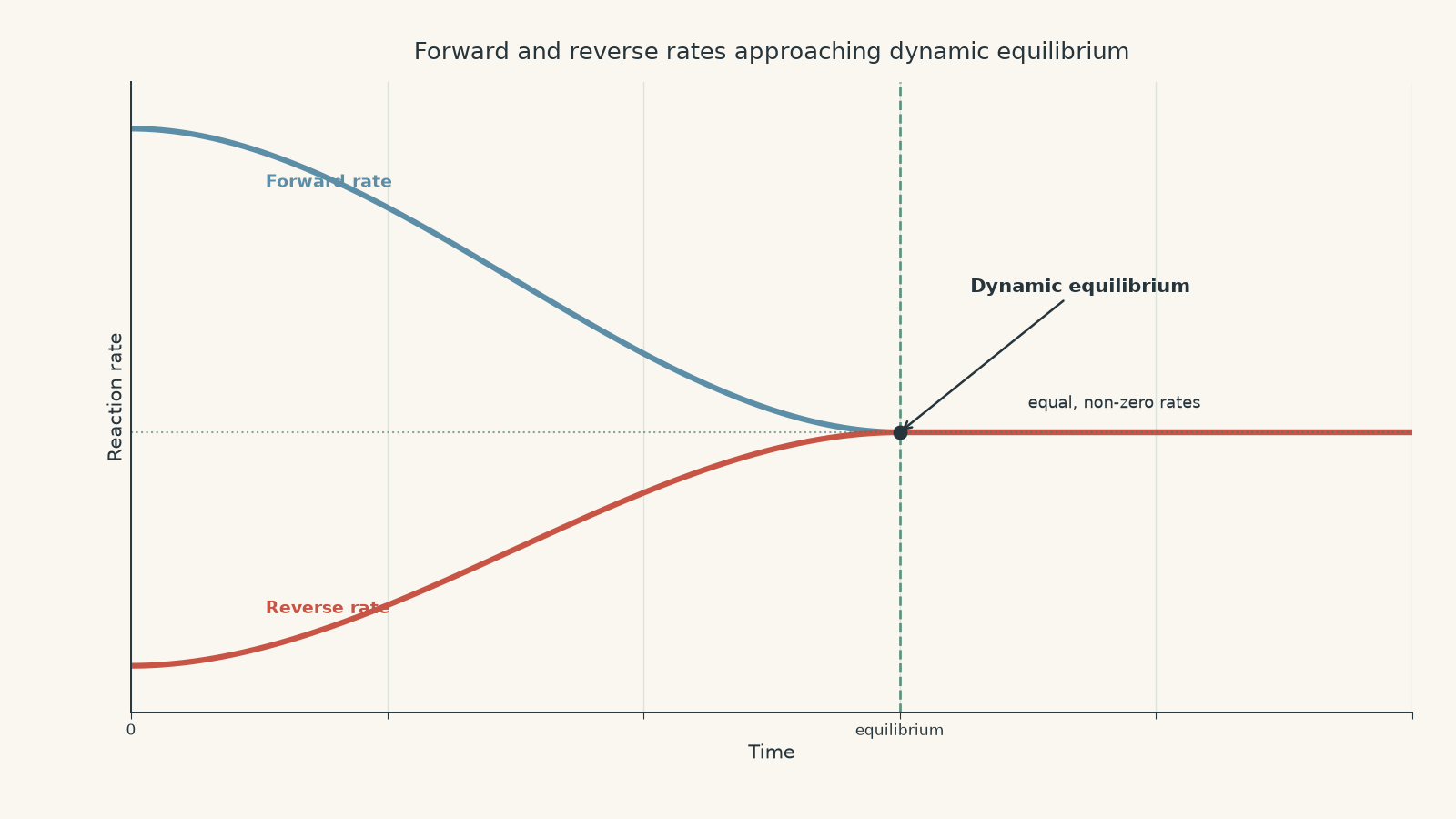
Once the rates are equal, every forward change is balanced by an equivalent reverse change.
There is therefore no net change:
\[
r_{\text{net}} = r_{\text{forward}} – r_{\text{reverse}} = 0
\]
This does not mean either reaction has stopped. It means their effects cancel.
If you need a refresher on why products can react to re-form reactants in the first place, see tutorgum’s guide to reversible chemical reactions.
03Static and dynamic equilibrium are not the same thing
In the HSC comparison, static equilibrium describes a situation in which the chemical change has effectively stopped. Dynamic equilibrium describes a reversible system in which chemical change continues in both directions.
| Feature | Static equilibrium | Dynamic equilibrium |
|---|---|---|
| Macroscopic change | None | None |
| Forward reaction | Stopped | Continues |
| Reverse reaction | Stopped | Continues |
| Forward and reverse rates | \(r_f=r_r=0\) | \(r_f=r_r>0\) |
| Microscopic conversion between reactants and products | No ongoing conversion | Continuous conversion in both directions |
| Typical chemical situation | A reaction has gone to completion | A reversible reaction has reached equilibrium in a closed system |
There is one wording trap here. Static does not mean the particles themselves are frozen.
Molecules in a liquid or gas still move, rotate, vibrate, and collide. What has stopped is the relevant chemical conversion between reactants and products.
Suppose an irreversible reaction is
\[
\ce{A + B -> C}
\]
and B is the limiting reactant. Once every available B particle has been consumed, the forward reaction cannot continue. There is also no meaningful reverse reaction under the conditions.
The chemical system has reached the HSC model of static equilibrium:
\[
r_{\text{forward}}=r_{\text{reverse}}=0
\]
Some A could still remain because A was in excess. A reaction going to completion does not mean every reactant must disappear.
04Why a closed system matters
Dynamic equilibrium is not just about reversibility. The reacting matter must also be contained.
A closed system can exchange energy with its surroundings, but not matter.
A sealed reaction vessel can therefore be treated as closed even if it is being heated. Thermal energy can cross the boundary, while the reacting chemicals remain inside.
An open system allows matter to enter or leave.
Consider a reversible gas reaction:
\[
\ce{A(g) <=> B(g)}
\]
If B continually escapes through an opening, the reverse reaction loses some of the B it needs. The system can keep being pulled away from equilibrium.
This gives a useful decision rule:
Constant-looking composition is not enough to prove dynamic equilibrium. Check that the reaction is reversible, the relevant matter is contained, and the forward and reverse rates are equal and non-zero.
An open system can sometimes maintain constant concentrations through a continuous inflow and outflow. That is called a steady state, and it is not automatically an equilibrium. We will return to that distinction in the final problem.
05Equal rates do not mean equal concentrations
This is probably the most tempting equilibrium mistake.
Suppose a closed system at equilibrium contains
\[
[A]=0.80\ \text{mol L}^{-1}
\]
and
\[
[B]=0.20\ \text{mol L}^{-1}
\]
for the reaction
\[
\ce{A <=> B}
\]
There is nothing wrong with this.
Dynamic equilibrium requires
\[
r_{\text{forward}}=r_{\text{reverse}}
\]
It does not require
\[
[A]=[B]
\]
Why can different concentrations produce equal rates?
Because the forward and reverse reactions need not respond identically to concentration. They have different reaction pathways and rate behaviour. At one particular mixture, the forward and reverse rates happen to match.
Think back to the party. One room can contain 80 people and the other 20, while four people per minute cross the doorway in each direction.
Equal traffic. Unequal crowds.
Worked example: Can unequal concentrations still be at equilibrium?
A closed \(1.00\ \text{L}\) vessel contains the reversible reaction
\[
\ce{A <=> B}
\]
During a \(30.0\ \text{s}\) interval, \(0.0120\ \text{mol}\) of A is converted to B, while \(0.0120\ \text{mol}\) of B is converted to A. At the beginning of the interval, \([A]=0.800\ \text{mol L}^{-1}\) and \([B]=0.200\ \text{mol L}^{-1}\).
Calculate the forward and reverse rates, determine the net concentration change during the interval, and explain whether the system can be at dynamic equilibrium.
Step 1
For this one-to-one reaction,
\[
r_{\text{forward}}
=
\frac{0.0120\ \text{mol}}
{(1.00\ \text{L})(30.0\ \text{s})}
=
4.00\times10^{-4}\ \text{mol L}^{-1}\text{s}^{-1}
\]
Step 2
\[
r_{\text{reverse}}
=
\frac{0.0120\ \text{mol}}
{(1.00\ \text{L})(30.0\ \text{s})}
=
4.00\times10^{-4}\ \text{mol L}^{-1}\text{s}^{-1}
\]
The rates are equal and both are non-zero.
Step 3
The same amount of A is consumed as is re-formed:
\[
\Delta n(A)=-0.0120+0.0120=0\ \text{mol}
\]
Similarly,
\[
\Delta n(B)=+0.0120-0.0120=0\ \text{mol}
\]
So
\[
\Delta[A]=\Delta[B]=0\ \text{mol L}^{-1}
\]
Step 4
The system is consistent with dynamic equilibrium because the forward and reverse reactions are continuing at equal, non-zero rates in a closed system.
The concentrations remain \(0.800\ \text{mol L}^{-1}\) and \(0.200\ \text{mol L}^{-1}\). Their inequality is irrelevant. It is the equality of the reaction rates that matters.
06The word “rate” needs one extra layer of care
A one-to-one reaction such as
\[
\ce{A <=> B}
\]
makes the idea look easier than it really is.
Now consider
\[
\ce{N2O4(g) <=> 2NO2(g)}
\]
One mole of \(\ce{N2O4}\) decomposing produces two moles of \(\ce{NO2}\).
That means you cannot simply compare the number of moles of two different species changing per second and call those the forward and reverse reaction rates. The stoichiometric coefficients matter.
For every \(1\) mole of \(\ce{N2O4}\) consumed in the forward direction,
\[
2\ \text{mol}
\]
of \(\ce{NO2}\) is produced.
So a forward reaction rate based on \(\ce{N2O4}\) can be written as
\[
r_{\text{forward}}
=
-\frac{\Delta[\ce{N2O4}]}{\Delta t}
\]
or, using \(\ce{NO2}\),
\[
r_{\text{forward}}
=
\frac{1}{2}\frac{\Delta[\ce{NO2}]}{\Delta t}
\]
The factor of \(\frac{1}{2}\) corrects for the coefficient of 2.
At equilibrium, it is the forward and reverse rates of the reaction that are equal. Raw mole changes for different species can have different numerical values because of stoichiometry.
Worked example: Is the reaction already at equilibrium?
A sealed \(2.00\ \text{L}\) vessel contains
\[
\ce{N2O4(g) <=> 2NO2(g)}
\]
During a \(20.0\ \text{s}\) interval, \(0.0400\ \text{mol}\) of \(\ce{N2O4}\) decomposes in the forward direction. During the same interval, the reverse reaction re-forms \(0.0280\ \text{mol}\) of \(\ce{N2O4}\).
Calculate the net changes in \([\ce{N2O4}]\) and \([\ce{NO2}]\), and determine whether the system is at dynamic equilibrium during this interval.
Step 1
The forward reaction consumes \(0.0400\ \text{mol}\), while the reverse reaction produces \(0.0280\ \text{mol}\):
\[
\Delta n(\ce{N2O4})
=
-0.0400+0.0280
=
-0.0120\ \text{mol}
\]
Step 2
The volume is \(2.00\ \text{L}\):
\[
\Delta[\ce{N2O4}]
=
\frac{-0.0120}{2.00}
=
-0.00600\ \text{mol L}^{-1}
\]
Step 3
Each net mole of \(\ce{N2O4}\) decomposed forms two moles of \(\ce{NO2}\):
\[
\Delta n(\ce{NO2})
=
2(0.0120)
=
0.0240\ \text{mol}
\]
Therefore,
\[
\Delta[\ce{NO2}]
=
\frac{0.0240}{2.00}
=
0.0120\ \text{mol L}^{-1}
\]
Step 4
Using the amount of \(\ce{N2O4}\) converted,
\[
r_{\text{forward}}
=
\frac{0.0400}
{(2.00)(20.0)}
=
1.00\times10^{-3}\ \text{mol L}^{-1}\text{s}^{-1}
\]
and
\[
r_{\text{reverse}}
=
\frac{0.0280}
{(2.00)(20.0)}
=
7.00\times10^{-4}\ \text{mol L}^{-1}\text{s}^{-1}
\]
The rates are not equal.
Step 5
The system is not yet at dynamic equilibrium. There is a net forward reaction, so \(\ce{N2O4}\) is decreasing while \(\ce{NO2}\) is increasing.
If a later interval showed equal, non-zero forward and reverse rates, the system would then be at dynamic equilibrium, provided the conditions remained constant.
07What you can actually observe
Dynamic equilibrium is awkward because its defining behaviour happens microscopically.
At the macroscopic level, quantities such as these remain constant:
- concentration,
- colour,
- pressure,
- pH, where relevant, and
- amounts of the substances present.
But “constant” does not automatically mean “equilibrium”.
A colour might stay constant because:
- the system is at dynamic equilibrium,
- an irreversible reaction has finished,
- the reaction is simply extremely slow, or
- an open system has reached a steady state in which flows replace whatever the reaction consumes.
So an observation such as “the colour stopped changing” is evidence of constant macroscopic composition, not proof by itself that the forward and reverse rates are equal.
That distinction is useful in longer HSC responses. Describe what is observed first, then explain the particle-level model that accounts for it.
08Four misconceptions worth killing early
| Tempting statement | What is wrong with it? |
|---|---|
| “At equilibrium, the reaction stops.” | At dynamic equilibrium, both directions continue at equal, non-zero rates. |
| “There must be equal amounts of reactants and products.” | Equilibrium requires equal rates, not equal concentrations. |
| “A closed system cannot exchange anything with its surroundings.” | A closed system cannot exchange matter, but it can exchange energy. |
| “If concentrations are constant, the system must be at equilibrium.” | An open system can maintain constant concentrations through balanced flows while its forward and reverse reaction rates remain unequal. |
The last mistake is the most subtle. It separates equilibrium from steady state.
09Questions and solutions
Question 1
A sealed flask at constant temperature contains
\[
\ce{H2(g) + I2(g) <=> 2HI(g)}
\]
After sufficient time, the concentrations of \(\ce{H2}\), \(\ce{I2}\), and \(\ce{HI}\) remain constant.
Explain what must be true about the forward and reverse reaction rates if the system is at dynamic equilibrium. Contrast this with static equilibrium.
Solution 1
At dynamic equilibrium, the forward and reverse reactions occur at equal, non-zero rates, whereas in static equilibrium the relevant forward and reverse chemical changes have effectively stopped.
For the reversible system,
\[
r_{\text{forward}}=r_{\text{reverse}}>0
\]
This equality means that \(\ce{H2}\) and \(\ce{I2}\) are being converted into \(\ce{HI}\) at the same overall rate that \(\ce{HI}\) is being converted back into \(\ce{H2}\) and \(\ce{I2}\).
The concentrations therefore remain constant even though chemical reactions continue.
The tempting mistake is to say that constant concentrations mean the reaction has stopped. That would describe the static model, where
\[
r_{\text{forward}}=r_{\text{reverse}}=0
\]
The macroscopic appearance can be unchanged in both cases, but the microscopic behaviour is different.
Question 2
A closed vessel contains the reversible reaction
\[
\ce{X <=> Y}
\]
at constant temperature. The following concentration data are recorded.
| Time (s) | \([X]\) (\(\text{mol L}^{-1}\)) | \([Y]\) (\(\text{mol L}^{-1}\)) |
|---|---|---|
| 0 | 1.20 | 0.00 |
| 20 | 0.92 | 0.28 |
| 40 | 0.78 | 0.42 |
| 60 | 0.72 | 0.48 |
| 80 | 0.72 | 0.48 |
| 100 | 0.72 | 0.48 |
Identify when the data first support the conclusion that dynamic equilibrium has been established. Explain what is happening microscopically from that point onwards, and evaluate the statement, “The system cannot be at equilibrium because \([X]\neq[Y]\).”
Solution 2
The data first support dynamic equilibrium from about \(60\ \text{s}\) onwards, and the unequal concentrations do not prevent equilibrium.
Between \(60\ \text{s}\) and \(100\ \text{s}\),
\[
[X]=0.72\ \text{mol L}^{-1}
\]
and
\[
[Y]=0.48\ \text{mol L}^{-1}
\]
remain constant.
Because the reaction is reversible, the vessel is closed, and the conditions are constant, this plateau is consistent with the forward and reverse rates becoming equal:
\[
r_{\text{forward}}=r_{\text{reverse}}\neq0
\]
Microscopically, X continues to form Y while Y continues to form X. Equal amounts are converted in opposite directions over the same time, so there is no net concentration change.
The tempting route is to compare \(0.72\) and \(0.48\) and conclude that equilibrium requires them to become equal. That confuses equilibrium composition with equilibrium rate.
There is no requirement that
\[
[X]=[Y]
\]
Only the forward and reverse reaction rates must be equal.
Question 3
Consider the decomposition
\[
\ce{CaCO3(s) <=> CaO(s) + CO2(g)}
\]
at a fixed high temperature.
In experiment A, the solids are heated in an open container, so \(\ce{CO2}\) can escape. In experiment B, the same chemical system is heated at the same temperature in a closed vessel. Assume the amounts and vessel conditions in experiment B allow both solid substances to remain present.
Explain why the ability of \(\ce{CO2}\) to leave experiment A changes whether dynamic equilibrium can be maintained. Predict what happens to the reverse reaction in experiment B as \(\ce{CO2}\) accumulates.
Solution 3
Experiment A cannot maintain the same dynamic equilibrium as the closed vessel because escaping \(\ce{CO2}\) continually removes a reactant needed for the reverse reaction.
The forward reaction is
\[
\ce{CaCO3(s) -> CaO(s) + CO2(g)}
\]
while the reverse reaction is
\[
\ce{CaO(s) + CO2(g) -> CaCO3(s)}
\]
In the open container, some \(\ce{CO2}\) leaves the system. That loss reduces the amount of gaseous reactant available for the reverse reaction, so the system is not free to settle into a balance determined only by the reactions occurring inside it.
The tempting prediction is that reversibility alone guarantees equilibrium. It does not. Matter must also be contained.
In experiment B, \(\ce{CO2}\) cannot escape. As decomposition produces more \(\ce{CO2}\), the reverse reaction becomes increasingly significant. Under suitable fixed conditions, the system can reach a state where
\[
r_{\text{forward}}=r_{\text{reverse}}\neq0
\]
At that point, the amounts of the substances become macroscopically constant even though both reactions continue.
Question 4
A closed system contains
\[
\ce{A <=> B}
\]
at constant temperature. Measurements show that \([A]\) and \([B]\) have remained unchanged for an hour.
A scientist then replaces \(0.50\%\) of the A particles with an isotopically labelled form, \(\ce{A^{*}}\). Assume the label does not significantly change the chemical behaviour of A, and the replacement does not change the total concentration of A.
Later, labelled \(\ce{B^{*}}\) is detected, even though the total concentrations of A and B are still unchanged.
Explain what the labelled particles reveal about the system. Could the original constant concentrations have been produced by static equilibrium? Does the appearance of \(\ce{B^{*}}\) mean that the equilibrium composition must have shifted?
Solution 4
The labelled B is strong evidence that the system is dynamically, rather than statically, equilibrated, and the appearance of the label does not by itself mean that the equilibrium composition has shifted.
Before the tracer was added, the unchanged concentrations showed only that there was no macroscopic change. On that evidence alone, a student might argue that nothing was reacting.
The labelled particles test that claim.
Because \(\ce{A^{*}}\) later appears as \(\ce{B^{*}}\), some A particles must still be undergoing the forward reaction:
\[
\ce{A^{*} -> B^{*}}
\]
Yet the total concentrations of A and B remain constant. The B produced in the forward direction must therefore be balanced by conversion in the reverse direction.
That is the microscopic signature of dynamic equilibrium.
A genuinely static system, in which no A-to-B or B-to-A conversion occurred, would not transfer the label from A into B.
The subtle trap is to assume that movement of the label means movement of the equilibrium position. It does not. We were told that replacing A with \(\ce{A^{*}}\) does not significantly change its chemical behaviour or the total concentration.
The label lets us follow individual particles while leaving the macroscopic composition essentially unchanged.
So the system can keep exactly the same overall concentrations while the identity of which individual particles belong to A and B continually changes.
Question 5
A continuously stirred \(1.00\ \text{L}\) vessel contains
\[
\ce{A(aq) <=> B(aq)}
\]
at constant temperature and volume.
For many minutes, the measured concentrations of A and B remain perfectly constant.
More detailed measurements reveal that inside the vessel:
- the forward reaction converts \(5.0\ \text{mmol}\) of A to B each second,
- the reverse reaction converts \(3.0\ \text{mmol}\) of B to A each second,
- a pump adds A at \(2.0\ \text{mmol s}^{-1}\), and
- another stream removes B at \(2.0\ \text{mmol s}^{-1}\).
First, show why the concentrations can remain constant. Then decide whether the vessel is at dynamic equilibrium.
Finally, both pumps are switched off and the vessel is immediately sealed without changing its temperature or volume. Predict the initial direction of net reaction after sealing, and state the condition that will mark the eventual establishment of dynamic equilibrium.
Solution 5
The concentrations are constant, but the open vessel is not at equilibrium; it is being held in a non-equilibrium steady state by the flows.
For A, the internal reactions produce a net loss of
\[
5.0-3.0=2.0\ \text{mmol s}^{-1}
\]
because the forward reaction consumes A faster than the reverse reaction produces it.
The pump adds exactly
\[
2.0\ \text{mmol s}^{-1}
\]
of A.
Therefore,
\[
\text{net change in A}
=
-2.0+2.0
=
0\ \text{mmol s}^{-1}
\]
For B, the reactions give a net production of
\[
5.0-3.0=2.0\ \text{mmol s}^{-1}
\]
while the outlet removes
\[
2.0\ \text{mmol s}^{-1}
\]
so
\[
\text{net change in B}
=
+2.0-2.0
=
0\ \text{mmol s}^{-1}
\]
The concentrations therefore remain constant.
The tempting conclusion is: “constant concentrations mean equilibrium”. The reaction-rate data show why that fails.
Inside the vessel,
\[
r_{\text{forward}}=5.0\ \text{mmol s}^{-1}
\]
and
\[
r_{\text{reverse}}=3.0\ \text{mmol s}^{-1}
\]
so
\[
r_{\text{forward}}\neq r_{\text{reverse}}
\]
There is a net forward chemical reaction. The pumps merely hide its effect on the measured concentrations.
When the pumps are switched off and the vessel is sealed, the concentrations are initially the same as they were an instant earlier. Assuming temperature and volume also remain unchanged, the reaction initially still has the same tendency:
\[
5.0-3.0=2.0\ \text{mmol s}^{-1}
\]
net towards B.
So A initially decreases and B initially increases.
As the composition changes, the forward and reverse rates also change. The system reaches dynamic equilibrium only when
\[
r_{\text{forward}}=r_{\text{reverse}}\neq0
\]
At that point, no external flow is needed to keep the concentrations constant.
This is why “nothing measurable is changing” is not the deepest definition of equilibrium. The decisive question is what processes are producing that lack of change.
10What this idea lets you understand next
Once you can distinguish static equilibrium, dynamic equilibrium, and an open-system steady state, the next equilibrium questions become much easier to organise.
You can now ask what happens when a genuine equilibrium is disturbed.
If extra reactant is added, the forward and reverse rates are temporarily no longer equal. If temperature changes, both rates can change, but not necessarily by the same amount. The system then changes composition until the forward and reverse rates become equal again.
That rate-based picture is the foundation for understanding Le Chatelier’s principle.
It also prepares you for equilibrium constants. Dynamic equilibrium tells you why concentrations become constant; the equilibrium constant tells you the quantitative relationship between those equilibrium concentrations.
Keep the order straight:
\[
\text{reversible reaction}
\rightarrow
\text{closed system}
\rightarrow
r_{\text{forward}}=r_{\text{reverse}}\neq0
\rightarrow
\text{constant macroscopic composition}
\]
The concentrations do not stop changing because the chemistry has stopped. They stop changing because the chemistry in one direction is exactly balancing the chemistry in the other.