
Combustion as a Non-Equilibrium System: HSC Chemistry
Understand why combustion is a non-equilibrium process by linking enthalpy, entropy, Gibbs free energy, activation energy, and chemical equilibrium.
A methane-oxygen mixture can sit in a container at room temperature for ages without doing much. Touch it with a spark, though, and the mixture can react violently:
\[ \ce{CH4(g) + 2O2(g) -> CO2(g) + 2H2O} \]
So which prediction makes more sense: the reaction was unfavourable before the spark, or it was favourable all along but unable to get started?
It was favourable all along. The spark mainly solves a kinetic problem. Once combustion begins, enthalpy and entropy explain why the reaction can keep moving strongly towards products, while the changing composition, temperature gradients, and continuing transfer of energy tell us something equally important: a burning flame is not an equilibrium system.
01Why a flame is not at equilibrium
At chemical equilibrium, the forward and reverse reactions continue, but at equal rates. Concentrations therefore remain constant overall.
That is not what is happening inside an ordinary flame.
Fuel and oxygen move into the reaction zone. They are converted into products. Hot products move away. Energy spreads into the surrounding gases, container, and environment. Across the flame there are large differences in both temperature and composition.
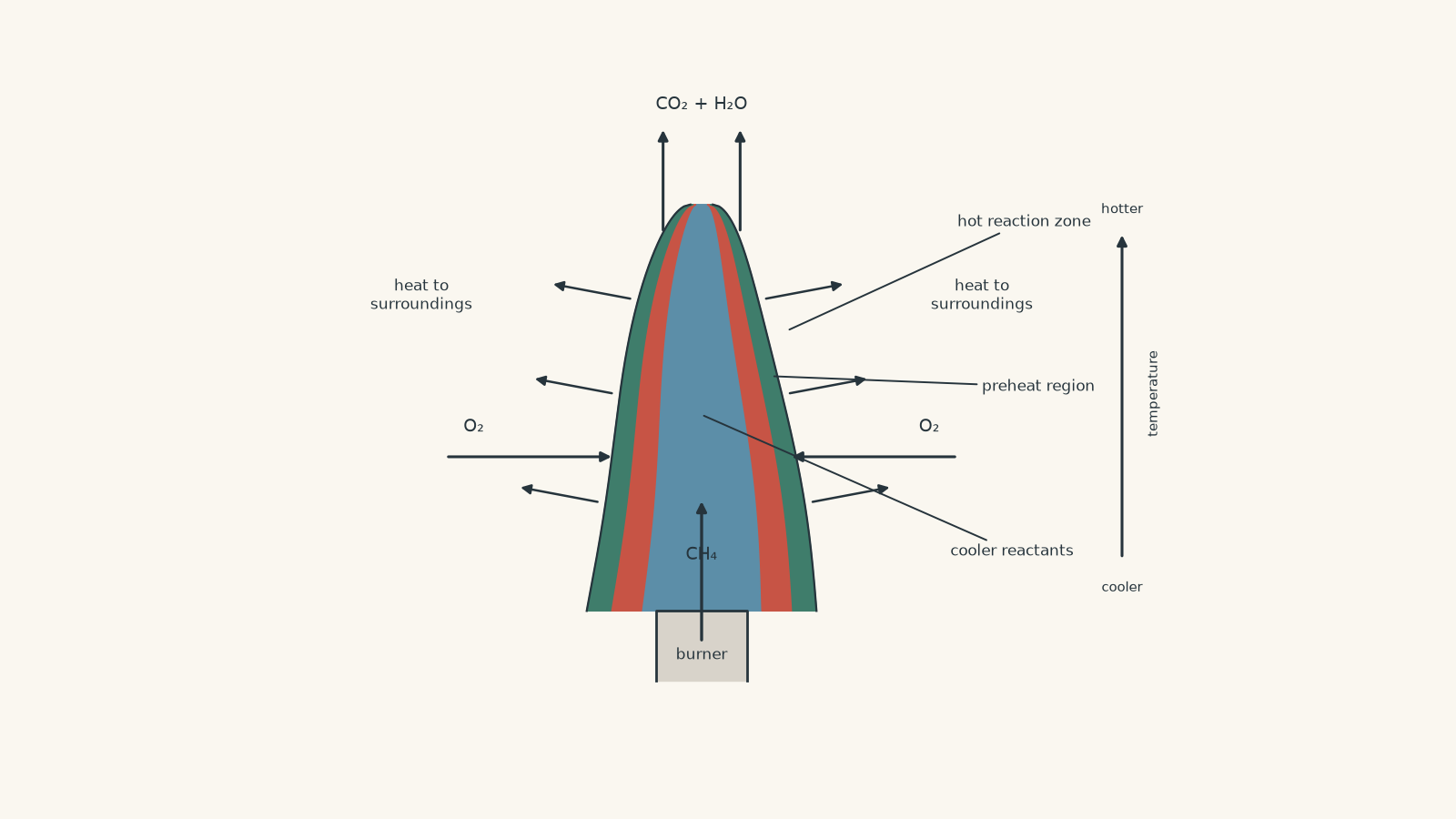
A flame can even look completely unchanged for several minutes. That still doesn’t make it an equilibrium system.
The useful distinction is this:
| At chemical equilibrium | In a steady flame |
|---|---|
| Forward and reverse reaction rates are equal | There is a continuing net conversion of fuel and oxygen into products |
| Composition is constant because opposing reactions balance | Composition at one position may stay roughly constant because material continuously flows through |
| No continuing macroscopic drive away from the equilibrium state | Temperature and concentration gradients are maintained |
| No net chemical change | Chemical reaction continuously produces entropy |
A steady flame is therefore a good example of a steady state that is not an equilibrium state.
If you need to refresh why equal-looking concentrations are not required at equilibrium, see Static vs Dynamic Equilibrium in HSC Chemistry.
02Enthalpy gives combustion a strong energetic push
Start with the easiest part to picture.
Chemical bonds have different energies. During combustion, bonds in the fuel and oxygen are broken, and new bonds form in products such as \(\ce{CO2}\) and \(\ce{H2O}\).
Breaking bonds requires energy. Forming bonds releases energy.
For common fuels, forming the product bonds releases substantially more energy than was required to break the original bonds. The products therefore end up at a lower enthalpy than the reactants.
The enthalpy change is
\[ \Delta H = H_{\text{products}}-H_{\text{reactants}} \]
where:
- \(\Delta H\) is the reaction enthalpy change, usually in \(\mathrm{kJ\,mol^{-1}}\),
- \(H_{\text{products}}\) is the enthalpy of the products, and
- \(H_{\text{reactants}}\) is the enthalpy of the reactants.
For combustion,
\[ \Delta H < 0 \]
so the reaction is exothermic.
This doesn’t mean the reactants contain a mysterious substance called “heat”. It means the reaction can transfer energy from the chemical system into other forms, particularly the thermal energy of the products and surroundings.
Worked example: Calculate the enthalpy change for methane combustion
Calculate the standard enthalpy change for
\[ \ce{CH4(g) + 2O2(g) -> CO2(g) + 2H2O(l)} \]
using these standard enthalpies of formation:
| Substance | \(\Delta H_f^\circ\) (\(\mathrm{kJ\,mol^{-1}}\)) |
|---|---|
| \(\ce{CH4(g)}\) | \(-74.8\) |
| \(\ce{O2(g)}\) | \(0\) |
| \(\ce{CO2(g)}\) | \(-393.5\) |
| \(\ce{H2O(l)}\) | \(-285.8\) |
Step 1
\[ \Delta H^\circ = \sum \Delta H_f^\circ(\text{products}) - \sum \Delta H_f^\circ(\text{reactants}) \]
Step 2
\[ \begin{aligned} \Delta H^\circ &= [(-393.5)+2(-285.8)] - [(-74.8)+2(0)]\\ &=-965.1-(-74.8)\\ &=-890.3\ \mathrm{kJ\,mol^{-1}} \end{aligned} \]
Step 3
The reaction enthalpy is \(-890.3\ \mathrm{kJ\,mol^{-1}}\) of methane for the reaction as written. The negative sign means energy is transferred out of the reacting chemical system under these standard-state conditions.
There is one detail worth noticing. Standard thermodynamic tables at \(298\ \mathrm{K}\) treat the product here as liquid water. Inside a hot flame, the water is mainly vapour. You cannot blindly treat a \(2000\ \mathrm{K}\) flame as though its products are liquid water at \(298\ \mathrm{K}\).
That distinction will matter later.
03Entropy explains where the released energy can go
Here is the tempting mistake: combustion often turns several gas particles into fewer gas particles, so the entropy of the reacting chemicals may decrease.
Does that mean combustion should be impossible?
No, because the second law is not a rule saying that the entropy of every individual system must always increase. The relevant quantity for a spontaneous process is the total entropy change of the system plus its surroundings.
A better mental model for entropy is energy spreading among available microscopic arrangements. Counting gas particles can sometimes help predict the sign, but it is only a shortcut.
For a process,
\[ \Delta S_{\text{universe}} = \Delta S_{\text{system}} + \Delta S_{\text{surroundings}} \]
A thermodynamically spontaneous change has
\[ \Delta S_{\text{universe}}>0 \]
under the conditions being considered.
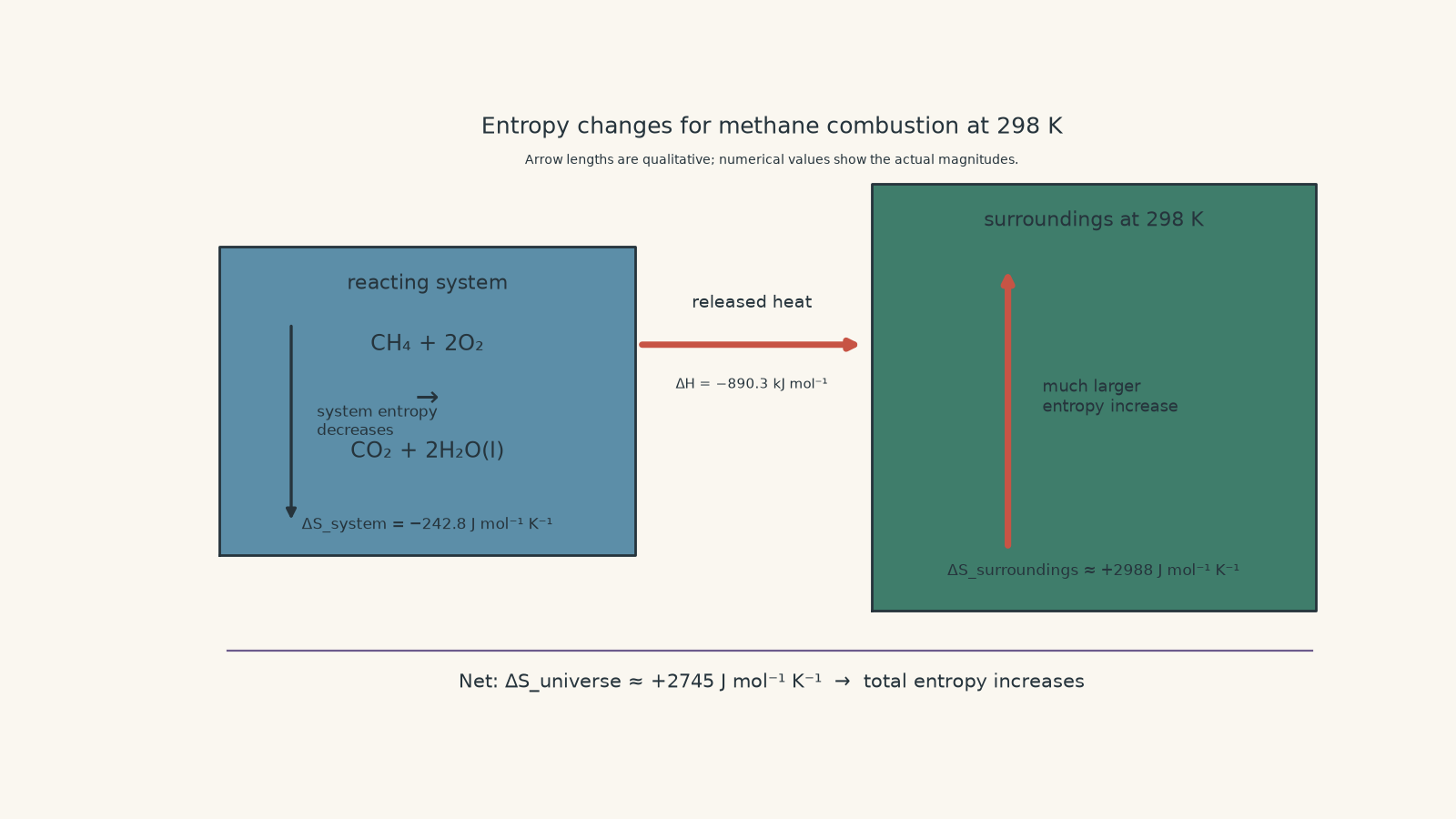
Combustion has a major advantage here. Because it is strongly exothermic, it transfers a large amount of energy to the surroundings. That energy becomes spread among enormous numbers of molecular motions in the surroundings, producing a substantial positive entropy change.
For an idealised reaction transferring heat to surroundings at constant temperature \(T\),
\[ \Delta S_{\text{surroundings}} = -\frac{\Delta H_{\text{system}}}{T} \]
where \(T\) is measured in kelvin.
If \(\Delta H_{\text{system}}\) is negative, then \(\Delta S_{\text{surroundings}}\) is positive.
That can easily outweigh a negative entropy change within the reacting chemicals.
Worked example: Can methane burn even if the reaction system loses entropy?
For methane combustion at \(298\ \mathrm{K}\),
\[ \ce{CH4(g) + 2O2(g) -> CO2(g) + 2H2O(l)} \]
the standard molar entropies are:
| Substance | \(S^\circ\) (\(\mathrm{J\,mol^{-1}\,K^{-1}}\)) |
|---|---|
| \(\ce{CH4(g)}\) | \(186.3\) |
| \(\ce{O2(g)}\) | \(205.0\) |
| \(\ce{CO2(g)}\) | \(213.7\) |
| \(\ce{H2O(l)}\) | \(69.9\) |
Using \(\Delta H^\circ=-890.3\ \mathrm{kJ\,mol^{-1}}\), determine the entropy changes of the reacting system, surroundings, and universe.
Step 1
\[ \Delta S^\circ_{\text{system}} = \sum S^\circ(\text{products}) - \sum S^\circ(\text{reactants}) \]
\[ \begin{aligned} \Delta S^\circ_{\text{system}} &= [213.7+2(69.9)] - [186.3+2(205.0)]\\ &=353.5-596.3\\ &=-242.8\ \mathrm{J\,mol^{-1}\,K^{-1}} \end{aligned} \]
So yes: for this reaction written with liquid water at \(298\ \mathrm{K}\), the reacting system loses entropy.
Step 2
First convert the reaction enthalpy into joules:
\[ -890.3\ \mathrm{kJ\,mol^{-1}} = -890300\ \mathrm{J\,mol^{-1}} \]
Then
\[ \begin{aligned} \Delta S_{\text{surroundings}} &=-\frac{\Delta H_{\text{system}}}{T}\\ &=-\frac{-890300}{298}\\ &=+2988\ \mathrm{J\,mol^{-1}\,K^{-1}} \end{aligned} \]
Step 3
\[ \begin{aligned} \Delta S_{\text{universe}} &=-242.8+2988\\ &=+2745\ \mathrm{J\,mol^{-1}\,K^{-1}} \end{aligned} \]
The total entropy change is strongly positive.
The useful conclusion is not “combustion increases the disorder of the products”. In this example, the product system actually has lower entropy. Combustion is thermodynamically favourable because the large exothermic enthalpy change allows much more entropy to be produced in the surroundings than is lost by the reacting chemicals.
04Enthalpy and entropy have to be considered together
At constant temperature and pressure, enthalpy and entropy can be combined using Gibbs free energy:
\[ \Delta G=\Delta H-T\Delta S \]
where:
- \(\Delta G\) is the Gibbs free-energy change in \(\mathrm{kJ\,mol^{-1}}\),
- \(\Delta H\) is the enthalpy change in \(\mathrm{kJ\,mol^{-1}}\),
- \(T\) is absolute temperature in kelvin, and
- \(\Delta S\) is the entropy change of the system in \(\mathrm{kJ\,mol^{-1}\,K^{-1}}\).
The signs give a compact decision rule:
- \(\Delta G<0\): forward change is thermodynamically favourable under the stated conditions.
- \(\Delta G=0\): the system is at equilibrium.
- \(\Delta G>0\): the forward change is not thermodynamically favourable under those conditions.
For methane combustion at \(298\ \mathrm{K}\), convert \(-242.8\ \mathrm{J\,mol^{-1}\,K^{-1}}\) to \(-0.2428\ \mathrm{kJ\,mol^{-1}\,K^{-1}}\):
\[ \begin{aligned} \Delta G^\circ &=\Delta H^\circ-T\Delta S^\circ\\ &=-890.3-(298)(-0.2428)\\ &\approx -817.9\ \mathrm{kJ\,mol^{-1}} \end{aligned} \]
The large negative result is consistent with a strongly product-favoured reaction under these standard conditions.
But this still doesn’t tell us how fast the reaction occurs.
05If combustion is favourable, why do we need a spark?
Leave methane and oxygen together at room temperature and they do not immediately erupt into flame.
This is where students sometimes mix up thermodynamics and kinetics.
Thermodynamics asks:
Is there a favourable direction from the starting state?
Kinetics asks:
Can the particles actually get there at a significant rate?
Combustion requires bonds to begin breaking before the lower-enthalpy product bonds can form. That creates an activation-energy barrier.
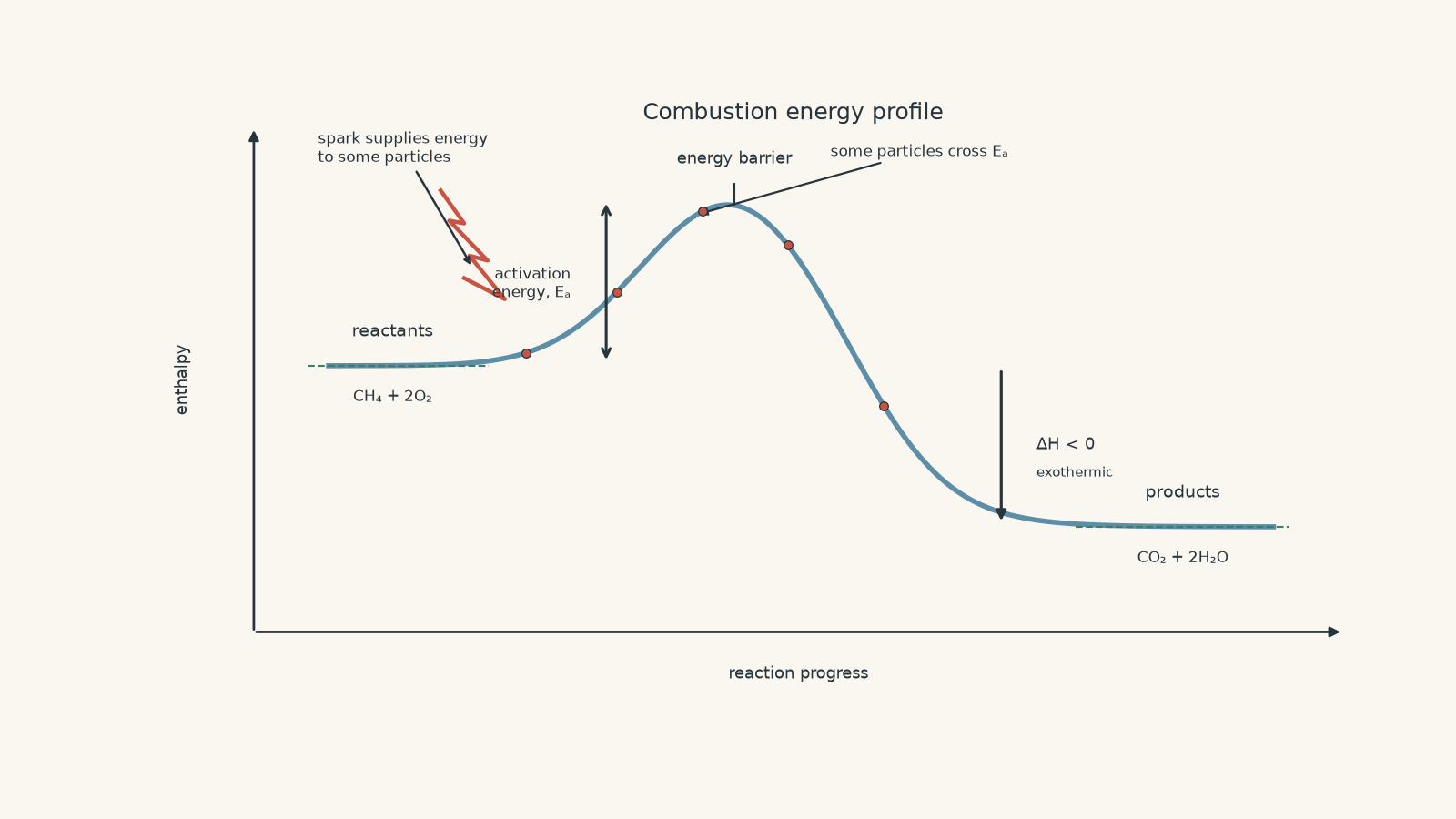
A slightly silly way to picture it is two people who would apparently make a very stable couple, but neither will send the first text. Thermodynamics says the final arrangement may be favourable; kinetics says nothing happens until someone gets the interaction started. The spark is the first text.
The analogy stops there. Molecules are not shy. The real barrier comes from the molecular energies and arrangements needed to break and rearrange bonds.
Once a small part of the mixture reacts, combustion releases heat. That raises the energy of nearby particles, allowing more collisions to overcome activation barriers. The reaction can therefore become self-sustaining.
So a spark does not make an unfavourable combustion reaction favourable. It helps a thermodynamically favourable reaction overcome its kinetic barrier.
06Why combustion counts as a non-equilibrium process
We can now put the pieces together.
Consider fuel entering a burner.
At first, the fuel and oxygen are away from chemical equilibrium. Once ignition occurs, there is a net reaction towards products. Enthalpy is released, entropy is produced, temperatures change rapidly, and matter moves through regions with different compositions.
The system is therefore travelling through changing states rather than sitting at equilibrium.
There is another subtle point. Calling combustion a non-equilibrium process does not mean that a reverse chemical reaction is forbidden by some special rule. At a sufficiently defined equilibrium state, both forward and reverse molecular processes can occur.
The important statement is that during ordinary burning, their rates are nowhere near balanced overall. There is a strong net reaction towards combustion products.
That is different from simply labelling combustion “irreversible”. For a closer look at what reversibility means in chemical systems, see Reversible Chemical Reactions: HSC Chemistry Guide.
07A useful decision process for HSC combustion questions
When a question asks you to analyse combustion using enthalpy and entropy, work in this order.
- Define the system. Are you considering only the reacting chemicals, or the chemicals plus their surroundings?
- Identify the enthalpy change. Combustion is usually strongly exothermic, so \(\Delta H<0\).
- Consider the system entropy. Look at physical states, numbers of gas particles, and the supplied entropy data. Do not assume it must be positive.
- Account for energy spreading into the surroundings. Exothermic combustion usually produces a substantial positive \(\Delta S_{\text{surroundings}}\).
- Judge the overall thermodynamic direction. A positive \(\Delta S_{\text{universe}}\), or equivalently a negative \(\Delta G\) at constant temperature and pressure, favours the forward change.
- Separate thermodynamics from reaction rate. A favourable reaction can still require ignition because of activation energy.
- Check whether the system is actually at equilibrium. A flowing flame with net reaction, energy transfer, and concentration gradients is not.
One final caution: always check the physical states and temperature used by the data. Thermodynamic values quoted at \(298\ \mathrm{K}\) are not automatically exact descriptions of a flame at thousands of kelvin.
08Questions and solutions
Question 1
Propane undergoes complete combustion according to
\[ \ce{C3H8(g) + 5O2(g) -> 3CO2(g) + 4H2O(l)} \]
Use the following standard enthalpies of formation to calculate \(\Delta H^\circ\) for the combustion of \(1.00\ \mathrm{mol}\) of propane.
| Substance | \(\Delta H_f^\circ\) (\(\mathrm{kJ\,mol^{-1}}\)) |
|---|---|
| \(\ce{C3H8(g)}\) | \(-103.8\) |
| \(\ce{CO2(g)}\) | \(-393.5\) |
| \(\ce{H2O(l)}\) | \(-285.8\) |
| \(\ce{O2(g)}\) | \(0\) |
Explain what the sign of your answer means.
Solution 1
The combustion enthalpy is \(-2219.9\ \mathrm{kJ\,mol^{-1}}\), so burning \(1.00\ \mathrm{mol}\) of propane is strongly exothermic under the stated standard conditions.
Use
\[ \Delta H^\circ = \sum \Delta H_f^\circ(\text{products}) - \sum \Delta H_f^\circ(\text{reactants}) \]
Substitute the data:
\[ \begin{aligned} \Delta H^\circ &= [3(-393.5)+4(-285.8)] - [(-103.8)+5(0)]\\ &=(-1180.5-1143.2)+103.8\\ &=-2219.9\ \mathrm{kJ\,mol^{-1}} \end{aligned} \]
The negative sign means the products lie at a lower enthalpy than the reactants, and energy can be transferred out of the reacting chemical system.
A common trap is to say that the negative sign means “the reaction loses energy”. Energy is conserved. What changes is where that energy is stored: chemical energy is transferred into thermal motion and ultimately into the surroundings.
Question 2
Hydrogen burns according to
\[ \ce{2H2(g) + O2(g) -> 2H2O(g)} \]
For this reaction as written at \(298\ \mathrm{K}\),
\[ \Delta H^\circ=-483.6\ \mathrm{kJ\,mol^{-1}} \]
and
\[ \Delta S^\circ_{\text{system}}=-88.8\ \mathrm{J\,mol^{-1}\,K^{-1}} \]
Suppose \(0.500\ \mathrm{mol}\) of hydrogen reacts completely under an idealised set of conditions in contact with surroundings at \(298\ \mathrm{K}\).
Calculate:
a. the entropy change of the reacting system,
b. the entropy change of the surroundings, and
c. the total entropy change.
Explain why the reaction can proceed even though \(\Delta S_{\text{system}}<0\).
Solution 2
The reacting system loses \(22.2\ \mathrm{J\,K^{-1}}\) of entropy, but the surroundings gain about \(406\ \mathrm{J\,K^{-1}}\), giving an overall increase of about \(383\ \mathrm{J\,K^{-1}}\). The reaction is therefore thermodynamically favourable under the stated idealised conditions.
The equation consumes \(2.00\ \mathrm{mol}\) of \(\ce{H2}\). Reacting \(0.500\ \mathrm{mol}\) corresponds to one quarter of the reaction as written.
For the system,
\[ \Delta S_{\text{system}} = \frac{0.500}{2.00}(-88.8) = -22.2\ \mathrm{J\,K^{-1}} \]
The enthalpy released is also one quarter of the tabulated value:
\[ \Delta H = \frac{0.500}{2.00}(-483.6) = -120.9\ \mathrm{kJ} \]
Convert this to joules:
\[ \Delta H=-120900\ \mathrm{J} \]
For surroundings at \(298\ \mathrm{K}\),
\[ \begin{aligned} \Delta S_{\text{surroundings}} &=-\frac{\Delta H}{T}\\ &=-\frac{-120900}{298}\\ &=+406\ \mathrm{J\,K^{-1}} \end{aligned} \]
Therefore,
\[ \begin{aligned} \Delta S_{\text{universe}} &=\Delta S_{\text{system}}+\Delta S_{\text{surroundings}}\\ &=-22.2+406\\ &\approx +383\ \mathrm{J\,K^{-1}} \end{aligned} \]
The tempting mistake is to stop as soon as \(\Delta S_{\text{system}}\) is negative. The second law concerns the total entropy change. The large exothermic enthalpy change spreads energy into the surroundings, and this more than compensates for the system’s entropy decrease.
Question 3
A methane burner runs for ten minutes. Its flame keeps approximately the same shape and size. Measurements show that methane and oxygen continuously enter the flame, carbon dioxide and water continuously leave it, and temperatures range from about \(300\ \mathrm{K}\) near the incoming gases to well above \(1000\ \mathrm{K}\) in the reaction zone.
A student argues:
“Nothing visible is changing, so the burner has reached dynamic equilibrium.”
Assess this claim. Then predict what happens after the methane supply is suddenly stopped while oxygen can still enter.
Solution 3
The burner is not at dynamic equilibrium; it is in a non-equilibrium steady state maintained by continuous flows of matter, reaction, and energy. Once the methane supply stops, combustion ceases after the remaining fuel in the reaction region is consumed.
The student’s observation that the flame looks constant is not enough to establish equilibrium.
In dynamic chemical equilibrium, the forward and reverse reaction rates are equal, so there is no net chemical conversion. In the burner, methane is continuously being consumed and combustion products are continuously being formed. The net combustion rate is therefore not zero.
There are also persistent temperature and concentration gradients. Hot material and energy move away from the reaction zone while fresh reactants enter. Those continuing flows are characteristic of a non-equilibrium system.
The apparent constancy of the flame comes from a different balance: roughly the same amount of fresh fuel arrives each second as is consumed each second. That can produce an approximately steady macroscopic flame without establishing chemical equilibrium.
When the methane supply is cut off, the residual methane reacts and the flame then disappears. The reverse reaction does not simply begin converting \(\ce{CO2}\) and \(\ce{H2O}\) back into methane and oxygen at the same rate. That predicted behaviour is another way to see why the original flame was not a dynamic equilibrium.
Question 4
A rigid, perfectly insulated vessel initially contains \(1.00\ \mathrm{mol}\) of methane and \(2.00\ \mathrm{mol}\) of oxygen at \(298\ \mathrm{K}\). A spark ignites the mixture.
A student uses the standard reaction
\[ \ce{CH4(g) + 2O2(g) -> CO2(g) + 2H2O(l)} \]
and notes that
\[ \Delta S^\circ_{\text{reaction}} = -242.8\ \mathrm{J\,mol^{-1}\,K^{-1}} \]
The student argues:
“Because the vessel is insulated, no entropy can be transferred to the surroundings. The reaction itself has a negative entropy change, so combustion would violate the second law and cannot occur.”
Evaluate the argument. Assume the vessel is strong enough to contain the hot gases and that the contents can eventually approach chemical equilibrium.
Solution 4
Combustion can occur; the student’s error is treating the standard \(298\ \mathrm{K}\) reaction entropy as though it were the entropy change of the actual hot, insulated process.
The vessel is insulated, so no heat crosses its boundary. That does mean there is no surroundings entropy increase produced by heat leaving the vessel.
It does not mean the entropy inside the vessel cannot increase.
During combustion, chemical energy is converted into thermal energy. Because the vessel is insulated, that energy remains inside and substantially raises the temperature of its contents. The final materials therefore are not simply the \(298\ \mathrm{K}\) products used in the tabulated calculation.
The value
\[ -242.8\ \mathrm{J\,mol^{-1}\,K^{-1}} \]
compares standard reactants and standard products at the same reference temperature and, crucially, treats the water as liquid. It does not include the entropy increase associated with heating the actual combustion products to their much higher final temperature.
For an isolated system, the second law requires the entropy of the whole isolated system to increase during a spontaneous irreversible change until equilibrium is reached. Combustion can therefore raise the vessel’s total entropy even though a particular \(298\ \mathrm{K}\) reactant-to-product comparison gives a negative reaction entropy.
There is another trap in saying the reaction must proceed to exactly \(100\%\) products. The final hot system tends towards chemical equilibrium, not towards a rule called “maximum amount of products”. At high temperatures, reverse reactions become more important, and real combustion mixtures can also undergo additional dissociation equilibria.
The spark merely allows the system to overcome the kinetic barrier. It does not supply all the energy released during combustion, and it does not decide the final equilibrium composition.
Question 5
For methane combustion written with liquid water,
\[ \ce{CH4(g) + 2O2(g) -> CO2(g) + 2H2O(l)} \]
the \(298\ \mathrm{K}\) standard values are
\[ \Delta H^\circ=-890.3\ \mathrm{kJ\,mol^{-1}} \]
and
\[ \Delta S^\circ=-242.8\ \mathrm{J\,mol^{-1}\,K^{-1}} \]
A student assumes these values stay constant with temperature and sets \(\Delta G^\circ=0\). They obtain a temperature near \(3670\ \mathrm{K}\) and conclude:
“Methane combustion becomes thermodynamically impossible above about \(3670\ \mathrm{K}\).”
You are also given the following approximate \(298\ \mathrm{K}\) data for combustion producing water vapour:
\[ \ce{CH4(g) + 2O2(g) -> CO2(g) + 2H2O(g)} \]
\[ \Delta H^\circ=-802.3\ \mathrm{kJ\,mol^{-1}} \]
\[ \Delta S^\circ=-5.0\ \mathrm{J\,mol^{-1}\,K^{-1}} \]
a. Show how the student obtained approximately \(3670\ \mathrm{K}\).
b. Using the gas-phase data as a deliberately simplified constant-\(\Delta H\), constant-\(\Delta S\) model, calculate \(\Delta G^\circ\) at \(2000\ \mathrm{K}\).
c. Explain why the student’s \(3670\ \mathrm{K}\) conclusion is not a physically valid prediction of what happens in a real flame.
Solution 5
The student’s arithmetic gives about \(3670\ \mathrm{K}\), but the physical conclusion is invalid: the calculation extends liquid-water data thousands of kelvin beyond the state for which that reaction description makes sense. Using the more appropriate gas-phase equation still gives a strongly negative approximate \(\Delta G^\circ\) at \(2000\ \mathrm{K}\).
For part a, start with
\[ \Delta G^\circ=\Delta H^\circ-T\Delta S^\circ \]
At the calculated crossover,
\[ \Delta G^\circ=0 \]
so
\[ T=\frac{\Delta H^\circ}{\Delta S^\circ} \]
Convert entropy into \(\mathrm{kJ\,mol^{-1}\,K^{-1}}\):
\[ -242.8\ \mathrm{J\,mol^{-1}\,K^{-1}} = -0.2428\ \mathrm{kJ\,mol^{-1}\,K^{-1}} \]
Then
\[ T = \frac{-890.3}{-0.2428} \approx 3667\ \mathrm{K} \]
So the arithmetic itself is consistent with the assumptions.
For part b, the gas-phase entropy value is
\[ -5.0\ \mathrm{J\,mol^{-1}\,K^{-1}} = -0.0050\ \mathrm{kJ\,mol^{-1}\,K^{-1}} \]
Therefore,
\[ \begin{aligned} \Delta G^\circ &=\Delta H^\circ-T\Delta S^\circ\\ &=-802.3-(2000)(-0.0050)\\ &=-802.3+10.0\\ &=-792.3\ \mathrm{kJ\,mol^{-1}} \end{aligned} \]
Under this simplified model, methane combustion remains strongly thermodynamically favourable at \(2000\ \mathrm{K}\).
Part c contains the real point of the question.
The first calculation imagines liquid water as a product at roughly \(3670\ \mathrm{K}\). That is not a physically sensible representation of a flame. Heating and vaporising water changes both the enthalpy and entropy of the products. This is why changing the product state from \(\ce{H2O(l)}\) to \(\ce{H2O(g)}\) changes the thermodynamic values so dramatically.
The student has also assumed that \(\Delta H^\circ\) and \(\Delta S^\circ\) remain constant over a temperature increase of thousands of kelvin. They do not. Heat capacities cause both quantities to vary with temperature.
Finally, a real high-temperature combustion mixture is not restricted to one perfectly clean equation. At sufficiently high temperatures, products can partially dissociate and several chemical equilibria can contribute to the final composition.
So the fair conclusion is not “combustion switches off at \(3670\ \mathrm{K}\)”. The correct conclusion is that thermodynamic predictions must use the relevant physical states, temperature-dependent data, and equilibrium composition. The neat crossover came from extending a simplified model beyond the conditions where that model was valid.
09What this lets you understand next
Combustion brings together three ideas that are easy to confuse.
Enthalpy explains why large amounts of energy can be released. Entropy explains why a reaction can be favourable even when the reacting chemicals themselves lose entropy. Kinetics explains why a spark may still be needed.
The non-equilibrium part is what connects them: while a flame burns, there is a net chemical reaction, energy and matter are moving, entropy is being produced, and the system has not settled into chemical equilibrium.
The next useful step is to ask what happens when that non-equilibrium process finally approaches equilibrium. At high temperatures, combustion products are not necessarily the only species present, and temperature can change the balance between forward and reverse reactions. That is where equilibrium constants and the temperature dependence of equilibrium become much more useful than simply labelling combustion “complete”.