
Indicators of Chemical Change: Evidence for HSC Chemistry
Learn how colour change, gas formation, precipitates, temperature changes, and light can provide evidence of chemical change, and when those clues can mislead you.
A student mixes two clear solutions. A white solid suddenly appears and sinks to the bottom. In another test tube, bubbles appear after acid is added to a powder. In a third, a solution warms up even though nobody heated it.
Have chemical reactions definitely occurred in all three cases?
Not necessarily. Each observation is evidence that a chemical change may have occurred, but the observation itself is not the definition of chemical change. Water boils and forms gas without becoming a new substance. A cold soft drink fizzes when opened because dissolved carbon dioxide escapes. Some substances heat or cool when they dissolve, even when no new substance is produced.
The useful skill is therefore not memorising “bubbles = reaction”. It is learning how to turn an observation into a justified claim about whether new substances have probably formed.
01From observation to chemical change
Imagine watching a reaction without being allowed to see individual particles. You can’t directly watch bonds break or atoms rearrange. All you have are macroscopic clues: things you can see, feel, or measure.
A chemical change involves atoms being rearranged into new substances. The particle-level change is invisible, so we look for observable consequences of that rearrangement.
Common indicators include:
- a colour change
- formation of a gas
- formation of a precipitate
- a temperature change without external heating or cooling
- production of light
The important phrase is indicator of chemical change, not proof by itself.
A detective analogy is useful here. Finding muddy footprints near a broken window is evidence that someone came through the garden. It isn’t, on its own, proof of exactly what happened. Chemical indicators work similarly: one clue may have several explanations, while several consistent clues can make the chemical explanation much stronger.
The analogy breaks because chemistry is more controlled than detective work. We can often identify the substances involved, write equations, test products, and repeat the experiment.
02Colour change: has a new coloured substance formed?
Suppose a pale blue solution becomes much darker after another substance is added.
Your first prediction might be: chemical reaction.
That may be right, but colour change alone needs care. Mixing blue food colouring with water also changes the colour intensity, yet that is mainly dilution, not formation of a new substance.
A useful question is:
Can the colour change be explained simply by mixing, dilution, concentration, or a change in lighting?
If not, the appearance of a new colour can be strong evidence that a different chemical species has formed.
For example, many transition-metal ions form substances with characteristic colours. If a reaction changes the ions or compounds present, the colour can change because the new particles interact with light differently.
So the useful reasoning is not:
It changed colour, therefore it reacted.
It is:
It changed colour in a way that cannot be explained by simple physical mixing, so the observation supports the formation of a new substance.
03Gas formation: bubbles are useful, but suspicious
Bubbles are one of the easiest indicators to spot.
Suppose hydrochloric acid is added to calcium carbonate. You immediately see fizzing.
You should predict that a gas is being produced. In this case, the reaction is:
\[ \ce{CaCO3(s) + 2HCl(aq) -> CaCl2(aq) + H2O(l) + CO2(g)} \]
The carbon dioxide, \(\ce{CO2}\), escapes as bubbles.
This is a chemical change because the reactants are converted into different substances. You can study the product pattern in more detail in tutorgum’s guide to acid-carbonate reactions.
But now imagine heating pure water until bubbles form.
No new substance is required:
\[ \ce{H2O(l) -> H2O(g)} \]
The water has changed state. That is a physical change.
The same warning applies when you open sparkling water. Carbon dioxide that was already dissolved can escape:
\[ \ce{CO2(aq) -> CO2(g)} \]
Again, bubbles appear without the carbon dioxide becoming a different substance.
So when you observe bubbles, ask what caused them.
| Observation | Possible chemical explanation | Possible non-chemical explanation |
|---|---|---|
| Bubbles after acid is added to carbonate | A gaseous product such as \(\ce{CO2}\) forms | Unlikely if the substances were initially at the same temperature and no dissolved gas explanation fits |
| Bubbles during strong heating | Gas may be a reaction product | The liquid may simply be boiling |
| Bubbles when a container is opened | A chemical reaction may be occurring | Dissolved gas may be escaping as pressure falls |
Worked example: Does fizzing show that calcium carbonate reacted?
A student adds dilute hydrochloric acid to a piece of calcium carbonate. Rapid fizzing occurs, and the solid gradually becomes smaller. Explain why these observations support the conclusion that a chemical reaction has occurred.
Step 1
There are two important observations:
- gas bubbles form
- the calcium carbonate solid is consumed
Step 2
Acid-carbonate reactions produce carbon dioxide:
\[ \ce{CaCO3(s) + 2HCl(aq) -> CaCl2(aq) + H2O(l) + CO2(g)} \]
The bubbles are therefore consistent with formation of \(\ce{CO2(g)}\).
Step 3
The calcium carbonate shrinking matters because the original solid is being consumed while new products form. The bubbling is not simply boiling caused by heating.
Step 4
The combination of gas production and consumption of the original solid provides strong evidence of chemical change. The equation gives a particle-level explanation: atoms from the reactants are rearranged into calcium chloride, water, and carbon dioxide.
04Precipitate formation: when two solutions make a solid
A precipitate is an insoluble solid formed when substances in solution react.
Imagine mixing two completely clear solutions. Seconds later, a cloudy solid appears.
That is different from simply seeing an undissolved powder that was already present. Something that was dispersed as dissolved ions has formed a solid product.
For example:
\[ \ce{AgNO3(aq) + NaCl(aq) -> AgCl(s) + NaNO3(aq)} \]
Both reactant solutions can be clear. Silver chloride, \(\ce{AgCl}\), is insoluble in water, so it appears as a white precipitate.
At the ionic level, the important change is:
\[ \ce{Ag+(aq) + Cl-(aq) -> AgCl(s)} \]
The \(\mathrm{Na}^{+}\) and \(\ce{NO3-}\) ions remain dissolved.
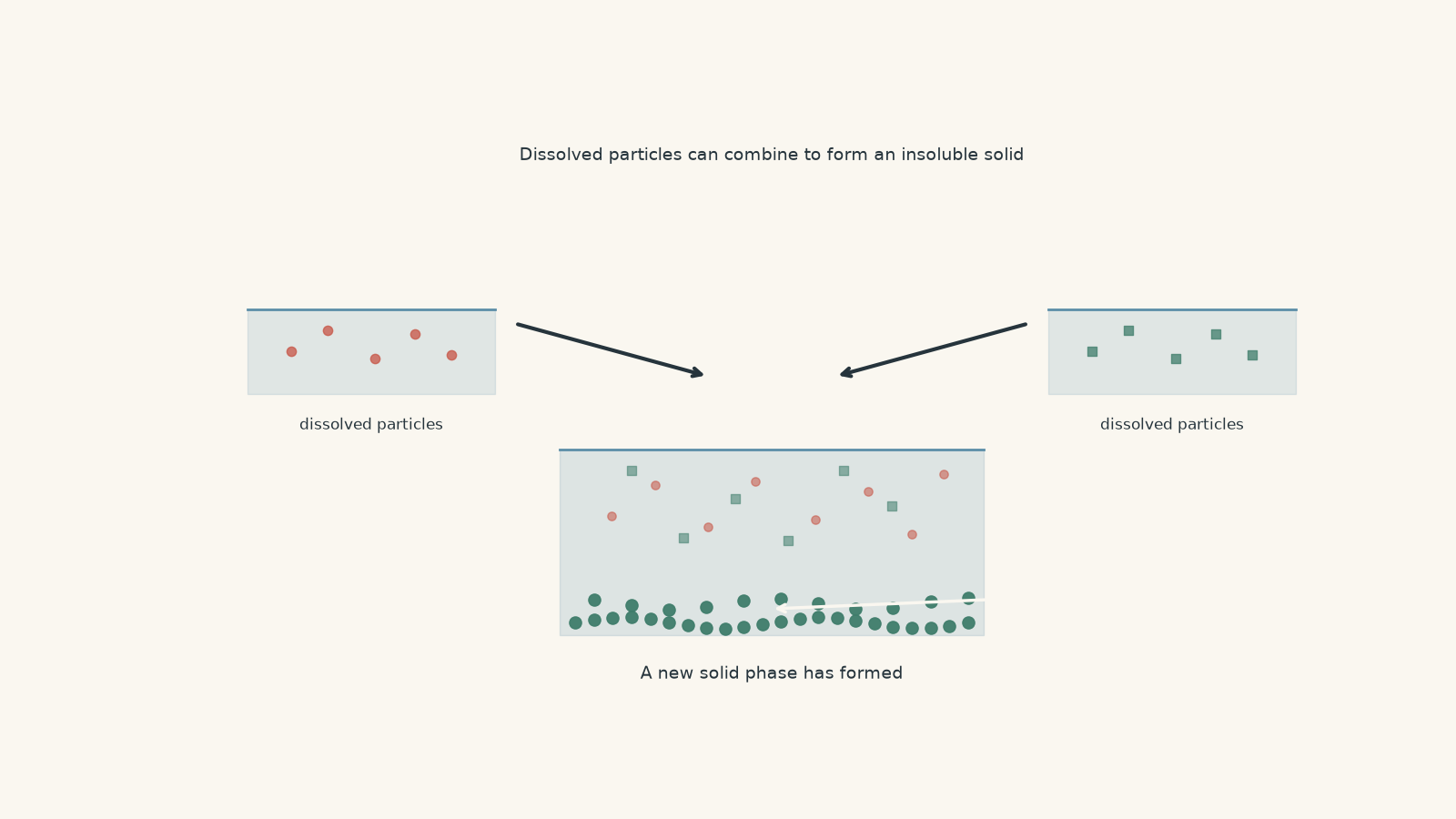
This is why a precipitate is such useful evidence: ions that were previously separated in solution have become part of a new solid structure.
There is still a subtle trap. Not every solid that appears is necessarily a precipitate caused by a reaction. If a saturated salt solution cools and crystals form, the substance may simply be crystallising from solution. Context matters.
For a full treatment of predicting these reactions and writing ionic equations, see precipitation reactions and net ionic equations.
05Temperature change: where did the energy go?
Suppose two room-temperature solutions are mixed and the temperature rises from \(22^\circ\text{C}\) to \(31^\circ\text{C}\).
Nothing has been placed over a flame. So where did the energy come from?
A chemical reaction may have transferred energy from the reacting system to its surroundings. The surroundings, including the solution and container, become warmer.
Such a reaction is exothermic.
If the temperature falls instead, the process may be endothermic, meaning energy is transferred from the surroundings into the system.
The tempting rule is:
Temperature changed, so a chemical reaction occurred.
That is too strong.
Physical processes can also change temperature. Some substances heat or cool their surroundings when they dissolve. Evaporation can cool a surface. Compression and expansion of gases can also change temperature.
The useful evidence is a temperature change that occurs under controlled conditions and fits with other evidence or with the known chemistry of the substances.
Worked example: Which observation gives the stronger evidence?
A student mixes two colourless aqueous solutions at \(20.0^\circ\text{C}\). The mixture reaches \(25.8^\circ\text{C}\), and a blue solid appears. Explain which observation provides the more direct evidence that a new substance has formed.
Step 1
The temperature increases by
\[ \Delta T = 25.8^\circ\text{C} - 20.0^\circ\text{C} = 5.8^\circ\text{C}. \]
This shows that energy has been transferred to the surroundings.
That observation is consistent with an exothermic chemical reaction, but it is not conclusive by itself because some physical processes can also cause temperature changes.
Step 2
Both starting substances were aqueous solutions. A new blue solid appears after they are mixed.
If that solid is an insoluble reaction product, it is a precipitate. Its formation indicates that dissolved particles have combined to form a new substance.
Step 3
The precipitate provides more direct evidence of a new substance forming than the temperature rise alone. The temperature change supports the chemical interpretation, while the new solid gives stronger evidence of a change in chemical composition.
Step 4
The best conclusion uses both pieces of evidence: formation of a new solid, together with energy transfer, strongly supports the conclusion that a chemical reaction occurred.
06Light production: energy you can see
Some reactions release enough energy that part of it appears as visible light.
Burning magnesium is a familiar example:
\[ \ce{2Mg(s) + O2(g) -> 2MgO(s)} \]
The reaction produces an intense white light as magnesium reacts with oxygen.
Here, several observations are consistent with chemical change:
- bright light is emitted
- heat is released
- magnesium metal is consumed
- a different solid product, magnesium oxide, forms
The light is useful evidence because it shows energy being released, but again, light alone does not define a chemical reaction. An electric filament can glow simply because it is hot. A lamp emits light without its light production needing to involve a chemical reaction.
For combustion, the chemical evidence becomes strongest when the energy release is linked to the formation of new products. tutorgum’s guide to combustion reactions develops that connection.
07One indicator is a clue; several can form an argument
HSC questions often ask you to identify evidence of chemical change. The strongest answers do more than name an observation.
Compare these two responses:
Bubbles formed.
and:
Gas bubbles formed when the reactants were mixed, indicating that a gaseous product may have been produced and therefore supporting the occurrence of a chemical reaction.
The second answer explains why the observation matters.
A useful decision process is:
- State exactly what was observed.
- Ask whether a physical process could reasonably produce the same observation.
- Look for another independent piece of evidence.
- Connect the observations to formation of new substances.
- If possible, use the known reactants, products, or equation to support the conclusion.
This prevents the most common mistake: treating a memorised indicator as automatic proof.
08The most tempting misconception: “Any visible change means a reaction”
Suppose blue copper sulfate solution is diluted with water. It becomes paler.
Colour change? Yes.
Chemical reaction? Not necessarily. The same dissolved copper species can simply be spread through a larger volume of water.
Now suppose two solutions are mixed and an insoluble blue compound forms. The mixture becomes cloudy and a solid settles.
That is different. The appearance of a new solid phase that cannot be explained by simple dilution is evidence that new particles have formed.
The deeper distinction is this:
An observation matters because of what it tells you about substances, not because it appears on a memorised list.
09Questions and solutions
Question 1
A student adds dilute hydrochloric acid to sodium carbonate. The mixture fizzes immediately.
Identify the observable indicator of chemical change, and explain what the observation suggests.
Solution 1
The observable indicator is gas formation, shown by the fizzing.
An acid-carbonate reaction produces carbon dioxide gas. A suitable equation is:
\[ \ce{Na2CO3(aq) + 2HCl(aq) -> 2NaCl(aq) + H2O(l) + CO2(g)}. \]
The \(\ce{CO2(g)}\) escapes as bubbles, so the fizzing supports the conclusion that a chemical reaction has occurred.
The tempting shortcut is to say that any bubbles prove a reaction. That is not generally valid because boiling or release of previously dissolved gas can also produce bubbles. Here, however, gas formation is expected from the known acid-carbonate chemistry.
Question 2
Two colourless solutions, A and B, are both at \(23^\circ\text{C}\). When they are mixed, a white solid appears and the temperature rises to \(27^\circ\text{C}\).
A student writes:
“The temperature increase proves that a chemical reaction occurred.”
Evaluate this statement using all the observations.
Solution 2
The conclusion that a chemical reaction probably occurred is well supported, but the temperature increase does not prove it by itself.
The rise in temperature is
\[ \Delta T = 27^\circ\text{C} - 23^\circ\text{C} = 4^\circ\text{C}. \]
This suggests that an exothermic process occurred and energy was transferred to the surroundings. However, some physical processes, including dissolution, can also produce temperature changes.
The stronger evidence is the formation of a white solid from two initially clear solutions. If this solid is an insoluble product, it is a precipitate and provides direct evidence that dissolved particles have combined to form a new substance.
The best conclusion is therefore that the precipitate formation, supported by the temperature increase, provides strong evidence of chemical change.
The tempting route is to treat the \(4^\circ\text{C}\) increase as decisive. The constraint that changes the reasoning is that energy transfer can accompany both chemical and physical processes.
Question 3
A sealed flask contains a colourless liquid and a small pocket of gas above it. The flask is warmed gently. Bubbles form throughout the liquid, but when the flask cools to its original temperature, the bubbles stop and the system returns to its original appearance.
A student argues that the bubbles show a gaseous product was formed by a chemical reaction.
Explain why the observations do not provide strong evidence for chemical change.
Solution 3
The observations are more consistent with a physical change than with formation of a new gaseous substance.
Heating can cause a liquid to vaporise or can cause dissolved gas to leave solution. Both processes produce bubbles without requiring the formation of a new substance.
The important evidence is that, after cooling to the original temperature, the system returns to its original appearance. That behaviour is consistent with a reversible physical process such as vaporisation and condensation:
\[ \ce{X(l) <=> X(g)} \]
where \(X\) represents the same substance in liquid and gaseous states.
The tempting route is to match “bubbles” directly with “gas-forming reaction”. The missing constraint is the origin of the gas. An indicator is chemically useful only when the observation is connected to formation of a new substance rather than a change of state or release of gas that was already present.
The experiment does not prove that no chemical reaction occurred, but the stated observations alone give no strong reason to conclude that one did.
Question 4
Three experiments are performed.
- Experiment I: A blue solution is diluted with water and becomes pale blue.
- Experiment II: Two colourless solutions are mixed. A white solid appears, but the temperature does not measurably change.
- Experiment III: A colourless solution is heated. It begins to bubble, and its temperature remains constant while boiling continues.
For each experiment, decide whether the stated observation by itself provides convincing evidence that a new substance has formed. Then explain why the absence of a temperature change in Experiment II does not weaken the chemical interpretation as much as a student might expect.
Solution 4
Only Experiment II provides convincing evidence, from the stated observations, that a new substance has probably formed.
For Experiment I, the colour becoming paler can be explained by dilution. The concentration of the coloured species decreases when water is added, so less light is absorbed along a given path. No new chemical species needs to form.
For Experiment II, formation of a white solid from two initially clear solutions is consistent with precipitation. Dissolved ions may have combined to form an insoluble compound:
\[ \ce{M+(aq) + X-(aq) -> MX(s)} \]
where \(\mathrm{M}^{+}\) and \(\mathrm{X}^{-}\) represent suitable ions. The appearance of a new solid phase is strong evidence of a new substance when crystallisation or another physical explanation has been excluded.
For Experiment III, bubbling at constant temperature during heating is characteristic of boiling. The liquid can change into its gaseous state without changing chemical identity:
\[ \ce{Y(l) -> Y(g)}. \]
The subtle part is Experiment II. A student may expect every chemical reaction to produce a noticeable temperature change. That is false. A reaction can occur even when the measured temperature stays approximately constant.
Several effects could explain this. The reaction may transfer only a small amount of energy, the energy change may be too small for the apparatus to detect, or heat exchanged with the surroundings may partly offset the reaction’s thermal effect.
The absence of one indicator does not cancel a different, stronger indicator. Chemical reactions do not have to display every item from the usual list of colour, gas, precipitate, temperature, and light.
Question 5
A student investigates two unknown colourless solutions, P and Q.
When equal volumes are mixed in an open test tube:
- vigorous bubbling begins immediately
- the mixture cools by \(3.0^\circ\text{C}\)
- no precipitate appears
- after two minutes, the liquid is still colourless
The student concludes:
“At least two indicators are present, so a chemical reaction definitely occurred.”
A second student disagrees and proposes this physical explanation:
“Q could contain a large amount of dissolved gas. Mixing P and Q could reduce the gas’s solubility, causing it to escape. The temperature fall could come from the energy required for that gas to leave the solution.”
No further visual observations are available.
Using only the evidence given, determine which conclusion is scientifically justified. Then identify one additional observation or test that could distinguish between the competing explanations, and explain how its result would affect the conclusion.
Solution 5
The scientifically justified conclusion is that the observations are consistent with chemical change, but do not establish that a chemical reaction definitely occurred.
The first student correctly identifies two common indicators: gas evolution and a temperature decrease. However, counting indicators is not a proof rule.
The second student’s model provides a physically possible alternative that explains both observations together. Gas that was already dissolved in Q could leave solution after mixing. If that process absorbs energy from the surroundings, the temperature could fall at the same time.
This is the key constraint: the two observations are not necessarily independent. They may both arise from one physical process.
That is what makes simply counting indicators unreliable.
An effective additional test would be to identify the gas and determine whether its quantity or identity fits a predicted chemical reaction between P and Q. For example, if the proposed reaction should form carbon dioxide, the collected gas could be tested for \(\ce{CO2}\), while the initial solution Q could also be examined to determine whether it already contained enough dissolved \(\ce{CO2}\) to account for the observed bubbling.
Another useful approach would be chemical analysis of the liquid before and after mixing. Evidence that a new dissolved species formed, or that a reactant was consumed in a stoichiometric way, would strengthen the chemical-reaction model.
The tempting route is to say “two indicators must be better than one, therefore the reaction is proven”. Usually multiple independent observations do strengthen a conclusion. Here, though, the hard part is recognising that the observations may have a shared non-chemical cause.
The broader lesson is that indicators of chemical change are evidence to interpret, not boxes to tick. Once you can distinguish observation from explanation, the next step is to connect those observations to the rearrangement of atoms and to chemical equations that specify exactly which new substances formed.