
Industrial Acid-Base Analysis and Titration for HSC Chemistry
Learn how acid-base titration is used in industrial quality control and processing, including concentration checks, titratable acidity, endpoints, dilution, and common sources of error.
Two process tanks can both read pH 3.20 and still contain very different amounts of acid. Imagine taking equal samples from each and titrating them with the same sodium hydroxide solution. Tank A reaches the endpoint after 4.0 mL of \(\ce{NaOH}\), while Tank B needs 18.0 mL.
Before reading on, predict this: if both tanks have the same pH, why does Tank B need more than four times as much base?
The pH tells us about the \(\ce{H3O+}\) present at that moment. It does not necessarily tell us how much acid is available to keep producing \(\ce{H3O+}\) as neutralisation occurs. Tank B has a much larger acid reserve.
That difference is why industrial chemists use acid-base titration alongside pH measurement. A pH probe can tell an operator what a process is doing now. A titration can tell them how much acid or base is actually there.
01What problem does acid-base analysis solve?
Industrial products and process solutions often have to stay within a specified composition.
A manufacturer might need to check:
- whether a food product contains the required amount of acid,
- whether an alkaline cleaning solution is still concentrated enough to work,
- whether an acidic process bath has become too dilute,
- how much acid or base has been consumed during a reaction,
- whether a batch is consistent with previous batches, or
- whether a neutralisation step has actually reached its required condition.
A pH measurement is useful for some of these decisions, but it cannot answer all of them.
At HSC level, we usually write
\[
\mathrm{pH}=-\log_{10}[\ce{H3O+}]
\]
where \([\ce{H3O+}]\) is the hydronium ion concentration in \(\mathrm{mol\,L^{-1}}\). More precisely, pH depends on hydronium ion activity, but the concentration model is normally the useful one for HSC calculations.
A titration answers a different question: how much standard acid or base must react with the sample according to a known stoichiometric equation?
That lets us calculate the amount, concentration, or titratable acidity of the material being analysed.
02Why pH and acid concentration are not the same thing
Suppose two solutions each contain a monoprotic acid, represented by \(\ce{HA}\).
A strong acid transfers almost completely to water:
\[
\ce{HA + H2O -> H3O+ + A^-}
\]
A weak acid establishes an equilibrium instead:
\[
\ce{HA + H2O <=> H3O+ + A^-}
\]
Only part of the weak acid is ionised at any instant.
A slightly silly way to picture this is to imagine \(\ce{HA}\) as someone who is reluctant to break up with their proton. The pH mainly notices the protons that are already “single”. But when \(\ce{OH^-}\) arrives and removes those protons, more \(\ce{HA}\) dissociates. A titration can therefore reveal acid that was not contributing directly to the original \([\ce{H3O+}]\).
The analogy stops there. Molecules do not have commitment issues; the fraction ionised is controlled by equilibrium, \(K_a\), and concentration.
This gives an important industrial distinction:
| Measurement | What it mainly tells us | Typical use |
|---|---|---|
| pH | Current acidity or alkalinity of the solution | Fast process monitoring |
| Acid-base titration | Amount of acid or base that reacts up to a defined endpoint | Composition and quality control |
| Titration curve | How pH changes as titrant is added | Identifying equivalence behaviour and choosing endpoints |
Two samples can therefore have similar pH values but very different titratable acidities.
03What actually happens during an industrial titration?
The basic laboratory idea is familiar: a known solution reacts with an unknown sample.
But industrial analysis only works if every stage of that process is controlled.
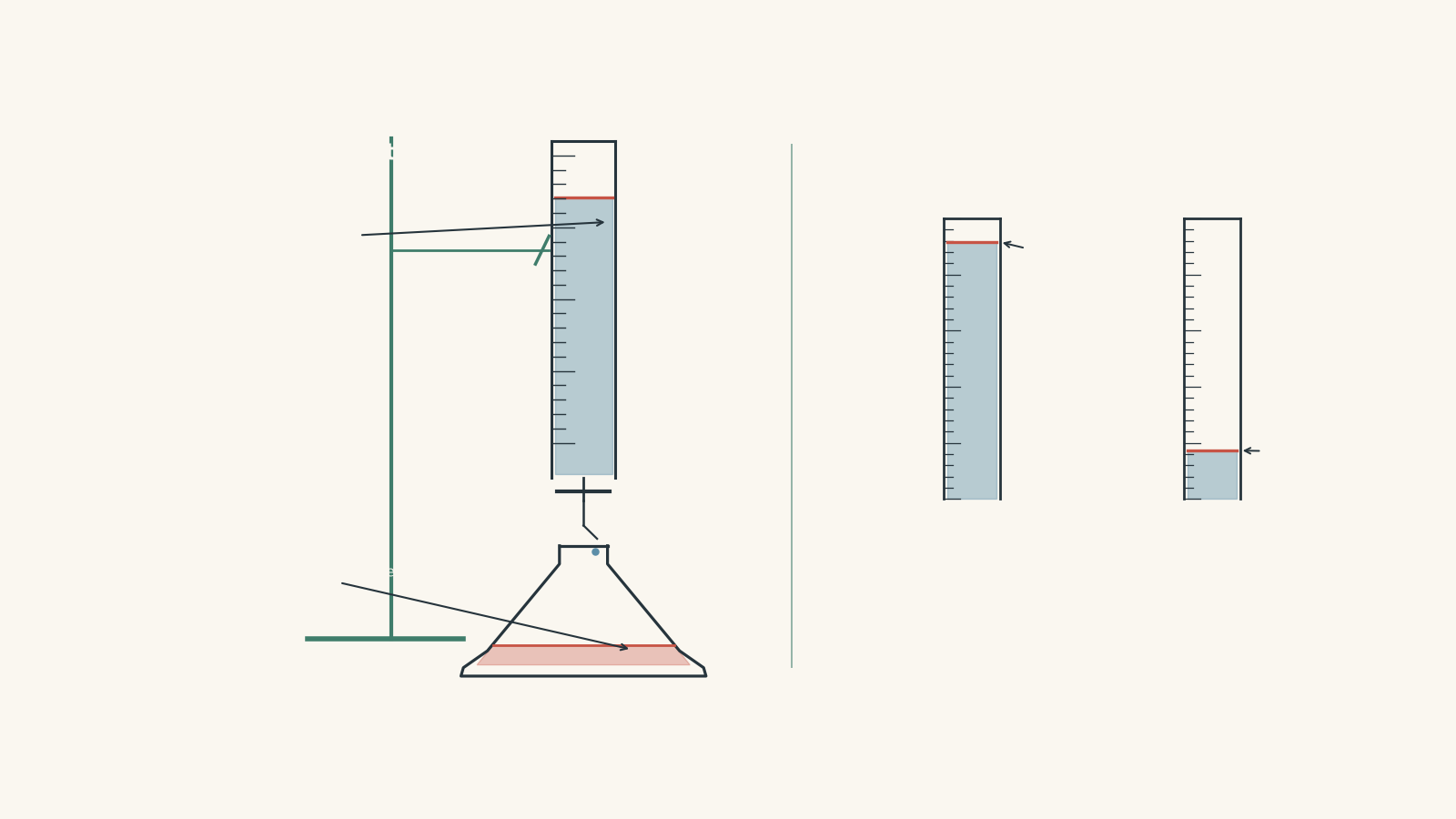
1. Take a representative sample
This sounds trivial. It isn’t.
Suppose acid has just been added to a 10 000 L tank and the contents have not mixed properly. A sample taken near the addition point may be much more acidic than the average tank composition.
A perfect titration of a bad sample still gives a bad answer.
Industrial quality control therefore depends on sampling as well as analytical chemistry. The sample must genuinely represent the material about which the decision will be made.
2. Measure a known amount of sample
A volumetric pipette may be used to transfer an accurately known aliquot.
If the industrial solution is too concentrated for convenient titration, a measured sample can first be diluted in a volumetric flask. The dilution changes concentration, but not the number of moles originally transferred.
If \(C_1\) and \(V_1\) are the concentration and volume before dilution, while \(C_2\) and \(V_2\) are the values after dilution,
\[
C_1V_1=C_2V_2
\]
for the same dissolved substance.
3. React it with a standard solution
The titrant has an accurately known concentration.
For example,
\[
\ce{HCl + NaOH -> NaCl + H2O}
\]
has a 1:1 mole ratio.
At the equivalence point,
\[
n(\ce{HCl})=n(\ce{NaOH})
\]
because one mole of \(\ce{HCl}\) reacts with one mole of \(\ce{NaOH}\).
The familiar relationship
\[
n=cV
\]
then connects amount \(n\), in moles, concentration \(c\), in \(\mathrm{mol\,L^{-1}}\), and volume \(V\), in litres.
For reactions with other coefficients, the balanced equation controls the mole ratio. You cannot automatically assume 1:1.
For example,
\[
\ce{H2SO4 + 2NaOH -> Na2SO4 + 2H2O}
\]
shows that one mole of sulfuric acid requires two moles of sodium hydroxide for complete neutralisation.
4. Detect an endpoint
The equivalence point is the theoretical point at which the reacting amounts are present in the exact stoichiometric ratio.
The endpoint is the experimentally detected point at which we stop the titration.
They are not automatically identical.
An indicator changes colour over a particular pH range, so it must be chosen so that its colour change occurs within the steep part of the titration curve near the equivalence point. An automatic titrator may instead use a calibrated pH electrode to follow the curve electronically.
This matters especially when a weak acid or weak base is involved.
For a weak acid titrated with a strong base, the equivalence point is above pH 7. Phenolphthalein can often be appropriate because its transition occurs on the basic side. An indicator that changes colour much earlier could systematically underestimate the amount of acid.
04Worked example: checking an industrial sodium hydroxide solution
A cleaning solution is specified to contain between \(1.80\) and \(2.00\ \mathrm{mol\,L^{-1}}\) \(\ce{NaOH}\). A \(5.00\ \mathrm{mL}\) sample is diluted to \(100.0\ \mathrm{mL}\). A \(20.00\ \mathrm{mL}\) aliquot of the diluted solution requires \(18.60\ \mathrm{mL}\) of \(0.1000\ \mathrm{mol\,L^{-1}}\) \(\ce{HCl}\) for neutralisation. Determine the original \(\ce{NaOH}\) concentration and decide whether it meets the specification.
The reaction is
\[
\ce{HCl + NaOH -> NaCl + H2O}
\]
Step 1
Convert \(18.60\ \mathrm{mL}\) to \(0.01860\ \mathrm{L}\).
\[
\begin{aligned}
n(\ce{HCl})&=cV\\
&=(0.1000)(0.01860)\\
&=1.860\times10^{-3}\ \mathrm{mol}
\end{aligned}
\]
Step 2
The ratio is 1:1, so the \(20.00\ \mathrm{mL}\) aliquot contained
\[
n(\ce{NaOH})=1.860\times10^{-3}\ \mathrm{mol}
\]
Step 3
\[
\begin{aligned}
c(\ce{NaOH})&=\frac{n}{V}\\
&=\frac{1.860\times10^{-3}}{0.02000}\\
&=0.09300\ \mathrm{mol\,L^{-1}}
\end{aligned}
\]
Step 4
The \(5.00\ \mathrm{mL}\) sample was diluted to \(100.0\ \mathrm{mL}\), giving a dilution factor of
\[
\frac{100.0}{5.00}=20.0
\]
Therefore,
\[
c_{\text{original}}=(0.09300)(20.0)=1.86\ \mathrm{mol\,L^{-1}}
\]
Step 5
The original cleaning solution contains \(1.86\ \mathrm{mol\,L^{-1}}\) \(\ce{NaOH}\), which lies within the specified range of \(1.80\) to \(2.00\ \mathrm{mol\,L^{-1}}\).
Notice that the titration is doing more than producing a concentration for a worksheet. It supports an actual quality-control decision: this batch meets the stated concentration requirement.
05Titratable acidity: when the useful answer is not simply pH
Weak-acid products are a particularly important case.
Imagine a food product containing mainly acetic acid. Measuring its pH tells us about its hydronium ion concentration. Titrating it with sodium hydroxide tells us how much acid can be neutralised up to the chosen endpoint.
For acetic acid,
\[
\ce{CH3COOH + OH^- -> CH3COO^- + H2O}
\]
As \(\ce{OH^-}\) removes acid, the equilibrium shifts and more of the weak acid is converted to \(\ce{CH3COO^-}\). The titration can therefore measure essentially the whole neutralisable acid amount, not merely the small fraction that was ionised before titration began.
This result is often described as titratable acidity.
There is an important qualification. If a product contains several acids, a titration may measure their combined neutralising capacity. Reporting the result “as acetic acid”, for example, does not prove that every mole of acidity actually came from acetic acid. It means the measured neutralising capacity has been converted to an equivalent amount using the stated method.
That is why an industrial specification needs to define the analytical method, not just give a number.
06Worked example: measuring titratable acidity in a food product
A manufacturer analyses an acidic food product by treating its acidity as acetic acid, \(\ce{CH3COOH}\). A \(10.00\ \mathrm{mL}\) sample is diluted to \(100.0\ \mathrm{mL}\). A \(25.00\ \mathrm{mL}\) aliquot of the diluted sample requires \(18.50\ \mathrm{mL}\) of \(0.1000\ \mathrm{mol\,L^{-1}}\) \(\ce{NaOH}\) to reach the specified endpoint.
Calculate the titratable acidity of the original product in \(\mathrm{mol\,L^{-1}}\) and \(\mathrm{g\,L^{-1}}\) expressed as acetic acid. Use \(M(\ce{CH3COOH})=60.05\ \mathrm{g\,mol^{-1}}\).
The neutralisation is
\[
\ce{CH3COOH + NaOH -> CH3COONa + H2O}
\]
Step 1
\[
\begin{aligned}
n(\ce{NaOH})&=cV\\
&=(0.1000)(0.01850)\\
&=1.850\times10^{-3}\ \mathrm{mol}
\end{aligned}
\]
Step 2
The aliquot therefore contained an acid amount equivalent to
\[
n(\ce{CH3COOH})=1.850\times10^{-3}\ \mathrm{mol}
\]
Step 3
The aliquot volume was \(25.00\ \mathrm{mL}=0.02500\ \mathrm{L}\).
\[
\begin{aligned}
c_{\text{diluted}}
&=\frac{1.850\times10^{-3}}{0.02500}\\
&=0.07400\ \mathrm{mol\,L^{-1}}
\end{aligned}
\]
Step 4
The dilution factor is
\[
\frac{100.0}{10.00}=10.00
\]
so
\[
c_{\text{original}}=(0.07400)(10.00)
=0.7400\ \mathrm{mol\,L^{-1}}
\]
Step 5
\[
\begin{aligned}
\text{mass concentration}
&=cM\\
&=(0.7400)(60.05)\\
&=44.4\ \mathrm{g\,L^{-1}}
\end{aligned}
\]
The product therefore has a titratable acidity of \(0.7400\ \mathrm{mol\,L^{-1}}\), or \(44.4\ \mathrm{g\,L^{-1}}\), expressed as acetic acid.
If other acids are present, \(44.4\ \mathrm{g\,L^{-1}}\) should not be interpreted as proof that the product literally contains exactly \(44.4\ \mathrm{g}\) of acetic acid per litre. It is an acid-equivalent result produced by the defined titration method.
07Why industries often use pH measurement and titration together
A reasonable first thought is: if an automatic pH probe can give a result in seconds, why bother taking samples and titrating them?
Because the two measurements answer different questions.
Consider a process containing a weak acid and its conjugate base. The solution can resist changes in pH because it acts as a buffer. Its pH might remain fairly stable even while the total amounts of the acid and conjugate base change substantially.
A titration can detect that change in neutralising capacity.
The reverse is also possible. Two samples could require nearly the same amount of base in a titration but have different starting pH values because their acid-base equilibria are different.
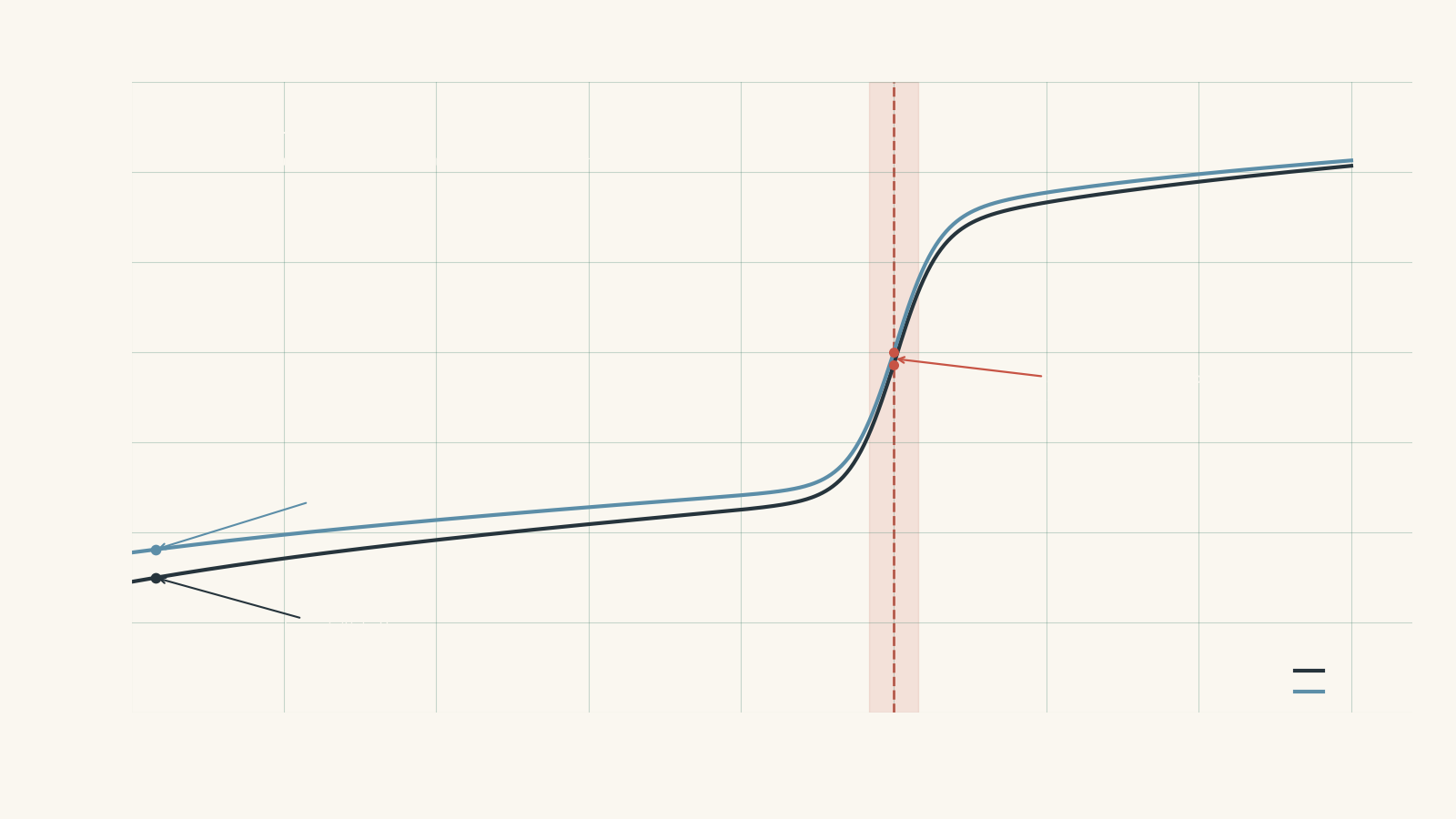
A useful industrial division is therefore:
- use pH for rapid monitoring of the chemical environment,
- use titration when the amount of acid or base matters,
- use both when both conditions are important.
For example, the pH might influence a reaction rate or product behaviour, while titratable acidity controls formulation consistency. One measurement cannot automatically replace the other.
08The biggest industrial errors are not always calculation errors
Students naturally focus on burette readings and significant figures. Those matter, but industrial analysis adds another layer: the sample and method must represent the real process.
| Problem | What happens | Likely consequence |
|---|---|---|
| Sample taken from a poorly mixed tank | Sample composition differs from bulk material | Accurate titration, wrong process conclusion |
| Titrant concentration is incorrect | Every calculated sample concentration is shifted | Systematic error across many analyses |
| Endpoint is consistently overshot | Too much titrant is recorded | Analyte amount is usually overestimated |
| Wrong indicator is used | Colour change occurs too far from equivalence | Systematic endpoint error |
| Volumetric pipette contains rinse water | Measured sample is unintentionally diluted | Fewer analyte moles are transferred |
| Distilled water is added to the conical flask after the sample | Concentration in the flask falls but analyte moles do not change | Ideally no change in titre |
| Sample is diluted accurately in a volumetric flask | Concentration decreases by a known factor | No problem if dilution is included in calculation |
The distilled-water case is a favourite source of confusion.
Suppose a flask contains exactly \(2.00\ \mathrm{mmol}\) of acid. Adding \(50\ \mathrm{mL}\) of water makes that acid less concentrated, but there are still \(2.00\ \mathrm{mmol}\) present. The same number of moles of base is still required to neutralise it.
By contrast, if a wet pipette contains water before the original sample is measured, the liquid drawn into the pipette has already been diluted. Now fewer moles of analyte are actually transferred.
The location of the dilution matters.
09From quality control to process control
Once titration has established the composition of a process sample, the result can be compared with a specification or used to diagnose what has happened in the process.
Suppose an alkaline process solution is slowly reacting with acidic material. Repeated titrations may show its \(\ce{OH^-}\) concentration falling over time. That trend tells the operator something different from a single pH reading.
Industrial acid-base analysis can therefore be used to:
- accept or reject a batch against a composition specification,
- monitor depletion of an acid or base,
- check raw materials before use,
- verify that a formulation contains the intended acid or alkali amount,
- investigate an unexpected pH reading, and
- provide data for adjusting a later processing step.
The key idea is that titration turns a measured reaction into a material balance. The burette volume becomes a measurement of how many reacting acid or base particles were present in the sample.
10Questions and solutions
Question 1
A \(25.00\ \mathrm{mL}\) sample of hydrochloric acid from an industrial process requires \(21.40\ \mathrm{mL}\) of \(0.1500\ \mathrm{mol\,L^{-1}}\) \(\ce{NaOH}\) for complete neutralisation.
Calculate the concentration of \(\ce{HCl}\).
Solution 1
The \(\ce{HCl}\) concentration is \(0.1284\ \mathrm{mol\,L^{-1}}\).
The reaction is
\[
\ce{HCl + NaOH -> NaCl + H2O}
\]
so the mole ratio is 1:1.
First find the moles of \(\ce{NaOH}\):
\[
\begin{aligned}
n(\ce{NaOH})&=cV\\
&=(0.1500)(0.02140)\\
&=3.210\times10^{-3}\ \mathrm{mol}
\end{aligned}
\]
Therefore,
\[
n(\ce{HCl})=3.210\times10^{-3}\ \mathrm{mol}
\]
in \(25.00\ \mathrm{mL}=0.02500\ \mathrm{L}\).
Hence,
\[
\begin{aligned}
c(\ce{HCl})
&=\frac{n}{V}\\
&=\frac{3.210\times10^{-3}}{0.02500}\\
&=0.1284\ \mathrm{mol\,L^{-1}}
\end{aligned}
\]
The tempting shortcut is to use the titrant and sample volumes directly without checking the reaction ratio. That happens to work simply here because the stoichiometric ratio is 1:1. It would fail for an acid such as \(\ce{H2SO4}\) undergoing complete neutralisation.
Question 2
An industrial sulfuric acid solution is analysed by diluting \(10.00\ \mathrm{mL}\) of the original solution to \(250.0\ \mathrm{mL}\).
A \(20.00\ \mathrm{mL}\) aliquot of the diluted solution requires \(16.80\ \mathrm{mL}\) of \(0.2000\ \mathrm{mol\,L^{-1}}\) \(\ce{NaOH}\) for complete neutralisation.
Calculate the concentration of \(\ce{H2SO4}\) in the original solution.
Solution 2
The original \(\ce{H2SO4}\) concentration is \(2.10\ \mathrm{mol\,L^{-1}}\).
The balanced equation is
\[
\ce{H2SO4 + 2NaOH -> Na2SO4 + 2H2O}
\]
so two moles of \(\ce{NaOH}\) react with one mole of \(\ce{H2SO4}\).
First calculate the \(\ce{NaOH}\) amount:
\[
\begin{aligned}
n(\ce{NaOH})
&=(0.2000)(0.01680)\\
&=3.360\times10^{-3}\ \mathrm{mol}
\end{aligned}
\]
Therefore the sulfuric acid amount in the aliquot is
\[
n(\ce{H2SO4})
=\frac{3.360\times10^{-3}}{2}
=1.680\times10^{-3}\ \mathrm{mol}
\]
The diluted acid concentration is
\[
\begin{aligned}
c_{\text{diluted}}
&=\frac{1.680\times10^{-3}}{0.02000}\\
&=0.08400\ \mathrm{mol\,L^{-1}}
\end{aligned}
\]
The original \(10.00\ \mathrm{mL}\) was diluted to \(250.0\ \mathrm{mL}\), so the dilution factor was
\[
\frac{250.0}{10.00}=25.00
\]
Thus,
\[
c_{\text{original}}
=(0.08400)(25.00)
=2.100\ \mathrm{mol\,L^{-1}}
\]
or \(2.10\ \mathrm{mol\,L^{-1}}\) to an appropriate number of significant figures.
The tempting mistake is to treat the acid-base reaction as 1:1. Doing so would give twice the correct sulfuric acid concentration. The balanced equation, not the fact that one substance is called an “acid” and one a “base”, determines the mole relationship.
Question 3
Two food-production samples, A and B, both have a measured pH of 3.40.
Equal \(10.00\ \mathrm{mL}\) portions are titrated to the same defined endpoint with \(0.1000\ \mathrm{mol\,L^{-1}}\) \(\ce{NaOH}\).
Sample A requires \(6.20\ \mathrm{mL}\).
Sample B requires \(24.80\ \mathrm{mL}\).
A technician claims that because the samples have the same pH, they contain the same amount of acid and one of the titrations must be wrong.
Explain whether that conclusion is justified and state what the measurements actually show.
Solution 3
The conclusion is not justified: the two samples can have the same pH while having very different titratable acidities.
For Sample A,
\[
\begin{aligned}
n(\ce{OH^-})
&=(0.1000)(0.00620)\\
&=6.20\times10^{-4}\ \mathrm{mol}
\end{aligned}
\]
For Sample B,
\[
\begin{aligned}
n(\ce{OH^-})
&=(0.1000)(0.02480)\\
&=2.480\times10^{-3}\ \mathrm{mol}
\end{aligned}
\]
Sample B therefore requires four times as many moles of hydroxide to reach the same endpoint.
The pH measurements show that the samples initially have similar hydronium ion activity. They do not show that the samples contain the same total neutralisable amount of acid.
One possible explanation is that Sample B contains a larger amount of weak acid, perhaps together with conjugate base or other buffering species. Its equilibrium can produce the same initial pH as Sample A while leaving a much larger reserve of acid available for neutralisation.
The tempting route is to treat pH as though it were simply another unit for total acid concentration. That only works in limited cases, such as suitably dilute strong-acid solutions of known composition. In a weak-acid or buffered industrial mixture, pH and titratable acidity are different properties.
For quality control, which measurement matters depends on the specification. If the requirement concerns initial pH, the pH result matters. If it concerns total neutralisable acidity, the titration matters. A product may need to satisfy both.
Question 4
An industrial sodium hydroxide solution has absorbed carbon dioxide from the air, producing some sodium carbonate. Assume the sample contains only \(\ce{OH^-}\) and \(\ce{CO3^2-}\) as bases, with negligible \(\ce{HCO3^-}\) initially.
A \(25.00\ \mathrm{mL}\) sample is titrated with \(0.1000\ \mathrm{mol\,L^{-1}}\) \(\ce{HCl}\).
At the first endpoint, after \(18.00\ \mathrm{mL}\) of acid has been added, all \(\ce{OH^-}\) has been neutralised and all \(\ce{CO3^2-}\) has been converted to \(\ce{HCO3^-}\).
At the second endpoint, the total acid volume is \(28.00\ \mathrm{mL}\), and the bicarbonate has been completely neutralised.
Determine the original concentrations of \(\ce{OH^-}\) and \(\ce{CO3^2-}\).
Solution 4
The original concentrations are \(0.0320\ \mathrm{mol\,L^{-1}}\) \(\ce{OH^-}\) and \(0.0400\ \mathrm{mol\,L^{-1}}\) \(\ce{CO3^2-}\).
The key is that the two endpoints do not measure the same reaction twice.
Before the first endpoint, acid reacts through
\[
\ce{OH^- + H+ -> H2O}
\]
and
\[
\ce{CO3^2- + H+ -> HCO3^-}
\]
Each mole of original \(\ce{OH^-}\) consumes one mole of \(\mathrm{H}^{+}\), and each mole of original \(\ce{CO3^2-}\) also consumes one mole of \(\mathrm{H}^{+}\) by the first endpoint.
Between the first and second endpoints,
\[
\ce{HCO3^- + H+ -> H2CO3}
\]
with \(\ce{H2CO3}\) ultimately associated with \(\ce{CO2}\) and water under the experimental conditions.
The extra acid used after the first endpoint is
\[
28.00-18.00=10.00\ \mathrm{mL}
\]
so
\[
\begin{aligned}
n(\mathrm{H}^{+})_{\text{second stage}}
&=(0.1000)(0.01000)\\
&=1.000\times10^{-3}\ \mathrm{mol}
\end{aligned}
\]
Every mole of carbonate present initially produced one mole of bicarbonate at the first endpoint. Therefore,
\[
n(\ce{CO3^2-})=1.000\times10^{-3}\ \mathrm{mol}
\]
The total acid used to reach the first endpoint was
\[
\begin{aligned}
n(\mathrm{H}^{+})_{\text{first}}
&=(0.1000)(0.01800)\\
&=1.800\times10^{-3}\ \mathrm{mol}
\end{aligned}
\]
Of this, \(1.000\times10^{-3}\ \mathrm{mol}\) was required for the first protonation of carbonate.
The remainder neutralised hydroxide:
\[
\begin{aligned}
n(\ce{OH^-})
&=1.800\times10^{-3}-1.000\times10^{-3}\\
&=8.00\times10^{-4}\ \mathrm{mol}
\end{aligned}
\]
Now divide each amount by the \(0.02500\ \mathrm{L}\) sample volume:
\[
\begin{aligned}
[\ce{CO3^2-}]
&=\frac{1.000\times10^{-3}}{0.02500}\\
&=0.0400\ \mathrm{mol\,L^{-1}}
\end{aligned}
\]
and
\[
\begin{aligned}
[\ce{OH^-}]
&=\frac{8.00\times10^{-4}}{0.02500}\\
&=0.0320\ \mathrm{mol\,L^{-1}}
\end{aligned}
\]
The tempting approach is to treat the total \(28.00\ \mathrm{mL}\) titre as though it came from hydroxide alone. That ignores the two-stage behaviour of carbonate.
This is a useful industrial lesson. A solution labelled “sodium hydroxide” can change composition after exposure to carbon dioxide. A single total-acidity or total-alkalinity number may hide that change, whereas appropriately interpreted endpoints can reveal which basic species are present.
Question 5
A process uses a weak monoprotic acid \(\ce{HA}\) with
\[
K_a=1.8\times10^{-5}
\]
and therefore \(pK_a\approx4.74\).
Two \(25.00\ \mathrm{mL}\) samples, A and B, are each titrated with \(0.1000\ \mathrm{mol\,L^{-1}}\) \(\ce{NaOH}\). Both require exactly \(25.00\ \mathrm{mL}\) to reach the same equivalence endpoint.
Before titration, Sample A has pH 2.88, while Sample B has pH 3.35.
The pH meter has been independently calibrated, and temperature and activity effects can be neglected.
An operator suggests that Sample B must simply be a more dilute version of Sample A because its pH is higher.
Evaluate that explanation. Then give a chemically consistent reason for the two samples having the same titre but different initial pH values.
Solution 5
Sample B cannot simply be a more dilute version of Sample A; the equal titres show that equal sample volumes contain the same titratable amount of \(\ce{HA}\). A chemically consistent explanation is that Sample B contains additional conjugate base, \(\mathrm{A}^{-}\), which raises the pH without removing the titratable \(\ce{HA}\).
Start with the titration result.
Each sample requires
\[
\begin{aligned}
n(\ce{NaOH})
&=(0.1000)(0.02500)\\
&=2.500\times10^{-3}\ \mathrm{mol}
\end{aligned}
\]
For the monoprotic reaction
\[
\ce{HA + OH^- -> A^- + H2O}
\]
the ratio is 1:1.
Therefore each \(25.00\ \mathrm{mL}\) sample contains a titratable acid amount of
\[
2.500\times10^{-3}\ \mathrm{mol}
\]
corresponding to
\[
\begin{aligned}
c(\ce{HA})_{\text{titratable}}
&=\frac{2.500\times10^{-3}}{0.02500}\\
&=0.1000\ \mathrm{mol\,L^{-1}}
\end{aligned}
\]
If Sample B were merely diluted, an equal \(25.00\ \mathrm{mL}\) portion would contain fewer moles of acid and would require a smaller volume of \(\ce{NaOH}\). It does not. The dilution explanation therefore contradicts the titration evidence.
Now consider Sample A.
For a \(0.1000\ \mathrm{mol\,L^{-1}}\) solution of a weak acid, the approximation
\[
[\ce{H3O+}]\approx\sqrt{K_a c}
\]
gives
\[
\begin{aligned}
[\ce{H3O+}]
&\approx\sqrt{(1.8\times10^{-5})(0.1000)}\\
&\approx1.34\times10^{-3}\ \mathrm{mol\,L^{-1}}
\end{aligned}
\]
so
\[
\mathrm{pH}\approx-\log_{10}(1.34\times10^{-3})\approx2.87
\]
which is very close to the measured pH of 2.88. Sample A is therefore consistent with a solution dominated by the weak acid at about the concentration indicated by the titration.
Sample B has the same titratable acid amount but a noticeably higher pH.
If additional \(\mathrm{A}^{-}\) is present, the equilibrium
\[
\ce{HA + H2O <=> H3O+ + A^-}
\]
is shifted towards \(\ce{HA}\). The additional conjugate base suppresses acid ionisation and lowers \([\ce{H3O+}]\), so the pH rises.
Using the Henderson-Hasselbalch relationship,
\[
\mathrm{pH}=pK_a+\log_{10}\left(\frac{[\mathrm{A}^{-}]}{[\ce{HA}]}\right)
\]
Sample B gives approximately
\[
\begin{aligned}
3.35
&=4.74+\log_{10}\left(\frac{[\mathrm{A}^{-}]}{[\ce{HA}]}\right)\\
\frac{[\mathrm{A}^{-}]}{[\ce{HA}]}
&=10^{-1.39}\\
&\approx0.041
\end{aligned}
\]
so a modest amount of conjugate base relative to the acid is enough to explain the higher pH.
The trap is to assume that a higher pH automatically means fewer moles of acid. It can mean that, but not necessarily. Acid concentration, acid strength, conjugate-base concentration, and buffering all influence pH.
The two measurements together reveal something that neither could establish alone. Titration says the samples contain the same titratable amount of weak acid. Their different pH values say their acid-base equilibria are not the same.
That is the larger purpose of industrial acid-base analysis: not simply finding a titre, but choosing measurements that distinguish between different chemical explanations. Once that distinction is clear, the next useful step is analysing entire titration curves, where the initial pH, buffer region, equivalence point, and indicator range can reveal much more about the composition of an unknown process sample.