
Household Acidity and Basicity Analysis for HSC Chemistry
Learn how to analyse household substances using pH measurements and acid-base titration, and distinguish pH from total neutralising capacity.
Two drinks are sitting on the bench. A cola has pH 2.6. An orange juice has pH 3.4. Which one is “more acidic”?
The obvious answer is the cola. Its pH is lower, so it has a greater concentration of hydronium ions at that moment. But now imagine adding sodium hydroxide to both drinks. The orange juice might need far more base before it is neutralised.
That isn’t a contradiction. It tells us that “how acidic is this household substance?” is actually two different questions. One is about the concentration of \(\ce{H3O+}\) already present. The other is about how much acid the sample can supply as neutralisation continues.
A useful household analysis starts by deciding which question you are trying to answer.
01What does “acidity” actually mean?
Suppose you are analysing juice, soft drink, vinegar, wine, or a liquid medicine. There are three different claims you might want to make.
| Question | Useful measurement | What the result tells you |
|---|---|---|
| Is the sample acidic, neutral, or basic? | pH | The hydronium ion concentration present at equilibrium |
| How strongly acidic is it at this moment? | pH | Allows comparison of \([\ce{H3O+}]\) between samples |
| How much acid or base can the sample neutralise? | Acid-base titration | The amount of neutralisable acid or base under the stated conditions |
The distinction between the last two is the one students most often miss.
Think of the acid in a drink as people arriving at a party. Measuring pH is like counting the people already standing on the dance floor. A titration is more like asking how many people can eventually come onto the floor as space is made.
The analogy is useful because weak acids do not release all their available protons at once. But it breaks down if you take it too literally: the particles are continuously reacting in a dynamic equilibrium, not waiting in an actual queue.
02Start with pH
For an aqueous solution,
\[ \mathrm{pH}=-\log_{10}[\ce{H3O+}] \]
where \([\ce{H3O+}]\) is the hydronium ion concentration in mol L\(^{-1}\).
Rearranging,
\[ [\ce{H3O+}]=10^{-\mathrm{pH}} \]
At \(25^\circ\text{C}\), we usually classify a solution as:
- pH below 7: acidic
- pH equal to 7: neutral
- pH above 7: basic
The temperature qualification matters. Neutrality means \([\ce{H3O+}]=[\ce{OH-}]\); pH 7 is the familiar neutral value specifically at about \(25^\circ\text{C}\).
Why the pH scale behaves strangely
Predict this before reading on: is a solution at pH 3 twice as acidic, in terms of hydronium concentration, as a solution at pH 6?
No. The pH scale is logarithmic.
At pH 3,
\[ [\ce{H3O+}]=10^{-3}\text{ mol L}^{-1} \]
while at pH 6,
\[ [\ce{H3O+}]=10^{-6}\text{ mol L}^{-1} \]
The pH 3 solution therefore has
\[ \frac{10^{-3}}{10^{-6}}=10^3=1000 \]
times the hydronium ion concentration.
A difference of one pH unit means a factor of 10 in \([\ce{H3O+}]\), not a fixed numerical increase.
Worked example: comparing the pH of two drinks
A cola has a measured pH of 2.70. An apple juice has a measured pH of 3.20. Calculate the hydronium ion concentration of each drink and determine how many times greater the concentration is in the cola.
Step 1
\[ [\ce{H3O+}]=10^{-2.70}=2.00\times10^{-3}\text{ mol L}^{-1} \]
Step 2
\[ [\ce{H3O+}]=10^{-3.20}=6.31\times10^{-4}\text{ mol L}^{-1} \]
Step 3
\[ \frac{2.00\times10^{-3}}{6.31\times10^{-4}}=3.17 \]
The cola has about \(3.2\) times the hydronium ion concentration of the apple juice.
That is a precise statement. Saying simply that the cola contains “more acid” would be less precise because pH does not tell us the total amount of acid capable of reacting with a base.
03Measuring pH properly
Litmus paper can tell you whether a colourless sample is acidic or basic. Universal indicator can give an approximate pH.
Neither is ideal for a serious analysis of many household substances.
Imagine adding universal indicator to dark purple grape juice. The indicator changes colour, but so does the juice itself. You are trying to judge one colour through another colour. There may be no reliable visual endpoint.
A calibrated pH probe avoids that problem by measuring an electrical response related to hydrogen ion activity. For HSC-level calculations, this is normally treated in terms of hydronium ion concentration.
A good procedure is to:
- calibrate the probe using suitable buffer solutions,
- rinse the probe with deionised water,
- gently blot rather than wipe the probe,
- immerse it in a well-mixed representative sample,
- allow the reading to stabilise,
- record the temperature and pH,
- rinse the probe before the next measurement, and
- repeat measurements so that anomalous readings are easier to detect.
If you are working specifically with electronic measurements, Digital Probes for Acid-Base Analysis in HSC Chemistry develops the calibration, reliability, and data-quality side in more detail.
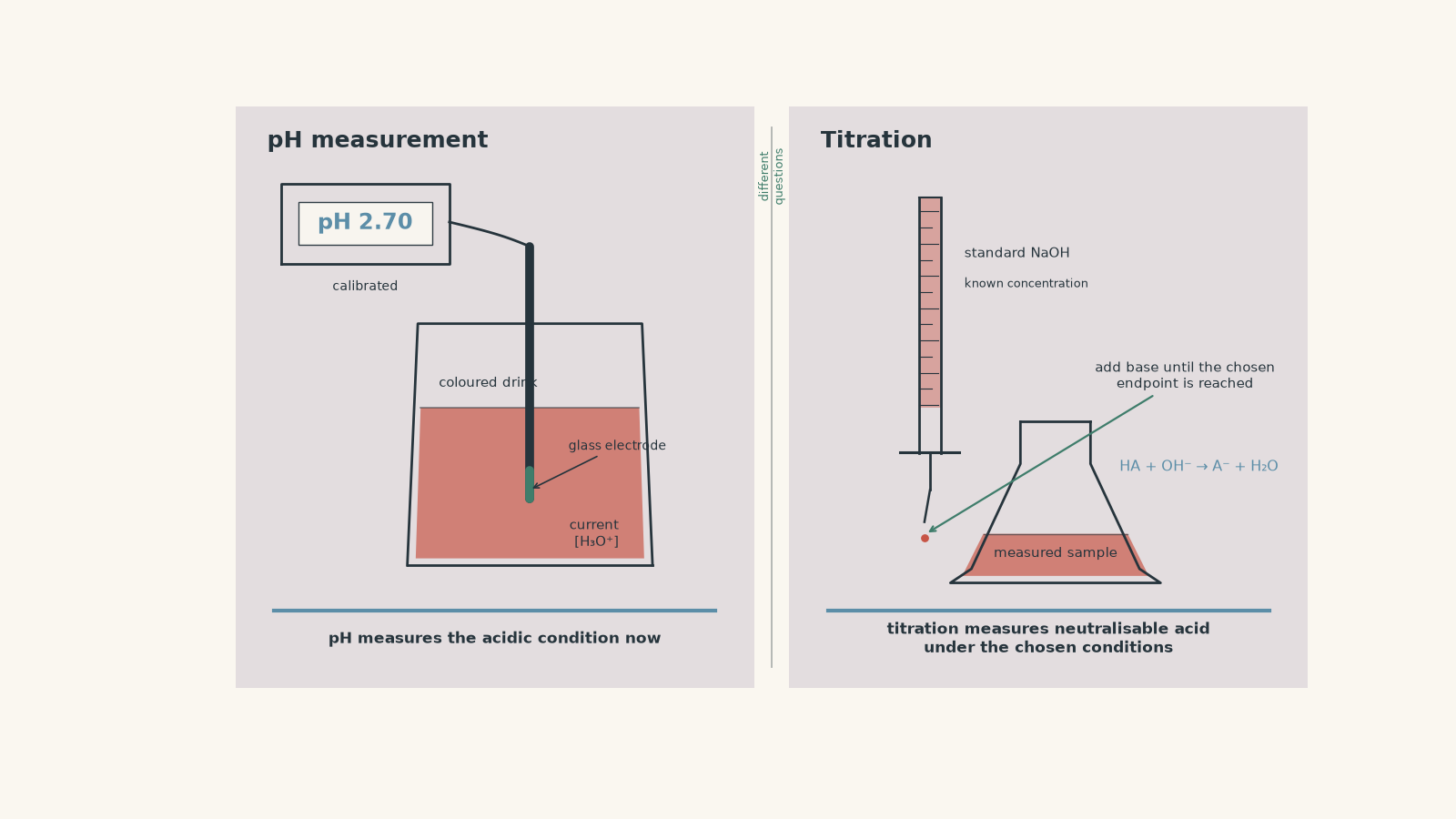
04Why pH does not tell you the total amount of acid
Consider ethanoic acid in vinegar:
\[ \ce{CH3COOH + H2O <=> H3O+ + CH3COO-} \]
Ethanoic acid is weak, so only some acid molecules have donated a proton at any particular moment.
Now add hydroxide ions.
They remove hydronium ions:
\[ \ce{H3O+ + OH- -> 2H2O} \]
As \(\ce{H3O+}\) is consumed, the ethanoic acid equilibrium shifts to the right. More \(\ce{CH3COOH}\) ionises and supplies more hydronium ions.
So the original pH measured only the equilibrium condition before the base was added. It did not directly count every acid molecule that could eventually react.
This is why two drinks can have similar pH values but very different titratable acidities.
05Using titration to measure household acidity
If the aim is to determine how much acid is present, titration can be much more informative than pH alone.
For a simple monoprotic acid, which can donate one proton per molecule, the reaction with hydroxide can be represented as
\[ \ce{HA + OH- -> A- + H2O} \]
At the equivalence point,
\[ n(\ce{HA})=n(\ce{OH-}) \]
where \(n\) represents amount in moles.
The basic calculation is
\[ n=cV \]
where:
- \(n\) is amount in mol,
- \(c\) is concentration in mol L\(^{-1}\), and
- \(V\) is volume in L.
The stoichiometric ratio from the balanced equation then connects the titrant to the substance being analysed.
Endpoint is not exactly the same as equivalence point
The equivalence point is the theoretical point at which the reactants have been mixed in the stoichiometric ratio given by the equation.
The endpoint is the experimental signal telling you to stop the titration. For an indicator titration, that is usually a persistent colour change.
A good method chooses an indicator whose colour-change range is close to the equivalence point. A pH probe can instead be used to generate a titration curve.
06Sample preparation can change what you are measuring
Household substances are rarely beautiful textbook solutions.
Soft drink can contain dissolved carbon dioxide. Juice may contain several acids, sugars, suspended pulp, and coloured compounds. A medicine might be a suspension containing undissolved active ingredient.
That means sample preparation is part of the chemical argument, not just laboratory housekeeping.
Carbonated drinks
Dissolved carbon dioxide participates in equilibria that can contribute to acidity. Degassing a soft drink before analysis can therefore change the result.
Neither “always degas it” nor “never degas it” is a good rule.
Instead, define the question.
If you want the acidity of a degassed soft-drink sample for a reproducible titration procedure, degas it and report that treatment. If you are investigating the drink as freshly opened and consumed, removing carbon dioxide would change the system you claimed to analyse.
Coloured samples
A dark sample can hide an indicator colour change. A pH probe or instrumental titration may give a more defensible endpoint.
Suspensions
A medicine labelled “shake well” is giving you an experimental instruction disguised as packaging advice.
If you sample the clear liquid above settled solid, your aliquot may not contain a representative amount of the active ingredient. Filtering can be even worse if the compound you are trying to measure is present as a suspended solid.
Dilution
Dilution is sometimes useful because it makes volumes easier to measure or an endpoint easier to observe.
But you must account for the dilution mathematically.
If 10.00 mL of the original sample is diluted to 100.0 mL, the concentration has been reduced by a factor of
\[ \frac{100.0}{10.00}=10.00 \]
The number of moles of solute transferred has not magically disappeared. It has simply been distributed through a larger volume.
07A titration tells you only what your reaction model justifies
Suppose lemon juice is titrated with sodium hydroxide. Lemon juice contains several chemical species, although citric acid is usually an important contributor to its acidity.
If a question explicitly tells you to model the neutralisable acid as citric acid, you can use
\[ \ce{H3C6H5O7 + 3OH- -> C6H5O7^3- + 3H2O} \]
One mole of citric acid can therefore react with three moles of hydroxide ions under complete neutralisation.
In an actual household mixture, however, a titration may measure the combined acid-neutralising behaviour of several species. Reporting the result as an exact concentration of one particular acid would require evidence that your reaction model is justified.
A safer expression is sometimes “titratable acidity”, together with a clear statement of how it was measured.
Worked example: analysing the acidity of lemon juice
A student transfers 10.00 mL of lemon juice into a 100.0 mL volumetric flask and dilutes it to the mark. A 20.00 mL aliquot of the diluted solution requires 15.60 mL of \(0.1000\text{ mol L}^{-1}\) \(\ce{NaOH}\) for complete neutralisation.
Assume all neutralisable acidity is due to citric acid, \(\ce{H3C6H5O7}\). Calculate the concentration of citric acid in the original lemon juice in mol L\(^{-1}\) and g L\(^{-1}\). The molar mass of citric acid is \(192.12\text{ g mol}^{-1}\).
Step 1
\[ \ce{H3C6H5O7 + 3NaOH -> Na3C6H5O7 + 3H2O} \]
Therefore,
\[ 1\text{ mol citric acid}:3\text{ mol NaOH} \]
Step 2
Convert \(15.60\text{ mL}\) to \(0.01560\text{ L}\).
\[ \begin{aligned} n(\ce{NaOH})&=cV\\ &=(0.1000)(0.01560)\\ &=1.560\times10^{-3}\text{ mol} \end{aligned} \]
Step 3
\[ n(\text{citric acid}) =\frac{1.560\times10^{-3}}{3} =5.200\times10^{-4}\text{ mol} \]
Step 4
The aliquot volume is \(0.02000\text{ L}\).
\[ \begin{aligned} c&=\frac{n}{V}\\ &=\frac{5.200\times10^{-4}}{0.02000}\\ &=0.02600\text{ mol L}^{-1} \end{aligned} \]
Step 5
The original 10.00 mL was diluted to 100.0 mL, so the dilution factor is 10.00.
\[ c_{\text{original}} =(0.02600)(10.00) =0.2600\text{ mol L}^{-1} \]
Step 6
\[ \begin{aligned} \text{mass concentration} &=(0.2600)(192.12)\\ &=49.95\text{ g L}^{-1} \end{aligned} \]
Under the stated model, the original juice contains \(0.2600\text{ mol L}^{-1}\), or about \(50.0\text{ g L}^{-1}\), of citric acid equivalent.
The words “under the stated model” matter. The arithmetic is precise, but real lemon juice is a mixture. The conclusion should not pretend the experiment distinguished every acidic species individually.
08The most tempting mistake: lower pH means more total acid
Imagine drink A has pH 2.5 and drink B has pH 3.0.
Drink A definitely has the greater initial \([\ce{H3O+}]\).
But now suppose equal volumes are titrated and drink B requires three times as many moles of \(\ce{NaOH}\) to reach the chosen endpoint.
Which drink is more acidic?
The scientifically useful answer is: specify what you mean.
Drink A has the lower pH and greater initial hydronium concentration. Drink B has the greater measured titratable acidity under that titration method.
Trying to force both observations into a single ranking throws useful information away.
The same distinction appears for bases. A suspension of a sparingly soluble basic compound might not produce an enormous \([\ce{OH-}]\), but it may contain a large reserve of solid base that continues dissolving as acid is added.
09A reliable household analysis is a chain of decisions
A strong investigation should make each link explicit.
| Stage | What you should decide |
|---|---|
| Question | Are you measuring pH, titratable acidity/basicity, or concentration of a particular species? |
| Sampling | How will you obtain a representative sample? |
| Preparation | Will you dilute, degas, filter, dissolve, or mix the sample? Could that treatment change the measurand? |
| Method | Is an indicator adequate, or is a calibrated pH probe more suitable? |
| Reaction | What balanced equation connects your titrant to the substance being measured? |
| Data | Are concordant titres or repeat pH measurements available? |
| Calculation | Have all dilution factors, stoichiometric ratios, and units been included? |
| Claim | Does your conclusion say only what the experiment actually established? |
That final row is often where a technically competent report becomes a scientifically good one.
Instead of writing:
The juice contains exactly 0.260 mol L\(^{-1}\) citric acid.
a better conclusion for a complex mixture could be:
Under the assumption that the measured neutralisable acidity behaves as citric acid, the titration corresponds to \(0.260\text{ mol L}^{-1}\) citric acid equivalent in the original sample.
The second statement communicates both the result and the model behind it.
10Questions and solutions
Question 1
A clear household cleaning solution has a measured pH of 11.30 at \(25^\circ\text{C}\).
Calculate its hydronium ion concentration and classify the solution as acidic, neutral, or basic.
Solution 1
The solution is basic, with \([\ce{H3O+}]=5.0\times10^{-12}\text{ mol L}^{-1}\).
Using
\[ [\ce{H3O+}]=10^{-\mathrm{pH}} \]
gives
\[ \begin{aligned} [\ce{H3O+}] &=10^{-11.30}\\ &=5.01\times10^{-12}\text{ mol L}^{-1} \end{aligned} \]
Because the pH is greater than 7 at \(25^\circ\text{C}\), the solution is basic.
A tempting mistake is to decide that a tiny hydronium concentration means there is “almost nothing” in the solution. That conclusion does not follow. In a basic solution, the small \([\ce{H3O+}]\) is associated with a much larger \([\ce{OH-}]\).
Question 2
A student wants to compare the pH of a colourless vinegar and a dark berry drink. They add universal indicator to both. The vinegar gives an obvious colour, but the berry drink becomes a muddy purple-brown that cannot be matched confidently to the indicator chart.
Explain why the method gives weaker evidence for the berry drink, and describe a better procedure for comparing the two pH values.
Solution 2
The berry drink’s indicator result is unreliable because the sample’s own colour interferes with observation of the indicator colour; a calibrated pH probe would give a stronger comparison.
Universal indicator works only if its colour change can be interpreted. In the berry drink, the observed colour is a combination of the original sample colour and the indicator response, so matching it to a pH chart introduces substantial observational uncertainty.
A better procedure would be to calibrate a pH probe using appropriate buffer solutions, rinse and blot the probe, measure each well-mixed sample at the same temperature, wait for a stable reading, and take repeat measurements.
The tempting route is to assume that using the same indicator for both samples automatically makes the test fair. Using the same procedure does improve consistency, but it does not remove a systematic problem that affects one sample much more strongly than the other.
Question 3
A student analyses household vinegar. They transfer 5.00 mL of vinegar into a 100.0 mL volumetric flask and dilute to the mark.
A 25.00 mL aliquot of the diluted vinegar requires 10.40 mL of \(0.1000\text{ mol L}^{-1}\) \(\ce{NaOH}\).
Assume the acid is ethanoic acid and reacts according to
\[ \ce{CH3COOH + NaOH -> CH3COONa + H2O} \]
Calculate:
a. the concentration of ethanoic acid in the original vinegar in mol L\(^{-1}\), and
b. its concentration as a percentage mass per volume, where the molar mass of ethanoic acid is \(60.05\text{ g mol}^{-1}\).
Solution 3
The original vinegar contains \(0.832\text{ mol L}^{-1}\) ethanoic acid, corresponding to approximately \(5.00\%\) mass per volume.
For part a, first calculate the amount of \(\ce{NaOH}\):
\[ \begin{aligned} n(\ce{NaOH}) &=cV\\ &=(0.1000)(0.01040)\\ &=1.040\times10^{-3}\text{ mol} \end{aligned} \]
The reaction ratio is \(1:1\), so the 25.00 mL aliquot contains
\[ n(\ce{CH3COOH})=1.040\times10^{-3}\text{ mol} \]
Therefore the concentration in the diluted vinegar is
\[ \begin{aligned} c &=\frac{1.040\times10^{-3}}{0.02500}\\ &=0.04160\text{ mol L}^{-1} \end{aligned} \]
The original 5.00 mL was diluted to 100.0 mL. The dilution factor is
\[ \frac{100.0}{5.00}=20.0 \]
so
\[ c_{\text{original}} =(0.04160)(20.0) =0.832\text{ mol L}^{-1} \]
For part b, convert molar concentration into mass concentration:
\[ \begin{aligned} \text{mass concentration} &=(0.832)(60.05)\\ &=49.96\text{ g L}^{-1} \end{aligned} \]
Since \(1\text{ L}=1000\text{ mL}\),
\[ 49.96\text{ g L}^{-1} =4.996\text{ g per }100\text{ mL} \]
Therefore,
\[ \boxed{5.00\%\text{ mass per volume}} \]
to three significant figures.
The common trap is to calculate the concentration of the diluted aliquot correctly and report \(0.04160\text{ mol L}^{-1}\) as the vinegar concentration. The titration measures the diluted solution, so the original \(20.0\)-fold dilution must be reversed.
Question 4
Equal 25.00 mL samples of drinks A and B are analysed.
Drink A has pH 2.60 and drink B has pH 3.10.
The samples are then titrated separately with \(0.1000\text{ mol L}^{-1}\) \(\ce{NaOH}\) to the same defined endpoint. Drink A requires 4.20 mL, while drink B requires 12.60 mL.
a. Which drink initially has the greater hydronium ion concentration, and by what factor?
b. Which drink has the greater measured titratable acidity, and by what factor?
c. A student says, “These measurements cannot both be correct because the lower-pH drink must contain more acid.” Assess this claim.
Solution 4
Drink A has about \(3.16\) times the initial hydronium ion concentration, while drink B has three times the measured titratable acidity; the two results can both be correct.
For part a,
\[ [\ce{H3O+}]_{\mathrm A}=10^{-2.60} \]
and
\[ [\ce{H3O+}]_{\mathrm B}=10^{-3.10} \]
so
\[ \frac{[\ce{H3O+}]_{\mathrm A}} {[\ce{H3O+}]_{\mathrm B}} = 10^{-2.60-(-3.10)} = 10^{0.50} = 3.16 \]
Drink A therefore has about \(3.16\) times the initial hydronium concentration.
For part b, both titrations use the same \(\ce{NaOH}\) concentration and the same sample volume, so the amount of base required is proportional to the titre:
\[ \frac{12.60}{4.20}=3.00 \]
Drink B therefore requires three times as many moles of hydroxide ions to reach the defined endpoint. Under this method, its titratable acidity is three times that of drink A.
For part c, the student’s claim confuses equilibrium hydronium concentration with total neutralisable acid.
The lower pH of A describes its initial acidic condition. It does not specify how much weak acid or other proton-donating material remains available to react as hydroxide is added. Drink B can begin with a lower \([\ce{H3O+}]\) while containing more neutralisable acid overall.
The tempting route is to treat pH as though it were a direct measurement of the total number of acid molecules. It is not. For weak acids and mixtures, equilibrium continually shifts during neutralisation.
Question 5
A liquid antacid is a suspension containing \(\ce{Mg(OH)2}\) and inert ingredients.
A student notices that the liquid becomes clearer when left standing. They filter a sample and measure the pH of the clear filtrate. Another unfiltered, well-mixed sample has almost the same pH.
The student concludes:
“The solid does not contribute significantly to the basicity because removing it barely changed the pH.”
To test this conclusion quantitatively, 10.00 mL of well-mixed antacid is treated with 40.00 mL of \(0.5000\text{ mol L}^{-1}\) \(\ce{HCl}\). The acid is added in excess, the mixture is allowed to react completely, and the remaining \(\ce{HCl}\) requires 22.50 mL of \(0.2000\text{ mol L}^{-1}\) \(\ce{NaOH}\) for neutralisation.
Assume \(\ce{Mg(OH)2}\) is the only substance in the medicine that reacts with the acid.
a. Explain why similar pH values for the filtered and unfiltered samples do not show that the solid \(\ce{Mg(OH)2}\) is unimportant.
b. Explain why adding a known excess of acid and then titrating the acid left over is a useful method here.
c. Calculate the mass of \(\ce{Mg(OH)2}\) in the 10.00 mL sample. Use \(M(\ce{Mg(OH)2})=58.32\text{ g mol}^{-1}\).
Solution 5
The solid can provide substantial acid-neutralising capacity even when removing it causes little immediate change in pH; the back titration shows that the 10.00 mL sample contains approximately \(0.452\text{ g}\) of \(\ce{Mg(OH)2}\).
For part a, pH measures the equilibrium condition of the liquid phase. \(\ce{Mg(OH)2}\) is only sparingly soluble, so the dissolved ions determine the measured pH.
If solid \(\ce{Mg(OH)2}\) is present, an equilibrium exists between the solid and dissolved ions. Removing the solid may initially leave a solution with a similar dissolved ion concentration, so its pH can remain similar.
That does not mean the solid is chemically irrelevant.
When acid is added, \(\mathrm{H}^{+}\) removes hydroxide ions. More solid \(\ce{Mg(OH)2}\) can then dissolve and react. The suspended solid is therefore a reserve of base that a single pH measurement does not count.
The tempting argument is that “same pH means same amount of base”. That would confuse an equilibrium concentration with the total amount of basic material available for neutralisation.
For part b, adding a known excess of \(\ce{HCl}\) allows time for the suspended \(\ce{Mg(OH)2}\) to dissolve and react. The unused acid can then be measured by titration with standard \(\ce{NaOH}\).
This is a back titration. It is useful when direct titration is complicated by slow dissolution or a drifting endpoint.
The relevant reactions are
\[ \ce{Mg(OH)2 + 2HCl -> MgCl2 + 2H2O} \]
and, for the excess acid,
\[ \ce{HCl + NaOH -> NaCl + H2O} \]
For part c, first calculate the initial amount of hydrochloric acid:
\[ \begin{aligned} n(\ce{HCl})_{\text{initial}} &=cV\\ &=(0.5000)(0.04000)\\ &=0.02000\text{ mol} \end{aligned} \]
The excess \(\ce{HCl}\) is determined from the back titration.
\[ \begin{aligned} n(\ce{NaOH}) &=(0.2000)(0.02250)\\ &=0.004500\text{ mol} \end{aligned} \]
Because \(\ce{HCl}\) and \(\ce{NaOH}\) react in a \(1:1\) ratio,
\[ n(\ce{HCl})_{\text{remaining}} =0.004500\text{ mol} \]
So the amount of \(\ce{HCl}\) consumed by the antacid is
\[ \begin{aligned} n(\ce{HCl})_{\text{consumed}} &=0.02000-0.004500\\ &=0.01550\text{ mol} \end{aligned} \]
From
\[ \ce{Mg(OH)2 + 2HCl -> MgCl2 + 2H2O} \]
one mole of \(\ce{Mg(OH)2}\) consumes two moles of \(\ce{HCl}\).
Therefore,
\[ \begin{aligned} n(\ce{Mg(OH)2}) &=\frac{0.01550}{2}\\ &=0.007750\text{ mol} \end{aligned} \]
Now convert amount to mass:
\[ \begin{aligned} m&=nM\\ &=(0.007750)(58.32)\\ &=0.4520\text{ g} \end{aligned} \]
The 10.00 mL sample therefore contains approximately \(0.452\text{ g}\) of \(\ce{Mg(OH)2}\).
This is the key result: a sample can show only a modest dissolved hydroxide concentration while still containing a much larger amount of solid base capable of reacting with added acid. The filtered and unfiltered pH readings were answering the wrong question if the goal was to measure total neutralising capacity.
11What this analysis lets you do next
Once you separate pH from titratable acidity or basicity, household samples stop behaving like awkward exceptions to textbook chemistry. Their behaviour follows from equilibrium, stoichiometry, solubility, sampling, and the limits of the measurement method.
The next useful step is to examine the full titration curve rather than relying on a single endpoint. The shape of that curve can reveal buffering regions, equivalence behaviour, and whether the chosen indicator was suitable. The same reasoning then carries into larger-scale analytical work, including the methods discussed in Industrial Acid-Base Analysis and Titration for HSC Chemistry.