
Addition Reactions of Unsaturated Hydrocarbons Explained
Learn how to predict and model addition reactions of alkenes and alkynes with hydrogen, halogens, hydrogen halides, and water. Includes worked examples, common misconceptions, and challenging HSC-style questions.
Two flasks contain colourless hydrocarbons. One holds hexane. The other holds hex-1-ene. Add bromine to each in the dark, and the hex-1-ene rapidly removes the bromine colour while the hexane does not.
Before worrying about reaction names, predict what happens to the \(\ce{C=C}\) bond in hex-1-ene. Does the carbon chain snap in two?
It doesn’t. The two carbon atoms stay connected. Instead, part of the double bond is replaced by two new bonds to incoming atoms. That single idea explains hydrogenation, halogenation, hydrohalogenation, and hydration.
01The model behind an addition reaction
Carbon normally forms four covalent bonds. In an alkene, two carbon atoms are joined by a double bond:
\[ \ce{C=C} \]
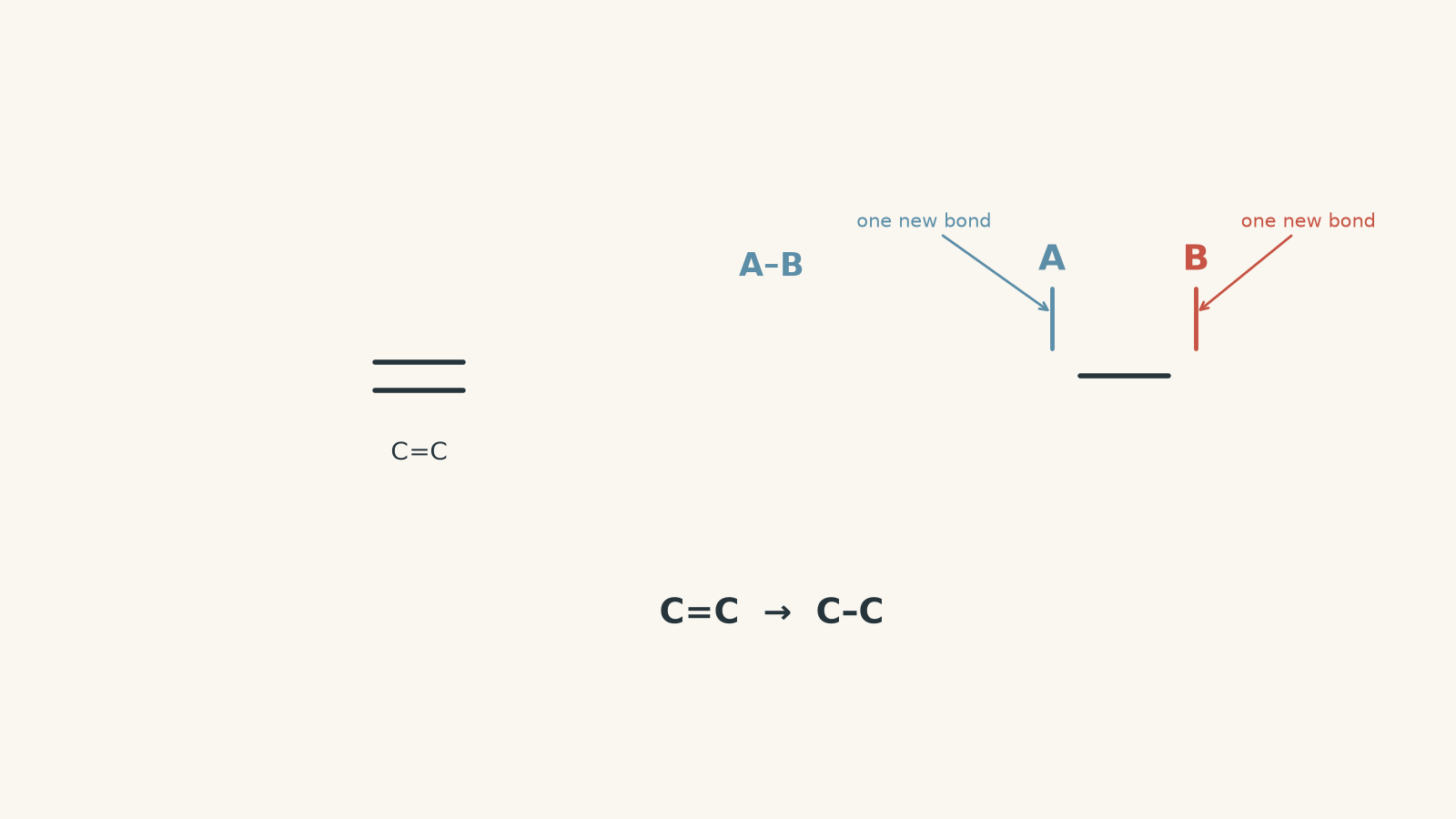
A carbon-carbon double bond contains one strong \(\sigma\) bond and one weaker, more exposed \(\pi\) bond. During an addition reaction, the \(\pi\) bond is consumed while the \(\sigma\) bond connecting the two carbon atoms remains.
The result is simple:
\[ \ce{C=C -> C-C} \]
The two former double-bond carbons now each have room to form one new bond.
A slightly silly picture helps. Imagine the two carbon atoms are a couple holding both hands. During an addition reaction they don’t break up. They release one pair of hands, keep holding with the other pair, and each freed hand grabs part of the incoming reagent.
That is useful for picturing the bond count, but it isn’t a literal reaction mechanism. Chemical bonds are shared electron density, not hands, and different reagents react through different microscopic steps.
This gives you a reliable model-building method.
- Find the \(\ce{C=C}\) or \(\ce{C#C}\).
- Keep the carbon skeleton in place.
- Reduce the multiple bond by one bond order: \(\ce{C=C}\) becomes \(\ce{C-C}\), or \(\ce{C#C}\) becomes \(\ce{C=C}\).
- Attach one part of the reagent to each of those two carbons.
- Check that every carbon now has four bonds.
The third step is especially important. Students sometimes see a double bond disappear and accidentally separate the two carbon atoms. The carbon-carbon \(\sigma\) bond remains.
02Four reagents, one basic pattern
For an alkene, the four addition reactions can be organised like this.
| Reagent | What is added across \(\ce{C=C}\)? | Main product type | Important condition or idea |
|---|---|---|---|
| \(\ce{H2}\) | H and H | alkane | Ni, Pd, or Pt catalyst |
| \(\ce{X2}\) | X and X | dihaloalkane | \(X\) is usually Cl or Br |
| \(\ce{HX}\) | H and X | haloalkane | position can matter for an unsymmetrical alkene |
| \(\ce{H2O}\) | H and OH | alcohol | acid catalyst |
The trick is not memorising four unrelated equations. It is seeing what gets attached to the two carbons that used to form the double bond.
03Hydrogenation: adding \(\ce{H2}\)
Suppose ethene reacts with hydrogen.
Each carbon in ethene needs one extra bond after the \(\pi\) bond is removed. The \(\ce{H2}\) molecule supplies one H atom to each carbon.
\[ \ce{CH2=CH2 + H2 ->[Ni] CH3-CH3} \]
Ethene becomes ethane.
This reaction is called hydrogenation. A metal catalyst such as nickel, palladium, or platinum is normally required.
There is no positioning problem here. Both atoms being added are hydrogen, so swapping them makes no difference.
The same reasoning works for any alkene:
\[ \ce{alkene + H2 -> alkane} \]
Hydrogenation therefore removes one carbon-carbon double bond from the molecule.
04Halogenation: adding \(\ce{X2}\)
Now replace \(\ce{H2}\) with a halogen molecule such as \(\ce{Br2}\).
One Br atom attaches to each of the two former double-bond carbons:
\[ \ce{CH2=CH2 + Br2 -> BrCH2-CH2Br} \]
The product is 1,2-dibromoethane.
The two bromine atoms are on neighbouring carbons because those are the two carbons that originally formed the double bond.
Propene follows the same pattern:
\[ \ce{CH3-CH=CH2 + Br2 -> CH3-CHBr-CH2Br} \]
The product is 1,2-dibromopropane.
Again, there is no choice about which end receives which part of the reagent because the two added atoms are identical.
This reaction also explains why bromine is useful when testing for unsaturation. An alkene can consume bromine by addition across its \(\ce{C=C}\) bond, so the bromine colour disappears. In a standard HSC comparison of hydrocarbons, this helps distinguish an unsaturated hydrocarbon from an alkane under conditions where substitution is not occurring.
Don’t overstate the test, though. Decolourising bromine tells you that something reactive towards bromine is present. By itself, it does not identify the exact hydrocarbon.
05Hydrohalogenation: adding \(\ce{HX}\)
A hydrogen halide has the form \(\ce{HX}\), where \(X\) is a halogen. Examples include \(\ce{HCl}\) and \(\ce{HBr}\).
With ethene, the product is easy because the two carbons are equivalent:
\[ \ce{CH2=CH2 + HBr -> CH3-CH2Br} \]
One carbon receives H. The other receives Br.
The interesting case is an unsymmetrical alkene such as propene:
\[ \ce{CH3-CH=CH2} \]
Now the two double-bond carbons are different. If H attaches to one carbon, Br attaches to the other. Reverse those positions, and you obtain a different structural product.
So which product should you predict?
Under the standard conditions used for these reactions, the major product follows Markovnikov’s rule:
When \(\ce{HX}\) adds to an unsymmetrical alkene, H preferentially attaches to the double-bond carbon that already has more H atoms. The halogen attaches to the other carbon.
You can also think of the halogen as tending to end up on the more substituted carbon: the double-bond carbon already attached to more carbon groups.
This is a major-product rule, not a claim that the other orientation is physically impossible.
Worked example: HBr added to but-1-ene
But-1-ene reacts with \(\ce{HBr}\). Predict the major organic product and write a structural equation.
Step 1
But-1-ene can be written as:
\[ \ce{CH2=CH-CH2-CH3} \]
The reacting carbons are C1 and C2.
Step 2
\(\ce{HBr}\) contributes H and Br. One goes to each of the two double-bond carbons.
Step 3
C1 is \(\ce{CH2}\), so it has two H atoms.
C2 is \(\ce{CH}\), so it has one H atom.
Under Markovnikov addition, the incoming H attaches to C1, which already has more H atoms. Br therefore attaches to C2.
Step 4
\[ \ce{CH2=CH-CH2-CH3 + HBr -> CH3-CHBr-CH2-CH3} \]
Step 5
The major product is 2-bromobutane.
The tempting answer is 1-bromobutane. That structure does conserve every atom, so it can look perfectly reasonable. The missing piece is orientation: for an unsymmetrical alkene reacting with an unsymmetrical reagent such as \(\ce{HBr}\), the two possible attachments are not generally produced in equal amounts.
06Hydration: adding water
Hydration adds the components of water across a carbon-carbon double bond.
Do not picture an intact \(\ce{H2O}\) molecule simply sticking to one carbon. For product prediction, treat the net addition as:
- H to one carbon
- OH to the other carbon
For ethene:
\[ \ce{CH2=CH2 + H2O ->[H^+] CH3-CH2OH} \]
The product is ethanol.
The \(\mathrm{H}^{+}\) represents acid catalysis. The catalyst helps provide a viable reaction pathway but is regenerated rather than being consumed as a reactant.
For an unsymmetrical alkene, position matters again. Under ordinary acid-catalysed hydration, the major product follows the same orientation pattern as Markovnikov addition: H goes preferentially to the double-bond carbon already carrying more H atoms, while OH goes to the more substituted carbon.
Worked example: hydration of 2-methylpropene
2-methylpropene reacts with water under acid-catalysed conditions. Predict the major alcohol product.
Step 1
\[ \ce{CH2=C(CH3)2} \]
One double-bond carbon is \(\ce{CH2}\). The other is bonded to two \(\ce{CH3}\) groups and has no hydrogen atoms.
Step 2
Hydration adds H to one double-bond carbon and OH to the other.
Step 3
The \(\ce{CH2}\) carbon already has more H atoms, so it receives the incoming H.
The OH group therefore attaches to the more substituted carbon.
Step 4
\[ \ce{CH2=C(CH3)2 + H2O ->[H^+] (CH3)3COH} \]
Step 5
The major product is 2-methylpropan-2-ol.
Check the carbon skeleton. No carbon atoms have appeared or disappeared. Only the bond order and the attached H/OH groups have changed.
A common mistake is to place OH on the end carbon because alcohol names such as ethanol may make an end-position OH feel more familiar. The position comes from the starting alkene and the reaction, not from which alcohol looks simpler.
07When does orientation actually matter?
You don’t need Markovnikov’s rule for every addition reaction.
Ask two questions.
First: are the two pieces being added different?
- \(\ce{H2}\): no
- \(\ce{Br2}\) or \(\ce{Cl2}\): no
- \(\ce{HBr}\) or \(\ce{HCl}\): yes
- \(\ce{H2O}\), considered as H and OH: yes
Second: are the two alkene carbons different?
If either the reagent or the two alkene carbons are symmetrical, reversing the attachment does not create a different constitutional product.
For example, but-2-ene is symmetrical around its double bond:
\[ \ce{CH3-CH=CH-CH3} \]
Adding \(\ce{HBr}\) gives the same constitutional product whichever double-bond carbon you label first:
\[ \ce{CH3-CH=CH-CH3 + HBr -> CH3-CHBr-CH2-CH3} \]
So there is no useful Markovnikov decision to make.
08What changes for alkynes?
An alkyne contains a carbon-carbon triple bond:
\[ \ce{C#C} \]
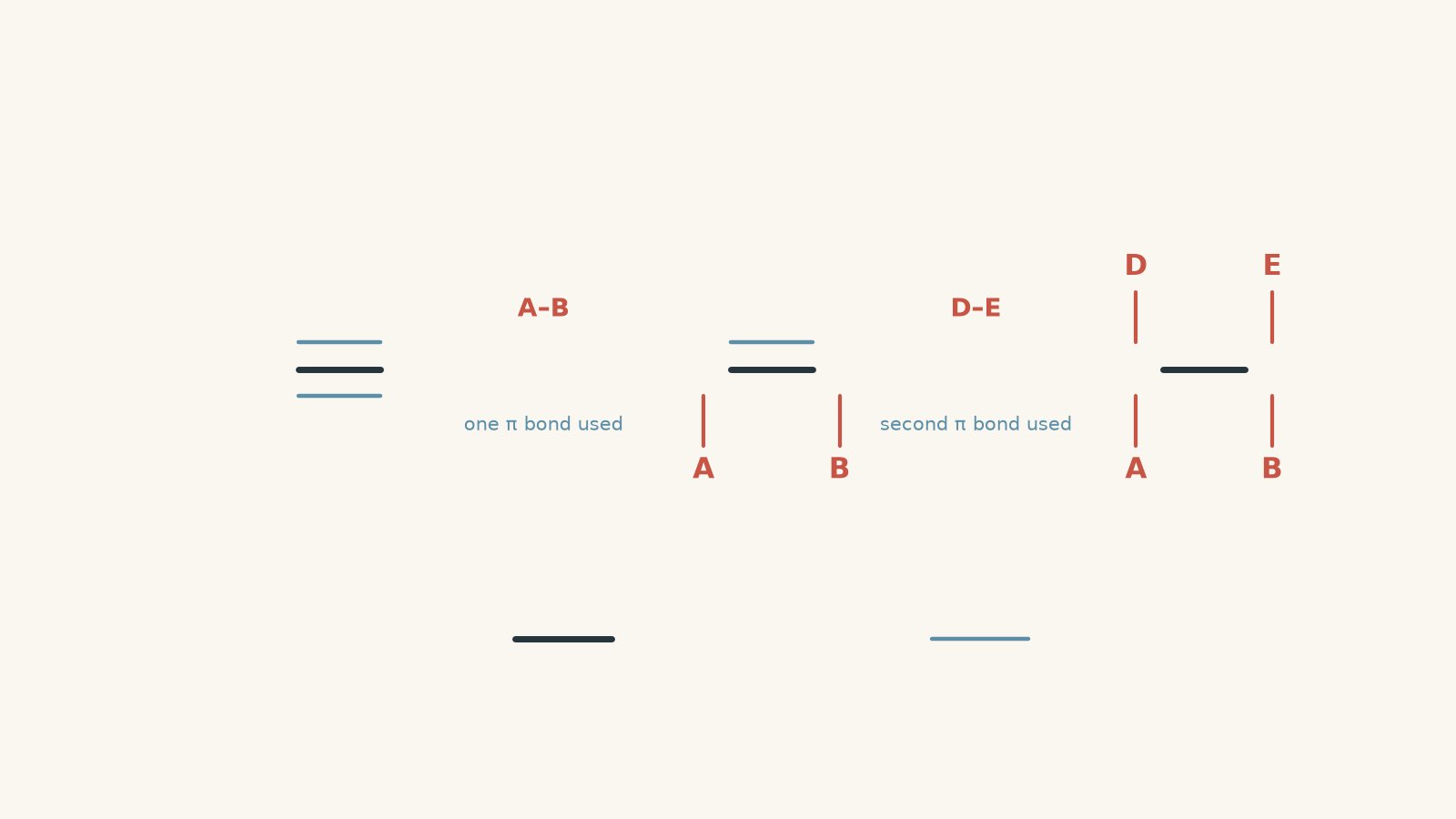
A triple bond consists of one \(\sigma\) bond and two \(\pi\) bonds. This creates an important difference from an alkene.
An alkene has one \(\pi\) bond available for addition.
An alkyne has two.
So, for reagents such as \(\ce{H2}\), \(\ce{X2}\), and \(\ce{HX}\), an alkyne can often undergo addition twice if enough reagent is supplied.
Complete hydrogenation of an alkyne
Consider ethyne:
\[ \ce{HC#CH} \]
One mole of \(\ce{H2}\) reduces the triple bond to a double bond.
A second mole of \(\ce{H2}\) can reduce the remaining double bond to a single bond.
For complete hydrogenation:
\[ \ce{HC#CH + 2H2 ->[catalyst] CH3-CH3} \]
The important ratio is:
\[ 1\text{ mol alkyne} : 2\text{ mol }\ce{H2} \]
for an alkyne containing one triple bond that is completely hydrogenated.
That stoichiometry becomes very useful in calculations.
Halogen addition to an alkyne
With one equivalent of bromine, ethyne undergoes one addition:
\[ \ce{HC#CH + Br2 -> BrCH=CHBr} \]
Notice that the product is still unsaturated. The triple bond has become a double bond.
Add a second equivalent of bromine:
\[ \ce{BrCH=CHBr + Br2 -> CHBr2-CHBr2} \]
Overall:
\[ \ce{HC#CH + 2Br2 -> CHBr2-CHBr2} \]
The final product, 1,1,2,2-tetrabromoethane, has a carbon-carbon single bond.
This is why the instruction “excess bromine” matters. One mole of \(\ce{Br2}\) and two moles of \(\ce{Br2}\) do not represent the same reaction with an alkyne.
Worked example: bromination of propyne
One mole of propyne, \(\ce{CH3-C#CH}\), reacts with two moles of \(\ce{Br2}\). Construct the final organic product.
Step 1
A triple bond contains two \(\pi\) bonds, so two additions are possible.
Step 2
One Br atom attaches to each alkyne carbon, and the triple bond becomes a double bond:
\[ \ce{CH3-C#CH + Br2 -> CH3-CBr=CHBr} \]
Step 3
The remaining \(\ce{C=C}\) can undergo another halogen addition:
\[ \ce{CH3-CBr=CHBr + Br2 -> CH3-CBr2-CHBr2} \]
Step 4
\[ \ce{CH3-C#CH + 2Br2 -> CH3-CBr2-CHBr2} \]
Step 5
The final product is 1,1,2,2-tetrabromopropane.
The carbon skeleton has not changed. Four Br atoms have been added because two \(\ce{Br2}\) molecules were consumed, and the carbon-carbon triple bond has ultimately become a single bond.
The common trap is seeing “addition of bromine” and automatically adding only one \(\ce{Br2}\). For an alkyne, the amount of reagent matters.
09Hydrohalogenation of an alkyne
The same one-addition-versus-two-addition idea applies to \(\ce{HX}\).
For ethyne with excess \(\ce{HCl}\):
\[ \ce{HC#CH + 2HCl -> CH3-CHCl2} \]
The final product is 1,1-dichloroethane.
After the first addition, the molecule still contains a double bond, so it can react again. Under the standard orientation, repeated hydrohalogenation can place both halogens on the same carbon.
You do not need to imagine that both \(\ce{HCl}\) molecules collide with the alkyne simultaneously. Think of it as two successive additions.
10Alkyne hydration is the important exception
It is tempting to reason like this:
An alkyne has two \(\pi\) bonds, so water should simply add twice and produce something with two OH groups.
That prediction extends the previous model too far.
Water can add to an alkyne, but the first product formed contains an OH group attached to a carbon-carbon double bond. This type of structure is called an enol. Under the reaction conditions, the enol rearranges to a more stable carbonyl compound.
For ethyne, the net reaction is:
\[ \ce{HC#CH + H2O -> CH3CHO} \]
The product is ethanal, not ethanol.
For product prediction, the important lesson is that alkyne hydration is a special case. The simple “repeat the addition twice” model works well for complete addition of \(\ce{H2}\), \(\ce{X2}\), and \(\ce{HX}\), but it does not describe the final stable product of alkyne hydration.
This is exactly why a useful model should eventually meet its limit.
11A fast method for predicting an addition product
When an HSC question gives you an unfamiliar structure, use this order rather than trying to remember the whole product at once.
1. Find every multiple carbon-carbon bond
Look specifically for \(\ce{C=C}\) or \(\ce{C#C}\).
An ordinary \(\ce{C-C}\) bond is not the site of an addition reaction.
2. Identify the reagent
Translate it into the groups that will be added.
| Reagent | Think |
|---|---|
| \(\ce{H2}\) | H + H |
| \(\ce{Cl2}\) | Cl + Cl |
| \(\ce{Br2}\) | Br + Br |
| \(\ce{HCl}\) | H + Cl |
| \(\ce{HBr}\) | H + Br |
| \(\ce{H2O}\) to an alkene | H + OH |
3. Reduce the bond order
For one addition:
\[ \ce{C#C -> C=C} \]
or
\[ \ce{C=C -> C-C} \]
4. Attach one incoming group to each reacting carbon
Don’t move the rest of the carbon skeleton around.
5. Deal with orientation only if necessary
If the alkene and reagent are both unsymmetrical, predict the major product using the standard orientation rule.
6. Check carbon valency and atom conservation
Every neutral carbon in these structures should have four bonds.
Also check that every atom from the reactants appears in the product. An addition reaction should not mysteriously eject an H atom or halogen atom.
12The misconceptions that cause most wrong products
“The double bond breaks, so the carbon chain breaks”
Only the \(\pi\) component of the double bond is consumed in ordinary alkene addition. The carbon-carbon \(\sigma\) bond stays.
“Water puts OH on both carbons”
Water contributes a net H and OH across an alkene double bond, not two OH groups.
“Markovnikov’s rule is needed for every addition”
It only helps when orientation could produce different constitutional products. There is no orientation choice when adding \(\ce{H2}\) or \(\ce{Br2}\), and there is no useful choice if the two alkene carbons are equivalent.
“An alkyne always stops after one addition”
Not if enough suitable reagent is present. A triple bond can become a double bond and then a single bond through two successive additions.
“If a hydrocarbon consumes two moles of hydrogen, it must contain a triple bond”
Not necessarily. One triple bond contains two \(\pi\) bonds, but two separate double bonds also contain two \(\pi\) bonds. Addition stoichiometry can tell you how much unsaturation is present without always telling you how that unsaturation is arranged.
That distinction becomes important in the harder questions below.
13Questions and solutions
Question 1
Ethene reacts with \(\ce{Br2}\).
Write a structural equation for the reaction, name the organic product, and explain what happens to the carbon-carbon bond.
Solution 1
Ethene forms 1,2-dibromoethane, and its carbon-carbon double bond becomes a carbon-carbon single bond.
The reaction is:
\[ \ce{CH2=CH2 + Br2 -> BrCH2-CH2Br} \]
One Br atom attaches to each of the two carbons that originally formed the \(\ce{C=C}\).
The \(\pi\) bond is consumed, but the carbon-carbon \(\sigma\) bond remains. This is why the molecule does not split into two carbon fragments.
The tempting mistake is to draw \(\ce{CH2Br}\) as two separate molecules. That would incorrectly break the carbon-carbon \(\sigma\) bond.
Question 2
But-1-ene undergoes two separate reactions.
(a) Predict the major organic product when it reacts with \(\ce{HBr}\).
(b) Predict the major organic product when it reacts with water under acid-catalysed conditions.
(c) Explain why the Br group in part (a) and the OH group in part (b) are predicted to attach to the same carbon of the original double bond.
Solution 2
The major products are 2-bromobutane with \(\ce{HBr}\) and butan-2-ol with water.
But-1-ene is:
\[ \ce{CH2=CH-CH2-CH3} \]
For part (a), hydrohalogenation gives:
\[ \ce{CH2=CH-CH2-CH3 + HBr -> CH3-CHBr-CH2-CH3} \]
so the major product is 2-bromobutane.
For part (b), hydration gives:
\[ \ce{CH2=CH-CH2-CH3 + H2O ->[H^+] CH3-CH(OH)-CH2-CH3} \]
so the major product is butan-2-ol.
In both reactions, the terminal double-bond carbon begins as \(\ce{CH2}\), while the second carbon begins as \(\ce{CH}\). Under the standard Markovnikov orientation, the incoming H preferentially attaches to the carbon that already has more H atoms: the terminal carbon.
That forces the other group, Br in part (a) or OH in part (b), onto C2.
A tempting approach is to memorise hydrohalogenation and hydration as unrelated reactions. The useful connection is that both add an unsymmetrical pair across the same unsymmetrical \(\ce{C=C}\), so the same orientation logic predicts the major product.
Question 3
A mixture contains only ethene, \(\ce{C2H4}\), and ethyne, \(\ce{C2H2}\).
There are \(0.100\ \mathrm{mol}\) of hydrocarbons in total. Complete hydrogenation consumes \(0.160\ \mathrm{mol}\) of \(\ce{H2}\).
Calculate the amount, in moles, of ethene and ethyne originally present.
Solution 3
The original mixture contained \(0.0400\ \mathrm{mol}\) of ethene and \(0.0600\ \mathrm{mol}\) of ethyne.
Let \(x\) be the amount of ethene in moles and \(y\) the amount of ethyne in moles.
The total amount of hydrocarbon is:
\[ x+y=0.100\ \mathrm{mol} \]
Ethene contains one \(\pi\) bond, so complete hydrogenation uses one mole of \(\ce{H2}\) per mole of ethene:
\[ \ce{C2H4 + H2 -> C2H6} \]
Ethyne contains two \(\pi\) bonds, so complete hydrogenation uses two moles of \(\ce{H2}\) per mole of ethyne:
\[ \ce{C2H2 + 2H2 -> C2H6} \]
Therefore:
\[ \begin{aligned} x+2y &= 0.160\ \mathrm{mol}\\ x+y &= 0.100\ \mathrm{mol} \end{aligned} \]
Subtracting the second equation from the first:
\[ y=0.0600\ \mathrm{mol} \]
Then:
\[ x=0.100-0.0600=0.0400\ \mathrm{mol} \]
So:
\[ \boxed{x=0.0400\ \mathrm{mol\ ethene},\qquad y=0.0600\ \mathrm{mol\ ethyne}} \]
The tempting error is to assume every unsaturated hydrocarbon consumes one mole of hydrogen. That works for one isolated \(\ce{C=C}\), but a \(\ce{C#C}\) requires two additions for complete hydrogenation.
The unusually large hydrogen consumption is therefore evidence that some molecules carry two \(\pi\) bonds.
Question 4
An acyclic hydrocarbon \(A\) has the molecular formula \(\ce{C4H6}\).
Complete hydrogenation of \(1.00\ \mathrm{mol}\) of \(A\) consumes \(2.00\ \mathrm{mol}\) of \(\ce{H2}\) and produces butane. In a separate experiment, \(1.00\ \mathrm{mol}\) of \(A\) can consume \(2.00\ \mathrm{mol}\) of \(\ce{Br2}\) during complete addition.
A student concludes:
“\(A\) must be an alkyne because it can undergo addition twice.”
Is that conclusion justified? Use two different possible structures for \(A\) to support your answer.
Solution 4
No. The evidence proves that \(A\) contains two \(\pi\) bonds available for addition, but it does not prove that those two \(\pi\) bonds belong to one triple bond.
A saturated acyclic four-carbon hydrocarbon has formula \(\ce{C4H10}\). Compound \(A\), \(\ce{C4H6}\), contains four fewer H atoms. That is consistent with two units of unsaturation.
One possible structure is an alkyne, such as but-2-yne:
\[ \ce{CH3-C#C-CH3} \]
Its complete hydrogenation is:
\[ \ce{CH3-C#C-CH3 + 2H2 -> CH3-CH2-CH2-CH3} \]
Its two \(\pi\) bonds can also consume two moles of \(\ce{Br2}\).
But another possible structure is buta-1,3-diene:
\[ \ce{CH2=CH-CH=CH2} \]
It contains two separate carbon-carbon double bonds. Complete hydrogenation also consumes two moles of \(\ce{H2}\):
\[ \ce{CH2=CH-CH=CH2 + 2H2 -> CH3-CH2-CH2-CH3} \]
Its two double bonds can likewise account for two additions of bromine overall.
So both models match the given hydrogenation product and total addition stoichiometry.
The tempting route is to translate “two additions” directly into “triple bond”. The real constraint is the number of \(\pi\) bonds. One triple bond has two \(\pi\) bonds, but two double bonds also have two.
More structural evidence is needed.
Question 5
An acyclic hydrocarbon \(A\) has molecular formula \(\ce{C5H8}\).
Complete hydrogenation consumes exactly \(2.00\ \mathrm{mol}\) of \(\ce{H2}\) per mole of \(A\) and produces 2-methylbutane.
Two structures are initially being considered:
- 3-methylbut-1-yne
- 2-methylbuta-1,3-diene
A separate experiment reacts \(A\) with exactly \(1.00\ \mathrm{mol}\) of \(\ce{Br2}\) per mole of \(A\). The product \(B\) still contains one \(\ce{C=C}\) bond. A structural model shows that both Br atoms are attached directly to the two carbon atoms forming that remaining \(\ce{C=C}\).
Identify \(A\) and \(B\), write equations for the bromine reaction and complete hydrogenation, and explain why the diene model is ruled out.
Solution 5
\(A\) is 3-methylbut-1-yne, and \(B\) is 1,2-dibromo-3-methylbut-1-ene.
Start with the crucial observation: after one equivalent of \(\ce{Br2}\) has reacted, the two bromine atoms are attached to the same two carbons that are still joined by a \(\ce{C=C}\).
That is exactly what the first addition to an alkyne produces.
3-methylbut-1-yne is:
\[ \ce{HC#C-CH(CH3)-CH3} \]
Adding one mole of bromine reduces the triple bond to a double bond while adding one Br to each of the two reacting carbons:
\[ \ce{HC#C-CH(CH3)-CH3 + Br2 -> BrCH=CBr-CH(CH3)-CH3} \]
So \(B\) is 1,2-dibromo-3-methylbut-1-ene.
Complete hydrogenation of \(A\) uses two moles of hydrogen:
\[ \ce{HC#C-CH(CH3)-CH3 + 2H2 -> CH3-CH2-CH(CH3)-CH3} \]
The product \(\ce{CH3-CH2-CH(CH3)-CH3}\) is 2-methylbutane, matching the evidence.
Now consider the tempting alternative, 2-methylbuta-1,3-diene:
\[ \ce{CH2=C(CH3)-CH=CH2} \]
It initially looks plausible. It has formula \(\ce{C5H8}\), contains two \(\pi\) bonds, can consume two moles of \(\ce{H2}\) on complete hydrogenation, and gives the same saturated carbon skeleton.
Those observations alone do not distinguish it from an alkyne.
The decisive evidence is the structure after exactly one bromine addition. Using the addition model, \(\ce{Br2}\) added across one of a diene’s \(\ce{C=C}\) bonds consumes that particular double bond. The two brominated carbons therefore do not remain joined to each other by that same \(\ce{C=C}\).
For the alkyne, however, one addition changes:
\[ \ce{C#C -> C=C} \]
The same two reacting carbons remain multiply bonded after the first addition, while each has gained Br.
That structural observation, not merely the total amount of bromine or hydrogen consumed, distinguishes the models.
There is one more useful constraint. Complete hydrogenation preserves the carbon skeleton and gives 2-methylbutane. In that branched skeleton, the branching carbon is already connected to three other carbons, so it cannot also participate in a carbon-carbon triple bond without exceeding carbon’s valency. The viable triple bond is therefore terminal, giving 3-methylbut-1-yne.
This is the broader lesson behind the whole question: reaction stoichiometry tells you how much unsaturation is present, but tracking exactly which bonds remain after each addition can reveal how that unsaturation was arranged.
14What addition reactions let you do next
Once you can track the carbon skeleton and the fate of each \(\pi\) bond, organic reaction pathways become much less like memorising arrows.
Hydrogenation lets you remove unsaturation. Hydration lets an alkene become an alcohol. Hydrohalogenation turns an alkene into a haloalkane. Halogenation gives both a reaction pathway and experimental evidence about unsaturation.
The next useful step is to combine those reactions with substitution, oxidation, dehydration, and polymerisation. The question then stops being merely “What does this reagent do?” and becomes “Which functional group do I have now, and what reactions are available from here?” That is the reasoning you need for multi-step HSC organic synthesis.