
Halogen Substitution of Saturated Hydrocarbons for HSC Chemistry
Learn how saturated hydrocarbons react with chlorine and bromine by substitution, including the required UV conditions, balanced equations, product prediction, and worked HSC-style problems.
A bottle of chlorine and a bottle of methane can sit together in the dark with very little happening. Shine ultraviolet light on the mixture, though, and methane begins turning into chloromethane. The strange part is that methane has no double bond to open up. So where does the chlorine go?
Before reading on, predict the products. Does chlorine attach to methane as an extra atom, or must something already attached to carbon leave?
Carbon in methane already has four bonds. It cannot simply bolt chlorine on as a fifth partner. Instead, one hydrogen atom is replaced by chlorine. That replacement is the key idea behind halogen substitution of saturated hydrocarbons.
01What is actually being substituted?
Take methane, \(\ce{CH4}\). Each carbon-hydrogen bond joins the carbon atom to one hydrogen atom.
Under ultraviolet radiation, methane can react with chlorine:
\[
\ce{CH4 + Cl2 ->[UV] CH3Cl + HCl}
\]
One \(\ce{C-H}\) bond has effectively been replaced by a \(\ce{C-Cl}\) bond. The carbon skeleton has not gained another carbon atom, and no carbon-carbon multiple bond was involved.
This is a substitution reaction because one atom attached to carbon is replaced by another atom.
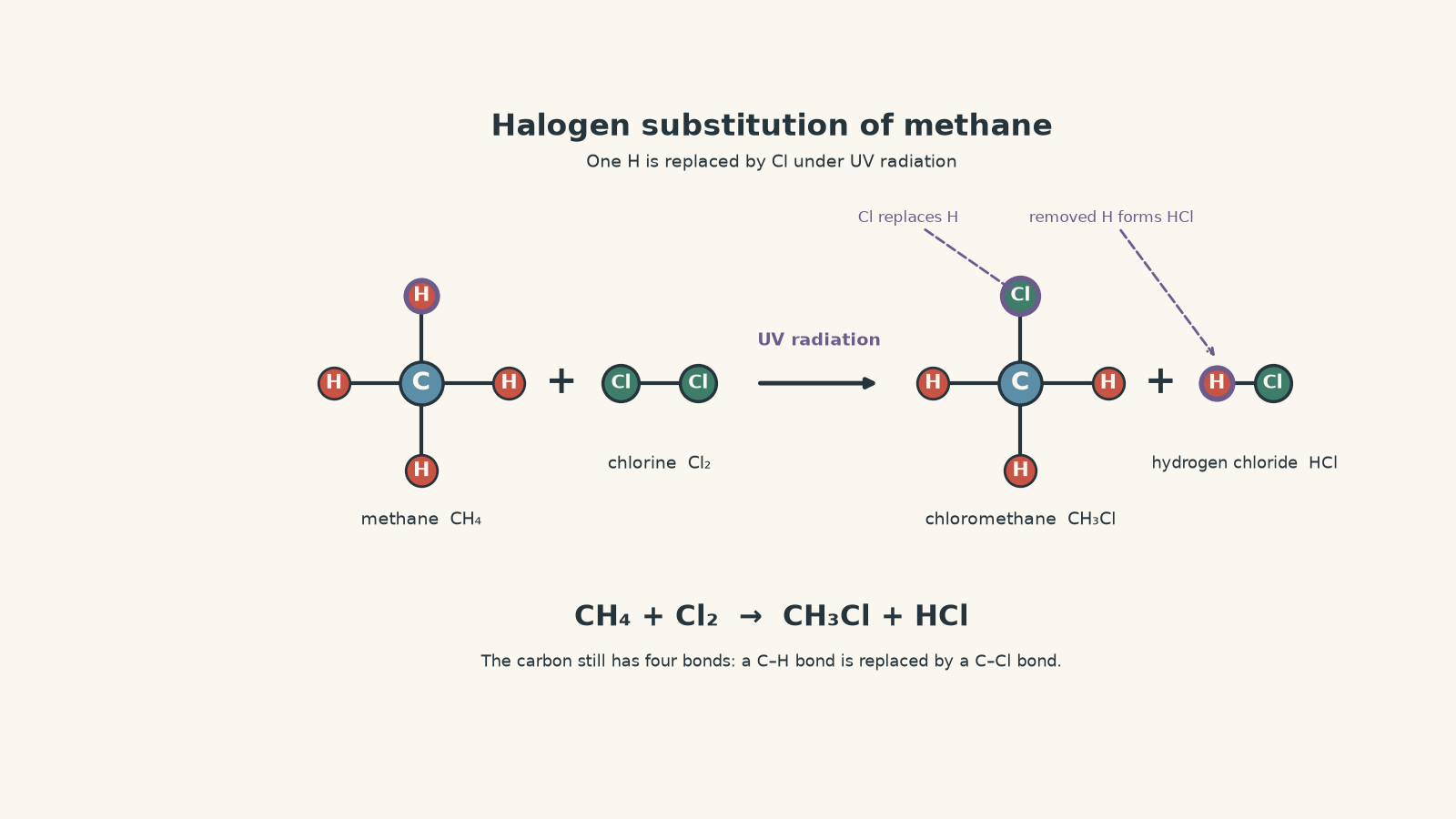
A slightly silly way to picture the net change is a dating-show recoupling. Carbon already has four partners, so chlorine cannot just join as partner number five. One hydrogen is replaced by chlorine, while the removed hydrogen ends up in hydrogen chloride.
The analogy stops there. Molecules do not make a one-step decision to swap partners. The real reaction proceeds through reactive radical species. For HSC questions about equations and conditions, the important overall change is the substitution shown above.
02The reaction pattern you need to recognise
For a saturated hydrocarbon reacting with chlorine or bromine, the usual HSC reaction pattern is:
\[
\ce{R-H + X2 ->[UV] R-X + H-X}
\]
Here:
- \(\ce{R-H}\) represents the saturated hydrocarbon containing the hydrogen being replaced
- \(\ce{X2}\) represents a halogen molecule, usually \(\ce{Cl2}\) or \(\ce{Br2}\)
- \(\ce{R-X}\) is the haloalkane product
- \(\ce{H-X}\) is the hydrogen halide by-product
- UV means ultraviolet radiation
For an alkane with molecular formula \(\ce{C_{n}H_{2n+2}}\), one substitution can be represented as:
\[
\ce{C_{n}H_{2n+2} + X2 ->[UV] C_{n}H_{2n+1}X + HX}
\]
This equation describes monosubstitution: exactly one hydrogen atom has been replaced.
For example:
\[
\ce{C2H6 + Br2 ->[UV] C2H5Br + HBr}
\]
Ethane becomes bromoethane, and hydrogen bromide is also formed.
03Why is UV radiation needed?
A student might reasonably think, “If chlorine is reactive, why doesn’t it just attack the alkane immediately?”
The problem is getting the reaction started. The \(\ce{Cl-Cl}\) or \(\ce{Br-Br}\) bond must first be broken to create very reactive radical species. UV radiation supplies energy that can initiate this process.
You do not normally need to reproduce the full radical mechanism when a question simply asks for the equation and conditions. The key exam condition is:
UV radiation, often written as UV light.
Sunlight may also initiate the reaction because sunlight contains ultraviolet radiation. If an HSC question asks for the standard condition, UV radiation is the clearest answer.
UV is not a chemical catalyst. A catalyst is a substance that participates in a reaction pathway and is regenerated. UV radiation is energy supplied to initiate the reaction.
04Chlorine and bromine are the important HSC examples
You will usually meet substitution reactions involving chlorine or bromine.
| Halogen | Typical alkane reaction | Useful HSC point |
|---|---|---|
| \(\ce{Cl2}\) | Chlorination | Occurs under UV radiation |
| \(\ce{Br2}\) | Bromination | Occurs under UV radiation |
| \(\ce{F2}\) | Fluorination | Extremely reactive and difficult to control |
| \(\ce{I2}\) | Iodination | Generally not favourable under ordinary alkane-halogenation conditions |
So although fluorine, chlorine, bromine, and iodine are all halogens, you should not assume they behave identically.
For ordinary HSC substitution equations, chlorine and bromine are the safest reaction partners to expect.
05A method for writing substitution equations
When you see a saturated hydrocarbon reacting with chlorine or bromine, use this sequence.
- Identify the hydrocarbon as saturated.
- Choose one hydrogen atom to replace.
- Attach the halogen atom in its place.
- Put the removed hydrogen into \(\ce{HCl}\) or \(\ce{HBr}\).
- Include the second halogen atom by checking the equation is balanced.
- Write UV radiation as the reaction condition.
- Check whether different hydrogen positions could produce different structural isomers.
That final step becomes important once the hydrocarbon is larger than ethane.
Worked example: methane reacting with chlorine
Write an equation, including conditions, for the monosubstitution reaction between methane and chlorine.
Step 1
Methane is \(\ce{CH4}\). One hydrogen atom will be replaced by chlorine.
The organic product is therefore chloromethane, \(\ce{CH3Cl}\).
Step 2
The hydrogen removed from methane forms hydrogen chloride, \(\ce{HCl}\).
Step 3
\[
\ce{CH4 + Cl2 ->[UV] CH3Cl + HCl}
\]
There is one carbon, four hydrogens, and two chlorines on each side.
Step 4
One \(\ce{C-H}\) bond in methane has been replaced by a \(\ce{C-Cl}\) bond. UV radiation is required to initiate the substitution reaction.
A common error is to write only \(\ce{CH3Cl}\) as a product. That loses one hydrogen and one chlorine atom. The missing atoms belong in \(\ce{HCl}\).
06Larger alkanes can give more than one product
Now consider propane:
\[
\ce{CH3CH2CH3}
\]
Are all eight hydrogen atoms equivalent?
No. There are two different environments.
A hydrogen on either end carbon is in one environment. A hydrogen on the middle carbon is in another.
Replacing an end hydrogen with bromine produces 1-bromopropane:
\[
\ce{CH3CH2CH3 + Br2 ->[UV] CH3CH2CH2Br + HBr}
\]
Replacing a hydrogen on the middle carbon produces 2-bromopropane:
\[
\ce{CH3CH2CH3 + Br2 ->[UV] CH3CHBrCH3 + HBr}
\]
Both equations are valid monosubstitution reactions.
This is an important improvement to the simple mental model. “Replace a hydrogen” is useful, but it is not always enough to specify one unique product. You must ask whether replacing hydrogen at different carbon positions gives different molecules.
Worked example: predicting the products of propane bromination
Propane reacts with bromine under UV radiation. Write equations for all different constitutional products formed by replacing exactly one hydrogen atom.
Step 1
Propane is:
\[
\ce{CH3CH2CH3}
\]
The two end carbons are equivalent to each other. The middle carbon is different.
Step 2
This gives 1-bromopropane:
\[
\ce{CH3CH2CH3 + Br2 ->[UV] CH3CH2CH2Br + HBr}
\]
Replacing a hydrogen on the other end gives the same compound, just drawn from the opposite direction.
Step 3
This gives 2-bromopropane:
\[
\ce{CH3CH2CH3 + Br2 ->[UV] CH3CHBrCH3 + HBr}
\]
Step 4
There are two different constitutional monosubstitution products because propane contains two different hydrogen environments.
The tempting mistake is to count the left and right ends separately and predict three products. They are not different molecules. Rotating the propane structure shows that the two end positions are equivalent.
07Substitution is not addition
Halogens also react with unsaturated hydrocarbons, but the reaction type is different.
Suppose bromine reacts with ethene. Ethene contains a carbon-carbon double bond. Bromine can add across that double bond rather than replacing a hydrogen.
That reaction is an addition reaction:
\[
\ce{CH2=CH2 + Br2 -> CH2BrCH2Br}
\]
Notice the difference: there is no \(\ce{HBr}\) product.
For an alkane such as ethane, bromine instead undergoes substitution under UV radiation:
\[
\ce{CH3CH3 + Br2 ->[UV] CH3CH2Br + HBr}
\]
A useful decision rule is therefore:
| Starting molecule | What happens to the halogen? | Reaction type |
|---|---|---|
| Alkane | One H is replaced by halogen | Substitution |
| Alkene | Halogen atoms add across \(\ce{C=C}\) | Addition |
If you are working with carbon-carbon double bonds, the related addition reactions of unsaturated hydrocarbons follow a different reaction pattern.
Do not memorise “bromine means addition”. Bromine can participate in either reaction. The structure of the hydrocarbon and the reaction conditions determine what happens.
08One substitution does not necessarily mean the reaction stops
Consider chloromethane, \(\ce{CH3Cl}\), formed from methane.
It still contains three hydrogen atoms. Under continuing UV irradiation in the presence of chlorine, another hydrogen can be substituted:
\[
\ce{CH3Cl + Cl2 ->[UV] CH2Cl2 + HCl}
\]
Dichloromethane can react again:
\[
\ce{CH2Cl2 + Cl2 ->[UV] CHCl3 + HCl}
\]
And chloromethane substitution can ultimately continue to tetrachloromethane:
\[
\ce{CHCl3 + Cl2 ->[UV] CCl4 + HCl}
\]
This explains an important limitation of a simple equation such as
\[
\ce{CH4 + Cl2 ->[UV] CH3Cl + HCl}
\]
The equation correctly describes one substitution step. It does not prove that a real reaction mixture contains only chloromethane.
If a question explicitly says monosubstitution, assume one hydrogen is replaced. If it describes prolonged halogenation or excess halogen, further substitution may matter.
09How to check your equation
Before moving on, inspect four things.
First, is the carbon skeleton still present? In substitution, you usually keep the same arrangement of carbon atoms.
Second, did one hydrogen disappear from the organic molecule for every halogen atom added?
Third, did you form the correct hydrogen halide, such as \(\ce{HCl}\) or \(\ce{HBr}\)?
Fourth, did you state UV radiation when the reaction is alkane halogenation?
For example, this equation is wrong:
\[
\ce{C2H6 + Br2 -> C2H5Br}
\]
The atoms do not balance. One hydrogen and one bromine have vanished.
The corrected equation is:
\[
\ce{C2H6 + Br2 ->[UV] C2H5Br + HBr}
\]
10Questions and solutions
Question 1
Ethane reacts with chlorine to form chloroethane by monosubstitution.
Write a balanced chemical equation for the reaction and state the required condition.
Solution 1
The reaction is:
\[
\ce{C2H6 + Cl2 ->[UV] C2H5Cl + HCl}
\]
UV radiation is the required condition.
One hydrogen atom in ethane is replaced by one chlorine atom. The removed hydrogen combines with the remaining chlorine atom to form hydrogen chloride.
The tempting mistake is to write only chloroethane as the product. That equation would not conserve hydrogen or chlorine atoms. Substitution gives both a haloalkane and a hydrogen halide.
Question 2
Propane reacts with bromine under UV radiation.
Write equations for every different constitutional product that can form if exactly one hydrogen atom is replaced. Explain why the number of products is smaller than the number of hydrogen atoms in propane.
Solution 2
Two different constitutional products can form: 1-bromopropane and 2-bromopropane.
For substitution at an end carbon:
\[
\ce{CH3CH2CH3 + Br2 ->[UV] CH3CH2CH2Br + HBr}
\]
For substitution at the middle carbon:
\[
\ce{CH3CH2CH3 + Br2 ->[UV] CH3CHBrCH3 + HBr}
\]
Propane has eight hydrogen atoms, but several are chemically equivalent because of the molecule’s symmetry.
The hydrogens on the two end carbon atoms lead to the same constitutional product, 1-bromopropane. Hydrogens on the middle carbon lead to 2-bromopropane.
A tempting approach is to count every hydrogen position separately. That overcounts products. What matters is not the number of hydrogen atoms, but the number of distinct carbon environments that produce structurally different molecules when substitution occurs.
Question 3
A reaction mixture contains \(0.120\ \mathrm{mol}\) of ethane and \(0.0850\ \mathrm{mol}\) of chlorine. The mixture is exposed to UV radiation.
Assume that only monosubstitution occurs according to:
\[
\ce{C2H6 + Cl2 -> C2H5Cl + HCl}
\]
Determine:
a. the limiting reactant
b. the maximum amount, in moles, of chloroethane formed
c. the amount, in moles, of hydrogen chloride formed
d. the amount of ethane remaining
Solution 3
Chlorine is the limiting reactant, \(0.0850\ \mathrm{mol}\) of chloroethane and \(0.0850\ \mathrm{mol}\) of hydrogen chloride can form, and \(0.0350\ \mathrm{mol}\) of ethane remains.
The balanced equation is:
\[
\ce{C2H6 + Cl2 ->[UV] C2H5Cl + HCl}
\]
The mole ratio is:
\[
\ce{C2H6 : Cl2 : C2H5Cl : HCl} = 1:1:1:1
\]
For \(0.0850\ \mathrm{mol}\) of chlorine, the amount of ethane required is:
\[
n(\ce{C2H6}) = 0.0850\ \mathrm{mol}
\]
There is \(0.120\ \mathrm{mol}\) of ethane available, so chlorine runs out first.
Therefore:
\[
n(\ce{C2H5Cl}) = 0.0850\ \mathrm{mol}
\]
and
\[
n(\ce{HCl}) = 0.0850\ \mathrm{mol}
\]
The ethane remaining is:
\[
\begin{aligned}
n(\ce{C2H6,\ remaining})
&=0.120-0.0850\\
&=0.0350\ \mathrm{mol}
\end{aligned}
\]
The tempting mistake is to use the initial \(0.120\ \mathrm{mol}\) of ethane to calculate product because ethane is the hydrocarbon being substituted. Product formation is actually restricted by the reactant that runs out first.
This calculation also depends critically on the instruction that only monosubstitution occurs. If further substitution were allowed, the simple \(1:1\) relationship between starting ethane molecules and total chlorine consumed would no longer describe the entire reaction mixture.
Question 4
A sealed vessel initially contains \(0.100\ \mathrm{mol}\) of methane and \(0.250\ \mathrm{mol}\) of chlorine. It is irradiated with UV light for long enough that repeated substitution may occur.
A student argues:
Methane is the limiting reactant, so no more than \(0.100\ \mathrm{mol}\) of HCl can form.
Is the student correct? Determine the greatest possible amount of HCl that can form from the stated quantities, assuming every chlorine molecule that reacts causes one substitution and there is no other reaction.
Can the amount of chloromethane, \(\ce{CH3Cl}\), in the final mixture be determined uniquely from the information given?
Solution 4
The student is incorrect. As much as \(0.250\ \mathrm{mol}\) of HCl can form, but the final amount of \(\ce{CH3Cl}\) cannot be determined uniquely.
Each substitution consumes one molecule of \(\ce{Cl2}\) and forms one molecule of \(\ce{HCl}\).
The first substitution is:
\[
\ce{CH4 + Cl2 ->[UV] CH3Cl + HCl}
\]
But chloromethane can undergo another substitution:
\[
\ce{CH3Cl + Cl2 ->[UV] CH2Cl2 + HCl}
\]
Further substitution can continue through \(\ce{CHCl3}\) and eventually \(\ce{CCl4}\).
Because \(0.250\ \mathrm{mol}\) of chlorine is available, at most \(0.250\ \mathrm{mol}\) of substitution events can occur. Therefore:
\[
n(\ce{HCl})_{\text{maximum}}=0.250\ \mathrm{mol}
\]
There are enough hydrogen atoms available for this. Each methane molecule contains four substitutable hydrogen atoms, so \(0.100\ \mathrm{mol}\) of methane initially contains:
\[
4(0.100)=0.400\ \mathrm{mol}
\]
of hydrogen atoms attached to carbon. Only \(0.250\ \mathrm{mol}\) of substitutions are required.
However, the data do not tell us how those \(0.250\ \mathrm{mol}\) of substitutions are distributed among the methane-derived molecules. Some molecules might be substituted once, while others might be substituted two, three, or four times.
The tempting route is to treat the overall process as though only the first equation exists. That would cap HCl production at \(0.100\ \mathrm{mol}\). The crucial constraint is that the first substitution product still contains \(\ce{C-H}\) bonds, so it can react again.
Stoichiometry determines the maximum total number of substitution events here, but it does not determine the complete product distribution.
Question 5
A chemist irradiates \(0.0500\ \mathrm{mol}\) of butane with excess chlorine. After the reaction, all of the original butane has reacted.
Analysis shows that:
- the organic products contain only molecules formed by either one or two chlorine substitutions
- no organic molecule has undergone three or four substitutions
- exactly \(0.0750\ \mathrm{mol}\) of HCl was produced
Determine the total amounts, in moles, of monochlorinated and dichlorinated organic products.
Then decide whether these measurements are sufficient to determine the exact structural composition of the organic mixture. Explain your reasoning.
Solution 5
The mixture contains \(0.0250\ \mathrm{mol}\) of monochlorinated products and \(0.0250\ \mathrm{mol}\) of dichlorinated products, but the measurements are not sufficient to determine the exact structural composition.
Let:
- \(x\) be the total amount of monochlorinated butane-derived molecules, in moles
- \(y\) be the total amount of dichlorinated butane-derived molecules, in moles
Every original butane molecule has become one organic product molecule. Since all \(0.0500\ \mathrm{mol}\) of butane reacted:
\[
x+y=0.0500
\]
A monochlorinated molecule required one substitution and therefore produced one \(\ce{HCl}\).
A dichlorinated molecule required two substitutions and therefore produced two \(\ce{HCl}\).
The measured amount of hydrogen chloride therefore gives:
\[
x+2y=0.0750
\]
Subtracting the first equation from the second:
\[
\begin{aligned}
x+2y-(x+y)&=0.0750-0.0500\\
y&=0.0250\ \mathrm{mol}
\end{aligned}
\]
Therefore:
\[
\begin{aligned}
x&=0.0500-0.0250\\
&=0.0250\ \mathrm{mol}
\end{aligned}
\]
So the total amounts are:
\[
n(\text{monochlorinated products})=0.0250\ \mathrm{mol}
\]
\[
n(\text{dichlorinated products})=0.0250\ \mathrm{mol}
\]
However, this does not identify the individual structures present.
Butane contains hydrogen atoms in different carbon environments. Even monosubstitution can produce different constitutional products, including 1-chlorobutane and 2-chlorobutane. Dichlorination creates still more possibilities depending on which two hydrogens are replaced.
The tempting conclusion is that knowing the number of chlorine atoms added should tell us what molecules formed. It does not. The HCl measurement tells us how many substitution events occurred in total, while structural identity depends on where those substitutions occurred.
That distinction is the important hinge: reaction stoichiometry can reveal the degree of substitution without uniquely revealing molecular structure.
Once you can separate those two ideas – how many substitutions occurred and where they occurred – you are ready to use structural formulas and isomerism to predict the individual haloalkanes that a substitution reaction can produce.