
pH and Acid-Base Strength: HSC Chemistry Explained
Learn how to use pH evidence to compare acid and base strength without confusing strength with concentration. Includes worked examples, dilution effects, and challenging HSC-style questions.
A \(1.0 \times 10^{-3}\ \mathrm{mol\,L^{-1}}\) hydrochloric acid solution has a pH of about 3.00. A \(0.100\ \mathrm{mol\,L^{-1}}\) ethanoic acid solution can have a pH of about 2.9.
Which acid is stronger?
It is tempting to choose ethanoic acid because its solution has the lower pH. That answer is wrong. Hydrochloric acid is the stronger acid. The ethanoic acid solution can still have the lower pH because there is far more acid present.
That is the central problem: pH, strength, and concentration are related, but they are not the same thing.
Before going further, make one prediction. If you dilute a strong acid with water and its pH rises, has the acid become weaker?
No. Its concentration has decreased. The acid’s tendency to ionise has not suddenly changed just because you added water.
01What pH actually tells you
pH tells you the concentration of hydronium ions, \(\ce{H3O+}\), in a solution.
\[ \mathrm{pH}=-\log_{10}[\ce{H3O+}] \]
Here, \([\ce{H3O+}]\) is measured in \(\mathrm{mol\,L^{-1}}\).
You can reverse the equation:
\[ [\ce{H3O+}]=10^{-\mathrm{pH}} \]
So a solution with pH 2.00 has
\[ [\ce{H3O+}]=10^{-2.00}=1.00\times10^{-2}\ \mathrm{mol\,L^{-1}} \]
while a solution with pH 4.00 has
\[ [\ce{H3O+}]=10^{-4.00}=1.00\times10^{-4}\ \mathrm{mol\,L^{-1}} \]
The pH 2 solution therefore contains 100 times the hydronium concentration of the pH 4 solution.
But notice what pH has not told us. We still do not know how much acid was originally added, or what fraction of that acid ionised.
That missing information is where acid strength comes in.
For bases, the corresponding quantity is pOH:
\[ \mathrm{pOH}=-\log_{10}[\ce{OH-}] \]
At \(25^\circ\mathrm{C}\),
\[ \mathrm{pH}+\mathrm{pOH}=14.00 \]
So a high pH means a high hydroxide ion concentration, \([\ce{OH-}]\).
If you need to revise how these measurements are actually obtained, see Measuring pH of Acids and Bases: HSC Chemistry Guide.
02Strength and concentration answer different questions
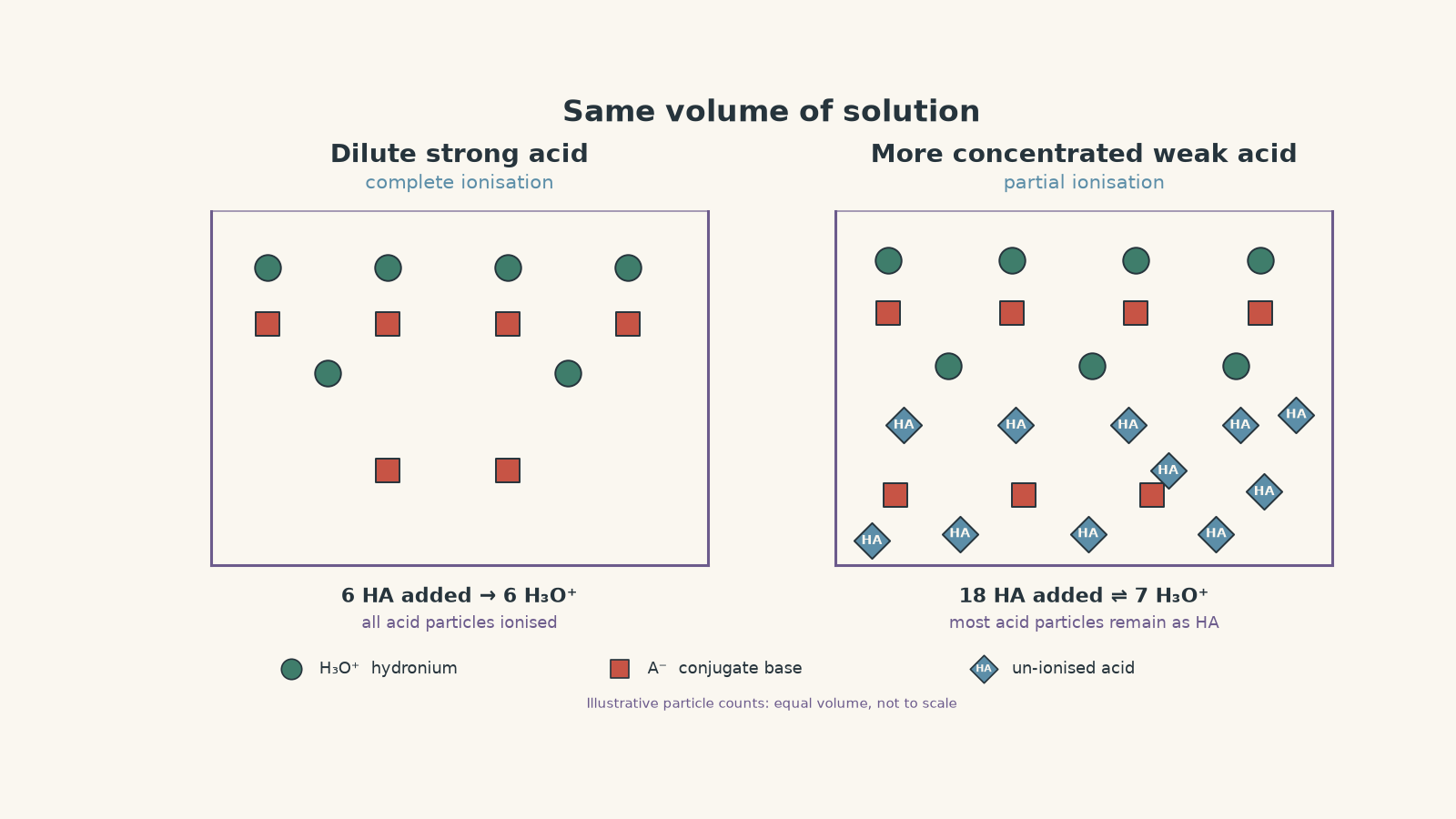
Imagine acid particles as couples at a fairly awkward party.
For an acid \(\ce{HA}\), the hydrogen ion is attached to \(\mathrm{A}^{-}\). Acid strength tells you how readily those two separate when water gets involved. Concentration tells you how many \(\ce{HA}\) particles turned up to the party in the first place.
A room containing very few couples who all split up can produce fewer free hydrogen ions than a packed room where only a small fraction split up.
That is how a dilute strong acid can have a higher pH than a concentrated weak acid.
The analogy stops there. Molecules do not make emotional decisions, thankfully. Ionisation is controlled by chemical equilibrium and energetics.
Strong acids
A strong acid ionises essentially completely in water under ordinary HSC conditions.
For hydrochloric acid:
\[ \ce{HCl + H2O -> H3O+ + Cl-} \]
If the HCl concentration is \(0.0100\ \mathrm{mol\,L^{-1}}\), then, ignoring the tiny contribution from water,
\[ [\ce{H3O+}]\approx0.0100\ \mathrm{mol\,L^{-1}} \]
Almost every HCl particle has produced a hydronium ion.
Weak acids
A weak acid ionises only partially. An equilibrium forms:
\[ \ce{HA + H2O <=> H3O+ + A-} \]
Its acid dissociation constant is
\[ K_a=\frac{[\ce{H3O+}][\mathrm{A}^{-}]}{[\ce{HA}]} \]
A larger \(K_a\) means greater ionisation and therefore a stronger weak acid, provided the comparison is made in the same solvent and at the same temperature.
Strong and weak bases
The same distinction applies to bases.
An ionic strong base such as sodium hydroxide dissociates essentially completely:
\[ \ce{NaOH -> Na+ + OH-} \]
A weak base such as ammonia reacts only partially with water:
\[ \ce{NH3 + H2O <=> NH4+ + OH-} \]
Its base dissociation constant is
\[ K_b=\frac{[\ce{NH4+}][\ce{OH-}]}{[\ce{NH3}]} \]
A larger \(K_b\) indicates a stronger weak base.
03The distinction worth memorising
| Quantity | What it describes | Typical evidence |
|---|---|---|
| Acid or base strength | How strongly the substance reacts or ionises in water | \(K_a\), \(K_b\), or degree of ionisation under controlled conditions |
| Concentration | How much solute is present per unit volume | \(\mathrm{mol\,L^{-1}}\) |
| pH | The hydronium ion concentration currently present | \( -\log[\ce{H3O+}] \) |
| pOH | The hydroxide ion concentration currently present | \( -\log[\ce{OH-}] \) |
Diluting a solution changes its concentration and usually its pH.
At a fixed temperature, dilution does not change \(K_a\) or \(K_b\). The substance has not changed identity.
04When pH can tell you about strength
Suppose two monoprotic acids have the same concentration.
Acid X has pH 2.0. Acid Y has pH 3.0.
Which is stronger?
Now the pH comparison is useful because concentration has been controlled. X produces more \(\ce{H3O+}\) from the same starting amount of acid, so a greater fraction has ionised.
For a simple monoprotic acid of concentration \(c\), the percentage ionisation can be estimated using
\[ \%\text{ ionisation} = \frac{[\ce{H3O+}]}{c}\times100 \]
provided the acid is the dominant source of \(\ce{H3O+}\).
For a base,
\[ \%\text{ ionisation} = \frac{[\ce{OH-}]}{c}\times100 \]
So the useful chain of reasoning is:
pH \(\rightarrow\) ion concentration \(\rightarrow\) fraction ionised \(\rightarrow\) evidence about strength.
The step students often skip is the middle one.
Worked example: Same concentration, different acid strength
Two \(0.0200\ \mathrm{mol\,L^{-1}}\) solutions contain monoprotic acids A and B at \(25^\circ\mathrm{C}\). Acid A has pH 1.70, while acid B has pH 2.60. Use the pH evidence to compare their strengths.
Step 1
\[ [\ce{H3O+}]_A = 10^{-1.70} = 1.995\times10^{-2}\ \mathrm{mol\,L^{-1}} \]
This is almost the full original acid concentration of \(0.0200\ \mathrm{mol\,L^{-1}}\).
Its percentage ionisation is
\[ \frac{1.995\times10^{-2}}{0.0200}\times100 = 99.8\% \]
Step 2
\[ [\ce{H3O+}]_B = 10^{-2.60} = 2.51\times10^{-3}\ \mathrm{mol\,L^{-1}} \]
Therefore,
\[ \%\text{ ionisation} = \frac{2.51\times10^{-3}}{0.0200}\times100 = 12.6\% \]
Step 3
A is essentially completely ionised, while B is only partly ionised.
Acid A is therefore much stronger than acid B under these conditions.
The important point is not simply that A has the lower pH. The comparison works because both acids began at the same concentration.
05When pH does not directly tell you strength
Return to the puzzle from the beginning.
Consider:
- \(1.00\times10^{-3}\ \mathrm{mol\,L^{-1}}\) HCl, a strong acid
- \(0.100\ \mathrm{mol\,L^{-1}}\) ethanoic acid, a weak acid with \(K_a=1.8\times10^{-5}\)
The HCl ionises essentially completely:
\[ [\ce{H3O+}] \approx 1.00\times10^{-3}\ \mathrm{mol\,L^{-1}} \]
so
\[ \mathrm{pH}=3.00 \]
For ethanoic acid,
\[ \ce{CH3COOH + H2O <=> H3O+ + CH3COO-} \]
If \(x=[\ce{H3O+}]\), the usual weak-acid approximation gives
\[ K_a\approx\frac{x^2}{c} \]
where \(c\) is the initial acid concentration.
Therefore,
\[ x\approx\sqrt{K_a c} = \sqrt{(1.8\times10^{-5})(0.100)} = 1.34\times10^{-3}\ \mathrm{mol\,L^{-1}} \]
and
\[ \mathrm{pH} = -\log(1.34\times10^{-3}) \approx2.87 \]
The weak ethanoic acid solution has the lower pH.
It has not somehow become a stronger acid than HCl. There are simply 100 times as many acid particles per litre to begin with.
Worked example: Can a weak base have a higher pH than a strong base?
Solution S is \(1.00\times10^{-3}\ \mathrm{mol\,L^{-1}}\) sodium hydroxide. Solution W is \(0.200\ \mathrm{mol\,L^{-1}}\) ammonia, with \(K_b=1.8\times10^{-5}\) at \(25^\circ\mathrm{C}\). Which solution has the higher pH?
Step 1
NaOH dissociates essentially completely, so
\[ [\ce{OH-}] = 1.00\times10^{-3}\ \mathrm{mol\,L^{-1}} \]
Hence,
\[ \mathrm{pOH} = -\log(1.00\times10^{-3}) = 3.00 \]
and
\[ \mathrm{pH} = 14.00-3.00 = 11.00 \]
Step 2
\[ \ce{NH3 + H2O <=> NH4+ + OH-} \]
Let \(x=[\ce{OH-}]\).
For a weak base,
\[ K_b = \frac{x^2}{0.200-x} \]
Because only a small fraction of the ammonia is expected to ionise, first use \(0.200-x\approx0.200\):
\[ 1.8\times10^{-5} \approx \frac{x^2}{0.200} \]
so
\[ x \approx \sqrt{(1.8\times10^{-5})(0.200)} = 1.90\times10^{-3}\ \mathrm{mol\,L^{-1}} \]
The fraction ionised is less than \(1\%\), so this approximation is reasonable.
Step 3
\[ \mathrm{pOH} = -\log(1.90\times10^{-3}) \approx2.72 \]
Therefore,
\[ \mathrm{pH} = 14.00-2.72 = 11.28 \]
Solution W, containing the weak base, has the higher pH.
The ammonia is much more concentrated. Its low percentage ionisation is still enough to produce more \(\ce{OH-}\) per litre than the dilute NaOH solution.
This is exactly why the sentence “higher pH means stronger base” is unsafe unless concentration has been controlled.
06Dilution changes pH, not intrinsic strength
Suppose you dilute a \(0.0100\ \mathrm{mol\,L^{-1}}\) strong monoprotic acid tenfold.
Its new concentration is approximately
\[ 0.00100\ \mathrm{mol\,L^{-1}} \]
so its hydronium concentration falls tenfold. The pH therefore rises by approximately 1 unit.
For example:
\[ \mathrm{pH}\ 2.00\rightarrow3.00 \]
Did the acid become weaker?
No. Its particles are still essentially completely ionised. There are just fewer acid particles in each litre.
Weak acids behave differently because dilution also changes their percentage ionisation.
For a weak acid, when the usual approximation is valid,
\[ [\ce{H3O+}] \approx \sqrt{K_a c} \]
A tenfold reduction in \(c\) therefore reduces \([\ce{H3O+}]\) by approximately \(\sqrt{10}\), not by 10.
Because
\[ \log_{10}(\sqrt{10})=0.5 \]
a tenfold dilution of a weak acid often raises its pH by roughly 0.5 units.
At the same time, its percentage ionisation increases.
That can sound contradictory at first. There is a greater percentage ionisation, yet a smaller hydronium concentration.
Both can be true. The fraction ionised has risen, but it is a fraction of a much smaller total concentration.
A similar pattern applies to bases.
| Tenfold dilution | Approximate pH change |
|---|---|
| Strong acid, while acid dominates water | \(+1\) |
| Weak acid under the usual approximation | about \(+0.5\) |
| Strong base, while base dominates water | \(-1\) |
| Weak base under the usual approximation | about \(-0.5\) |
These are useful patterns, not universal laws. They break down when ionisation is no longer small or when the solution becomes so dilute that water’s own ionisation matters.
07A reliable decision process for HSC questions
When a question asks you to use pH as evidence of acid or base strength, work through the chemistry in this order:
- Check whether the substances are being compared at the same concentration. If not, pH alone cannot normally rank their strengths.
- Convert pH into \([\ce{H3O+}]\), or convert pH to pOH and then find \([\ce{OH-}]\).
- Compare that ion concentration with the original acid or base concentration.
- If the concentrations differ, calculate \(K_a\) or \(K_b\) when enough information is available.
- Treat a lower acid pH or higher base pH as evidence of greater strength only when the comparison is genuinely like-for-like.
- Check whether an approximation makes physical sense. In particular, an ion concentration cannot exceed the amount of solute available to produce it.
The final point catches a surprising number of errors.
08The misconceptions that cause most mistakes
| Tempting claim | Why it feels reasonable | What is actually true |
|---|---|---|
| “The lower-pH acid is stronger.” | Strong acids often do have low pH. | Only a fair comparison when concentration and relevant stoichiometry are controlled. |
| “Strong means concentrated.” | Strong acids often appear in concentrated laboratory solutions. | Strength describes ionisation; concentration describes amount per volume. |
| “Dilution makes an acid weaker.” | Its pH rises after water is added. | Dilution lowers concentration. \(K_a\) remains constant at a fixed temperature. |
| “Two acids with the same pH have the same strength.” | They have equal \([\ce{H3O+}]\). | They may have different concentrations and very different \(K_a\) values. |
| “A strong acid must always have a very low pH.” | Strong acids ionise essentially completely. | A very dilute strong acid can have a pH close to 7. |
| “A concentrated weak acid must be mostly ionised.” | There are many acid particles present. | Concentration and percentage ionisation are separate quantities. |
The safest habit is to stop reading pH as a label saying “strong” or “weak”. Read it as a measurement of \([\ce{H3O+}]\), then ask what combination of concentration and ionisation produced that measurement.
09Questions and solutions
Question 1
Two monoprotic acids, X and Y, each have an initial concentration of \(0.0100\ \mathrm{mol\,L^{-1}}\) at \(25^\circ\mathrm{C}\).
X has pH 2.00. Y has pH 3.20.
Determine which acid is stronger and calculate the percentage ionisation of each.
Solution 1
Acid X is stronger. X is essentially completely ionised, while Y is only about \(6.31\%\) ionised.
For X,
\[ [\ce{H3O+}] = 10^{-2.00} = 1.00\times10^{-2}\ \mathrm{mol\,L^{-1}} \]
Therefore,
\[ \%\text{ ionisation} = \frac{1.00\times10^{-2}}{0.0100}\times100 = 100\% \]
For Y,
\[ [\ce{H3O+}] = 10^{-3.20} = 6.31\times10^{-4}\ \mathrm{mol\,L^{-1}} \]
so
\[ \%\text{ ionisation} = \frac{6.31\times10^{-4}}{0.0100}\times100 = 6.31\% \]
Because both acids have the same initial concentration, their pH values can be compared meaningfully. X produces far more hydronium from the same amount of acid.
The tempting shortcut, “lower pH means stronger”, happens to give the correct conclusion here, but only because concentration has been controlled.
Question 2
A \(0.100\ \mathrm{mol\,L^{-1}}\) solution of a monoprotic weak acid \(\ce{HA}\) has pH 3.00 at \(25^\circ\mathrm{C}\).
The solution is diluted tenfold to \(0.0100\ \mathrm{mol\,L^{-1}}\).
Calculate:
(a) the \(K_a\) of \(\ce{HA}\),
(b) the approximate pH after dilution, and
(c) why the pH change differs from the approximately 1-unit change expected for a strong monoprotic acid.
Solution 2
The acid has \(K_a\approx1.01\times10^{-5}\), and its diluted solution has pH about 3.50. Its pH rises by only about 0.50 because dilution increases the percentage ionisation of the weak acid.
Initially,
\[ [\ce{H3O+}] = 10^{-3.00} = 1.00\times10^{-3}\ \mathrm{mol\,L^{-1}} \]
Let
\[ x=1.00\times10^{-3}\ \mathrm{mol\,L^{-1}} \]
At equilibrium,
\[ [\mathrm{A}^{-}]=x \]
and
\[ [\ce{HA}] = 0.100-0.00100 = 0.0990\ \mathrm{mol\,L^{-1}} \]
Therefore,
\[ K_a = \frac{(1.00\times10^{-3})^2}{0.0990} = 1.01\times10^{-5} \]
After dilution, \(c=0.0100\ \mathrm{mol\,L^{-1}}\).
Using the weak-acid approximation,
\[ [\ce{H3O+}] \approx \sqrt{K_a c} = \sqrt{(1.01\times10^{-5})(0.0100)} = 3.18\times10^{-4}\ \mathrm{mol\,L^{-1}} \]
The percentage ionisation is about
\[ \frac{3.18\times10^{-4}}{0.0100}\times100 = 3.18\% \]
so the small-ionisation approximation is reasonable.
The pH is
\[ \mathrm{pH} = -\log(3.18\times10^{-4}) \approx3.50 \]
A strong monoprotic acid would remain essentially completely ionised. Tenfold dilution would therefore reduce \([\ce{H3O+}]\) almost exactly tenfold and raise the pH by 1.
For this weak acid, dilution shifts the equilibrium towards greater ionisation. That extra ionisation partly offsets the decrease in total concentration, so \([\ce{H3O+}]\) falls by less than a factor of 10.
The tempting mistake is to say the acid became weaker because its pH increased. Its \(K_a\) has not changed.
Question 3
Two hypothetical monoprotic weak bases, P and Q, are studied at \(25^\circ\mathrm{C}\).
- P has concentration \(0.0200\ \mathrm{mol\,L^{-1}}\) and pH 11.70.
- Q has concentration \(0.200\ \mathrm{mol\,L^{-1}}\) and pH 12.00.
A student claims Q must be the stronger base because Q has the higher pH.
Calculate \(K_b\) for each base and evaluate the claim.
Solution 3
P is the stronger base even though Q has the higher pH. P has \(K_b\approx1.68\times10^{-3}\), while Q has \(K_b\approx5.26\times10^{-4}\).
For P,
\[ \mathrm{pOH} = 14.00-11.70 = 2.30 \]
so
\[ [\ce{OH-}] = 10^{-2.30} = 5.01\times10^{-3}\ \mathrm{mol\,L^{-1}} \]
For the equilibrium
\[ \ce{P + H2O <=> PH+ + OH-} \]
the equilibrium concentration of un-ionised P is
\[ 0.0200-0.00501 = 0.01499\ \mathrm{mol\,L^{-1}} \]
Therefore,
\[ K_b = \frac{(5.01\times10^{-3})^2}{0.01499} = 1.68\times10^{-3} \]
For Q,
\[ \mathrm{pOH} = 14.00-12.00 = 2.00 \]
and hence
\[ [\ce{OH-}] = 1.00\times10^{-2}\ \mathrm{mol\,L^{-1}} \]
Its remaining base concentration is
\[ 0.200-0.0100 = 0.190\ \mathrm{mol\,L^{-1}} \]
so
\[ K_b = \frac{(1.00\times10^{-2})^2}{0.190} = 5.26\times10^{-4} \]
Since
\[ 1.68\times10^{-3}>5.26\times10^{-4} \]
P is the stronger base.
Q nevertheless has the higher pH because Q began ten times more concentrated. It produces a larger total \([\ce{OH-}]\) despite having the smaller \(K_b\).
The student’s mistake is treating pH as though it directly measures intrinsic base strength.
Question 4
At \(25^\circ\mathrm{C}\), two monoprotic weak acids produce solutions with exactly the same initial pH of 3.00.
- Acid A has concentration \(0.100\ \mathrm{mol\,L^{-1}}\).
- Acid B has concentration \(0.0100\ \mathrm{mol\,L^{-1}}\).
(a) Calculate \(K_a\) for each acid and determine which acid is stronger.
Each solution is then diluted tenfold.
(b) Calculate the new pH of each solution.
(c) Determine which diluted solution has the lower pH, and explain why that result does not contradict your answer to part (a).
Assume ideal aqueous behaviour and neglect water autoionisation at these concentrations.
Solution 4
B is the stronger acid, but after both solutions are diluted tenfold, the weaker acid A has the slightly lower pH. This happens because pH is controlled by both strength and analytical concentration, not strength alone.
Both original solutions have pH 3.00, so
\[ [\ce{H3O+}] = 1.00\times10^{-3}\ \mathrm{mol\,L^{-1}} \]
For acid A,
\[ K_{a,A} = \frac{(1.00\times10^{-3})^2}{0.100-0.00100} = \frac{1.00\times10^{-6}}{0.0990} = 1.01\times10^{-5} \]
For acid B,
\[ K_{a,B} = \frac{(1.00\times10^{-3})^2}{0.0100-0.00100} = \frac{1.00\times10^{-6}}{0.00900} = 1.11\times10^{-4} \]
Therefore B is about eleven times stronger according to its \(K_a\).
After tenfold dilution,
\[ c_A=0.0100\ \mathrm{mol\,L^{-1}} \]
and
\[ c_B=0.00100\ \mathrm{mol\,L^{-1}} \]
At these concentrations, particularly for B, blindly using the small-ionisation approximation would be unsafe. Use
\[ K_a=\frac{x^2}{c-x} \]
where \(x=[\ce{H3O+}]\).
Rearranging gives
\[ x^2+K_ax-K_ac=0 \]
with positive solution
\[ x= \frac{-K_a+\sqrt{K_a^2+4K_ac}}{2} \]
For A,
\[ [\ce{H3O+}]_A = \frac{-(1.01\times10^{-5})+ \sqrt{(1.01\times10^{-5})^2+ 4(1.01\times10^{-5})(0.0100)}}{2} \]
\[ [\ce{H3O+}]_A = 3.13\times10^{-4}\ \mathrm{mol\,L^{-1}} \]
so
\[ \mathrm{pH}_A = -\log(3.13\times10^{-4}) = 3.50 \]
For B,
\[ [\ce{H3O+}]_B = \frac{-(1.11\times10^{-4})+ \sqrt{(1.11\times10^{-4})^2+ 4(1.11\times10^{-4})(0.00100)}}{2} \]
\[ [\ce{H3O+}]_B = 2.82\times10^{-4}\ \mathrm{mol\,L^{-1}} \]
and therefore
\[ \mathrm{pH}_B = -\log(2.82\times10^{-4}) = 3.55 \]
Acid A therefore finishes with the slightly lower pH, even though B has the larger \(K_a\).
That is not a contradiction.
After dilution, A still contains ten times the total acid concentration of B. B compensates by ionising much more strongly: about \(28\%\) of B is ionised compared with roughly \(3.1\%\) of A. But that higher fraction is not quite enough to overcome the tenfold concentration difference.
The tempting route is to reason, “B is stronger, so B must always have the lower pH.” The missing constraint is the amount of acid available per litre.
This is exactly why an intrinsic strength ranking and a solution pH ranking can point in opposite directions.
Question 5
A student prepares an extremely dilute \(1.00\times10^{-8}\ \mathrm{mol\,L^{-1}}\) HCl solution at \(25^\circ\mathrm{C}\).
They reason:
\[ \mathrm{pH} = -\log(1.00\times10^{-8}) = 8.00 \]
and conclude that sufficiently diluting a strong acid eventually makes its solution basic.
Determine the actual pH. Explain precisely what fails in the student’s argument.
Use
\[ K_w=1.00\times10^{-14} \]
at \(25^\circ\mathrm{C}\).
Solution 5
The solution has pH approximately 6.98, not 8.00. Diluting HCl with neutral water does not eventually turn the solution basic.
HCl is still a strong acid. At this concentration it remains essentially completely dissociated, so
\[ [\mathrm{Cl}^{-}] = 1.00\times10^{-8}\ \mathrm{mol\,L^{-1}} \]
The student’s mistake is different: they assumed HCl was the only source of hydronium ions.
Pure water at \(25^\circ\mathrm{C}\) already contains hydronium and hydroxide ions due to autoionisation:
\[ \ce{2H2O <=> H3O+ + OH-} \]
with
\[ K_w = [\ce{H3O+}][\ce{OH-}] = 1.00\times10^{-14} \]
Let the total hydronium concentration be \(h\).
Electrical neutrality requires the positive charge from \(\ce{H3O+}\) to balance the negative charges from both \(\mathrm{Cl}^{-}\) and \(\ce{OH-}\):
\[ h = 1.00\times10^{-8} + [\ce{OH-}] \]
Since
\[ [\ce{OH-}] = \frac{K_w}{h} \]
we obtain
\[ h = 1.00\times10^{-8} + \frac{1.00\times10^{-14}}{h} \]
Multiplying by \(h\),
\[ h^2-(1.00\times10^{-8})h-1.00\times10^{-14}=0 \]
Taking the positive root,
\[ h = \frac{ 1.00\times10^{-8} + \sqrt{(1.00\times10^{-8})^2+4(1.00\times10^{-14})} }{2} \]
\[ h = 1.05\times10^{-7}\ \mathrm{mol\,L^{-1}} \]
Therefore,
\[ \mathrm{pH} = -\log(1.05\times10^{-7}) \approx6.98 \]
The solution is very slightly acidic.
The familiar shortcut
\[ [\ce{H3O+}]\approx c_{\text{acid}} \]
works well for a strong acid only when the acid contribution is much larger than water’s own hydronium concentration. At \(1.00\times10^{-8}\ \mathrm{mol\,L^{-1}}\), that assumption has completely failed.
This is the useful boundary case to remember: strength tells you that HCl ionises essentially completely, but it does not guarantee a dramatically low pH. If the acid is dilute enough, the solution approaches neutral pH from the acidic side.
Once that distinction is clear, \(K_a\), \(K_b\), buffer calculations, and titration curves become much easier to interpret. In each case, pH describes the state of the solution at that moment, while strength and concentration explain how the solution reached that state.