
Conjugate Acid-Base Pairs and Proton Transfer | HSC Chemistry
Learn how to identify conjugate acid-base pairs, track proton transfers, and write balanced Brønsted-Lowry equations in aqueous solution.
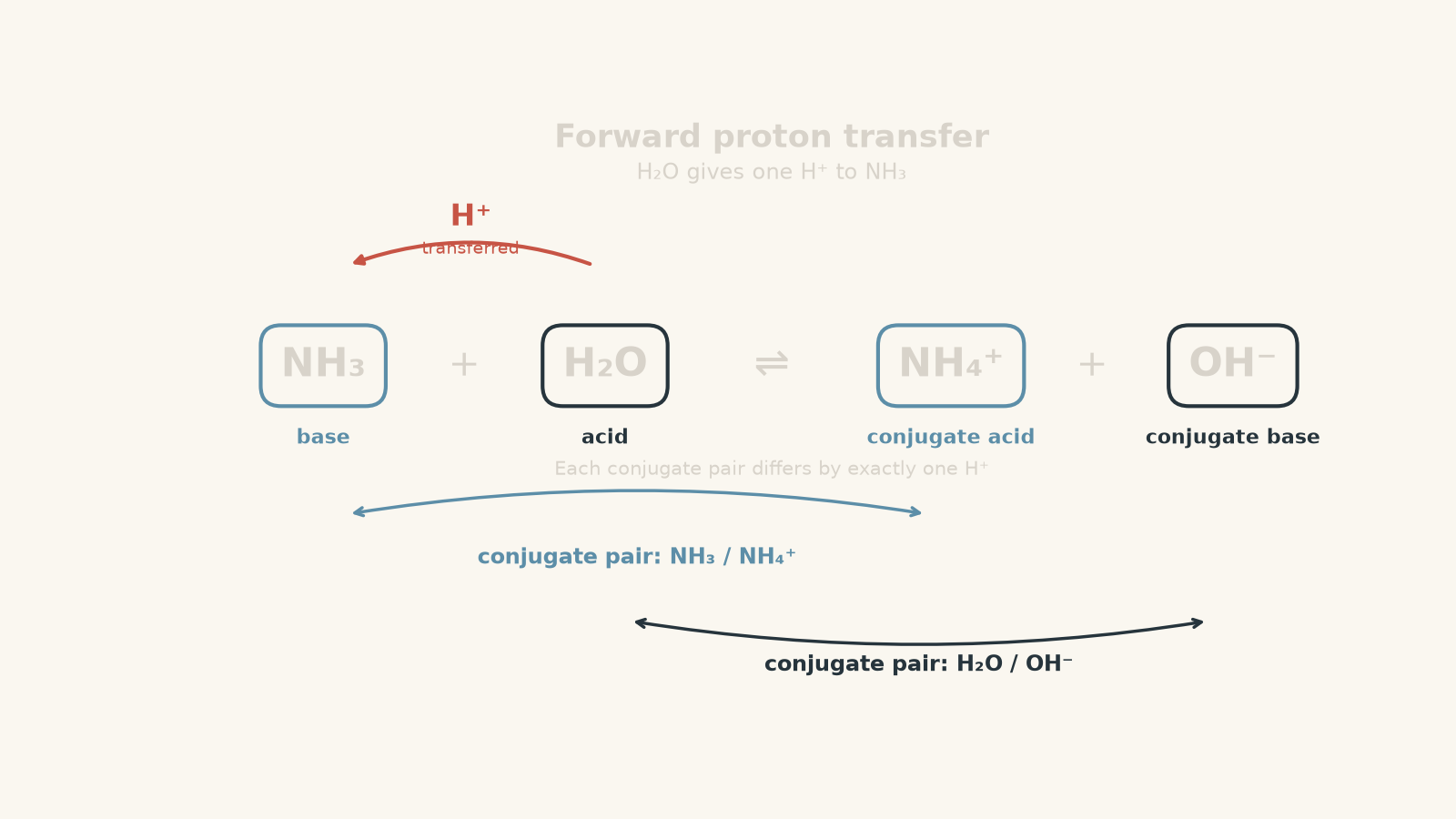
Suppose ammonia, \(\ce{NH3}\), is added to water. After the reaction, some \(\ce{NH4+}\) and \(\ce{OH^-}\) are present.
Before worrying about definitions, track one thing: where did the extra hydrogen on \(\ce{NH4+}\) come from?
It came from water. A proton moved from \(\ce{H2O}\) to \(\ce{NH3}\):
\[ \ce{NH3 + H2O <=> NH4+ + OH^-} \]
That single proton transfer is the key to conjugate acid-base pairs. If you can follow the proton, most identification questions become bookkeeping rather than memorisation.
01Follow the proton
A Brønsted-Lowry acid donates a proton, \(\mathrm{H}^{+}\). A Brønsted-Lowry base accepts a proton.
In the ammonia reaction, water loses a proton:
\[ \ce{H2O -> OH^-} \]
So \(\ce{H2O}\) is acting as the acid.
Ammonia gains that proton:
\[ \ce{NH3 -> NH4+} \]
So \(\ce{NH3}\) is acting as the base.
Now we can introduce the conjugate forms.
- When an acid loses \(\mathrm{H}^{+}\), what remains is its conjugate base.
- When a base gains \(\mathrm{H}^{+}\), what forms is its conjugate acid.
For the reaction
\[ \ce{NH3 + H2O <=> NH4+ + OH^-} \]
the conjugate pairs are:
| Original species | What happens? | Conjugate species | Pair |
|---|---|---|---|
| \(\ce{H2O}\) | loses \(\mathrm{H}^{+}\) | \(\ce{OH^-}\) | acid/conjugate base |
| \(\ce{NH3}\) | gains \(\mathrm{H}^{+}\) | \(\ce{NH4+}\) | base/conjugate acid |
A slightly silly way to picture this is a borrowed hoodie. One person gives the hoodie away; another person receives it. The acid is the giver, the base is the receiver, and each person’s before-and-after versions form a pair.
The analogy stops there. A proton isn’t clothing: adding or removing one changes the species’ electrical charge and chemical behaviour.
02The one-proton test
Here is the fastest reliable test for a conjugate acid-base pair:
The two species must differ by exactly one proton, \(\mathrm{H}^{+}\).
That means they differ by:
- one hydrogen, and
- one unit of charge.
For an acid and its conjugate base,
\[ \ce{acid -> conjugate\ base + H+} \]
the conjugate base has one fewer H and a charge one unit more negative.
For example:
\[ \ce{NH4+ -> NH3 + H+} \]
\(\ce{NH4+}\) has one more H than \(\ce{NH3}\), and its charge is one unit more positive.
Likewise,
\[ \ce{H2O -> OH^- + H+} \]
and
\[ \ce{H2PO4^- -> HPO4^2- + H+} \]
The rule works whether the species are neutral or charged.
Pairs that look plausible but are not
| Species | Species | Conjugate pair? | Reason |
|---|---|---|---|
| \(\ce{HCl}\) | \(\mathrm{Cl}^{-}\) | Yes | differ by one \(\mathrm{H}^{+}\) |
| \(\ce{NH4+}\) | \(\ce{NH3}\) | Yes | differ by one \(\mathrm{H}^{+}\) |
| \(\ce{H2SO4}\) | \(\ce{SO4^2-}\) | No | differ by two protons |
| \(\ce{H3O+}\) | \(\ce{OH^-}\) | No | differ by two protons |
| \(\ce{H3O+}\) | \(\ce{H2O}\) | Yes | differ by one \(\mathrm{H}^{+}\) |
| \(\ce{H2O}\) | \(\ce{OH^-}\) | Yes | differ by one \(\mathrm{H}^{+}\) |
The sulfuric acid example is a common trap. \(\ce{H2SO4}\) can eventually become \(\ce{SO4^2-}\), but it happens through two proton transfers:
\[ \ce{H2SO4 -> HSO4^- -> SO4^2-} \]
So the conjugate pairs are \(\ce{H2SO4/HSO4^-}\) and \(\ce{HSO4^-/SO4^2-}\), not \(\ce{H2SO4/SO4^2-}\).
03How to write a proton-transfer equation
When you’re given two reacting species, don’t start by guessing products. Work out who gives away the proton and who receives it.
A useful method is:
- Identify the proton donor. Remove one \(\mathrm{H}^{+}\) to make its conjugate base.
- Identify the proton acceptor. Add one \(\mathrm{H}^{+}\) to make its conjugate acid.
- Put the conjugate species on the product side.
- Check both atoms and total charge.
The charge check is especially useful with polyatomic ions.
Suppose an acid has charge \(q\). After losing \(\mathrm{H}^{+}\), its conjugate base has charge \(q-1\).
Suppose a base has charge \(q\). After gaining \(\mathrm{H}^{+}\), its conjugate acid has charge \(q+1\).
What happens to \(\mathrm{H}^{+}\) in water?
You’ll often hear acids described as producing \(\mathrm{H}^{+}\) in water. That is useful shorthand, but a bare proton does not simply sit by itself in an aqueous solution.
Water accepts the proton to form hydronium, \(\ce{H3O+}\):
\[ \ce{HCl + H2O -> H3O+ + Cl^-} \]
So when writing an explicit proton-transfer equation in aqueous solution, it is usually clearer to show the proton being transferred directly to another species rather than leaving a free \(\mathrm{H}^{+}\) floating on the product side.
Worked example: Identify the pairs in ammonia reacting with water
Identify the acid, base, conjugate acid, conjugate base, and the two conjugate acid-base pairs in:
\[ \ce{NH3 + H2O <=> NH4+ + OH^-} \]
Step 1
\(\ce{H2O}\) becomes \(\ce{OH^-}\). It has lost one \(\mathrm{H}^{+}\), so \(\ce{H2O}\) is the acid.
Its conjugate base is \(\ce{OH^-}\).
Step 2
\(\ce{NH3}\) becomes \(\ce{NH4+}\). It has gained one \(\mathrm{H}^{+}\), so \(\ce{NH3}\) is the base.
Its conjugate acid is \(\ce{NH4+}\).
Step 3
The two conjugate acid-base pairs are:
\[ \ce{H2O/OH^-} \]
and
\[ \ce{NH4+/NH3} \]
Notice that each pair contains species from opposite sides of the equation. The two reactants, \(\ce{NH3}\) and \(\ce{H2O}\), are an acid and a base in this reaction, but they are not a conjugate pair.
Worked example: Write a proton transfer between two polyatomic species
In aqueous solution, \(\ce{H2PO4^-}\) donates a proton to \(\ce{NH3}\). Write the proton-transfer equation and identify both conjugate acid-base pairs.
Step 1
\(\ce{H2PO4^-}\) loses \(\mathrm{H}^{+}\):
\[ \ce{H2PO4^- -> HPO4^2-} \]
Its charge changes from \(-1\) to \(-2\), as expected when a positive proton is removed.
Step 2
\(\ce{NH3}\) accepts \(\mathrm{H}^{+}\):
\[ \ce{NH3 -> NH4+} \]
Its charge changes from \(0\) to \(+1\).
Step 3
\[ \ce{H2PO4^- + NH3 <=> HPO4^2- + NH4+} \]
Step 4
The left side has total charge \(-1\).
The right side has:
\[ -2 + 1 = -1 \]
So charge is conserved.
Step 5
\(\ce{H2PO4^-}\) is the acid, and \(\ce{HPO4^2-}\) is its conjugate base.
\(\ce{NH3}\) is the base, and \(\ce{NH4+}\) is its conjugate acid.
So the conjugate pairs are:
\[ \ce{H2PO4^-/HPO4^2-} \]
and
\[ \ce{NH4+/NH3} \]
The equation tells us which proton transfer is being considered. How far that reaction proceeds is a separate question involving relative acid and base strength.
04Acid and base are roles, not permanent labels
A tempting shortcut is to memorise a species as either “an acid” or “a base”. That works sometimes, but it breaks down quickly.
Consider hydrogen carbonate, \(\ce{HCO3^-}\).
It can lose a proton:
\[ \ce{HCO3^- + H2O <=> CO3^2- + H3O+} \]
Here, \(\ce{HCO3^-}\) is an acid.
But it can also gain a proton:
\[ \ce{HCO3^- + H2O <=> H2CO3 + OH^-} \]
Here, \(\ce{HCO3^-}\) is a base.
A species that can both donate and accept a proton is described as amphiprotic.
Water is another important example. With ammonia, water donates a proton:
\[ \ce{NH3 + H2O <=> NH4+ + OH^-} \]
So water acts as an acid.
With an acid such as \(\ce{HCl}\), water accepts a proton:
\[ \ce{HCl + H2O -> H3O+ + Cl^-} \]
Now water acts as a base.
There is no contradiction. “Acid” and “base” describe what a species is doing in a particular proton-transfer reaction.
05The misconception that causes most pairing errors
Suppose you see:
\[ \ce{HA + B <=> A^- + HB+} \]
A student might pair \(\ce{HA}\) with \(\ce{B}\) because they are the acid and base reacting together.
That is not what “conjugate pair” means.
The acid-base reaction partners are:
- acid: \(\ce{HA}\)
- base: \(\ce{B}\)
The conjugate pairs are instead:
- \(\ce{HA/A^-}\), because \(\ce{HA}\) loses one proton to become \(\mathrm{A}^{-}\)
- \(\ce{HB+/B}\), because \(\ce{B}\) gains one proton to become \(\ce{HB+}\)
So when you’re asked to identify conjugate pairs, don’t pair species because they sit next to each other. Pair each species with its one-proton-changed version.
A reliable question to ask is:
If I add or remove exactly one \(\mathrm{H}^{+}\), do I get the other species?
If yes, you probably have a conjugate pair. Then check the charge.
Being able to identify these pairs makes acid-base equilibrium much easier, because acid strength and equilibrium direction depend on the relationship between an acid and its conjugate base. That connection is developed further in pH and Acid-Base Strength: HSC Chemistry Explained. When you move from equations to actual solutions, Measuring pH of Acids and Bases: HSC Chemistry Guide shows how that chemistry appears in measurements.
06Questions and solutions
Question 1
Consider the reaction:
\[ \ce{HNO3 + H2O -> H3O+ + NO3^-} \]
Identify the Brønsted-Lowry acid, the Brønsted-Lowry base, the conjugate acid, the conjugate base, and both conjugate acid-base pairs.
Solution 1
The acid is \(\ce{HNO3}\), the base is \(\ce{H2O}\), the conjugate base is \(\ce{NO3^-}\), and the conjugate acid is \(\ce{H3O+}\).
Track the proton.
\(\ce{HNO3}\) loses one \(\mathrm{H}^{+}\):
\[ \ce{HNO3 -> NO3^-} \]
So \(\ce{HNO3}\) is the acid, and \(\ce{NO3^-}\) is its conjugate base.
Water gains the proton:
\[ \ce{H2O -> H3O+} \]
So \(\ce{H2O}\) is the base, and \(\ce{H3O+}\) is its conjugate acid.
The two conjugate acid-base pairs are therefore:
\[ \ce{HNO3/NO3^-} \]
and
\[ \ce{H3O+/H2O} \]
The tempting mistake is to pair \(\ce{HNO3}\) with \(\ce{H2O}\) because they are the reacting acid and base. They are reaction partners, but conjugate partners must differ from each other by exactly one proton.
Question 2
An aqueous proton-transfer reaction is represented by:
\[ \ce{X + H2O <=> H2PO4^- + OH^-} \]
Species \(X\) contains one phosphorus atom and four oxygen atoms.
Determine the formula and charge of \(X\). Then identify the acid, base, conjugate acid, conjugate base, and both conjugate pairs.
Solution 2
\(X\) is \(\ce{HPO4^2-}\), and it acts as the base.
Start from the change in water. \(\ce{H2O}\) becomes \(\ce{OH^-}\), so water has lost one proton:
\[ \ce{H2O -> OH^- + H+} \]
Water is therefore the acid, and \(\ce{OH^-}\) is its conjugate base.
The lost proton must be accepted by \(X\). The product is \(\ce{H2PO4^-}\), so removing that newly accepted proton tells us the original species:
\[ \ce{H2PO4^- -> HPO4^2- + H+} \]
Therefore,
\[ X=\ce{HPO4^2-} \]
and the full equation is:
\[ \ce{HPO4^2- + H2O <=> H2PO4^- + OH^-} \]
A charge check confirms the result.
Left side:
\[ -2+0=-2 \]
Right side:
\[ -1+(-1)=-2 \]
So charge is conserved.
The two conjugate pairs are:
\[ \ce{H2PO4^-/HPO4^2-} \]
and
\[ \ce{H2O/OH^-} \]
The tempting route is to see \(\ce{H2PO4^-}\) and assume it must be the acid because its formula begins with H. Here it is the conjugate acid because it has gained a proton from water. The direction of the actual proton transfer determines the role.
Question 3
Sulfuric acid can lose its two acidic protons in separate stages:
\[ \ce{H2SO4 + H2O -> HSO4^- + H3O+} \]
and
\[ \ce{HSO4^- + H2O <=> SO4^2- + H3O+} \]
For each equation:
- identify both conjugate acid-base pairs, and
- state the role of \(\ce{HSO4^-}\).
Then explain why \(\ce{H2SO4}\) and \(\ce{SO4^2-}\) are not a conjugate acid-base pair.
Solution 3
The pairs are \(\ce{H2SO4/HSO4^-}\) and \(\ce{H3O+/H2O}\) in the first reaction, then \(\ce{HSO4^-/SO4^2-}\) and \(\ce{H3O+/H2O}\) in the second. \(\ce{HSO4^-}\) is the conjugate base in the first reaction but acts as an acid in the second.
In the first equation,
\[ \ce{H2SO4 -> HSO4^-} \]
shows \(\ce{H2SO4}\) losing one proton. Therefore:
- \(\ce{H2SO4}\) is the acid,
- \(\ce{HSO4^-}\) is its conjugate base,
- \(\ce{H2O}\) is the base, and
- \(\ce{H3O+}\) is its conjugate acid.
In the second equation,
\[ \ce{HSO4^- -> SO4^2-} \]
shows \(\ce{HSO4^-}\) losing another proton. Therefore:
- \(\ce{HSO4^-}\) is now the acid,
- \(\ce{SO4^2-}\) is its conjugate base,
- \(\ce{H2O}\) is the base, and
- \(\ce{H3O+}\) is its conjugate acid.
The important point is that the role of \(\ce{HSO4^-}\) depends on the reaction being considered. In the first reaction it is formed after an acid loses \(\mathrm{H}^{+}\), so it is a conjugate base. In the second reaction it donates \(\mathrm{H}^{+}\), so it is an acid.
\(\ce{H2SO4}\) and \(\ce{SO4^2-}\) are not a conjugate pair because they differ by two protons:
\[ \ce{H2SO4 -> HSO4^- -> SO4^2-} \]
The tempting argument is that they must be conjugates because one eventually forms the other. The one-proton condition is stricter: conjugate species must be connected by one proton-transfer step, not two.
Question 4
Hydrogen carbonate can participate in both of these aqueous proton-transfer equations:
\[ \ce{HCO3^- + H2O <=> CO3^2- + H3O+} \]
and
\[ \ce{HCO3^- + H2O <=> H2CO3 + OH^-} \]
A student argues that at least one equation must be incorrectly labelled because \(\ce{HCO3^-}\) cannot be both an acid and a base.
Evaluate the student’s claim. For both equations, identify the role of \(\ce{HCO3^-}\) and list the conjugate acid-base pairs. Then state what you could conclude if an exam question gave you only the formula \(\ce{HCO3^-}\), with no reaction.
Solution 4
Both equations are valid proton-transfer equations, and \(\ce{HCO3^-}\) can act as either an acid or a base because it is amphiprotic.
In the first equation,
\[ \ce{HCO3^- + H2O <=> CO3^2- + H3O+} \]
\(\ce{HCO3^-}\) becomes \(\ce{CO3^2-}\). It has lost one proton:
\[ \ce{HCO3^- -> CO3^2- + H+} \]
So \(\ce{HCO3^-}\) acts as the acid.
Water accepts that proton and becomes \(\ce{H3O+}\), so water acts as the base.
The conjugate pairs are:
\[ \ce{HCO3^-/CO3^2-} \]
and
\[ \ce{H3O+/H2O} \]
In the second equation,
\[ \ce{HCO3^- + H2O <=> H2CO3 + OH^-} \]
\(\ce{HCO3^-}\) becomes \(\ce{H2CO3}\). It has gained one proton:
\[ \ce{HCO3^- + H+ -> H2CO3} \]
So \(\ce{HCO3^-}\) now acts as the base.
Water loses the proton and becomes \(\ce{OH^-}\), so water acts as the acid.
The conjugate pairs are:
\[ \ce{H2CO3/HCO3^-} \]
and
\[ \ce{H2O/OH^-} \]
There is no contradiction. Acid and base are roles in a particular proton transfer, not permanent labels attached to a chemical formula.
If only \(\ce{HCO3^-}\) were given, with no reaction, you could not uniquely label it as “the acid” or “the base”. You could state that it is amphiprotic and can perform either role depending on the species with which it reacts.
The tempting route is to memorise a fixed category for every species. The constraint that changes the answer is the actual movement of the proton: losing \(\mathrm{H}^{+}\) makes \(\ce{HCO3^-}\) the acid, while gaining \(\mathrm{H}^{+}\) makes it the base.
Question 5
Consider this proton-transfer equilibrium in aqueous solution:
\[ \ce{H2CO3 + CO3^2- <=> 2HCO3^-} \]
A student argues:
“There is only one product formula, so there can only be one conjugate acid-base pair.”
Test this claim.
Identify the proton donor and proton acceptor, identify both conjugate acid-base pairs, and explain how \(\ce{HCO3^-}\) can appear in two different conjugate roles in the same equation.
Finally, suppose the particles are completely unlabelled. Can the formula \(\ce{HCO3^-}\) alone tell you whether a particular product particle came from the original \(\ce{H2CO3}\) or the original \(\ce{CO3^2-}\)?
Solution 5
The student’s claim is incorrect: there are two conjugate acid-base relationships, \(\ce{H2CO3/HCO3^-}\) and \(\ce{HCO3^-/CO3^2-}\), even though both product particles have the formula \(\ce{HCO3^-}\).
First follow the proton.
Carbonic acid can donate one proton:
\[ \ce{H2CO3 -> HCO3^- + H+} \]
So \(\ce{H2CO3}\) is the proton donor and therefore the acid. The \(\ce{HCO3^-}\) formed from it is its conjugate base.
At the same time, carbonate accepts that proton:
\[ \ce{CO3^2- + H+ -> HCO3^-} \]
So \(\ce{CO3^2-}\) is the proton acceptor and therefore the base. The \(\ce{HCO3^-}\) formed from it is its conjugate acid.
The two relationships are therefore:
\[ \ce{H2CO3/HCO3^-} \]
and
\[ \ce{HCO3^-/CO3^2-} \]
This looks strange because the same chemical formula, \(\ce{HCO3^-}\), appears in both relationships. But “conjugate acid” and “conjugate base” describe a relationship between two species; they are not permanent labels attached to the formula.
Relative to \(\ce{H2CO3}\), \(\ce{HCO3^-}\) is the species left after a proton is removed, so it is the conjugate base.
Relative to \(\ce{CO3^2-}\), \(\ce{HCO3^-}\) is the species formed after a proton is added, so it is the conjugate acid.
The two product particles happen to have the same formula because the starting acid and base sit one proton above and one proton below the same intermediate species:
\[ \ce{H2CO3 -> HCO3^- -> CO3^2-} \]
If the particles are unlabelled, the formula \(\ce{HCO3^-}\) alone cannot tell you which starting particle a particular bicarbonate ion came from. Once formed, both are the same chemical species as far as the formula and charge are concerned.
That is the hinge in this question. It is tempting to treat “conjugate acid” and “conjugate base” as properties that a species must carry forever. They are actually relational descriptions. The same species can be the conjugate base of one acid and the conjugate acid of another base.
Once that idea is secure, the next useful question is not just which proton transfer is possible, but which direction an acid-base equilibrium prefers. That requires comparing the strengths of the acids and their conjugate bases rather than changing the conjugate-pair rules themselves.