
pH After Dilution and Acid-Base Mixing | HSC Chemistry
Learn how to calculate pH after diluting acids or bases and after mixing strong acids with strong bases. Use mole ratios, neutralisation, final volume, and worked HSC-style examples.
Two beakers both start with \(25.0\ \mathrm{mL}\) of \(0.100\ \mathrm{mol\,L^{-1}}\) hydrochloric acid. In the first, you add water until the volume is \(250.0\ \mathrm{mL}\). In the second, you add \(25.0\ \mathrm{mL}\) of \(0.100\ \mathrm{mol\,L^{-1}}\) sodium hydroxide.
Which final solution should have a pH closer to 7?
The second one. Dilution only spreads the acid through a larger volume. Mixing with sodium hydroxide actually removes \(\mathrm{H}^{+}\) by neutralisation.
That distinction controls almost every HSC question about pH after dilution or mixing. The safest rule is simple: do the mole bookkeeping before you touch the pH button on your calculator.
01Start with moles, not pH
pH is a logarithmic way of reporting hydrogen ion concentration:
\[ pH=-\log_{10}[H^+] \]
Here, \([H^+]\) means the concentration of hydrogen ions in \(\mathrm{mol\,L^{-1}}\). In aqueous chemistry, \(\mathrm{H}^{+}\) is shorthand for the hydrated proton present in water.
For hydroxide ions,
\[ pOH=-\log_{10}[OH^-] \]
and, at \(25^\circ\mathrm{C}\),
\[ pH+pOH=14.00 \]
Those equations matter, but they come last.
Before calculating concentration, ask a more physical question: how many moles of \(\mathrm{H}^{+}\) or \(\ce{OH^-}\) are actually present?
The basic relationship is
\[ n=cV \]
where:
- \(n\) is amount in moles, \(\mathrm{mol}\)
- \(c\) is concentration in \(\mathrm{mol\,L^{-1}}\)
- \(V\) is volume in litres, \(\mathrm{L}\)
A millilitre value must therefore be divided by 1000 before using it in \(n=cV\).
A useful mental model
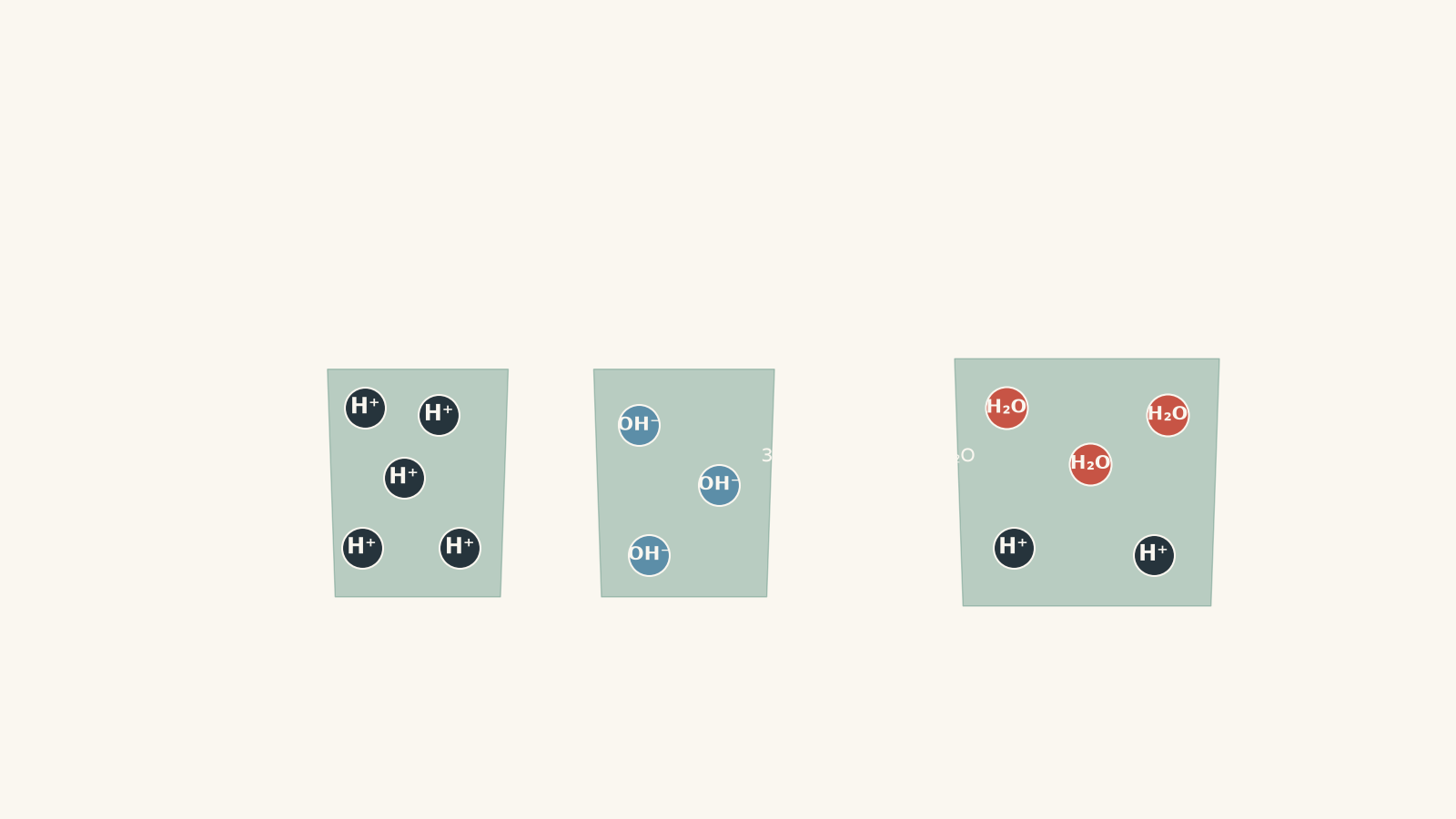
Imagine \(\mathrm{H}^{+}\) and \(\ce{OH^-}\) as people arriving at a painfully organised school formal. One person from each side pairs off and leaves the dance floor.
Chemically, the pairing is:
\[ \ce{H+(aq) + OH-(aq) -> H2O(l)} \]
If there are \(0.0040\ \mathrm{mol}\) of \(\mathrm{H}^{+}\) and \(0.0030\ \mathrm{mol}\) of \(\ce{OH^-}\), then \(0.0030\ \mathrm{mol}\) of each reacts. That leaves \(0.0010\ \mathrm{mol}\) of \(\mathrm{H}^{+}\).
The analogy is useful because it makes the one-to-one mole ratio obvious. It breaks down for weak acids and bases, where not every acid or base particle exists as free \(\mathrm{H}^{+}\) or \(\ce{OH^-}\) at once.
02The calculation map
For the usual HSC strong-acid and strong-base problems, decide which situation you have before calculating anything.
| Situation | First move | What determines the final pH? |
|---|---|---|
| Strong acid diluted with water | Find the acid moles before dilution | Final \([H^+]\) after dividing by the new volume |
| Strong base diluted with water | Find the hydroxide moles before dilution | Final \([OH^-]\), then pOH and pH |
| Strong acid mixed with strong base | Find moles of \(\mathrm{H}^{+}\) and \(\ce{OH^-}\), then neutralise | Concentration of whichever ion is left over |
| Two strong acid solutions mixed | Add their \(\mathrm{H}^{+}\) moles | Total \(\mathrm{H}^{+}\) moles divided by total volume |
| Two strong base solutions mixed | Add their \(\ce{OH^-}\) moles | Total \(\ce{OH^-}\) moles divided by total volume |
| Equal moles of strong acid and strong base | They neutralise completely | \(pH=7.00\) at \(25^\circ\mathrm{C}\), under the usual HSC assumptions |
Unless a question says otherwise, HSC calculations normally treat the solution volumes as additive. If the question gives a final volume directly, use that instead.
03Dilution: the amount stays the same
Suppose you have \(20\) acid particles in a small beaker. Add water. You still have \(20\) acid particles, but they are spread through more space.
That is dilution.
The number of moles of solute stays constant:
\[ n_\text{before}=n_\text{after} \]
Since \(n=cV\),
\[ c_1V_1=c_2V_2 \]
where subscripts 1 and 2 mean before and after dilution.
For a strong monoprotic acid such as \(\ce{HCl}\) or \(\ce{HNO3}\), one mole of acid produces approximately one mole of \(\mathrm{H}^{+}\):
\[ \ce{HCl(aq) -> H+(aq) + Cl-(aq)} \]
So, for normal HSC concentration ranges, the acid concentration after dilution can be treated as \([H^+]\).
Worked example: Find the pH after diluting HCl
\(25.0\ \mathrm{mL}\) of \(0.120\ \mathrm{mol\,L^{-1}}\) \(\ce{HCl}\) is diluted with water to a final volume of \(300.0\ \mathrm{mL}\). Calculate the final pH.
Step 1
Convert \(25.0\ \mathrm{mL}\) to \(0.0250\ \mathrm{L}\).
\[ n(\ce{HCl})=cV=(0.120)(0.0250)=3.00\times10^{-3}\ \mathrm{mol} \]
Because \(\ce{HCl}\) is a strong monoprotic acid,
\[ n(\mathrm{H}^{+})=3.00\times10^{-3}\ \mathrm{mol} \]
Step 2
The final volume is \(0.3000\ \mathrm{L}\).
\[ [H^+] =\frac{3.00\times10^{-3}}{0.3000} =1.00\times10^{-2}\ \mathrm{mol\,L^{-1}} \]
Step 3
\[ pH=-\log_{10}(1.00\times10^{-2})=2.000 \]
The final pH is \(2.000\). A tenfold dilution reduced \([H^+]\) by a factor of ten, which increased the pH by exactly one unit.
That last sentence is worth noticing. A tenfold dilution does not make the pH ten times larger because pH itself is logarithmic.
04Mixing acid and base: react first
Now suppose acid and base are put into the same beaker.
A common mistake is to calculate the diluted acid concentration, calculate the diluted base concentration, and then somehow compare the two pH values. That skips the main event.
The ions react:
\[ \ce{H+(aq) + OH-(aq) -> H2O(l)} \]
So the reliable method is:
- calculate moles of \(\mathrm{H}^{+}\)
- calculate moles of \(\ce{OH^-}\)
- subtract according to the reaction ratio
- divide the excess moles by the total final volume
- calculate pH or pOH
Do not subtract the original concentrations unless the volumes happen to make that mathematically valid. Neutralisation depends on amount, so the comparison must be made in moles.
Worked example: Which reactant is left after mixing?
\(35.0\ \mathrm{mL}\) of \(0.150\ \mathrm{mol\,L^{-1}}\) \(\ce{HCl}\) is mixed with \(20.0\ \mathrm{mL}\) of \(0.200\ \mathrm{mol\,L^{-1}}\) \(\ce{NaOH}\). Calculate the final pH.
Step 1
\[ n(\mathrm{H}^{+})=(0.150)(0.0350)=5.25\times10^{-3}\ \mathrm{mol} \]
Step 2
\[ n(\ce{OH^-})=(0.200)(0.0200)=4.00\times10^{-3}\ \mathrm{mol} \]
Step 3
There is more \(\mathrm{H}^{+}\), so the solution remains acidic.
\[ n(\mathrm{H}^{+})_\text{excess} =5.25\times10^{-3}-4.00\times10^{-3} =1.25\times10^{-3}\ \mathrm{mol} \]
Step 4
The total volume is
\[ 35.0+20.0=55.0\ \mathrm{mL}=0.0550\ \mathrm{L} \]
Therefore,
\[ [H^+] =\frac{1.25\times10^{-3}}{0.0550} =2.27\times10^{-2}\ \mathrm{mol\,L^{-1}} \]
Step 5
\[ pH=-\log_{10}(2.27\times10^{-2})=1.643 \]
The final pH is \(1.643\). The base has raised the pH substantially, but there was not enough \(\ce{OH^-}\) to neutralise all of the acid.
Notice that the original acid had \(pH\approx0.824\). The final solution is still acidic, but much less acidic than the starting HCl solution.
05Watch the coefficients
One mole of \(\ce{NaOH}\) produces one mole of \(\ce{OH^-}\):
\[ \ce{NaOH(aq) -> Na+(aq) + OH-(aq)} \]
But one mole of \(\ce{Ba(OH)2}\) produces two moles of \(\ce{OH^-}\):
\[ \ce{Ba(OH)2(aq) -> Ba^2+(aq) + 2OH-(aq)} \]
So you cannot always compare moles of acid formula units with moles of base formula units. Convert each substance into moles of the reacting species first.
Worked example: A base supplies two hydroxide ions
\(25.0\ \mathrm{mL}\) of \(0.0500\ \mathrm{mol\,L^{-1}}\) \(\ce{Ba(OH)2}\) is mixed with \(20.0\ \mathrm{mL}\) of \(0.100\ \mathrm{mol\,L^{-1}}\) \(\ce{HNO3}\). Calculate the final pH at \(25^\circ\mathrm{C}\).
Step 1
\[ n(\ce{Ba(OH)2})=(0.0500)(0.0250) =1.25\times10^{-3}\ \mathrm{mol} \]
Each mole supplies two moles of \(\ce{OH^-}\):
\[ n(\ce{OH^-})=2(1.25\times10^{-3}) =2.50\times10^{-3}\ \mathrm{mol} \]
Step 2
\[ n(\mathrm{H}^{+})=(0.100)(0.0200) =2.00\times10^{-3}\ \mathrm{mol} \]
Step 3
\[ n(\ce{OH^-})_\text{excess} =2.50\times10^{-3}-2.00\times10^{-3} =5.00\times10^{-4}\ \mathrm{mol} \]
So the final solution is basic.
Step 4
\[ V_\text{total}=0.0250+0.0200=0.0450\ \mathrm{L} \]
\[ [OH^-] =\frac{5.00\times10^{-4}}{0.0450} =1.11\times10^{-2}\ \mathrm{mol\,L^{-1}} \]
Step 5
\[ pOH=-\log_{10}(1.11\times10^{-2})=1.954 \]
\[ pH=14.00-1.954=12.046 \]
The final pH is \(12.046\). Treating one mole of \(\ce{Ba(OH)2}\) as one mole of \(\ce{OH^-}\) would give the wrong excess reagent and could even make you predict the wrong side of neutral.
06Never average pH values
Suppose equal volumes of two strong acid solutions have pH values of 2.00 and 4.00.
It is tempting to say the mixture has
\[ \frac{2.00+4.00}{2}=3.00 \]
It does not.
A pH of 2.00 means
\[ [H^+]=1.00\times10^{-2}\ \mathrm{mol\,L^{-1}} \]
while a pH of 4.00 means
\[ [H^+]=1.00\times10^{-4}\ \mathrm{mol\,L^{-1}} \]
For equal volumes, the final concentration is the average of the concentrations:
\[ [H^+]_\text{final} =\frac{1.00\times10^{-2}+1.00\times10^{-4}}{2} =5.05\times10^{-3}\ \mathrm{mol\,L^{-1}} \]
Therefore,
\[ pH=-\log_{10}(5.05\times10^{-3})=2.297 \]
The pH is much closer to 2 than to 4 because the pH 2 solution contains one hundred times the hydrogen ion concentration of the pH 4 solution.
The logarithm hides that huge difference.
07A reliable exam decision rule
When you see a dilution or mixing question, work through these decisions in order.
1. Is there a chemical reaction?
Adding only water: no neutralisation.
Mixing acid with base: usually yes.
Mixing two strong acids: no acid-base neutralisation between them, so add their \(\mathrm{H}^{+}\) moles.
2. What are the reacting moles?
Use \(n=cV\), with volume in litres.
Then account for coefficients. For example, \(1\ \mathrm{mol}\) of \(\ce{Ba(OH)2}\) provides \(2\ \mathrm{mol}\) of \(\ce{OH^-}\).
3. Which ion remains?
For a strong acid-strong base mixture,
\[ n_\text{excess} =\left|n(\mathrm{H}^{+})-n(\ce{OH^-})\right| \]
But keep track of which species is actually in excess. The absolute value alone does not tell you whether the final solution is acidic or basic.
4. What is the final volume?
After any reactions and dilutions,
\[ c_\text{excess}=\frac{n_\text{excess}}{V_\text{final}} \]
Use the total mixed volume unless a different final volume is stated.
5. Which logarithm do you need?
If \(\mathrm{H}^{+}\) remains,
\[ pH=-\log_{10}[H^+] \]
If \(\ce{OH^-}\) remains,
\[ pOH=-\log_{10}[OH^-] \]
then, at \(25^\circ\mathrm{C}\),
\[ pH=14.00-pOH \]
08Where this model needs more care
The method above is exact enough for the usual HSC strong-acid and strong-base calculations, but some shortcuts inside it have limits.
Weak acids and bases
For a weak acid, its analytical concentration is not equal to \([H^+]\). Only a fraction of the acid molecules ionise.
Dilution still conserves the total moles of acid, so \(c_1V_1=c_2V_2\) can still describe the acid’s formal concentration. But you cannot automatically insert that new concentration into the pH equation as \([H^+]\).
Similarly, if a weak acid is mixed with a strong base, there are usually two stages:
- do the neutralisation stoichiometry
- analyse the acid-base equilibrium of whatever remains
That is why knowing the difference between concentration and acid strength matters. If that distinction is shaky, review Strong vs Weak, Concentrated vs Dilute Acids and Bases.
Exact neutralisation is not always pH 7
Equal reacting moles of a strong acid and strong base such as \(\ce{HCl}\) and \(\ce{NaOH}\) give approximately \(pH=7.00\) at \(25^\circ\mathrm{C}\).
But a weak acid mixed to equivalence with a strong base can give a basic solution because its conjugate base reacts with water. A weak base mixed to equivalence with a strong acid can give an acidic solution.
So “equal moles means pH 7” is not a universal law.
Extremely dilute strong acids
There is one more boundary worth knowing.
Imagine diluting a strong acid until its formal concentration is \(1\times10^{-8}\ \mathrm{mol\,L^{-1}}\). The shortcut
\[ pH=-\log_{10}(1\times10^{-8})=8 \]
would claim that adding acid has produced a basic solution.
That cannot be right.
The missing piece is water itself, which already contributes about \(1\times10^{-7}\ \mathrm{mol\,L^{-1}}\) each of \(\mathrm{H}^{+}\) and \(\ce{OH^-}\) at \(25^\circ\mathrm{C}\). At ordinary HSC concentrations, that contribution is tiny compared with the acid or base concentration, so we ignore it. Near \(10^{-7}\ \mathrm{mol\,L^{-1}}\), we no longer can.
Question 5 below pushes that idea properly.
09Tempting mistakes
| Tempting move | Why it fails | Better move |
|---|---|---|
| Average two pH values | pH is logarithmic | Convert to moles or concentrations first |
| Subtract acid and base concentrations | Different volumes may contain different amounts | Convert each to moles |
| Use the original volume after mixing | The excess ions occupy the whole solution | Use the final total volume |
| Forget that \(\ce{Ba(OH)2}\) supplies two \(\ce{OH^-}\) | Formula-unit moles are not always reacting-ion moles | Use the chemical coefficients |
| Find pOH and report it as pH | pOH measures hydroxide concentration | At \(25^\circ\mathrm{C}\), use \(pH=14.00-pOH\) |
| Assume equal acid and base concentrations means neutral | Their volumes and reaction coefficients also matter | Compare reacting moles |
| Treat every acid as fully ionised | Weak acids establish equilibria | Decide whether the acid or base is strong first |
10Questions and solutions
Question 1
\(20.0\ \mathrm{mL}\) of \(0.0500\ \mathrm{mol\,L^{-1}}\) \(\ce{HNO3}\) is diluted to \(250.0\ \mathrm{mL}\). Calculate the final pH.
Assume complete ionisation.
Solution 1
The final pH is \(2.398\).
\(\ce{HNO3}\) is a strong monoprotic acid, so its moles equal the moles of \(\mathrm{H}^{+}\).
First calculate the initial moles:
\[ n(\mathrm{H}^{+}) =(0.0500)(0.0200) =1.00\times10^{-3}\ \mathrm{mol} \]
Dilution does not change this amount.
The final volume is \(0.2500\ \mathrm{L}\), so
\[ [H^+] =\frac{1.00\times10^{-3}}{0.2500} =4.00\times10^{-3}\ \mathrm{mol\,L^{-1}} \]
Therefore,
\[ pH =-\log_{10}(4.00\times10^{-3}) =2.398 \]
The tempting mistake is to manipulate the pH directly using the change in volume. The safe route is to conserve moles, find the new \([H^+]\), and only then take the logarithm.
Question 2
\(30.0\ \mathrm{mL}\) of \(0.120\ \mathrm{mol\,L^{-1}}\) \(\ce{HCl}\) is mixed with \(20.0\ \mathrm{mL}\) of \(0.150\ \mathrm{mol\,L^{-1}}\) \(\ce{NaOH}\). A further \(150.0\ \mathrm{mL}\) of water is then added.
Calculate the final pH at \(25^\circ\mathrm{C}\).
Solution 2
The final pH is \(2.523\).
The neutralisation must happen before the later dilution is handled.
Moles of \(\mathrm{H}^{+}\):
\[ n(\mathrm{H}^{+}) =(0.120)(0.0300) =3.60\times10^{-3}\ \mathrm{mol} \]
Moles of \(\ce{OH^-}\):
\[ n(\ce{OH^-}) =(0.150)(0.0200) =3.00\times10^{-3}\ \mathrm{mol} \]
The reaction is one-to-one:
\[ \ce{H+ + OH- -> H2O} \]
Therefore, the excess hydrogen ions are
\[ n(\mathrm{H}^{+})_\text{excess} =3.60\times10^{-3}-3.00\times10^{-3} =6.00\times10^{-4}\ \mathrm{mol} \]
After the extra water is added, the final volume is
\[ 30.0+20.0+150.0=200.0\ \mathrm{mL} =0.2000\ \mathrm{L} \]
So,
\[ [H^+] =\frac{6.00\times10^{-4}}{0.2000} =3.00\times10^{-3}\ \mathrm{mol\,L^{-1}} \]
and
\[ pH=-\log_{10}(3.00\times10^{-3})=2.523 \]
A tempting route is to dilute the original HCl through the full \(200.0\ \mathrm{mL}\) and ignore the NaOH. That overestimates \([H^+]\). Some of the hydrogen ions have been chemically removed, not merely spread out.
Question 3
\(40.0\ \mathrm{mL}\) of \(0.0500\ \mathrm{mol\,L^{-1}}\) \(\ce{Ba(OH)2}\) is mixed with \(15.0\ \mathrm{mL}\) of \(0.200\ \mathrm{mol\,L^{-1}}\) \(\ce{HCl}\). The resulting mixture is then diluted to a final volume of \(250.0\ \mathrm{mL}\).
Calculate the final pH at \(25^\circ\mathrm{C}\).
Solution 3
The final pH is \(11.602\).
The key constraint is that every mole of \(\ce{Ba(OH)2}\) supplies two moles of \(\ce{OH^-}\).
First calculate the moles of \(\ce{Ba(OH)2}\):
\[ n(\ce{Ba(OH)2}) =(0.0500)(0.0400) =2.00\times10^{-3}\ \mathrm{mol} \]
Therefore,
\[ n(\ce{OH^-}) =2(2.00\times10^{-3}) =4.00\times10^{-3}\ \mathrm{mol} \]
The acid supplies
\[ n(\mathrm{H}^{+}) =(0.200)(0.0150) =3.00\times10^{-3}\ \mathrm{mol} \]
After neutralisation,
\[ n(\ce{OH^-})_\text{excess} =4.00\times10^{-3}-3.00\times10^{-3} =1.00\times10^{-3}\ \mathrm{mol} \]
The final volume is given directly as \(0.2500\ \mathrm{L}\). Therefore,
\[ [OH^-] =\frac{1.00\times10^{-3}}{0.2500} =4.00\times10^{-3}\ \mathrm{mol\,L^{-1}} \]
Now calculate pOH:
\[ pOH=-\log_{10}(4.00\times10^{-3})=2.398 \]
At \(25^\circ\mathrm{C}\),
\[ pH=14.00-2.398=11.602 \]
The obvious trap is to compare \(2.00\times10^{-3}\ \mathrm{mol}\) of \(\ce{Ba(OH)2}\) with \(3.00\times10^{-3}\ \mathrm{mol}\) of HCl and conclude that the acid is in excess. That compares formula units rather than reacting ions. Once the two hydroxides per formula unit are counted, the base is actually in excess.
Question 4
Two unlabelled solutions, X and Y, are known to be \(\ce{HCl}\) and \(\ce{NaOH}\), but you do not know which is which or their concentrations.
In Experiment 1, \(20.0\ \mathrm{mL}\) of X is mixed with \(30.0\ \mathrm{mL}\) of Y. The final pH is \(12.00\).
In Experiment 2, \(30.0\ \mathrm{mL}\) of X is mixed with \(20.0\ \mathrm{mL}\) of Y. The final pH is \(1.70\).
Assume volumes are additive and the temperature is \(25^\circ\mathrm{C}\).
Identify X and Y, and determine the concentration of each.
Solution 4
X is \(\ce{HCl}\) at approximately \(0.0799\ \mathrm{mol\,L^{-1}}\), and Y is \(\ce{NaOH}\) at approximately \(0.0699\ \mathrm{mol\,L^{-1}}\).
The important idea is that each measured pH tells us the number of excess moles left after neutralisation, not the original concentration of either stock solution.
Let the concentration of X, assuming X is the acid, be \(a\), and let the concentration of Y, assuming Y is the base, be \(b\), both in \(\mathrm{mol\,L^{-1}}\).
In Experiment 1, the pH is \(12.00\), so
\[ pOH=14.00-12.00=2.00 \]
Therefore,
\[ [OH^-]=10^{-2.00}=1.00\times10^{-2}\ \mathrm{mol\,L^{-1}} \]
The final volume is \(0.0500\ \mathrm{L}\), so the excess hydroxide amount is
\[ n(\ce{OH^-})_\text{excess} =(1.00\times10^{-2})(0.0500) =5.00\times10^{-4}\ \mathrm{mol} \]
If X is acid and Y is base,
\[ 0.0300b-0.0200a=5.00\times10^{-4} \]
In Experiment 2, \(pH=1.70\), so
\[ [H^+]=10^{-1.70} =1.995\times10^{-2}\ \mathrm{mol\,L^{-1}} \]
The excess hydrogen amount is therefore
\[ n(\mathrm{H}^{+})_\text{excess} =(1.995\times10^{-2})(0.0500) =9.98\times10^{-4}\ \mathrm{mol} \]
This gives
\[ 0.0300a-0.0200b=9.98\times10^{-4} \]
Solving the simultaneous equations,
\[ a=0.0799\ \mathrm{mol\,L^{-1}} \]
and
\[ b=0.0699\ \mathrm{mol\,L^{-1}} \]
So X is the acid and Y is the base.
Could the identities be reversed? That is a reasonable possibility after looking at only one experiment. But applying both experiments with X as the base and Y as the acid produces negative concentrations when the simultaneous equations are solved. Negative concentrations are physically impossible, so that assignment must be rejected.
The deeper point is that the two experiments constrain each other. One pH measurement alone would not be enough to identify both stock solutions uniquely.
Question 5
A strong \(\ce{HCl}\) solution is diluted until its formal acid concentration is exactly \(1.00\times10^{-8}\ \mathrm{mol\,L^{-1}}\) at \(25^\circ\mathrm{C}\).
A student argues:
\(\ce{HCl}\) is a strong acid, so \([H^+]=1.00\times10^{-8}\ \mathrm{mol\,L^{-1}}\), giving \(pH=8.00\).
Explain why this result is impossible and calculate the actual pH.
Use
\[ K_w=[H^+][OH^-]=1.00\times10^{-14} \]
at \(25^\circ\mathrm{C}\).
Solution 5
The actual pH is approximately \(6.978\), not \(8.00\).
The student’s calculation uses a normally useful approximation in a situation where it has broken down.
At ordinary acid concentrations, the \(\mathrm{H}^{+}\) supplied by water is tiny compared with the \(\mathrm{H}^{+}\) supplied by the acid. But pure water itself already contains approximately
\[ 1.00\times10^{-7}\ \mathrm{mol\,L^{-1}} \]
of both \(\mathrm{H}^{+}\) and \(\ce{OH^-}\) at \(25^\circ\mathrm{C}\).
It would therefore make no physical sense for adding a strong acid to water to produce \(pH=8.00\), which is basic.
Let
\[ h=[H^+] \]
and let the formal HCl concentration be
\[ C=1.00\times10^{-8}\ \mathrm{mol\,L^{-1}} \]
Because HCl is fully dissociated,
\[ [Cl^-]=C \]
The solution must remain electrically neutral. The total positive charge from \(\mathrm{H}^{+}\) must equal the negative charge from \(\mathrm{Cl}^{-}\) and \(\ce{OH^-}\):
\[ [H^+]=[Cl^-]+[OH^-] \]
Therefore,
\[ h=C+[OH^-] \]
From the water equilibrium,
\[ [OH^-]=\frac{K_w}{h} \]
so
\[ h=C+\frac{K_w}{h} \]
Multiplying through by \(h\),
\[ h^2-Ch-K_w=0 \]
Using the positive solution of the quadratic,
\[ h =\frac{C+\sqrt{C^2+4K_w}}{2} \]
Substitute the values:
\[ h =\frac{1.00\times10^{-8} +\sqrt{(1.00\times10^{-8})^2+4(1.00\times10^{-14})}}{2} \]
\[ h=1.051\times10^{-7}\ \mathrm{mol\,L^{-1}} \]
Therefore,
\[ pH=-\log_{10}(1.051\times10^{-7}) =6.978 \]
The tempting shortcut fails because it silently assumes that all relevant \(\mathrm{H}^{+}\) comes from the acid. At \(10^{-8}\ \mathrm{mol\,L^{-1}}\), water’s own ionisation is actually the larger contribution.
This is a useful boundary check for any model: if a calculation says adding acid makes water basic, the approximation has failed before the chemistry has.
11What this lets you do next
The useful habit from this topic is separating stoichiometry from equilibrium.
For strong acids and bases, the sequence is usually moles, neutralisation, final concentration, then pH. When weak acids, weak bases, buffers, or equivalence points appear, the first part often stays the same, but an equilibrium calculation has to follow it.
That next layer makes much more sense once you can identify which acid-base species survive the initial reaction. The ideas of proton transfer and conjugate species are developed in Conjugate Acid-Base Pairs and Proton Transfer.