
Strong Acid-Strong Base Titration Curves for HSC Chemistry
Learn how to analyse a strong acid-strong base titration curve, calculate pH before and after equivalence, and explain equivalence behaviour.
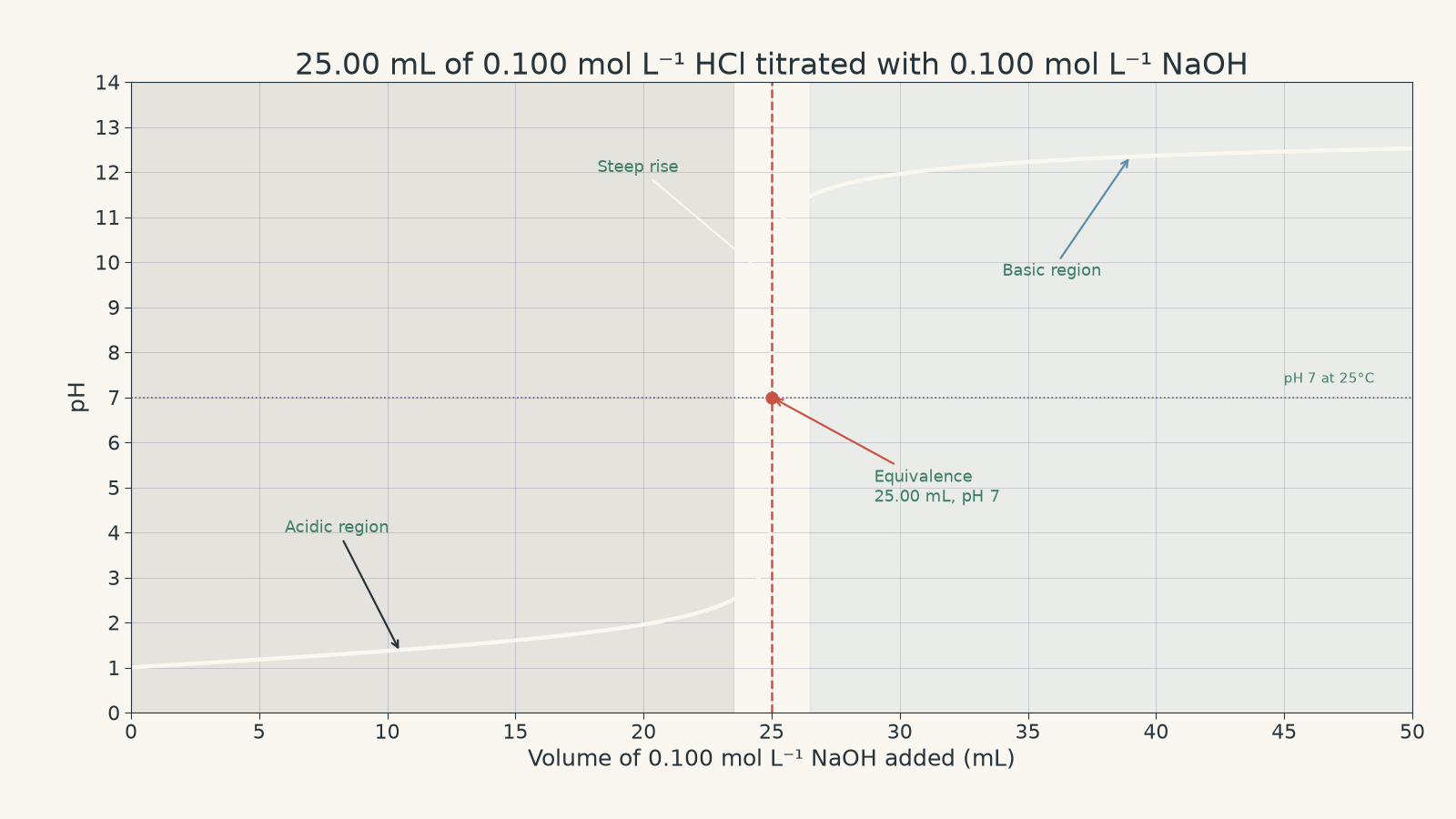
Suppose you have \(25.00\ \mathrm{mL}\) of \(0.100\ \mathrm{mol\,L^{-1}}\) hydrochloric acid and add \(0.100\ \mathrm{mol\,L^{-1}}\) sodium hydroxide.
At \(24.90\ \mathrm{mL}\) of base added, the solution is still acidic. At \(25.00\ \mathrm{mL}\), it is neutral at \(25^\circ\mathrm{C}\). Add just another \(0.10\ \mathrm{mL}\), and it is strongly basic.
Before reading on, predict the shape of the pH curve. Would the pH rise at roughly the same rate all the way through the titration?
It doesn’t. The curve changes slowly at first, shoots upwards near the equivalence point, then flattens again. The reason is not that sodium hydroxide somehow becomes more powerful near \(25.00\ \mathrm{mL}\). The reason is that the identity and concentration of the ions left over after neutralisation change dramatically near equivalence.
01The question that controls the entire titration
A strong acid such as hydrochloric acid is effectively completely ionised in water:
\[ \ce{HCl(aq) + H2O(l) -> H3O+(aq) + Cl-(aq)} \]
A strong base such as sodium hydroxide dissociates effectively completely:
\[ \ce{NaOH(aq) -> Na+(aq) + OH-(aq)} \]
The important reaction during the titration is therefore
\[ \ce{H3O+(aq) + OH-(aq) -> 2H2O(l)} \]
For stoichiometric calculations, chemists often use \(\mathrm{H}^{+}\) as shorthand for the acidic hydrogen ion in solution, even though \(\ce{H3O+}\) is a better picture of what is present in water.
Here is the useful mental model: imagine \(\ce{H3O+}\) and \(\ce{OH-}\) are on a ridiculously efficient dating app. One of each matches, disappears from the singles pool, and becomes water. The pH is controlled by whoever is left unmatched.
The analogy stops there. Ions are not literally being matched into fixed couples, and neutralisation is a chemical reaction rather than a dating crisis. But the one-to-one bookkeeping is exactly what you need for a strong monoprotic acid and a strong base.
So every point on the curve begins with one question:
After the acid and base react, which one is in excess?
| Position in titration | What remains in excess? | What determines pH? |
|---|---|---|
| Before equivalence | Strong acid | Excess \(\ce{H3O+}\) |
| At equivalence | Neither | Water, assuming the salt ions do not hydrolyse significantly |
| After equivalence | Strong base | Excess \(\ce{OH-}\) |
That table is the backbone of the whole topic.
02Equivalence is about moles, not volumes
The equivalence point occurs when acid and base have reacted in exactly the stoichiometric ratio required by the equation.
For a monoprotic strong acid such as \(\ce{HCl}\) or \(\ce{HNO3}\) reacting with \(\ce{NaOH}\) or \(\ce{KOH}\), the ratio is \(1:1\). Therefore,
\[ n(\mathrm{H}^{+}) = n(\ce{OH-}) \]
where \(n\) is amount in moles.
Using \(n=cV\),
\[ c_\mathrm{acid}V_\mathrm{acid} = c_\mathrm{base}V_\mathrm{eq} \]
where \(c\) is concentration in \(\mathrm{mol\,L^{-1}}\), \(V\) is volume in litres, and \(V_\mathrm{eq}\) is the volume of titrant at equivalence.
Notice what this does not say: the volumes must be equal.
Equal volumes occur only when the acid and base concentrations are also equal for a \(1:1\) reaction.
For example, \(20.00\ \mathrm{mL}\) of \(0.150\ \mathrm{mol\,L^{-1}}\) acid contains
\[ n = cV = 0.150 \times 0.02000 = 3.00\times10^{-3}\ \mathrm{mol} \]
If the base concentration is only \(0.100\ \mathrm{mol\,L^{-1}}\), equivalence requires
\[ V=\frac{3.00\times10^{-3}}{0.100} =0.0300\ \mathrm{L} =30.0\ \mathrm{mL} \]
The chemistry cares about reacting amounts, not whether the burette reading happens to match the pipette volume.
03Why the titration curve has its characteristic shape
Consider the original \(25.00\ \mathrm{mL}\) sample of \(0.100\ \mathrm{mol\,L^{-1}}\) \(\ce{HCl}\), titrated with \(0.100\ \mathrm{mol\,L^{-1}}\) \(\ce{NaOH}\).
Its equivalence volume is \(25.00\ \mathrm{mL}\).
Before equivalence: acid controls the pH
At first there is much more \(\ce{H3O+}\) than the added \(\ce{OH-}\) can remove.
Suppose \(10.00\ \mathrm{mL}\) of base has been added. The starting acid amount is
\[ n(\mathrm{H}^{+})=0.100\times0.02500 =2.500\times10^{-3}\ \mathrm{mol} \]
The amount of hydroxide added is
\[ n(\ce{OH-})=0.100\times0.01000 =1.000\times10^{-3}\ \mathrm{mol} \]
After neutralisation,
\[ n(\mathrm{H}^{+})_\mathrm{excess} = 1.500\times10^{-3}\ \mathrm{mol} \]
There is still plenty of acid left.
As base is added, the amount of excess acid falls and the total volume increases. Both effects decrease \([\ce{H3O+}]\), so the pH rises.
Near equivalence: a tiny volume can cause a huge pH change
Now move much closer to equivalence.
At \(24.90\ \mathrm{mL}\) of base added,
\[ n(\mathrm{H}^{+})_\mathrm{excess} = 2.500\times10^{-3} - (0.100\times0.02490) = 1.00\times10^{-5}\ \mathrm{mol} \]
The total volume is
\[ 25.00+24.90=49.90\ \mathrm{mL} =0.04990\ \mathrm{L} \]
Therefore,
\[ [\ce{H3O+}] = \frac{1.00\times10^{-5}}{0.04990} = 2.00\times10^{-4}\ \mathrm{mol\,L^{-1}} \]
and
\[ \mathrm{pH} = -\log_{10}(2.00\times10^{-4}) \approx3.70 \]
Now add only another \(0.20\ \mathrm{mL}\), taking the burette volume to \(25.10\ \mathrm{mL}\).
There is now excess hydroxide:
\[ n(\ce{OH-})_\mathrm{excess} = (0.100\times0.02510)-2.500\times10^{-3} = 1.00\times10^{-5}\ \mathrm{mol} \]
The total volume is \(0.05010\ \mathrm{L}\), so
\[ [\ce{OH-}] = \frac{1.00\times10^{-5}}{0.05010} = 2.00\times10^{-4}\ \mathrm{mol\,L^{-1}} \]
At \(25^\circ\mathrm{C}\),
\[ \mathrm{pH}+\mathrm{pOH}=14.00 \]
so
\[ \mathrm{pOH} = -\log_{10}(2.00\times10^{-4}) \approx3.70 \]
and
\[ \mathrm{pH} = 14.00-3.70 = 10.30 \]
A change of only \(0.20\ \mathrm{mL}\) has taken the solution from about pH \(3.70\) to pH \(10.30\).
That is the near-vertical section of the titration curve.
The tempting explanation is that the neutralisation reaction suddenly becomes faster or stronger. It doesn’t. Near equivalence, almost all the original acid has already been consumed. A tiny extra amount of base can therefore change which reagent is in excess.
At equivalence: why is the pH about 7?
At equivalence, neither strong acid nor strong base remains in stoichiometric excess.
For \(\ce{HCl}\) and \(\ce{NaOH}\), the solution contains mainly water, \(\mathrm{Na}^{+}\), and \(\mathrm{Cl}^{-}\).
The ions \(\mathrm{Na}^{+}\) and \(\mathrm{Cl}^{-}\) do not significantly hydrolyse under the usual HSC treatment. They are spectator ions in the acid-base calculation.
At \(25^\circ\mathrm{C}\), pure water satisfies
\[ [\ce{H3O+}] = [\ce{OH-}] = 1.0\times10^{-7}\ \mathrm{mol\,L^{-1}} \]
so
\[ \mathrm{pH}=7.00 \]
There is an important precision point here: neutral does not universally mean pH 7. Neutral means
\[ [\ce{H3O+}]=[\ce{OH-}] \]
The value \(7.00\) applies at \(25^\circ\mathrm{C}\), because the ionic product of water depends on temperature.
For typical HSC calculations, unless the question tells you otherwise, pH \(7\) at the strong acid-strong base equivalence point is the expected model.
After equivalence: excess base controls the pH
Once the equivalence point has been passed, every additional mole of \(\ce{OH-}\) has no strong acid left to neutralise it.
The calculation therefore changes.
You find excess \(\ce{OH-}\), divide by total solution volume, calculate pOH, and then convert to pH.
As more base is added, the pH keeps increasing, but the curve gradually flattens. Far beyond equivalence, the mixture’s hydroxide concentration begins to approach the concentration of the titrant itself.
04The calculation method that works across the curve
Do not try to memorise separate mysterious equations for every region. Use the chemistry.
For any point away from exact equivalence:
- Convert all required volumes to litres.
- Calculate the initial moles of acid.
- Calculate the moles of base added.
- Use the reaction ratio to determine which reagent is in excess.
- Subtract to find excess moles.
- Divide excess moles by the total solution volume.
- If acid is in excess, calculate pH directly.
- If base is in excess, calculate pOH first, then pH.
The total-volume step is easy to miss. After you add \(20.00\ \mathrm{mL}\) of titrant to \(25.00\ \mathrm{mL}\) of acid, the relevant volume is \(45.00\ \mathrm{mL}\), not \(25.00\ \mathrm{mL}\).
For an unknown-concentration calculation, the same stoichiometric reasoning sits underneath the method in Acid-Base Titration of an Unknown: HSC Chemistry Guide.
Worked example: pH before the equivalence point
A \(25.00\ \mathrm{mL}\) sample of \(0.100\ \mathrm{mol\,L^{-1}}\) \(\ce{HCl}\) is titrated with \(0.100\ \mathrm{mol\,L^{-1}}\) \(\ce{NaOH}\). Calculate the pH after \(20.00\ \mathrm{mL}\) of sodium hydroxide has been added.
Step 1
\[ n(\mathrm{H}^{+}) = cV = 0.100\times0.02500 = 2.50\times10^{-3}\ \mathrm{mol} \]
Step 2
\[ n(\ce{OH-}) = 0.100\times0.02000 = 2.00\times10^{-3}\ \mathrm{mol} \]
Step 3
The reaction is \(1:1\), so
\[ n(\mathrm{H}^{+})_\mathrm{excess} = 2.50\times10^{-3} - 2.00\times10^{-3} = 5.00\times10^{-4}\ \mathrm{mol} \]
Acid remains in excess.
Step 4
\[ V_\mathrm{total} = 25.00+20.00 = 45.00\ \mathrm{mL} = 0.04500\ \mathrm{L} \]
Therefore,
\[ [\ce{H3O+}] = \frac{5.00\times10^{-4}}{0.04500} = 1.11\times10^{-2}\ \mathrm{mol\,L^{-1}} \]
Step 5
\[ \mathrm{pH} = -\log_{10}(1.11\times10^{-2}) = 1.95 \]
The solution is still clearly acidic because the titration has not yet reached equivalence.
Worked example: equivalence volume and pH after equivalence
A \(20.00\ \mathrm{mL}\) sample of \(0.150\ \mathrm{mol\,L^{-1}}\) \(\ce{HNO3}\) is titrated with \(0.120\ \mathrm{mol\,L^{-1}}\) \(\ce{KOH}\).
Calculate:
- the volume of \(\ce{KOH}\) required for equivalence, and
- the pH after \(27.00\ \mathrm{mL}\) of \(\ce{KOH}\) has been added at \(25^\circ\mathrm{C}\).
Step 1
\[ n(\mathrm{H}^{+}) = 0.150\times0.02000 = 3.00\times10^{-3}\ \mathrm{mol} \]
Step 2
At equivalence,
\[ n(\ce{OH-})=3.00\times10^{-3}\ \mathrm{mol} \]
so
\[ V_\mathrm{eq} = \frac{n}{c} = \frac{3.00\times10^{-3}}{0.120} = 0.0250\ \mathrm{L} = 25.0\ \mathrm{mL} \]
Therefore, \(27.00\ \mathrm{mL}\) is beyond equivalence.
Step 3
\[ n(\ce{OH-})_\mathrm{added} = 0.120\times0.02700 = 3.24\times10^{-3}\ \mathrm{mol} \]
Step 4
\[ n(\ce{OH-})_\mathrm{excess} = 3.24\times10^{-3} - 3.00\times10^{-3} = 2.40\times10^{-4}\ \mathrm{mol} \]
Step 5
\[ V_\mathrm{total} = 20.00+27.00 = 47.00\ \mathrm{mL} = 0.04700\ \mathrm{L} \]
\[ [\ce{OH-}] = \frac{2.40\times10^{-4}}{0.04700} = 5.11\times10^{-3}\ \mathrm{mol\,L^{-1}} \]
Step 6
\[ \mathrm{pOH} = -\log_{10}(5.11\times10^{-3}) = 2.29 \]
\[ \mathrm{pH} = 14.00-2.29 = 11.71 \]
The result makes chemical sense: the solution is beyond its \(25.0\ \mathrm{mL}\) equivalence volume, so excess strong base gives a high pH.
05Why you must not average the acid and base pH
A very tempting method is to see, for example, pH \(1\) acid and pH \(13\) base and think their mixture should have pH \(7\).
Sometimes it does. Usually it doesn’t.
pH is logarithmic, and acid and base chemically react. You must compare moles of \(\mathrm{H}^{+}\) and \(\ce{OH-}\) before calculating the final pH.
Suppose you mix:
- \(10.0\ \mathrm{mL}\) of \(0.100\ \mathrm{mol\,L^{-1}}\) \(\ce{HCl}\), and
- \(20.0\ \mathrm{mL}\) of \(0.100\ \mathrm{mol\,L^{-1}}\) \(\ce{NaOH}\).
The acid has pH \(1\). The base has pH \(13\). Their numerical average is \(7\).
But there are twice as many moles of hydroxide as hydronium:
\[ n(\mathrm{H}^{+})=1.00\times10^{-3}\ \mathrm{mol} \]
\[ n(\ce{OH-})=2.00\times10^{-3}\ \mathrm{mol} \]
After neutralisation, \(1.00\times10^{-3}\ \mathrm{mol}\) of \(\ce{OH-}\) remains. The mixture is basic, not neutral.
Averaging pH ignores both stoichiometry and the logarithmic pH scale.
06Equivalence point and endpoint are not the same thing
The equivalence point is a theoretical chemical condition: the reacting acid and base are present in the exact stoichiometric amounts.
The endpoint is what you observe experimentally, such as an indicator changing colour.
Those points should be close, but they are not definitions of the same thing.
For a strong acid-strong base titration, the pH changes through a broad range over a very small volume near equivalence. That means several indicators can work because their transition ranges lie inside the steep section.
For example, phenolphthalein changes colour roughly over pH \(8.2\) to \(10.0\). Its transition is not centred at pH \(7\), yet it can still give a good endpoint for a typical strong acid-strong base titration because reaching pH \(8.2\) requires only a tiny excess of base.
This is one of those cases where staring only at the pH numbers can mislead you. The titration measures volume. A large vertical change on the graph may correspond to an extremely small horizontal change.
With a pH probe, you can collect the full curve rather than relying on a colour change. The way those measurements are obtained and interpreted is developed further in Titration Curves and Conductivity Graphs for HSC Chemistry.
07What happens if the acid is diluted first?
Here is a prediction worth making.
Take \(25.00\ \mathrm{mL}\) of \(0.100\ \mathrm{mol\,L^{-1}}\) \(\ce{HCl}\). In one flask, titrate it immediately. In another, add \(75.00\ \mathrm{mL}\) of water first, then titrate it with the same sodium hydroxide.
Will the diluted flask need more base to reach equivalence?
No.
Adding water lowers the acid concentration, but it does not remove any acid particles. The number of moles of \(\mathrm{H}^{+}\) is unchanged.
Both flasks therefore require exactly the same number of moles, and hence the same volume, of the same \(\ce{NaOH}\) titrant to reach equivalence.
What does change is the shape of the curve.
The diluted sample begins at a higher pH, and near equivalence any tiny excess of \(\mathrm{H}^{+}\) or \(\ce{OH-}\) is spread through a larger total volume. The vertical jump is therefore less extreme.
This distinction matters:
- dilution can change the pH at most points on the curve;
- dilution does not change the equivalence volume, provided no acid is lost or chemically changed.
That separation between concentration and amount is one of the most useful ideas in titration chemistry.
08Questions and solutions
Question 1
A \(20.00\ \mathrm{mL}\) sample of \(0.100\ \mathrm{mol\,L^{-1}}\) \(\ce{HCl}\) is titrated with \(0.100\ \mathrm{mol\,L^{-1}}\) \(\ce{NaOH}\).
Calculate the pH after \(15.00\ \mathrm{mL}\) of sodium hydroxide has been added.
Solution 1
The pH is \(1.85\), because hydrochloric acid is still in excess.
The starting amount of acid is
\[ n(\mathrm{H}^{+}) = 0.100\times0.02000 = 2.00\times10^{-3}\ \mathrm{mol} \]
The added hydroxide amount is
\[ n(\ce{OH-}) = 0.100\times0.01500 = 1.50\times10^{-3}\ \mathrm{mol} \]
Because the reaction ratio is \(1:1\),
\[ n(\mathrm{H}^{+})_\mathrm{excess} = 2.00\times10^{-3} - 1.50\times10^{-3} = 5.00\times10^{-4}\ \mathrm{mol} \]
The total volume is
\[ 20.00+15.00=35.00\ \mathrm{mL} =0.03500\ \mathrm{L} \]
so
\[ [\ce{H3O+}] = \frac{5.00\times10^{-4}}{0.03500} = 1.43\times10^{-2}\ \mathrm{mol\,L^{-1}} \]
Therefore,
\[ \mathrm{pH} = -\log_{10}(1.43\times10^{-2}) = 1.85 \]
A common trap is dividing the excess moles by the original \(20.00\ \mathrm{mL}\). The titrant is part of the solution, so the denominator must be the full \(35.00\ \mathrm{mL}\).
Question 2
A \(25.00\ \mathrm{mL}\) sample of a strong monoprotic acid is titrated with \(0.1200\ \mathrm{mol\,L^{-1}}\) \(\ce{NaOH}\). The equivalence point occurs after \(18.60\ \mathrm{mL}\) of base is added.
- Calculate the concentration of the acid.
- Calculate the pH after \(20.00\ \mathrm{mL}\) of base has been added at \(25^\circ\mathrm{C}\).
Solution 2
The acid concentration is \(0.08928\ \mathrm{mol\,L^{-1}}\), and the pH after \(20.00\ \mathrm{mL}\) of base is \(11.57\).
At equivalence, the initial amount of acid equals the amount of hydroxide added:
\[ n(\mathrm{H}^{+}) = 0.1200\times0.01860 = 2.232\times10^{-3}\ \mathrm{mol} \]
Therefore,
\[ c_\mathrm{acid} = \frac{2.232\times10^{-3}}{0.02500} = 0.08928\ \mathrm{mol\,L^{-1}} \]
At \(20.00\ \mathrm{mL}\), the amount of hydroxide added is
\[ n(\ce{OH-}) = 0.1200\times0.02000 = 2.400\times10^{-3}\ \mathrm{mol} \]
The excess is therefore
\[ n(\ce{OH-})_\mathrm{excess} = 2.400\times10^{-3} - 2.232\times10^{-3} = 1.68\times10^{-4}\ \mathrm{mol} \]
The total volume is
\[ 25.00+20.00=45.00\ \mathrm{mL} =0.04500\ \mathrm{L} \]
so
\[ [\ce{OH-}] = \frac{1.68\times10^{-4}}{0.04500} = 3.73\times10^{-3}\ \mathrm{mol\,L^{-1}} \]
Then
\[ \mathrm{pOH} = -\log_{10}(3.73\times10^{-3}) = 2.43 \]
and
\[ \mathrm{pH} = 14.00-2.43 = 11.57 \]
The tempting mistake is to use \(18.60\ \mathrm{mL}\) as though it were the acid volume. It is the equivalence volume of the titrant. The acid volume remains \(25.00\ \mathrm{mL}\).
Question 3
A \(25.00\ \mathrm{mL}\) sample of \(0.100\ \mathrm{mol\,L^{-1}}\) \(\ce{HCl}\) is titrated with \(0.100\ \mathrm{mol\,L^{-1}}\) \(\ce{NaOH}\).
A student says:
At half the equivalence volume, half the acid has been neutralised, so the solution should be halfway between its initial pH of 1 and its equivalence pH of 7. The pH should therefore be about 4.
Calculate the actual pH at half-equivalence, and explain exactly why the student’s reasoning fails.
Solution 3
The actual pH at half-equivalence is \(1.48\), not \(4\), because pH does not change linearly with the fraction of acid neutralised.
The equivalence volume is \(25.00\ \mathrm{mL}\), so half-equivalence occurs after
\[ 12.50\ \mathrm{mL} \]
of base has been added.
Initially,
\[ n(\mathrm{H}^{+}) = 0.100\times0.02500 = 2.500\times10^{-3}\ \mathrm{mol} \]
The hydroxide added at half-equivalence is
\[ n(\ce{OH-}) = 0.100\times0.01250 = 1.250\times10^{-3}\ \mathrm{mol} \]
Therefore, exactly half the original acid amount remains:
\[ n(\mathrm{H}^{+})_\mathrm{excess} = 1.250\times10^{-3}\ \mathrm{mol} \]
But it is now distributed through a total volume of
\[ 25.00+12.50 = 37.50\ \mathrm{mL} = 0.03750\ \mathrm{L} \]
Hence,
\[ [\ce{H3O+}] = \frac{1.250\times10^{-3}}{0.03750} = 3.33\times10^{-2}\ \mathrm{mol\,L^{-1}} \]
and
\[ \mathrm{pH} = -\log_{10}(3.33\times10^{-2}) = 1.48 \]
The student’s idea feels plausible because “half neutralised” sounds as though the pH should also have travelled halfway to its final value.
The constraint they have missed is that pH is logarithmic:
\[ \mathrm{pH}=-\log_{10}[\ce{H3O+}] \]
Halving an acid amount does not add three pH units. In this case, a substantial concentration of strong acid is still present.
There is another trap worth avoiding: the special half-equivalence relationship used for some weak-acid titrations does not apply here. A strong acid and its conjugate base do not form the buffer system required for that reasoning.
Question 4
A \(25.00\ \mathrm{mL}\) sample of \(0.1000\ \mathrm{mol\,L^{-1}}\) \(\ce{HCl}\) is titrated with \(0.1000\ \mathrm{mol\,L^{-1}}\) \(\ce{NaOH}\) at \(25^\circ\mathrm{C}\).
Phenolphthalein changes colour approximately between pH \(8.2\) and pH \(10.0\).
A student argues that phenolphthalein must be a poor indicator because its entire colour change occurs above the equivalence-point pH of \(7\).
For the idealised titration:
- calculate the volume of \(\ce{NaOH}\) added when the solution reaches pH \(8.2\);
- calculate the volume when it reaches pH \(10.0\);
- determine the titrant-volume interval between those two pH values; and
- assess the student’s argument.
Solution 4
The student is incorrect: despite spanning pH \(8.2\) to \(10.0\), the idealised phenolphthalein transition occurs over only about \(0.0493\ \mathrm{mL}\) of titrant near equivalence.
The equivalence volume is exactly
\[ 25.00\ \mathrm{mL} \]
because the acid and base have equal concentrations and react \(1:1\).
Both target pH values lie on the basic side of equivalence, so excess \(\ce{OH-}\) controls the pH.
For a titrant volume \(V\) in litres,
\[ n(\ce{OH-})_\mathrm{excess} = 0.1000V - (0.1000\times0.02500) \]
The total solution volume is
\[ 0.02500+V \]
so
\[ [\ce{OH-}] = \frac{0.1000V-0.002500}{0.02500+V} \]
At pH \(8.2\),
\[ \mathrm{pOH}=14.00-8.2=5.8 \]
Therefore,
\[ [\ce{OH-}] = 10^{-5.8} = 1.585\times10^{-6}\ \mathrm{mol\,L^{-1}} \]
Substituting,
\[ 1.585\times10^{-6} = \frac{0.1000V-0.002500}{0.02500+V} \]
Solving gives
\[ V=0.02500079\ \mathrm{L} =25.00079\ \mathrm{mL} \]
Now consider pH \(10.0\):
\[ \mathrm{pOH}=4.0 \]
so
\[ [\ce{OH-}] = 1.00\times10^{-4}\ \mathrm{mol\,L^{-1}} \]
Hence,
\[ 1.00\times10^{-4} = \frac{0.1000V-0.002500}{0.02500+V} \]
which gives
\[ V=0.02505005\ \mathrm{L} =25.05005\ \mathrm{mL} \]
The titrant-volume interval is therefore
\[ 25.05005-25.00079 = 0.04926\ \mathrm{mL} \]
or approximately
\[ 0.0493\ \mathrm{mL} \]
The student’s argument focuses on the vertical pH scale and misses the horizontal volume scale. A change from pH \(8.2\) to \(10.0\) sounds enormous, and chemically it is a large relative change in ion concentration. But near equivalence, the titration curve is so steep that this entire pH range corresponds to less than \(0.05\ \mathrm{mL}\) in the ideal calculation.
This does not mean real endpoint measurements are infinitely precise. Drop size, mixing, indicator concentration, observation of the first persistent colour, and apparatus uncertainty all matter. The point is narrower: an indicator does not need its transition range to be centred exactly on the equivalence-point pH. Its transition needs to occur within the steep part of the curve.
Question 5
Two flasks initially contain exactly the same amount of hydrochloric acid.
- Flask A contains \(25.00\ \mathrm{mL}\) of \(0.1000\ \mathrm{mol\,L^{-1}}\) \(\ce{HCl}\).
- Flask B is prepared by taking an identical \(25.00\ \mathrm{mL}\) sample and adding \(75.00\ \mathrm{mL}\) of pure water.
Both are titrated with \(0.1000\ \mathrm{mol\,L^{-1}}\) \(\ce{NaOH}\) at \(25^\circ\mathrm{C}\).
A student predicts that Flask B will have a larger equivalence volume because “more liquid has to be neutralised”.
Determine:
- the equivalence volume for each flask;
- the initial pH of each flask;
- the pH in each flask at \(24.90\ \mathrm{mL}\) of titrant added;
- the pH in each flask at \(25.10\ \mathrm{mL}\) of titrant added; and
- what the results reveal about how dilution changes the titration curve.
Solution 5
Both flasks have the same \(25.00\ \mathrm{mL}\) equivalence volume, but Flask B has a less extreme pH change around equivalence because the same excess amount of acid or base is diluted through a larger volume.
The student’s prediction fails because water changes concentration, not the number of moles of acid available for neutralisation.
Each flask contains initially
\[ n(\mathrm{H}^{+}) = 0.1000\times0.02500 = 2.500\times10^{-3}\ \mathrm{mol} \]
The required hydroxide volume is therefore
\[ V_\mathrm{eq} = \frac{2.500\times10^{-3}}{0.1000} = 0.02500\ \mathrm{L} = 25.00\ \mathrm{mL} \]
for both flasks.
For Flask A, the initial acid concentration is \(0.1000\ \mathrm{mol\,L^{-1}}\), so
\[ \mathrm{pH} = -\log_{10}(0.1000) = 1.000 \]
For Flask B, the same \(2.500\times10^{-3}\ \mathrm{mol}\) of acid is now present in
\[ 25.00+75.00 = 100.00\ \mathrm{mL} = 0.10000\ \mathrm{L} \]
Therefore,
\[ [\ce{H3O+}] = \frac{2.500\times10^{-3}}{0.10000} = 0.02500\ \mathrm{mol\,L^{-1}} \]
and
\[ \mathrm{pH} = -\log_{10}(0.02500) = 1.602 \]
Now move to \(24.90\ \mathrm{mL}\) of titrant.
The amount of hydroxide added is
\[ n(\ce{OH-}) = 0.1000\times0.02490 = 2.490\times10^{-3}\ \mathrm{mol} \]
so both flasks contain the same excess acid amount:
\[ n(\mathrm{H}^{+})_\mathrm{excess} = 2.500\times10^{-3} - 2.490\times10^{-3} = 1.00\times10^{-5}\ \mathrm{mol} \]
In Flask A, the total volume is
\[ 25.00+24.90 = 49.90\ \mathrm{mL} = 0.04990\ \mathrm{L} \]
so
\[ [\ce{H3O+}] = \frac{1.00\times10^{-5}}{0.04990} = 2.00\times10^{-4}\ \mathrm{mol\,L^{-1}} \]
and
\[ \mathrm{pH}=3.70 \]
In Flask B, the total volume is
\[ 100.00+24.90 = 124.90\ \mathrm{mL} = 0.12490\ \mathrm{L} \]
so
\[ [\ce{H3O+}] = \frac{1.00\times10^{-5}}{0.12490} = 8.01\times10^{-5}\ \mathrm{mol\,L^{-1}} \]
and
\[ \mathrm{pH}=4.10 \]
Now move to \(25.10\ \mathrm{mL}\).
The amount of hydroxide added is
\[ n(\ce{OH-}) = 0.1000\times0.02510 = 2.510\times10^{-3}\ \mathrm{mol} \]
so each flask now has
\[ n(\ce{OH-})_\mathrm{excess} = 1.00\times10^{-5}\ \mathrm{mol} \]
For Flask A,
\[ [\ce{OH-}] = \frac{1.00\times10^{-5}}{0.05010} = 2.00\times10^{-4}\ \mathrm{mol\,L^{-1}} \]
Therefore,
\[ \mathrm{pOH}=3.70 \]
and
\[ \mathrm{pH}=10.30 \]
For Flask B,
\[ [\ce{OH-}] = \frac{1.00\times10^{-5}}{0.12510} = 7.99\times10^{-5}\ \mathrm{mol\,L^{-1}} \]
Therefore,
\[ \mathrm{pOH}=4.10 \]
and
\[ \mathrm{pH}=9.90 \]
The comparison is the important part:
| Point | Flask A | Flask B |
|---|---|---|
| Initial pH | \(1.00\) | \(1.60\) |
| pH at \(24.90\ \mathrm{mL}\) | \(3.70\) | \(4.10\) |
| Equivalence volume | \(25.00\ \mathrm{mL}\) | \(25.00\ \mathrm{mL}\) |
| pH at equivalence, \(25^\circ\mathrm{C}\) | \(7.00\) | \(7.00\) |
| pH at \(25.10\ \mathrm{mL}\) | \(10.30\) | \(9.90\) |
Flask A changes by about \(6.60\) pH units between \(24.90\) and \(25.10\ \mathrm{mL}\). Flask B changes by about \(5.81\) pH units over the same titrant interval.
The fair-looking but incorrect shortcut is to assume “more solution” means “more base required”. The exact constraint that decides equivalence is amount of reacting acid, not total flask volume.
Dilution leaves that amount unchanged, so the equivalence volume stays fixed. But dilution reduces the concentration produced by any small excess of \(\ce{H3O+}\) or \(\ce{OH-}\), so the steep section of the curve becomes less extreme.
That distinction becomes especially useful when you move from strong acid-strong base curves to weak acid or weak base titrations. There, the equivalence point is no longer generally at pH \(7\), and the species present before equivalence can resist pH change through buffer behaviour. The same habit still works: first identify what particles are actually present, then decide which chemical process controls the pH.