
Ionic Equations for Acid and Base Dissociation in Water
Learn how to write ionic equations for strong and weak acids, bases, polyprotic acids, and amphiprotic species in water. Includes worked examples and challenging HSC-style questions.
Put 0.10 mol L\(^{-1}\) hydrochloric acid beside 0.10 mol L\(^{-1}\) ethanoic acid. Both contain hydrogen. Both are acids. Yet hydrochloric acid produces a much higher concentration of \(\ce{H3O+}\). What has changed?
Before reading on, predict which equation should use a one-way arrow and which should use an equilibrium arrow. That tiny choice of arrow is doing a lot of chemical work: it tells us whether proton transfer to water is essentially complete or only partial.
01What an acid equation is actually showing
It is tempting to imagine an acid simply dropping off an \(\mathrm{H}^{+}\) ion:
\[
\ce{HA -> H+ + A-}
\]
That shorthand can be useful, but it hides the important part. In water, a proton is transferred to a water molecule. We normally represent the product as hydronium, \(\ce{H3O+}\):
\[
\ce{HA(aq) + H2O(l) -> H3O+(aq) + A-(aq)}
\]
Here:
- \(\ce{HA}\) represents an acid,
- \(\ce{H2O}\) accepts the proton,
- \(\ce{H3O+}\) is the hydronium ion,
- \(\mathrm{A}^{-}\) is what remains after the acid has donated \(\mathrm{H}^{+}\).
You can picture the proton transfer as a slightly awkward relationship handover. \(\ce{HA}\) arrives attached to \(\mathrm{H}^{+}\), water takes the proton, and \(\mathrm{A}^{-}\) leaves without it. The analogy stops there: molecules are not choosing partners, and the transfer is controlled by energetics and equilibrium, not hurt feelings.
The equation is really a record of that proton transfer.
There is also a useful language distinction. Molecular acids such as \(\ce{HCl}\) and \(\ce{CH3COOH}\) technically ionise in water because neutral molecules form ions. Ionic compounds such as \(\ce{NaOH}\) dissociate because ions that already existed in the solid separate in water. In school chemistry, you will sometimes see “acid dissociation” used more loosely.
02Strong acids and weak acids need different arrows
Suppose we add hydrochloric acid to water. Almost every \(\ce{HCl}\) molecule transfers its proton to water:
\[
\ce{HCl(aq) + H2O(l) -> H3O+(aq) + Cl-(aq)}
\]
The one-way arrow represents essentially complete ionisation.
Now compare ethanoic acid:
\[
\ce{CH3COOH(aq) + H2O(l) <=> H3O+(aq) + CH3COO-(aq)}
\]
Only some of the ethanoic acid molecules are ionised at any moment. The forward and reverse reactions both occur, so we use an equilibrium arrow.
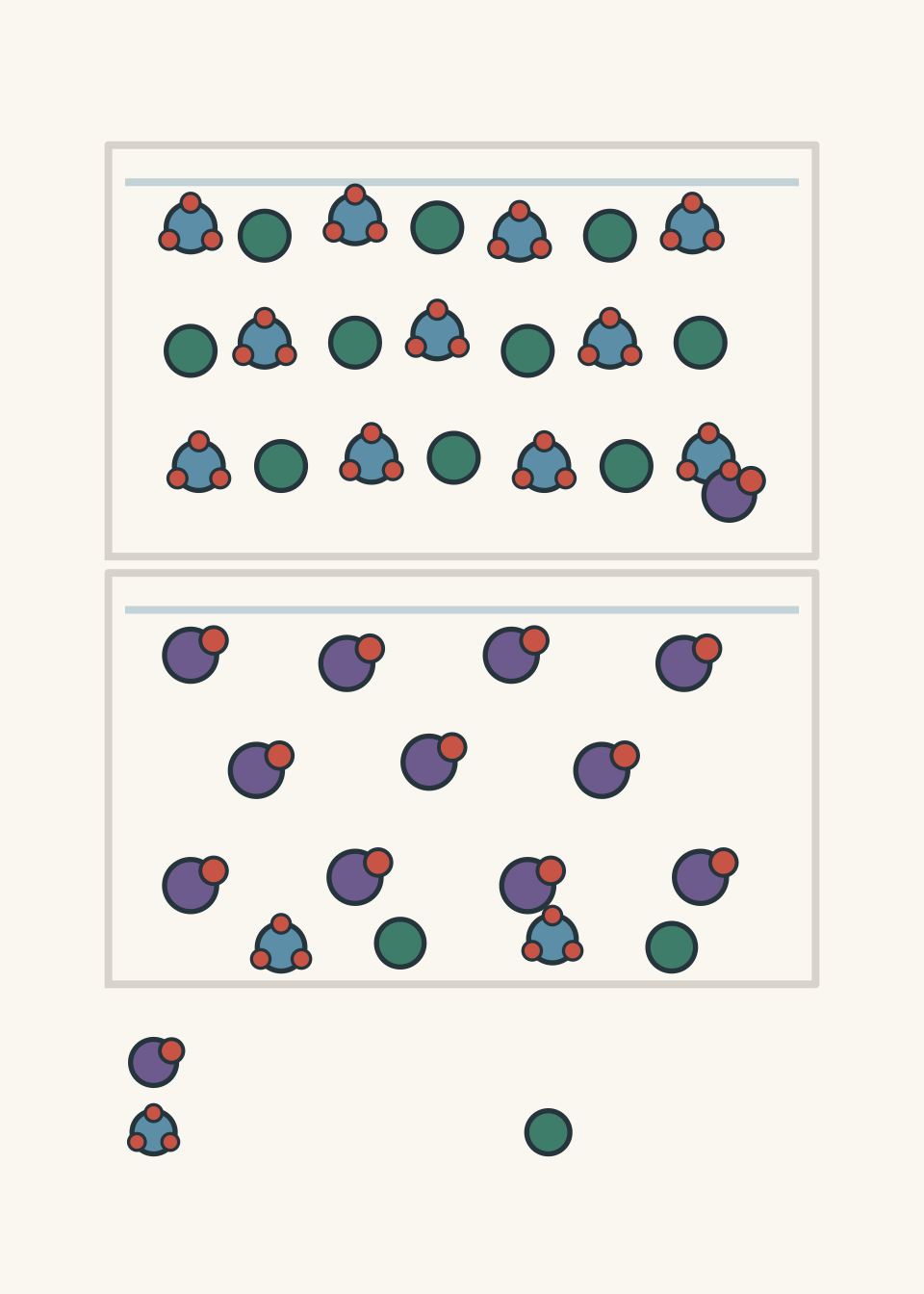
This gives a useful decision rule:
| Species | What happens in water? | Typical equation |
|---|---|---|
| Strong molecular acid | Ionises essentially completely | \(\ce{HA + H2O -> H3O+ + A-}\) |
| Weak molecular acid | Ionises partially | \(\ce{HA + H2O <=> H3O+ + A-}\) |
| Soluble ionic hydroxide | Existing ions separate | \(\ce{MOH -> M+ + OH-}\) |
| Weak molecular base | Accepts a proton from water | \(\ce{B + H2O <=> BH+ + OH-}\) |
This is one reason “strong” and “concentrated” must not be treated as synonyms. Strength describes the extent of ionisation or reaction with water; concentration tells you how much solute was added per volume. The distinction is developed further in Strong vs Weak, Concentrated vs Dilute Acids and Bases.
03Bases do not all produce hydroxide in the same way
Consider sodium hydroxide. It is an ionic solid containing \(\mathrm{Na}^{+}\) and \(\ce{OH-}\) ions already.
When it dissolves:
\[
\ce{NaOH(s) -> Na+(aq) + OH-(aq)}
\]
No proton transfer is needed to create the hydroxide ion. The solid simply separates into its ions.
Now predict what should happen with ammonia, \(\ce{NH3}\). Ammonia contains no oxygen, so it clearly cannot release a pre-existing \(\ce{OH-}\) ion.
Instead, ammonia accepts a proton from water:
\[
\ce{NH3(aq) + H2O(l) <=> NH4+(aq) + OH-(aq)}
\]
Water loses \(\mathrm{H}^{+}\), becoming \(\ce{OH-}\), while ammonia gains \(\mathrm{H}^{+}\), becoming \(\ce{NH4+}\).
That equation explains something the formula \(\ce{NH3}\) alone does not: a substance does not need to contain \(\ce{OH-}\) to behave as a base.
Worked example: Write the equation for ethanoic acid in water
Write an equation showing how ethanoic acid, \(\ce{CH3COOH}\), behaves in water.
Step 1
Ethanoic acid can donate the hydrogen from its \(\ce{-COOH}\) group. The species left after proton loss is the ethanoate ion, \(\ce{CH3COO-}\).
Step 2
Water accepts \(\mathrm{H}^{+}\), forming \(\ce{H3O+}\).
Step 3
Ethanoic acid is a weak acid, so its ionisation is only partial:
\[
\ce{CH3COOH(aq) + H2O(l) <=> H3O+(aq) + CH3COO-(aq)}
\]
The equilibrium arrow is not a decorative detail. It tells us that appreciable amounts of both \(\ce{CH3COOH}\) and its ions remain in the solution.
Worked example: Explain how ammonia makes a solution basic
Write the relevant equation for ammonia dissolved in water, and explain why the solution becomes basic.
Step 1
There is none. Treat ammonia as a proton acceptor instead.
Step 2
When \(\ce{NH3}\) accepts \(\mathrm{H}^{+}\), it becomes \(\ce{NH4+}\). Water becomes \(\ce{OH-}\):
\[
\ce{NH3(aq) + H2O(l) <=> NH4+(aq) + OH-(aq)}
\]
Step 3
The reaction increases the concentration of \(\ce{OH-}\), so the solution becomes basic.
Because ammonia is a weak base, the reaction does not proceed completely to the right. A substantial amount remains as \(\ce{NH3}\).
This is also a proton-transfer relationship between conjugate acid-base pairs. If those pairs are still feeling slippery, see Conjugate Acid-Base Pairs and Proton Transfer.
04Polyprotic acids lose protons one at a time
A monoprotic acid can donate one proton per molecule. A diprotic acid can donate two.
The common trap is to remove both protons in one giant step:
\[
\ce{H2A + 2H2O -> 2H3O+ + A^2-}
\]
That may balance overall, but it hides the actual acid-base chemistry. Proton transfer occurs stepwise.
For a generic diprotic acid, the first stage is:
\[
\ce{H2A(aq) + H2O(l) <=> H3O+(aq) + HA-(aq)}
\]
Then the species \(\ce{HA-}\) can donate another proton:
\[
\ce{HA-(aq) + H2O(l) <=> H3O+(aq) + A^2-(aq)}
\]
Notice what happened after the first step. The acid became negatively charged. Removing another positive proton from an already negative ion is generally less favourable, so successive ionisations become less extensive.
Sulfuric acid gives an important example. Its first proton is transferred essentially completely in aqueous solution:
\[
\ce{H2SO4(aq) + H2O(l) -> H3O+(aq) + HSO4-(aq)}
\]
Its second proton is not transferred completely:
\[
\ce{HSO4-(aq) + H2O(l) <=> H3O+(aq) + SO4^2-(aq)}
\]
So writing one equation that implies every \(\ce{H2SO4}\) molecule instantly produces two hydronium ions misses an important piece of chemistry.
Worked example: Write both ionisation stages of carbonic acid
Carbonic acid, \(\ce{H2CO3}\), is a weak diprotic acid. Write its two acid ionisation equations in water.
Step 1
Water accepts the proton, leaving hydrogen carbonate:
\[
\ce{H2CO3(aq) + H2O(l) <=> H3O+(aq) + HCO3-(aq)}
\]
Step 2
Hydrogen carbonate, \(\ce{HCO3-}\), can lose another proton:
\[
\ce{HCO3-(aq) + H2O(l) <=> H3O+(aq) + CO3^2-(aq)}
\]
Step 3
In the second equation, the total charge on the left is \(-1\). On the right it is \(+1 + (-2) = -1\). Charge is conserved.
Both arrows are equilibrium arrows because both ionisation stages are weak.
The second equation also reveals something interesting: \(\ce{HCO3-}\) can donate a proton. Elsewhere, it can accept one. That makes hydrogen carbonate amphiprotic.
05Four checks that catch most equation mistakes
Before accepting an acid-base equation, check four things.
1. Did the proton go somewhere?
Writing
\[
\ce{HCl -> H+ + Cl-}
\]
is convenient shorthand, but if the question asks what happens in water, the more complete proton-transfer equation is:
\[
\ce{HCl + H2O -> H3O+ + Cl-}
\]
2. Does the arrow match the strength?
Do not write an equilibrium arrow for a strong monoprotic acid simply because “all reactions are reversible at some level”. At HSC level, the equation should communicate the dominant chemistry clearly.
Similarly, do not give a weak acid or weak base a one-way arrow.
3. Are atoms and charge conserved?
Consider:
\[
\ce{H2CO3 + H2O <=> H3O+ + HCO3-}
\]
The total charge is zero on both sides.
For:
\[
\ce{Ca(OH)2(s) -> Ca^2+(aq) + 2OH-(aq)}
\]
the total charge on the right is \(+2 + 2(-1)=0\), matching the neutral solid.
The coefficient 2 in front of \(\ce{OH-}\) matters.
4. Are you separating dissociation from proton transfer?
For sodium hydroxide:
\[
\ce{NaOH(s) -> Na+(aq) + OH-(aq)}
\]
For ammonia:
\[
\ce{NH3(aq) + H2O(l) <=> NH4+(aq) + OH-(aq)}
\]
Both produce a basic solution, but the mechanism is not the same.
That distinction becomes especially useful when salts contain ions that can themselves react with water.
06Questions and solutions
Question 1
Nitric acid, \(\ce{HNO3}\), is a strong monoprotic acid.
Write its ionisation equation in water and identify the conjugate base formed.
Solution 1
Nitric acid ionises essentially completely to form hydronium and nitrate ions:
\[
\ce{HNO3(aq) + H2O(l) -> H3O+(aq) + NO3-(aq)}
\]
The conjugate base is \(\ce{NO3-}\).
\(\ce{HNO3}\) donates one proton to water, so water becomes \(\ce{H3O+}\). After losing that proton, nitric acid becomes \(\ce{NO3-}\).
A tempting mistake is to use an equilibrium arrow because acid-base reactions can be reversible. For HSC equations, however, the one-way arrow communicates that nitric acid is a strong acid and its ionisation in water is essentially complete.
Question 2
Two solutions are each prepared at the same initial solute concentration.
Solution A contains \(\ce{NaOH}\). Solution B contains \(\ce{NH3}\).
Write an equation for the process that produces \(\ce{OH-}\) in each solution. Explain why equal initial concentrations do not imply equal equilibrium \(\ce{OH-}\) concentrations.
Solution 2
\(\ce{NaOH}\) supplies hydroxide by ionic dissociation, while \(\ce{NH3}\) produces hydroxide by partially reacting with water.
For sodium hydroxide:
\[
\ce{NaOH(s) -> Na+(aq) + OH-(aq)}
\]
For ammonia:
\[
\ce{NH3(aq) + H2O(l) <=> NH4+(aq) + OH-(aq)}
\]
A soluble strong base such as \(\ce{NaOH}\) dissociates essentially completely. Each mole of dissolved \(\ce{NaOH}\) therefore gives approximately one mole of \(\ce{OH-}\).
Ammonia is a weak base. Only some ammonia molecules accept protons from water, so the equilibrium concentration of \(\ce{OH-}\) is much less than the initial ammonia concentration.
The tempting route is to notice that both solutions started at the same concentration and conclude that their \(\ce{OH-}\) concentrations must match. That ignores base strength. Concentration tells us how much solute was added; strength determines how extensively it forms ions through the relevant acid-base process.
Question 3
A student writes the following equation for sulfuric acid:
\[
\ce{H2SO4(aq) + 2H2O(l) -> 2H3O+(aq) + SO4^2-(aq)}
\]
The atoms and charge balance.
Explain why the equation is still an incomplete description of sulfuric acid in water, and replace it with two more informative equations.
Solution 3
Sulfuric acid should be represented as two successive proton-transfer stages because the first ionisation is essentially complete, while the second is only partial.
The first stage is:
\[
\ce{H2SO4(aq) + H2O(l) -> H3O+(aq) + HSO4-(aq)}
\]
The second stage is:
\[
\ce{HSO4-(aq) + H2O(l) <=> H3O+(aq) + SO4^2-(aq)}
\]
The student’s equation passes the basic balancing test, which is why it looks convincing. The problem is chemical rather than mathematical.
It implies that both protons are transferred completely. In reality, \(\ce{HSO4-}\) is itself an acid, but its further ionisation is not complete. The equilibrium arrow in the second equation records that distinction.
Balancing is therefore necessary, but it is not enough. A chemically correct equation must also represent the extent and sequence of the process.
Question 4
Ethanoic acid establishes the equilibrium:
\[
\ce{CH3COOH(aq) + H2O(l) <=> H3O+(aq) + CH3COO-(aq)}
\]
A small amount of sodium hydroxide is then added.
A student argues that the only relevant ionic equation is:
\[
\ce{H3O+(aq) + OH-(aq) -> 2H2O(l)}
\]
Another student writes:
\[
\ce{CH3COOH(aq) + OH-(aq) -> CH3COO-(aq) + H2O(l)}
\]
Which equation better describes the overall reaction of the added hydroxide with the weak acid? Explain how both equations are connected to the original acid equilibrium.
Solution 4
The better overall net ionic equation is:
\[
\ce{CH3COOH(aq) + OH-(aq) -> CH3COO-(aq) + H2O(l)}
\]
The hydronium-neutralisation equation is real:
\[
\ce{H3O+(aq) + OH-(aq) -> 2H2O(l)}
\]
However, a weak ethanoic acid solution contains mostly un-ionised \(\ce{CH3COOH}\), not a supply of \(\ce{H3O+}\) equal to the original acid concentration.
When added \(\ce{OH-}\) removes \(\ce{H3O+}\), the equilibrium
\[
\ce{CH3COOH + H2O <=> H3O+ + CH3COO-}
\]
responds by shifting to the right. More \(\ce{CH3COOH}\) ionises, replacing some of the consumed \(\ce{H3O+}\).
Combining that proton-transfer equilibrium with hydronium neutralisation gives the overall equation:
\[
\ce{CH3COOH + OH- -> CH3COO- + H2O}
\]
The tempting mistake is to treat the initial amount of \(\ce{H3O+}\) as the total amount of acid available to react. For a weak acid, most acid initially remains molecular, but it can ionise further as products are removed. The equilibrium and the neutralisation cannot be treated as unrelated events.
Question 5
Sodium hydrogen carbonate, \(\ce{NaHCO3}\), is dissolved in water. The final solution is mildly basic.
A student gives this explanation:
“\(\ce{NaHCO3}\) is a base, so when it dissociates it must release \(\ce{OH-}\).”
Another student writes:
\[
\ce{NaHCO3 -> Na+ + H+ + CO3^2-}
\]
Assess both explanations. Write the equations needed to describe what actually happens, including equations showing why \(\ce{HCO3-}\) can behave as either an acid or a base. Use the observed basic solution to decide which behaviour has the greater effect.
Solution 5
Neither explanation correctly describes the chemistry: \(\ce{NaHCO3}\) first dissociates into \(\mathrm{Na}^{+}\) and \(\ce{HCO3-}\), and the hydrogen carbonate ion then undergoes acid-base reactions with water. Its proton-accepting behaviour has the greater overall effect in this solution.
First, the ionic solid dissociates:
\[
\ce{NaHCO3(s) -> Na+(aq) + HCO3-(aq)}
\]
No hydroxide ion appears in this equation. The first student’s mistake is assuming that every base must contain and release \(\ce{OH-}\), just as ammonia does not need to contain \(\ce{OH-}\) to make a basic solution.
The hydrogen carbonate ion can accept a proton from water:
\[
\ce{HCO3-(aq) + H2O(l) <=> H2CO3(aq) + OH-(aq)}
\]
Here, \(\ce{HCO3-}\) acts as a base. The production of \(\ce{OH-}\) explains the observed basicity.
But \(\ce{HCO3-}\) can also donate a proton:
\[
\ce{HCO3-(aq) + H2O(l) <=> CO3^2-(aq) + H3O+(aq)}
\]
Here, the same ion acts as an acid.
The observation that the final solution is basic tells us that, under these conditions, the proton-accepting behaviour has the greater effect on the hydronium-hydroxide balance.
The second student’s equation,
\[
\ce{NaHCO3 -> Na+ + H+ + CO3^2-}
\]
is especially tempting because both atoms and charge can be made to balance. But it wrongly combines two different processes. Sodium hydrogen carbonate first separates into its existing ions. Any later proton transfer involving \(\ce{HCO3-}\) occurs through interaction with water, rather than by releasing a free proton directly into solution.
The deeper point is that an equation is not correct merely because it balances. It must also show the actual particles present and the chemical process connecting them.
This is the idea behind amphiprotic species: one particle can behave as an acid in one proton-transfer reaction and as a base in another. The next useful step is learning how to decide which behaviour dominates for salts such as hydrogen carbonate; that is developed in Amphiprotic Salts and Ionic Equations.