
Factors Affecting Reaction Rate: HSC Chemistry Explained
Learn how temperature, concentration, surface area, and catalysts change reaction rates using particle theory, data analysis, and worked examples.
A reaction can look like it should happen instantly, but it often does not. A piece of magnesium ribbon dropped into acid fizzes slowly at room temperature, yet the same reaction can become much faster if the acid is warmed or the magnesium is powdered.
Why?
The chemicals are already present. The particles are already moving. So why does the reaction rate change?

The answer comes down to how often reacting particles collide with enough energy to actually rearrange their atoms. Chemistry is not just about whether particles collide. It is about whether the collision is successful.
This idea explains why changing temperature, concentration, surface area, or adding a catalyst can speed up or slow down reactions.
01A simple particle model of reaction rate
Imagine two people trying to high-five in a crowded hallway. They need to be close enough, facing each other, and moving in the right way. Random movement alone does not guarantee a successful high-five.
Chemical particles behave in a similar way.
For a reaction to occur:
- Reacting particles must collide.
- The collision must have enough energy to break old bonds.
- The particles must collide in a suitable orientation.
The minimum energy needed for a successful collision is called the activation energy.
A simplified version of the idea is:
- More successful collisions each second → faster reaction.
- Fewer successful collisions each second → slower reaction.
The collision model is useful, but it is not the full story. Particles are not tiny billiard balls with perfectly predictable paths. Quantum effects, bond structures, and reaction pathways matter too. For HSC Chemistry, the collision model is the tool that helps explain observable changes in reaction rate.
02Predicting reaction speed
Suppose you have two identical pieces of calcium carbonate reacting with hydrochloric acid.
One piece is a large marble chip. The other is crushed into powder.
Before reading further, predict:
Which one should react faster, and why?
The powdered calcium carbonate reacts faster. The chemical formula is the same, but the powder exposes a much larger surface area. More acid particles can touch the calcium carbonate at the same time, creating more possible collisions.
The reaction is:
\[ \ce{CaCO3(s) + 2HCl(aq) -> CaCl2(aq) + CO2(g) + H2O(l)} \]
The amount of calcium carbonate has not changed. The type of particles has not changed. Only the amount of exposed surface has changed.
03Factor 1: Surface area
Surface area affects how many particles are available for collisions.
A large block of a solid has particles inside that cannot directly touch reactant particles. Only particles at the surface can collide.
Crushing a solid creates more exposed surface.

A useful mental picture is a chocolate bar.
A whole block has fewer exposed edges. Breaking it into many small pieces gives more outside area for contact. The chocolate analogy breaks down because chocolate is not reacting with another chemical, but the idea of increased exposed area is useful.
Worked example: Comparing reaction rates using surface area
A student reacts 5.0 g of calcium carbonate with excess hydrochloric acid. The student records the volume of carbon dioxide produced.
Large chips:
- 10 mL of carbon dioxide after 30 seconds
Powder:
- 42 mL of carbon dioxide after 30 seconds
Which sample has the faster reaction rate?
Step 1
The mass of calcium carbonate and the acid amount are the same. The only change is surface area.
Step 2
A faster reaction produces more product in the same time.
The powder produces:
\[ 42 \text{ mL CO}_2 > 10 \text{ mL CO}_2 \]
after 30 seconds.
Step 3
The powdered calcium carbonate has more exposed surface area, so more acid particles can collide with carbonate particles each second.
Conclusion: The powdered calcium carbonate has the faster reaction rate because its larger surface area allows more successful collisions per second.
04Factor 2: Concentration
Concentration describes how much solute is present in a certain volume of solution.
A more concentrated solution contains more reactant particles in the same space.
Imagine a crowded dance floor. If twice as many people are in the same area, accidental bumps happen more often.
The same principle applies to particles in solution.

Before reading the explanation, predict:
If a reaction mixture is made more concentrated, does each particle become more energetic?
No. The particles do not become faster. Instead, there are more particles in the same volume, so collisions happen more frequently.
For example, increasing hydrochloric acid concentration increases the number of \(\mathrm{H}^{+}\) ions available to collide with a metal such as magnesium.
The rate increases because the frequency of successful collisions increases.
05Factor 3: Temperature
Heating a reaction mixture does two things.
First, particles move faster.
Second, a greater proportion of particles have enough energy to overcome the activation energy barrier.

A common prediction is:
“If particles only move a little faster, the reaction should only speed up a little.”
That sounds reasonable, but the effect is often much larger because of the activation energy barrier.
A small temperature increase can move many more particles into the group capable of successful collisions.
06Factor 4: Catalysts
A catalyst increases reaction rate without being used up overall.
It works by providing an alternative reaction pathway with a lower activation energy.
Think of climbing over a hill. A catalyst does not make the hill shorter by changing the start and finish points. It creates a tunnel through the hill.
The reactants and products remain the same.
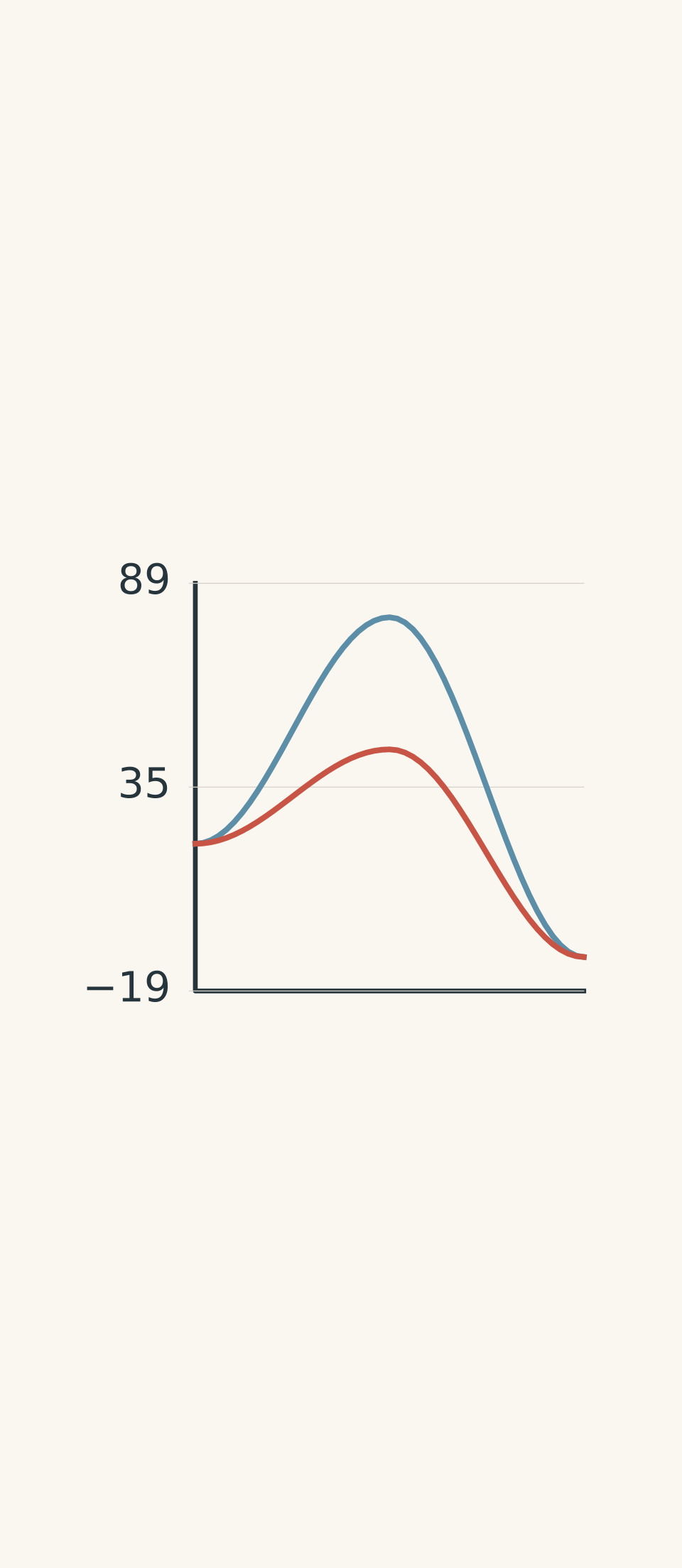
A catalyst does not:
- increase the amount of reactant,
- increase particle speed,
- increase the energy of individual collisions.
It increases the number of collisions that can successfully lead to products.
07Comparing the four factors
| Factor changed | What happens to particles? | Why reaction rate changes |
|---|---|---|
| Surface area increases | More particles are exposed | More collision opportunities |
| Concentration increases | More reactant particles in the same volume | More frequent collisions |
| Temperature increases | Particles move faster, and more exceed activation energy | More successful collisions |
| Catalyst added | A lower-energy pathway is available | More collisions become successful |
08Measuring reaction rate
Chemists often measure rate by tracking how quickly a reactant disappears or a product forms.
For example, if a gas is produced:
\[ \text{Reaction rate} = \frac{\text{change in gas volume}}{\text{time}} \]
The units depend on the measurement.
If carbon dioxide volume changes by 60 mL in 20 seconds:
\[ \text{Rate} = \frac{60 \text{ mL}}{20 \text{ s}} \]
\[ = 3.0 \text{ mL s}^{-1} \]
The rate tells us how quickly the observable change occurs, not how much product is eventually made.
09Worked example: Finding a reaction rate
A student measures oxygen production from a reaction and collects 150 mL of oxygen in 50 seconds.
Calculate the average reaction rate.
Step 1
\[ \text{Rate} = \frac{\text{change in product amount}}{\text{time}} \]
Step 2
\[ \text{Rate} = \frac{150 \text{ mL}}{50 \text{ s}} \]
Step 3
\[ \text{Rate} = 3.0 \text{ mL s}^{-1} \]
Step 4
The reaction produces oxygen at an average rate of 3.0 mL every second during this time interval.
10Worked example: Explaining multiple changes
A reaction between zinc and hydrochloric acid is repeated. In experiment A, the zinc pieces are larger and the acid concentration is lower. In experiment B, the zinc is powdered and the acid concentration is higher.
Which experiment should react faster?
Step 1
Two factors increase the expected rate:
- Powdered zinc increases surface area.
- Higher acid concentration increases collision frequency.
Step 2
Powdered zinc gives more exposed zinc particles for collisions.
Higher acid concentration gives more acid particles available to collide.
Step 3
Both changes increase the number of successful collisions each second.
Conclusion: Experiment B should have the faster reaction rate because both increased surface area and increased concentration favour faster reactions.
11Questions and solutions
Question 1
A student reacts magnesium ribbon with hydrochloric acid. They cut the same mass of magnesium into smaller pieces before repeating the experiment.
Explain why the second reaction is faster.
Solution 1
The second reaction is faster because the smaller magnesium pieces have a greater surface area.
Breaking the magnesium into smaller pieces exposes more magnesium particles to the hydrochloric acid. This increases the number of possible collisions between magnesium and acid particles each second.
The magnesium particles do not become more energetic. The improvement comes from having more contact between reactants.
Question 2
Two experiments measure the rate of carbon dioxide production from calcium carbonate and hydrochloric acid.
| Experiment | Calcium carbonate | Acid concentration | CO₂ produced after 60 s |
|---|---|---|---|
| A | Large chips | 1.0 mol L\(^{-1}\) | 35 mL |
| B | Powder | 1.0 mol L\(^{-1}\) | 120 mL |
Explain why experiment B produces more carbon dioxide in the same time.
Solution 2
Experiment B produces more carbon dioxide because the powdered calcium carbonate has a larger surface area.
Both experiments have the same acid concentration, so the concentration effect is controlled. The difference is the physical form of calcium carbonate.
The powder exposes more carbonate particles, increasing the frequency of successful collisions:
\[ \ce{CaCO3 + 2HCl -> CaCl2 + CO2 + H2O} \]
More successful collisions per second means carbon dioxide is produced faster.
Question 3
A reaction mixture is heated from 20°C to 40°C. A student says:
“The particles are only twice as hot, so the reaction rate should double.”
Evaluate this explanation.
Solution 3
The explanation is incorrect because temperature does not simply double the reaction rate.
Increasing temperature increases the average kinetic energy of particles and increases the fraction of particles with energy above the activation energy.
The important change is not only that particles move faster. More collisions become successful.
The exact rate increase depends on the reaction because different reactions have different activation energies.
Question 4
A catalyst is added to a reaction. The final amount of product after the reaction finishes is unchanged, but the product forms faster.
Explain how this is possible.
Solution 4
The catalyst speeds up the reaction by lowering the activation energy, but it does not change the amount of product possible.
The reactants still contain the same atoms, and the products are still made from those atoms. The catalyst changes the pathway, not the final chemical quantities.
The common mistake is thinking a catalyst creates more product. It only allows the system to reach the same final state faster.
Question 5
A student investigates the reaction:
\[ \ce{Mg(s) + 2HCl(aq) -> MgCl2(aq) + H2(g)} \]
They compare two experiments.
Experiment A:
- 2.0 g magnesium ribbon
- 25 mL of 2.0 mol L\(^{-1}\) hydrochloric acid
- temperature: 20°C
Experiment B:
- 2.0 g powdered magnesium
- 25 mL of 1.0 mol L\(^{-1}\) hydrochloric acid
- temperature: 40°C
The student predicts experiment B must be fastest because it is hotter and has a larger surface area.
Is this conclusion always correct? Explain the reasoning needed before deciding.
Solution 5
The conclusion is not always correct because the three changing factors affect the reaction in competing ways.
Experiment B has advantages:
- Higher temperature increases particle energy and the number of successful collisions.
- Powdered magnesium increases surface area and collision opportunities.
However, experiment B has a lower hydrochloric acid concentration. That means fewer acid particles are available in the same volume, reducing collision frequency.
The tempting route is to count the number of factors that increase rate and declare B faster. That ignores that factors do not all have equal effects. A small temperature increase may have a larger effect than a concentration decrease, or the reverse may occur depending on the reaction conditions.
To determine which experiment is actually faster, the student must collect rate data, such as hydrogen volume produced over time.
The key idea is that reaction rate is controlled by the total number of successful collisions, and several factors can influence that number at the same time.
Understanding reaction rates gives you the foundation for the next step: using equilibrium ideas to predict what happens when reaction conditions are changed after a system has already started.