
Collision Theory and Equilibrium Shifts: HSC Chemistry Explained
Learn how collision theory explains changes in reaction rates and equilibrium. Explore activation energy, temperature, catalysts, and competing changes through clear explanations and worked HSC Chemistry examples.
Heat a mixture at equilibrium containing \(\ce{N2O4(g) <=> 2NO2(g)}\), and it becomes darker brown. Add a catalyst to a separate equilibrium mixture, and the reaction reaches equilibrium sooner but ends with the same composition. Both changes affect reaction rates. Why does heating change the final mixture while a catalyst does not?
Predict before reading on: does heating make the forward reaction faster while slowing the reverse reaction, or does it speed up both? Both rates increase, but not necessarily by the same proportion. That difference can temporarily favour one direction and shift the equilibrium. A catalyst, by contrast, speeds up the approach to equilibrium without changing the equilibrium composition.
Understanding why requires connecting collision theory to activation energy, heat of reaction, and the changing rates of reversible reactions.
01Collision theory: why some collisions cause reactions
Imagine two molecules colliding. Have they reacted?
Not necessarily. They might collide and separate unchanged. For a reaction to occur, the particles generally need two things:
- Enough energy to overcome the reaction’s activation energy.
- A suitable orientation so that the necessary bonds can break and form.
Activation energy, \(E_a\), is the energy barrier that particles must overcome along a reaction pathway.
Think of it like trying to step over a garden fence. Colliding with the fence isn’t enough; you need enough energy to get over it. A lower fence makes success easier.
The analogy has a limit: molecules do not literally jump over a physical barrier. Activation energy represents an energy requirement along the reaction pathway.
Collision theory gives us three important ways to change a reaction rate.
- Increase concentration: particles are more crowded, so collisions generally happen more frequently.
- Increase temperature: particles move faster, and a greater fraction have enough energy to overcome the activation energy.
- Add a catalyst: an alternative reaction pathway becomes available with a lower activation energy, allowing a greater fraction of collisions to be successful.
Temperature and a catalyst can both increase the number of successful collisions per second, but they do so differently. Temperature changes the distribution of particle energies. A catalyst changes the available reaction pathway.
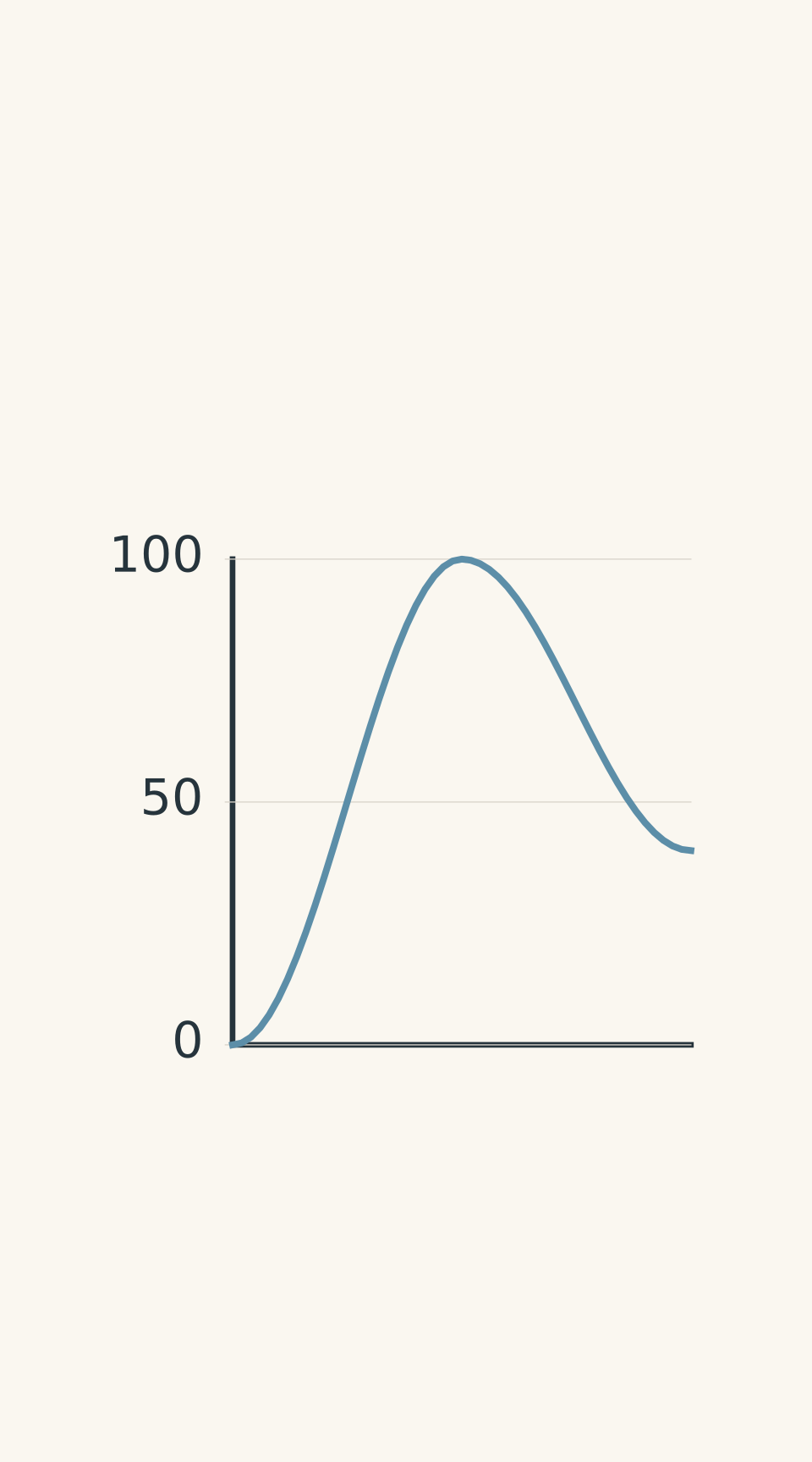
- Reaction pathway
The energy profile shows why activation energy matters in reversible reactions. For an endothermic forward reaction, the products sit at a higher energy than the reactants. The forward activation energy is therefore greater than the reverse activation energy for this pathway.
The relationship is:
\[ \Delta H=E_{a,\text{forward}}-E_{a,\text{reverse}} \]
Here, \(\Delta H\) is the enthalpy change for the reaction as written, measured in \(\text{kJ mol}^{-1}\). A positive value means the forward reaction is endothermic; a negative value means it is exothermic.
This relationship will become important when we examine what happens to equilibrium after heating.
02Dynamic equilibrium: equal rates, not stopped reactions
Consider a reversible reaction:
\[ \ce{A(g) <=> B(g)} \]
The forward reaction converts A into B. The reverse reaction converts B into A.
At equilibrium, both reactions are still occurring. The system is in dynamic equilibrium because the forward and reverse reactions happen at equal rates.
\[ r_{\text{forward}}=r_{\text{reverse}} \]
The symbols \(r_{\text{forward}}\) and \(r_{\text{reverse}}\) represent the forward and reverse reaction rates.
Equal rates do not mean equal concentrations. You could have much more A than B at equilibrium, or much more B than A. What matters is that the two directions balance.
Now imagine that something disturbs the system. The concentrations or temperature change, and the forward and reverse rates may no longer be equal.
If the forward rate becomes greater than the reverse rate, there is a net conversion of A into B. As the concentrations change, the two rates adjust until they become equal again.
This gives us a useful rule for HSC Chemistry:
To explain an equilibrium shift, identify which direction initially becomes faster, then explain how the system reaches a new equilibrium.
03Temperature: both rates increase, but one gains more
Temperature changes are particularly interesting because they affect both directions of a reversible reaction.
When a reaction mixture is heated, particles have greater average kinetic energy. More importantly, a greater fraction of particles have enough energy to overcome the activation energy.
Both the forward and reverse rates increase immediately after heating, provided the concentrations have not yet changed.
But here is the crucial detail: the two rates do not necessarily increase by the same proportion.
In the standard HSC energy-profile model, the direction with the larger activation energy has the greater proportional increase in rate when temperature rises.
What does this mean for an endothermic reaction?
Consider the equilibrium:
\[ \ce{N2O4(g) <=> 2NO2(g)} \]
The forward reaction is endothermic, with an enthalpy change of approximately \(+57\ \text{kJ mol}^{-1}\).
The forward activation energy is greater than the reverse activation energy. When the mixture is heated, both rates increase, but the forward rate increases by a greater proportion.
Immediately after heating:
\[ r_{\text{forward}}>r_{\text{reverse}} \]
More \(\ce{N2O4}\) decomposes to form \(\ce{NO2}\). The equilibrium shifts to the right, and the mixture becomes darker brown because \(\ce{NO2}\) is brown.
As the reaction proceeds, the concentration of \(\ce{N2O4}\) decreases and the concentration of \(\ce{NO2}\) increases. The forward rate falls relative to its immediate post-heating value, while the reverse rate rises. Eventually, the rates become equal again.
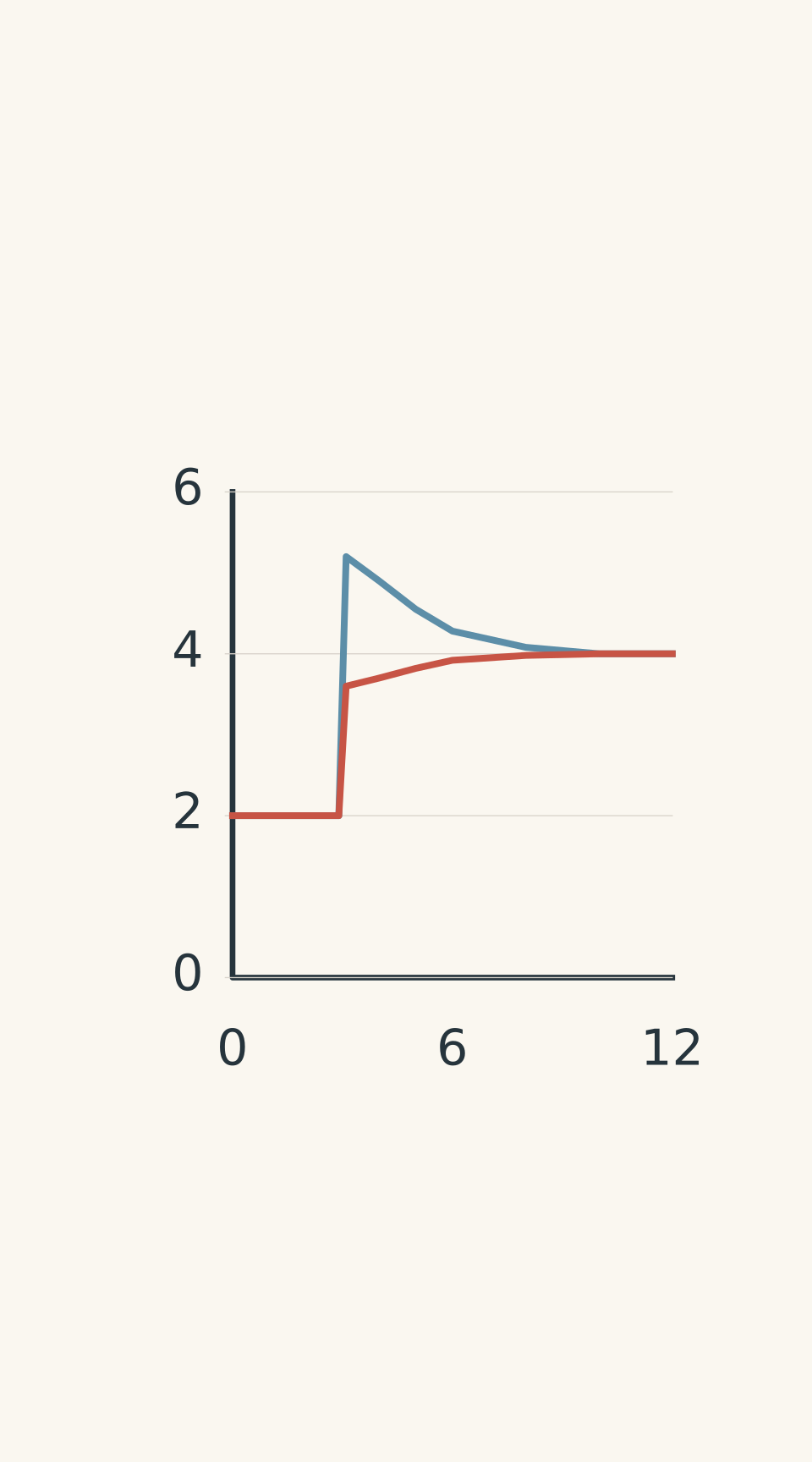
- Forward rate
- Reverse rate
Notice what the graph tells you. The forward rate does not remain greater forever. The temporary imbalance causes the shift; equal rates are restored at the new equilibrium.
What about an exothermic forward reaction?
The reverse direction is now endothermic. In the standard energy-profile model, the reverse activation energy is greater than the forward activation energy.
Heating therefore favours the reverse direction. The equilibrium shifts to the left.
You can organise the temperature rules like this:
| Change | Direction favoured |
|---|---|
| Increase temperature | Endothermic direction |
| Decrease temperature | Exothermic direction |
A useful bookkeeping model is to treat heat as a reactant in an endothermic reaction and as a product in an exothermic reaction. This is not claiming that heat is a chemical particle. It simply helps you predict the effect of changing temperature.
Remember that heating does not slow one reaction direction down. It increases both rates; the difference in their relative responses produces the shift.
04Concentration and pressure: changing collision frequency
Temperature changes the energy distribution of particles. Changing concentration primarily changes how frequently particles encounter one another.
Changing concentration
Suppose a system at equilibrium has some reactant added.
The forward rate generally increases immediately because the reactant concentration has increased. If the product concentration has not changed, the reverse rate is initially unchanged.
The forward rate is now greater than the reverse rate, so the system shifts towards products.
The same reasoning works in reverse. If a product is removed, the reverse rate initially decreases, allowing the forward reaction to dominate until equilibrium is restored.
The key is to distinguish the immediate response from the final state.
Changing pressure in a gaseous equilibrium
For gases, reducing the volume increases the concentration of every gaseous species. This generally increases collision frequency and changes both directional reaction rates.
Consider the reaction:
\[ \ce{2SO2(g) + O2(g) <=> 2SO3(g)} \]
There are three moles of gaseous reactants for every two moles of gaseous products in the balanced equation.
If the volume is reduced at constant temperature, the equilibrium shifts to the right, towards the side with fewer moles of gas. The net reaction forms more \(\ce{SO3}\) until the forward and reverse rates become equal again.
There is an important limit to the collision-theory explanation here. A balanced chemical equation tells you the overall stoichiometry, but it does not necessarily reveal the reaction mechanism or the exact rate law. You cannot calculate the precise change in reaction rate just by reading the coefficients in the equation.
For HSC equilibrium questions, use the standard pressure rule:
- Compression favours the side with fewer moles of gas.
- Expansion favours the side with more moles of gas.
- If both sides have the same total number of gaseous moles, changing pressure does not shift the equilibrium position.
These rules apply to changes in pressure caused by changing volume at constant temperature. Adding an inert gas at constant volume, for example, does not change the partial pressures of the reacting gases and does not shift the equilibrium.
05Catalysts: a faster route, not a different destination
A catalyst lowers the activation energy by providing an alternative reaction pathway.
This increases the proportion of collisions that can lead to reaction. Both the forward and reverse reactions are catalysed, so both can proceed faster.
Notice what does not change in the diagram. The energy levels of the reactants and products remain the same, so the enthalpy change, \(\Delta H\), is unchanged.
The catalyst also does not change the equilibrium constant at a given temperature. It changes how quickly equilibrium is reached, not the equilibrium composition.
Suppose a reaction mixture is already at equilibrium when a catalyst is added. The forward and reverse rates increase, but they remain equal. There is no net shift.
If the system is not at equilibrium, the catalyst speeds up the approach to equilibrium in whichever net direction the existing conditions favour.
This is a common HSC misconception: a catalyst does not favour the forward reaction simply because it makes reactions faster. It speeds up both directions.
Quick comparison
| Change | Immediate effect on rates | Does \(K_c\) change? |
|---|---|---|
| Add a reactant | Forward rate generally increases first | No |
| Compress a gaseous mixture | Both directional rates generally change | No |
| Increase temperature | Both rates increase | Yes |
| Add a catalyst | Both directions become faster | No |
Here, \(K_c\) is the equilibrium constant expressed using concentrations. It depends on temperature, not on the presence of a catalyst or a temporary concentration disturbance.
06When changes compete, compare \(Q_c\) with \(K_c\)
The rules above are useful when one condition changes at a time. But what if temperature and pressure change together?
One change might favour the forward reaction while the other favours the reverse reaction. Applying each rule separately does not necessarily tell you the final direction.
This is where the reaction quotient, \(Q_c\), becomes useful.
For the reaction
\[ \ce{2A(g) <=> B(g)} \]
the reaction quotient is
\[ Q_c=\frac{[B]}{[A]^2} \]
The square on \([A]\) comes from its coefficient of 2 in the balanced equation. The square brackets represent molar concentrations.
The expression for \(K_c\) has the same form, but \(K_c\) uses the equilibrium concentrations at a particular temperature. By contrast, \(Q_c\) uses the system’s current concentrations, whether or not it is at equilibrium.
Compare \(Q_c\) with \(K_c\) at the current temperature:
- If \(Q_c<K_c\), the system proceeds in the forward direction.
- If \(Q_c>K_c\), the system proceeds in the reverse direction.
- If \(Q_c=K_c\), the system is at equilibrium.
For a single disturbance, Le Chatelier’s principle is often the quickest way to predict the shift. For competing disturbances, comparing \(Q_c\) and \(K_c\) provides a more reliable decision rule. You can read more about the shift predictions in tutorgum’s guide to Le Chatelier’s Principle.
Keep the distinction clear: concentration and pressure changes alter \(Q_c\), while temperature changes \(K_c\). A catalyst changes neither.
07Worked examples
Worked example: Heating an endothermic equilibrium
At equilibrium, a mixture contains \(\ce{N2O4(g)}\) and \(\ce{NO2(g)}\), according to
\[ \ce{N2O4(g) <=> 2NO2(g)} \]
The forward reaction has \(\Delta H=+57\ \text{kJ mol}^{-1}\). The mixture is heated at constant volume. Predict the immediate rate changes, the direction of the shift, and the final rate relationship.
Step 1
The positive enthalpy change means the forward reaction is endothermic. Its activation energy is greater than that of the reverse reaction in the standard energy-profile model.
Step 2
Heating increases the rates of both directions because a greater fraction of particles can overcome their activation energies. The forward rate increases by a greater proportion.
Therefore, immediately after heating,
\[ r_{\text{forward}}>r_{\text{reverse}} \]
Step 3
The forward reaction dominates temporarily, converting \(\ce{N2O4}\) into \(\ce{NO2}\). The equilibrium shifts to the right, and the mixture becomes darker brown.
Step 4
As the concentrations change, the forward and reverse rates move towards equality. At the new equilibrium, the rates are equal again, but the equilibrium composition differs from the original mixture.
The important point is that the shift results from a temporary rate imbalance, not from one reaction direction stopping.
Worked example: Calculating the reverse activation energy
A reversible reaction has a forward enthalpy change of \(-35\ \text{kJ mol}^{-1}\) and a forward activation energy of \(52\ \text{kJ mol}^{-1}\).
Calculate the reverse activation energy and predict which direction is favoured when the system is heated at constant volume.
Step 1
For the same reaction pathway,
\[ \Delta H=E_{a,\text{forward}}-E_{a,\text{reverse}} \]
Rearrange to make the reverse activation energy the subject:
\[ E_{a,\text{reverse}} =E_{a,\text{forward}}-\Delta H \]
Step 2
\[ \begin{aligned} E_{a,\text{reverse}} &=52-(-35)\\ &=52+35\\ &=87\ \text{kJ mol}^{-1} \end{aligned} \]
The reverse activation energy is \(87\ \text{kJ mol}^{-1}\).
Step 3
The forward reaction is exothermic, so the reverse reaction is endothermic. The reverse activation energy is larger, meaning its rate constant is more sensitive to temperature in the standard energy-profile model.
When the mixture is heated, both rates increase, but the reverse rate increases by a greater proportion. The equilibrium therefore shifts to the left.
At the new equilibrium, the rates become equal again. They do not have to return to their original values.
08Questions and solutions
Question 1
At equilibrium, the reaction
\[ \ce{H2(g) + I2(g) <=> 2HI(g)} \]
is disturbed by adding some \(\ce{H2}\) at constant temperature and volume.
Explain the immediate changes to the forward and reverse rates, and predict the direction of the equilibrium shift.
Solution 1
The equilibrium shifts to the right, producing more \(\ce{HI}\).
Adding \(\ce{H2}\) increases the reactant concentration, so the forward rate increases immediately. The reverse rate is initially unchanged because the concentration of \(\ce{HI}\) has not yet changed.
The forward rate is now greater than the reverse rate, creating a net forward reaction. As \(\ce{H2}\) is consumed and \(\ce{HI}\) forms, the rates adjust until they become equal again.
The equilibrium constant remains unchanged because the temperature is constant.
Question 2
Consider the gaseous equilibrium
\[ \ce{2SO2(g) + O2(g) <=> 2SO3(g)} \]
At equilibrium, the volume of the reaction vessel is halved while the temperature remains constant.
Explain the expected equilibrium shift and whether \(K_c\) changes. Can the exact factor by which each reaction rate changes be calculated from the balanced equation alone?
Solution 2
The equilibrium shifts to the right, and \(K_c\) remains unchanged.
First, consider the pressure change. Halving the volume increases the concentration of every gaseous species, increasing collision frequency and generally increasing both directional rates.
There are three moles of gas on the reactant side and two on the product side. The net response favours the side with fewer gaseous moles, so more \(\ce{SO3}\) forms as equilibrium is restored.
Next, consider the equilibrium constant. Since the temperature has not changed, \(K_c\) stays the same. The concentrations change, but the equilibrium condition at that temperature does not.
Finally, the balanced equation alone cannot provide the exact numerical rate changes. It describes the overall reaction, not necessarily its elementary steps or rate law. Collision theory explains why the rates change, while the equilibrium principle predicts the direction of the net shift.
Question 3
A mixture containing \(\ce{A(g)}\) and \(\ce{B(g)}\) is at equilibrium:
\[ \ce{A(g) <=> B(g)} \]
A small amount of A is added at constant temperature and volume. Before the concentrations have time to readjust, a catalyst is added.
Explain the initial net direction of reaction, the effect of the catalyst on the rates, and the final equilibrium composition compared with an otherwise identical mixture that receives no catalyst.
Solution 3
The system initially proceeds towards B, and the catalyst makes it reach equilibrium faster without changing the final equilibrium composition.
Adding A increases the forward rate immediately, while the reverse rate is initially unchanged. The forward rate therefore exceeds the reverse rate, producing a net forward reaction.
The catalyst lowers the activation energy for both directions. It increases the rates, but it does not change the equilibrium constant or reverse the net direction favoured by the current conditions.
As the reaction proceeds, the concentrations adjust until the forward and reverse rates are equal again. The final equilibrium composition is the same as that of the mixture receiving the same addition of A without a catalyst.
The difference is the time taken to reach equilibrium, not the equilibrium position.
Question 4
For a reversible reaction \(\ce{A(g) <=> B(g)}\), the forward and reverse rates are initially both \(8.0\ \text{mol L}^{-1}\text{ s}^{-1}\) at equilibrium.
The temperature is suddenly increased at constant volume. Before the concentrations have time to change, the forward rate becomes \(20.0\ \text{mol L}^{-1}\text{ s}^{-1}\), and the reverse rate becomes \(28.0\ \text{mol L}^{-1}\text{ s}^{-1}\).
Assume the standard HSC energy-profile model, with the measured proportional changes reflecting the temperature sensitivity of the activation energies.
Determine:
(a) The initial net direction of reaction.
(b) Whether the forward reaction is endothermic or exothermic.
(c) Why the rates must become equal again, even though their new values need not return to \(8.0\ \text{mol L}^{-1}\text{ s}^{-1}\).
Solution 4
The initial net reaction is in the reverse direction, and the forward reaction is exothermic.
(a) Determine the net direction.
Immediately after heating, the reverse rate is \(28.0\ \text{mol L}^{-1}\text{ s}^{-1}\), while the forward rate is \(20.0\ \text{mol L}^{-1}\text{ s}^{-1}\).
Since the reverse rate is greater, the system initially shifts to the left, converting B into A.
(b) Infer the heat of reaction.
Calculate the proportional increase in each rate.
For the forward reaction:
\[ \frac{20.0}{8.0}=2.5 \]
For the reverse reaction:
\[ \frac{28.0}{8.0}=3.5 \]
The forward rate increases by a factor of \(2.5\), while the reverse rate increases by a factor of \(3.5\).
Under the stated model, the reverse direction has the greater activation energy and is therefore more temperature-sensitive. It is the endothermic direction, so the forward reaction must be exothermic.
Hence, \(\Delta H<0\) for the forward reaction.
(c) Explain the new equilibrium.
The reverse reaction initially produces more A and consumes B. The increasing concentration of A supports the forward reaction, while the decreasing concentration of B reduces the reverse rate.
The rates eventually become equal again at the new equilibrium. They do not need to return to their original values because the temperature and equilibrium composition have changed.
The key inference is that both rates increased on heating, but the reverse rate increased by a greater proportion, revealing which direction was favoured.
Question 5
Consider the gaseous equilibrium
\[ \ce{2A(g) <=> B(g)} \]
The forward reaction is endothermic.
At temperature \(T_1\), the system is at equilibrium with:
\[ [A]=1.0\ \text{mol L}^{-1} \]
\[ [B]=4.0\ \text{mol L}^{-1} \]
The equilibrium constant at \(T_1\) is therefore \(K_c=4.0\ \text{L mol}^{-1}\).
The volume is suddenly halved at the same time as the system is cooled to temperature \(T_2\). At the lower temperature, the equilibrium constant is \(K_c=1.0\ \text{L mol}^{-1}\).
Assume the concentration changes occur before any significant reaction takes place. A catalyst is then added immediately.
Determine the net direction of reaction after all three changes. Explain why applying the pressure rule alone gives the wrong answer, and state the effect of the catalyst.
Solution 5
The net reaction proceeds in the reverse direction, converting B into A. Compression alone would favour the forward direction, but cooling changes the equilibrium constant enough to reverse the final prediction.
Step 1: Calculate the concentrations immediately after compression.
Halving the volume doubles the concentration of each gas, assuming no reaction occurs during the change.
Therefore,
\[ [A]=2.0\ \text{mol L}^{-1} \]
\[ [B]=8.0\ \text{mol L}^{-1} \]
These are the concentrations immediately after compression and cooling, before the composition has had time to change through reaction.
Step 2: Calculate the new reaction quotient.
For the reaction as written,
\[ Q_c=\frac{[B]}{[A]^2} \]
Substituting the new concentrations gives:
\[ \begin{aligned} Q_c&=\frac{8.0}{(2.0)^2}\\ &=\frac{8.0}{4.0}\\ &=2.0\ \text{L mol}^{-1} \end{aligned} \]
The reaction quotient is \(2.0\ \text{L mol}^{-1}\).
Step 3: Compare \(Q_c\) with the equilibrium constant at the new temperature.
Cooling favours the exothermic direction, which is the reverse reaction. The given value \(K_c=1.0\ \text{L mol}^{-1}\) is consistent with the lower equilibrium constant for the endothermic forward reaction at the lower temperature.
Now compare the values:
\[ Q_c=2.0>K_c=1.0 \]
There is too much product relative to the equilibrium condition at \(T_2\). The net reaction must proceed in the reverse direction, consuming B and producing A until \(Q_c=K_c\).
Step 4: Explain why the pressure rule alone fails.
Compression favours the side with fewer moles of gas. The right side contains one mole of gas per reaction as written, while the left contains two, so compression alone would favour the forward reaction.
However, that prediction assumes the temperature is unchanged. Here, cooling also occurs, and the forward reaction is endothermic. The equilibrium constant decreases from \(4.0\) to \(1.0\ \text{L mol}^{-1}\), changing the condition the mixture must satisfy at equilibrium.
Comparing \(Q_c\) with the new \(K_c\) accounts for both changes together. It gives the reverse direction, despite the forward shift that compression alone would cause.
Step 5: Explain the catalyst’s role.
The catalyst lowers the activation energy for both directions and speeds up the approach to equilibrium. It does not change \(Q_c\), \(K_c\), or the net direction required by the current conditions.
The system therefore continues towards the reverse equilibrium, but reaches it faster than it would without the catalyst.
This is the central distinction to carry into equilibrium calculations: collision theory explains how reaction rates respond to a disturbance, while comparing \(Q_c\) with \(K_c\) determines the net direction when several changes compete.