
Bond Polarity and Electronegativity: HSC Chemistry Guide
Learn how electronegativity and periodic table trends determine bond polarity. Compare bonds, calculate electronegativity differences, and avoid common HSC misconceptions.
Two atoms form a covalent bond by sharing electrons. But “sharing” can be misleading. If fluorine bonds to hydrogen, the electrons are shared, but fluorine gets much more of their attention. If two fluorine atoms bond, neither one has an advantage.
So here is the useful question: how can you predict whether a bond shares electrons evenly, slightly unevenly, or extremely unevenly just from the elements involved?
Before reading on, compare an \(\ce{H-F}\) bond with an \(\ce{H-I}\) bond. Which one would you expect to have the more uneven electron distribution?
It is \(\ce{H-F}\). The reason comes from where fluorine and iodine sit in the periodic table, and from a property called electronegativity.
01Start with uneven sharing
Picture a covalent bond as two people sharing one blanket. If both pull with about the same strength, the blanket stays roughly centred. If one person pulls much harder, most of the blanket ends up on their side.
The blanket represents the bonding electrons. Each person’s pull represents an atom’s attraction for those electrons.
It is a useful picture, but it is only a model. Electrons are not pieces of fabric sitting at one point. A bond involves a distribution of electron density between nuclei. “Pulling the blanket” is just a way to picture one atom attracting that electron density more strongly.
When two atoms attract the bonding electrons equally, or almost equally, the bond is non-polar or only very weakly polar.
When one atom attracts the bonding electrons more strongly, electron density shifts towards that atom. The bond is polar.
For example, in \(\ce{H-Cl}\), chlorine attracts the bonding electrons more strongly than hydrogen. Chlorine therefore becomes slightly negative, and hydrogen becomes slightly positive:
\[
\ce{H^{\delta+}-Cl^{\delta-}}
\]
The symbol \(\delta\), read as “delta”, means a partial charge. The hydrogen has not completely lost an electron, and the chlorine has not completely gained one. The electrons are still shared.
That distinction matters because bond polarity is a spectrum, not a choice between only “perfectly covalent” and “completely ionic”.
02The periodic table gives you the first prediction
The property controlling this unequal sharing is electronegativity.
Electronegativity is an atom’s ability to attract the shared electrons in a covalent bond.
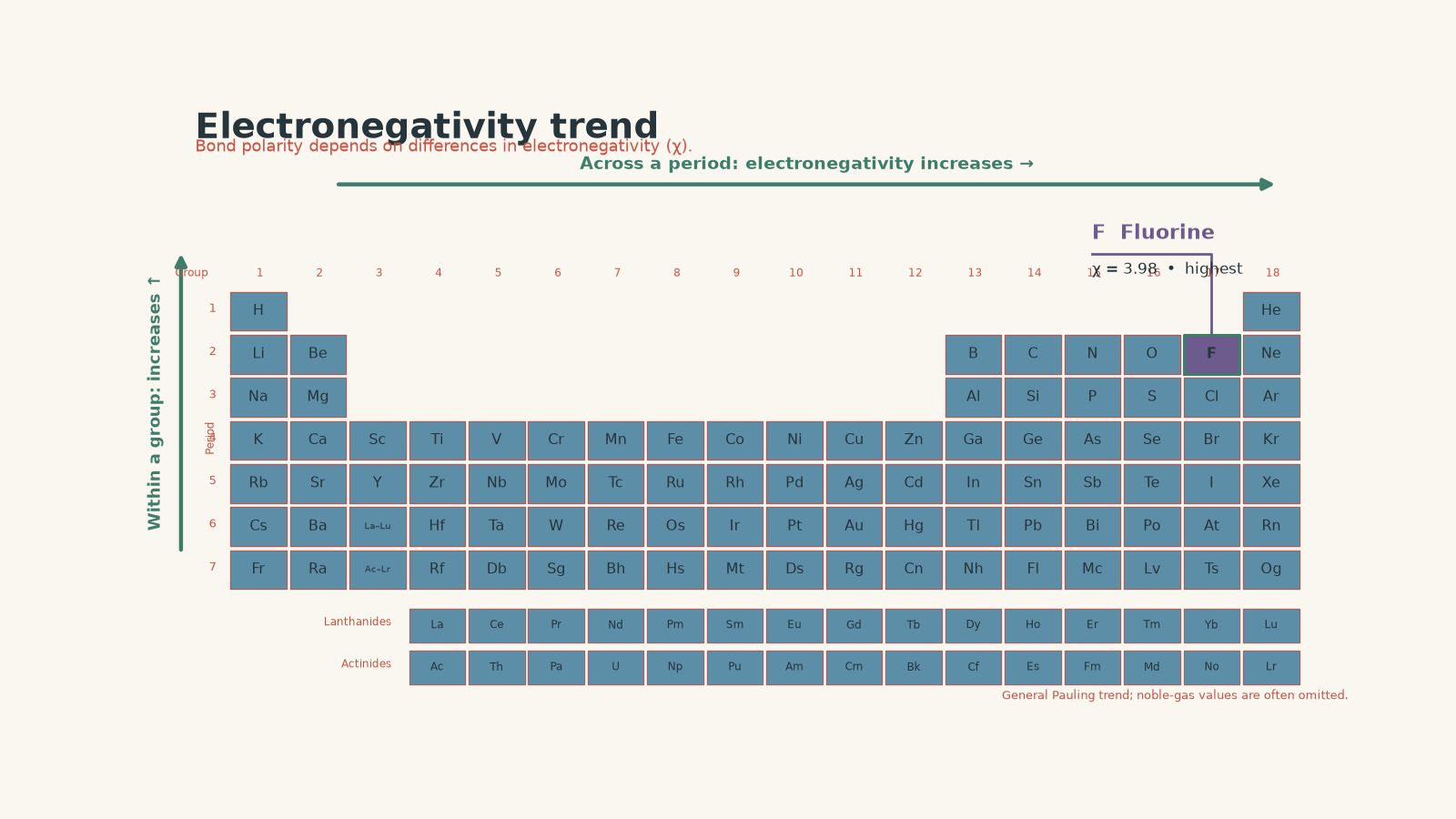
You do not need to memorise the electronegativity of every element to make useful predictions. The periodic table gives you the main trend:
- electronegativity generally increases from left to right across a period
- electronegativity generally decreases as you move down a group
- fluorine, near the top-right of the periodic table, has the highest electronegativity
- metals on the left generally have low electronegativities, while non-metals on the upper-right generally have higher electronegativities
Why does this happen?
Across a period, the number of protons in the nucleus increases while the added electrons enter the same main electron shell. The nucleus therefore tends to attract bonding electrons more strongly.
Down a group, atoms gain additional occupied electron shells. Bonding electrons are farther from the nucleus and experience more shielding from inner electrons, so the atom generally attracts shared electrons less strongly.
This gives us a useful prediction rule:
The greater the difference in electronegativity between two bonded atoms, the more unevenly the bonding electrons tend to be shared.
Now return to \(\ce{H-F}\) and \(\ce{H-I}\). Fluorine is much higher in Group 17 than iodine, so fluorine is more electronegative. That makes the electronegativity difference in \(\ce{H-F}\) larger, and the \(\ce{H-F}\) bond more polar.
03Measuring the difference
Electronegativity is usually represented by the symbol \(\chi\), the Greek letter chi.
For atoms A and B, the electronegativity difference is
\[
\Delta \chi = |\chi_{\mathrm{A}}-\chi_{\mathrm{B}}|
\]
where:
- \(\Delta \chi\) is the electronegativity difference
- \(\chi_{\mathrm{A}}\) is the electronegativity of atom A
- \(\chi_{\mathrm{B}}\) is the electronegativity of atom B
The vertical bars mean take the absolute value, so \(\Delta \chi\) is positive regardless of which element you write first.
Suppose atom A has an electronegativity of \(3.0\), while atom B has an electronegativity of \(2.0\).
Then
\[
\Delta \chi = |3.0-2.0|=1.0
\]
Atom A attracts the bonding electrons more strongly, so A becomes partially negative and B becomes partially positive.
A spectrum, not three separate boxes
You will sometimes see bonding divided into categories such as non-polar covalent, polar covalent, and ionic. These categories are useful, but the boundaries between them are not laws of nature.
A better mental model is a continuous spectrum:
| Electronegativity difference | Electron distribution | Useful description |
|---|---|---|
| Very small | Nearly even | Non-polar or very weakly polar covalent |
| Intermediate | Noticeably uneven | Polar covalent |
| Very large | Strong charge separation | Increasing ionic character |
As \(\Delta \chi\) increases, the bond generally develops more charge separation.
Some textbooks attach exact numerical cut-offs to these categories. Treat those numbers as guidelines, not universal rules. A value of \(1.69\) does not create a fundamentally different kind of bond from a value of \(1.71\).
The chemistry changes gradually.
Worked example: Which hydrogen halide has the more polar bond?
Compare the polarity of the \(\ce{H-Cl}\) and \(\ce{H-Br}\) bonds using the Pauling electronegativities \(H=2.20\), \(Cl=3.16\), and \(Br=2.96\).
Step 1
\[
\Delta \chi_{\ce{H-Cl}}
=|3.16-2.20|
=0.96
\]
Step 2
\[
\Delta \chi_{\ce{H-Br}}
=|2.96-2.20|
=0.76
\]
Step 3
Since \(0.96>0.76\), the \(\ce{H-Cl}\) bond has the greater electronegativity difference.
Therefore, \(\ce{H-Cl}\) is more polar than \(\ce{H-Br}\).
In both bonds, the halogen carries the partial negative charge because both chlorine and bromine are more electronegative than hydrogen:
\[
\ce{H^{\delta+}-Cl^{\delta-}}
\]
\[
\ce{H^{\delta+}-Br^{\delta-}}
\]
This agrees with the periodic table trend. Chlorine sits above bromine in Group 17, so chlorine attracts bonding electrons more strongly.
04Position matters on both sides of the bond
It is tempting to focus only on which element is more electronegative. For bond polarity, though, you need the difference between both elements.
Consider these three bonds:
- \(\ce{C-F}\)
- \(\ce{Si-F}\)
- \(\ce{Si-Cl}\)
You might immediately notice that fluorine is extremely electronegative. Good. But silicon is also less electronegative than carbon, so changing the atom at the other end of the bond matters too.
Worked example: Rank three bonds from least to most polar
Rank \(\ce{C-F}\), \(\ce{Si-F}\), and \(\ce{Si-Cl}\) from least polar to most polar using the Pauling electronegativities \(C=2.55\), \(Si=1.90\), \(F=3.98\), and \(Cl=3.16\).
Step 1
\[
\Delta \chi_{\ce{C-F}}
=|3.98-2.55|
=1.43
\]
Step 2
\[
\Delta \chi_{\ce{Si-F}}
=|3.98-1.90|
=2.08
\]
Step 3
\[
\Delta \chi_{\ce{Si-Cl}}
=|3.16-1.90|
=1.26
\]
Step 4
\[
1.26<1.43<2.08
\]
Therefore, the order from least polar to most polar is
\[
\ce{Si-Cl < C-F < Si-F}
\]
The \(\ce{Si-F}\) bond is the most polar because it joins a relatively low-electronegativity atom, silicon, to the most electronegative element, fluorine.
Notice something slightly awkward here. A difference of \(2.08\) is large enough that a simple numerical cut-off might tempt you to label the \(\ce{Si-F}\) bond “ionic”. But compounds containing silicon-fluorine covalent bonds exist.
That is why electronegativity differences are better used to compare degree of polarity and ionic character than as a machine that assigns every bond to a rigid category.
05Predicting polarity without being given numbers
In many questions, you can reason from periodic table positions before reaching for electronegativity values.
Suppose you need to compare \(\ce{C-Cl}\) and \(\ce{Si-Cl}\).
Carbon and silicon are in the same group, with carbon above silicon. Electronegativity decreases down the group, so carbon is more electronegative than silicon.
That means carbon is closer to chlorine in electronegativity than silicon is.
So you would predict:
\[
\Delta \chi_{\ce{Si-Cl}}>\Delta \chi_{\ce{C-Cl}}
\]
and therefore \(\ce{Si-Cl}\) should be more polar.
This gives you a practical process.
- Locate both elements on the periodic table.
- Decide which atom should be more electronegative.
- Consider how far apart their electronegativities are likely to be.
- If numerical values are supplied, calculate \(\Delta \chi\).
- The more electronegative atom receives \(\delta-\), while the less electronegative atom receives \(\delta+\).
The important part is step 3. Simply saying “fluorine is electronegative” is not enough. Polarity depends on the difference, not one atom’s value by itself.
06The tempting misconception: different elements must form a polar bond
Here is a prediction worth checking. If two different elements form a covalent bond, must one attract the electrons noticeably more strongly?
No.
Take phosphorus and hydrogen. Their Pauling electronegativities are approximately
\[
\chi_{\ce{P}}=2.19
\]
and
\[
\chi_{\ce{H}}=2.20
\]
So
\[
\Delta \chi=|2.20-2.19|=0.01
\]
That difference is tiny.
The \(\ce{P-H}\) bond is therefore essentially non-polar by this measure, even though phosphorus and hydrogen are different elements.
Compare that with a bond between identical atoms such as \(\ce{Cl-Cl}\). Its electronegativity difference is exactly zero because both atoms have the same electronegativity.
So there are two useful ideas to keep separate:
- bonds between identical atoms are non-polar because \(\Delta\chi=0\)
- bonds between different atoms may still be almost non-polar if their electronegativities are very similar
The name of the element does not decide the polarity. The difference in its attraction for bonding electrons does.
07Another misconception: a polar bond makes the whole molecule polar
Bond polarity and molecular polarity are related, but they are not the same question.
A bond asks: “Is electron density distributed unevenly between these two atoms?”
A molecule asks: “When all of its bond polarities are combined in three dimensions, is there an overall uneven distribution of charge?”
For example, each \(\ce{C=O}\) bond in \(\ce{CO2}\) is polar. Oxygen is more electronegative than carbon.
But \(\ce{CO2}\) is linear, with two identical bond polarities pointing in opposite directions. Their effects cancel, so the molecule has no overall permanent dipole.
By contrast, water contains polar \(\ce{O-H}\) bonds, and its bent shape means those bond polarities do not cancel.
So bond polarity is one ingredient in molecular polarity. Molecular shape tells you how those ingredients combine.
That becomes important when you move on to intermolecular forces and properties such as solubility and boiling point.
08Questions and solutions
Question 1
The Pauling electronegativities of nitrogen, phosphorus, and hydrogen are \(3.04\), \(2.19\), and \(2.20\), respectively.
Compare the polarity of an \(\ce{N-H}\) bond with a \(\ce{P-H}\) bond. Identify the partially negative atom in each bond, if a meaningful partial charge exists.
Solution 1
The \(\ce{N-H}\) bond is much more polar than the \(\ce{P-H}\) bond. Nitrogen is partially negative in \(\ce{N-H}\), while the \(\ce{P-H}\) bond is essentially non-polar.
For \(\ce{N-H}\),
\[
\Delta\chi
=|3.04-2.20|
=0.84
\]
Nitrogen is more electronegative, so electron density is shifted towards nitrogen:
\[
\ce{N^{\delta-}-H^{\delta+}}
\]
For \(\ce{P-H}\),
\[
\Delta\chi
=|2.19-2.20|
=0.01
\]
The difference is extremely small, so there is almost no unequal sharing.
The trap is assuming that two different elements must automatically produce a strongly polar bond. What matters is their electronegativity difference.
Question 2
Oxygen and sulfur are in Group 16. Carbon forms bonds with both elements.
Using the electronegativities \(C=2.55\), \(O=3.44\), and \(S=2.58\):
- calculate the electronegativity difference for \(\ce{C-O}\) and \(\ce{C-S}\)
- identify which bond is more polar
- explain how the result agrees with the periodic table trend
Solution 2
The \(\ce{C-O}\) bond is substantially more polar, while the \(\ce{C-S}\) bond is almost non-polar.
For \(\ce{C-O}\),
\[
\Delta\chi_{\ce{C-O}}
=|3.44-2.55|
=0.89
\]
For \(\ce{C-S}\),
\[
\Delta\chi_{\ce{C-S}}
=|2.58-2.55|
=0.03
\]
Therefore,
\[
\Delta\chi_{\ce{C-O}}>\Delta\chi_{\ce{C-S}}
\]
so \(\ce{C-O}\) is more polar.
In the \(\ce{C-O}\) bond, oxygen is partially negative because it is more electronegative:
\[
\ce{C^{\delta+}-O^{\delta-}}
\]
Carbon and sulfur have almost identical electronegativities, so the \(\ce{C-S}\) bond has very little charge separation.
The periodic trend explains why. Oxygen lies above sulfur in Group 16, and electronegativity generally decreases down a group. Oxygen therefore attracts bonding electrons much more strongly than sulfur does.
Question 3
Consider bonds between chlorine and three Period 3 elements: sodium, magnesium, and aluminium.
Their Pauling electronegativities are \(Na=0.93\), \(Mg=1.31\), \(Al=1.61\), and \(Cl=3.16\).
Rank the \(\ce{Na-Cl}\), \(\ce{Mg-Cl}\), and \(\ce{Al-Cl}\) interactions in order of decreasing electronegativity difference. Explain what this suggests about their relative ionic character.
Solution 3
The order of decreasing electronegativity difference is \(\ce{Na-Cl > Mg-Cl > Al-Cl}\), so the simple electronegativity model predicts decreasing ionic character across that sequence.
For \(\ce{Na-Cl}\),
\[
\Delta\chi
=|3.16-0.93|
=2.23
\]
For \(\ce{Mg-Cl}\),
\[
\Delta\chi
=|3.16-1.31|
=1.85
\]
For \(\ce{Al-Cl}\),
\[
\Delta\chi
=|3.16-1.61|
=1.55
\]
Therefore,
\[
\ce{Na-Cl > Mg-Cl > Al-Cl}
\]
in electronegativity difference.
This trend follows the periodic table. Moving from sodium to magnesium to aluminium across Period 3, electronegativity increases. Chlorine’s electronegativity stays fixed, so the difference between chlorine and the other element becomes progressively smaller.
A larger electronegativity difference generally corresponds to greater charge separation and greater ionic character.
The trap is treating “ionic” and “covalent” as completely separate boxes based only on a numerical cut-off. Actual bonding and compound structure depend on more than \(\Delta\chi\), but the electronegativity difference is useful for predicting the trend.
Question 4
A student makes the following argument:
Fluorine is the most electronegative element, so every bond containing fluorine must be more polar than every bond containing chlorine.
Test this claim using \(\ce{F-F}\) and \(\ce{Na-Cl}\). Use \(F=3.98\), \(Na=0.93\), and \(Cl=3.16\).
Solution 4
The claim is false. Bond polarity depends on the difference between the two bonded atoms, not on whether one atom has a high electronegativity by itself.
For \(\ce{F-F}\), both atoms have the same electronegativity:
\[
\Delta\chi_{\ce{F-F}}
=|3.98-3.98|
=0
\]
The bond is non-polar.
For \(\ce{Na-Cl}\),
\[
\Delta\chi_{\ce{Na-Cl}}
=|3.16-0.93|
=2.23
\]
This interaction has a very large electronegativity difference and substantial charge separation.
Therefore, \(\ce{Na-Cl}\) has far greater polarity or ionic character than \(\ce{F-F}\), despite fluorine itself being more electronegative than chlorine.
The student’s mistake is considering only one end of a bond. Electronegativity tells you how strongly an atom attracts bonding electrons. Bond polarity compares the competing attractions of both atoms.
Question 5
A student is given two unknown covalent bonds, X-Y and M-N. Both pairs have the same calculated electronegativity difference.
The student concludes:
The two bonds must have exactly the same distribution of electron density and exactly the same bond dipole.
Is that conclusion justified? Explain what electronegativity difference can and cannot tell you.
Solution 5
No. The same electronegativity difference suggests a similar tendency towards unequal sharing, but it does not guarantee identical electron distributions or identical bond dipoles.
Electronegativity is a model used to compare how strongly atoms attract bonding electrons. If two bonds have the same \(\Delta\chi\), the model gives us reason to expect a similar degree of polarity.
However, \(\Delta\chi\) is not a direct measurement of partial charge. The actual electron distribution depends on the atoms involved and their bonding environment.
Bond dipole also depends on both the amount of separated charge and the distance across which that charge is separated. Two different bonds need not have identical bond lengths or identical partial charges simply because their tabulated electronegativity differences match.
So the justified conclusion is limited:
equal \(\Delta\chi\) values suggest similar polarity, but do not prove that two different bonds are physically identical.
The trap is turning a useful predictive model into an exact law.
09What bond polarity lets you understand next
Bond polarity gives you the first piece of a larger chain of reasoning.
Once you know which bonds are polar, you can combine their directions with molecular shape to decide whether the bond polarities reinforce or cancel one another. That gives you molecular polarity.
From there, you can make better predictions about intermolecular forces, solubility, boiling points, and how substances behave around water and other solvents.
The useful sequence is:
\[
\text{periodic position}
\rightarrow
\text{electronegativity}
\rightarrow
\Delta\chi
\rightarrow
\text{bond polarity}
\rightarrow
\text{molecular polarity}
\rightarrow
\text{intermolecular behaviour}
\]
So when you see two bonded elements, do not start by asking, “Is this bond ionic or covalent?”
Start with the more useful question: which atom attracts the shared electrons more strongly, and by how much?