
Molecular Shapes: Predicting Geometry with VSEPR for HSC Chemistry
Learn how to predict molecular shapes using electron regions, bonding pairs, lone pairs, and VSEPR theory. Includes worked examples, common misconceptions, and HSC-style practice.
Put three atoms together and you might expect them to form a straight line. Sometimes they do. \(\ce{CO2}\) is linear. But \(\ce{H2O}\), which also has three atoms, is bent.
So what makes one molecule straight and another bent?
Before reading on, make a prediction. If the oxygen atom in \(\ce{H2O}\) is bonded to two hydrogen atoms, what could be pushing those O-H bonds away from a straight-line arrangement?
The missing pieces are lone pairs of electrons. They take up space around the oxygen even though we don’t see them in the molecular formula. To predict molecular shape properly, we need to count all the regions of electron density around the central atom, not just the atoms attached to it.
That idea is the basis of valence shell electron pair repulsion, or VSEPR, theory.
01The basic idea: electron regions spread out
Imagine several balloons tied together at one point. Each balloon pushes against the others, so they arrange themselves as far apart as possible.
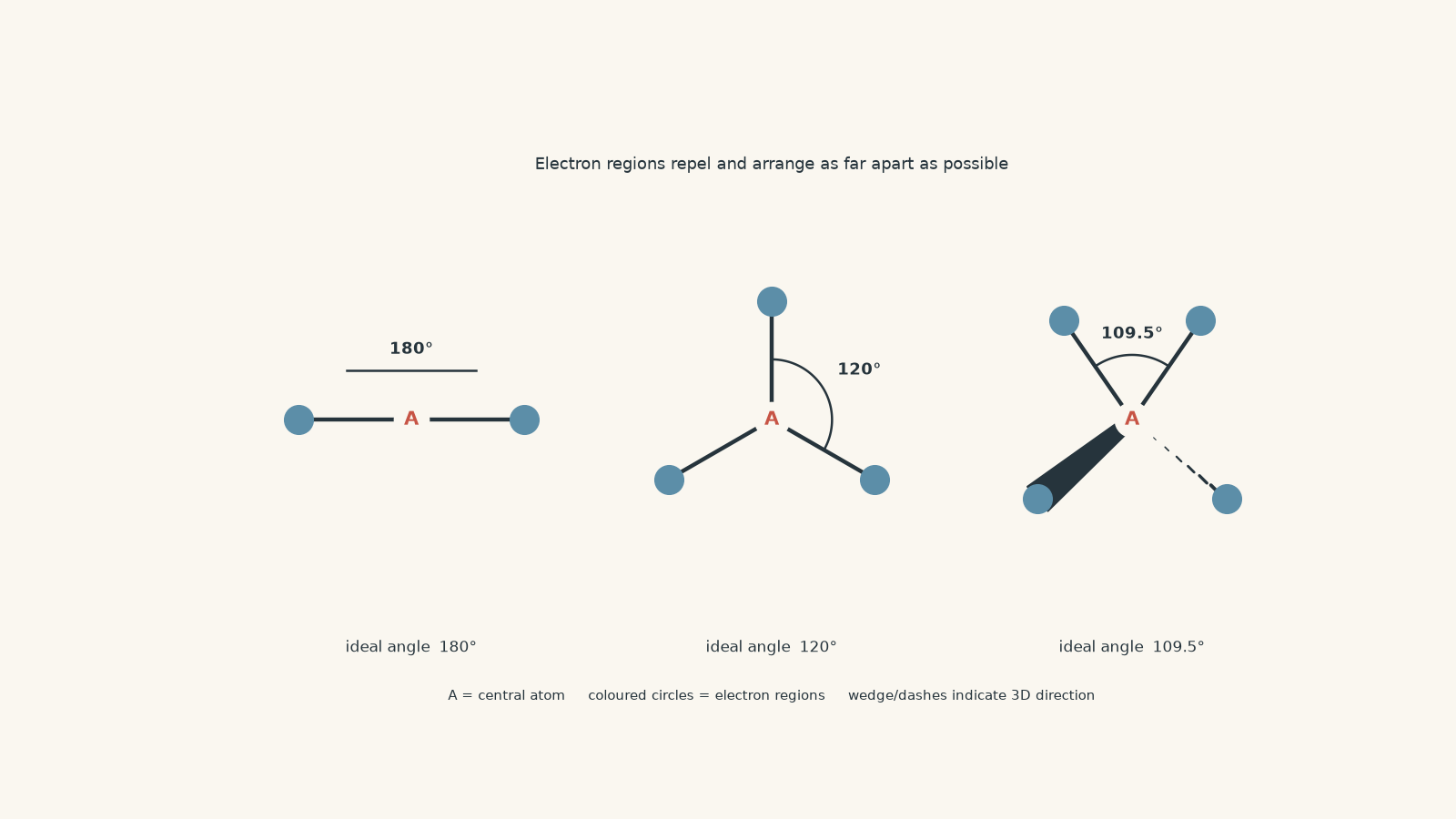
Electron regions around an atom behave in a roughly similar way. Electrons are negatively charged, so regions containing electrons repel one another. The arrangement that keeps these regions furthest apart is usually the most stable.
The comparison isn’t exact. Electron clouds aren’t solid balloons, and their shapes and repulsions aren’t all identical. But the model gives us a useful first picture:
Electron regions around a central atom arrange themselves to minimise repulsion.
An electron region can be:
- a single bond
- a double bond
- a triple bond
- a lone pair
There is one rule here that catches a lot of students:
A double or triple bond still counts as one electron region.
It contains more electron density than a single bond, so its repulsion can be somewhat stronger, but it points in one general direction from the central atom.
02Electron arrangement comes before molecular shape
Suppose a central atom has four electron regions around it.
Those four regions spread into a tetrahedral electron arrangement, with ideal angles of about \(109.5^\circ\).
But there is an important distinction.
The electron-domain geometry describes the arrangement of all electron regions, including lone pairs.
The molecular shape describes the positions of the atoms only.
This is why four electron regions can produce several different molecular shapes.
| Electron regions around central atom | Bonding regions | Lone pairs | Electron-domain geometry | Molecular shape |
|---|---|---|---|---|
| 2 | 2 | 0 | Linear | Linear |
| 3 | 3 | 0 | Trigonal planar | Trigonal planar |
| 3 | 2 | 1 | Trigonal planar | Bent |
| 4 | 4 | 0 | Tetrahedral | Tetrahedral |
| 4 | 3 | 1 | Tetrahedral | Trigonal pyramidal |
| 4 | 2 | 2 | Tetrahedral | Bent |
The last column is usually what a question means when it asks for the shape of the molecule.
03Why lone pairs change the shape
Consider \(\ce{CH4}\), ammonia \(\ce{NH3}\), and water \(\ce{H2O}\).
All three have four electron regions around their central atom.
Yet their shapes are different.
Methane: \(\ce{CH4}\)
Carbon has four bonding regions and no lone pairs.
All four electron regions contain bonds, so the molecular shape is the same as the electron-domain geometry:
tetrahedral, with bond angles of approximately \(109.5^\circ\).
Ammonia: \(\ce{NH3}\)
Nitrogen has three N-H bonding regions and one lone pair.
There are still four electron regions, so the underlying electron arrangement is tetrahedral. But molecular shape ignores the lone pair when naming the positions of atoms.
The three hydrogen atoms therefore form a trigonal pyramidal shape.
The H-N-H angle is about \(107^\circ\), slightly smaller than the ideal tetrahedral angle.
Why?
A lone pair is attracted to only one nucleus, rather than being shared between two bonded atoms. Its electron cloud spreads out more around the central atom and repels neighbouring bonding regions more strongly.
A useful ordering is:
\[
\text{lone pair-lone pair repulsion} > \text{lone pair-bonding pair repulsion} > \text{bonding pair-bonding pair repulsion}
\]
So the lone pair on nitrogen squeezes the N-H bonds slightly closer together.
Water: \(\ce{H2O}\)
Oxygen has two O-H bonding regions and two lone pairs.
There are again four electron regions, so the electron-domain geometry is tetrahedral.
But only two of those regions contain atoms. The molecular shape is therefore bent.
The H-O-H angle is about \(104.5^\circ\), even smaller than the angle in ammonia because there are two lone pairs producing strong repulsion.
This gives us a useful pattern:
\[
\ce{CH4}: 109.5^\circ
\]
\[
\ce{NH3}: \text{about }107^\circ
\]
\[
\ce{H2O}: \text{about }104.5^\circ
\]
The number of electron regions hasn’t changed. What changes is how many of those regions are lone pairs.
04A reliable method for predicting shape
For most HSC molecular-shape problems, use this sequence.
Step 1: Find the central atom
The central atom is usually the atom bonded to several others. Hydrogen is never the central atom in the molecules considered here because it forms only one bond.
Step 2: Use the Lewis structure
You need to know where the bonds and lone pairs are.
If the Lewis structure isn’t supplied, remember the basic process:
- Count the total valence electrons.
- Connect the atoms with single bonds.
- Complete the outer atoms’ valence shells where appropriate.
- Place remaining electrons on the central atom.
- Form multiple bonds if required to obtain a reasonable Lewis structure.
Formal charge and resonance can matter in more complicated structures, but the shape calculation begins once you know the electron regions around the central atom.
Step 3: Count electron regions around the central atom
Count each of these as one region:
- one single bond
- one double bond
- one triple bond
- one lone pair
For example, the carbon atom in \(\ce{CO2}\) has two double bonds:
\[
\ce{O=C=O}
\]
That is two electron regions, not four.
Step 4: Find the electron-domain geometry
The most important arrangements are:
| Number of electron regions | Basic electron-domain geometry | Ideal angles |
|---|---|---|
| 2 | Linear | \(180^\circ\) |
| 3 | Trigonal planar | \(120^\circ\) |
| 4 | Tetrahedral | \(109.5^\circ\) |
| 5 | Trigonal bipyramidal | \(90^\circ\), \(120^\circ\), \(180^\circ\) |
| 6 | Octahedral | \(90^\circ\), \(180^\circ\) |
Step 5: Ignore lone pairs when naming molecular shape
Do not remove the lone pairs before deciding the electron arrangement. Let them determine the arrangement first.
Then hide them when naming the molecular shape.
That order matters.
05Worked example: What is the shape of ammonia?
Predict the molecular shape and approximate H-N-H bond angle of \(\ce{NH3}\).
Step 1
Nitrogen is bonded to all three hydrogen atoms, so nitrogen is central.
Step 2
Nitrogen has three N-H bonds and one lone pair.
That gives:
\[
3\text{ bonding regions} + 1\text{ lone pair} = 4\text{ electron regions}
\]
Step 3
Four electron regions arrange tetrahedrally.
Step 4
One tetrahedral position contains a lone pair, leaving three bonded hydrogen atoms.
The molecular shape is trigonal pyramidal.
Step 5
A perfect tetrahedral angle is \(109.5^\circ\). The lone pair repels the N-H bonding regions more strongly than those bonding regions repel one another, so the H-N-H angle becomes slightly smaller.
The observed angle is about:
\[
107^\circ
\]
So \(\ce{NH3}\) is trigonal pyramidal, with bond angles of about \(107^\circ\).
06Three electron regions: why \(\ce{CO2}\) and \(\ce{SO2}\) differ
Now compare two molecules containing double bonds.
Carbon dioxide is:
\[
\ce{O=C=O}
\]
The carbon atom has two electron regions. They move as far apart as possible, giving a \(180^\circ\) arrangement.
So \(\ce{CO2}\) is linear.
Sulfur dioxide, \(\ce{SO2}\), is different. Around the central sulfur there are three main electron regions: two bonding regions directed towards oxygen atoms and one lone pair.
Three regions favour a trigonal planar electron arrangement.
But one of those positions is occupied by a lone pair, so the atoms form a bent molecule.
A student might look at two S-O connections and predict linear because there are “two things attached”. That prediction ignores the lone pair. VSEPR depends on electron regions, not simply the number of surrounding atoms.
Worked example: Predict the shape of \(\ce{SO2}\)
Predict the electron-domain geometry, molecular shape, and approximate O-S-O bond angle of \(\ce{SO2}\).
Step 1
Sulfur is central. A suitable Lewis description gives two S-O bonding regions and one lone pair around sulfur.
Each S-O bonding direction counts as one region, even where the bonding is represented using a double bond in a Lewis structure.
Therefore:
\[
2\text{ bonding regions} + 1\text{ lone pair} = 3\text{ electron regions}
\]
Step 2
Three electron regions give a trigonal planar electron arrangement with an ideal separation of \(120^\circ\).
Step 3
Only the sulfur and the two oxygen atoms define the molecular shape.
The molecule is therefore bent.
Step 4
The lone pair occupies more space around sulfur than a bonding region does. It pushes the two S-O bonding regions closer together.
Therefore:
\[
\angle\ce{OSO} < 120^\circ
\]
The important HSC reasoning is not memorising a particular decimal angle. It is explaining why the angle should be less than \(120^\circ\).
07What happens with five or six electron regions?
The same repulsion idea continues beyond four regions.
Five regions
Five electron regions form a trigonal bipyramidal arrangement.
There are two types of position:
- three equatorial positions in one plane, separated by \(120^\circ\)
- two axial positions above and below that plane
A lone pair generally prefers an equatorial position because this gives it fewer \(90^\circ\) interactions with other electron regions.
For example, \(\ce{SF4}\) has five electron regions around sulfur: four bonding regions and one lone pair.
Its electron-domain geometry is trigonal bipyramidal, but with one equatorial position occupied by a lone pair, the molecular shape is seesaw.
Six regions
Six electron regions form an octahedral arrangement.
For example, \(\ce{SF6}\) has six bonding regions and no lone pairs, so it is octahedral.
If an octahedral arrangement contains two lone pairs, the way those lone pairs are positioned matters. Placing them opposite each other keeps them \(180^\circ\) apart and reduces their mutual repulsion.
This occurs in \(\ce{XeF4}\). Xenon has six electron regions: four Xe-F bonding regions and two lone pairs.
The two lone pairs occupy opposite positions, leaving four fluorine atoms in one plane.
The molecular shape is square planar.
08The two most common counting mistakes
Mistake 1: Counting bonds instead of electron regions
Suppose the central carbon has one double bond and two single bonds.
You might count:
\[
2 + 1 + 1 = 4
\]
and predict a tetrahedral arrangement.
That is incorrect.
A double bond counts as one electron region, because its electron density points in one overall direction.
So the correct count is:
\[
1 + 1 + 1 = 3\text{ electron regions}
\]
The electron-domain geometry is trigonal planar.
Mistake 2: Ignoring lone pairs too early
Suppose an oxygen atom is bonded to two atoms.
If you look only at those two bonds, you might predict a linear shape because two regions would sit \(180^\circ\) apart.
But oxygen commonly also has two lone pairs. That gives four electron regions in total.
The electron arrangement is therefore tetrahedral, and the two bonded atoms occupy only two of those four directions. The result is bent.
A good decision rule is:
Count lone pairs when finding the electron arrangement. Ignore them only when naming the final molecular shape.
09VSEPR predicts useful trends, not perfect angles
The simple VSEPR model often begins with ideal angles such as \(120^\circ\) and \(109.5^\circ\). Real molecules don’t always have exactly those values.
Different electron regions don’t repel equally.
In particular:
- lone pairs usually repel more strongly than bonding regions
- multiple bonds can repel more strongly than single bonds
- different surrounding atoms can alter the distribution of bonding electrons
So when a question asks you to explain a distorted bond angle, don’t just state that “electrons repel”.
Be more precise:
- identify the electron regions,
- identify which regions produce stronger repulsion,
- state which bonds are pushed closer together or further apart,
- compare the resulting angle with the ideal geometry.
That explanation is much stronger than memorising isolated bond angles.
10Questions and solutions
Question 1
The central boron atom in \(\ce{BF3}\) forms three B-F bonds and has no lone pairs. Predict the molecular shape and F-B-F bond angle.
Solution 1
\(\ce{BF3}\) is trigonal planar, with F-B-F bond angles of approximately \(120^\circ\).
The boron atom has three bonding regions and no lone pairs:
\[
3\text{ bonding regions} = 3\text{ electron regions}
\]
Three electron regions minimise their repulsion by spreading out in one plane, \(120^\circ\) apart.
Because every electron region contains a bond, the electron-domain geometry and molecular shape are both trigonal planar.
The common trap is to assume every molecule with several bonds becomes tetrahedral. Tetrahedral geometry requires four electron regions, not merely “more than two”.
Question 2
A molecule has a central atom with four electron regions. Three are bonding regions and one is a lone pair.
State its electron-domain geometry and molecular shape. Would you expect its bond angles to be exactly \(109.5^\circ\)? Explain.
Solution 2
The electron-domain geometry is tetrahedral, the molecular shape is trigonal pyramidal, and the bond angles should be slightly less than \(109.5^\circ\).
Four total electron regions produce the tetrahedral arrangement:
\[
3\text{ bonding regions} + 1\text{ lone pair} = 4\text{ regions}
\]
When the lone pair is ignored for the purpose of naming the positions of the atoms, three bonded atoms remain, producing a trigonal pyramidal molecular shape.
The angle is compressed because a lone pair occupies more space around the central atom and repels neighbouring bonding regions more strongly than bonding regions repel one another. The mistake would be to use \(109.5^\circ\) automatically just because the underlying electron arrangement is tetrahedral.
Question 3
Formaldehyde, \(\ce{CH2O}\), contains a central carbon atom bonded to two hydrogen atoms and double-bonded to an oxygen atom.
Predict the arrangement around carbon. Explain why treating the C=O double bond as two separate electron regions gives the wrong result.
Solution 3
The arrangement around carbon is trigonal planar, with bond angles around carbon close to \(120^\circ\).
Around the carbon atom there are:
\[
2\text{ C-H regions} + 1\text{ C=O region} = 3\text{ electron regions}
\]
Therefore, the three regions spread into a trigonal planar arrangement.
The C=O double bond contains two shared electron pairs, but both lie in the same overall bonding direction between carbon and oxygen. VSEPR therefore treats the entire double bond as one region of electron density, not two independent directions.
Counting the double bond twice would incorrectly give four regions and lead to a tetrahedral prediction.
The exact angles need not all be exactly \(120^\circ\), because the electron-rich double bond can repel neighbouring bonding regions somewhat more strongly than a single bond.
Question 4
Ammonia can react with a hydrogen ion to form ammonium:
\[
\ce{NH3 + H+ -> NH4+}
\]
Predict how the molecular shape around nitrogen changes from \(\ce{NH3}\) to \(\ce{NH4+}\). Also predict whether the H-N-H angles become larger, smaller, or remain unchanged.
Solution 4
The shape changes from trigonal pyramidal in \(\ce{NH3}\) to tetrahedral in \(\ce{NH4+}\), and the H-N-H angles become slightly larger.
In \(\ce{NH3}\), nitrogen has:
\[
3\text{ bonding regions} + 1\text{ lone pair} = 4\text{ electron regions}
\]
The electron-domain geometry is tetrahedral, but one position contains a lone pair. The molecular shape is trigonal pyramidal, with H-N-H angles of about \(107^\circ\).
When \(\ce{NH3}\) forms \(\ce{NH4+}\), the nitrogen lone pair is used to form the additional N-H bond. Nitrogen now has:
\[
4\text{ bonding regions} + 0\text{ lone pairs} = 4\text{ electron regions}
\]
All four tetrahedral positions now contain bonded hydrogen atoms, so the molecular shape is tetrahedral.
With no lone pair producing extra compression, the H-N-H angles become approximately:
\[
109.5^\circ
\]
The tempting mistake is to say that adding another hydrogen must create more crowding and therefore a smaller angle. What matters is not just the number of atoms. The strongly repelling lone pair has been replaced by a bonding region, making the four regions more equivalent.
Question 5
A student says:
“Any molecule with two atoms bonded to the central atom must be linear because the two bonds can point in opposite directions.”
Evaluate this claim using \(\ce{CO2}\) and \(\ce{H2O}\).
Solution 5
The claim is incorrect because molecular shape depends on all electron regions around the central atom, not only the number of bonded atoms.
In \(\ce{CO2}\), carbon has two electron regions:
\[
\ce{O=C=O}
\]
Each double bond counts as one region, so there are two regions in total. They move \(180^\circ\) apart, making \(\ce{CO2}\) linear.
In \(\ce{H2O}\), oxygen has:
\[
2\text{ bonding regions} + 2\text{ lone pairs} = 4\text{ electron regions}
\]
Four regions produce a tetrahedral electron arrangement. When the two lone pairs are ignored in the molecular-shape name, the two O-H bonds remain in a bent arrangement.
So the important comparison is:
| Molecule | Bonding regions | Lone pairs on central atom | Total regions | Shape |
|---|---|---|---|---|
| \(\ce{CO2}\) | 2 | 0 | 2 | Linear |
| \(\ce{H2O}\) | 2 | 2 | 4 | Bent |
The student’s reasoning feels plausible because two isolated objects can maximise their separation by sitting opposite each other. It fails when other, invisible electron regions are also competing for space.
Question 6
In \(\ce{XeF4}\), xenon has four Xe-F bonding regions and two lone pairs.
A student correctly identifies six electron regions and an octahedral electron arrangement, but then predicts a tetrahedral molecular shape because there are four fluorine atoms.
Explain why this prediction fails and determine the correct molecular shape.
Solution 6
The correct molecular shape is square planar, not tetrahedral.
There are six electron regions around xenon:
\[
4\text{ bonding regions} + 2\text{ lone pairs} = 6\text{ electron regions}
\]
Six electron regions form an octahedral arrangement.
The two lone pairs repel one another strongly. In an octahedral arrangement, they can occupy positions directly opposite each other, placing them \(180^\circ\) apart.
That leaves the four Xe-F bonds in the same plane, arranged at \(90^\circ\) to neighbouring bonds. The four fluorine atoms therefore form a square around xenon.
The student’s mistake is subtle. Four bonded atoms do not automatically mean tetrahedral. Tetrahedral shape occurs when those four bonds are arranged among four total electron regions. In \(\ce{XeF4}\), the four bonds are part of a six-region octahedral arrangement, so their positions are different.
11Where molecular shape takes you next
Once you can predict shape, you can do more than name structures.
Shape tells you how individual bond dipoles are arranged in space. That means it becomes essential when deciding whether a molecule is polar or non-polar.
For example, both \(\ce{CO2}\) and \(\ce{H2O}\) contain polar bonds. Their different shapes determine whether those bond dipoles cancel.
So the next useful question isn’t simply, “Are the bonds polar?” It is: once those bonds are placed in the molecular shape, what happens when their dipoles are combined?