
Balancing Chemical Equations for HSC Chemistry
Learn how to balance chemical equations by conserving atoms, using coefficients correctly, and reading balanced equations as mole ratios.
Suppose you burn hydrogen in oxygen to make water:
\[
\ce{H2 + O2 -> H2O}
\]
It looks reasonable. The substances are correct, and the reaction points in the right direction. But count the oxygen atoms. There are two on the left and only one on the right.
Where did the other oxygen atom go?
It didn’t. Atoms are rearranged during a chemical reaction, not created or destroyed. So a chemical equation has to show the same number of atoms of each element before and after the reaction. Balancing an equation is the process of making that conservation visible.
Before reading on, predict what you would change in the equation above. Would you change \(\ce{H2O}\) to \(\ce{H2O2}\), or put a number in front of one of the formulas?
Only the second option is allowed. Changing a formula changes the substance itself. Changing a number in front changes how much of that substance is involved.
01What balancing actually means
Think of each chemical formula as a sealed box containing a particular collection of atoms.
One \(\ce{H2}\) box contains two hydrogen atoms. One \(\ce{O2}\) box contains two oxygen atoms. One \(\ce{H2O}\) box contains two hydrogen atoms and one oxygen atom.
You can bring in more identical boxes, but you can’t open a box and rewrite what is inside it.
That gives us the key distinction:
- a subscript is part of the chemical formula
- a coefficient tells us how many units of that substance are involved
For example:
\[
\ce{2H2O}
\]
means two lots of \(\ce{H2O}\). Altogether, that represents four hydrogen atoms and two oxygen atoms.
But:
\[
\ce{H2O2}
\]
is hydrogen peroxide, a different substance.
This box model is useful for balancing equations, but it has a limit. Not every substance exists as neat little molecules. Ionic solids such as \(\ce{NaCl}\) form extended lattices. The coefficient still tells us the relative amount of substance, even when imagining separate “boxes” is not literally accurate.
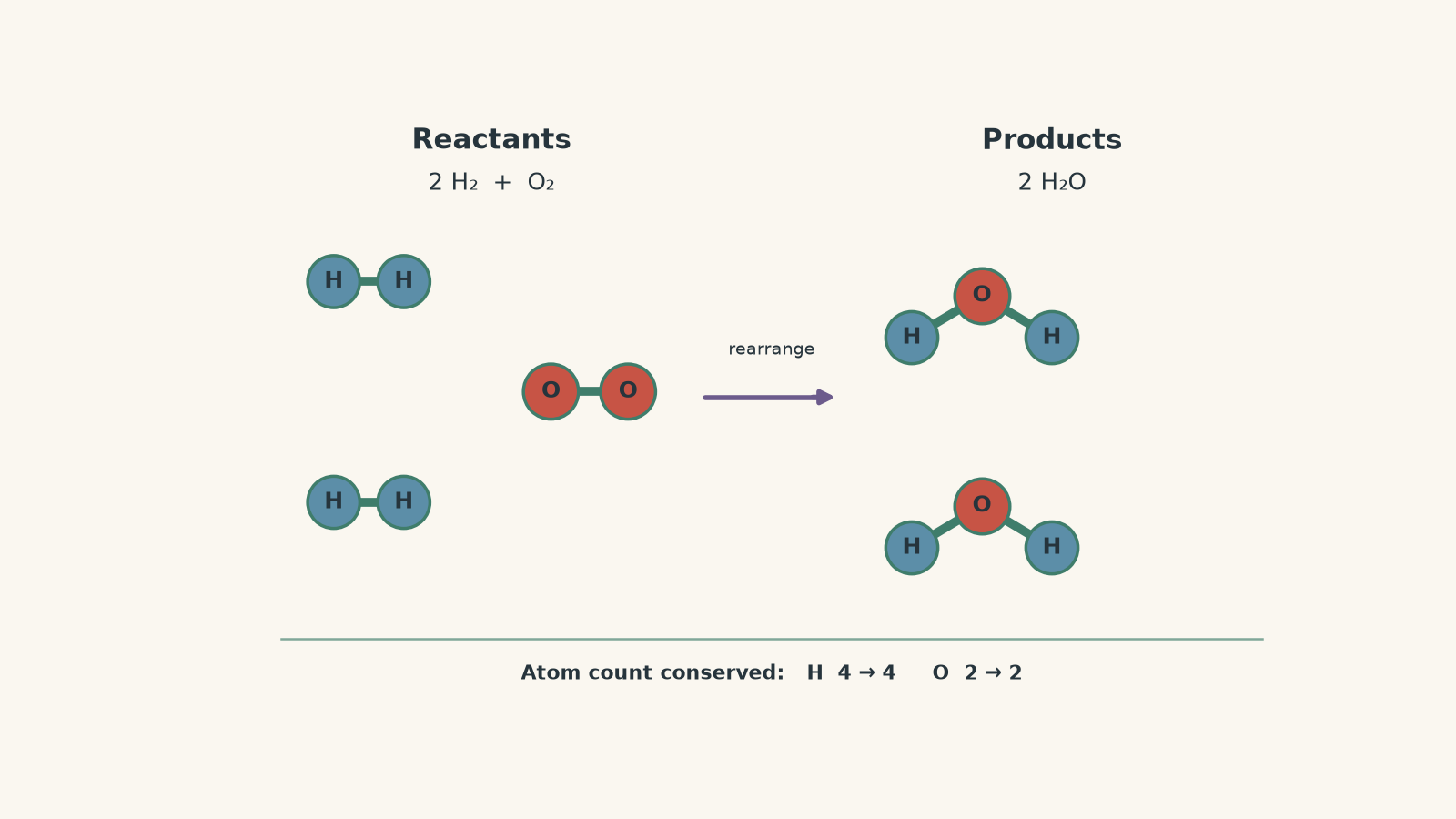
Now return to our original equation:
\[
\ce{H2 + O2 -> H2O}
\]
Putting a 2 in front of water gives:
\[
\ce{H2 + O2 -> 2H2O}
\]
The oxygen is now balanced, but the hydrogen isn’t. There are two hydrogen atoms on the left and four on the right.
So we also need a 2 in front of \(\ce{H2}\):
\[
\ce{2H2 + O2 -> 2H2O}
\]
Now count again.
| Element | Left side | Right side |
|---|---|---|
| H | \(2 \times 2 = 4\) | \(2 \times 2 = 4\) |
| O | \(1 \times 2 = 2\) | \(2 \times 1 = 2\) |
The equation is balanced.
02The rule you cannot break: change coefficients, not subscripts
This is the most important balancing rule.
Never change a subscript just to make the atom counts work.
Suppose a student sees:
\[
\ce{H2 + O2 -> H2O}
\]
and writes:
\[
\ce{H2 + O2 -> H2O2}
\]
The atom count is now balanced, but the chemistry is wrong. The reaction was supposed to produce water. The student has replaced water with hydrogen peroxide.
A useful way to think about it is this: changing a coefficient is like inviting another identical couple to a party. Changing a subscript is like changing one person’s identity because your seating plan didn’t work. The first changes the number present. The second changes who they are.
The analogy stops being exact because chemical formulas describe particles or formula units, not people, but the distinction is the important part.
03A reliable method for balancing equations
You do not need to guess randomly. Use the same process each time.
1. Make sure the formulas are correct
Balancing comes after writing the correct chemical formulas.
If you start with an incorrect formula, balancing cannot rescue the equation.
For example, magnesium chloride is \(\ce{MgCl2}\), not \(\ce{MgCl}\). That formula comes from the ions involved, not from whatever numbers would make the equation convenient.
2. Count each element on both sides
Make a quick mental count, or write one down if the equation is complicated.
3. Add coefficients to balance one element at a time
A coefficient multiplies the whole formula.
In:
\[
\ce{3Ca(OH)2}
\]
there are:
- 3 calcium atoms
- 6 oxygen atoms
- 6 hydrogen atoms
The coefficient 3 multiplies everything in \(\ce{Ca(OH)2}\).
4. Leave awkward free elements until later when useful
If oxygen appears as \(\ce{O2}\) on its own but also appears inside several compounds, it is often easier to balance the other elements first and oxygen last.
This is a strategy, not a law. The real requirement is simply that every element finishes balanced.
5. Check every element again
Changing one coefficient can disturb an element you balanced earlier.
Do a complete recount at the end.
6. Use the smallest whole-number coefficients
For example:
\[
\ce{4H2 + 2O2 -> 4H2O}
\]
is balanced, but all coefficients share a factor of 2. Divide them by 2:
\[
\ce{2H2 + O2 -> 2H2O}
\]
That is the usual final form.
04Worked example: aluminium reacting with oxygen
Balance the equation:
\[
\ce{Al + O2 -> Al2O3}
\]
The awkward part is oxygen. It comes in groups of 2 on the left and groups of 3 on the right.
Step 1
The smallest common multiple is 6. We can make 6 oxygen atoms using three \(\ce{O2}\) units or two \(\ce{Al2O3}\) units.
\[
\ce{Al + 3O2 -> 2Al2O3}
\]
Step 2
Two \(\ce{Al2O3}\) units contain:
\[
2 \times 2 = 4
\]
aluminium atoms.
So put a coefficient of 4 in front of aluminium:
\[
\ce{4Al + 3O2 -> 2Al2O3}
\]
Step 3
Aluminium:
\[
4 = 2 \times 2 = 4
\]
Oxygen:
\[
3 \times 2 = 2 \times 3 = 6
\]
So the balanced equation is:
\[
\boxed{\ce{4Al + 3O2 -> 2Al2O3}}
\]
The coefficients \(4:3:2\) also tell us the reaction’s mole ratio. Four moles of aluminium react stoichiometrically with three moles of oxygen to form two moles of aluminium oxide.
05Coefficients are mole ratios
Balancing is not just an exercise in counting atoms. The coefficients become the numerical link between substances in stoichiometry.
Consider:
\[
\ce{2H2 + O2 -> 2H2O}
\]
The coefficients give the ratio:
\[
\ce{H2 : O2 : H2O} = 2:1:2
\]
So:
- 2 mol of \(\ce{H2}\) react with 1 mol of \(\ce{O2}\)
- 1 mol of \(\ce{O2}\) can produce 2 mol of \(\ce{H2O}\)
- 4 mol of \(\ce{H2}\) would require 2 mol of \(\ce{O2}\)
Notice what the ratio does not mean. It does not say that every reaction mixture must initially contain exactly those amounts. You might supply excess oxygen, for example. The coefficients describe the stoichiometric proportions in which substances react and form products.
This is why balancing has to come before mole calculations. An unbalanced equation gives the wrong mole ratio.
Worked example: using a balanced equation as a mole ratio
Magnesium reacts with hydrochloric acid according to:
\[
\ce{Mg + 2HCl -> MgCl2 + H2}
\]
How many moles of \(\ce{HCl}\) are required to react completely with \(0.35\ \text{mol}\) of \(\ce{Mg}\)?
Step 1
The equation shows:
\[
\ce{Mg : HCl} = 1:2
\]
So every 1 mol of magnesium requires 2 mol of hydrochloric acid.
Step 2
\[
n(\ce{HCl}) = 0.35\ \text{mol} \times \frac{2\ \text{mol HCl}}{1\ \text{mol Mg}}
= 0.70\ \text{mol}
\]
Here, \(n\) represents amount of substance in moles.
Step 3
\[
\boxed{n(\ce{HCl}) = 0.70\ \text{mol}}
\]
A stoichiometric reaction with \(0.35\ \text{mol}\) of magnesium requires \(0.70\ \text{mol}\) of hydrochloric acid.
The factor of 2 did not come from the masses or molar masses. It came directly from the balanced equation.
06Worked example: balancing a combustion equation
Balance the complete combustion of ethanol:
\[
\ce{C2H5OH + O2 -> CO2 + H2O}
\]
This equation is more complicated because oxygen appears in three different formulas.
A common strategy for combustion equations is to balance carbon first, hydrogen second, and oxygen last.
Step 1
One ethanol molecule contains two carbon atoms, so we need two \(\ce{CO2}\):
\[
\ce{C2H5OH + O2 -> 2CO2 + H2O}
\]
Step 2
\(\ce{C2H5OH}\) contains six hydrogen atoms in total.
Each \(\ce{H2O}\) contains two hydrogen atoms, so we need three waters:
\[
\ce{C2H5OH + O2 -> 2CO2 + 3H2O}
\]
Step 3
Two \(\ce{CO2}\) units contain:
\[
2 \times 2 = 4
\]
oxygen atoms.
Three \(\ce{H2O}\) units contain:
\[
3 \times 1 = 3
\]
oxygen atoms.
The products therefore contain:
\[
4 + 3 = 7
\]
oxygen atoms.
Step 4
The ethanol molecule already contributes one oxygen atom. That leaves six oxygen atoms to be supplied by \(\ce{O2}\).
Three \(\ce{O2}\) molecules provide:
\[
3 \times 2 = 6
\]
oxygen atoms.
Therefore:
\[
\boxed{\ce{C2H5OH + 3O2 -> 2CO2 + 3H2O}}
\]
Check the totals:
| Element | Reactants | Products |
|---|---|---|
| C | 2 | 2 |
| H | 6 | 6 |
| O | \(1 + 3 \times 2 = 7\) | \(2 \times 2 + 3 = 7\) |
The coefficients give the mole ratio:
\[
\ce{C2H5OH : O2 : CO2 : H2O} = 1:3:2:3
\]
So complete combustion of 1 mol of ethanol requires 3 mol of oxygen and, under the equation’s stoichiometric model, produces 2 mol of carbon dioxide and 3 mol of water.
07When a polyatomic ion stays together
Some equations become much easier if the same polyatomic ion appears unchanged on both sides.
Consider:
\[
\ce{Fe2(SO4)3 + KOH -> Fe(OH)3 + K2SO4}
\]
The sulfate group, \(\ce{SO4^2-}\), appears intact on both sides. Instead of balancing sulfur and oxygen inside sulfate separately at first, you can temporarily treat \(\ce{SO4}\) as one unit.
There are three sulfate groups on the left, so put a 3 in front of \(\ce{K2SO4}\):
\[
\ce{Fe2(SO4)3 + KOH -> Fe(OH)3 + 3K2SO4}
\]
There are now six potassium atoms on the right, so put a 6 in front of \(\ce{KOH}\):
\[
\ce{Fe2(SO4)3 + 6KOH -> Fe(OH)3 + 3K2SO4}
\]
There are two iron atoms on the left, so put a 2 in front of \(\ce{Fe(OH)3}\):
\[
\ce{Fe2(SO4)3 + 6KOH -> 2Fe(OH)3 + 3K2SO4}
\]
Now the hydroxide groups also work out: six \(\ce{OH}\) groups appear on each side.
The balanced equation is:
\[
\boxed{\ce{Fe2(SO4)3 + 6KOH -> 2Fe(OH)3 + 3K2SO4}}
\]
Treating sulfate as one unit was a shortcut, not a new conservation law. Sulfur atoms and oxygen atoms are still what must ultimately be conserved. The shortcut works because the sulfate group remained unchanged through this particular equation.
08Fractions can help, but finish with whole numbers
Sometimes balancing an equation temporarily produces a fraction.
For example, suppose you reach:
\[
\ce{C2H6 + \frac{7}{2}O2 -> 2CO2 + 3H2O}
\]
The atom counts are correct. The fraction represents a valid stoichiometric proportion.
However, chemical equations are normally written using the smallest whole-number coefficients. Multiply every coefficient by 2:
\[
\ce{2C2H6 + 7O2 -> 4CO2 + 6H2O}
\]
Do not multiply only the fractional coefficient. Every coefficient must be scaled by the same factor or you change the reaction ratio.
09The quickest way to check your own equation
When you think you are finished, do three checks.
Check the formulas. Did you accidentally alter a subscript?
Check every element. Count atoms separately on the left and right.
Check the coefficient ratio. Can every coefficient be divided by the same whole number?
For:
\[
\ce{6N2 + 18H2 -> 12NH3}
\]
the atoms balance, but the coefficients are not in their simplest ratio. Divide all three by 6:
\[
\ce{N2 + 3H2 -> 2NH3}
\]
There is another useful warning sign. If you have spent a long time changing the same coefficients back and forth, stop and recount from scratch. One incorrect atom count early in the process can send the rest of the balancing in circles.
10Questions and solutions
Question 1
Balance the following equation using the smallest whole-number coefficients, then state the mole ratio of hydrochloric acid to hydrogen gas.
\[
\ce{Mg + HCl -> MgCl2 + H2}
\]
Solution 1
The balanced equation is:
\[
\boxed{\ce{Mg + 2HCl -> MgCl2 + H2}}
\]
Magnesium is already balanced with one atom on each side. Because \(\ce{MgCl2}\) contains two chlorine atoms, we need two \(\ce{HCl}\):
\[
\ce{Mg + 2HCl -> MgCl2 + H2}
\]
Those two \(\ce{HCl}\) units also provide two hydrogen atoms, matching the two hydrogen atoms in \(\ce{H2}\).
The mole ratio of hydrochloric acid to hydrogen gas is therefore:
\[
\boxed{\ce{HCl : H2} = 2:1}
\]
This means 2 mol of \(\ce{HCl}\) correspond stoichiometrically to 1 mol of \(\ce{H2}\) produced.
Question 2
Balance:
\[
\ce{Na3PO4 + CaCl2 -> Ca3(PO4)2 + NaCl}
\]
Explain one shortcut that makes the balancing easier.
Solution 2
The balanced equation is:
\[
\boxed{\ce{2Na3PO4 + 3CaCl2 -> Ca3(PO4)2 + 6NaCl}}
\]
The phosphate group, \(\ce{PO4}\), appears unchanged on both sides, so it can initially be treated as one unit.
There are two phosphate groups in \(\ce{Ca3(PO4)2}\). We therefore need two \(\ce{Na3PO4}\):
\[
\ce{2Na3PO4 + CaCl2 -> Ca3(PO4)2 + NaCl}
\]
The product contains three calcium atoms, so we need three \(\ce{CaCl2}\):
\[
\ce{2Na3PO4 + 3CaCl2 -> Ca3(PO4)2 + NaCl}
\]
The reactants now contain:
\[
2 \times 3 = 6
\]
sodium atoms, so we need six \(\ce{NaCl}\):
\[
\ce{2Na3PO4 + 3CaCl2 -> Ca3(PO4)2 + 6NaCl}
\]
This also gives six chlorine atoms on each side.
The shortcut works because phosphate remains intact in this equation. It does not mean phosphorus and oxygen stop being conserved individually.
Question 3
Propane undergoes complete combustion:
\[
\ce{C3H8 + O2 -> CO2 + H2O}
\]
Balance the equation. Then determine the amount of oxygen required for complete reaction with \(0.40\ \text{mol}\) of propane.
Solution 3
The balanced equation is:
\[
\boxed{\ce{C3H8 + 5O2 -> 3CO2 + 4H2O}}
\]
Start with carbon. Three carbon atoms in propane require three \(\ce{CO2}\):
\[
\ce{C3H8 + O2 -> 3CO2 + H2O}
\]
Next balance hydrogen. Eight hydrogen atoms require four \(\ce{H2O}\):
\[
\ce{C3H8 + O2 -> 3CO2 + 4H2O}
\]
The products now contain:
\[
(3 \times 2) + (4 \times 1) = 10
\]
oxygen atoms.
Because each \(\ce{O2}\) supplies two oxygen atoms:
\[
\frac{10}{2} = 5
\]
molecules, or stoichiometric units, of \(\ce{O2}\) are required.
The coefficient ratio is:
\[
\ce{C3H8 : O2} = 1:5
\]
Therefore:
\[
n(\ce{O2})
= 0.40\ \text{mol} \times
\frac{5\ \text{mol O2}}{1\ \text{mol C3H8}}
= 2.0\ \text{mol}
\]
So:
\[
\boxed{n(\ce{O2}) = 2.0\ \text{mol}}
\]
The tempting mistake is to count the oxygen compounds instead of the oxygen atoms. Three \(\ce{CO2}\) and four \(\ce{H2O}\) do not require seven \(\ce{O2}\). You must count the ten oxygen atoms present in the products.
Question 4
Iron pyrite, \(\ce{FeS2}\), reacts with oxygen to form iron(III) oxide and sulfur dioxide:
\[
\ce{FeS2 + O2 -> Fe2O3 + SO2}
\]
Balance the equation using the smallest whole-number coefficients.
Solution 4
The balanced equation is:
\[
\boxed{\ce{4FeS2 + 11O2 -> 2Fe2O3 + 8SO2}}
\]
A useful approach is to balance iron and sulfur before oxygen.
Choose two \(\ce{Fe2O3}\) units on the right. That gives four iron atoms, so we need four \(\ce{FeS2}\) on the left:
\[
\ce{4FeS2 + O2 -> 2Fe2O3 + SO2}
\]
Four \(\ce{FeS2}\) units contain eight sulfur atoms, so we need eight \(\ce{SO2}\):
\[
\ce{4FeS2 + O2 -> 2Fe2O3 + 8SO2}
\]
Now count oxygen on the right.
The iron oxide contains:
\[
2 \times 3 = 6
\]
oxygen atoms.
The sulfur dioxide contains:
\[
8 \times 2 = 16
\]
oxygen atoms.
Total oxygen atoms:
\[
6 + 16 = 22
\]
Each \(\ce{O2}\) contributes two oxygen atoms, so:
\[
\frac{22}{2} = 11
\]
Thus:
\[
\ce{4FeS2 + 11O2 -> 2Fe2O3 + 8SO2}
\]
The coefficients have no common whole-number factor, so this is already the simplest whole-number ratio.
The main trap is trying to balance \(\ce{O2}\) too early. Its required coefficient depends on both oxygen-containing products, so leaving oxygen until the end reduces the amount of reworking.
Question 5
A student is asked to balance the formation of water and writes:
\[
\ce{H2 + O2 -> H2O2}
\]
They argue that there are now two hydrogen atoms and two oxygen atoms on each side, so the equation must be correctly balanced.
Explain why their equation is chemically invalid, and write the correct balanced equation.
Solution 5
The student’s equation is chemically invalid because they changed the identity of the product. The correct balanced equation is:
\[
\boxed{\ce{2H2 + O2 -> 2H2O}}
\]
The original product formula \(\ce{H2O}\) represents water. Changing its subscript to give \(\ce{H2O2}\) does not “balance water”. It replaces water with hydrogen peroxide, which is a different substance.
Balancing must therefore use coefficients:
\[
\ce{H2 + O2 -> H2O}
\]
First place a 2 in front of water:
\[
\ce{H2 + O2 -> 2H2O}
\]
There are now four hydrogen atoms on the right, so place a 2 in front of hydrogen:
\[
\ce{2H2 + O2 -> 2H2O}
\]
This gives four hydrogen atoms and two oxygen atoms on each side.
The student’s atom-counting instinct was reasonable, but conservation of atoms is not the only requirement. The chemical formulas must continue to represent the actual reactants and products.
Question 6
Consider the correctly balanced equation:
\[
\ce{2C2H6 + 7O2 -> 4CO2 + 6H2O}
\]
A student divides every coefficient by 2 and writes:
\[
\ce{C2H6 + \frac{7}{2}O2 -> 2CO2 + 3H2O}
\]
Another student says this cannot be balanced because “you cannot have half an oxygen molecule”.
Which part of the second student’s reasoning is useful, and which part is misleading? What form should normally be used as the final balanced equation?
Solution 6
Both equations represent the same stoichiometric proportions, but the whole-number form is normally used as the final balanced equation:
\[
\boxed{\ce{2C2H6 + 7O2 -> 4CO2 + 6H2O}}
\]
The fractional equation:
\[
\ce{C2H6 + \frac{7}{2}O2 -> 2CO2 + 3H2O}
\]
is atom-balanced. Check oxygen:
\[
\frac{7}{2}\times 2 = 7
\]
oxygen atoms come from \(\ce{O2}\), while the products contain:
\[
(2 \times 2) + (3 \times 1) = 7
\]
oxygen atoms.
The useful part of the student’s objection is that equations are conventionally reported using the smallest whole-number coefficients.
The misleading part is treating every coefficient only as a literal count of individual molecules. In stoichiometry, coefficients also represent ratios of amounts in moles. A quantity such as \(3.5\ \text{mol}\) of \(\ce{O2}\) is perfectly meaningful.
Multiplying every coefficient by 2 removes the fraction without changing the stoichiometric ratio:
\[
1:\frac{7}{2}:2:3
\]
and
\[
2:7:4:6
\]
describe the same proportions.
11What balancing lets you do next
A balanced equation is more than a tidy version of a reaction. It is the bridge from a chemical formula to a quantitative prediction.
Once the coefficients are correct, you can use their mole ratios to move between amounts of reactants and products. That leads directly into stoichiometry, limiting reagents, theoretical yield, gas-volume calculations, and concentration calculations.
The habit to keep is simple: formulas tell you what the substances are, while coefficients tell you the proportions in which those substances react. Keep those two jobs separate, and balancing becomes much more systematic.