
Conservation of Mass in Chemical Reactions: HSC Chemistry
Learn how stoichiometry explains conservation of mass, including why measured mass can increase or decrease in open systems.
A strip of magnesium is weighed, heated strongly in air, then weighed again. The solid is heavier after the reaction.
That sounds wrong. If chemical reactions obey conservation of mass, where did the extra mass come from?
Before reading on, make a prediction. Which explanation is better?
- The reaction created new mass.
- Something from the surroundings became part of the solid.
It is the second. Magnesium reacts with oxygen from the air. If you only weigh the magnesium-containing solid, your measured mass increases because oxygen has crossed into the part of the system you are measuring.
That distinction is the key to understanding conservation of mass properly. Mass conservation is not a claim that every object you place on a balance must keep the same mass. It is a claim about accounting for all the matter involved in a reaction.
01Start by deciding what is inside your system
Imagine putting a lunchbox on a balance. Someone secretly drops an apple into it. The lunchbox reading increases.
No mass was created. Mass entered the lunchbox.
Now imagine someone steals the apple while you are looking away. The reading decreases. Again, no mass disappeared from existence. It left the system you chose to measure.
Chemical experiments work the same way, except the escaping or entering material is often an invisible gas.
The system is the part of the universe you are keeping track of. The surroundings are everything outside it.
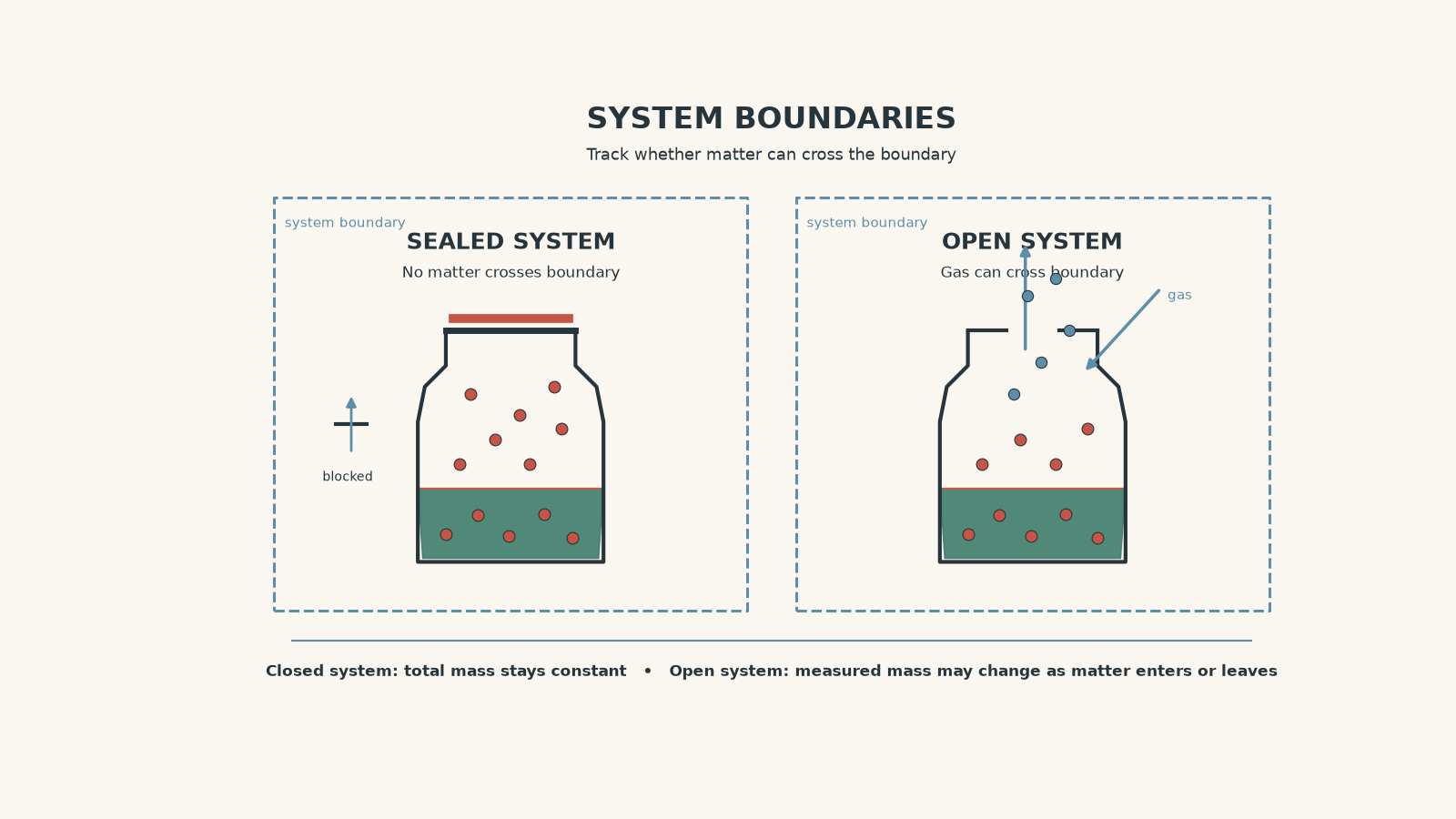
For a chemical reaction, the mass balance can be written as:
\[ m_{\text{final}} = m_{\text{initial}} + m_{\text{in}} - m_{\text{out}} \]
where:
- \(m_{\text{final}}\) is the final mass inside the system
- \(m_{\text{initial}}\) is the initial mass inside the system
- \(m_{\text{in}}\) is mass that enters from the surroundings
- \(m_{\text{out}}\) is mass that leaves for the surroundings
In a closed system, matter cannot enter or leave. Therefore \(m_{\text{in}} = 0\) and \(m_{\text{out}} = 0\), so:
\[ m_{\text{final}} = m_{\text{initial}} \]
That is the form of the law of conservation of mass you will use most often in HSC Chemistry.
02Why balancing equations is really mass accounting
Consider the reaction between hydrogen and oxygen:
\[ \ce{2H2(g) + O2(g) -> 2H2O(l)} \]
A chemical equation is balanced because the number of atoms of each element is the same before and after the reaction.
On the left:
- 4 hydrogen atoms
- 2 oxygen atoms
On the right:
- 4 hydrogen atoms
- 2 oxygen atoms
The atoms have been rearranged. They have not vanished or appeared from nowhere.
That atomic accounting becomes mass accounting when we use molar masses.
Using \(M(\ce{H2}) = 2.016\ \text{g mol}^{-1}\), \(M(\ce{O2}) = 32.00\ \text{g mol}^{-1}\), and \(M(\ce{H2O}) = 18.016\ \text{g mol}^{-1}\):
\[ \begin{aligned} \text{reactant mass} &= 2(2.016) + 1(32.00)\\ &= 36.032\ \text{g} \end{aligned} \]
and
\[ \begin{aligned} \text{product mass} &= 2(18.016)\\ &= 36.032\ \text{g} \end{aligned} \]
The coefficients do not tell you that the masses are in a 2:1:2 ratio. They tell you the ratio of reacting amounts in moles.
Mass enters the calculation through molar mass.
03The stoichiometry you need
Three quantities connect most conservation-of-mass calculations:
\[ n = \frac{m}{M} \]
where:
- \(n\) is amount in moles, measured in mol
- \(m\) is mass, measured in g
- \(M\) is molar mass, measured in \(\text{g mol}^{-1}\)
A reliable method is:
- Write and balance the chemical equation.
- Convert the known mass to moles.
- Use the mole ratio from the equation.
- Convert the required moles back to mass.
- Decide whether any substance has entered or left the measured system.
Step 5 is what often separates a correct conservation-of-mass explanation from a calculation with no physical meaning.
04Why an open container can lose mass
Suppose calcium carbonate is heated:
\[ \ce{CaCO3(s) -> CaO(s) + CO2(g)} \]
If the reaction occurs in an open crucible, carbon dioxide can escape into the room.
Predict what happens to the mass recorded for the crucible and its contents. Does it stay constant because mass is conserved?
No. The measured mass falls because \(\ce{CO2}\) leaves the measured system.
If you somehow collected the escaping carbon dioxide and included it in your final measurement, the total mass would still equal the starting mass.
Worked example: How much mass is lost when calcium carbonate decomposes?
A student heats \(10.0\ \text{g}\) of pure calcium carbonate until it decomposes completely according to:
\[ \ce{CaCO3(s) -> CaO(s) + CO2(g)} \]
The carbon dioxide escapes. Calculate the expected mass of carbon dioxide released and the mass of calcium oxide remaining.
Step 1
The molar mass of \(\ce{CaCO3}\) is approximately \(100.09\ \text{g mol}^{-1}\).
\[ n(\ce{CaCO3}) = \frac{10.0}{100.09} = 0.0999\ \text{mol} \]
Step 2
The mole ratio is:
\[ \ce{CaCO3} : \ce{CO2} : \ce{CaO} = 1:1:1 \]
Therefore:
\[ n(\ce{CO2}) = 0.0999\ \text{mol} \]
and
\[ n(\ce{CaO}) = 0.0999\ \text{mol} \]
Step 3
Using \(M(\ce{CO2}) = 44.01\ \text{g mol}^{-1}\):
\[ m(\ce{CO2}) = nM = 0.0999 \times 44.01 = 4.40\ \text{g} \]
Step 4
Using \(M(\ce{CaO}) = 56.08\ \text{g mol}^{-1}\):
\[ m(\ce{CaO}) = 0.0999 \times 56.08 = 5.60\ \text{g} \]
Step 5
\[ 5.60 + 4.40 = 10.00\ \text{g} \]
So \(10.0\ \text{g}\) of reactant becomes \(5.60\ \text{g}\) of solid calcium oxide and \(4.40\ \text{g}\) of carbon dioxide.
The balance reading drops by about \(4.40\ \text{g}\) because that gas has left the measured system. The reaction itself has not destroyed \(4.40\ \text{g}\) of matter.
05Why an open container can gain mass
Mass loss is not the only trap.
Magnesium burns in oxygen:
\[ \ce{2Mg(s) + O2(g) -> 2MgO(s)} \]
If you begin by weighing only the magnesium, the final magnesium oxide can have a larger mass.
Where does that extra mass come from?
The oxygen was already present in the surrounding air. During the reaction, oxygen atoms enter the measured solid and become part of magnesium oxide.
Worked example: Why does burning magnesium gain mass?
A \(2.40\ \text{g}\) sample of magnesium burns completely in excess oxygen. Calculate the expected mass of magnesium oxide produced and hence the increase in the mass of the solid.
Step 1
Using \(M(\ce{Mg}) = 24.31\ \text{g mol}^{-1}\):
\[ n(\ce{Mg}) = \frac{2.40}{24.31} = 0.0987\ \text{mol} \]
Step 2
From
\[ \ce{2Mg + O2 -> 2MgO} \]
the ratio \(\ce{Mg}:\ce{MgO}\) is \(1:1\).
Therefore:
\[ n(\ce{MgO}) = 0.0987\ \text{mol} \]
Step 3
Using \(M(\ce{MgO}) = 40.31\ \text{g mol}^{-1}\):
\[ m(\ce{MgO}) = 0.0987 \times 40.31 = 3.98\ \text{g} \]
Step 4
\[ \Delta m = 3.98 - 2.40 = 1.58\ \text{g} \]
The solid gains \(1.58\ \text{g}\).
That \(1.58\ \text{g}\) is the oxygen that has joined the magnesium.
We can check this directly. The balanced equation requires half as many moles of \(\ce{O2}\) as magnesium:
\[ \begin{aligned} n(\ce{O2}) &= \frac{0.0987}{2}\\ &= 0.0494\ \text{mol} \end{aligned} \]
so:
\[ m(\ce{O2}) = 0.0494 \times 32.00 = 1.58\ \text{g} \]
Exactly the amount by which the solid becomes heavier.
06The most common misconception: “The balance changed, so mass wasn’t conserved”
A balance only measures the matter that remains within whatever physical boundary you have chosen.
That means an observed mass change is often evidence that matter crossed the boundary.
| Observation | Likely explanation |
|---|---|
| Mass decreases during a reaction | A gas or vapour may have escaped |
| Mass increases during a reaction | A gas from the surroundings may have reacted with the sample |
| Mass remains constant in a sealed vessel | Matter has been rearranged without crossing the system boundary |
| Measured change does not match the stoichiometric prediction | Check for incomplete reaction, gas remaining dissolved or trapped, evaporation, spillage, impurities, or measurement uncertainty |
There is an important limit to that last row. You cannot automatically blame every disagreement on “experimental error”. Stoichiometry gives you a specific prediction, so the size and direction of the disagreement can help you work out what may have happened.
For example, if a reaction should release \(0.50\ \text{g}\) of gas but the measured loss is only \(0.30\ \text{g}\), some of the gas may still be inside the apparatus, or the reaction may not have gone to completion.
If the measured loss is \(0.80\ \text{g}\), escaping reaction gas alone cannot explain it. Something else, such as evaporation of solvent or loss of droplets, must also be considered.
07Closed system does not mean “nothing happens”
Picture two solutions inside a sealed flask. They react and produce a gas. You can see bubbles forming, pressure may increase, and the substances present may completely change.
Would the mass of the sealed flask and everything inside it change?
At HSC level, no.
The gas is still inside the flask. It has changed location and chemical form, but it has not crossed the system boundary.
This is why sealed reaction systems are useful when demonstrating conservation of mass. They prevent an invisible gaseous product from quietly leaving halfway through the experiment and making the result look mysterious.
There is a deeper physical point here. Chemical reactions involve tiny energy changes that, through \(E = mc^2\), correspond to extremely tiny changes in mass. Those changes are far below what ordinary HSC chemical measurements detect. For HSC stoichiometry, mass is treated as conserved in chemical reactions.
08Conservation does not mean every reactant is completely used
Another tempting mistake is to add all the reactant masses, calculate a product mass, and assume every reactant disappeared.
That only works if the reactants are present in exactly the required stoichiometric ratio.
If one reactant is in excess, some of it remains after the reaction. Conservation of mass includes both the products and any leftover reactants.
Suppose a sealed vessel contains aluminium and oxygen:
\[ \ce{4Al(s) + 3O2(g) -> 2Al2O3(s)} \]
If there is more oxygen than needed, the final system contains aluminium oxide plus unused oxygen. You do not get to turn all the oxygen into product just because it was inside the container.
This is where conservation of mass connects directly to limiting reagents.
09A useful decision rule for measured mass changes
When a question tells you that an experimental mass increased or decreased, do not immediately reach for a formula.
First ask:
What exactly was weighed before and after the reaction?
Then ask:
Could any matter have crossed that boundary?
Only after answering those questions should you interpret the measured change.
For an open system:
\[ \text{measured mass change} = \text{mass entering} - \text{mass leaving} \]
For a closed system:
\[ \text{total measured mass change} \approx 0 \]
provided the complete closed apparatus is weighed and ordinary chemical reactions are involved.
10Questions and solutions
Question 1
A sample of \(8.00\ \text{g}\) of a carbonate is heated in an open container. After heating, the container and solid together have lost \(2.10\ \text{g}\).
Assuming the only material to leave the system is carbon dioxide, what mass of solid remains, and why does the mass loss not violate conservation of mass?
Solution 1
The remaining solid has a mass of \(5.90\ \text{g}\), and conservation of mass is not violated because the missing \(2.10\ \text{g}\) has left the measured system as carbon dioxide.
The mass balance is:
\[ m_{\text{final}} = m_{\text{initial}} - m_{\text{out}} \]
Substituting:
\[ m_{\text{final}} = 8.00 - 2.10 = 5.90\ \text{g} \]
The reaction vessel is open, so the balance does not include the escaped \(\ce{CO2}\) in the final measurement.
If the \(2.10\ \text{g}\) of carbon dioxide were collected and weighed as part of the final system:
\[ 5.90 + 2.10 = 8.00\ \text{g} \]
The common trap is to assume that conservation of mass requires the solid to keep the same mass. It requires all matter to be accounted for.
Question 2
Hydrogen peroxide decomposes according to:
\[ \ce{2H2O2(aq) -> 2H2O(l) + O2(g)} \]
An open flask loses \(0.320\ \text{g}\) during the reaction. Assume oxygen is the only substance that leaves the flask.
Calculate:
a. the amount of oxygen released in moles
b. the amount of hydrogen peroxide that decomposed
Solution 2
The reaction releases \(0.0100\ \text{mol}\) of \(\ce{O2}\), which means \(0.0200\ \text{mol}\) of \(\ce{H2O2}\) decomposed.
For part a, the measured mass loss is the mass of escaping oxygen.
Using \(M(\ce{O2}) = 32.00\ \text{g mol}^{-1}\):
\[ n(\ce{O2}) = \frac{m}{M} = \frac{0.320}{32.00} = 0.0100\ \text{mol} \]
For part b, the balanced equation gives:
\[ \ce{H2O2}:\ce{O2} = 2:1 \]
Therefore:
\[ n(\ce{H2O2}) = 2(0.0100) = 0.0200\ \text{mol} \]
The balance loses mass because oxygen leaves the open flask. Stoichiometry lets us work backwards from that measured loss to determine how much reactant decomposed.
The important assumption is that oxygen is the only material leaving. If water were also evaporating, the mass loss could not be treated as oxygen mass alone.
Question 3
Magnesium reacts with oxygen according to:
\[ \ce{2Mg(s) + O2(g) -> 2MgO(s)} \]
A student heats \(4.86\ \text{g}\) of magnesium in air. After the reaction, the solid has a mass of \(7.70\ \text{g}\).
Assuming all the magnesium reacted, determine the theoretical mass of magnesium oxide and decide whether the measured result can be explained solely by magnesium reacting with oxygen.
Solution 3
The theoretical mass of magnesium oxide is about \(8.06\ \text{g}\), so a final mass of \(7.70\ \text{g}\) cannot represent complete conversion of all \(4.86\ \text{g}\) of magnesium into retained \(\ce{MgO}\).
First calculate the amount of magnesium:
\[ n(\ce{Mg}) = \frac{4.86}{24.31} = 0.1999\ \text{mol} \]
The balanced equation gives a \(1:1\) mole ratio between magnesium and magnesium oxide:
\[ n(\ce{MgO}) = 0.1999\ \text{mol} \]
Using \(M(\ce{MgO}) = 40.31\ \text{g mol}^{-1}\):
\[ m(\ce{MgO}) = 0.1999 \times 40.31 = 8.06\ \text{g} \]
The measured result is:
\[ 8.06 - 7.70 = 0.36\ \text{g} \]
below the theoretical mass.
If all the starting magnesium really reacted to form magnesium oxide, and all the product remained in the container, the final solid should have a mass of about \(8.06\ \text{g}\).
Therefore at least one assumption must be wrong. Possibilities include loss of solid product from the container or formation of products other than the assumed pure \(\ce{MgO}\). If the statement that all magnesium reacted is itself uncertain, incomplete reaction would also need investigation.
The trap is to look only at the fact that the mass increased and declare the result correct. Conservation of mass gives the general direction of the change, but stoichiometry predicts its size.
Question 4
A sealed vessel initially contains \(5.40\ \text{g}\) of aluminium and \(4.00\ \text{g}\) of oxygen gas. They react according to:
\[ \ce{4Al(s) + 3O2(g) -> 2Al2O3(s)} \]
Determine:
a. the limiting reactant
b. the mass of aluminium oxide formed
c. the mass of excess reactant remaining
d. the total final mass inside the sealed vessel
Solution 4
Aluminium is the limiting reactant. About \(10.2\ \text{g}\) of aluminium oxide cannot form here because the vessel contains only \(9.40\ \text{g}\) of matter in total. The correct product mass is approximately \(10.2\ \text{g}\) only if enough oxygen is supplied, so we must check the stoichiometry carefully before accepting that result.
Start with the amounts of each reactant.
For aluminium, using \(M(\ce{Al}) = 26.98\ \text{g mol}^{-1}\):
\[ n(\ce{Al}) = \frac{5.40}{26.98} = 0.200\ \text{mol} \]
For oxygen:
\[ n(\ce{O2}) = \frac{4.00}{32.00} = 0.125\ \text{mol} \]
The reaction requires:
\[ \ce{Al}:\ce{O2} = 4:3 \]
To react with \(0.200\ \text{mol}\) of aluminium, the oxygen required would be:
\[ n(\ce{O2,required}) = 0.200 \times \frac{3}{4} = 0.150\ \text{mol} \]
Only \(0.125\ \text{mol}\) is available. Therefore oxygen, not aluminium, is the limiting reactant.
This is why checking the stoichiometric ratio matters before calculating product mass.
Using oxygen as the limiting reactant:
\[ n(\ce{Al2O3}) = 0.125 \times \frac{2}{3} = 0.0833\ \text{mol} \]
Using \(M(\ce{Al2O3}) \approx 101.96\ \text{g mol}^{-1}\):
\[ m(\ce{Al2O3}) = 0.0833 \times 101.96 \approx 8.50\ \text{g} \]
So the answer to part b is approximately:
\[ \boxed{8.50\ \text{g of }\ce{Al2O3}} \]
Now find how much aluminium reacted:
\[ n(\ce{Al,reacted}) = 0.125 \times \frac{4}{3} = 0.1667\ \text{mol} \]
Its mass is:
\[ m(\ce{Al,reacted}) = 0.1667 \times 26.98 \approx 4.50\ \text{g} \]
Therefore the aluminium remaining is:
\[ m(\ce{Al,remaining}) = 5.40 - 4.50 = 0.90\ \text{g} \]
For part d, the vessel is sealed. Nothing has entered or left, so the final total mass must equal the initial total mass:
\[ m_{\text{final,total}} = 5.40 + 4.00 = 9.40\ \text{g} \]
We can confirm this using the products and leftover reactant:
\[ 8.50 + 0.90 = 9.40\ \text{g} \]
The correct conclusions are therefore:
- limiting reactant: \(\ce{O2}\)
- aluminium oxide formed: approximately \(8.50\ \text{g}\)
- aluminium remaining: approximately \(0.90\ \text{g}\)
- total final mass: \(9.40\ \text{g}\)
This question exposes a useful safety check. If a calculated product mass exceeds the total mass available in a sealed system, stop. Either matter entered from outside, or the stoichiometry has gone wrong.
11Where this idea leads next
Conservation of mass gives stoichiometry its physical meaning. A balanced equation tells you how atoms are rearranged, molar masses turn that rearrangement into measurable masses, and the system boundary tells you why an experimental balance reading may rise, fall, or remain constant.
The next useful step is limiting-reagent and yield calculations. Once you can account for where every gram should go, you can compare the theoretical prediction with the amount actually obtained and decide whether the difference comes from stoichiometry, incomplete reaction, product loss, or another experimental process.