
Ionic and Covalent Naming and Valency for HSC Chemistry
Learn how to use valency, ionic charge, oxidation states, and naming rules to write and interpret ionic and covalent formulae.
Suppose you are asked to write the formula for iron(III) oxide. Which looks right: \(\ce{FeO}\), \(\ce{Fe2O3}\), or \(\ce{Fe3O2}\)?
A tempting choice is \(\ce{Fe3O2}\). After all, the name contains “III”, and oxide has a valency of 2. But the Roman numeral is not telling you how many iron atoms to write. It tells you the oxidation state of iron. The formula must then be built so that the positive and negative charges cancel.
That gives \(\ce{Fe2O3}\).
This is the central idea behind chemical nomenclature: names and formulae contain different kinds of information, and you need to know which information controls the subscripts.
01Three ideas that are easy to mix up
Before naming compounds, separate three related ideas: valency, ionic charge, and oxidation state.
| Idea | What it tells you | Example |
|---|---|---|
| Valency | A simple measure of combining capacity | Mg has valency 2 in common compounds |
| Ionic charge | The actual charge carried by an ion | \(\mathrm{Mg}^{2+}\) |
| Oxidation state | A signed bookkeeping value assigned to an atom in a substance | Mg is \(+2\) in \(\ce{MgCl2}\) |
At HSC level, valency is useful as a formula-writing shortcut, especially for familiar monatomic ions. Magnesium commonly forms \(\mathrm{Mg}^{2+}\), so we often say it has valency 2. Chlorine commonly forms \(\mathrm{Cl}^{-}\), so its valency is 1.
But valency is not exactly the same thing as oxidation state.
Valency is usually written as an unsigned whole number. Oxidation state has a sign and depends on the compound. An element can have several oxidation states.
Iron, for example, commonly occurs as both \(\mathrm{Fe}^{2+}\) and \(\mathrm{Fe}^{3+}\). That is why names such as iron(II) chloride and iron(III) chloride need a Roman numeral.
02Ionic formulae are controlled by charge
Picture an ionic compound as a very strict dinner party: every positive charge must be cancelled by an equal amount of negative charge before anyone is allowed to sit down.
One \(\mathrm{Na}^{+}\) and one \(\mathrm{Cl}^{-}\) work perfectly:
\[
(+1)+(-1)=0
\]
So sodium chloride is \(\ce{NaCl}\).
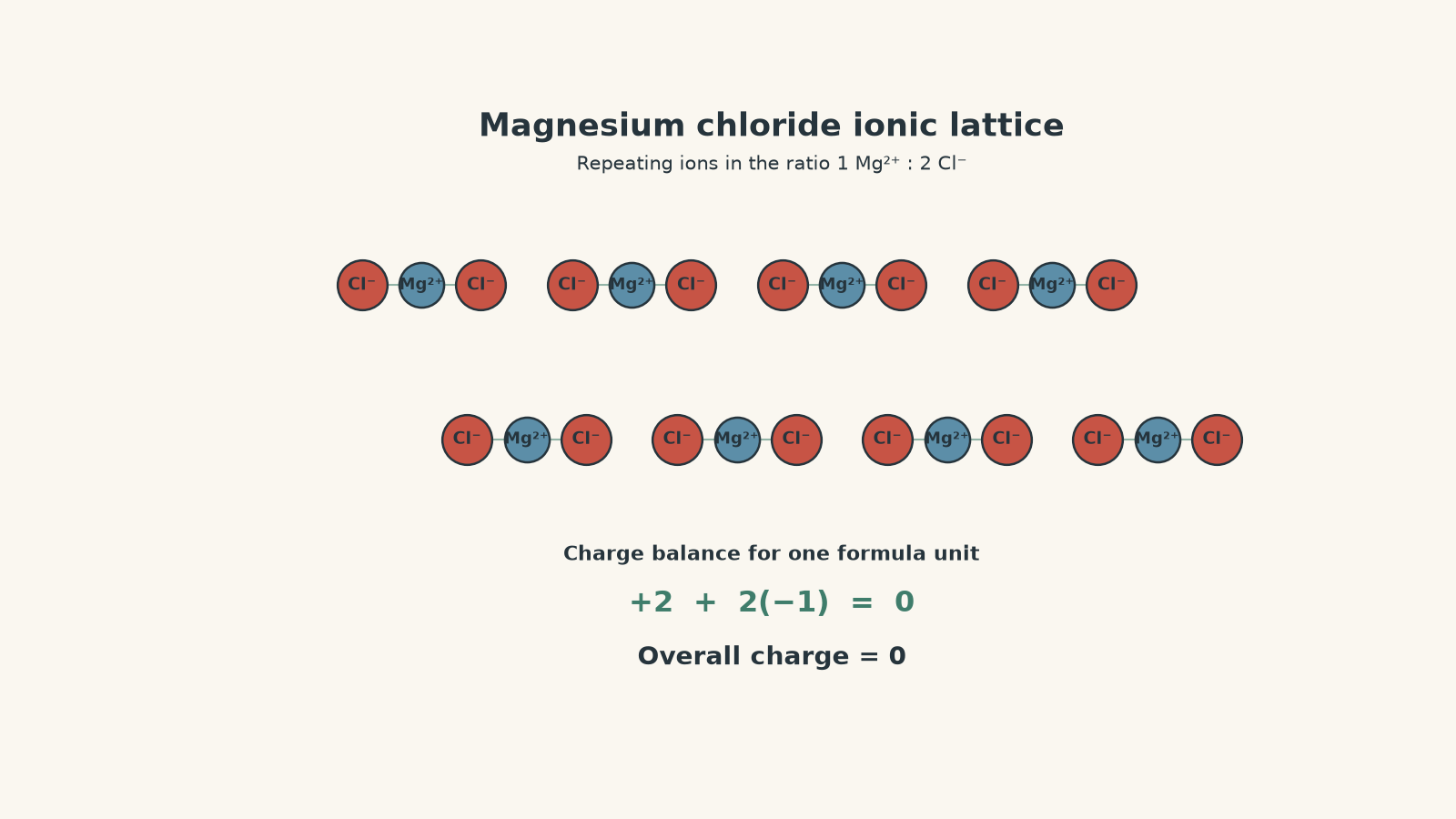
Now try magnesium and chloride. One \(\mathrm{Mg}^{2+}\) has two units of positive charge, while each \(\mathrm{Cl}^{-}\) supplies only one unit of negative charge.
You need two chloride ions:
\[
(+2)+2(-1)=0
\]
So the formula is \(\ce{MgCl2}\).
The dinner-party picture is only an analogy. An ionic solid is not made from separate little \(\ce{MgCl2}\) molecules sitting in pairs. It forms a large three-dimensional lattice. The formula \(\ce{MgCl2}\) gives the simplest whole-number ratio of ions.
Common ion charges worth knowing
You do not need to derive every common ion from scratch each time.
| Ion or group | Common charge |
|---|---|
| Group 1 metal ions, such as \(\mathrm{Na}^{+}\), \(\mathrm{K}^{+}\) | \(+1\) |
| Group 2 metal ions, such as \(\mathrm{Mg}^{2+}\), \(\mathrm{Ca}^{2+}\) | \(+2\) |
| \(\mathrm{Al}^{3+}\) | \(+3\) |
| \(\mathrm{Ag}^{+}\) | \(+1\) |
| \(\mathrm{Zn}^{2+}\) | \(+2\) |
| Halide ions, such as \(\mathrm{Cl}^{-}\), \(\mathrm{Br}^{-}\) | \(-1\) |
| Oxide, \(\mathrm{O}^{2-}\) | \(-2\) |
| Sulfide, \(\mathrm{S}^{2-}\) | \(-2\) |
| Nitride, \(\mathrm{N}^{3-}\) | \(-3\) |
| Ammonium, \(\ce{NH4+}\) | \(+1\) |
| Hydroxide, \(\ce{OH^-}\) | \(-1\) |
| Nitrate, \(\ce{NO3^-}\) | \(-1\) |
| Carbonate, \(\ce{CO3^2-}\) | \(-2\) |
| Sulfate, \(\ce{SO4^2-}\) | \(-2\) |
| Phosphate, \(\ce{PO4^3-}\) | \(-3\) |
Polyatomic ions such as sulfate and nitrate behave as a single charged unit when you build an ionic formula.
Worked example: Write the formula for aluminium oxide
Write the chemical formula for aluminium oxide.
Step 1
Aluminium forms \(\mathrm{Al}^{3+}\). Oxide is \(\mathrm{O}^{2-}\).
Step 2
The lowest common multiple of 3 and 2 is 6.
Two aluminium ions give:
\[
2(+3)=+6
\]
Three oxide ions give:
\[
3(-2)=-6
\]
Step 3
\[
\ce{Al2O3}
\]
The result means that the simplest charge-neutral ratio is two aluminium ions for every three oxide ions.
A “criss-cross” shortcut would also produce the subscripts 2 and 3. That shortcut is fine for checking your work, but charge balance is the reason it works. If you understand the charges, you are much less likely to misuse the shortcut.
Always simplify an ionic ratio
What happens with calcium oxide?
Calcium is \(\mathrm{Ca}^{2+}\), and oxide is \(\mathrm{O}^{2-}\). Criss-crossing the 2s mechanically might give \(\ce{Ca2O2}\).
But one calcium ion already balances one oxide ion:
\[
(+2)+(-2)=0
\]
The simplest ratio is therefore \(1:1\), so the formula is:
\[
\ce{CaO}
\]
Ionic formulae use the lowest whole-number ratio.
03Polyatomic ions stay together
Now consider calcium nitrate.
Calcium is \(\mathrm{Ca}^{2+}\), while nitrate is \(\ce{NO3^-}\). Two nitrate ions are needed:
\[
(+2)+2(-1)=0
\]
The formula is:
\[
\ce{Ca(NO3)2}
\]
The brackets matter. The subscript 2 applies to the entire nitrate ion.
Without brackets, \(\ce{CaNO3_2}\) would not communicate the structure correctly.
There is also an important rule hiding here: do not alter the subscripts inside a polyatomic ion when balancing charges. Nitrate is \(\ce{NO3^-}\). You cannot turn it into some new arrangement of nitrogen and oxygen just to make the arithmetic convenient.
Worked example: Write the formula for iron(III) sulfate
Write the chemical formula for iron(III) sulfate.
Step 1
Iron(III) means the iron has oxidation state \(+3\). For this monatomic iron ion, that corresponds to \(\mathrm{Fe}^{3+}\).
Sulfate is \(\ce{SO4^2-}\).
Step 2
The lowest common multiple of 3 and 2 is 6.
Two \(\mathrm{Fe}^{3+}\) ions contribute \(+6\).
Three sulfate ions contribute:
\[
3(-2)=-6
\]
Step 3
\[
\ce{Fe2(SO4)3}
\]
The brackets are necessary because there are three complete sulfate ions.
04Naming ionic compounds
Writing the formula is one direction. HSC questions can just as easily give you a formula and ask for its name.
The basic rule is:
- Name the positive ion first.
- Name the negative ion second.
- Change a monatomic negative ion ending to -ide.
- Keep the established name of a polyatomic ion.
- If the metal can have different oxidation states, state its oxidation state using a Roman numeral.
For example:
| Formula | Name |
|---|---|
| \(\ce{NaCl}\) | sodium chloride |
| \(\ce{MgO}\) | magnesium oxide |
| \(\ce{Al2S3}\) | aluminium sulfide |
| \(\ce{CaCO3}\) | calcium carbonate |
| \(\ce{FeCl2}\) | iron(II) chloride |
| \(\ce{FeCl3}\) | iron(III) chloride |
Notice what is not present: prefixes such as di-, tri-, and tetra-.
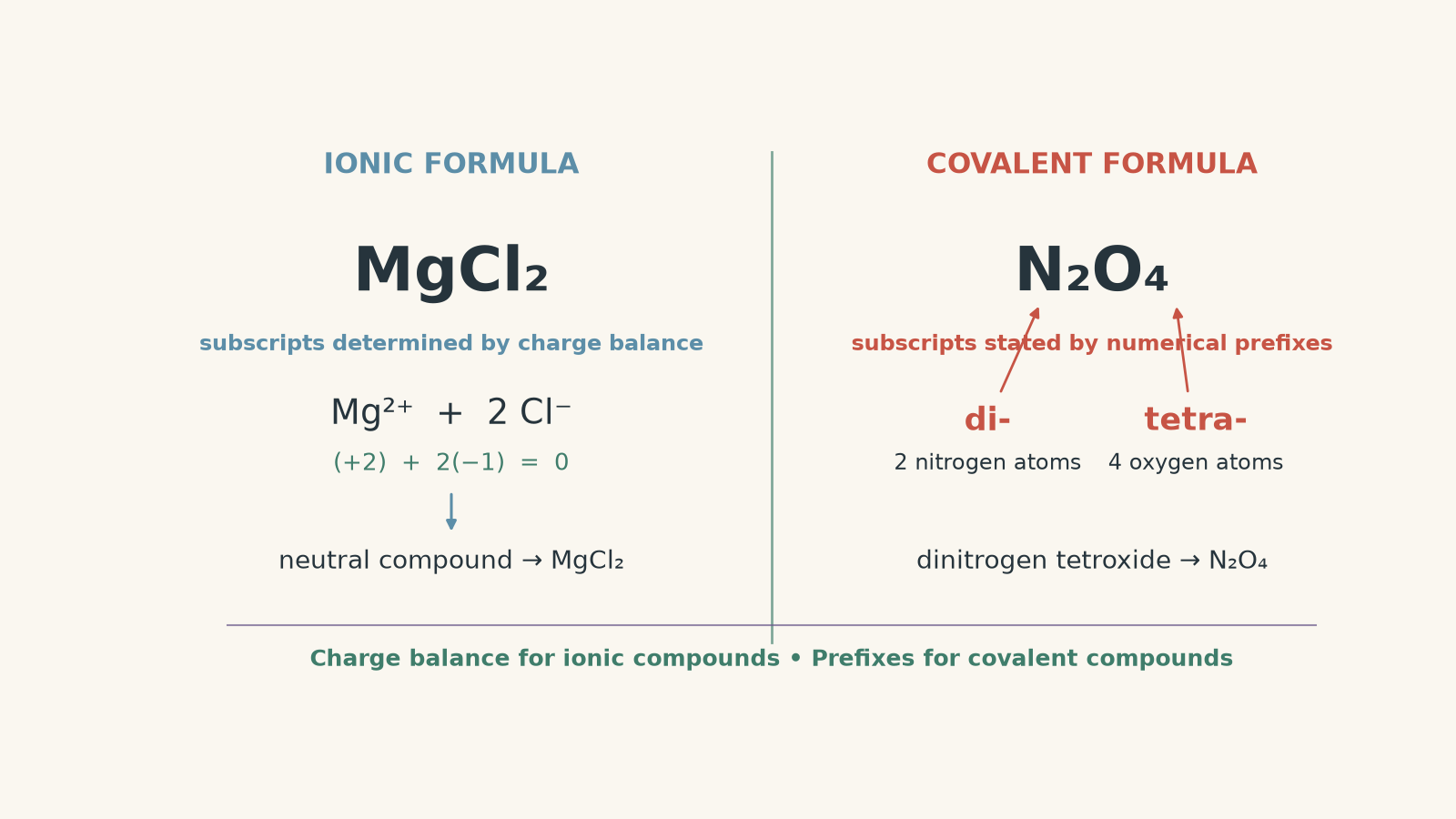
You do not call \(\ce{MgCl2}\) “magnesium dichloride” when using standard ionic nomenclature. The \(1:2\) ratio follows from charge balance, so a prefix is unnecessary.
05Finding a metal’s oxidation state from a formula
Suppose you are given \(\ce{Cu2O}\).
Copper can have more than one oxidation state, so simply saying “copper oxide” leaves out useful information.
How can you find the Roman numeral?
Oxide has oxidation state \(-2\). The compound is neutral, so the oxidation states must add to zero.
Let the oxidation state of each copper atom be \(x\):
\[
2x+(-2)=0
\]
Therefore:
\[
2x=+2
\]
and:
\[
x=+1
\]
So \(\ce{Cu2O}\) is copper(I) oxide.
Worked example: Name \(\ce{Co2O3}\)
Name the ionic compound \(\ce{Co2O3}\).
Step 1
Oxygen is usually \(-2\) in ordinary oxides.
Three oxygen atoms therefore contribute:
\[
3(-2)=-6
\]
Step 2
Let each cobalt atom have oxidation state \(x\).
\[
2x-6=0
\]
So:
\[
2x=6
\]
\[
x=+3
\]
Step 3
The metal is cobalt, its oxidation state is \(+3\), and \(\mathrm{O}^{2-}\) is oxide.
The name is cobalt(III) oxide.
The Roman numeral III means \(+3\). It does not mean that the formula contains three cobalt atoms.
06Oxidation state is not the same as an ion’s overall charge
This distinction becomes especially important with polyatomic ions.
Take sulfate, \(\ce{SO4^2-}\).
The entire sulfate ion has charge \(-2\). That does not mean sulfur has oxidation state \(-2\).
Oxygen usually has oxidation state \(-2\). Four oxygen atoms therefore contribute:
\[
4(-2)=-8
\]
The oxidation states inside the ion must add to the ion’s total charge, \(-2\).
Let sulfur’s oxidation state be \(x\):
\[
x-8=-2
\]
so:
\[
x=+6
\]
Sulfur therefore has oxidation state \(+6\) in sulfate, even though the sulfate ion as a whole has charge \(-2\).
That is why “charge” and “oxidation state” should not be used as interchangeable words.
A compact set of oxidation-state rules will take you a long way:
- an element by itself has oxidation state \(0\)
- a monatomic ion has an oxidation state equal to its ionic charge
- oxidation states add to \(0\) in a neutral compound
- oxidation states add to the overall charge in a polyatomic ion
- oxygen is usually \(-2\)
- hydrogen is usually \(+1\)
The words usually matter. Chemistry contains exceptions, and you will meet some of them when oxidation and reduction become a larger part of the course.
07Covalent nomenclature uses a different system
Now consider \(\ce{N2O4}\).
If you tried to treat this like an ionic compound, you would immediately hit a problem. There is no metal cation whose charge needs balancing against an anion.
For simple binary covalent compounds, the name instead tells you how many atoms are represented in the formula.
Predict the name of \(\ce{N2O4}\). Would “nitrogen oxide” be enough?
No. There are several compounds containing nitrogen and oxygen, so the atom counts matter. Prefixes carry that information.
| Number | Prefix |
|---|---|
| 1 | mono- |
| 2 | di- |
| 3 | tri- |
| 4 | tetra- |
| 5 | penta- |
| 6 | hexa- |
| 7 | hepta- |
| 8 | octa- |
| 9 | nona- |
| 10 | deca- |
For a binary covalent compound:
- name the first element
- use a numerical prefix when there is more than one atom of the first element
- name the second element with an -ide ending
- use a prefix for the number of atoms of the second element, including mono- when there is one
The prefix mono- is normally omitted from the first element.
Some names contract adjacent vowels. For example, mono + oxide becomes monoxide, not “monooxide”, and tetra + oxide becomes tetroxide.
Worked example: Name \(\ce{N2O4}\)
Name the binary covalent compound \(\ce{N2O4}\).
Step 1
There are two nitrogen atoms. The prefix for two is di-.
This gives dinitrogen.
Step 2
There are four oxygen atoms. The prefix is tetra-, and oxygen becomes oxide.
“Tetraoxide” contracts to tetroxide.
Step 3
The name is dinitrogen tetroxide.
The prefixes directly encode the \(2:4\) atom count in the written formula. Do not simplify it to \(\ce{NO2}\) just because both subscripts are divisible by 2. A molecular formula and an ionic empirical ratio are doing different jobs.
Worked example: Write the formula for sulfur hexafluoride
Write the formula for sulfur hexafluoride.
Step 1
There is no prefix before sulfur, so there is one sulfur atom.
Step 2
Hexa- means six. Fluoride tells you the second element is fluorine.
There are therefore six fluorine atoms.
Step 3
\[
\ce{SF6}
\]
There is no charge-balancing calculation here. The word hexa- has already told you the required subscript.
08Ionic or covalent? Decide before using a naming rule
Many nomenclature errors happen because a student remembers a rule but applies it to the wrong type of compound.
Use the composition as your first clue.
| What you see | Likely treatment |
|---|---|
| Metal + nonmetal | Ionic |
| Metal + polyatomic ion | Ionic |
| Ammonium + anion | Ionic |
| Two nonmetals in a simple binary compound | Covalent prefix naming |
For example:
- \(\ce{CaCl2}\): calcium is a metal, so use ionic naming -> calcium chloride
- \(\ce{NCl3}\): nitrogen and chlorine are nonmetals, so use prefixes -> nitrogen trichloride
- \(\ce{CuSO4}\): copper plus sulfate is ionic -> determine copper’s oxidation state, giving copper(II) sulfate
This rule is deliberately focused on the common inorganic compounds covered here. Acids, hydrates, organic compounds, and more advanced coordination compounds require additional naming rules.
09A better method than memorising “criss-cross”
The criss-cross method can be useful, but it becomes dangerous when it replaces thinking.
For example, suppose you need the formula for aluminium sulfate.
You know:
\[
\mathrm{Al}^{3+}
\]
and:
\[
\ce{SO4^2-}
\]
Criss-crossing the charge magnitudes suggests:
\[
\ce{Al2(SO4)3}
\]
That happens to be correct.
But the stronger reasoning is:
\[
2(+3)+3(-2)=0
\]
This tells you why there are two aluminium ions and three sulfate ions. It also reminds you that sulfate is one intact ion, so brackets are needed.
Use this decision process instead:
Name to ionic formula
- Identify the cation and anion.
- Write their charges.
- Find the smallest numbers of each that make the total charge zero.
- Use brackets if more than one polyatomic ion is required.
- Check that the ratio cannot be simplified.
Ionic formula to name
- Identify the cation and anion.
- Determine whether the metal has a variable oxidation state.
- If it does, calculate that oxidation state from charge balance.
- Write the oxidation state as a Roman numeral.
- Name the anion correctly.
Covalent name to formula
- Identify each element.
- Translate each prefix directly into a subscript.
- Do not charge-balance the formula.
Covalent formula to name
- Count each type of atom.
- Convert the numbers into prefixes.
- Omit mono- from the first element.
- Give the second element an -ide ending.
10The most tempting mistakes
Mistake 1: Treating a Roman numeral as a subscript
Iron(III) chloride is not \(\ce{Fe3Cl}\).
The III means iron has oxidation state \(+3\):
\[
\mathrm{Fe}^{3+}
\]
Each chloride is \(\mathrm{Cl}^{-}\), so three chlorides are needed:
\[
\ce{FeCl3}
\]
Mistake 2: Using covalent prefixes for ionic compounds
\(\ce{CaCl2}\) is calcium chloride, not calcium dichloride.
The subscript 2 is already determined by the charges \(\mathrm{Ca}^{2+}\) and \(\mathrm{Cl}^{-}\).
Mistake 3: Assuming the subscript equals oxidation state
In \(\ce{Fe2O3}\), iron is not \(+2\) because its subscript is 2.
Three oxygen atoms at \(-2\) contribute \(-6\). The two iron atoms must together contribute \(+6\), so each iron is \(+3\).
The compound is iron(III) oxide.
Mistake 4: Forgetting to simplify ionic ratios
For \(\mathrm{Ca}^{2+}\) and \(\mathrm{O}^{2-}\), a mechanical criss-cross could produce \(\ce{Ca2O2}\).
The correct simplest ratio is:
\[
\ce{CaO}
\]
Mistake 5: Changing a polyatomic ion internally
Sulfate is \(\ce{SO4^2-}\). If three sulfates are required, write:
\[
\ce{(SO4)3}
\]
Do not alter the \(\ce{SO4}\) unit itself.
11Questions and solutions
Question 1
Name the compound \(\ce{K2S}\). Explain why the name does not need a numerical prefix.
Solution 1
The compound is potassium sulfide.
Potassium is a Group 1 metal and forms \(\mathrm{K}^{+}\). Sulfur forms the sulfide ion, \(\mathrm{S}^{2-}\). Two potassium ions are therefore required to balance one sulfide ion:
\[
2(+1)+(-2)=0
\]
The compound is ionic, so the \(2:1\) ratio is determined by charge balance. Numerical prefixes such as di- are not used in the standard ionic name.
Question 2
Write the chemical formula for magnesium nitride.
Solution 2
The formula is \(\ce{Mg3N2}\).
Magnesium forms \(\mathrm{Mg}^{2+}\), while nitride is \(\mathrm{N}^{3-}\). The smallest common total charge is 6:
\[
3(+2)=+6
\]
and:
\[
2(-3)=-6
\]
So three magnesium ions balance two nitride ions:
\[
\ce{Mg3N2}
\]
The \(3:2\) ratio is already the lowest whole-number ratio.
Question 3
Write the chemical formula for aluminium sulfate.
Solution 3
The formula is \(\ce{Al2(SO4)3}\).
Aluminium forms \(\mathrm{Al}^{3+}\), and sulfate is \(\ce{SO4^2-}\). Two aluminium ions contribute \(+6\), while three sulfate ions contribute \(-6\):
\[
2(+3)+3(-2)=0
\]
Therefore:
\[
\ce{Al2(SO4)3}
\]
The brackets are necessary because the formula contains three complete sulfate ions. The internal formula \(\ce{SO4}\) must not be changed during charge balancing.
Question 4
Name \(\ce{MnO2}\), given that manganese can form ions with different oxidation states.
Solution 4
The compound is manganese(IV) oxide.
Each oxygen has oxidation state \(-2\). Two oxygen atoms therefore contribute:
\[
2(-2)=-4
\]
The compound is neutral, so manganese must contribute \(+4\):
\[
x-4=0
\]
\[
x=+4
\]
The Roman numeral IV records this oxidation state. The subscript 2 belongs to oxygen and does not mean that manganese has oxidation state \(+2\).
Question 5
Give the systematic binary covalent name of \(\ce{N2O3}\), and determine the oxidation state of nitrogen in the compound.
Solution 5
The name is dinitrogen trioxide, and nitrogen has oxidation state \(+3\).
The naming and oxidation-state calculations are two separate tasks.
For the name, two nitrogen atoms give the prefix di-, and three oxygen atoms give tri- plus oxide:
dinitrogen trioxide
For the oxidation state, oxygen is usually \(-2\). Three oxygen atoms contribute:
\[
3(-2)=-6
\]
Let the oxidation state of each nitrogen atom be \(x\). Because the compound is neutral:
\[
2x-6=0
\]
\[
2x=6
\]
\[
x=+3
\]
The important distinction is that the prefix di- reports the number of nitrogen atoms, while the oxidation state \(+3\) describes the electron-bookkeeping state assigned to each nitrogen atom.
Question 6
A student uses the criss-cross method on calcium oxide and writes \(\ce{Ca2O2}\). The student argues that the charges have been copied correctly, so the formula must be correct. Evaluate the argument and give the correct formula.
Solution 6
The correct formula is \(\ce{CaO}\), so the student’s argument is incomplete.
Calcium forms \(\mathrm{Ca}^{2+}\), and oxide is \(\mathrm{O}^{2-}\). One of each already gives a neutral combination:
\[
(+2)+(-2)=0
\]
The ratio is therefore \(1:1\).
Although mechanically criss-crossing the charge magnitudes can produce the temporary ratio \(2:2\), an ionic formula must be reduced to the simplest whole-number ratio:
\[
\ce{Ca2O2} \rightarrow \ce{CaO}
\]
The trap is treating criss-cross as a rule that creates the final formula. Charge neutrality and simplest ratio are the actual rules.
Question 7
A metal \(X\) can form either \(X^{2+}\) or \(X^{3+}\). A compound of this metal has formula \(\ce{X2O3}\).
A student claims that \(X\) must have oxidation state \(+2\) because the formula contains the subscript 2 after \(X\). Determine the oxidation state of \(X\), and explain the flaw in the student’s reasoning.
Solution 7
The oxidation state of \(X\) is \(+3\).
Each oxygen has oxidation state \(-2\). Three oxygen atoms therefore contribute:
\[
3(-2)=-6
\]
If the oxidation state of each \(X\) atom is \(x\), the neutral compound must satisfy:
\[
2x-6=0
\]
Therefore:
\[
2x=6
\]
\[
x=+3
\]
The subscript 2 tells us that there are two \(X\) atoms in the formula unit. It does not state their oxidation state. In fact, the two \(X\) atoms must together supply \(+6\), so each one must be \(+3\).
This is exactly why oxidation states should be calculated from the whole formula rather than guessed from nearby subscripts.
Question 8
A container is labelled only chromium phosphate. Chromium can have oxidation states \(+2\) and \(+3\), while phosphate is \(\ce{PO4^3-}\).
Explain why the label does not uniquely specify a formula. Write the formula that would result from chromium(II), and the formula that would result from chromium(III).
Solution 8
The label is ambiguous because chromium can have more than one oxidation state. A Roman numeral is needed to identify which chromium ion is present.
For chromium(II), the ion is \(\mathrm{Cr}^{2+}\), while phosphate is \(\ce{PO4^3-}\). The smallest common total charge is 6:
\[
3(+2)+2(-3)=0
\]
so chromium(II) phosphate is:
\[
\ce{Cr3(PO4)2}
\]
For chromium(III), the charges are equal in magnitude:
\[
(+3)+(-3)=0
\]
so the ratio is \(1:1\):
\[
\ce{CrPO4}
\]
The two possible compounds therefore have different formulae:
- chromium(II) phosphate: \(\ce{Cr3(PO4)2}\)
- chromium(III) phosphate: \(\ce{CrPO4}\)
The missing Roman numeral is not a minor naming detail. Without it, the oxidation state, ion ratio, and chemical formula cannot be determined uniquely.
12What this lets you do next
Nomenclature becomes much easier once you stop treating names as strings to memorise. An ionic formula is a charge-balancing statement. A covalent prefix is an atom-count instruction. A Roman numeral is an oxidation-state statement.
Those same ideas reappear almost immediately elsewhere in Chemistry. Correct formulae let you balance equations and calculate molar masses, while oxidation states become a way to track electron transfer in redox reactions. If you can look at \(\ce{Fe2O3}\) and explain why the iron is \(+3\), you have already started doing the reasoning needed for oxidation and reduction rather than merely learning compound names.