
Allotropy in HSC Chemistry: How Structure Changes Properties
Learn how different structures of the same element produce different physical properties. Compare key allotropes including diamond, graphite, oxygen, and ozone.
Diamond can scratch glass. Graphite is soft enough to rub onto paper. Yet both substances contain only carbon atoms.
If chemical composition were the whole story, that would make no sense. So before reading on, predict this: what must be different between diamond and graphite if the atoms themselves are the same?
The answer is their structure. The carbon atoms are bonded and arranged differently. That changes how strongly different parts of the material are held together, how electrons can move, and therefore the physical properties we observe.
This is the central idea behind allotropy.
01What makes two substances allotropes?
Imagine giving two people identical boxes of LEGO bricks. One person builds a rigid three-dimensional tower. The other builds thin sheets that can slide over each other.
The pieces haven’t changed. Their arrangement has.
That is a useful first model for allotropy. The same element can sometimes arrange its atoms in more than one stable structure. These different structural forms are called allotropes.
More precisely, allotropes are different structural forms of the same element. The difference may involve:
- how many atoms are joined into each molecule
- how the atoms are bonded
- how atoms are arranged in a crystal
- the shape and dimensionality of the bonding network
This means an element’s identity alone does not determine all of its properties. Structure matters.
A quick decision rule
When deciding whether two substances are allotropes, ask:
| Question | If the answer is yes… |
|---|---|
| Do they contain only one element? | They might be allotropes. |
| Is it the same element in both substances? | Keep checking. |
| Are the atoms arranged or bonded differently? | They can be different allotropes. |
| Is the only difference the number of neutrons in the atoms? | They are isotopes, not allotropes. |
| Is the only difference solid, liquid, or gas state? | That is a phase change, not allotropy. |
For example, diamond and graphite are allotropes of carbon. \(\ce{O2}\) and \(\ce{O3}\) are allotropes of oxygen.
Carbon-12 and carbon-13 are not allotropes. They are isotopes because their nuclei contain different numbers of neutrons.
02Why can allotropes have such different properties?
A physical property comes from what particles can actually do.
Ask questions such as:
- Can layers slide?
- Can electrons move through the structure?
- How many strong covalent bonds must be broken to deform the material?
- Are the particles small molecules or part of a giant covalent network?
Change the structure, and the answers can change even though the element stays the same.
That gives us a useful chain of reasoning:
\[
\text{structure} \rightarrow \text{bonding and electron behaviour} \rightarrow \text{physical properties}
\]
HSC questions often reward this chain much more than a memorised statement such as “diamond is hard”.
You need to explain why.
03Diamond and graphite: the same carbon, very different behaviour
Diamond and graphite give the clearest example because their differences can be traced directly to bonding.
Diamond
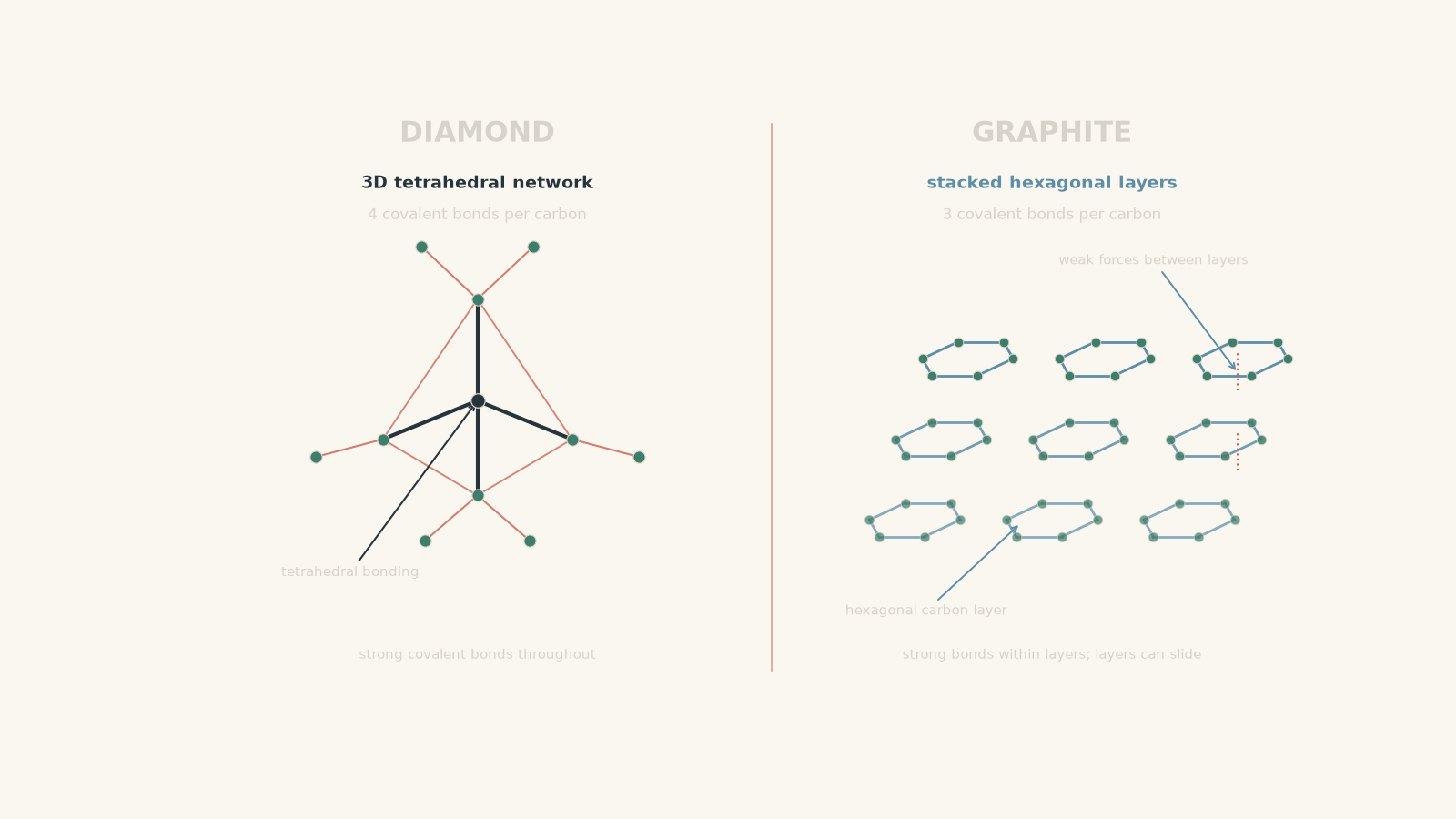
In diamond, each carbon atom forms four strong covalent bonds to four other carbon atoms.
The atoms form a continuous three-dimensional covalent network. There are no separate carbon molecules sitting next to each other. The entire crystal is connected by strong covalent bonds.
That immediately predicts several properties.
Diamond is extremely hard because changing its shape requires disrupting strong covalent bonds in a rigid three-dimensional network.
Diamond also has a very high temperature required for its structure to be broken apart. A large amount of energy is needed because many strong covalent bonds are involved.
But what about electrical conductivity?
Each carbon atom has four valence electrons, and in diamond those electrons are involved in covalent bonding. There are no freely mobile electrons moving through the structure.
So diamond is a poor electrical conductor.
Worked example: Predicting the properties of an unfamiliar diamond-like structure
A hypothetical allotrope of element X forms a three-dimensional covalent network. Each atom is strongly covalently bonded to neighbouring atoms, and all of its valence electrons are localised in those bonds. Predict whether the material is likely to be hard and whether it should conduct electricity well.
Step 1
The atoms are joined throughout a three-dimensional network by strong covalent bonds. Deforming the solid would require changing or breaking these bonds.
So the material should be hard.
Step 2
Electrical conduction requires mobile charged particles. The question states that the valence electrons are localised in covalent bonds.
There are therefore no obvious mobile electrons available to carry charge.
Step 3
The material should be hard but a poor electrical conductor.
The important point is that neither prediction came from the name of the element. Both came from its structure and electron behaviour.
04Graphite: strong layers, weak links between them
Graphite is also made entirely from carbon, but each carbon atom is covalently bonded to only three neighbouring carbon atoms.
The carbon atoms form flat hexagonal sheets.
Within each sheet, the covalent bonds are strong. Between neighbouring sheets, however, the attractions are much weaker than the covalent bonds inside a sheet.
Here is a prediction worth making: if you push one graphite layer sideways, what should happen?
It can slide past the layer underneath relatively easily. That is why graphite is soft and flakes onto paper.
This is where a common oversimplification causes trouble. Students sometimes say, “Graphite has weak bonds.”
That is not generally true.
The covalent bonds within each layer are strong. It is the forces between the layers that are much weaker. You need to say which interaction you mean.
Why does graphite conduct electricity?
Each carbon in graphite forms three covalent bonds. This allows electrons to be delocalised across the layers.
A delocalised electron is not restricted to one particular bond between two atoms. It can move through a larger region of the structure.
Those mobile electrons allow graphite to conduct electricity, particularly along its layers.
So graphite and diamond contain the same element, but their electron arrangements are different:
| Property | Diamond | Graphite |
|---|---|---|
| Basic structure | 3D covalent network | Covalent layers |
| Bonds from each carbon | 4 | 3 |
| Can layers slide? | No layers present | Yes |
| Mobile delocalised electrons? | No | Yes, within layers |
| Hardness | Very hard | Soft |
| Electrical conductivity | Poor | Conducts |
Notice that “carbon conducts electricity” would be a bad general statement. Some forms of carbon conduct, while others do not.
The allotrope matters.
Worked example: Explaining two observations about graphite
A student observes that graphite from a pencil leaves marks on paper and can also conduct an electric current. Explain both observations using its structure.
Step 1
Graphite consists of layers of carbon atoms. Strong covalent bonds hold atoms together within each layer, but much weaker attractions act between neighbouring layers.
When graphite is rubbed against paper, layers can slide and separate from one another.
Small pieces of graphite are therefore transferred to the paper.
Step 2
Each carbon atom forms three covalent bonds, leaving electrons that are delocalised across the layers.
These electrons can move through the structure and carry electrical charge.
Step 3
Graphite’s softness and conductivity are not unrelated facts to memorise. Both result from its particular bonding and structure.
Its layered arrangement explains its softness, while its delocalised electrons explain its conductivity.
05Allotropy is not limited to giant covalent structures
Diamond and graphite can make allotropy look like a phenomenon that only involves crystals. It isn’t.
Oxygen gives a different kind of example.
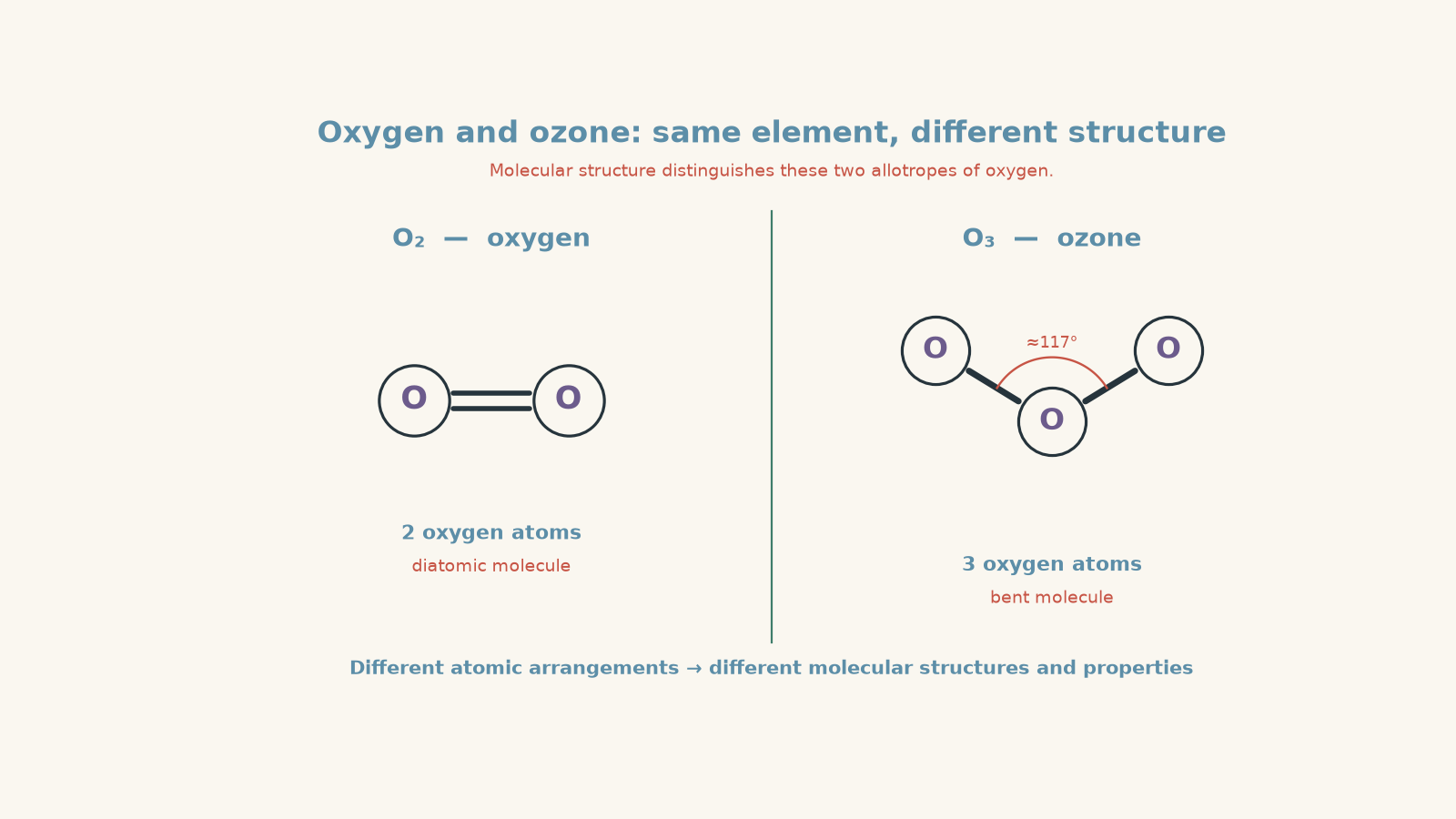
Ordinary oxygen gas mainly consists of \(\ce{O2}\) molecules. Ozone consists of \(\ce{O3}\) molecules.
Both substances contain only oxygen atoms, but the oxygen atoms are grouped and bonded differently.
That makes \(\ce{O2}\) and \(\ce{O3}\) allotropes of oxygen.
Oxygen, \(\ce{O2}\)
An \(\ce{O2}\) molecule contains two oxygen atoms.
This is the familiar form involved in processes such as respiration and combustion.
Ozone, \(\ce{O3}\)
An ozone molecule contains three oxygen atoms arranged in a bent molecular structure.
Its bonding and electron distribution differ from those of \(\ce{O2}\), so ozone has different chemical and physical behaviour. Ozone is generally more reactive than ordinary molecular oxygen.
This gives us an important correction to the LEGO model from earlier.
Allotropy does not always mean taking a giant structure and rearranging it. Sometimes the difference is the number and arrangement of atoms within individual molecules.
06Why ozone’s location matters
The properties of an allotrope can make it useful in one situation and harmful in another.
Ozone in the stratosphere absorbs a significant amount of incoming ultraviolet radiation. That helps reduce the amount of biologically damaging ultraviolet radiation reaching Earth’s surface.
Near ground level, however, ozone is an air pollutant. Its reactivity means it can damage living tissue and materials.
The oxygen atoms have not suddenly become a different element. The structure and resulting chemical behaviour of \(\ce{O3}\) differ from those of \(\ce{O2}\).
That is allotropy doing something environmentally important rather than just giving us another table to memorise.
07Other examples of allotropy
Several elements can exist in multiple allotropes.
Phosphorus
Phosphorus has allotropes including white, red, and black phosphorus.
White phosphorus contains discrete \(\ce{P4}\) units and is highly reactive. Red and black phosphorus have different extended structures, giving them markedly different properties.
You do not need to assume that one element must have one characteristic appearance or one level of reactivity.
Sulfur
Solid sulfur can form different crystal structures. The same sulfur atoms can be arranged differently in the solid, producing distinct allotropes.
Again, the chemical identity of the element remains sulfur. The arrangement changes.
08The most tempting misconception: “same element means same properties”
It feels reasonable to think every pure sample of carbon should behave like every other pure sample of carbon.
After all, each contains carbon atoms.
The mistake is treating composition as the only level of chemical structure that matters.
Suppose two restaurants have exactly the same ingredients. One turns them into a cake and the other dumps them into separate bowls. Saying “same ingredients, therefore same food” misses the arrangement.
That analogy has limits. Chemical bonds are not cooking instructions, and atoms cannot be rearranged arbitrarily without energy and chemical constraints. But it captures the important point: knowing what is present does not always tell you how it is organised.
For allotropes, both questions matter:
- What element is present?
- How are its atoms bonded and arranged?
09Allotropy, isotopes, and compounds are different ideas
These terms are easy to mix up because all three involve comparing substances or particles that are related in some way.
| Idea | What changes? | Example |
|---|---|---|
| Allotropes | Arrangement or bonding of atoms of the same element | Diamond and graphite |
| Isotopes | Number of neutrons in atoms of the same element | Carbon-12 and carbon-13 |
| Compounds | Different elements are chemically bonded together | \(\ce{CO2}\) and \(\ce{H2O}\) |
An allotrope is still an elemental substance. Diamond contains carbon and nothing else. Ozone contains oxygen and nothing else.
A compound, by contrast, contains atoms of at least two different elements chemically combined.
10How to explain an allotrope question in an HSC response
When a question asks you to relate allotropy to physical properties, avoid listing isolated facts.
Use this sequence:
1. Identify the structural difference.
For example, graphite consists of layers, while diamond has a three-dimensional covalent network.
2. Identify the relevant bonding or electron behaviour.
For example, graphite has weaker attractions between layers and delocalised electrons.
3. Link that feature to the observed property.
For example, the layers can slide, so graphite is soft.
A strong explanation therefore looks like:
Graphite is soft because its carbon atoms form strongly bonded layers with much weaker attractions between neighbouring layers. These layers can slide over one another relatively easily.
A weaker explanation would simply say:
Graphite is soft because it has a layered structure.
The second statement identifies the structure but does not finish the causal explanation.
11Questions and solutions
Question 1
A student is given samples of diamond and graphite but is told only that both contain pure carbon. Explain why the two samples can have different physical properties without contradicting the claim that both are pure carbon.
Solution 1
Diamond and graphite can have different physical properties because they are different allotropes of carbon, with different arrangements and bonding between the same type of atom.
Both substances contain only carbon atoms, so both are pure forms of the element carbon. Purity tells us which substances are present. It does not require every pure sample of an element to have the same structure.
In diamond, each carbon atom is bonded into a rigid three-dimensional covalent network. In graphite, carbon atoms form layered structures with delocalised electrons and much weaker attractions between neighbouring layers.
These structural differences produce differences in hardness, electrical conductivity, and other physical properties.
The trap is assuming that chemical composition alone determines every property.
Question 2
Two forms of an unknown element contain exactly the same isotope of element X. Form A consists of small four-atom molecules. Form B consists of an extended network of X atoms.
A student claims that they cannot be allotropes because “the atoms themselves are identical”.
Evaluate the student’s claim.
Solution 2
The student’s claim is incorrect. Identical atoms can form different allotropes if those atoms have different bonding arrangements or structures.
The fact that both forms contain the same isotope confirms that the identity of the atoms has not changed.
That does not prevent allotropy. Allotropy specifically involves different structural forms of the same element.
Form A contains discrete four-atom molecules, while Form B contains an extended network. Their different structures could produce different melting behaviour, hardness, conductivity, or reactivity.
The misconception is confusing allotropy with isotopes. Isotopes differ in nuclear composition. Allotropes differ in how atoms of an element are arranged or bonded.
Question 3
A fictional allotrope of carbon consists of flat covalently bonded sheets. However, unlike graphite, its electrons are all localised in bonds and cannot move freely through a sheet.
Predict how its mechanical behaviour might resemble graphite while its electrical behaviour differs. Justify both predictions.
Solution 3
The allotrope could still be soft or easy to shear like graphite, but it would be expected to conduct electricity much less effectively.
Its mechanical behaviour depends on how the sheets interact with one another. If neighbouring sheets are held together by interactions much weaker than the strong covalent bonds within a sheet, the sheets could slide past one another. That would make the material relatively soft or easy to shear.
Its electrical behaviour would be different. The question states that all electrons are localised in bonds. Without mobile delocalised electrons or another mobile charge carrier, electrical charge cannot easily move through the structure.
Therefore:
- the layered structure could explain graphite-like softness
- the absence of mobile electrons would prevent graphite-like electrical conductivity
The important insight is that two properties of graphite come from different structural features. “Layered” does not automatically mean “conductive”.
Question 4
A student writes:
“Ozone has different properties from oxygen because an ozone molecule has a greater relative molecular mass. Therefore, any two molecules made from the same element but containing different numbers of atoms must be allotropes.”
Identify what is useful in this reasoning, and explain why the final conclusion is too broad.
Solution 4
The student correctly recognises that \(\ce{O2}\) and \(\ce{O3}\) are structurally different forms of the same element, but the rule they propose is too broad because allotropy is defined by distinct structural forms of an element, not simply by finding any two clusters containing different numbers of atoms.
An \(\ce{O2}\) molecule contains two oxygen atoms, while an \(\ce{O3}\) molecule contains three. This difference changes molecular structure and contributes to differences in physical and chemical behaviour.
However, simply counting atoms is not a complete test for allotropy. The important issue is whether the forms represent distinct structural forms of the elemental substance.
The student’s explanation is also incomplete because relative molecular mass alone does not account for all of the differences between oxygen and ozone. Their bonding, geometry, electron distribution, and stability also differ.
A better explanation is that \(\ce{O2}\) and \(\ce{O3}\) are allotropes because they are distinct molecular structures made entirely from oxygen atoms, and their different structures lead to different properties.
Question 5
A researcher discovers two black solids, P and Q. Chemical analysis shows that both contain only element Y.
Solid P is extremely hard and does not conduct electricity. Solid Q is soft and conducts electricity along one direction through the crystal.
Another researcher argues that this evidence proves P and Q are allotropes of Y.
Is that conclusion fully justified? Explain what the observations suggest and what additional information would be needed.
Solution 5
The evidence strongly suggests that P and Q may have different structures, but it does not by itself prove that they are allotropes.
The contrasting properties are consistent with different bonding arrangements.
For P, high hardness and poor electrical conductivity could be explained by a rigid covalent network with localised electrons.
For Q, softness and direction-dependent conductivity could be explained by an anisotropic structure, such as layers or chains, containing mobile electrons along particular directions.
However, physical properties alone do not establish allotropy. The researchers would need evidence that:
- both samples are genuinely elemental forms of Y rather than compounds, mixtures, or contaminated samples
- the atoms of Y have different structures or bonding arrangements in P and Q
Structural evidence could come from techniques that reveal atomic or crystal arrangement.
The hidden assumption in the original claim is that different physical properties automatically prove different allotropes. They provide useful evidence, but the definition of allotropy depends on structure, so the structural difference must ultimately be established.
12What this idea lets you understand next
Allotropy is one example of a much bigger principle in chemistry: properties emerge from structure.
Once you can explain why diamond and graphite behave differently despite having identical elemental composition, you are ready to apply the same reasoning more widely. Molecular shape, intermolecular forces, crystal structures, metallic bonding, and polymer properties all rely on the same habit of thought.
Do not stop at asking, “What atoms are present?”
The more useful next question is: how are those atoms arranged, what holds them together, and what does that arrangement allow the particles or electrons to do?