
Lewis Dot Diagrams for Atoms, Ions and Covalent Molecules
Learn how to count valence electrons and construct Lewis dot diagrams for atoms, ions, and covalent molecules. Worked examples show how to identify bonds, lone pairs, and common mistakes.
A Lewis dot diagram becomes useful the moment a chemical formula stops telling you enough. \(\ce{H2O}\) tells you that water contains two hydrogen atoms and one oxygen atom, but it doesn’t show which electrons form bonds, which electrons stay as lone pairs, or why oxygen usually forms two bonds while hydrogen forms one.
Try a prediction before we build the method. Oxygen has six valence electrons. Does that mean an oxygen atom in water contributes all six of them to bonds?
No. Only two of oxygen’s valence electrons are used to form the two O-H bonds. The other four remain as two lone pairs. Lewis dot diagrams make that electron arrangement visible.
01What a Lewis dot diagram is actually showing
For bonding, the most important electrons are usually the valence electrons, the electrons in the outer shell of an atom.
Think of these as the electrons available for chemical negotiations. Core electrons are already tucked away close to the nucleus and usually don’t take part in ordinary covalent bonding.
A Lewis diagram shows:
- an element symbol for each atom
- valence electrons as dots
- shared pairs of electrons as covalent bonds
- unshared pairs as lone pairs
- brackets and a charge when the whole species is an ion
For common main-group elements, the group in the periodic table tells you the number of valence electrons.
| Element group | Valence electrons | Common examples |
|---|---|---|
| Group 1 | 1 | H, Na |
| Group 2 | 2 | Mg, Ca |
| Group 13 | 3 | B, Al |
| Group 14 | 4 | C, Si |
| Group 15 | 5 | N, P |
| Group 16 | 6 | O, S |
| Group 17 | 7 | F, Cl |
| Group 18 | 8 | Ne, Ar |
Helium is the exception in Group 18. It has only two electrons because its first shell is full with two.
02Lewis dot diagrams for individual atoms
Start with chlorine.
A chlorine atom has seven valence electrons. Before drawing it, predict what the dots should look like. Would you put all seven dots on one side of the symbol?
That would still give seven electrons, but it wouldn’t communicate their arrangement clearly. The usual Lewis convention is to place one electron on each of the four sides first, then begin pairing them.
So chlorine can be represented as:
   ••
•• Cl ••
   •
There are seven dots altogether:
- three pairs
- one unpaired electron
That single unpaired electron is a useful clue. Chlorine commonly forms one covalent bond, allowing it to share one more electron and reach a stable outer-shell arrangement.
Worked example: Draw the Lewis dot diagram for a nitrogen atom
Draw a Lewis dot diagram for one neutral nitrogen atom.
Step 1
Nitrogen is in Group 15, so it has five valence electrons.
Step 2
N
Step 3
One acceptable arrangement is:
   ••
•  N  •
   •
The exact side containing the pair doesn’t matter for an isolated atom. What matters is that all five valence electrons are shown.
This diagram has one electron pair and three unpaired electrons.
That helps explain why nitrogen commonly forms three covalent bonds in molecules such as \(\ce{NH3}\).
03Lewis diagrams for monatomic ions
Now suppose an atom gains or loses electrons.
The most common mistake here is to draw the neutral atom first and then simply write a charge next to it. The charge isn’t decorative. It tells you that the number of electrons has actually changed.
Consider an oxide ion, \(\mathrm{O}^{2-}\).
A neutral oxygen atom has six valence electrons. A \(2-\) charge means it has gained two electrons:
\[
6 + 2 = 8 \text{ valence electrons}
\]
Its Lewis diagram therefore has eight dots:
    ••
[•• O ••]²⁻
    ••
Notice two important features:
- There are eight electrons around O.
- The entire Lewis symbol is enclosed in square brackets, with \(2-\) written outside.
For a positive ion, do the opposite: subtract electrons.
For example, sodium has one valence electron as a neutral atom. The sodium ion \(\mathrm{Na}^{+}\) has lost that electron, so its Lewis symbol has no dots:
[Na]⁺
A handy rule is:
\[
\text{electrons in an anion} = \text{neutral valence electrons} + \text{negative charge}
\]
\[
\text{electrons in a cation} = \text{neutral valence electrons} – \text{positive charge}
\]
The words “plus” and “minus” can be confusing here. A negative ion has more electrons, while a positive ion has fewer electrons.
04From atoms to covalent molecules
A covalent bond forms when two atoms share a pair of electrons.
This is the first place where the dots change meaning slightly. In an isolated atom, a dot belongs to that atom. In a covalent bond, a pair of electrons is shared between two nuclei.
We normally replace a shared pair of dots with a line:
H:H
becomes
H-H
One line represents two electrons, not one.
That’s worth fixing in your head now because accidentally counting each bond as one electron causes a lot of Lewis diagram errors.
The octet idea
Many main-group atoms tend towards eight electrons in their valence shell when they bond. This is called the octet rule.
Hydrogen is different. Its first shell can contain only two electrons, so hydrogen aims for a duet, not an octet.
The octet rule is a useful model, not a law that every species obeys. There are important exceptions, including molecules containing elements such as boron and species with expanded valence shells. For the common HSC Lewis structures considered here, though, the octet rule is an excellent starting point.
05A reliable method for drawing a molecule
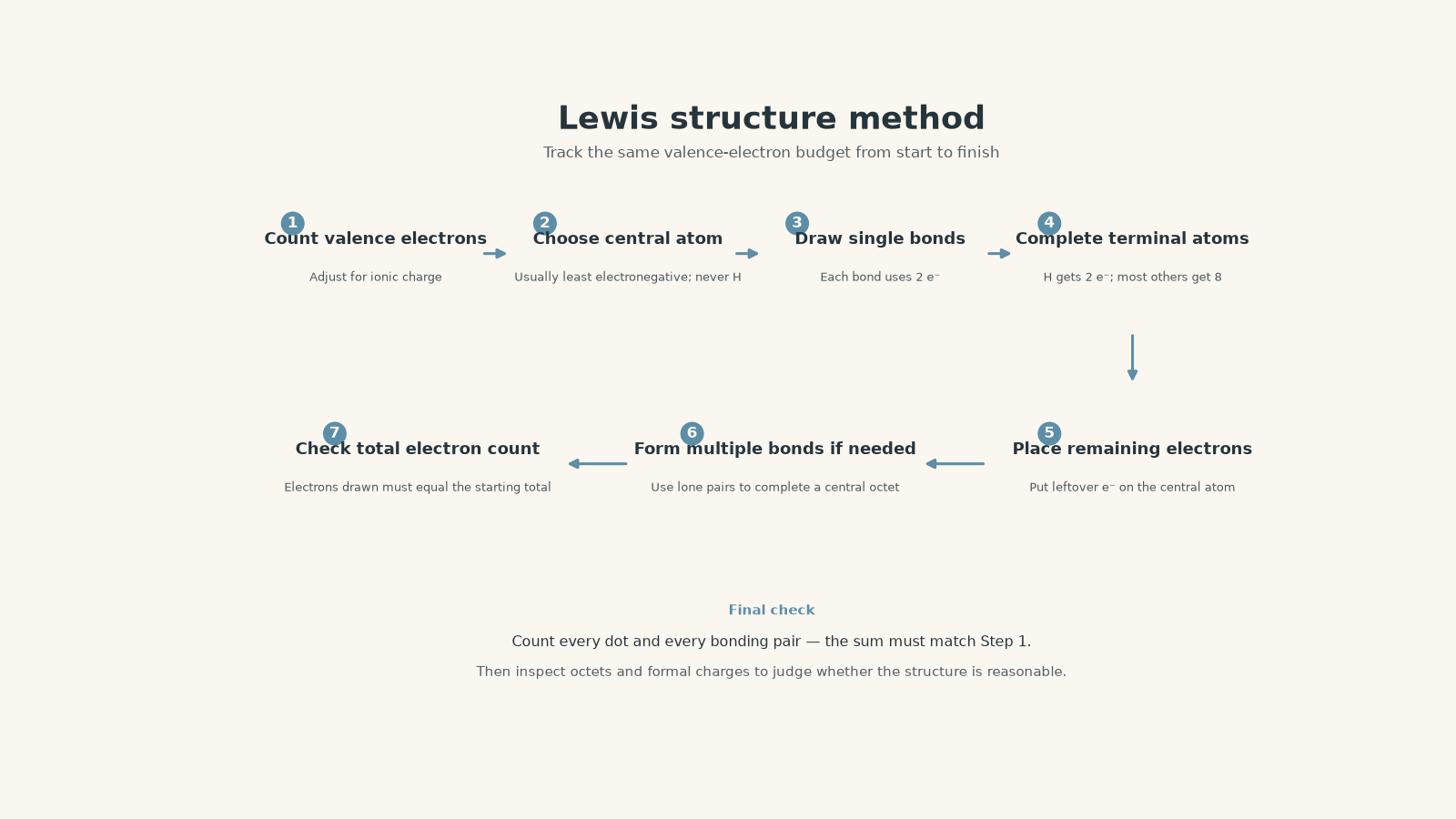
For simple covalent molecules and polyatomic ions, use this sequence.
1. Count every valence electron
Add the valence electrons contributed by every atom.
Then adjust for charge:
- add one electron for each negative charge
- subtract one electron for each positive charge
2. Choose the central atom
The central atom is usually the atom able to form several bonds.
Hydrogen is never the central atom in an ordinary Lewis structure because it forms only one bond.
Halogens such as fluorine and chlorine are also usually terminal atoms.
3. Join the atoms with single bonds
Each single bond contains two electrons.
Subtract those bonding electrons from your total.
4. Complete the outer atoms first
Give terminal atoms enough electrons to reach an octet, except hydrogen, which needs only two.
5. Put remaining electrons on the central atom
Any electrons still unused become lone pairs on the central atom.
6. Check the central atom
If the central atom still doesn’t have an octet, a lone pair from a neighbouring atom may need to become a second or third bonding pair.
That creates a double or triple bond.
7. Count everything again
Your final structure must contain exactly the number of valence electrons you calculated at the start.
This last check catches a surprising number of mistakes.
06Lone pairs are not spare electrons
A lone pair is a pair of valence electrons located on one atom and not used in a bond.
Imagine a group project where two students agree to share a textbook. That shared book is like a bonding pair. A student keeping another two books entirely to themselves is more like a lone pair.
The analogy breaks because electrons aren’t owned objects sitting still on one atom. Electron density is described quantum mechanically, and bonding electrons occupy molecular orbitals. But for Lewis diagrams, “shared pair” and “lone pair” are useful bookkeeping ideas.
Lone pairs matter because they affect more than the drawing. Later, they’ll help you predict:
- molecular shape
- bond angles
- molecular polarity
- intermolecular forces
So don’t treat them as leftover dots that can be ignored.
Worked example: Draw the Lewis structure of water
Draw the Lewis structure of \(\ce{H2O}\), showing all bonding and lone pairs.
Step 1
Each H contributes one electron. O contributes six.
\[
2(1) + 6 = 8 \text{ valence electrons}
\]
Step 2
Hydrogen cannot be the central atom, so oxygen goes in the middle:
H O H
Step 3
H-O-H
There are two bonds, and each bond represents two electrons:
\[
2 \times 2 = 4 \text{ bonding electrons}
\]
We started with eight electrons, so four remain.
Step 4
Four electrons make two lone pairs:
  ••
H-O-H
  ••
Step 5
There are four electrons in the two O-H bonds and four electrons in oxygen’s two lone pairs:
\[
4 + 4 = 8
\]
Each hydrogen has two electrons available through its bond. Oxygen has eight electrons around it: four in bonds and four in lone pairs.
The important result isn’t just that water contains two bonds. Oxygen also has two lone pairs, which becomes crucial when predicting the bent shape of the molecule.
07When single bonds aren’t enough
Now consider \(\ce{CO2}\).
If we joined everything with single bonds, we might begin with:
O-C-O
It looks plausible. But Lewis structures are constrained by electron counting, not by how tidy the drawing looks.
Worked example: Why does carbon dioxide need double bonds?
Construct the Lewis structure of \(\ce{CO2}\).
Step 1
Carbon contributes four. Each oxygen contributes six.
\[
4 + 2(6) = 16 \text{ valence electrons}
\]
Step 2
O-C-O
Two single bonds use four electrons, leaving:
\[
16 – 4 = 12 \text{ electrons}
\]
Step 3
Giving each oxygen three lone pairs uses all 12 remaining electrons.
That produces the temporary structure:
••       ••
••O-C-O••
••       ••
Each oxygen has eight electrons around it.
Carbon, however, has only four electrons around it because it has only two single bonds.
So the structure isn’t finished.
Step 4
This gives:
••     ••
O=C=O
••     ••
Each double bond contains two shared electron pairs, or four electrons.
Step 5
Each oxygen has:
- four electrons in its double bond
- four electrons in two lone pairs
Carbon has eight electrons around it through the two double bonds.
The structure still contains 16 valence electrons altogether.
The final Lewis structure is therefore \(\ce{O=C=O}\), with two lone pairs on each oxygen.
This is a good example of why “draw single bonds and stop” isn’t a reliable method. You have to check the central atom’s electron count.
08Single, double, and triple bonds
Lewis diagrams represent different numbers of shared electron pairs using different numbers of lines.
| Bond | Shared electron pairs | Shared electrons | Example |
|---|---|---|---|
| Single bond | 1 | 2 | \(\ce{H-H}\) |
| Double bond | 2 | 4 | \(\ce{O=O}\) |
| Triple bond | 3 | 6 | \(\ce{N#N}\) |
A triple bond in nitrogen can be shown as:
:N≡N:
Each nitrogen has:
- six electrons involved in the triple bond
- one lone pair containing two electrons
So each nitrogen has an octet.
Don’t read three bond lines as “three electrons”. Three lines mean three pairs, so the bond represents six electrons.
09Lewis structures for polyatomic ions
A polyatomic ion contains several covalently bonded atoms but has an overall electrical charge.
The method is almost the same as for a neutral molecule. The major difference comes right at the start: the charge changes the total number of electrons available.
Consider the ammonium ion, \(\ce{NH4+}\).
Nitrogen contributes five valence electrons. Four hydrogens contribute four more:
\[
5 + 4 = 9
\]
But the species has a \(+1\) charge, meaning one electron has been removed:
\[
9 – 1 = 8 \text{ valence electrons}
\]
Those eight electrons form four N-H bonds:
    H
    |
[H-N-H]⁺
    |
    H
There are no lone pairs on nitrogen in \(\ce{NH4+}\).
Compare that with neutral ammonia, \(\ce{NH3}\):
   ••
H-N-H
   |
   H
Ammonia has three N-H bonds and one lone pair on nitrogen.
Adding \(\mathrm{H}^{+}\) to ammonia can form \(\ce{NH4+}\). The nitrogen lone pair becomes involved in the new N-H bond.
That comparison is useful because it shows that a charge can change the bonding pattern, not merely the label outside the diagram.
10The most tempting Lewis diagram mistakes
Mistake 1: Counting bonds as one electron each
A bond line represents two electrons.
So three single bonds contain:
\[
3 \times 2 = 6 \text{ electrons}
\]
not three electrons.
Mistake 2: Giving hydrogen eight electrons
Hydrogen only needs two electrons in its first shell.
If you find yourself drawing multiple bonds or lone pairs around hydrogen, something has gone wrong.
Mistake 3: Forgetting to adjust for an ionic charge
For \(\ce{NH4+}\), count one fewer electron than the neutral atoms would supply.
For a species with a negative charge, add electrons.
Mistake 4: Completing the outer atoms but forgetting the centre
This is exactly what happens in the first attempt at \(\ce{CO2}\). The oxygen atoms can have complete octets while carbon is still short.
Always check every atom.
Mistake 5: Adding or removing electrons until the diagram “looks right”
The total valence-electron count is fixed.
You aren’t allowed to invent extra dots to give everything an octet. If the count doesn’t work, reconsider the bonding arrangement.
Mistake 6: Assuming the octet rule has no exceptions
The octet rule works extremely well for many simple structures, but it isn’t universal.
For example, boron can form stable compounds in which it has fewer than eight electrons around it. Elements in Period 3 and beyond can also appear in structures containing more than eight electrons around the central atom.
So use the octet rule as a powerful model, then check whether the species you’re studying is one of the recognised exceptions.
11A fast checking routine
Before accepting any Lewis structure, check four things:
- Electron total: Does the diagram contain exactly the calculated number of valence electrons?
- Hydrogen: Does every H have one bond and therefore access to two electrons?
- Outer atoms: Do the usual main-group atoms have complete octets where expected?
- Central atom: Does it also have an appropriate electron arrangement, or do you need multiple bonds?
This routine is usually quicker than trying to memorise a finished diagram for every molecule.
12Questions and solutions
Question 1
Draw the Lewis dot diagram for a neutral fluorine atom. State how many valence electrons it has and how many of them are unpaired.
Solution 1
A fluorine atom has seven valence electrons, with one unpaired electron.
Fluorine is in Group 17, so it has seven electrons in its outer shell. Place one electron on each side of F before pairing the remaining electrons.
One acceptable diagram is:
   ••
•• F ••
   •
There are three pairs and one single electron:
\[
3(2) + 1 = 7 \text{ valence electrons}
\]
The single unpaired electron is consistent with fluorine commonly forming one covalent bond. The common trap is to confuse “seven valence electrons” with “seven bonds”. Lewis dots represent electrons, not bonds.
Question 2
Construct the Lewis diagram for a fluoride ion, \(\mathrm{F}^{-}\), and explain why it has a different number of dots from a neutral fluorine atom.
Solution 2
The fluoride ion has eight valence electrons shown around F, enclosed in brackets with a \(1-\) charge.
Neutral fluorine has seven valence electrons. The negative charge tells us that it has gained one additional electron:
\[
7 + 1 = 8 \text{ electrons}
\]
Its Lewis diagram is:
    ••
[•• F ••]⁻
    ••
Fluorine therefore has four electron pairs and a complete octet.
The tempting mistake is to draw seven dots and simply add a minus sign. That would ignore what the negative charge physically means: the ion contains one more electron than the neutral atom.
Question 3
Construct the Lewis structure of \(\ce{NH3}\). State the number of bonding pairs and lone pairs around the nitrogen atom.
Solution 3
The Lewis structure of \(\ce{NH3}\) has three N-H bonding pairs and one lone pair on nitrogen.
Nitrogen contributes five valence electrons, and the three hydrogen atoms contribute one each:
\[
5 + 3(1) = 8 \text{ valence electrons}
\]
Place nitrogen in the centre and make three N-H single bonds. These bonds use:
\[
3(2) = 6 \text{ electrons}
\]
Two electrons remain:
\[
8 – 6 = 2
\]
They form one lone pair on nitrogen:
   ••
H-N-H
   |
   H
Each hydrogen has access to two electrons through one bond. Nitrogen has six electrons in its three bonds plus two in the lone pair, giving eight electrons around nitrogen.
The lone pair is important. Leaving it off would account for only six of the molecule’s eight valence electrons.
Question 4
A student proposes the following Lewis structure for \(\ce{CH2O}\):
H
|
H-C-O
They then place three lone pairs on oxygen.
Determine whether the structure is valid. If it is not, construct a better Lewis structure and explain what was wrong.
Solution 4
The proposed structure is not valid as the complete Lewis structure. The carbon atom has an incomplete octet, so a C=O double bond is required.
First count the valence electrons:
- C contributes 4
- two H atoms contribute \(2(1)=2\)
- O contributes 6
Therefore:
\[
4 + 2 + 6 = 12 \text{ valence electrons}
\]
The proposed three single bonds use:
\[
3(2) = 6 \text{ electrons}
\]
Three lone pairs on oxygen use another six electrons, so all 12 electrons have been used.
However, carbon has only three bonds around it, giving it access to six electrons rather than eight.
One lone pair from oxygen must therefore become a second C-O bonding pair:
H
 \
  C=O
 /
H
  ••
  ••
Equivalently, with the atoms arranged differently:
  H
  |
H-C=O
    ••
    ••
The final structure has two C-H single bonds, one C=O double bond, and two lone pairs on oxygen.
The trap is assuming that a correct total electron count automatically guarantees a correct structure. You must also check the electron arrangement around each atom.
Question 5
A student says, “The ammonium ion, \(\ce{NH4+}\), must have a lone pair on nitrogen because neutral nitrogen starts with five valence electrons.”
Use electron counting to test the claim.
Solution 5
The claim is incorrect: nitrogen has no lone pair in the usual Lewis structure of \(\ce{NH4+}\).
Start by counting the electrons supplied by the neutral atoms:
\[
5 + 4(1) = 9
\]
The \(+1\) charge means the ion has one fewer electron:
\[
9 – 1 = 8 \text{ valence electrons}
\]
Four N-H single bonds require exactly eight electrons:
\[
4(2) = 8 \text{ electrons}
\]
So the structure is:
    H
    |
[H-N-H]⁺
    |
    H
All eight available valence electrons are already contained in the four bonds. None remain as a lone pair.
Nitrogen still has an octet because four bonds place eight bonding electrons around it.
The misconception comes from following nitrogen’s original five electrons individually after bonding. Lewis structures are better handled by counting the total valence-electron pool for the complete species.
Question 6
A hypothetical molecule \(\ce{OF2}\) contains oxygen bonded to two fluorine atoms.
A student argues that oxygen should form double bonds to both fluorine atoms because “double bonds give the central atom a stronger octet”.
Construct the appropriate Lewis structure and explain why the proposed double bonds are unnecessary.
Solution 6
The appropriate Lewis structure has two O-F single bonds, two lone pairs on oxygen, and three lone pairs on each fluorine. Double bonds are unnecessary.
Count the valence electrons:
\[
6 + 2(7) = 20 \text{ valence electrons}
\]
Two O-F single bonds use four electrons:
\[
2(2) = 4
\]
That leaves:
\[
20 – 4 = 16 \text{ electrons}
\]
Completing both fluorine octets requires six lone-pair electrons on each fluorine:
\[
2(6) = 12 \text{ electrons}
\]
Four electrons remain, forming two lone pairs on oxygen.
A compact diagram is:
  ••       ••
••F-O-F••
  •• ••    ••
     ••
More importantly, count the electrons around oxygen. It has four electrons from its two bonds and four from its two lone pairs:
\[
4 + 4 = 8
\]
Oxygen already has an octet.
Double bonds would therefore not be required to complete oxygen’s valence shell. The student’s mistake is treating a double bond as automatically “better” than a single bond. Lewis structures aren’t a contest to maximise bond order. The bonding arrangement has to satisfy the available electron count and give a sensible distribution of electrons.
Fluorine, in particular, normally forms one bond in simple Lewis structures because its seven valence electrons already leave it only one electron short of an octet.
13What Lewis diagrams let you work out next
A Lewis structure is more than a final picture of electrons. Once you know the number of bonding regions and lone pairs around a central atom, you can start predicting three-dimensional molecular shape.
For example, \(\ce{CO2}\) has two bonding regions around carbon and no lone pairs, while \(\ce{H2O}\) has two bonding regions and two lone pairs around oxygen. Their Lewis structures therefore contain the information needed to explain why carbon dioxide is linear but water is bent.
That next step is where electron-pair repulsion and molecular geometry turn a flat Lewis diagram into a model of the molecule’s actual shape.