
Gas Volumes in Chemical Reactions for HSC Chemistry
Learn how to measure and calculate gas volumes in chemical reactions using stoichiometric ratios, molar volume, and the ideal gas equation.
A gas syringe stops at 51 mL after magnesium reacts with hydrochloric acid. That number isn’t random. If you know how much magnesium reacted, you can predict the gas volume before the experiment even starts.
Now make a prediction. If you double the amount of hydrochloric acid, but keep the magnesium unchanged, will you collect twice as much hydrogen? Not necessarily. If the acid was already in excess, the magnesium fixes how many moles of hydrogen can form. Gas volume is just another way of measuring that amount.
That is the useful idea behind gas stoichiometry: a measured gas volume can tell you how many moles of gas you have, and the balanced equation tells you how those moles relate to every other substance in the reaction.
01Gas volume is really a way of counting moles
You can’t count gas molecules one by one. Fortunately, gases give us a shortcut.
Imagine two identical 1 L containers at the same temperature and pressure. One contains hydrogen and the other contains nitrogen. The particles have different masses, but each container has the same number of gas particles, assuming ideal behaviour.
This is Avogadro’s law:
At constant temperature and pressure, gas volume is directly proportional to the amount of gas in moles.
So, at the same temperature and pressure:
- twice as many moles occupy twice the volume
- half as many moles occupy half the volume
- equal gas volumes contain equal numbers of particles
You can picture it as an extremely strict chemistry speed-dating event. Every 1 L “booth”, provided the temperature and pressure are the same, admits the same number of gas particles. A 2 L booth therefore contains twice as many particles.
The analogy breaks if the temperature or pressure changes. Gas particles aren’t actually sitting in fixed seats. Heat a gas or reduce the pressure, and the same number of particles can occupy a different volume.
That condition, same temperature and pressure, is what makes gas-volume calculations work.
02Molar volume connects litres to moles
The molar volume, \(V_m\), is the volume occupied by one mole of a gas at a specified temperature and pressure:
\[
V_m = \frac{V}{n}
\]
where:
- \(V_m\) is molar volume in \(\text{L mol}^{-1}\)
- \(V\) is gas volume in litres
- \(n\) is amount of gas in moles
Rearranging gives the form you will usually use:
\[
n = \frac{V}{V_m}
\]
The HSC Chemistry formula sheet gives an ideal-gas molar volume of \(22.71\text{ L mol}^{-1}\) at \(0^\circ\text{C}\) and 100 kPa, and \(24.79\text{ L mol}^{-1}\) at \(25^\circ\text{C}\) and 100 kPa. It also provides \(PV=nRT\) for gases at other conditions. (NSW Government)
A good habit is to use the actual temperature and pressure given in the question rather than relying on labels such as “room conditions” or “standard conditions”.
For example, \(0.500\text{ mol}\) of an ideal gas at \(25^\circ\text{C}\) and 100 kPa occupies:
\[
V = nV_m = 0.500 \times 24.79 = 12.4\text{ L}
\]
The chemistry of the gas hasn’t entered the calculation. At the same temperature and pressure, \(0.500\text{ mol}\) of hydrogen, oxygen, or nitrogen would occupy the same ideal-gas volume.
03When equation coefficients become volume ratios
Consider:
\[
\ce{2CO(g) + O2(g) -> 2CO2(g)}
\]
The coefficients tell us the mole ratio:
\[
2\text{ mol CO} : 1\text{ mol O2} : 2\text{ mol CO2}
\]
Because all three substances are gases, those coefficients also become a gas-volume ratio if every volume is compared at the same temperature and pressure:
\[
2\text{ volumes CO} : 1\text{ volume O2} : 2\text{ volumes CO2}
\]
That means:
\[
200\text{ mL CO} + 100\text{ mL O2} \rightarrow 200\text{ mL CO2}
\]
or:
\[
40\text{ L CO} + 20\text{ L O2} \rightarrow 40\text{ L CO2}
\]
There is no need to convert each volume into moles first. The conversion would work, but the common molar volume would simply cancel.
For a general gaseous reaction,
\[
\ce{aA(g) + bB(g) -> cC(g)}
\]
measured at the same temperature and pressure:
\[
V_A : V_B : V_C = a:b:c
\]
This shortcut is powerful, but only when the conditions genuinely match.
Worked example: Which gaseous reactant runs out first?
125 mL of carbon monoxide reacts with 80.0 mL of oxygen according to \(\ce{2CO(g) + O2(g) -> 2CO2(g)}\). All gas volumes are measured at the same temperature and pressure. Determine the volume of carbon dioxide formed and the volume of excess reactant remaining.
Step 1
\[
\ce{2CO(g) + O2(g) -> 2CO2(g)}
\]
So 2 volumes of CO need 1 volume of \(\ce{O2}\).
For 125 mL of CO:
\[
V(\ce{O2}) = 125\text{ mL}\times\frac{1}{2}=62.5\text{ mL}
\]
Step 2
There are 80.0 mL of oxygen available, but only 62.5 mL is required.
Therefore, CO is the limiting reactant and oxygen is in excess.
Step 3
The equation gives a CO to \(\ce{CO2}\) ratio of \(2:2\), or \(1:1\).
\[
V(\ce{CO2})=125\text{ mL}
\]
Step 4
\[
V(\ce{O2, remaining})=80.0-62.5=17.5\text{ mL}
\]
So the reaction produces 125 mL of carbon dioxide, with 17.5 mL of oxygen remaining.
Notice that the final gas volume is \(142.5\text{ mL}\), not the original \(205\text{ mL}\). Chemical reactions conserve atoms and mass. They do not have to conserve the number of gas molecules or the total gas volume.
04When you cannot use the direct volume ratio
The volume-ratio shortcut is not a universal stoichiometry rule.
Consider:
\[
\ce{CaCO3(s) + 2HCl(aq) -> CaCl2(aq) + H2O(l) + CO2(g)}
\]
You cannot say “one volume of calcium carbonate produces one volume of carbon dioxide”. Calcium carbonate is a solid. Its coefficient represents a mole ratio, not a gas-volume ratio.
Instead, move through moles:
\[
\text{given quantity}
\rightarrow
\text{moles of known substance}
\rightarrow
\text{stoichiometric mole ratio}
\rightarrow
\text{moles of gas}
\rightarrow
\text{gas volume}
\]
That chain is worth remembering because it works even when the reactants are solids, solutions, or gases measured under different conditions.
A useful decision table is:
| Situation | Best method |
|---|---|
| Two gaseous substances measured at the same temperature and pressure | Use the coefficient ratio directly as a volume ratio |
| A mass is given and a gas volume is required | Convert mass to moles, use the mole ratio, then convert gas moles to volume |
| Gas is at \(25^\circ\text{C}\) and 100 kPa | \(V=n(24.79)\) |
| Gas is at \(0^\circ\text{C}\) and 100 kPa | \(V=n(22.71)\) |
| Gas is at another stated temperature or pressure | Use \(PV=nRT\) |
| Reactants include solids or liquids | Do not treat their coefficients as volume ratios |
05Gas volumes at other temperatures and pressures
Suppose you have the same number of gas molecules but warm them up. They move faster and, if pressure is allowed to remain constant, the gas occupies more space.
Similarly, lowering the pressure allows the same particles to spread through a larger volume.
So a volume of 100 mL at \(25^\circ\text{C}\) and 100 kPa is not automatically equivalent to 100 mL at \(50^\circ\text{C}\) and 90 kPa.
For general conditions, use the ideal gas equation:
\[
PV=nRT
\]
where:
- \(P\) is gas pressure
- \(V\) is gas volume
- \(n\) is amount in moles
- \(R\) is the gas constant
- \(T\) is absolute temperature in kelvin
For pressure in kPa and volume in litres, you can use:
\[
R=8.314\text{ kPa L mol}^{-1}\text{K}^{-1}
\]
because \(1\text{ kPa L}=1\text{ J}\).
Temperature must be in kelvin:
\[
T(\text{K})=T(^\circ\text{C})+273.15
\]
Using Celsius directly in \(PV=nRT\) will produce nonsense.
Worked example: From a solid mass to a gas volume
A 0.150 g sample of calcium carbonate reacts completely with excess hydrochloric acid. The carbon dioxide produced is collected in a gas syringe at \(31.0^\circ\text{C}\) and 98.0 kPa. Calculate the expected volume of carbon dioxide.
Step 1
\[
\ce{CaCO3(s) + 2HCl(aq) -> CaCl2(aq) + H2O(l) + CO2(g)}
\]
One mole of \(\ce{CaCO3}\) produces one mole of \(\ce{CO2}\).
Step 2
The molar mass of \(\ce{CaCO3}\) is approximately:
\[
M(\ce{CaCO3})=40.08+12.01+3(16.00)=100.09\text{ g mol}^{-1}
\]
Therefore:
\[
n(\ce{CaCO3})
=
\frac{m}{M}
=
\frac{0.150}{100.09}
=
1.50\times10^{-3}\text{ mol}
\]
Step 3
The mole ratio is \(1:1\), so:
\[
n(\ce{CO2})=1.50\times10^{-3}\text{ mol}
\]
Step 4
\[
T=31.0+273.15=304.15\text{ K}
\]
Step 5
Rearrange \(PV=nRT\):
\[
V=\frac{nRT}{P}
\]
Substitute:
\[
V
=
\frac{(1.50\times10^{-3})(8.314)(304.15)}
{98.0}
=
0.0387\text{ L}
\]
\[
V=38.7\text{ mL}
\]
The theoretical volume is therefore 38.7 mL of carbon dioxide under the stated conditions.
That last phrase matters. If the gas were measured at a different temperature or pressure, the number of moles could stay exactly the same while the measured volume changed.
06Measuring gas volume in an experiment
Calculating a theoretical volume is only half the job. In a practical investigation, you also need a method that measures the gas without quietly losing or adding volume.
A gas syringe is often useful. The reaction occurs in a sealed flask, the gas travels through a delivery tube, and the gas pushes a plunger outwards. The syringe scale gives the collected volume directly.
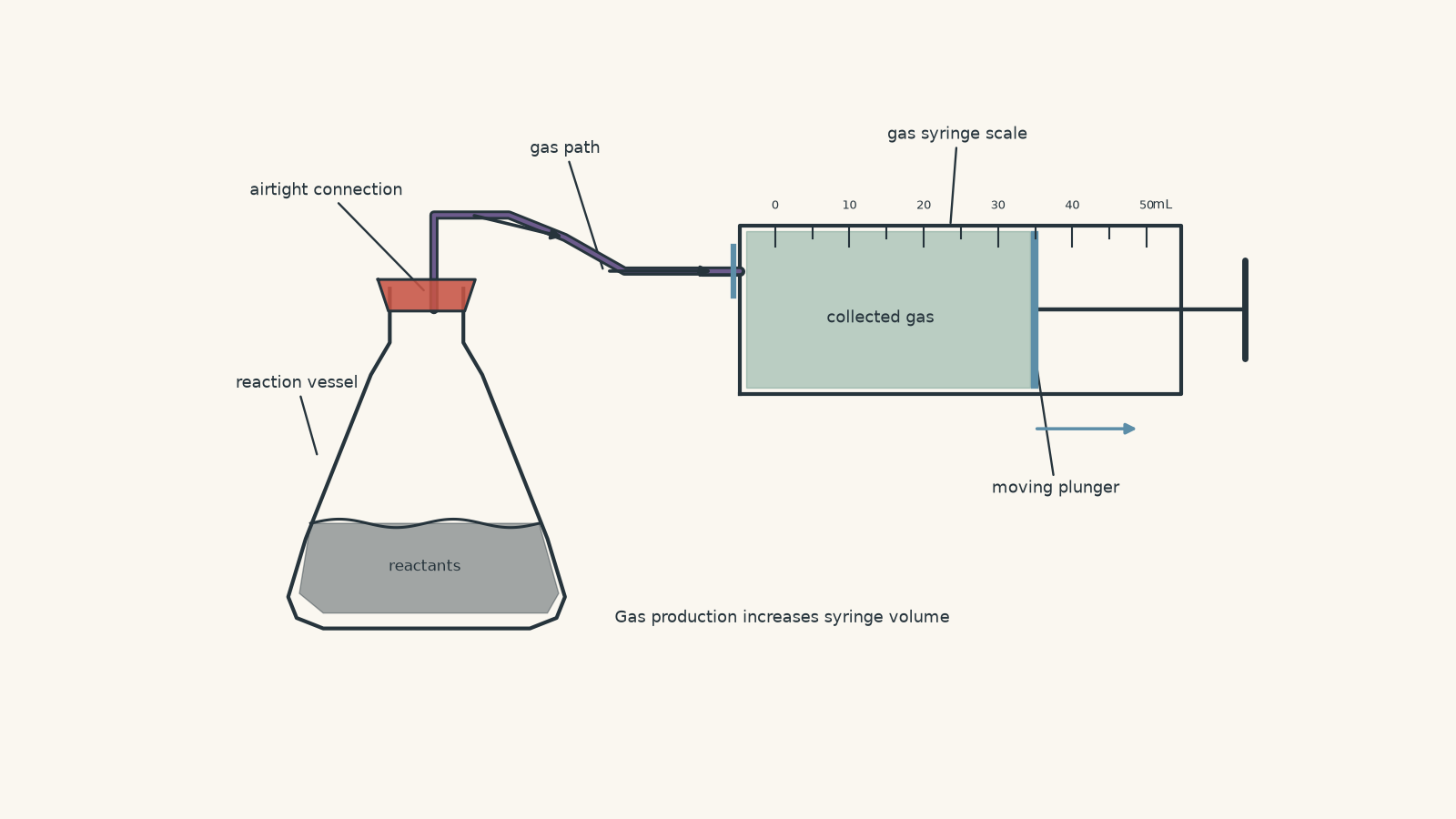
For a useful measurement:
- connect the apparatus before substantial gas production begins
- make sure the connections are airtight
- allow the gas to reach the intended measuring temperature
- read the syringe scale carefully
- choose a syringe large enough that the plunger will not reach its limit
Gas can also be collected by displacing water from an inverted measuring cylinder. This works best when the gas has low solubility in water and does not react significantly with it.
The method itself can affect your result.
| Problem | Likely effect on measured gas volume | Reason |
|---|---|---|
| Gas leaks from the apparatus | Too low | Some product never reaches the measuring device |
| Gas escapes before the bung is fitted | Too low | Product is lost before collection |
| Gas is measured while warmer than intended | Too high | A warmer gas occupies more volume at the same pressure |
| Some gas dissolves in the collection water | Too low | Dissolved gas is not included in the measured gas volume |
| Air was trapped in the apparatus and counted as product gas | Too high | The measured volume contains gas that was already present |
This is why a result close to the theoretical value does not automatically prove that an experiment was accurate. Two errors can push in opposite directions and partly cancel.
07The most tempting misconception: coefficients are always volume ratios
A student sees:
\[
\ce{2H2(g) + O2(g) -> 2H2O(l)}
\]
and says:
“Two litres of hydrogen and one litre of oxygen must produce two litres of water.”
The first part looks reasonable because hydrogen and oxygen are gases. At the same temperature and pressure, their \(2:1\) coefficient ratio can indeed be treated as a \(2:1\) gas-volume ratio.
The problem is the product.
The equation shows \(\ce{H2O(l)}\), not \(\ce{H2O(g)}\). Liquid water does not obey the gas-volume relationship. Two moles of liquid water certainly do not occupy the same volume as two moles of hydrogen gas.
The safer rule is:
Coefficients always represent mole ratios. They represent gas-volume ratios only for gaseous substances compared at the same temperature and pressure.
There is a second trap hiding inside that rule. Even if every substance is a gas, the direct volume ratio fails if their volumes are measured under different temperature or pressure conditions.
08Questions and solutions
Question 1
Nitrogen reacts with hydrogen according to:
\[
\ce{N2(g) + 3H2(g) -> 2NH3(g)}
\]
At the same temperature and pressure, what volume of hydrogen is required to react completely with 36.0 mL of nitrogen?
Solution 1
108 mL of hydrogen is required.
The balanced equation gives the ratio:
\[
1\text{ volume }\ce{N2}:3\text{ volumes }\ce{H2}
\]
Because both gas volumes are being compared at the same temperature and pressure, the coefficients can be used directly:
\[
V(\ce{H2})
=
36.0\text{ mL}\times\frac{3}{1}
=
108\text{ mL}
\]
So 36.0 mL of nitrogen requires 108 mL of hydrogen.
There is no need to convert the 36.0 mL into moles first. Doing so would give the same result, but it adds unnecessary working because the molar-volume factor would cancel.
Question 2
A 0.0750 g sample of magnesium reacts completely with excess hydrochloric acid:
\[
\ce{Mg(s) + 2HCl(aq) -> MgCl2(aq) + H2(g)}
\]
Calculate the volume of hydrogen produced at \(25^\circ\text{C}\) and 100 kPa. Use \(M(\ce{Mg})=24.31\text{ g mol}^{-1}\).
Solution 2
The reaction produces approximately 76.5 mL of hydrogen.
First calculate the amount of magnesium:
\[
n(\ce{Mg})
=
\frac{m}{M}
=
\frac{0.0750}{24.31}
=
3.09\times10^{-3}\text{ mol}
\]
The equation gives a \(1:1\) mole ratio between magnesium and hydrogen:
\[
n(\ce{H2})=3.09\times10^{-3}\text{ mol}
\]
At \(25^\circ\text{C}\) and 100 kPa, one mole of ideal gas occupies 24.79 L:
\[
V=nV_m
\]
\[
V
=
(3.09\times10^{-3})(24.79)
=
0.0765\text{ L}
\]
Converting to millilitres:
\[
0.0765\text{ L}\times1000=76.5\text{ mL}
\]
So the theoretical hydrogen volume is 76.5 mL.
The important step is the mole ratio. The 2 in front of \(\ce{HCl}\) does not mean twice as much hydrogen forms. One mole of magnesium still produces one mole of hydrogen.
Question 3
120 mL of nitrogen monoxide is mixed with 80.0 mL of oxygen. The gases react according to:
\[
\ce{2NO(g) + O2(g) -> 2NO2(g)}
\]
All volumes are compared at the same temperature and pressure. Assume the reaction goes to completion and \(\ce{NO2}\) remains gaseous.
Determine the limiting reactant, the volume of \(\ce{NO2}\) formed, and the volume of excess reactant remaining.
Solution 3
Nitrogen monoxide is limiting, 120 mL of \(\ce{NO2}\) forms, and 20.0 mL of oxygen remains.
The gas-volume ratio is:
\[
2\ce{NO}:1\ce{O2}:2\ce{NO2}
\]
For 120 mL of NO, the required oxygen volume is:
\[
V(\ce{O2})
=
120\text{ mL}\times\frac{1}{2}
=
60.0\text{ mL}
\]
There are 80.0 mL of oxygen available, so oxygen is in excess and NO is limiting.
The NO to \(\ce{NO2}\) ratio is \(2:2\), so:
\[
V(\ce{NO2})=120\text{ mL}
\]
The oxygen left over is:
\[
80.0-60.0=20.0\text{ mL}
\]
Therefore:
- limiting reactant: NO
- \(\ce{NO2}\) formed: 120 mL
- \(\ce{O2}\) remaining: 20.0 mL
A common trap is to compare the starting volumes, notice that oxygen has the smaller volume, and call oxygen limiting. Limiting reagents are determined using the required reaction ratio, not simply by choosing the smaller amount.
Question 4
A rigid 2.00 L vessel contains gas A at 100 kPa and 300 K. Gas A reacts completely according to:
\[
\ce{2A(g) -> B(g)}
\]
The final temperature is also 300 K.
A student argues that because two volumes of A produce one volume of B, the product must occupy 1.00 L. Evaluate the student’s claim and determine the final pressure.
Solution 4
The student’s volume claim is incorrect. The gas still occupies the full 2.00 L vessel, while the final pressure is 50.0 kPa.
The \(2:1\) coefficient ratio tells us that the number of moles of gas halves:
\[
n_{\text{final}}=\frac{1}{2}n_{\text{initial}}
\]
But the vessel is rigid. Its physical volume cannot shrink from 2.00 L to 1.00 L.
Using the ideal gas relationship:
\[
P=\frac{nRT}{V}
\]
The temperature and container volume stay constant, so pressure is directly proportional to the number of moles:
\[
\frac{P_{\text{final}}}{P_{\text{initial}}}
=
\frac{n_{\text{final}}}{n_{\text{initial}}}
=
\frac{1}{2}
\]
Therefore:
\[
P_{\text{final}}
=
100\text{ kPa}\times\frac{1}{2}
=
50.0\text{ kPa}
\]
The gas therefore occupies 2.00 L at 50.0 kPa.
The tempting mistake is treating a stoichiometric gas-volume ratio as though it forces the walls of a rigid container to move. The coefficient ratio describes how amounts of gas compare when temperature and pressure are held the same. Here, volume is fixed instead, so the pressure changes.
Question 5
A student predicts that a reaction should produce 48.0 mL of gas at room temperature. During the experiment, a small leak allows some product gas to escape. The student also records the syringe reading immediately, while the gas is still noticeably warmer than the room.
The syringe reads 48.1 mL. The student concludes that the method must be highly accurate because the experimental and theoretical volumes are almost identical.
Is that conclusion justified?
Solution 5
No. The close agreement does not show that the experimental method was accurate.
Two systematic effects are acting in opposite directions.
The leak causes product gas to escape, which tends to make the recorded volume too low.
The gas being warmer than the intended measuring temperature makes a fixed amount of gas occupy a larger volume, which tends to make the recorded volume too high.
These effects could partly cancel:
\[
\text{loss from leak}
\quad\text{and}\quad
\text{increase from heating}
\]
A reading of 48.1 mL may therefore be close to the theoretical 48.0 mL by coincidence.
This is an important experimental principle. Agreement with an expected value does not, by itself, prove validity. You still need to examine the method and identify possible systematic errors.
09What gas stoichiometry lets you do next
Once you see gas volume as a measurement of moles, gas-reaction questions stop being a separate type of chemistry.
The same stoichiometric chain still applies:
\[
\text{measured quantity}
\rightarrow
\text{moles}
\rightarrow
\text{mole ratio}
\rightarrow
\text{required quantity}
\]
Gas volumes simply give you extra shortcuts. At the same temperature and pressure, gaseous coefficients can be read directly as volume ratios. At specified molar-volume conditions, \(n=V/V_m\) connects litres to moles. At other conditions, \(PV=nRT\) does the same job while accounting for temperature and pressure.
That leads directly into the gas laws. Instead of only asking how much gas a reaction produces, you can start predicting what happens to that gas when its temperature, pressure, or container volume changes.