
Rearrangement of Atoms in Reactions: HSC Chemistry Guide
Learn how chemical reactions rearrange atoms while conserving each element and total mass. Includes balancing strategies, worked examples, and HSC-style reasoning questions.
A reaction seems to do something impossible. Hydrogen gas and oxygen gas can disappear, and water can appear in their place. If the substances have changed, what happened to the atoms that made the original gases?
Before reading on, make a prediction. In the reaction between hydrogen and oxygen, could an oxygen atom simply vanish because it is no longer part of an oxygen molecule?
No. In an ordinary chemical reaction, the atoms survive. What changes is which atoms are bonded to which. Hydrogen atoms that were bonded to hydrogen atoms can end up bonded to oxygen atoms. The substances change because the arrangement of the atoms changes.
That one idea explains both why reactions produce new substances and why chemical equations have to balance.
01Think of a reaction as a rearrangement
Imagine four students sitting at two tables. During lunch, nobody enters or leaves the room, but everyone swaps seats and forms new groups.
The people are like atoms. The groups at the tables are like molecules.
A chemical reaction is similar: the atoms present before the reaction are reorganised into different combinations after the reaction. The analogy has a limit, though. Atoms do not choose new partners. Chemical bonding is controlled by interactions involving electrons and energy.
Take the formation of water:
\[ \ce{2H2 + O2 -> 2H2O} \]
Before the reaction, the hydrogen atoms are arranged as \(\ce{H2}\) molecules and the oxygen atoms are arranged as \(\ce{O2}\) molecules.
After the reaction, those same atoms are arranged as \(\ce{H2O}\) molecules.
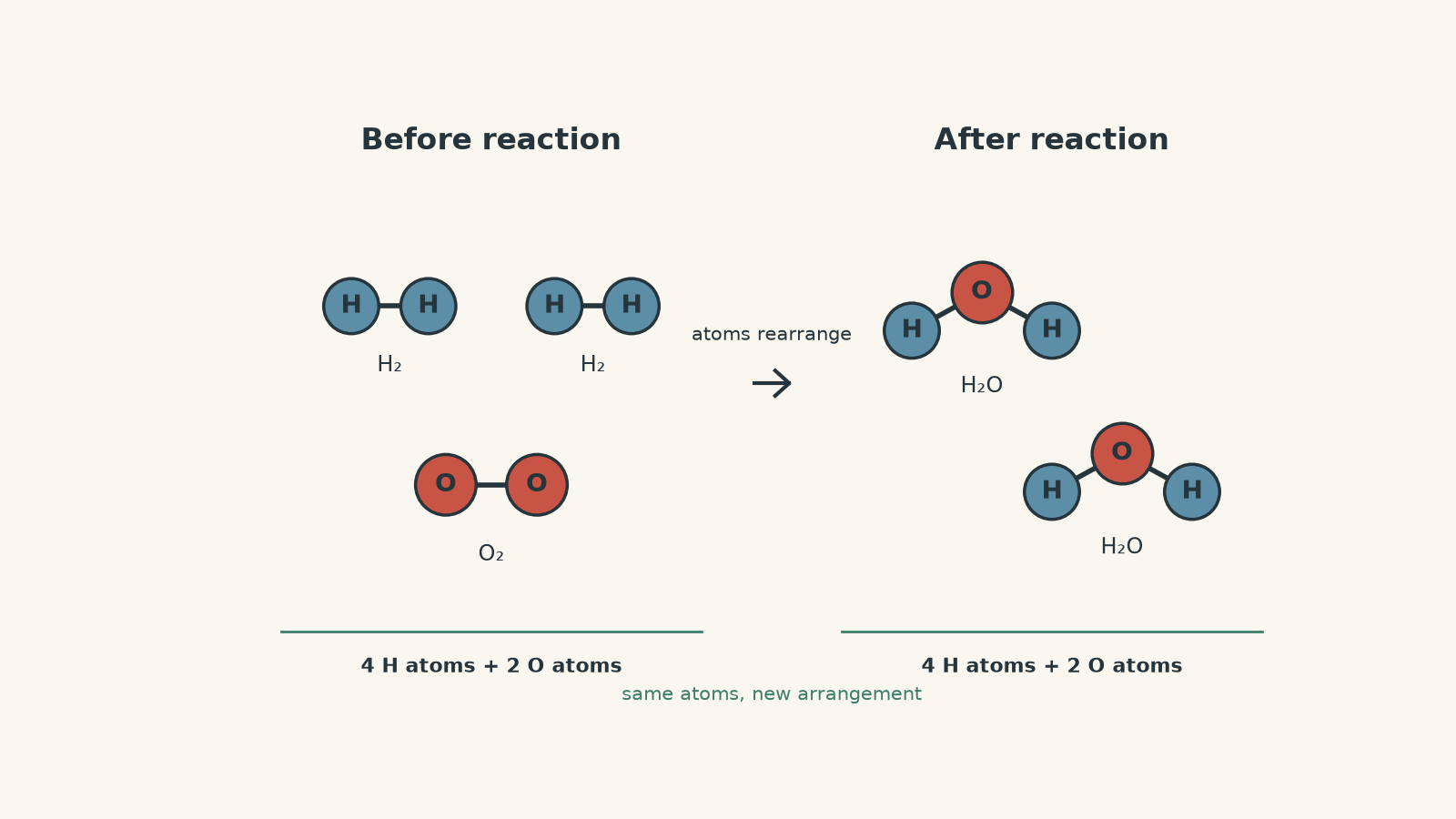
Count them.
| Element | Before reaction | After reaction |
|---|---|---|
| Hydrogen | 4 atoms | 4 atoms |
| Oxygen | 2 atoms | 2 atoms |
The molecules have changed. The number of atoms of each element has not.
That is the central model.
02What is actually conserved?
In an ordinary chemical reaction, atoms are rearranged rather than created, destroyed, or changed into atoms of another element.
A carbon atom that enters a reaction remains a carbon atom. An oxygen atom remains an oxygen atom.
At HSC level, this means you should expect:
- the number of atoms of each element to be the same before and after the reaction
- the total mass of a closed reacting system to remain constant
- the substances present before and after the reaction to be allowed to change completely
That last point is worth noticing. Conservation does not mean nothing changes. It means certain quantities remain constant while the arrangement changes.
The first model is slightly simplified. At a more detailed level, chemical reactions involve changes in electron arrangements and chemical bonds. Atomic nuclei are not changed in an ordinary chemical reaction, which is why each atom keeps its elemental identity.
Nuclear reactions are different. They can change one element into another, but that is not what is happening in normal HSC chemical equations.
03Why chemical equations must balance
Consider this equation:
\[ \ce{H2 + O2 -> H2O} \]
It looks reasonable if you read only the substance names: hydrogen reacts with oxygen to make water.
But count the atoms.
On the left:
- 2 hydrogen atoms
- 2 oxygen atoms
On the right:
- 2 hydrogen atoms
- 1 oxygen atom
One oxygen atom has apparently disappeared.
The chemistry is not wrong. The equation is incomplete as a model of the reaction.
We fix it using coefficients:
\[ \ce{2H2 + O2 -> 2H2O} \]
A coefficient tells us how many particles, or how many moles of particles, participate.
So \(2\ce{H2}\) means two hydrogen molecules in a particle model, or two moles of hydrogen molecules in a macroscopic calculation.
The atom counts now match.
Coefficients can change. Subscripts cannot.
This is one of the most important decision rules in balancing equations.
Suppose you tried to fix
\[ \ce{H2 + O2 -> H2O} \]
by changing the water formula to \(\ce{H2O2}\).
You would certainly get two oxygen atoms on the right, but you would no longer be describing water. \(\ce{H2O2}\) is hydrogen peroxide, a different substance.
A subscript is part of a substance’s chemical identity.
A coefficient changes the amount of that substance.
For example:
- \(\ce{H2O}\) means water
- \(\ce{2H2O}\) means two water molecules, or two moles of water
- \(\ce{H2O2}\) means hydrogen peroxide
When balancing an equation, change coefficients only.
04A reliable way to track rearrangement
When an equation becomes messy, stop trying to make it “look balanced”. Count atoms systematically.
Use this process:
- Write the correct chemical formulas first.
- Count each element on both sides.
- Choose an element whose count is easiest to fix.
- Change a coefficient, not a subscript.
- Recount every element.
- Reduce the coefficients to the smallest whole-number ratio if possible.
The goal is not simply to satisfy a mathematical rule. Each coefficient must represent a possible rearrangement in which every atom can be accounted for.
Worked example: Magnesium reacting with oxygen
Balance the equation for magnesium reacting with oxygen to form magnesium oxide:
\[ \ce{Mg + O2 -> MgO} \]
Step 1
On the left, there is 1 Mg atom and 2 O atoms.
On the right, there is 1 Mg atom and 1 O atom.
Oxygen is not conserved yet.
Step 2
\[ \ce{Mg + O2 -> 2MgO} \]
There are now 2 O atoms on each side. However, there are 2 Mg atoms on the right and only 1 on the left.
Step 3
\[ \ce{2Mg + O2 -> 2MgO} \]
Step 4
| Element | Reactants | Products |
|---|---|---|
| Mg | 2 | 2 |
| O | 2 | 2 |
The balanced equation is therefore
\[ \ce{2Mg + O2 -> 2MgO} \]
The equation represents two magnesium atoms combining with the two oxygen atoms from one oxygen molecule to form two formula units of magnesium oxide. Nothing has vanished and no atom has changed element.
05Molecule count does not have to be conserved
Here is a tempting prediction: if atoms are conserved, perhaps the number of molecules must also stay the same.
Look again at:
\[ \ce{2H2 + O2 -> 2H2O} \]
On the reactant side there are three molecules in the particle model: two \(\ce{H2}\) molecules and one \(\ce{O2}\) molecule.
On the product side there are only two \(\ce{H2O}\) molecules.
So the number of molecules has changed from 3 to 2.
That is completely allowed.
Atoms are the conserved pieces in this model. Molecules are arrangements of those pieces, so molecules can be broken apart, formed, and changed in number.
This is like breaking three dating couples into two larger friendship groups. The number of groups can change even though nobody mysteriously disappears from the room. The analogy breaks because molecules have fixed chemical structures rather than social preferences, but the bookkeeping idea is useful.
06Conservation of atoms leads to conservation of mass
Atoms have mass. If the same atoms are present before and after a reaction, the total mass of a closed system stays the same.
Suppose 12.0 g of carbon reacts completely with 32.0 g of oxygen in a sealed container to form carbon dioxide.
The reaction is
\[ \ce{C + O2 -> CO2} \]
The total reactant mass is
\[ m_{\text{reactants}} = 12.0\text{ g} + 32.0\text{ g} = 44.0\text{ g} \]
So the total product mass must also be 44.0 g.
This does not mean every reactant has the same mass as every product. It means the mass of the whole closed system is conserved.
Why “closed system” matters
Imagine heating a carbonate in an open test tube and finding that the solid weighs less afterwards.
Has mass been destroyed?
Not necessarily. A gaseous product may have escaped into the surroundings.
If your “system” includes only the test tube and remaining solid, matter has left that system. If you could contain and measure all reactants and products, including the gas, the mass balance would be restored.
So when experimental masses seem not to match, ask a more useful question than “Was conservation broken?”
Ask: What exactly did we include inside the system boundary?
Worked example: Finding the mass of a gaseous product
A reaction occurs in a sealed vessel. Initially, the vessel contains 5.60 g of a solid and 18.40 g of another reactant. After the reaction, 20.75 g of solid products remain, together with a gaseous product. What mass of gas was formed?
Step 1
Because the vessel is sealed, all matter remains inside the system.
\[ m_{\text{initial}} = 5.60\text{ g} + 18.40\text{ g} = 24.00\text{ g} \]
Step 2
The final mass must also be 24.00 g.
Let \(m_{\text{gas}}\) be the mass of the gaseous product.
\[ 20.75\text{ g} + m_{\text{gas}} = 24.00\text{ g} \]
Step 3
\[ m_{\text{gas}} = 24.00\text{ g} - 20.75\text{ g} = 3.25\text{ g} \]
The gaseous product has a mass of 3.25 g.
The gas was not newly created mass. Its atoms came from the original reactants and were rearranged into a gaseous substance.
07A harder rearrangement: combustion
Balancing becomes more useful when several elements are being rearranged at once.
Consider the complete combustion of ethane:
\[ \ce{C2H6 + O2 -> CO2 + H2O} \]
Before touching the coefficients, identify where each element can go.
- Carbon in \(\ce{C2H6}\) ends up in \(\ce{CO2}\).
- Hydrogen in \(\ce{C2H6}\) ends up in \(\ce{H2O}\).
- Oxygen from \(\ce{O2}\) is distributed between both products.
This suggests a useful strategy: balance carbon and hydrogen first, then oxygen.
Worked example: Balance ethane combustion
Balance:
\[ \ce{C2H6 + O2 -> CO2 + H2O} \]
Step 1
One \(\ce{C2H6}\) molecule contains 2 carbon atoms, so place a 2 before \(\ce{CO2}\).
\[ \ce{C2H6 + O2 -> 2CO2 + H2O} \]
Step 2
There are 6 H atoms on the left. Each water molecule contains 2 H atoms, so three water molecules are needed.
\[ \ce{C2H6 + O2 -> 2CO2 + 3H2O} \]
Step 3
The two \(\ce{CO2}\) molecules contain
\[ 2 \times 2 = 4 \]
oxygen atoms.
The three \(\ce{H2O}\) molecules contain
\[ 3 \times 1 = 3 \]
oxygen atoms.
So there are \(4 + 3 = 7\) oxygen atoms on the right.
Because oxygen enters as \(\ce{O2}\), this would require \(7/2\) oxygen molecules:
\[ \ce{C2H6 + \frac{7}{2}O2 -> 2CO2 + 3H2O} \]
Step 4
Multiply every coefficient by 2:
\[ \ce{2C2H6 + 7O2 -> 4CO2 + 6H2O} \]
Step 5
| Element | Reactants | Products |
|---|---|---|
| C | 4 | 4 |
| H | 12 | 12 |
| O | 14 | 14 |
The equation is balanced.
The final coefficients are not arbitrary numbers. They describe a rearrangement in which 4 carbon atoms, 12 hydrogen atoms, and 14 oxygen atoms are present both before and after the reaction.
08The misconception that causes most balancing errors
Students often treat balancing as a puzzle where numbers can be placed anywhere until both sides “match”.
That approach causes trouble because chemical formulas are not adjustable bookkeeping symbols.
Consider:
\[ \ce{N2 + H2 -> NH3} \]
You might notice there are two nitrogen atoms on the left and think, “I’ll change \(\ce{NH3}\) to \(\ce{N2H3}\).”
That does not balance the reaction. It invents a different substance.
Instead, preserve the formula \(\ce{NH3}\) and change how many particles are present:
\[ \ce{N2 + 3H2 -> 2NH3} \]
Now there are:
- 2 N atoms on each side
- 6 H atoms on each side
A useful test is:
Am I changing how many particles are present, or what each particle is?
If you are balancing an equation, you are allowed to change the first, not the second.
09Questions and solutions
Question 1
A particle model begins with three \(\ce{H2}\) molecules and two \(\ce{O2}\) molecules. Two \(\ce{H2O}\) molecules form.
After those two water molecules have formed, how many \(\ce{H2}\) molecules and \(\ce{O2}\) molecules remain?
Solution 1
Two \(\ce{H2}\) molecules and one \(\ce{O2}\) molecule remain.
Forming two water molecules follows the rearrangement
\[ \ce{2H2 + O2 -> 2H2O} \]
So the reaction uses two \(\ce{H2}\) molecules and one \(\ce{O2}\) molecule.
Starting amounts:
\[ 3\ce{H2} \quad \text{and} \quad 2\ce{O2} \]
After one reaction event:
\[ 3 - 2 = 1\ce{H2} \]
and
\[ 2 - 1 = 1\ce{O2} \]
So the correct remaining amounts are actually one \(\ce{H2}\) molecule and one \(\ce{O2}\) molecule.
The important point is that the two water molecules contain four H atoms and two O atoms. Those atoms must come from two hydrogen molecules and one oxygen molecule. Simply comparing “three molecules before” with “two molecules formed” would miss the required atom counts.
Question 2
Balance the following equation using the smallest whole-number coefficients:
\[ \ce{Al + Cl2 -> AlCl3} \]
Explain why changing \(\ce{AlCl3}\) to \(\ce{AlCl2}\) is not a valid way to balance the equation.
Solution 2
The balanced equation is \(\ce{2Al + 3Cl2 -> 2AlCl3}\), and the subscript in \(\ce{AlCl3}\) cannot be changed because that would change the substance itself.
Each \(\ce{AlCl3}\) formula unit contains three chlorine atoms, while chlorine enters as pairs in \(\ce{Cl2}\).
The smallest number divisible by both 2 and 3 is 6, so arrange for six chlorine atoms on each side.
Three \(\ce{Cl2}\) molecules contain
\[ 3 \times 2 = 6 \]
Cl atoms.
Two \(\ce{AlCl3}\) formula units contain
\[ 2 \times 3 = 6 \]
Cl atoms.
That gives
\[ \ce{Al + 3Cl2 -> 2AlCl3} \]
There are now two Al atoms on the right, so place a 2 before Al:
\[ \ce{2Al + 3Cl2 -> 2AlCl3} \]
Changing \(\ce{AlCl3}\) to \(\ce{AlCl2}\) would change the formula and therefore the chemical identity of the compound. Balancing changes coefficients, not subscripts.
Question 3
A student writes:
\[ \ce{2CO + O2 -> 2CO2} \]
They say, “The equation cannot be correct because there are three molecules before the reaction but only two molecules afterwards. Matter has disappeared.”
Is the student’s reasoning correct? Explain using both atom counts and molecule counts.
Solution 3
No. The equation conserves atoms even though it does not conserve the number of molecules.
On the reactant side:
- \(2\ce{CO}\) contains 2 C atoms and 2 O atoms
- \(\ce{O2}\) contains another 2 O atoms
Total reactant atoms:
- C: 2
- O: 4
On the product side, \(2\ce{CO2}\) contains:
- C: 2
- O: 4
Every atom is accounted for.
The number of molecules changes from three reactant molecules to two product molecules, but molecule count is not required to stay constant. Molecules are arrangements of atoms, and a reaction can change the number of those arrangements.
The student’s misconception is treating molecules themselves as the conserved units. In an ordinary chemical reaction, it is the number of atoms of each element that must be conserved.
Question 4
A sealed reaction vessel has a total mass of 86.35 g before a reaction. After the reaction, a student measures 61.20 g of liquid and 25.15 g of solid inside the vessel.
Another student insists that a gas must also have formed because “most chemical reactions make some gas”.
Use the measurements to assess this claim.
Solution 4
The mass measurements provide no evidence that a gas with measurable mass is also present, because the measured liquid and solid already account for the entire initial mass.
The initial mass is
\[ m_{\text{initial}} = 86.35\text{ g} \]
The measured final mass is
\[ m_{\text{final}} = 61.20\text{ g} + 25.15\text{ g} = 86.35\text{ g} \]
So
\[ m_{\text{initial}} = m_{\text{final}} \]
and there is no unaccounted mass.
A gas could only be present if some of the stated measurements included it indirectly, or if another measured component had been interpreted incorrectly. The given mass data alone do not require a gaseous product.
The trap is assuming that a particular type of product must exist because it sounds chemically common. Conservation tells us whether the proposed products can account for the matter present, but it does not tell us that every reaction must produce a gas.
Question 5
A student proposes the following particle-level reaction:
\[ \ce{2AB2 + B2 -> 2AB3} \]
Here \(A\) and \(B\) represent two different elements.
Another student says the model is impossible because each product particle contains more atoms than each original \(\ce{AB2}\) particle.
Determine whether the proposed rearrangement is possible, and explain the flaw in the second student’s reasoning.
Solution 5
The proposed rearrangement is possible because the total number of \(A\) and \(B\) atoms is conserved.
Count the atoms on the left.
From \(2\ce{AB2}\):
- \(A: 2\)
- \(B: 4\)
From \(\ce{B2}\):
- \(B: 2\)
So the total reactant count is:
\[ A = 2, \qquad B = 6 \]
Now count the products.
From \(2\ce{AB3}\):
\[ A = 2, \qquad B = 6 \]
The counts match exactly.
The second student compares each product particle only with an \(\ce{AB2}\) particle and ignores the extra \(\ce{B2}\) reactant. Product particles can contain more atoms than one particular reactant particle if atoms from another reactant join them.
The correct comparison is between all atoms in all reactants and all atoms in all products.
Question 6
A metal reacts with a gas in an open container. The solid product has a greater mass than the original piece of metal.
A student concludes, “This violates conservation of mass because the product weighs more than the starting solid.”
Explain why this conclusion does not follow. Then state what additional measurement would allow a proper test of conservation of mass.
Solution 6
The greater product mass does not violate conservation of mass because atoms from the gaseous reactant have become part of the solid product.
The student’s comparison leaves out one of the reactants.
If a metal \(M\) reacts with oxygen, a simplified equation might look like
\[ \ce{M + O2 -> metal\ oxide} \]
The final solid contains the original metal atoms plus oxygen atoms that came from the surrounding gas. Its mass can therefore be greater than the original metal mass.
For example, if 10.0 g of metal combines with 2.5 g of oxygen, the resulting oxide could have a mass of
\[ m_{\text{product}} = 10.0\text{ g} + 2.5\text{ g} = 12.5\text{ g} \]
No mass has been created. The 2.5 g increase came from matter that was not included in the student’s original measurement.
A proper conservation test would need the total mass of every reactant before the reaction and every product afterwards, ideally using a closed system so that matter cannot enter or escape.
This is the deeper lesson behind balanced equations. They are not just a notation exercise. They are particle-level models of where every atom goes. Once that model is secure, it becomes the foundation for mole ratios, stoichiometric calculations, limiting reagents, and quantitative predictions about how much product a reaction can actually form.