
Why Isotopes Share a Position in the Periodic Table
Learn why isotopes of the same element occupy one periodic-table position even when they differ in mass, neutron number, and nuclear stability.
A sample contains carbon-12 and carbon-14. One nucleus has two more neutrons than the other, and carbon-14 is radioactive. So should they appear in different places on the periodic table?
Predict before reading on: if two atoms have different masses and different nuclear stability, what single feature could still make them the same element?
The answer is the number of protons. Carbon-12 and carbon-14 both have 6 protons, so both belong in carbon’s position, atomic number 6. Their different neutron numbers change their mass and nuclear behaviour, but not their elemental identity.
That one distinction explains why isotopes share a periodic-table position.
01The periodic table cares about proton number
Picture the periodic table as a seating plan where your seat number is determined by one thing only: the number of protons in your nucleus.
Carbon gets seat 6 because every carbon atom has 6 protons. Oxygen gets seat 8 because every oxygen atom has 8 protons.
Adding a neutron is like arriving at your seat carrying an extra backpack. You’re heavier, but you haven’t become a different person and you don’t move to another seat.
The analogy has a limit. A neutron is not just passive luggage. Changing the neutron number can affect the nucleus’s stability quite dramatically.
The exact rule is:
An element’s position in the periodic table is determined by its atomic number, which is its number of protons.
If two atoms have the same number of protons, they are the same element.
If they have different numbers of protons, they are different elements.
02What makes isotopes different?
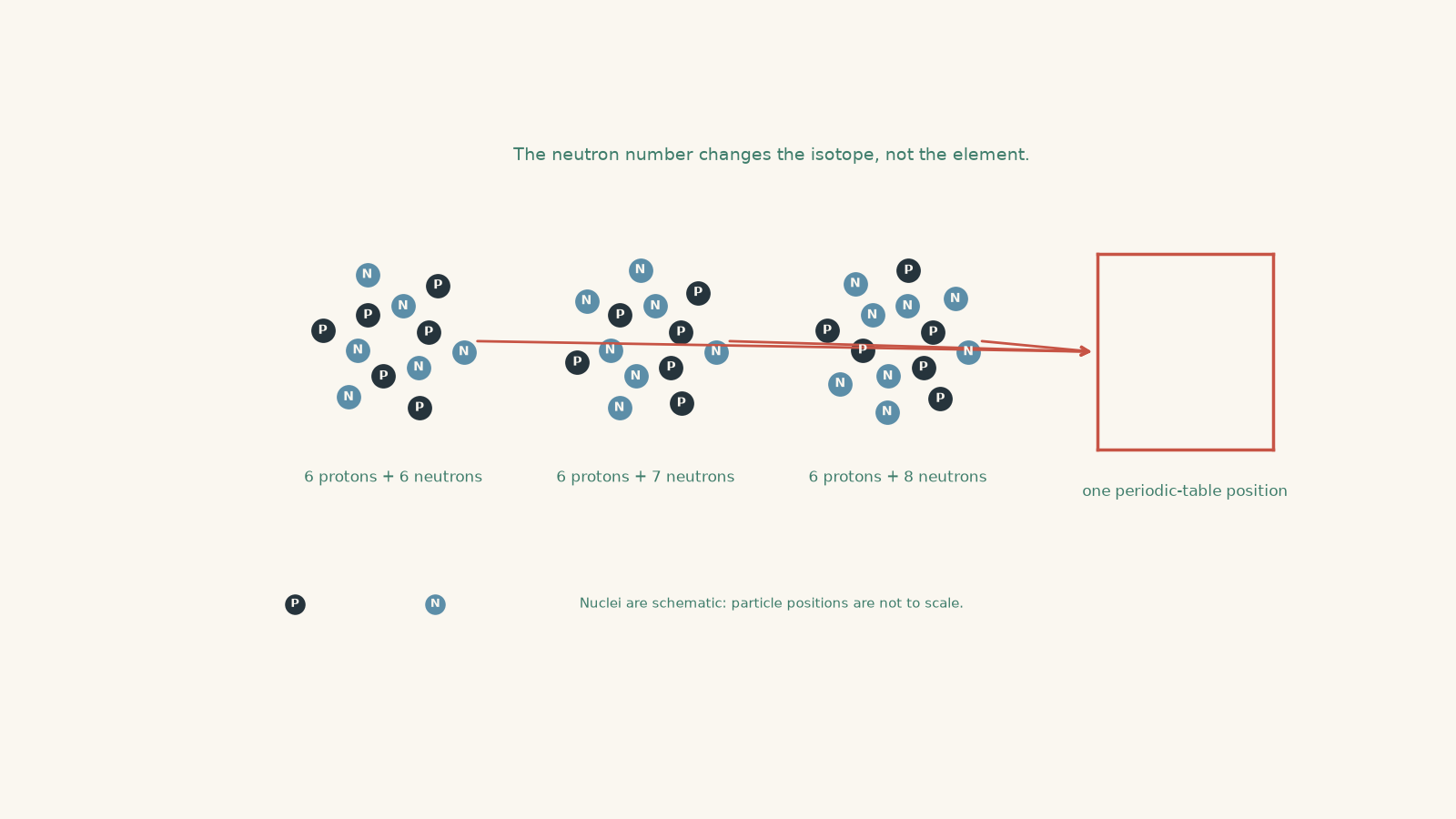
Isotopes are atoms of the same element that contain the same number of protons but different numbers of neutrons.
For example:
| Isotope | Protons | Neutrons | Mass number |
|---|---|---|---|
| carbon-12 | 6 | 6 | 12 |
| carbon-13 | 6 | 7 | 13 |
| carbon-14 | 6 | 8 | 14 |
All three have atomic number 6, so all three occupy the carbon position in the periodic table.
Their mass numbers differ because mass number counts both protons and neutrons.
\[
A = Z + N
\]
where:
- \(A\) is the mass number, with no unit
- \(Z\) is the atomic number, equal to the number of protons
- \(N\) is the number of neutrons
Rearranging gives:
\[
N = A – Z
\]
This is why changing neutron number changes an isotope’s mass without changing its periodic-table position.
Worked example: Where does magnesium-26 belong?
A neutral atom of magnesium-26 contains 12 protons. Determine its number of neutrons and explain where it belongs in the periodic table.
Step 1
The atom has 12 protons, so:
\[
Z = 12
\]
Atomic number 12 is magnesium. Its periodic-table position is therefore the magnesium position.
Step 2
For magnesium-26:
\[
A = 26
\]
Using \(N = A – Z\):
\[
N = 26 – 12 = 14
\]
So magnesium-26 contains 14 neutrons.
Step 3
The 14 neutrons contribute to the isotope’s mass, but they do not decide its element. The 12 protons do.
Magnesium-24, magnesium-25, and magnesium-26 therefore all occupy the same periodic-table position because they all have \(Z = 12\).
If proton, neutron, and electron counting still feels slippery, revise how to count protons, neutrons, and electrons in atoms and ions before going further.
03Why isotopes usually have very similar chemistry
Suppose you compare two neutral chlorine atoms:
- chlorine-35 has 17 protons and 18 neutrons
- chlorine-37 has 17 protons and 20 neutrons
Predict their electron numbers.
Both neutral atoms have 17 electrons because a neutral atom has equal numbers of protons and electrons.
That matters because ordinary chemical reactions mainly involve electrons, especially the outer electrons. Since neutral isotopes of the same element have the same proton number, they also have the same electron number and essentially the same electronic configuration.
So chlorine-35 and chlorine-37 belong in the same periodic-table group and have extremely similar chemical behaviour.
This is an important chain of reasoning:
\[
\text{same proton number}
\rightarrow
\text{same element}
\rightarrow
\text{same periodic-table position}
\]
and, for neutral atoms,
\[
\text{same proton number}
\rightarrow
\text{same electron number}
\rightarrow
\text{same electronic configuration}
\rightarrow
\text{very similar chemistry}
\]
The word very matters. Isotopes are not physically identical. Their different masses can cause small differences in properties and reaction rates, called isotope effects. At HSC level, however, the key idea is that isotopes of an element have essentially the same chemical properties because their electronic structures are the same.
For more detail on why electron arrangement controls chemical behaviour, see Electronic Configuration for HSC Chemistry: Atoms and Ions.
04Mass number is not the number printed in the periodic table
This is one of the easiest isotope traps to fall into.
Imagine a periodic table gives chlorine a relative atomic mass of about \(35.45\). A student might look at that number and say, “A chlorine atom has 35.45 nucleons.”
It doesn’t.
A single nucleus cannot contain 0.45 of a nucleon.
The number shown as the relative atomic mass on a periodic table is generally a weighted average based on the naturally occurring isotopes of that element.
By contrast, an individual isotope has a whole-number mass number.
For chlorine:
- chlorine-35 has \(A = 35\)
- chlorine-37 has \(A = 37\)
- naturally occurring chlorine contains both isotopes, so its relative atomic mass lies between 35 and 37
The periodic table therefore needs only one chlorine box. The average atomic mass in that box summarises an isotopic mixture. It does not create a separate element.
Worked example: An unfamiliar isotope in a mass spectrum
A mass spectrum indicates an atom with mass number 81. Independent evidence shows that its nucleus contains 35 protons.
Determine the element, its number of neutrons, and whether an isotope of the same element with mass number 79 would occupy a different periodic-table position.
Step 1
\[
Z = 35
\]
Atomic number 35 is bromine.
The isotope is therefore bromine-81.
Step 2
\[
N = A – Z
\]
Substituting \(A = 81\) and \(Z = 35\):
\[
N = 81 – 35 = 46
\]
Bromine-81 contains 46 neutrons.
Step 3
For bromine-79:
\[
N = 79 – 35 = 44
\]
So bromine-79 has 44 neutrons, while bromine-81 has 46.
Both still contain 35 protons.
Step 4
Both isotopes occupy the bromine position, atomic number 35. Their different neutron numbers change their mass numbers from 79 to 81, but they do not change the element.
05Nuclear stability is a separate question from periodic-table position
Now consider carbon-12 and carbon-14 again.
Both have 6 protons, so both are carbon. But carbon-12 is stable, while carbon-14 is radioactive.
How can two atoms be the same element if one nucleus is stable and the other is not?
Because element identity and nuclear stability depend on different things.
Element identity depends on proton number.
Nuclear stability depends on how successfully the nucleus holds together with its particular combination of protons and neutrons.
Inside the nucleus, two important effects compete:
- the strong nuclear force attracts nucleons, meaning protons and neutrons, over very short distances
- electrostatic repulsion acts between the positively charged protons
Neutrons contribute to the strong nuclear attraction without adding extra proton-proton electrostatic repulsion. This is one reason neutrons can help stabilise nuclei.
But the tempting conclusion, “more neutrons always means more stable”, is wrong.
A nucleus can also contain an unsuitable excess of neutrons. Stable nuclei occupy particular ranges of neutron-to-proton combinations. Moving too far away from these combinations can make a nucleus unstable.
So carbon-14 does not become a different element merely because it is radioactive. Before it decays, it is still carbon because it still contains 6 protons.
06What happens when an unstable isotope decays?
Here is the important boundary of the idea.
Changing the number of neutrons alone can produce another isotope of the same element.
Changing the number of protons changes the element itself.
Carbon-14 undergoes beta minus decay. At the nuclear level, a neutron is converted into a proton, with beta radiation and an antineutrino emitted. The nuclear equation can be represented as:
\[
\ce{^{14}_{6}C -> ^{14}_{7}N + ^0_{-1}e + \bar{\nu}_e}
\]
Before decay, the nucleus has 6 protons, so it is carbon.
After decay, the daughter nucleus has 7 protons, so it is nitrogen.
Notice what changed the periodic-table position: not radioactivity itself, but the change in proton number during the decay.
That gives a useful decision rule:
| What changes? | Same element? | Same periodic-table position? |
|---|---|---|
| Neutron number only | Yes | Yes |
| Electron number only | Yes | Yes |
| Proton number | No | No |
An ion is therefore still in the same periodic-table position as its neutral atom. Losing an electron changes charge, not proton number.
An isotope is also in the same position. Changing neutron number changes mass, not proton number.
A nuclear reaction that changes proton number is different. It changes the identity of the element.
07Keep these three numbers separate
Most isotope mistakes come from mixing up atomic number, mass number, and relative atomic mass.
| Quantity | Meaning | Usually a whole number? | Determines element? |
|---|---|---|---|
| Atomic number, \(Z\) | Number of protons | Yes | Yes |
| Mass number, \(A\) | Protons + neutrons in one nucleus | Yes | No |
| Relative atomic mass | Weighted average involving an element’s isotopes | Not necessarily | No |
A fast way to test your thinking is to ask:
Which number tells me how many protons there are?
That is the number that fixes the element’s periodic-table position.
08Questions and solutions
Question 1
Two atoms are represented as \(\ce{^{63}_{29}Cu}\) and \(\ce{^{65}_{29}Cu}\).
State whether they occupy the same position in the periodic table, and determine the number of neutrons in each nucleus.
Solution 1
They occupy the same periodic-table position because both nuclei contain 29 protons.
Atomic number is determined by proton number, so both atoms are copper.
For \(\ce{^{63}_{29}Cu}\):
\[
N = A – Z = 63 – 29 = 34
\]
It contains 34 neutrons.
For \(\ce{^{65}_{29}Cu}\):
\[
N = A – Z = 65 – 29 = 36
\]
It contains 36 neutrons.
The neutron numbers differ, so the atoms are different isotopes. Their proton numbers are identical, so their elemental identity and periodic-table position are identical.
Question 2
Atom X contains 16 protons, 18 neutrons, and 16 electrons. Atom Y contains 16 protons, 20 neutrons, and 18 electrons.
Determine whether X and Y are isotopes of the same element, and explain whether they occupy the same periodic-table position.
Solution 2
X and Y are isotopes of the same element, and they occupy the same periodic-table position.
Both particles contain 16 protons:
\[
Z = 16
\]
Atomic number 16 is sulfur.
For X:
\[
A = Z + N = 16 + 18 = 34
\]
so X is sulfur-34.
For Y:
\[
A = Z + N = 16 + 20 = 36
\]
so Y contains the sulfur-36 nucleus.
Y has 18 electrons rather than 16, so it is a \(2-\) ion. That does not change its element. Electron loss or gain changes charge, whereas proton number determines periodic-table position.
The trap is to assume that different electron numbers mean different elements. They do not. Both X and Y have \(Z = 16\), so both belong to sulfur’s position.
Question 3
A student makes the following claim:
“An isotope with a larger mass number should appear further to the right in the periodic table because the elements get heavier as you move across a period.”
Evaluate this claim using \(\ce{^{20}_{10}Ne}\) and \(\ce{^{22}_{10}Ne}\).
Solution 3
The claim is incorrect because periodic-table position is determined by atomic number, not mass number.
Both nuclides have:
\[
Z = 10
\]
so both contain 10 protons and are neon.
For \(\ce{^{20}_{10}Ne}\):
\[
N = 20 – 10 = 10
\]
For \(\ce{^{22}_{10}Ne}\):
\[
N = 22 – 10 = 12
\]
Neon-22 is heavier because it has two more neutrons. It does not move to another periodic-table position because its proton number remains 10.
The student’s observation that atomic masses often increase as atomic number increases does not give the rule for arranging elements. The modern periodic table is ordered by increasing atomic number. Mass is not the defining coordinate.
Question 4
An unknown nucleus initially contains 11 protons and 13 neutrons. During a nuclear process, one neutron in the nucleus is converted into a proton.
Compare the nuclide before and after the process. State whether it remains in the same periodic-table position, and explain why simply saying “the mass number stayed the same” is not enough to identify the element.
Solution 4
The nucleus moves to a different periodic-table position because its proton number changes from 11 to 12, even though its mass number remains 24.
Initially:
\[
Z = 11
\]
and:
\[
N = 13
\]
so the mass number is:
\[
A = Z + N = 11 + 13 = 24
\]
Atomic number 11 is sodium, so the initial nucleus is \(\ce{^{24}_{11}Na}\).
After one neutron is converted into a proton:
\[
Z = 12
\]
and:
\[
N = 12
\]
The new mass number is still:
\[
A = 12 + 12 = 24
\]
but atomic number 12 is magnesium, so the daughter nucleus is \(\ce{^{24}_{12}Mg}\).
The key trap is treating mass number as the identifier of an element. Two nuclei can have the same mass number but different proton numbers. Such nuclei are not isotopes of each other because isotopes must have the same proton number.
Mass number tells you the total number of nucleons. Atomic number tells you which element you have.
Question 5
Three neutral atoms have the following nuclear compositions:
- P: 8 protons and 8 neutrons
- Q: 8 protons and 10 neutrons
- R: 9 protons and 9 neutrons
An experiment shows that Q is less nuclear-stable than P.
A student concludes, “Q must be in a different part of the periodic table from P because its nucleus behaves differently.”
Assess the conclusion. Then compare the expected chemical similarity of P with Q and of P with R.
Solution 5
The conclusion is incorrect. P and Q occupy the same periodic-table position despite their different nuclear stabilities. P and Q should also have much more similar chemical behaviour than P and R.
P and Q both contain 8 protons:
\[
Z_P = Z_Q = 8
\]
They are therefore both oxygen isotopes.
Their mass numbers are:
\[
A_P = 8 + 8 = 16
\]
and:
\[
A_Q = 8 + 10 = 18
\]
so P is oxygen-16 and Q is oxygen-18.
Their different neutron numbers can affect nuclear mass and stability, but neutron number does not determine the element.
Because both atoms are neutral and have 8 protons, each also has 8 electrons. They therefore have the same electronic configuration and very similar chemistry.
R contains 9 protons:
\[
Z_R = 9
\]
so R is fluorine, not oxygen. As a neutral atom it also has 9 electrons, giving it a different electronic configuration and different chemical behaviour.
The deeper point is that nuclear behaviour and chemical identity are connected to different parts of the atom. Nuclear stability depends strongly on the proton-neutron combination inside the nucleus. Ordinary chemical behaviour depends mainly on the electron arrangement. Periodic-table position links to both through proton number, but it is not determined by nuclear stability.
Once you can keep proton number, neutron number, mass number, and electron number separate, radioactive decay becomes much easier to follow. You can look at a nuclear equation and decide immediately whether the product is a new isotope of the same element or a completely different element. That is the next useful step when learning to balance nuclear equations for HSC Chemistry.